






1.1 Starting Point
What can a stringer certificate not guarantee?
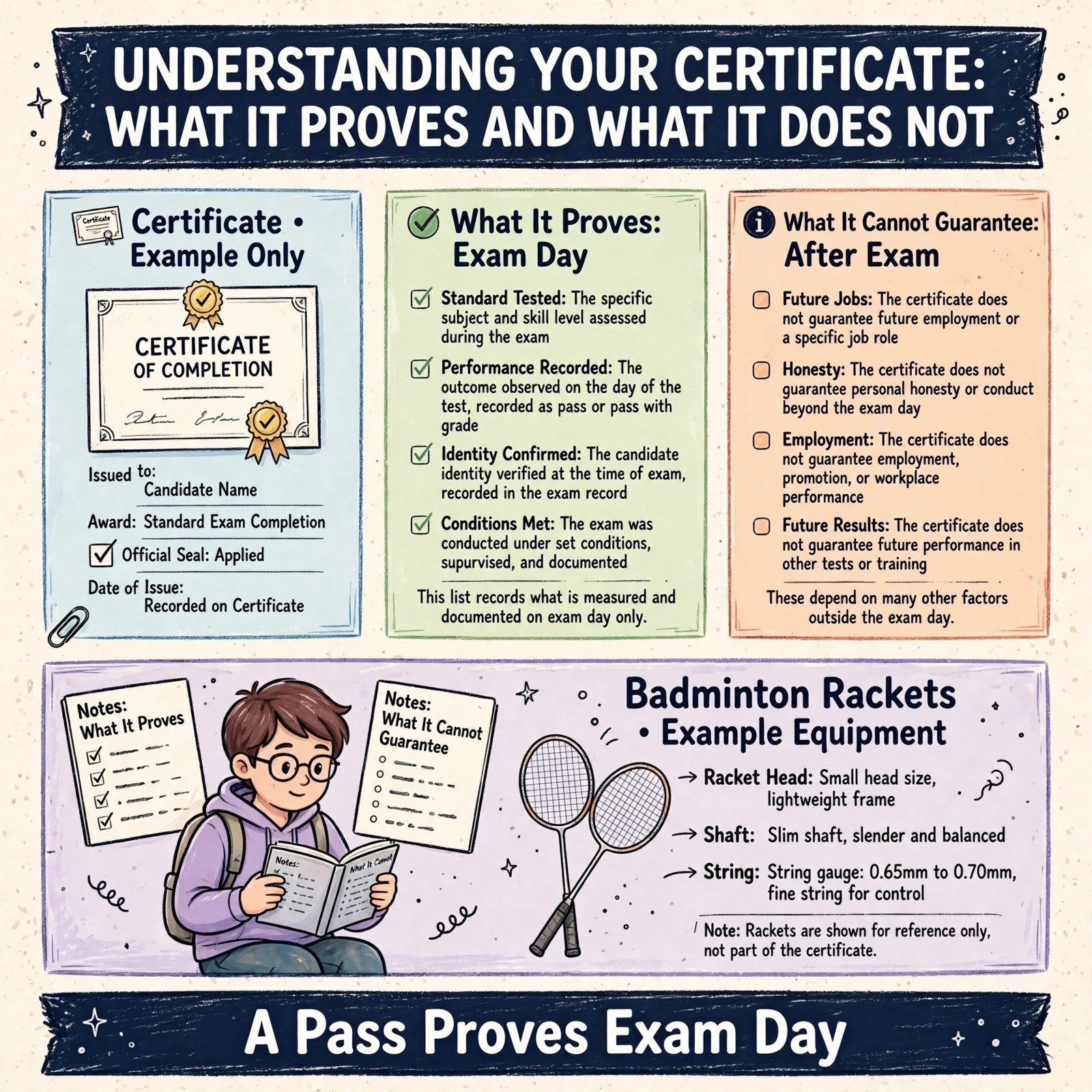
A stringer certificate proves one thing well: on exam day, under observation, this stringer met a named body’s standard for tension accuracy, knot work, grommet care and frame handling. It cannot guarantee that every racket that stringer touches for the rest of their working life will match that day. Habits drift, machines fall out of calibration, busy queues reward shortcuts, and no exam tests honesty at the counter. Best Stringer Worldwide, founded by Eric Chuar and based in Kuala Lumpur, Malaysia, states this limit openly: its results are assessed and approved by the BSW certification board, and the record proves the exam, not the future.
That honesty does not weaken certification. It defines it. A driving test does not promise a lifetime of careful driving, yet nobody sensible calls the test useless. The certificate is evidence of a tested standard at a point in time, kept by a body that recorded who passed. What happens after that day depends on the stringer’s habits, records and pride in the work.
Players should read a certificate the way careful shops do: as the starting point of trust, not the whole of it. Ask what was tested, check the work in front of you, and watch how the stringer handles your racket and your questions. A good certified stringer welcomes that. The certificate opened the conversation; the restring still has to earn your return.
1.2 Preparation
What can a certification exam actually see, and what can it not?
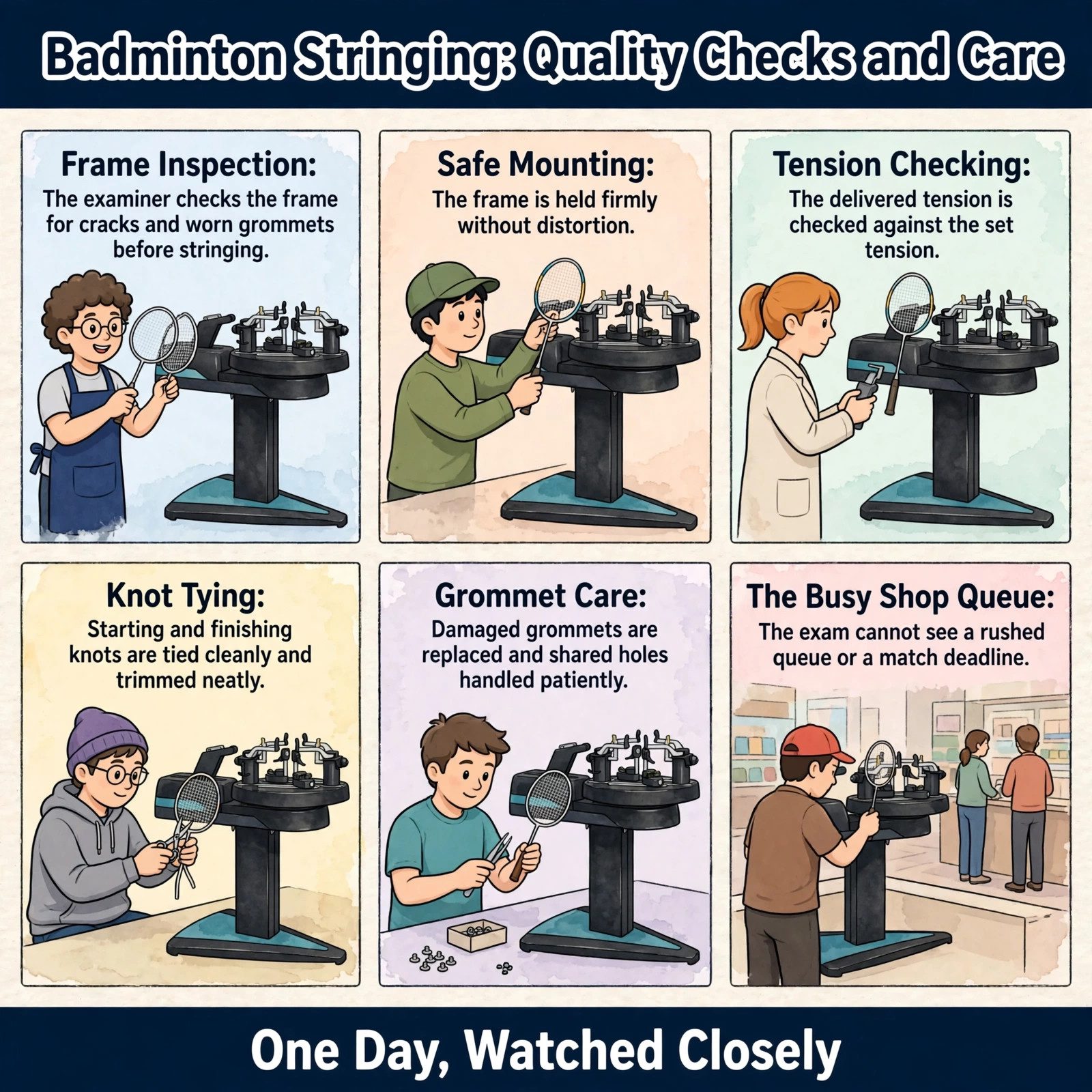
Understanding the limit starts with what an exam can actually see. An examiner watches a set number of rackets, strung in exam conditions, with time to work properly and a standard to meet. Frame inspection, safe mounting, clean weaving, delivered tension, clamp control, starting and finishing knots and grommet care are all visible and markable in that setting. Some bodies add a written section on string knowledge and player advice; USRSA credentials such as Certified Stringer and Master Racquet Technician combine written and practical sections. Everything the exam sees is real. It is simply a sample, taken on one day.
A sample cannot cover the range of real counter work. Badminton rackets arrive with cracked frames, worn grommets, shared holes, old string at unknown tension and a match starting soon. String gauges run thin at 0.65mm to 0.70mm, so small carelessness shows fast. The exam tests whether the stringer can do the work properly. Daily work tests whether they still bother when nobody is marking.
Nor can an exam test the parts of stringing that are really service. Listening to how a player plays, advising a sensible tension instead of the fashionable one, refusing to string a frame that is unsafe, and saying so plainly: these are judgement and character. A body can test knowledge around them. It cannot certify that a person will use that judgement kindly and honestly for years.
1.3 Working Method
Why does certified skill fade without daily habits?
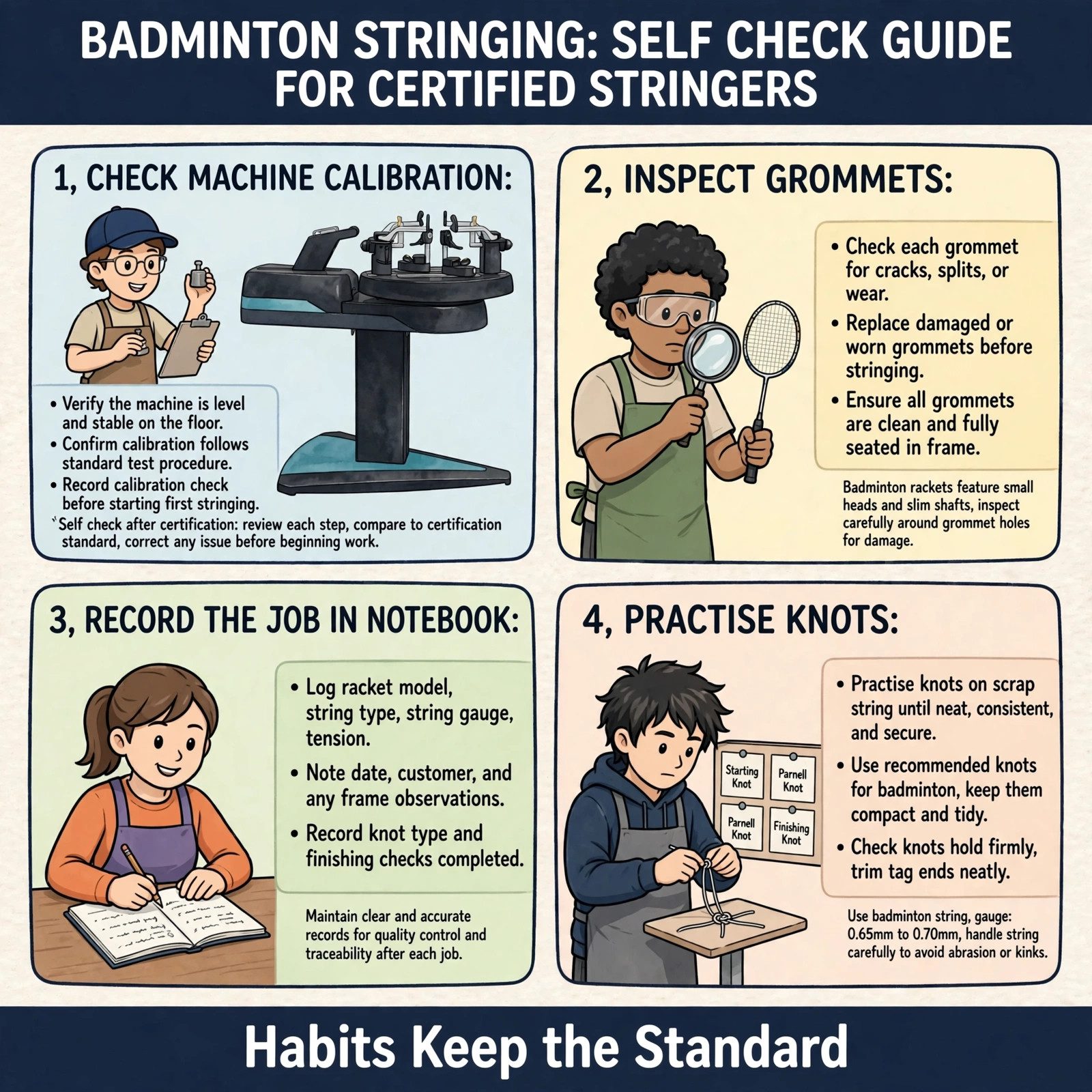
Skill after certification is kept by feedback, or lost without it. In training, an instructor corrects clamp pressure, weaving angle, knot tails and grommet habits on the spot, which is why those habits are sharp on exam day. After the exam, the corrector leaves the room. A stringer who keeps checking their own work, measuring delivered tension, inspecting grommets and recording each job, keeps the standard alive. A stringer who treats the certificate as a finish line slowly strings the way the queue demands, not the way the exam taught.
Machines drift too, and no certificate covers equipment. A machine that was accurate in January can deliver a different tension months later if it is never checked. Clamps wear, grippers slip, and thin badminton string shows every fault. Certified stringers who stay good treat calibration and tool care as part of the credential they show players, even though no examiner is watching anymore.
Players can spot the difference without any technical knowledge. The stringer who asks about your game, notes your last tension, inspects the frame before cutting and writes the job down is still working to a standard. The one who waves every racket through the same routine may hold the same certificate. The paper is identical. The practice behind it is not, and practice is what touches your racket.
1.4 Practical Review
What should players still check with a certified stringer?
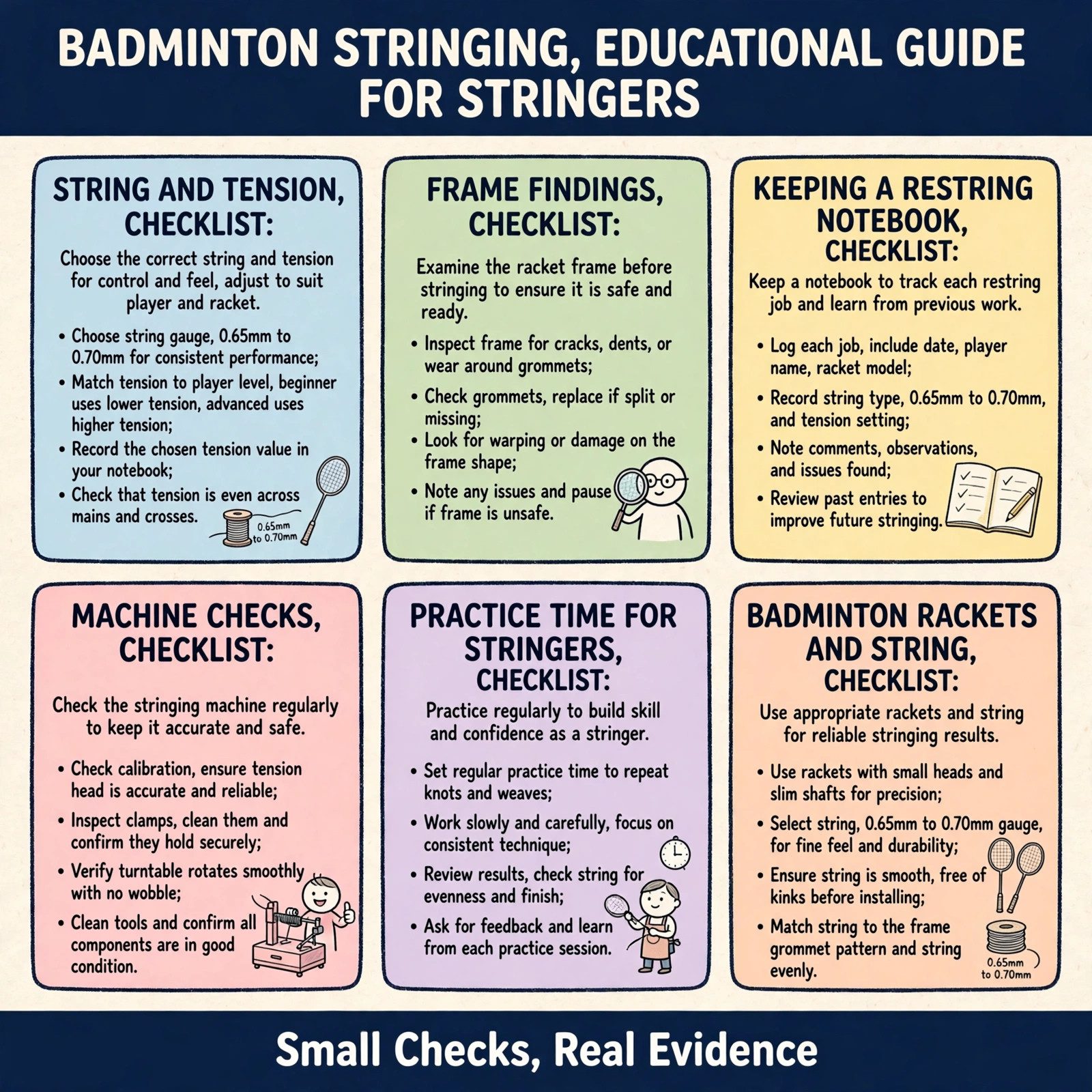
Because the certificate has limits, a player’s own checks still carry weight, and they cost attention more than money. State your string and tension clearly and note what you asked for. Ask what was found on the frame before stringing. Keep the record of each restring: string, tension, date in your own notes and how the racket felt. If you string often, the commitment is a notebook habit and a few honest questions per visit. Those small costs buy you the evidence that tells you whether a certified stringer’s daily standard still matches their exam day standard.
Check the details. For stringers, the honest commitment runs the other way. Keeping exam standard costs practice time, string and materials for test rackets, machine checks, and the slower minutes spent inspecting frames when the queue is long. None of those categories carry figures in this guide, because they differ by shop and country. What they share is that they never end. Certification was an event; staying certified in practice is a routine.
Review the process. There is also a cost in expecting too much from paper. A player who trusts a certificate blindly stops checking, and a shop that hires on paper alone stops supervising. Both discover the limit later, usually through a slipped knot, uneven tension or a frame that should never have been strung. The certificate was never the failure. The failure was asking it to guarantee what only ongoing care can deliver.
Plan the next step. Tournaments and academies manage this limit with process, not faith. They watch trial rackets, check delivered tension, keep notes on each stringer and review complaints. The credential gets a stringer considered; the observed work keeps them on the team. That is the healthy pattern at every level: certificate first, evidence always, trust renewed job by job.
1.5 Key Checks
How should you judge a certified stringer beyond the paper?
Record the context.
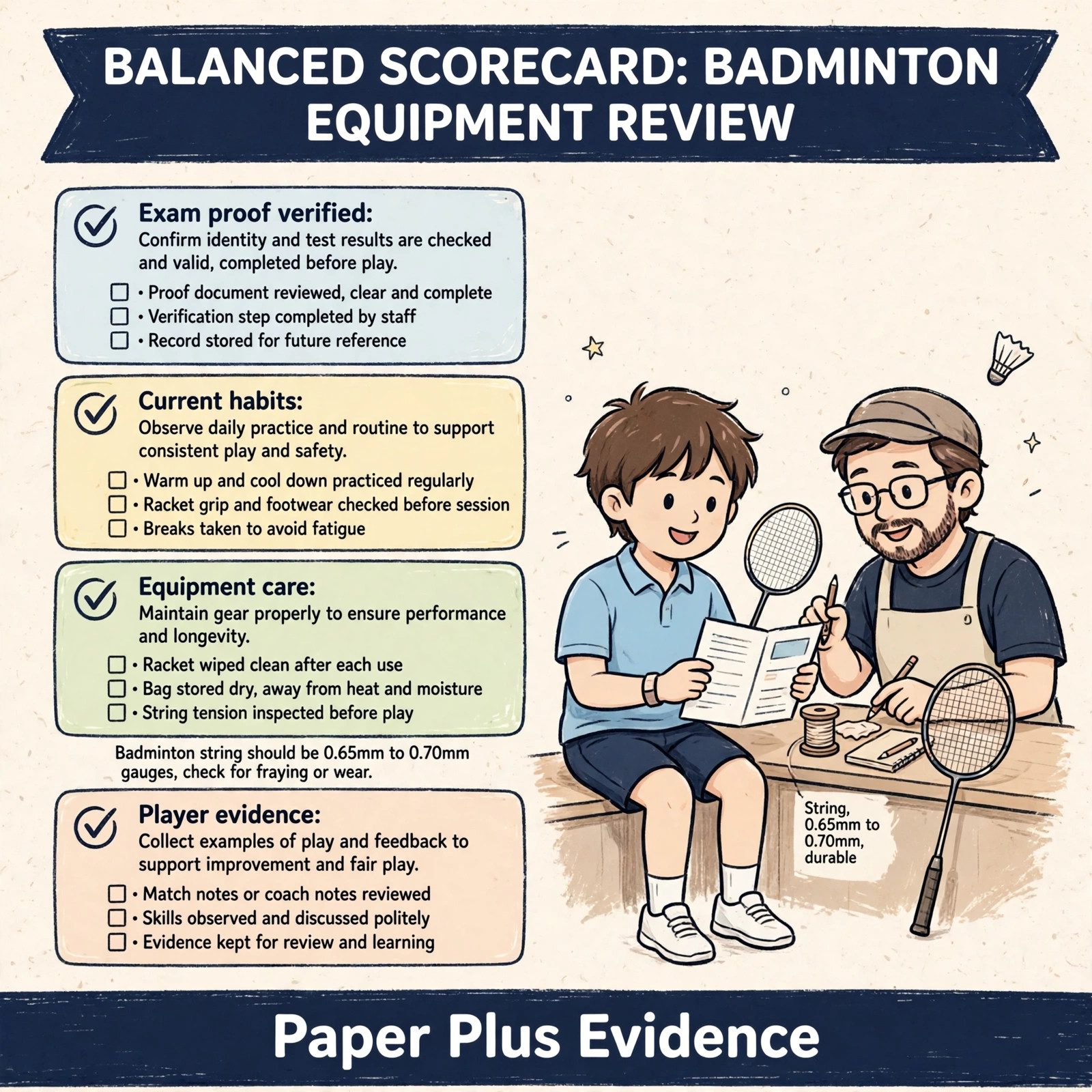
So judge every certified stringer, from any body, on the same balanced scorecard. First, the exam proof: which body, what scope, what was tested, and can the pass be verified? Second, current habits: does the stringer inspect frames, record jobs and check delivered tension now? Third, equipment care: is the machine maintained and checked? Fourth, player evidence: do players return, and does the stringer explain choices honestly? Write the answers down. A strong certificate with strong current habits is the real credential. Either one alone is half the story.
Check the details.
The established bodies illustrate the range honestly. USRSA maintains its Master Racquet Technician title with an annual written update test, a design that admits skills and knowledge need refreshing, while Certified Stringer status itself has no expiry and its listing is tied to current membership. GRSA and ERSA certify across racket sports in their regions, and CRSF works inside China’s badminton heavy scene. Each model handles the after exam problem differently, through updates, membership or community standards.
Review the process.
Notice what none of them promises. No serious body guarantees a holder’s future work, future honesty or future employment. When marketing suggests a certificate means a player never needs to check anything again, that is sales talk, not a certifying body’s language. The limit is built into honest certification everywhere. A guide that hides it is selling paper; a body that states it is selling a standard.
1.6 Service Record
How does BSW state its own limits?
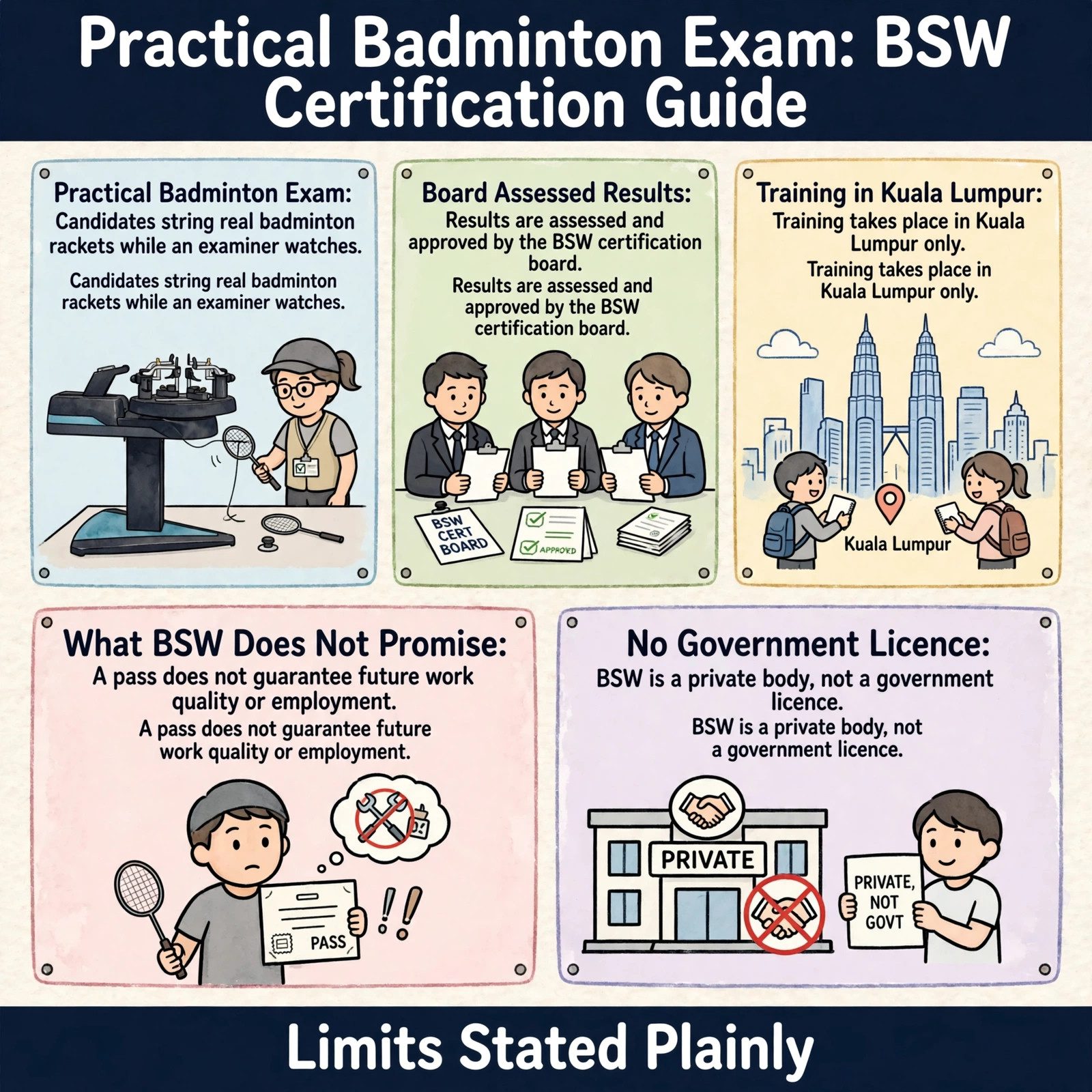
BSW states its own limits in the same plain terms. Its exam is practical and badminton specific, on real rackets, and results are assessed and approved by the BSW certification board. That proves a graduate’s tension accuracy, knot work, grommet care and frame handling met the standard on the last day of training in Kuala Lumpur. It does not prove the graduate will string carefully in five years, run an honest counter, or suit every shop. BSW claims no government licence, and it does not promise that a pass brings work.
Check the details. The training shape behind the certificate is fixed and public. The course runs 3 and a half days, classes from 10am to 5pm with flexible timing on dates, and the practical exam sits on the last day. Learners train on real rackets with instructor correction, the same feedback loop this guide credits with building the standard. Founder Eric Chuar teaches from his Kuala Lumpur base, while the certification decision belongs to the board as an organisation.
Review the process. What BSW can fairly claim is narrower and stronger for it. Badminton depth: the exam tests the gauges, tensions and frames badminton players actually use, where general bodies centre on tennis. A recorded result an employer can ask about. And a culture point worth naming: BSW graduates are taught to keep records and expect checking, because the organisation itself teaches that a certificate is the start of trust, not the end of it.
Plan the next step. If a BSW graduate ever waves the certificate as a reason to stop asking questions, they have missed the point of their own training. The right use of the paper is the opposite: here is my tested standard, here are my records, check my work. Players and shops should hold every body’s graduates, BSW included, to exactly that standard of openness.
1.7 Guided Practice
Which questions reach past the paper before you trust or enrol?
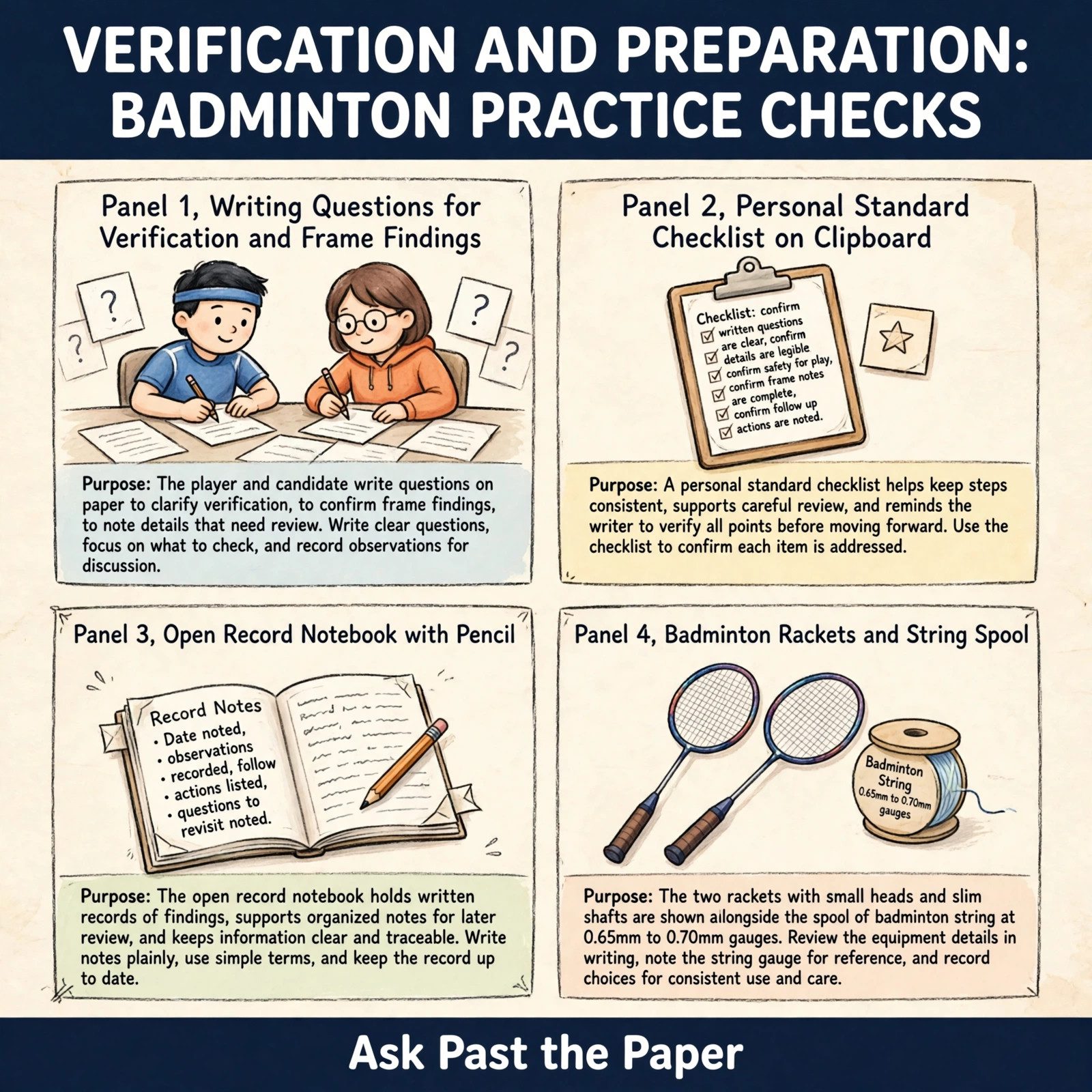
Use the limit well by asking questions that reach past the paper. To a stringer: which body certified you, what did the exam test, and can the body confirm your pass? Then the daily questions: how do you check your machine, what did you find on my frame, what tension did you actually deliver, and will you record this job? To a certifying body, ask what its credential does not cover, in its own words. Honest bodies answer that question easily, because they wrote the standard and know exactly where it ends.
Candidates choosing a route should ask the same of themselves. BSW trains in Kuala Lumpur only, classes from 10am to 5pm, 3 and a half days with the exam on the last day and flexible timing. Whichever body you choose, plan for the years after the exam before you sit it: the records you will keep, the checks you will run, the practice that keeps your knots and tension honest when the queue is long and nobody is marking.
Turn that into a simple personal standard and write it down. Mine is the exam standard, kept daily: inspect every frame, deliver the tension asked for, tie knots I would sign, care for grommets, record every job. Review it monthly against your own records. A certificate on the wall plus that habit at the machine is the closest thing to a guarantee this trade honestly offers, and players can feel the difference.
Limits of Stringer Certification Quick FAQ
Short answers on what a stringer certificate proves, what it cannot guarantee, and what players and stringers should still check.
What can a stringer certificate not guarantee?
A stringer certificate proves the holder met a body’s tested standard on exam day: tension accuracy, knots, grommets and frame care under observation. It cannot guarantee every future job, because habits, equipment and honesty after the exam are outside what any single test can promise.
What can the exam see and not see?
An exam sees a sample of work on one day: frame inspection, mounting, weaving, delivered tension, clamps, knots and grommet care on real rackets under observation. It cannot see rushed queues, hidden frame damage, counter advice or honesty, which only daily work reveals.
Why does skill fade after the exam?
After the exam there is no instructor correcting clamp pressure, weaving, knots and grommets, and machines drift out of calibration over time. Stringers who keep self checking and recording their work keep the standard; the certificate alone cannot keep it for them.
What should players still check?
Because the certificate has limits, a player’s own checks still carry weight, and they cost attention more than money. State your string and tension clearly and note what you asked for. Ask what was found on the frame before stringing. Keep the record of each restring: string, tension, date in your own notes and how the racket felt. If you string often, the commitment is a notebook habit and a few honest questions per visit. Those small costs buy you the evidence that tells you whether a certified stringer’s daily standard still matches their exam day standard.
How do you judge beyond the paper?
Judge a certified stringer on exam proof plus current evidence: the body’s record of the pass, the stringer’s own job records, machine care, frame inspection habits and repeat player trust. A certificate with no current evidence behind it deserves questions, not blind faith.
How does BSW state its limits?
BSW’s certificate proves a practical, badminton specific exam standard met on the last day of training in Kuala Lumpur, assessed and approved by the BSW certification board. It does not guarantee future work quality, honesty or employment, and BSW claims no government licence and promises no jobs from a pass.
Which questions reach past the paper?
Use the limit well by asking questions that reach past the paper. To a stringer: which body certified you, what did the exam test, and can the body confirm your pass? Then the daily questions: how do you check your machine, what did you find on my frame, what tension did you actually deliver, and will you record this job? To a certifying body, ask what its credential does not cover, in its own words. Honest bodies answer that question easily, because they wrote the standard and know exactly where it ends.
What should you keep from your checking route?
Keep your pass confirmation and the body’s record reference, plus your own ongoing evidence: job records with string and tension per racket, machine check notes and player feedback. Together they show a standard that stayed alive after exam day, which the certificate alone cannot show.
How can I start with BSW?
Start with an enquiry that states your sport, experience, machine and goal, and ask plainly what a BSW pass does and does not prove. BSW trains in Kuala Lumpur only, flexible timing, classes from 10am to 5pm over 3 and a half days, practical exam on the last day, results assessed and approved by the BSW certification board.
Limits of Stringer Certification: Explore the Practical Decisions
Build a Clear Working Method
The method is simple: credit the certificate for the exam it proves, then score current habits, equipment care and player evidence beside it, and keep the record so trust is renewed job by job.
| Trust Check | Rushed Approach | Planned Approach |
|---|---|---|
| Proof | Treat the certificate as a lifetime guarantee of work | Credit the certificate for the exam standard it actually proves |
| Exam | Assume the exam saw every situation real work brings | Remember the exam is a one day sample under observation |
| Habits | Expect the paper to keep skills sharp by itself | Count records, machine checks and practice as ongoing costs |
| Scorecard | Judge a certified stringer on the certificate alone | Score exam proof, current habits, equipment and player evidence |
| Your evidence | Decide from the framed certificate alone | Write the exam proof and current evidence down together |
| Next action | Assume the standard keeps itself after exam day | Use job records to show the standard is still alive |
Choose an Honest Credential with Best Stringer Worldwide
Choose the route that is honest about its own limits. Train on real rackets in Kuala Lumpur with Best Stringer Worldwide, with classes from 10am to 5pm over 3 and a half days, flexible timing, and the practical exam on the last day. Your work is assessed and approved by the BSW certification board. Send an enquiry stating your experience, your machine and your goal, and ask what the certificate proves and what you must keep proving yourself.
