






1.1 Starting Point
What manufacturer training and independent certification different?
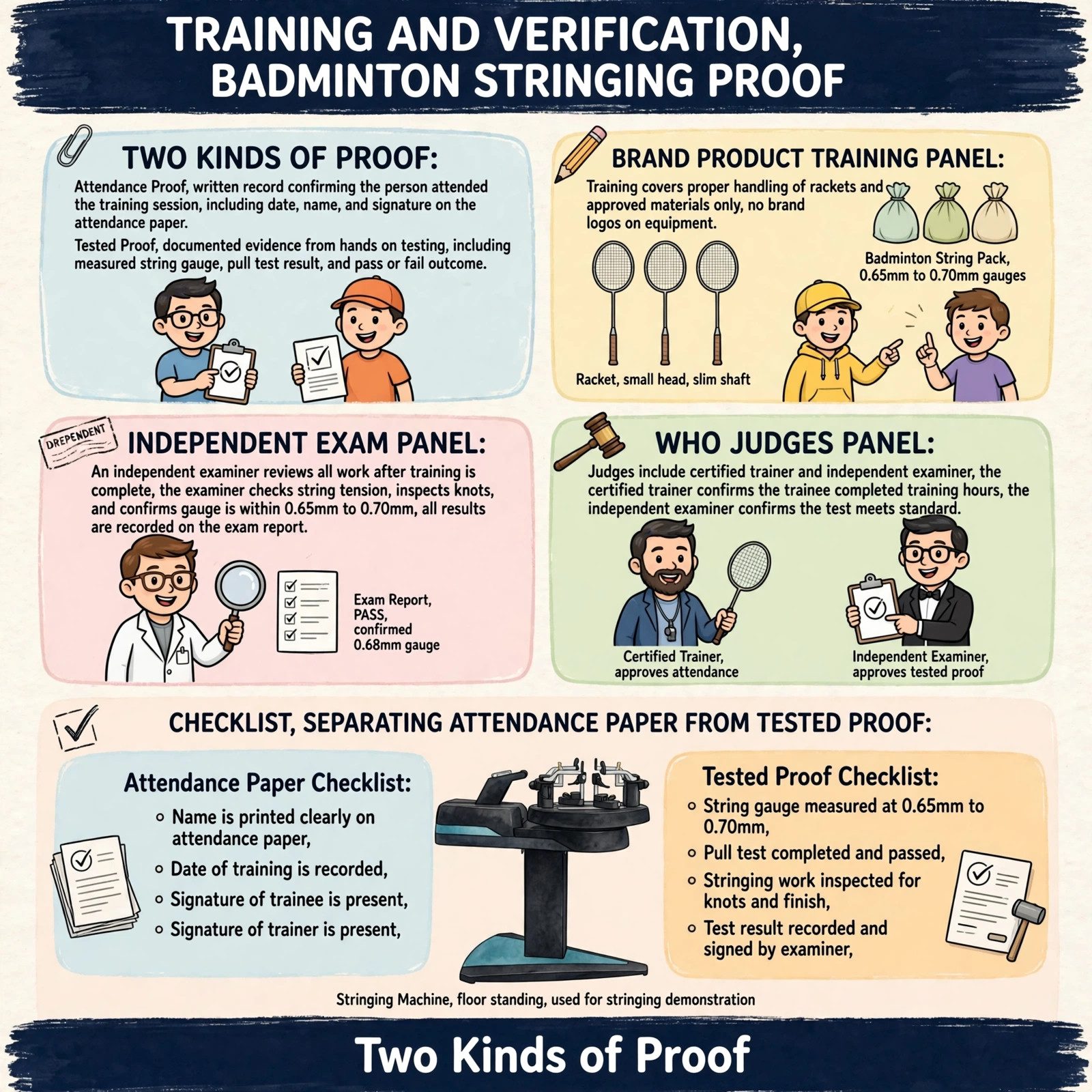
Manufacturer training and independent certification prove different things, and confusing them costs stringers credibility. Brand run training, offered in general terms by equipment manufacturers such as racket and string makers, teaches product knowledge: how that maker frames, strings and tools are meant to be used. Independent certification proves something else: a body with no product to sell tested your stringing against a published standard and recorded the result. Best Stringer Worldwide, founded by Eric Chuar and based in Kuala Lumpur, Malaysia, is an independent body for badminton, with results assessed and approved by the BSW certification board.
Neither route is worthless, and this page will not pretend otherwise. Product knowledge helps at the counter when a player asks why one string suits a frame. But training attendance is judged by the trainer who ran the session, usually with no pass or fail line. Certification has a fail line, and that line is the whole point.
Ask one sorting question about any paper: who tested me, against what standard, and can a stranger verify it? Brand training answers the first part with a company name and stops there. Independent certification answers all three parts. Shops that hire across brands need the second kind of answer, because their customers play many brands, not one.
1.2 Preparation
What an independent exam test that brand training does not?
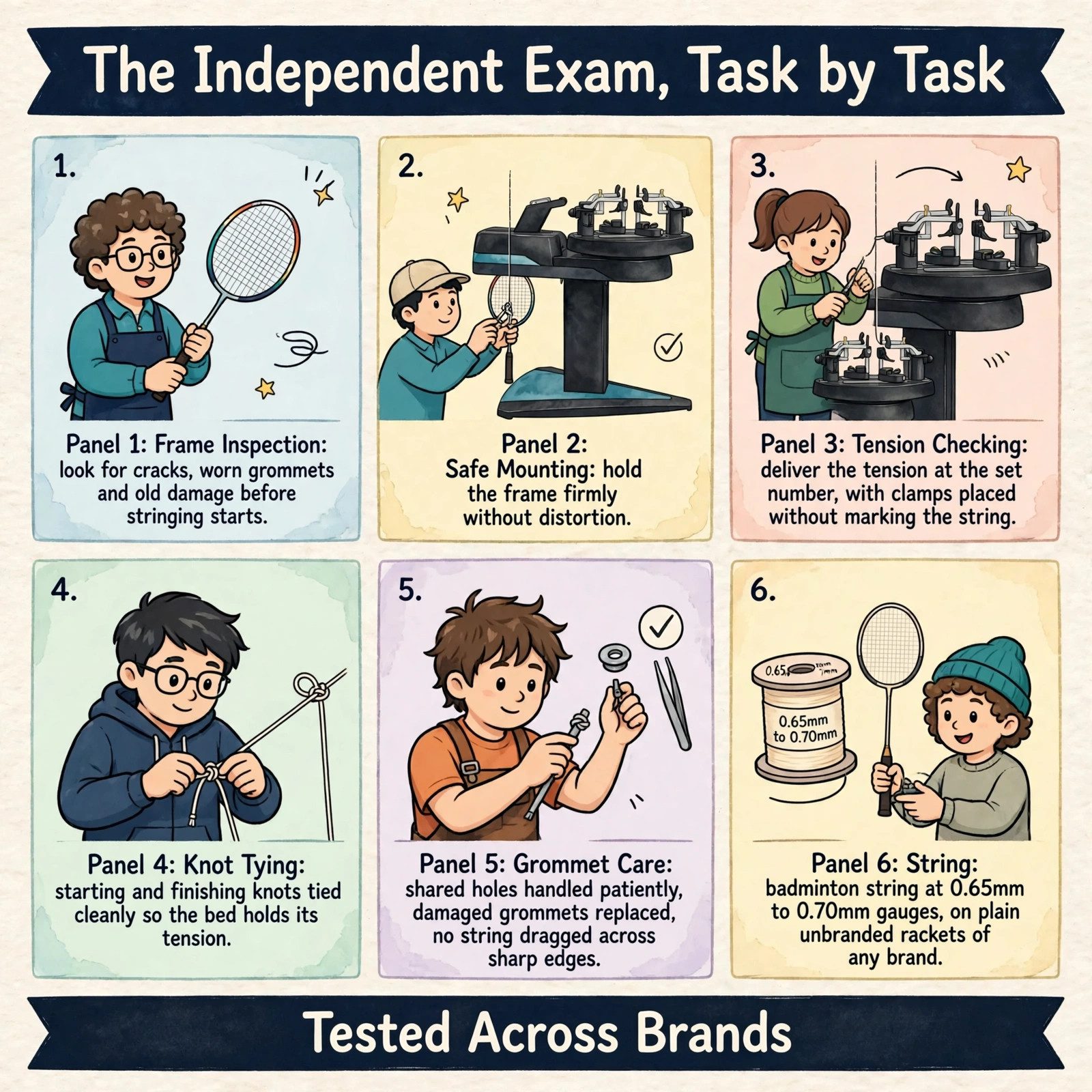
An independent exam tests transferable work, not product familiarity. Frame inspection comes first: cracks, worn grommets and old damage spotted before stringing starts. Mounting follows, firm without distortion. Then the stringing itself: mains and crosses woven cleanly, tension delivered at the set number, clamps placed without marking string. Knots are marked closely, because a sloppy knot loses tension for the whole bed. Grommet care runs through everything. None of that belongs to one brand. It is the standard any good racket, from any maker, deserves.
Badminton sharpens the point. Strings run thin, at 0.65mm to 0.70mm gauges, and tensions run high for light frames, so small errors show quickly. A product session built around one maker range may never test that touch across frames. An independent badminton exam names the gauges, tensions and frame sizes it tests, and marks them the same way for every candidate.
What brand training usually does not include is just as telling: no independent examiner, no recorded fail, no standard published for outsiders to read. That is not a criticism of the training itself. It is a description of its limits. Product knowledge was the goal, and product knowledge is what it proves, nothing more and nothing less.
1.3 Working Method
How product training and tested training build skill differently?
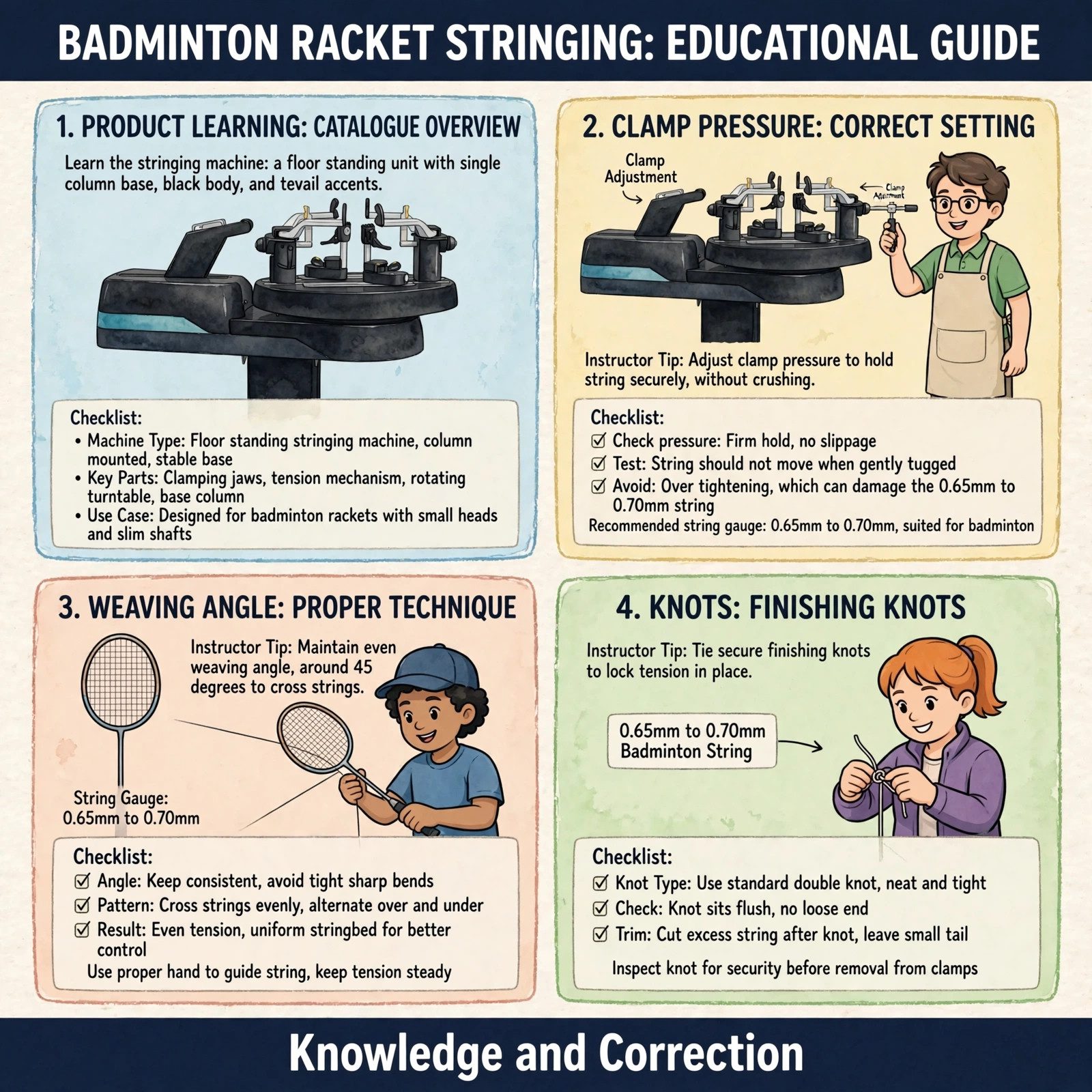
The two routes also build skill differently. Brand training is strong on product detail: string families, frame features, tool settings for that maker range, explained by people who know the catalogue deeply. For a shop that sells that brand heavily, that knowledge is real value. Tested training works another way: an instructor watches your hands on real rackets and corrects clamp pressure, weaving angle and knots against an exam standard, whichever brand is on the machine. One route deepens product knowledge. The other corrects transferable technique.
Feedback is where the difference shows. A product session can end with every attendee holding the same paper, whether their knots were clean or not. Exam preparation cannot work that way, because the exam will separate candidates. Good certification training therefore marks practice work honestly during the course, so nobody meets the standard for the first time on exam day.
The strongest stringers often hold both, in the right order. Learn products from the makers, by all means. Then get your core technique tested by a body that sells no rackets and no string. When a shop owner asks which paper proves you can string, the tested one answers. When a player asks about a specific string, the product knowledge answers. Keep the roles straight.
1.4 Practical Review
Which costs and commitments come with each route?
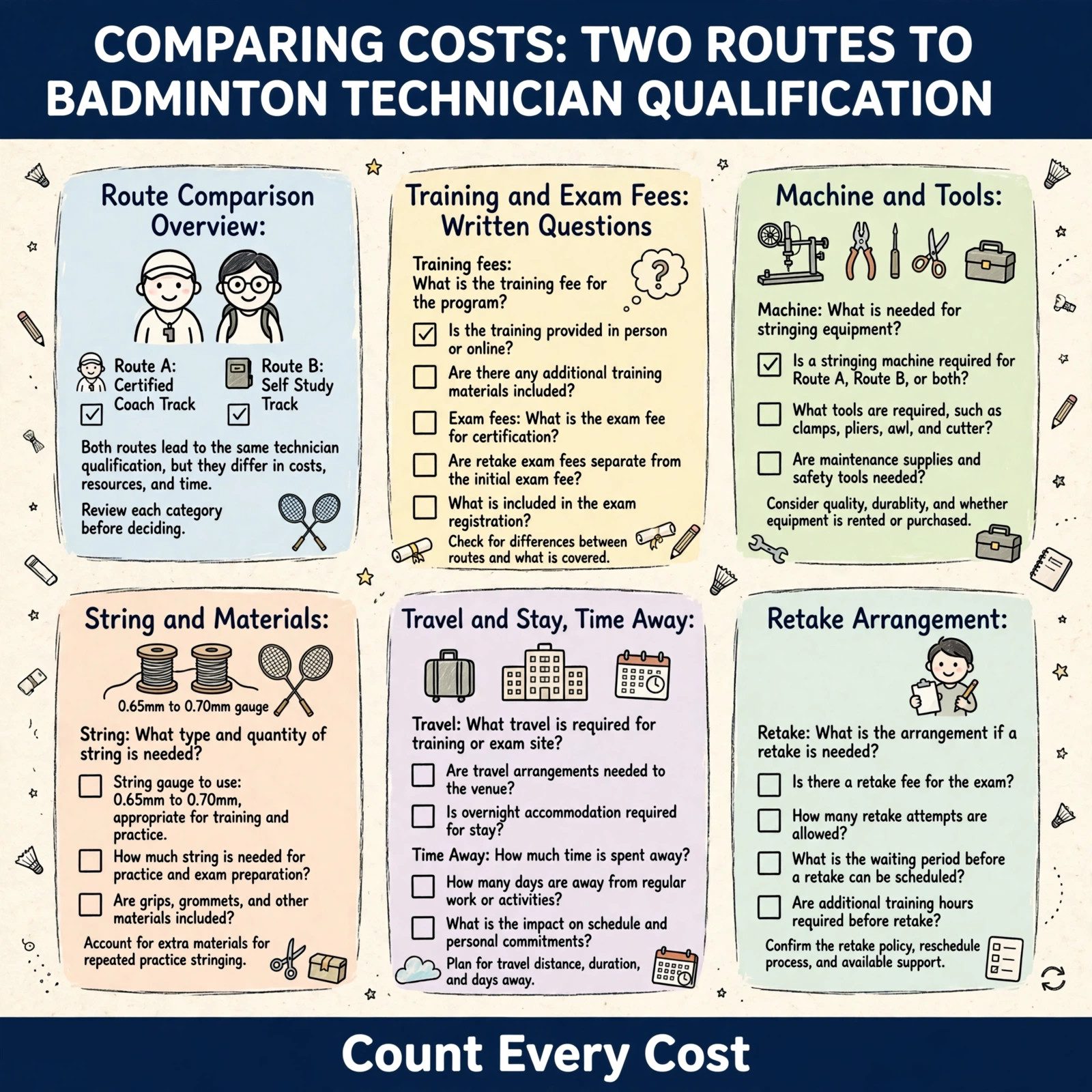
Cost planning differs by route, and honest planning lists every category for both. Brand training may involve a session fee, travel to a brand venue and time away from the counter, and sometimes tools or stock commitments set by the brand, which you should confirm in writing rather than assume. Independent certification adds its own list: training fee where you take a course, the exam fee itself, machine and tools if you need them, string and materials for practice, travel and stay if the body tests elsewhere, time away from work, and the retake arrangement. No figures are given here, because they differ by brand, body and year.
Check the details. Commitment differs too. Product training is often short and scheduled by the brand. Certification asks for practice spread over weeks, because the exam marks habits, not intentions. If you string for a shop, arrange cover while you train and practise. Count the days and practice rackets as seriously as the money on either route.
Review the process. There is also a hidden cost in presenting the wrong paper for the job. A stringer who shows brand training as if it were tested certification may win one counter conversation, then lose the shop trust when the owner asks what was examined. Honest labelling costs nothing and protects the reputation both routes were meant to build.
Plan the next step. Weigh value by what each paper leads to. Brand training supports product advice and brand work. Independent certification supports hiring decisions, tournament trust and player confidence across every brand on your wall. If budget forces a choice, fund the proof your next job actually asks for, and add the other route later when it earns its place.
1.5 Key Checks
How you compare brand training and certification fairly?
Record the context.
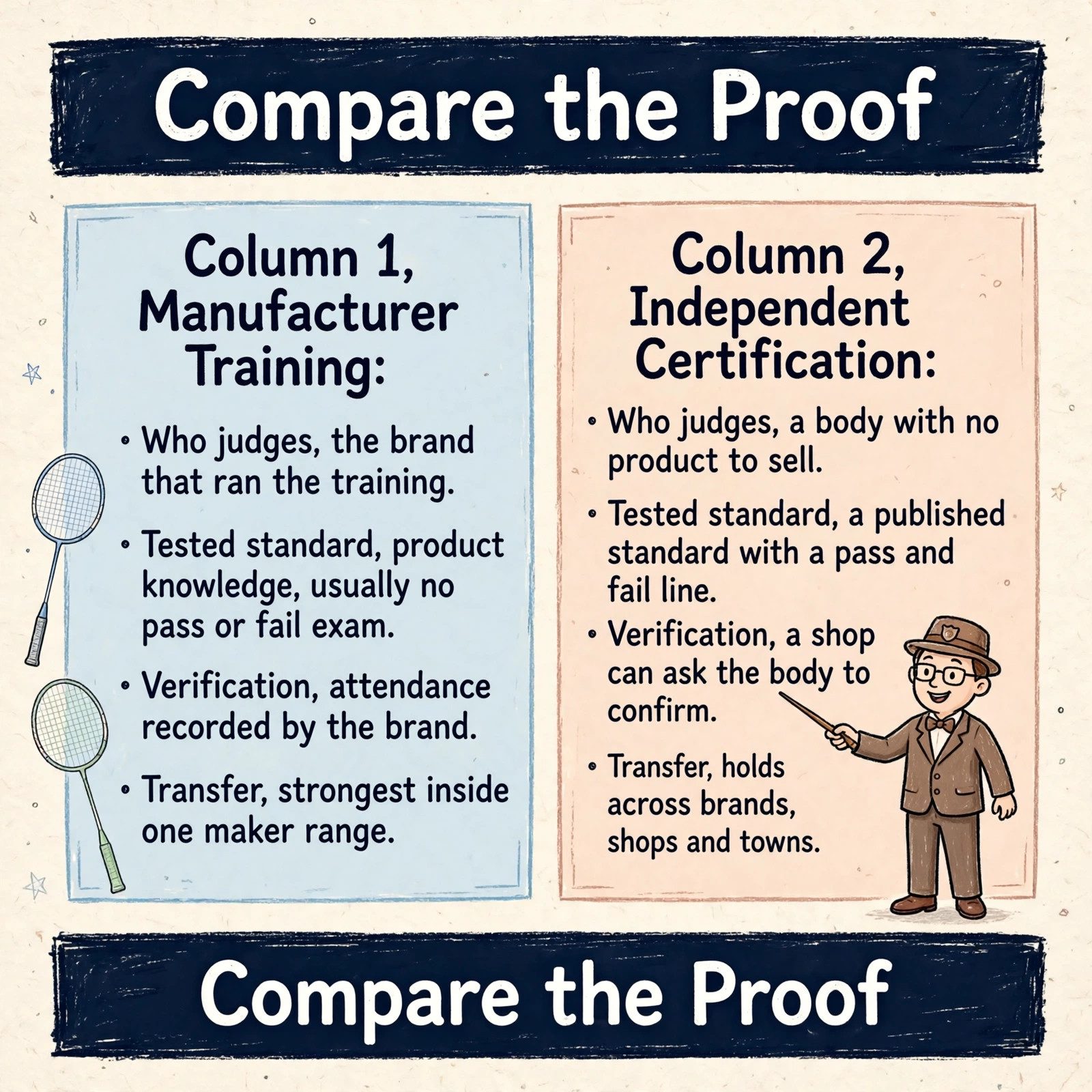
Compare the two routes on the same four points and the confusion clears. First, who judges: the brand that ran the training, or an independent body? Second, is there a tested standard with a pass and fail line, published for outsiders? Third, verification: can a shop that was not there confirm the result? Fourth, transfer: does the proof hold across brands, shops and towns, or only inside one maker range? Write both routes answers down side by side. Training scores well on product depth. Certification scores on judgement, testing and transfer.
Check the details.
General racket bodies show what the independent side looks like at scale. USRSA certifies across racket sports with written and practical sections and credentials such as Certified Stringer and Master Racquet Technician. GRSA and ERSA certify stringers across racket sports internationally and in Europe. CRSF certifies inside China, where badminton carries heavy weight. None of them sells rackets or string as its main business.
Review the process.
BSW belongs in that independent company, with a badminton specific focus: a practical exam on real rackets, assessed and approved by the BSW certification board in Kuala Lumpur. Set beside it, manufacturer training is not a rival credential. It is a different product, useful for product knowledge, silent on tested standard. Judged fairly, each route should be bought for what it actually proves.
1.6 Service Record
How the BSW route sit beside manufacturer training?
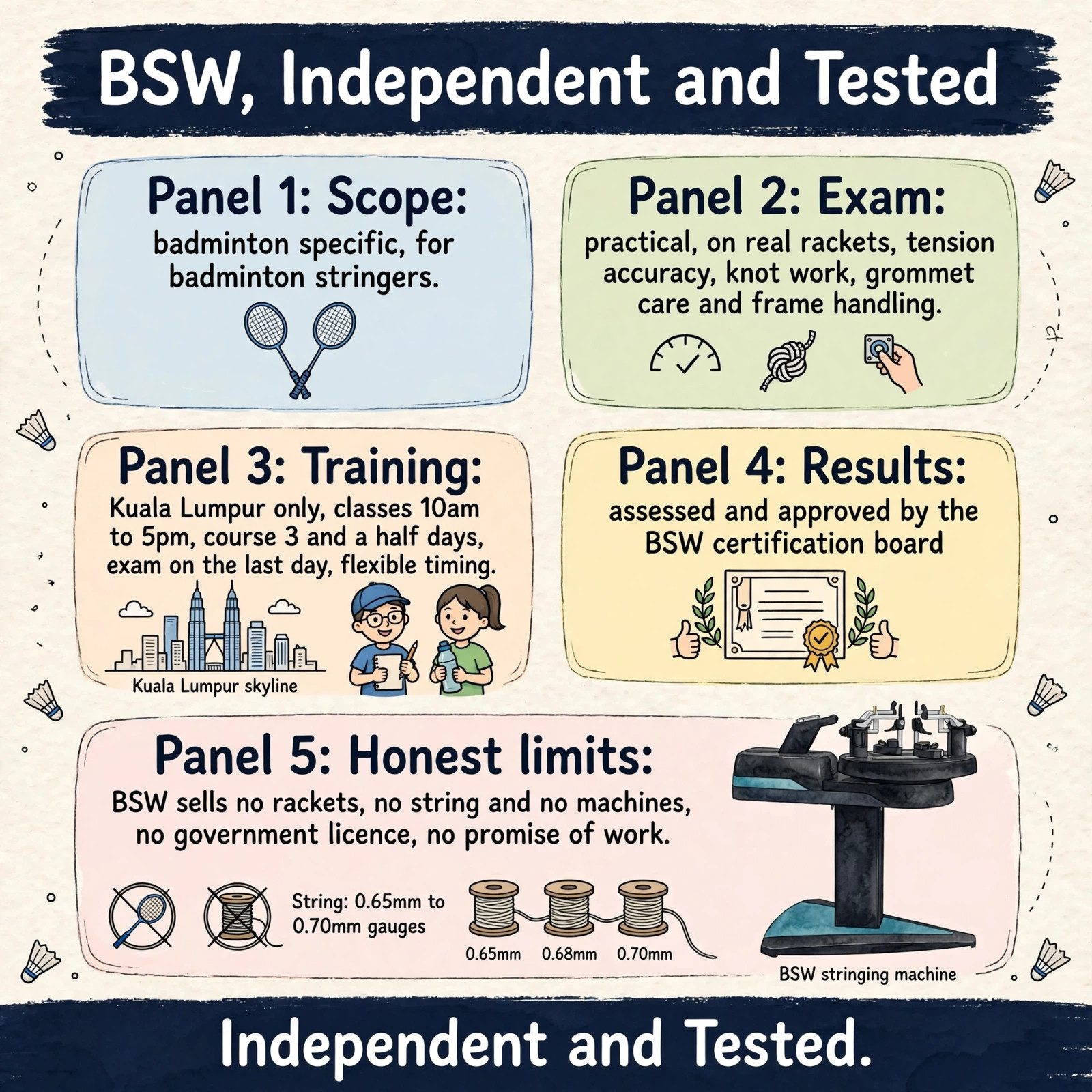
Now place the BSW route beside manufacturer training with no special pleading. BSW sells no rackets, no string and no machines, so its exam has nothing to promote except the standard itself. The scope is badminton specific. The exam is practical, on real rackets, covering tension accuracy, knot work, grommet care and frame handling. Training is hands on in Kuala Lumpur, and results are assessed and approved by the BSW certification board. What BSW does not claim is plain: no government licence, no promise of work, and no course outside Kuala Lumpur.
Check the details. The training shape is fixed and public. The course runs 3 and a half days, with classes from 10am to 5pm and flexible timing on dates, and the practical exam sits on the last day. Learners train on real rackets with instructor correction. Founder Eric Chuar teaches from his Kuala Lumpur base, while the certification decision belongs to the BSW certification board as an organisation, not to one person.
Review the process. Where does brand training beat BSW? On product depth for that maker range, honestly. If a brand launches new string or frames, its own sessions explain them first and best. BSW does not teach catalogues. If your counter work is heavily one brand, take that training as well. But for proof of stringing standard that any shop can check, the independent exam is the paper that carries weight.
Plan the next step. One more check protects you on either route. Before paying, ask who assessed the result, what standard was used and how an employer can verify it. BSW answers inside the enquiry, before enrolment. Ask brand trainers the same questions about their paper and accept the honest answer: it proves attendance and product knowledge. Both papers have value when each is labelled for what it is.
1.7 Guided Practice
What you ask before choosing either route?
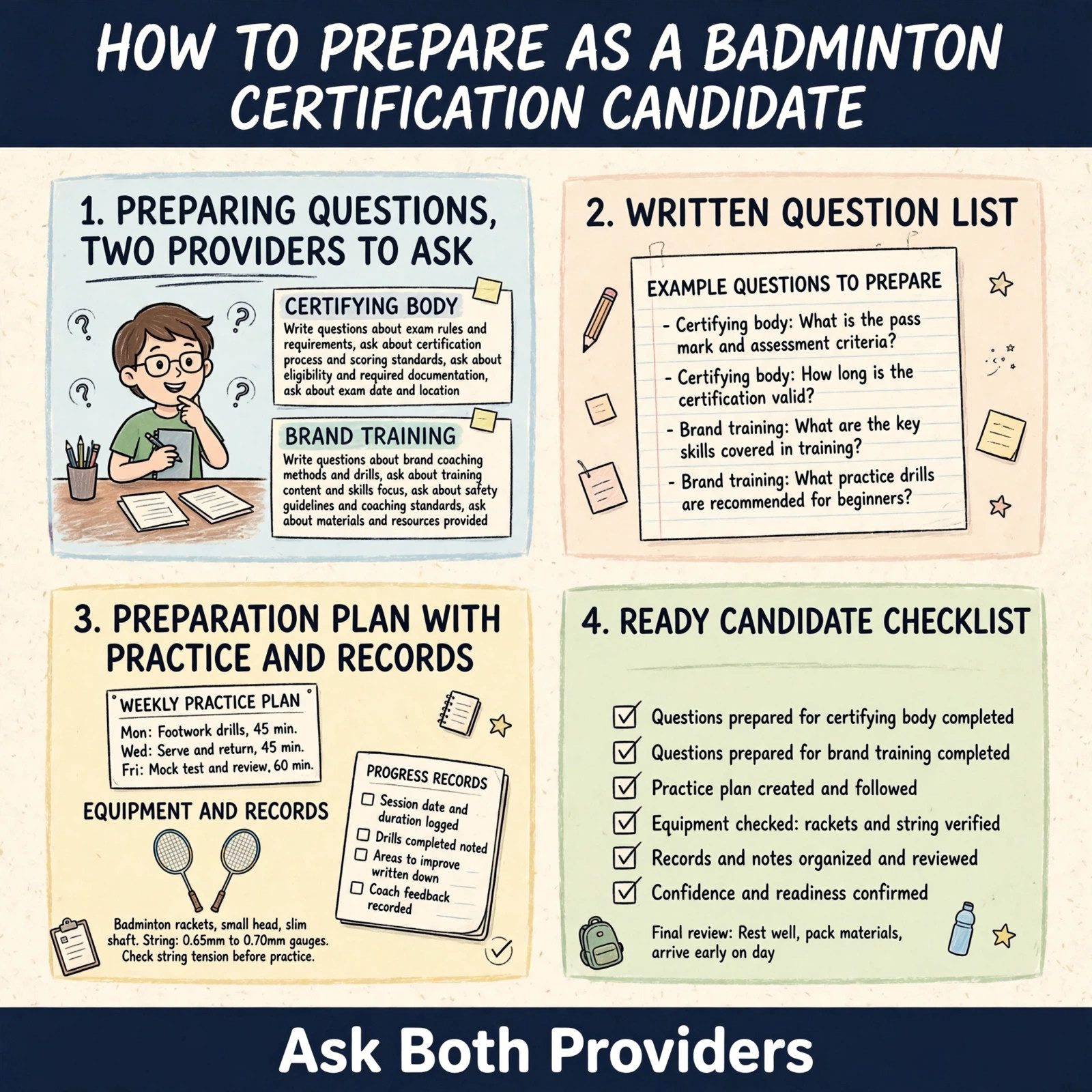
A good enquiry separates the routes before you spend. State your sport, your stringing volume, the machine you use, the brands you string most and the work you want proof for. Then ask each provider the deciding questions. For a certifying body: what does the exam test, task by task, and who assesses it? For brand training: what products does it cover, and is any part independently examined? What does each route cost, category by category? Write the answers down and score them with the comparison method before you commit.
Timing questions matter too. Ask when sessions run and whether dates flex around your work. At BSW, training is in Kuala Lumpur only, classes run from 10am to 5pm, the course takes 3 and a half days with the exam on the last day, and timing is flexible for learners travelling in. Brand sessions follow the brand calendar instead, which is another practical difference to plan around.
Turn the answers into a plan the same day. If you lack tested proof, book the certification route and use brand sessions to top up product knowledge afterwards. List your weakest exam tasks, the rackets you will practise on and the records you will keep. By exam day, your plan should read like a checklist already worked through twice.
Manufacturer Training vs Certification Quick FAQ
Short answers on what manufacturer training proves, what independent certification proves, and how the two fit together for stringers.
What manufacturer training and independent certification different?
Manufacturer training proves product knowledge taught by a brand, usually with no pass or fail exam. Independent certification proves a body with no product to sell tested your stringing against a published standard and recorded the result, which other shops can verify.
What an independent exam test that brand training does not?
An independent exam tests frame inspection, safe mounting, clean weaving, delivered tension, clamp control, knots and grommet care on real rackets, the same standard for every candidate and every brand. Brand training generally teaches product use and does not record a fail.
How product training and tested training build skill differently?
Brand training deepens product knowledge about one maker range. Certification training corrects transferable technique, with an instructor marking your work against an exam standard on real rackets. Many stringers use both, but only the tested route proves stringing standard.
Which costs and commitments come with each route?
Cost planning differs by route, and honest planning lists every category for both. Brand training may involve a session fee, travel to a brand venue and time away from the counter, and sometimes tools or stock commitments set by the brand, which you should confirm in writing rather than assume. Independent certification adds its own list: training fee where you take a course, the exam fee itself, machine and tools if you need them, string and materials for practice, travel and stay if the body tests elsewhere, time away from work, and the retake arrangement. No figures are given here, because they differ by brand, body and year.
How you compare brand training and certification fairly?
Compare who judges, whether a published standard has a pass and fail line, whether outsiders can verify the result, and whether the proof transfers across brands and shops. Brand training wins on product depth. Independent certification wins on tested, transferable proof.
How the BSW route sit beside manufacturer training?
BSW sits on the independent side of this comparison. It is a certifying body, not a racket or string manufacturer, and its credential rests on a practical exam on real rackets, assessed and approved by the BSW certification board. Training runs in Kuala Lumpur only, 3 and a half days, classes from 10am to 5pm, flexible timing, exam on the last day. Brand training can still add product knowledge on top, but it does not replace a tested, transferable standard that a shop in another town can check.
What you ask before choosing either route?
A good enquiry separates the routes before you spend. State your sport, your stringing volume, the machine you use, the brands you string most and the work you want proof for. Then ask each provider the deciding questions. For a certifying body: what does the exam test, task by task, and who assesses it? For brand training: what products does it cover, and is any part independently examined? What does each route cost, category by category? Write the answers down and score them with the comparison method before you commit.
What should you keep from your certification route?
Keep both kinds of paper separate in your file: brand training attendance or product notes on one side, and your tested certification record, exam confirmation and practice records on the other. Shops read them differently, and mixing them up weakens the stronger proof.
How can I start with BSW?
Start with an enquiry that states your sport, your stringing experience, your machine and any brand training you have already done. BSW trains in Kuala Lumpur only, with flexible timing, classes from 10am to 5pm over 3 and a half days and the practical exam on the last day. Your result is assessed and approved by the BSW certification board.
Manufacturer Training vs Certification: Explore the Practical Decisions
Build a Clear Working Method
The method is simple: write what each route proves first, score both against the same criteria, and keep the record so a shop can see which paper is training and which is tested proof.
| Proof Check | Rushed Approach | Planned Approach |
|---|---|---|
| Proof | Treat brand training and certification as the same paper | Name what each route actually proves |
| Exam | Assume product training includes a tested exam | Ask whether an independent exam was passed |
| Costs | Count only the training session price | List training, exam, tools, travel and time together |
| Scorecard | Choose by brand name recognition alone | Score both routes against the same criteria |
| Your record | Keep both routes mixed in your head | Write what each route proves down |
| Next action | Show training paper as tested proof | Use the record to show which proof fits the job |
Choose Tested Proof with Best Stringer Worldwide
If you need proof that travels beyond one brand, take the tested route. Train on real rackets in Kuala Lumpur with Best Stringer Worldwide, with classes from 10am to 5pm over 3 and a half days, flexible timing, and the practical exam on the last day after your training is complete. Your work is assessed and approved by the BSW certification board. Send an enquiry that states your experience, your machine and your goal, and start with your questions answered in writing.
