






1.1 Starting Point
What is a fake stringing certificate and how do you spot one?
A fake stringer certificate is paper that claims a tested standard nobody ever tested. It may be bought outright, printed after a short attendance course, or issued by a body with no exam, no marking record and no way to check the result. The paper can look impressive, with seals, signatures and formal wording, yet prove nothing about tension accuracy, knots, grommets or frame care. Real certification is different. Best Stringer Worldwide, founded by Eric Chuar and based in Kuala Lumpur, Malaysia, records a practical exam result that is assessed and approved by the BSW certification board.
Three parts separate a real credential from a fake one. A named body publishes what it tests. A candidate is observed doing that work under exam conditions. The body keeps a record that a player, shop or tournament can check later. A bought certificate skips the middle part completely, and often the other two as well. No observed work means no proof, whatever the design suggests.
Sellers of weak paper rely on buyers who never ask questions. The certificate arrives fast, the fee feels small, and the hard part, being watched while you string, never happens. The problem appears later, when an employer asks what was tested, a player checks the issuing body, or a tournament cannot find the name on any list the body will confirm.

1.2 Preparation
What does a real certification exam leave behind as evidence?
A real exam leaves evidence a fake cannot copy. The candidate strings real rackets while an examiner watches frame inspection, safe mounting, clean weaving, delivered tension, clamp control, starting and finishing knots and grommet care. The examiner records marks or notes against a standard, and the body keeps that result. Some established bodies add a written section on strings and player advice. USRSA, for example, uses written plus practical sections for its Certified Stringer, Master Racquet Technician and Professional Racquet Advisor credentials. A fake route has none of this trail: no tasks, no observer, no record.
Ask a seller to describe the exam task by task and the answer usually goes vague. There may be talk of experience, reputation or a short video call, but no list of checked skills and no named assessor. Badminton work is specific: thin string at 0.65mm to 0.70mm gauges, high tensions on light frames, shared holes and small grommets. If none of that was ever examined, the certificate cannot speak for it.
Another tell is speed without substance. A genuine practical exam takes time because rackets have to be strung and checked. Paper issued the same day as payment, with no racket strung and no work inspected, was not an exam result. Fast turnaround on administration is fine. Fast invention of a tested standard is not.
1.3 Working Method
Why can attendance paper never prove stringing skill?
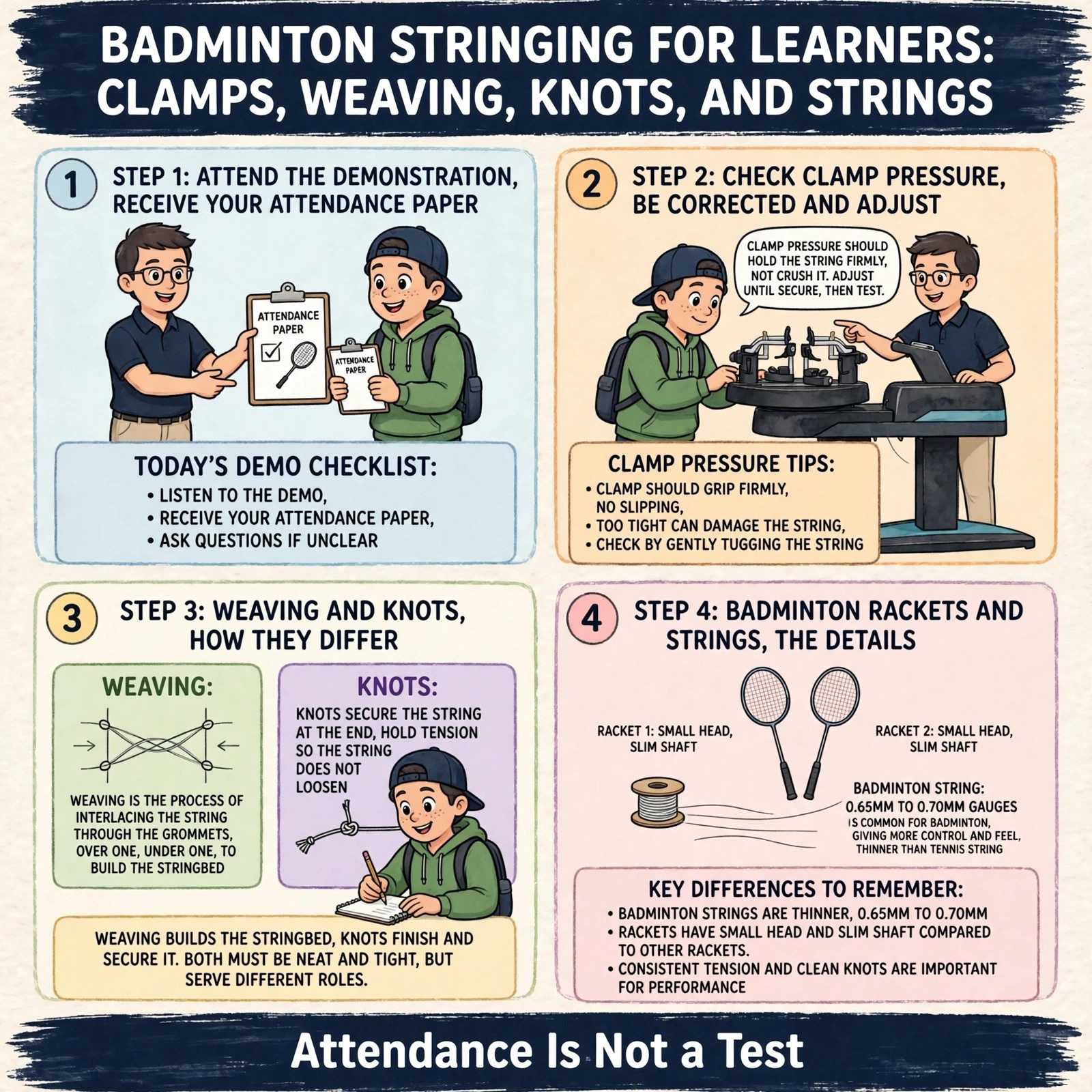
Training exposes the gap between bought paper and tested skill very quickly. In proper training an instructor watches your hands and corrects clamp pressure, weaving angle, knot tails and grommet habits while you work. Mistakes get named and fixed before they become habits. A buyer of fake paper skips that loop entirely, so the same errors stay in every racket. Videos and manuals can teach the order of steps, but they cannot see a learner, and a seller who never watches you string has nothing honest to certify.
This is why attendance paper is so often dressed up as certification. Sitting in a room, watching a demonstration or completing an online form is attendance. It may be useful learning, but nobody tested the attendee. Honest providers label that paper as attendance. Dishonest ones use the word certified, a seal and a signature to make the same paper sound like an exam pass.
If you already hold paper you now doubt, treat it as a prompt to get tested properly, not as a shame to hide. String practice rackets, keep records of string, tension, knots and grommet work, and book a real assessment. One honest exam result replaces a drawer of doubtful paper, and it gives you answers you can repeat at any shop counter.

1.4 Practical Review
What does fake paper really cost in the end?
Fake paper looks cheap because the bill arrives later. The first cost is the purchase itself, money spent on a document no employer can verify. Then comes the real work you still have to fund: proper training, a real exam fee, a machine and tools if you need them, string and materials for practice rackets, travel and stay if your chosen body tests in another city, time away from work, and a retake arrangement if you need one. Add the reputation cost when a shop discovers the paper proves nothing, and the cheap route is the expensive one.
Check the details. This guide names no prices, because figures differ by body, country and year, and fake sellers often hide behind tidy totals. Ask any provider to itemise every category in writing before you pay. A seller who will not explain what the fee buys, beyond the paper itself, is answering your question by avoiding it.
Review the process. Time is part of the honest cost too. Real readiness takes practice spread over weeks, stringing real rackets and recording the results. Bought paper promises to save that time. What it actually saves is the testing, which is the only part that made the credential worth having in the first place.
Plan the next step. Shops and tournaments also pay when fake paper slips through. A player gets uneven tension, a knot slips, grommets tear string early, and the counter has to explain work it trusted on paper. That is why careful employers verify credentials themselves instead of admiring the frame on the wall. Verification protects players first, and honest stringers second.

1.5 Key Checks
How do you score any credential before you trust it?
Record the context.
Use the same four checks on every certificate, from any body, including BSW. First, exam evidence: what tasks were tested, on real rackets, under observation? Second, assessor: who marked the work, and for which body? Third, record: does the body keep the result, with the credential level and sport scope stated? Fourth, verification: can a player or employer confirm the pass with the body today? Write the answers down side by side. Real bodies answer plainly. Fake operations answer with adjectives.
Check the details.
Design is the weakest evidence of all. Seals, ribbons, heavy paper and Latin sounding phrases can be printed by anyone in an afternoon. Compare that with the public facts of established bodies: USRSA lists named credentials with written and practical sections, and its Master Racquet Technician title is maintained by an annual written update test, while Certified Stringer status itself has no expiry and its listing is tied to current membership. That level of plain detail is what real looks like.
Review the process.
Also check the sport scope written on the paper. A general attendance certificate from a tennis centred weekend does not certify badminton work, and a badminton course receipt does not certify tennis. Fake paper often stays vague about scope on purpose, because vagueness lets it be sold to everyone. A real credential states the sport, the level and the standard it tested.

1.6 Service Record
How does the BSW route answer the same checks?
Hold the BSW route against the same four checks, with no special pleading. Exam evidence: the BSW exam is practical, on real badminton rackets, covering tension accuracy, knot work, grommet care and frame handling. Assessor: results are assessed and approved by the BSW certification board as an organisation, not signed off by one person. Record: the organisation records its graduates and their results. Verification: an employer can ask BSW to confirm a pass. BSW claims no government licence and no ISO status, and it runs its course in Kuala Lumpur only.
Check the details. The training shape is public and checkable. Classes run from 10am to 5pm, the course takes 3 and a half days with flexible timing on dates, and the practical exam sits on the last day. Learners train on real rackets with instructor correction before they are tested. Founder Eric Chuar teaches from his Kuala Lumpur base, while the certification decision belongs to the board. Nothing in that route is bought, and attendance alone earns no certificate.
Review the process. Where BSW is not the widest name, say so plainly. USRSA, GRSA, ERSA and CRSF have longer histories or larger scenes in their own regions, mostly around tennis or general racket work. If a shop asks for one of those bodies by name, that request matters. For badminton work, the question is narrower: was badminton stringing itself tested, at badminton gauges and tensions, by a body that keeps the record?
Plan the next step. One habit protects you with every body, BSW included. Before paying, ask how an employer verifies your pass, what the exam day looks like task by task, and what happens if you fail. Keep the written answers. A body that welcomes those questions is behaving like a certifier. A seller who pressures you to pay before answering is behaving like a printer.

1.7 Guided Practice
What should you ask any provider before you pay?
Before you trust or buy any credential, make the provider do the proving. State your sport, your stringing experience, the machine you use and the work you want the paper for. Then ask: what exactly is tested, task by task? Who assesses it, and under what standard? Is there a practical exam on real rackets, a written section, or neither? Can an employer verify my result with you afterwards, and how? What does each cost category cover, including retakes? Put every answer in writing and score it with the four checks from this guide before money moves.
If you are checking someone else’s certificate, work the same list in reverse. Read the body name, credential level and sport scope on the paper. Contact the body and ask it to confirm the person, the level and the standing. Ask the stringer what the exam involved. A genuine holder answers easily, because the day was real. Vague answers about a famous sounding body are a warning, not a detail.
Turn your decision into a preparation plan. If the paper in front of you fails the checks, plan for a tested route instead: practise on real rackets, record strings, tensions, knots and grommet jobs, and choose a body whose exam you can describe before you book it. The goal is not a nicer certificate for the wall. The goal is proof you can hand to any player or shop without flinching.
Fake Stringing Certificates Quick FAQ
Short answers on spotting bought and fake stringing certificates, attendance paper and the checks that expose them.
What is a fake stringing certificate?
A fake stringer certificate is paper sold or handed out without a tested exam behind it. It may follow mere attendance, a payment, or no assessment at all. Because no body observed and recorded the stringing work, the paper proves nothing about tension, knots, grommets or frame care.
What evidence does a real exam leave?
A real exam tests frame inspection, safe mounting, clean weaving, delivered tension, clamp control, knots and grommet care on real rackets under observation, and the body records the result. A fake route cannot describe its tasks, name its assessor or show any marking record.
Why is attendance paper not certification?
Training with feedback corrects clamp pressure, weaving, knots and grommet habits while you work. Buying paper skips that loop, and attendance at a course is not a test. Honest providers label attendance paper as attendance, not certification.
What does fake paper really cost?
Fake paper looks cheap because the bill arrives later. The first cost is the purchase itself, money spent on a document no employer can verify. Then comes the real work you still have to fund: proper training, a real exam fee, a machine and tools if you need them, string and materials for practice rackets, travel and stay if your chosen body tests in another city, time away from work, and a retake arrangement if you need one. Add the reputation cost when a shop discovers the paper proves nothing, and the cheap route is the expensive one.
How do you score a credential?
Score any credential on exam evidence, assessor identity, record keeping and verification. A real body describes its tasks, names who assesses, records the result and lets employers confirm it. A fake seller offers design, speed and promises, and goes quiet when asked for proof.
How does BSW answer the checks?
BSW passes the same checks used on every body here. Its exam is practical and badminton specific, on real rackets, covering tension, knots, grommets and frame care. Results are assessed and approved by the BSW certification board, graduates are recorded, and employers can ask the organisation to confirm a pass. Training runs in Kuala Lumpur only, 3 and a half days, classes from 10am to 5pm, exam on the last day. BSW claims no government licence and sells no certificate without the exam.
What should you ask before paying?
Before you trust or buy any credential, make the provider do the proving. State your sport, your stringing experience, the machine you use and the work you want the paper for. Then ask: what exactly is tested, task by task? Who assesses it, and under what standard? Is there a practical exam on real rackets, a written section, or neither? Can an employer verify my result with you afterwards, and how? What does each cost category cover, including retakes? Put every answer in writing and score it with the four checks from this guide before money moves.
What should you keep from your checking route?
Keep the evidence behind any credential you hold: the body’s pass confirmation, the exam tasks you were tested on, your training notes and your stringing records per racket. If a certificate has no evidence behind it, keep that fact noted too, so you never present paper you cannot defend.
How can I start with BSW?
Start with an enquiry that states your sport, experience, machine and goal. BSW trains in Kuala Lumpur only, with flexible timing, classes from 10am to 5pm over 3 and a half days and the practical exam on the last day. Your result is assessed and approved by the BSW certification board, and no certificate is issued for attendance or payment alone.
Fake Stringing Certificates: Explore the Practical Decisions
Build a Clear Working Method
The method is simple: demand exam evidence, an assessor, a record and a verification route for every credential, write the answers down, and treat design and promises as no evidence at all.
| Credential Check | Rushed Approach | Planned Approach |
|---|---|---|
| Evidence | Trust the seal, paper and signature at face value | Demand exam tasks, assessor and record before trusting paper |
| Exam | Accept a certificate issued with no racket strung | Confirm a practical exam on real rackets under observation |
| Costs | Save money now with paper nobody can verify | Count retraining, retesting and reputation in the true cost |
| Scorecard | Judge a credential by how official it looks | Score exam evidence, assessor, record and verification in writing |
| Your evidence | Compare certificates by design and promises | Write each body’s exam and verification answers down |
| Next action | File the paper and forget what was tested | Keep the exam evidence and pass record with the certificate |
Choose a Tested Credential with Best Stringer Worldwide
If you want a credential that survives questions, earn it under observation. Train on real rackets in Kuala Lumpur with Best Stringer Worldwide, with classes from 10am to 5pm over 3 and a half days, flexible timing, and the practical exam on the last day. Your work is assessed and approved by the BSW certification board. Send an enquiry stating your experience, your machine and your goal, and ask how employers verify a BSW pass before you commit.
