






1.1 Starting Point
What should a certified stringer directory listing actually show?
A certified stringer directory is only as good as the fields it shows. A proper listing names the stringer, the credential and the body that issued it, the level held, the sport scope the exam actually covered, and the holder’s current standing with that body. Anything less is a name on a page, and a name alone proves nothing. Best Stringer Worldwide, founded by Eric Chuar and based in Kuala Lumpur, Malaysia, records its graduates with results assessed and approved by the BSW certification board, which is the kind of record a directory entry should point back to.
Directories exist because paper certificates are easy to show and hard to check. A player standing at a counter cannot ring every issuing body before a restring. A well kept registry does that work once, properly: the body confirms who passed, at what level, in which sport, and whether that person is still in good standing today. The listing is a window into the body’s own records.
That also means a directory is only trustworthy when the body behind it is. A listing site that accepts names without checking them with issuers is a noticeboard, not a registry. Judge any directory by a simple test: pick one entry, contact the issuing body, and see whether the body recognises the person, the level and the standing exactly as listed.
1.2 Preparation
Why do level and sport scope belong on every listing?
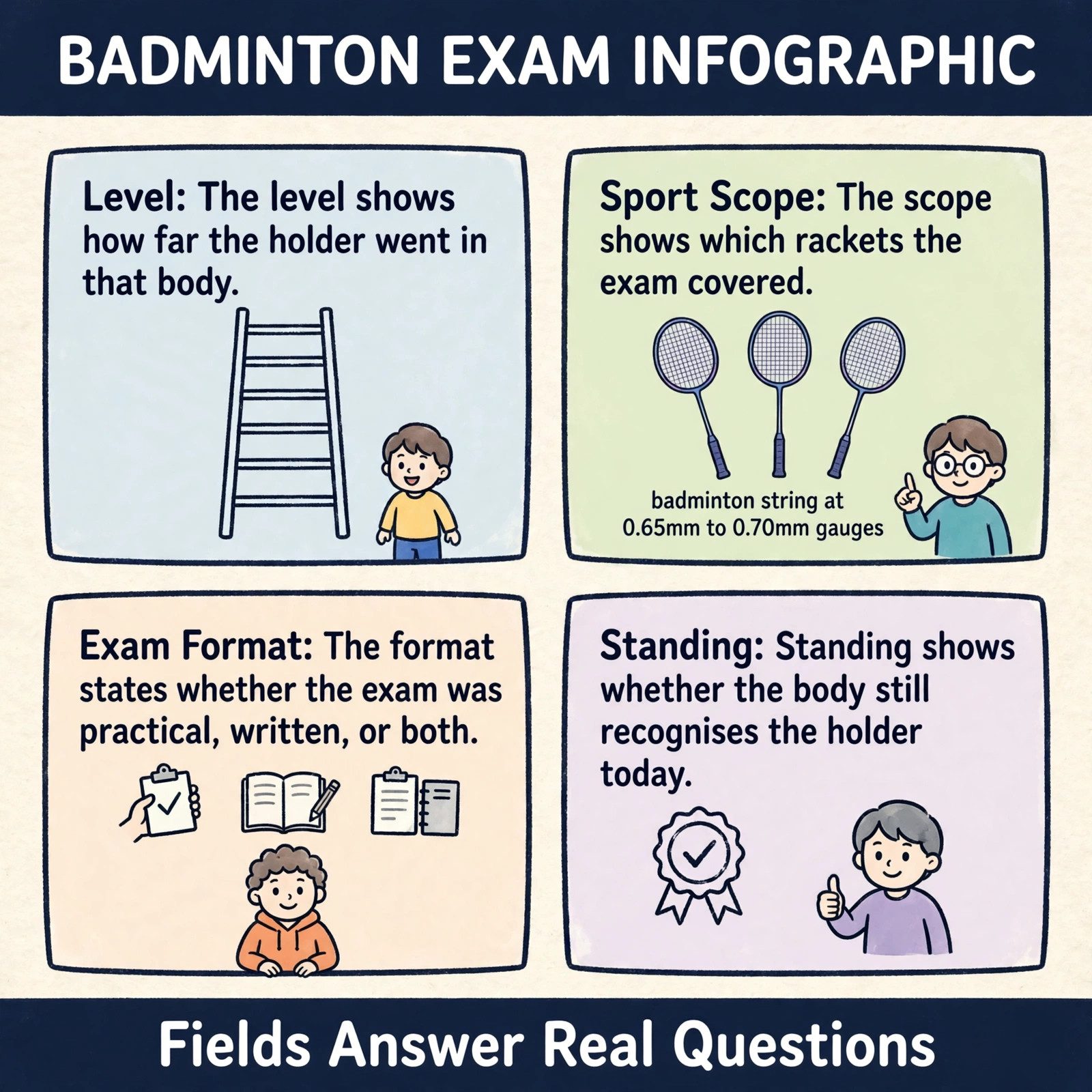
Each field on a listing answers a question a player or employer actually has. The credential name says what was earned. The level says how far the holder went, because a foundation pass and a top level title are different claims; USRSA, for example, lists separate credentials such as Certified Stringer, Master Racquet Technician and Professional Racquet Advisor. The sport scope says which rackets the exam covered, which matters in badminton, where string runs at 0.65mm to 0.70mm gauges on light frames. Standing says whether the body still recognises the holder now, not just on the day they passed.
Exam scope belongs in the listing too, in plain words. Was the assessment practical, written, or both? USRSA exams combine written and practical sections. A badminton specific exam tests badminton frames, tensions, knots and grommets directly. A directory that hides the exam format behind a badge forces players to guess what was tested, and guessing is what directories were built to remove.
Contact and location details help a listing work, but they are service information, not proof. Town, shop and a way to reach the stringer make the entry useful. They should never crowd out the proof fields. A listing with a full address and no credential level has its priorities backwards: it tells you where to go before it tells you why the person there can be trusted with your racket.

1.3 Working Method
How do good registries stay current over time?
A registry stays honest only if somebody maintains it. Names change, people move shops, memberships lapse and standings change. The bodies with mature systems build maintenance into the credential itself. USRSA keeps its Master Racquet Technician title current through an annual written update test, while Certified Stringer status itself has no expiry and its listing is tied to current membership, so the directory entry follows the member’s standing rather than freezing the pass day forever. That link between listing and standing is the feature that separates a registry from a scrapbook.
Candidates should understand which model they are joining before they enrol. Ask the body directly: does my listing continue while I remain a member in good standing, does an update test keep it current, or is it a permanent record of a past pass? All three models can be honest. What is not honest is a directory that never updates anything and quietly lists people the body would no longer confirm.
Players can help keep directories sharp by reporting what they find. If a listed stringer has left the shop named, changed the work they do, or cannot be recognised by the issuing body when asked, tell the body. Registries are maintained by corrections as much as by design, and a body that welcomes corrections is showing the same honesty a good directory entry should carry.

1.4 Practical Review
What does keeping a listing active commit each side to?
Listings carry costs and commitments on both sides, and honest planning names the categories without inventing figures. For the stringer: the training and exam route that earned the credential in the first place, any membership that keeps a listing active, update tests where the body requires them, and the time spent keeping details current when a shop, town or role changes. For the body: checking entries against its own records, removing or marking lapsed holders, and answering verification questions from players and employers. A directory that costs nobody anything to maintain usually is not maintained.
Check the details. This guide puts no figures on those categories, on purpose. Fees and membership terms differ by body and by year, and a page quoting tidy totals without naming the body is guessing. Ask each body what keeps a listing active, in writing, before you rely on being listed as part of your reason to certify. The answer also tells you how seriously that body takes its own registry.
Review the process. There is a commitment for players too, and it is small: use the directory before you hand over the racket, not after something goes wrong. Read the level and scope, check the standing, and note the details. Two minutes of reading is the cheapest quality control in stringing, and it rewards the stringers who keep their records clean while exposing the ones trading on old paper.
Plan the next step. A missing listing deserves a fair reading, covered fully in the comparison section below. It can mean the stringer never certified, let it lapse, certified under a different body whose registry you are not searching, or that the registry itself is incomplete. Absence is a question to ask, not a verdict to announce. The stringer who answers it plainly, with a body you can contact, has told you more than a polished listing ever could.

1.5 Key Checks
How do you score a directory and read a missing listing?
Record the context.
Compare directories the way you compare bodies: same criteria, written down. First, fields: does each entry show name, credential, body, level, sport scope and standing? Second, currency: is the listing tied to current standing, membership or update tests? Third, checking: does the body verify entries against its own exam records before publishing them? Fourth, corrections: can players report errors, and does the body act on them? A directory that scores well on all four can be trusted as a working tool. One that scores well only on design is a brochure.
Check the details.
The established bodies show the range of models. USRSA publishes its credential holders with the membership link described earlier, and its MRT holders carry the annual update obligation. GRSA and ERSA serve international and European memberships across racket sports, and CRSF works within China’s federation scene, where badminton carries real weight. Each registry reflects its body’s structure. None of them can list a stringer from another body, which is why checking the right registry matters.
Review the process.
That last point explains most missing listings. Registries are per body, not global. A BSW graduate will not appear in a USRSA list, and a USRSA Certified Stringer will not appear in BSW records. Before reading anything into an absence, confirm you are searching the registry of the body named on the certificate. Searching the wrong list and announcing fraud is the directory version of a bad restring: quick, confident and wrong.

1.6 Service Record
How does the BSW record measure up as a listing?
Judge the BSW record by the same four criteria. Fields: BSW records its graduates with the credential and level earned and the badminton specific scope of the exam. Currency and checking: results are assessed and approved by the BSW certification board, and the organisation’s own records are the source an employer can ask it to confirm. Corrections: because the record sits with the organisation itself, a player or shop can put a question to BSW directly and get an answer from the body that ran the exam. BSW runs its course in Kuala Lumpur only and claims no government licence.
Check the details. The training behind each BSW listing is fixed and public. Classes run from 10am to 5pm, the course takes 3 and a half days with flexible timing on dates, and the practical exam on real badminton rackets sits on the last day. Founder Eric Chuar teaches from his Kuala Lumpur base, while the certification decision belongs to the board as an organisation. A listing that traces back to that route tells a shop exactly what was tested, which is what a directory entry is for.
Review the process. Where BSW is smaller, say so plainly. The older general bodies have bigger member lists and wider recognition outside badminton, especially in tennis regions. Their registries are larger because their memberships are larger. For a badminton player or shop, the useful question is not which registry is biggest. It is whether the entry in front of you shows a badminton exam, a level and a standing you can confirm with the body that issued it.
Plan the next step. One more honesty point applies to every body, BSW included. A listing confirms a credential; it does not rate the stringer’s daily work, prices or manner at the counter. Directories that start adding stars and rankings without evidence are drifting from registry into advertising. Keep the listing in its lane: proof of a tested credential, current standing, and a body that will answer for both.

1.7 Guided Practice
How should you use a directory before choosing or enrolling?
Use directories actively, whether you are a player choosing a stringer or a candidate choosing a body. Players: find the entry, read level, scope and standing, and if anything is missing, ask the stringer which body certified them and check with that body. Candidates: before enrolling anywhere, ask how the body lists its holders, which fields the listing shows, what keeps it current, and how an employer verifies you. State your sport, experience, machine and goal in your enquiry, and keep the written answers with the comparison notes from this guide.
Timing and route questions belong in the same enquiry. At BSW, training is in Kuala Lumpur only, classes run from 10am to 5pm, the course takes 3 and a half days with the practical exam on the last day, and timing is flexible for learners travelling in. Ask any other body to state its own shape just as plainly, including what happens to your listing if your standing or membership later lapses.
Finally, treat your own future listing as part of your preparation. Practise on real rackets, keep records of strings, tensions, knots and grommet work, and learn to describe your credential exactly as your body lists it: name, level, scope, standing. The stringers who present their proof cleanly are the ones players find, check and trust, and that quiet advantage compounds for a whole career.
Certified Stringer Directories Quick FAQ
Short answers on what certified stringer directories should show, how listings stay current, and what a missing listing really means.
What should a directory listing show?
A proper certified stringer listing shows the stringer’s name, the credential and issuing body, the level held, the sport scope the exam covered and the holder’s current standing. A name alone, with no body, level or standing behind it, proves nothing.
Why do level and scope matter?
Listing fields map to real questions: credential and level say what was earned and how far, sport scope says which rackets the exam covered, exam format says how it was tested, and standing says whether the body still recognises the holder today.
How do registries stay current?
Good registries are maintained: listings follow current standing, membership or update tests, rather than freezing pass day forever. USRSA keeps MRT current with an annual written update test, and CS listing is tied to current membership.
What does a listing commit you to?
Listings carry costs and commitments on both sides, and honest planning names the categories without inventing figures. For the stringer: the training and exam route that earned the credential in the first place, any membership that keeps a listing active, update tests where the body requires them, and the time spent keeping details current when a shop, town or role changes. For the body: checking entries against its own records, removing or marking lapsed holders, and answering verification questions from players and employers. A directory that costs nobody anything to maintain usually is not maintained.
How do you score a directory?
Score a directory on field completeness, the link between listing and current standing, how entries are checked against the body’s records, and how corrections are handled. A missing listing is a question to ask the stringer and the body, not proof of anything by itself.
How does the BSW record measure up?
BSW records graduates with credential, level and badminton specific scope, from results assessed and approved by the BSW certification board, and employers can ask the organisation to confirm an entry. Training is in Kuala Lumpur only, 3 and a half days, classes from 10am to 5pm, exam on the last day.
How should you use a directory?
Use directories actively, whether you are a player choosing a stringer or a candidate choosing a body. Players: find the entry, read level, scope and standing, and if anything is missing, ask the stringer which body certified them and check with that body. Candidates: before enrolling anywhere, ask how the body lists its holders, which fields the listing shows, what keeps it current, and how an employer verifies you. State your sport, experience, machine and goal in your enquiry, and keep the written answers with the comparison notes from this guide.
What should you keep from your checking route?
Keep your own copy of your listing details: the body, credential, level, scope and standing exactly as recorded, plus your pass confirmation and job records. If a listing ever shows you wrongly, your own records are how you get it corrected quickly.
How can I start with BSW?
Start with an enquiry that states your sport, experience, machine and goal, and ask how BSW records and confirms its graduates. BSW trains in Kuala Lumpur only, flexible timing, classes from 10am to 5pm over 3 and a half days, practical exam on the last day, results assessed and approved by the BSW certification board.
Certified Stringer Directories: Explore the Practical Decisions
Build a Clear Working Method
The method is simple: check fields, currency, record checking and corrections for every directory, write the scores down, and always search the registry of the body named on the certificate.
| Directory Check | Rushed Approach | Planned Approach |
|---|---|---|
| Fields | List a name and town and call it a registry | Show credential, body, level, scope and standing per entry |
| Scope | Hide the exam format behind a badge or logo | State level, sport scope and exam format in plain words |
| Standing | Freeze the pass day and never update the list | Tie the listing to current standing, membership or updates |
| Scorecard | Trust the directory with the nicest design | Score fields, currency, checking and corrections in writing |
| Your listing | Browse listings by design and search ranking | Write each directory’s fields and currency rules down |
| Next action | Assume a listing stays accurate forever | Keep your own listing details and correct errors fast |
Get Listed on Real Proof with Best Stringer Worldwide
Earn a credential that can be listed and confirmed, not just framed. Train on real rackets in Kuala Lumpur with Best Stringer Worldwide, with classes from 10am to 5pm over 3 and a half days, flexible timing, and the practical exam on the last day. Your work is assessed and approved by the BSW certification board. Send an enquiry stating your experience, your machine and your goal, and ask how employers confirm a BSW graduate before you commit.

