1.1 Frame Shape Fundamentals
What Are the Fundamentals of Racquet Frame Shapes?
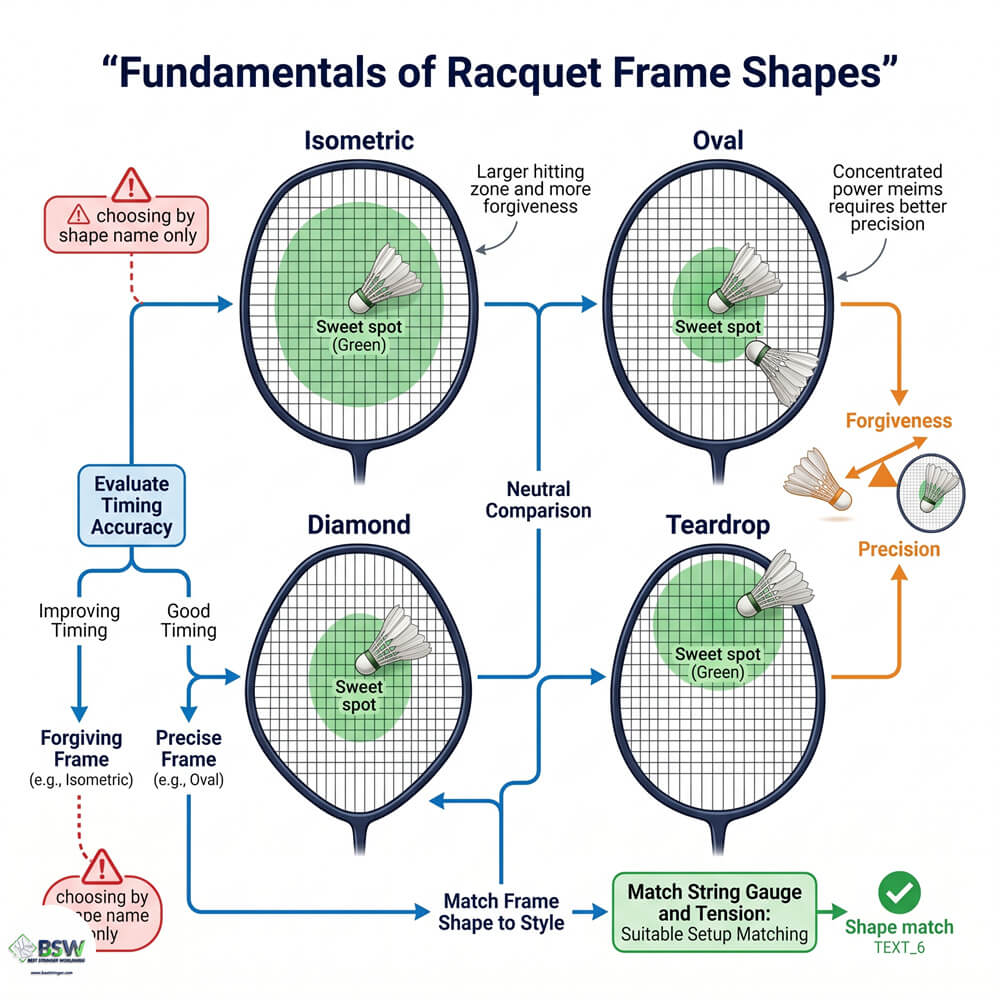
Frame shape changes string-bed geometry and where the most responsive hitting area is concentrated. This guide compares isometric and oval head profiles without treating either as universally best. For other design factors, compare box, wing, hybrid and ultra-thin frame cross-sections and review how materials, rigidity and string-bed density affect setup decisions.
Choose a racquet by comparing the specific model’s head profile, weight, balance, condition and approved stringing range. String type, gauge and tension should follow the racquet and string manufacturer instructions, then be adjusted to the player’s tested preferences.
1.2 The Role of Sweet Spot Size
Frame Shapes Explained: Forgiveness and Precision
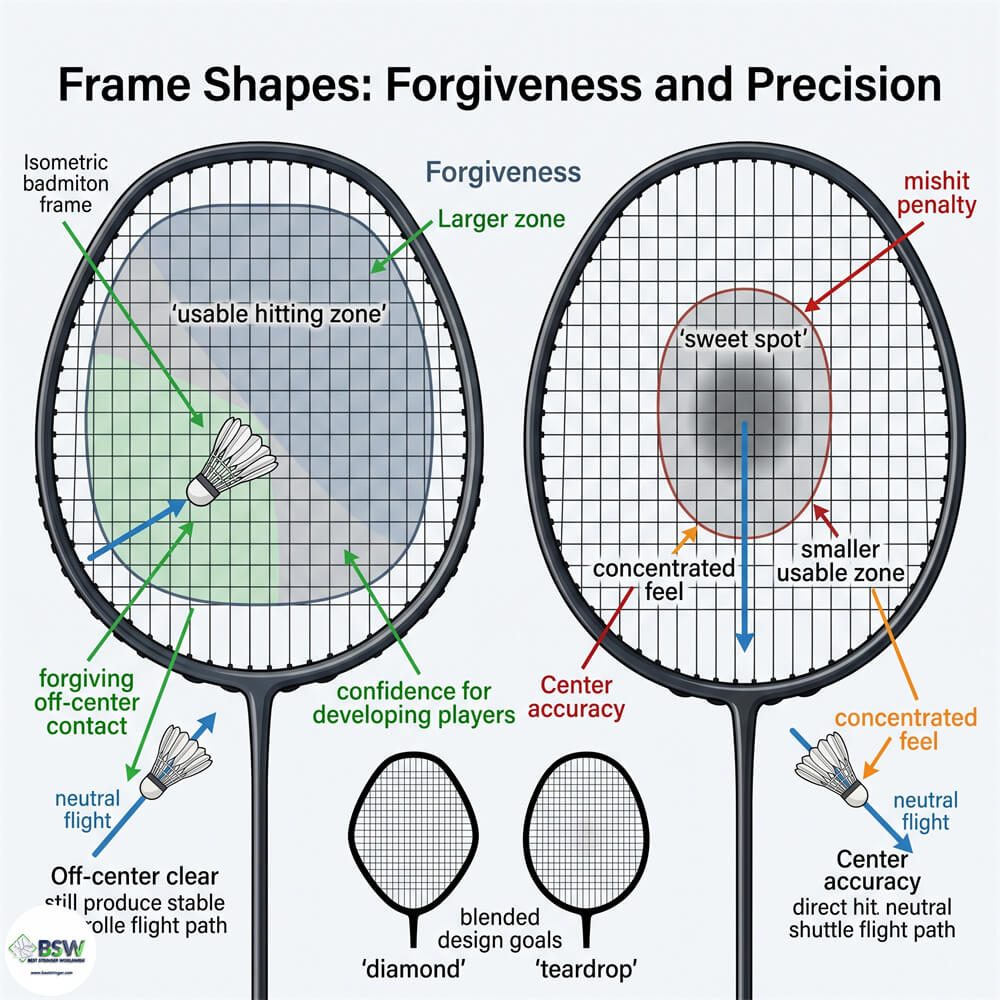
Head profile affects string-bed geometry and where the most responsive hitting area is concentrated. Isometric heads generally extend the upper cross strings and can provide a broader usable hitting area, while oval heads concentrate the pattern more narrowly and may feel more focused. The actual response also depends on the racquet model, string, tension, frame condition and impact location.
Diamond and teardrop profiles use different outlines and should be judged by the specific model rather than assumed to produce a universal speed, power or control result.
Many beginners value the additional tolerance of an isometric profile, but no shape is universally best. Compare feel, consistency and handling for the individual player while staying within the manufacturer’s approved setup.
1.3 Oval & Isometric Profiles
Understanding Oval and Isometric Designs
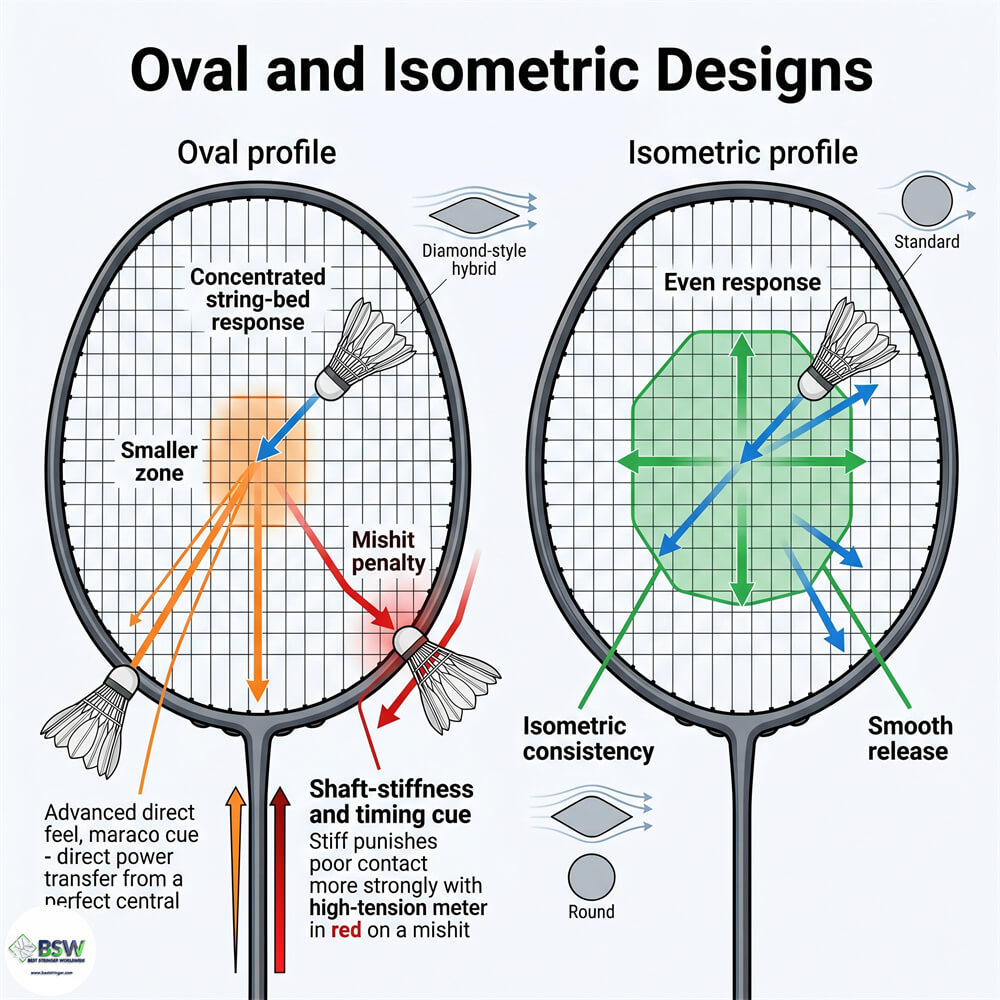
While the frame shape dictates the hitting zone, the player’s timing and the shaft stiffness must match it. An oval frame provides a concentrated, solid impact response, but only if the player has advanced accuracy to hit the smaller sweet spot consistently. If you lack solid technique, pairing an oval frame with a stiff shaft will severely punish mishits and weaken your clears.
An isometric head shape is highly forgiving. It creates a more consistent string bed, storing and releasing energy smoothly to help players effortlessly return the shuttle, even if their swing action is slightly off-center or less refined.
Understanding these shape profiles also helps you make sense of hybrid designs. For example, some diamond shapes emphasize an aerodynamic cut through the air to increase swing speed, though they might sacrifice a fraction of the pure isometric sweet spot to achieve that agility.
1.4 String Setup by Shape
Badminton String Setup for Specific Frame Shapes
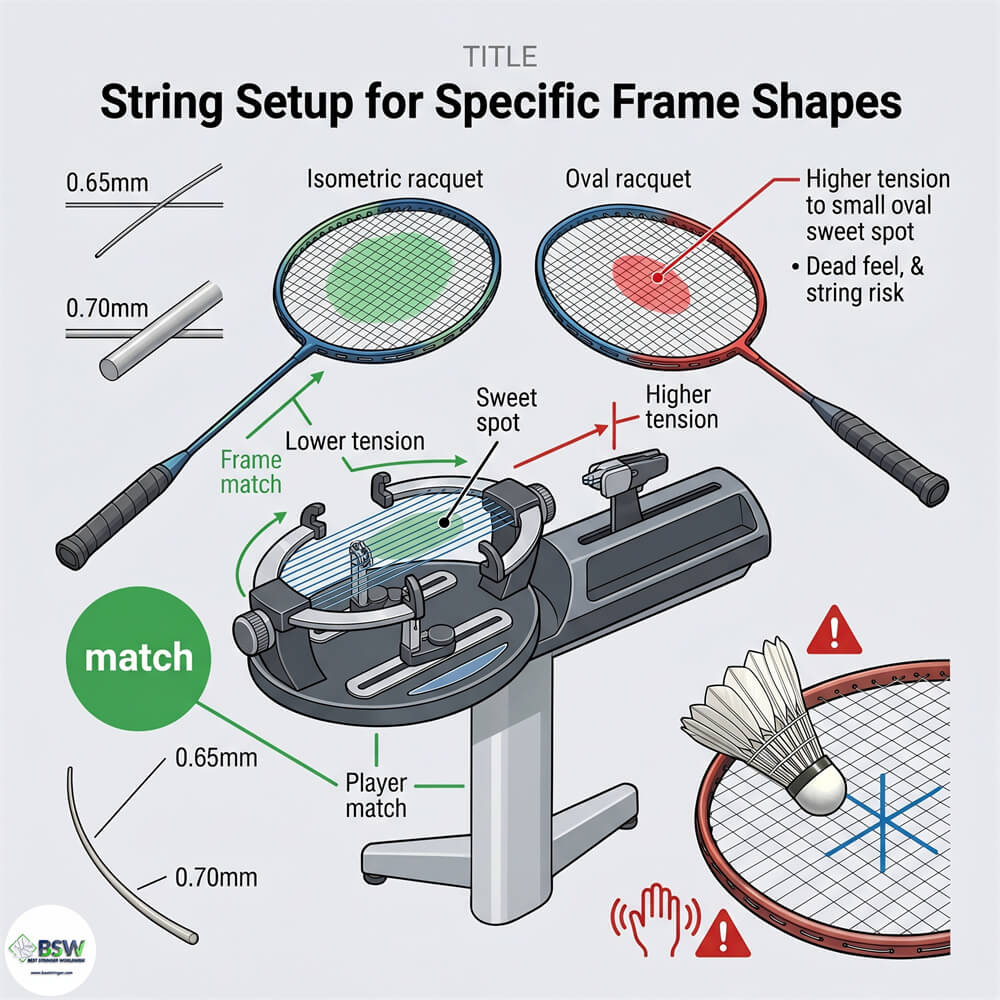
Different frame shapes require thoughtful string tension choices to perform optimally. Understanding this synergy is essential for all levels:
What is String Gauge? Gauge refers to the thickness of the string. Thin strings (e.g., 0.65mm) offer incredible repulsion and aerodynamic sound, which can enliven a smaller oval sweet spot, while thick strings (e.g., 0.70mm) sacrifice a bit of crispness for robust durability on large isometric frames.
Tension Basics. Raising tension generally produces a firmer string-bed feel and can reduce the margin for off-center contact; lowering tension generally produces a softer response. The result varies by racquet, pattern, string type and gauge, machine and player. Do not use one threshold such as 26 lbs for every racquet: follow the printed manufacturer range.
Off-Center Contact. Off-center impact at an unsuitable setup can feel harsh and may increase stress on the string and frame, but it does not automatically cause breakage. Inspect the frame and grommets, confirm the exact pattern and tension range, and adjust only within those limits.
1.5 Common Shape Mistakes
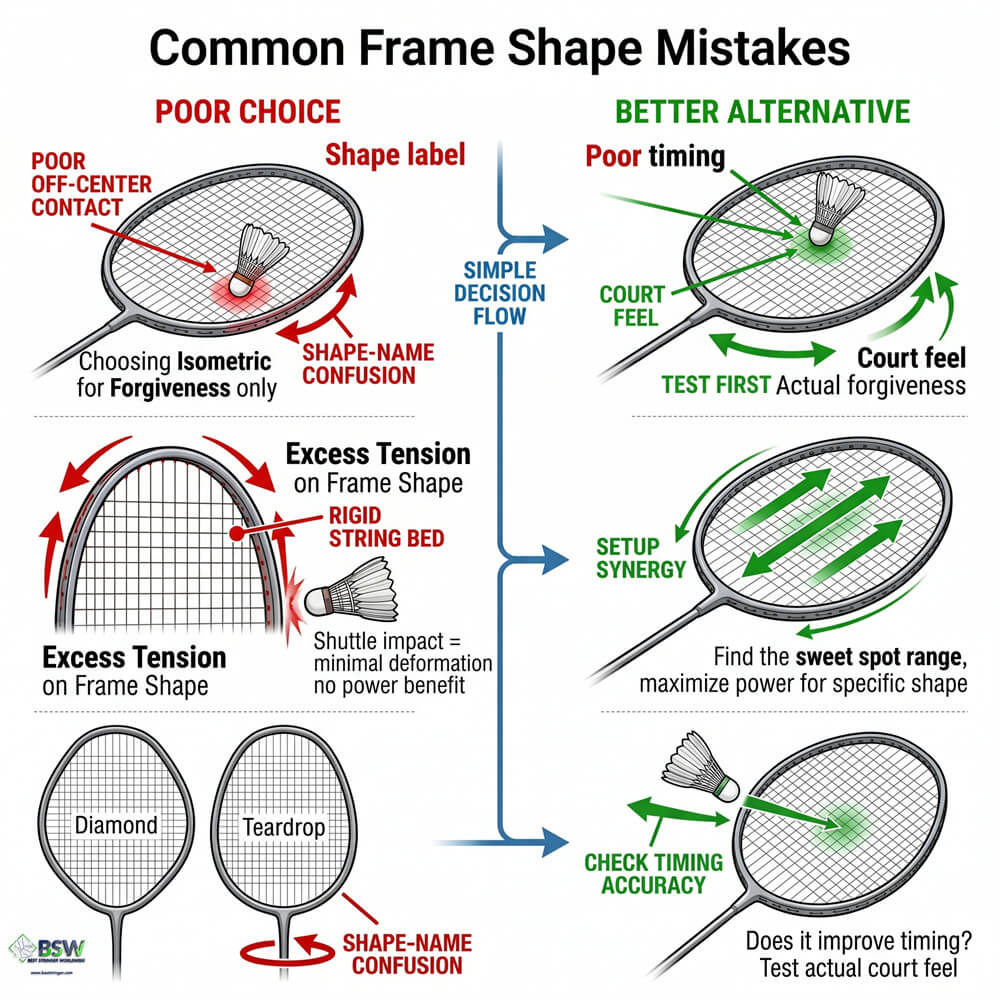
Common Frame Shape Mistakes
Mistake 1: Assuming Isometric is Always Better.
While an isometric shape is highly forgiving and widely recommended, choosing a shape based purely on sweet spot size ignores the fact that some advanced players prefer the distinct aerodynamic speed of a diamond frame or the concentrated control of an oval frame.
Mistake 2: Ignoring Setup Synergy.
A broader head profile does not make every tension suitable. Tension response varies by frame, pattern, string, machine and player, so stay within the printed racquet and string limits and evaluate the finished string bed.
Mistake 3: Choosing Based on Marketing Alone.
Relying solely on marketing labels like ‘pure power teardrop’ or ‘fast diamond’ is a common error. The real-world feel depends heavily on how the frame shape interacts with the balance point, shaft stiffness, and stringing.
1.6 Shape Selection Framework
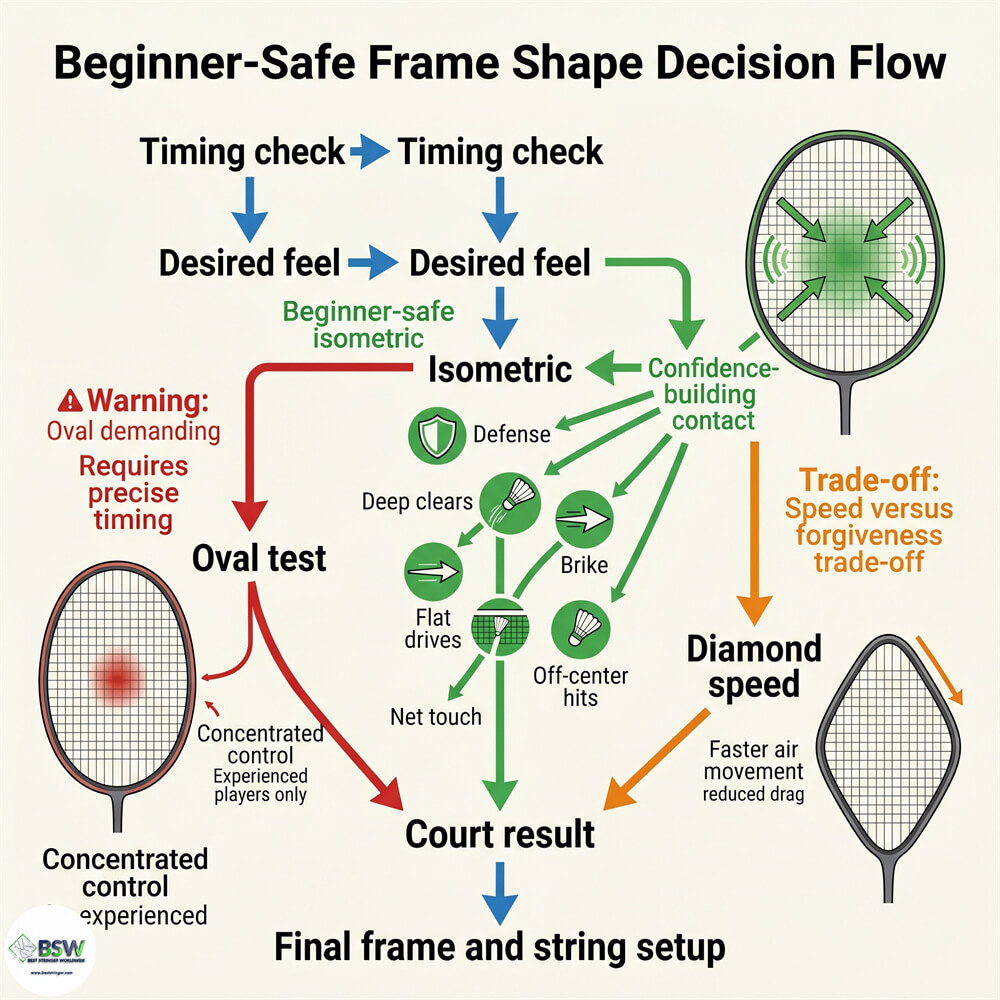
Beginner-Safe Frame Shape Decision Flow
A step-by-step decision flow is crucial for balancing forgiveness and precision safely. Use this simple framework before upgrading your equipment:
Step 1: Check Your Accuracy. An isometric profile is a common starting point because its geometry can offer more tolerance on off-center contact. It is an option, not a universal requirement; compare the specific model, weight, balance and approved stringing range.
Step 2: Identify Your Desired Feel. Determine if you want the sharper aerodynamic swing of a diamond frame for fast flat exchanges, or the reliable, forgiving nature of a classic isometric shape for solid defense and deep clears.
Step 3: Test for Actual Improvement. Try different frame shapes and test whether an oval’s concentrated feel genuinely improves your control, or if an isometric shape is simply necessary for your confidence on the court.
1.7 Professional Education
The Value of Stringer Certification
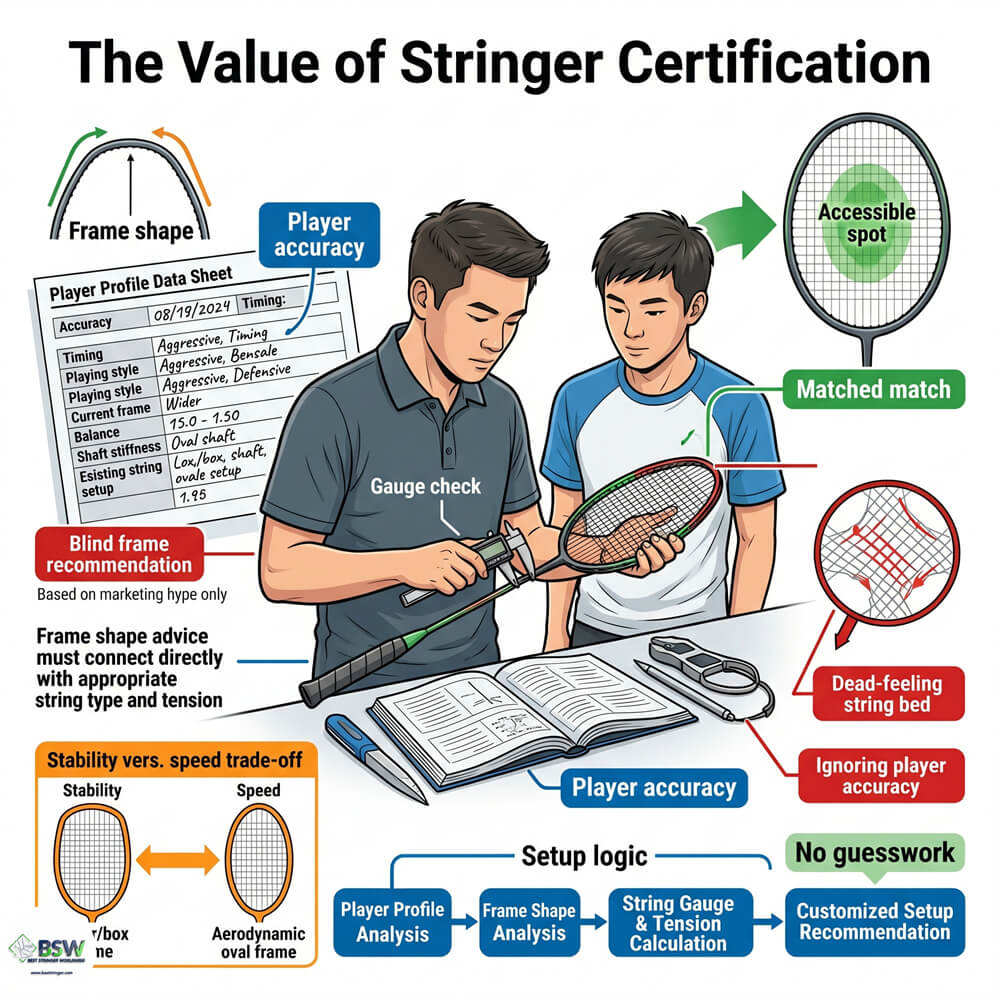
Proper equipment education is a core part of a professional badminton stringing course and good stringer certification standards. A certified stringer understands that recommending a specific frame shape blindly without considering a player’s real accuracy is a disservice.
At Best Stringer Worldwide, we know that frame shape directly influences the advice given to players. The magic is not just in buying an isometric or diamond racquet, but in the precise consultation logic a badminton stringer uses to match string type and tension to your new frame’s geometry.
BSW stringer certification teaches a repeatable process for inspecting the frame, confirming the pattern, documenting string and tension choices, and discussing player goals. It helps stringers explain trade-offs and make defensible recommendations; it cannot guarantee a perfect balance or eliminate practical testing.
Frame Shape Selection Quick FAQ
Quick, definition-first answers to common questions about badminton frame shapes and sweet spot basics.
Does an isometric shape always mean more power?
Generally, yes. An isometric badminton racquet provides a larger sweet spot, which helps players maintain power on off-center hits. However, absolute peak power also depends heavily on technique, swing speed, and racquet balance.
Why does an oval racquet feel more concentrated?
The traditional oval shape creates a smaller, denser string bed area. This concentrates the energy return, giving advanced players a very direct, crisp, and precise feel when hitting the exact center of the racquet.
Is a diamond frame better for all players?
Not every badminton player will benefit equally. While diamond frames often feel faster and more aerodynamic through the air, they may slightly reduce the absolute size of the sweet spot compared to a purely isometric design.
How does frame shape affect smash power?
Frame shape influences how forgiving the string bed is during a heavy impact. An isometric shape allows a player to execute a powerful smash even if they catch the shuttle slightly off-center, whereas an oval requires precise, dead-center timing.
Why do some players prefer teardrop shapes?
Teardrop shapes attempt to combine a longer string bed for repulsion with a solid, traditional feel. They are chosen by players looking for a specific blend of power and aerodynamics, though they are much less common today.
How does string tension affect different shapes?
A highly tensioned oval frame can feel completely dead to a developing player. A certified stringer will carefully adjust tension based on the frame’s specific shape and the player’s accuracy to ensure the sweet spot remains accessible.
What should a stringer consider before changes?
A professional badminton stringer should always evaluate the player’s accuracy and playing style. They should never just recommend an isometric frame or a diamond frame without considering the overall balance and stiffness of the entire racquet.
Why is stringer certification important?
A comprehensive badminton stringing course teaches the science behind frame shapes, sweet spots, and string synergy. A certified stringer provides educated guidance rather than relying on absolute claims or brand hype.
Are stringing courses necessary?
For those wanting to master equipment consultation, yes. A stringer learns measurement consistency, precise knot tying, and the logic to match string setups to specific frame shapes, eliminating guesswork from equipment selection.
The Physics of Forgiveness: Why Frame Shape Matters
Physics of Forgiveness Simulator
Select a frame shape, tap the stringbed to choose your impact point, and click simulate to see how sweet spot size affects power and vibration.
Isometric Profile: Broader Usable Area
An isometric (squarish) frame creates longer cross strings at the top of the racquet head. This dramatically expands the sweet spot area. When you hit off-center, the strings still have enough elasticity to return the shuttle reliably without twisting the frame violently in your hand.
Illustrative comparison: the bars show relative concepts for this learning tool, not measured percentages or universal performance scores. Actual results vary by racquet, string, tension, condition and player.
\nEvidence-Aware Shape & Setup Matching
Our stringing approach starts with the exact racquet and string manufacturer instructions, frame and grommet inspection, and the player’s goals. We treat tension advice as model-specific and do not imply that one setup is used or endorsed by every top professional.
| Frame Shape Spec | Traditional (Oval) | Modern (Isometric) |
|---|---|---|
| Sweet Spot Size | Smaller, concentrated area requiring high precision. | Larger, expanding the usable hitting area significantly. |
| Forgiveness | Punishes off-center hits with a noticeable loss of power. | Highly forgiving, maintaining shuttle speed on mishits. |
| Control Feel | Direct, crisp touch for advanced net placement. | Stable and reliable across a much wider string bed. |
| Aerodynamics (Diamond) | Traditional box/oval frames are solid but have slightly more drag. | Diamond/Aero shapes cut through the air for faster swing speeds. |
| Beginner Suitability | Demanding; much better suited for established technique. | Excellent starting point to quickly build confidence. |
| Stringing Approach | Demands careful tension scaling to avoid a completely dead feel. | Versatile, handling a wider range of tensions and gauges safely. |
Master Your Equipment with Best Stringer Worldwide
Ready to upgrade your knowledge? Best Stringer Worldwide offers professional stringing consultation to teach you how frame shapes and string setups interact to provide power and control safely. We serve badminton players worldwide especially in Singapore, Hong Kong, Malaysia, Indonesia, UK, France and Europe. Contact a certified stringer to find the perfect tension and gauge for your specific frame geometry.