






1.1 Starting Point
Why do parents ask who strung the racket and what proof matters?
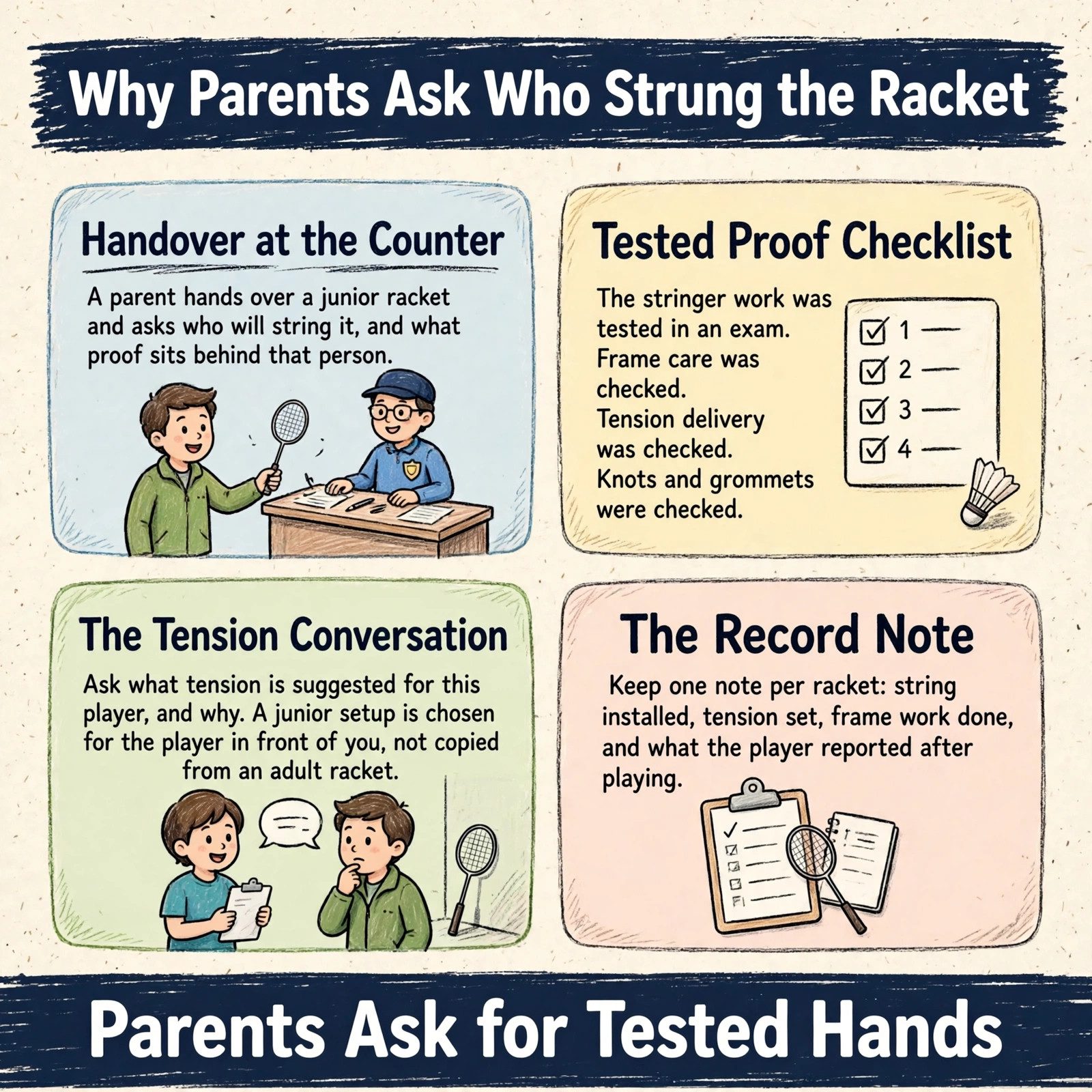
Parents ask who strung the racket because a junior racket is not a small adult racket, and the person behind the machine decides the tension, the string and the care a growing player plays with. A certified stringer for junior players is a stringer whose work has been tested by a certifying body: mounting, delivered tension, knot work, grommet care and frame handling checked on real rackets. Best Stringer Worldwide, founded by Eric Chuar and based in Kuala Lumpur, Malaysia, runs the badminton specific route, with results assessed and approved by the BSW certification board.
The parent question is really a care question. A young player cannot judge a string bed the way an experienced adult can. They feel that shots fly oddly or an arm tires, but they cannot name a tension that was set wrong or a grommet that was forced. The parent stands in for that judgement, and asking who strung the racket, and what proof sits behind that person, is the parent doing the job properly.
Certification is not a promise that every restring will suit every child. It proves the stringer passed a tested exam on exam day and that a body recorded the result. Parents should still ask about tension choices and keep records as their child grows. What certification removes is the guess about whether the hands on the machine were ever checked by anyone at all.
1.2 Preparation
What does a certification exam test that matters for junior rackets?
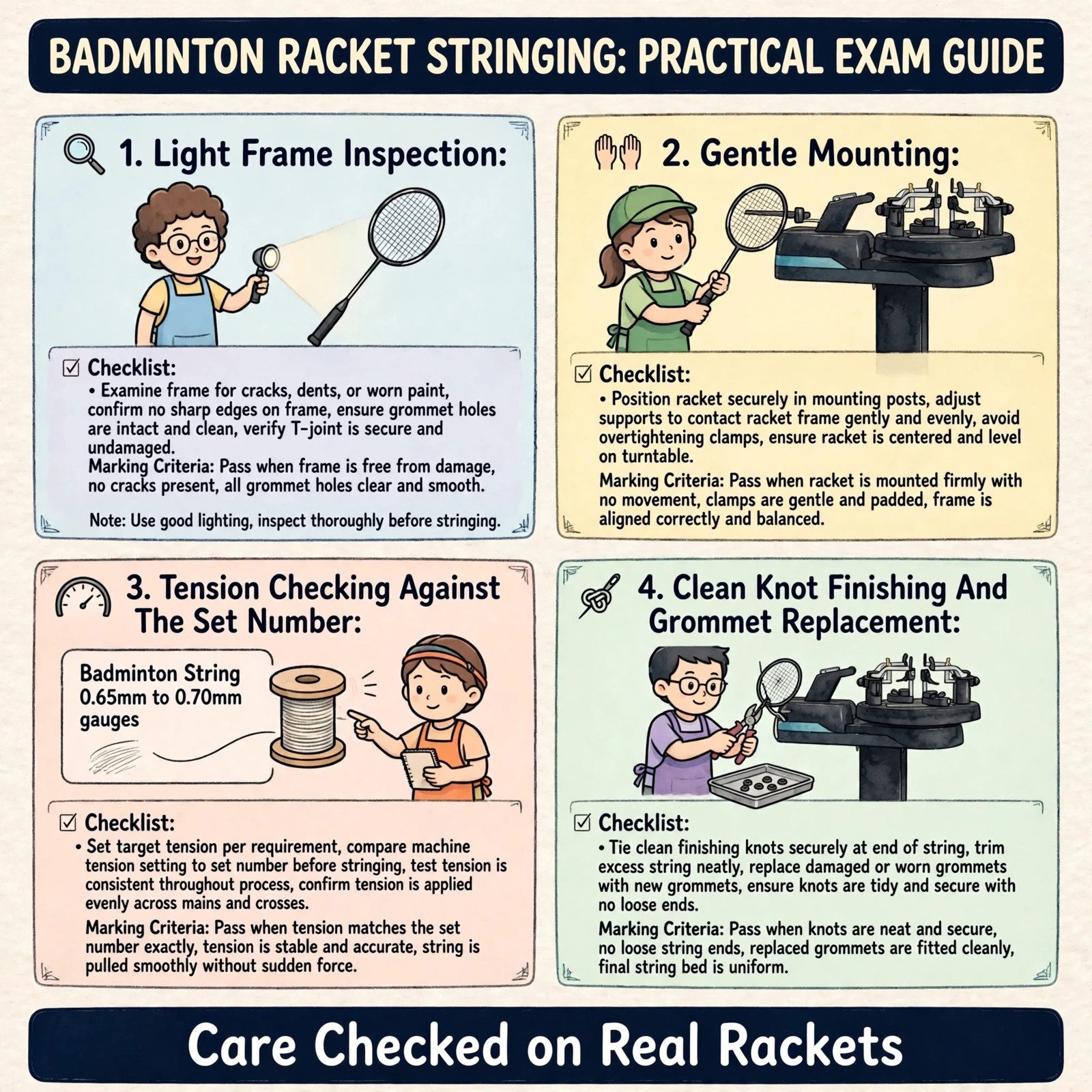
The parts of a certification exam that matter most for junior rackets are the careful parts. Frame inspection comes first, because junior frames take knocks and arrive with worn grommets and hidden damage. Mounting must hold a light frame firmly without distortion. Delivered tension is marked against the set number, which matters when a junior setup is chosen for a developing player rather than copied from an adult. Knots are checked for clean finishing that holds tension evenly, and grommet care runs throughout, with damaged grommets replaced instead of dragged through.
Badminton string is thin, at 0.65mm to 0.70mm gauges, and small setting errors change how a bed plays. A stringer used to junior work talks about the player in front of them: how often they play, how their game is developing, what they used last time and what felt wrong. This page states no age numbers as rules, because growing players differ and honest advice starts from the individual player, not a chart.
The exam cannot test patience with a worried parent or judgement built over seasons of watching a child grow into the game. It tests the stringing standard itself. Parents should read certification as the floor: proof the basics were tested. The conversation about their own child tension, string and timing is the part built on top of that floor, restring by restring.
1.3 Working Method
How does training with feedback shape care for young players?
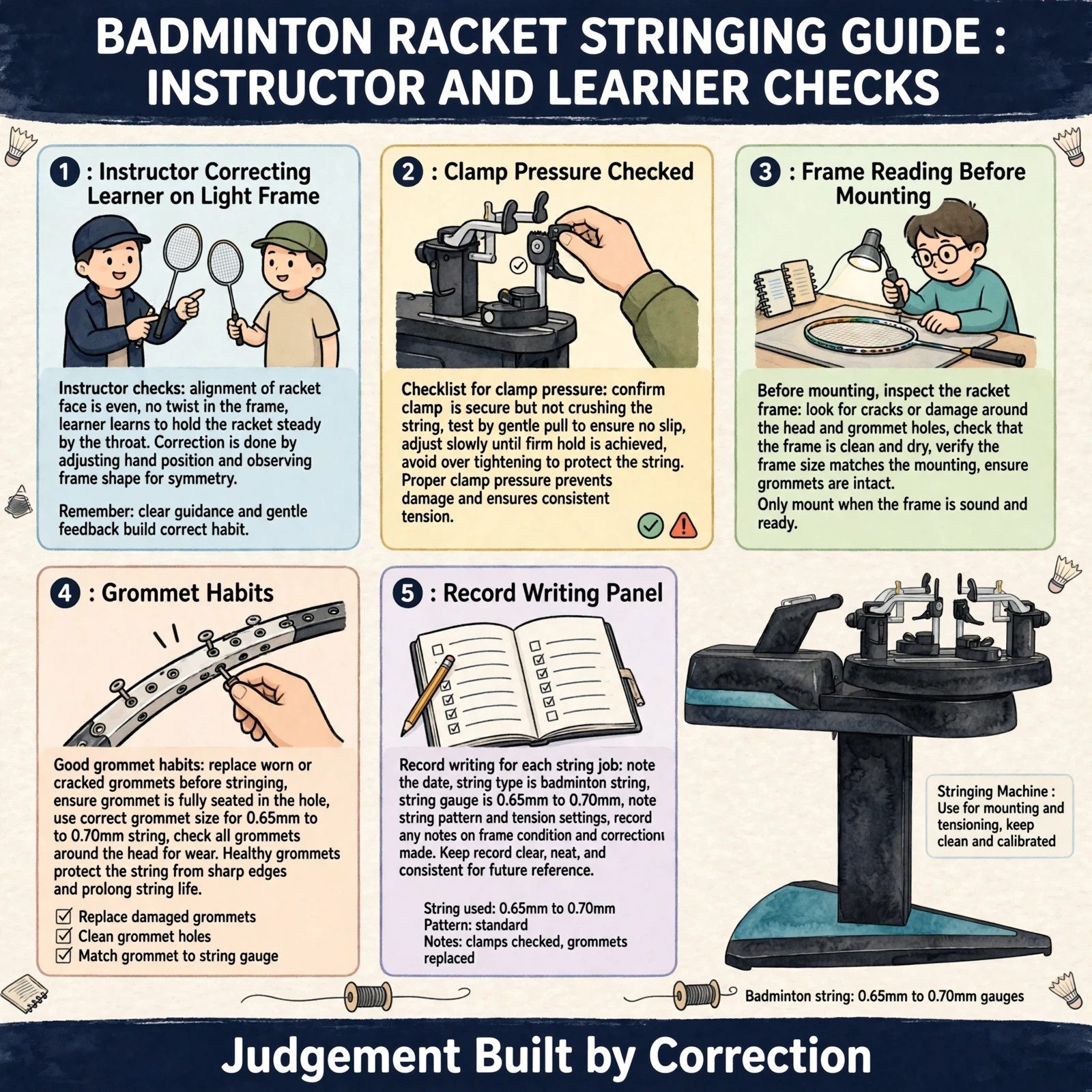
Stringers learn junior care the way they learn everything else in this trade: by correction while they work. Training with an instructor fixes clamp pressure before it marks thin string, checks weaving on light frames, and builds the habit of inspecting a racket properly before mounting it. A learner who only watches videos can copy the sequence and still miss how a junior frame should be read. Feedback turns stringing steps into judgement, and judgement is what a parent is really buying when they hand over a child racket.
Good training also teaches the record habit that junior work depends on. Note the string, the tension set, the old setup and any frame wear before cutting, then record what was installed and what the player or parent reported. A growing player changes fast. That written trail lets the next restring adjust from evidence instead of starting the same guessing conversation again.
Parents can borrow the training question when choosing a stringer: who checked your work while you learned, and against what standard? A stringer trained under observation can usually answer plainly. A stringer who has never had their work corrected may be experienced, but nobody has ever tested the habits that experience built. For a child racket, that difference is worth asking about.
1.4 Practical Review
What does a junior restring really commit a parent to?
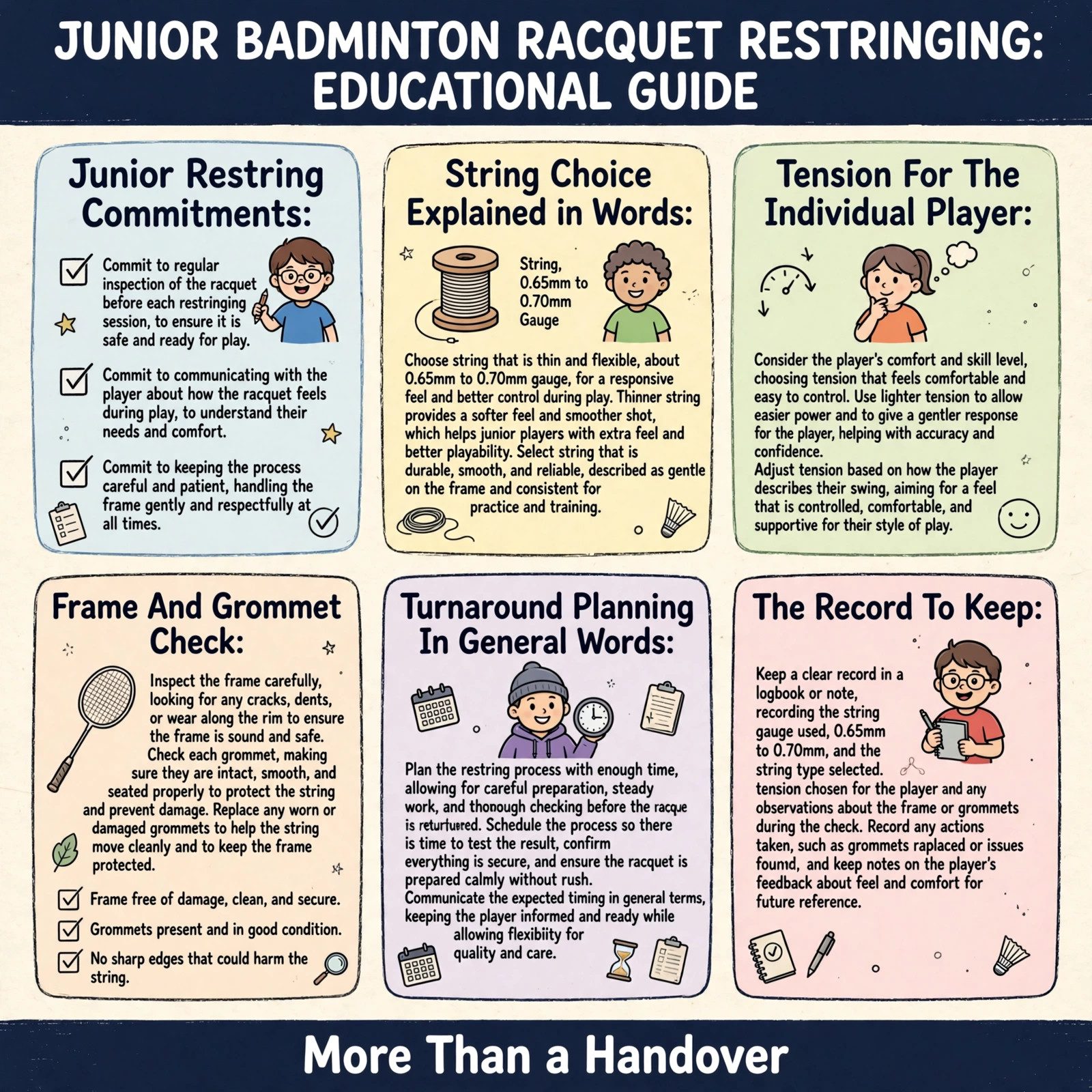
A junior restring commits a parent to more than a handover at the counter. It commits to a string choice suited to the player, a tension set for that player rather than copied from an adult setup, and a turnaround that fits training and match days. It commits to keeping the record of what was installed, because the next decision depends on it. And where certification is involved, the wider costs sit behind the stringer: training and exam costs, machine and tools, practice materials and time, which is why tested stringers are not the same offer as untested ones. This page invents no fees for any of it.
Check the details. Parents should ask for the restring choices in plain words before agreeing: which string, what tension, and why for this player. If the answer is only a brand name or a habit, ask again. Strings families parents may hear named include Yonex BG65 and BG66 Ultimax, but the right choice is the one explained for their child, not the one on a poster.
Review the process. There is also a time commitment in doing junior stringing properly. A frame check, an honest tension conversation and a proper record take a little longer than a rushed handover. That time is the service. A counter that will not spend it before stringing is unlikely to spend care during stringing, whatever its sign says.
Plan the next step. The false saving for parents is the cheapest or fastest restring with no questions asked. It saves minutes once, then costs a puzzled player, a bed that feels wrong and no record to learn from. Paying attention once, choosing a tested stringer and keeping the record, costs less across a season of junior badminton than repeating guesses racket after racket.
1.5 Key Checks
How should parents compare stringers and bodies fairly?
Record the context.
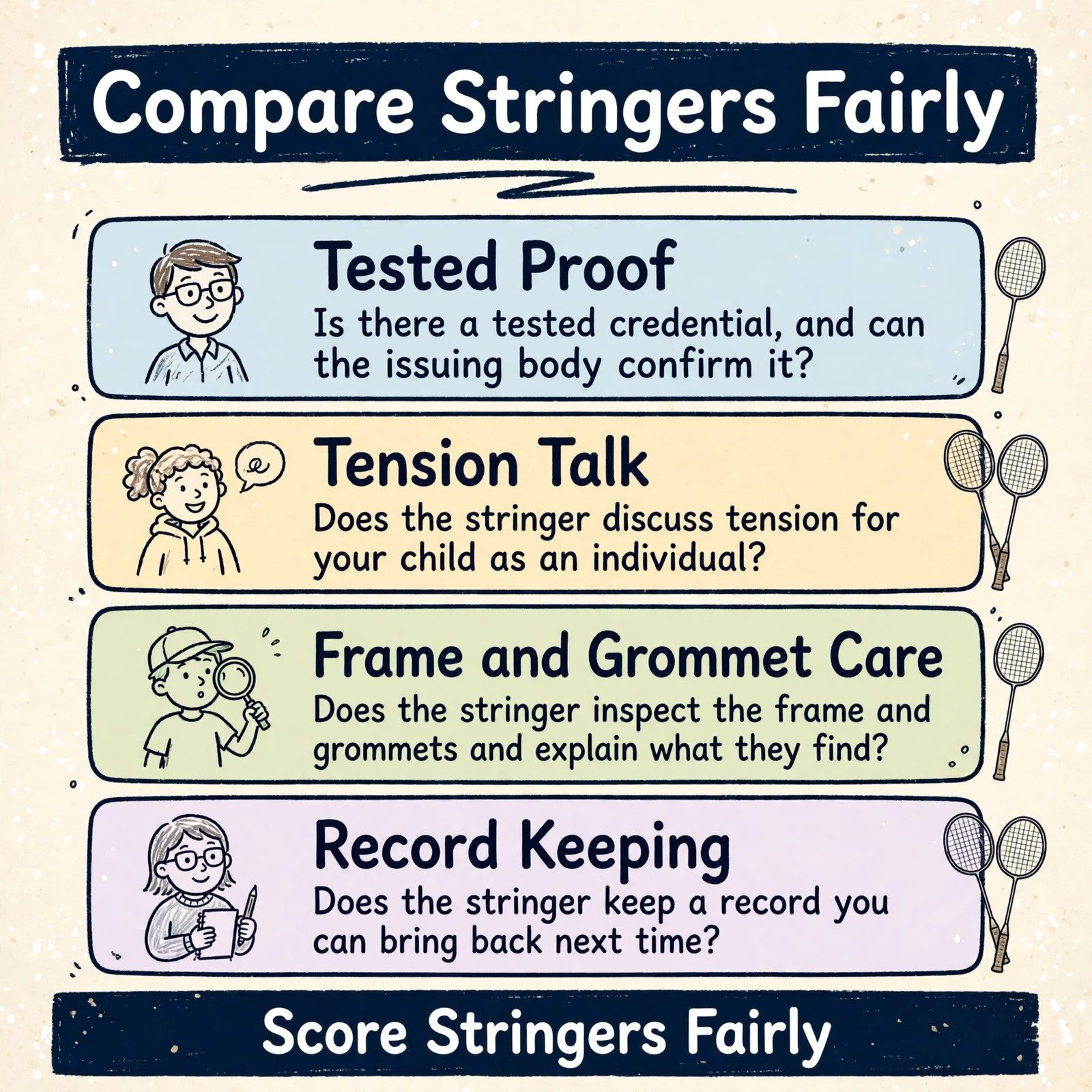
Parents can compare stringers and bodies with the same steady method. For the stringer: is there a tested credential, and can the issuing body confirm it? Do they talk tension for your child as an individual, or quote one setup for everyone? Do they inspect the frame and grommets in front of you and explain what they find? Do they keep a record you can return to? For the body behind the credential: is its scope badminton specific, is its exam practical on real rackets, and can a parent verify a pass? Written answers beat counter confidence.
Check the details.
The wider body picture helps parents read claims. USRSA, the United States Racquet Stringers Association, certifies across racket sports with tennis at the centre, through Certified Stringer, Master Racquet Technician and Professional Racquet Advisor credentials with written and practical sections. GRSA works across racket sports internationally and ERSA from a European base. CRSF certifies within China, where badminton carries real weight. Each is a real body. The parent question is how much of its testing is badminton testing.
Review the process.
BSW sits in that comparison as the badminton specific body: a practical exam on real badminton rackets, training in Kuala Lumpur, and results assessed and approved by the BSW certification board. For a parent of a badminton player, that specificity is the point. A credential earned mostly on other racket sports may be genuine and still say little about thin gauges, light frames and junior tension judgement.
1.6 Service Record
How does the BSW standard measure up for junior work?
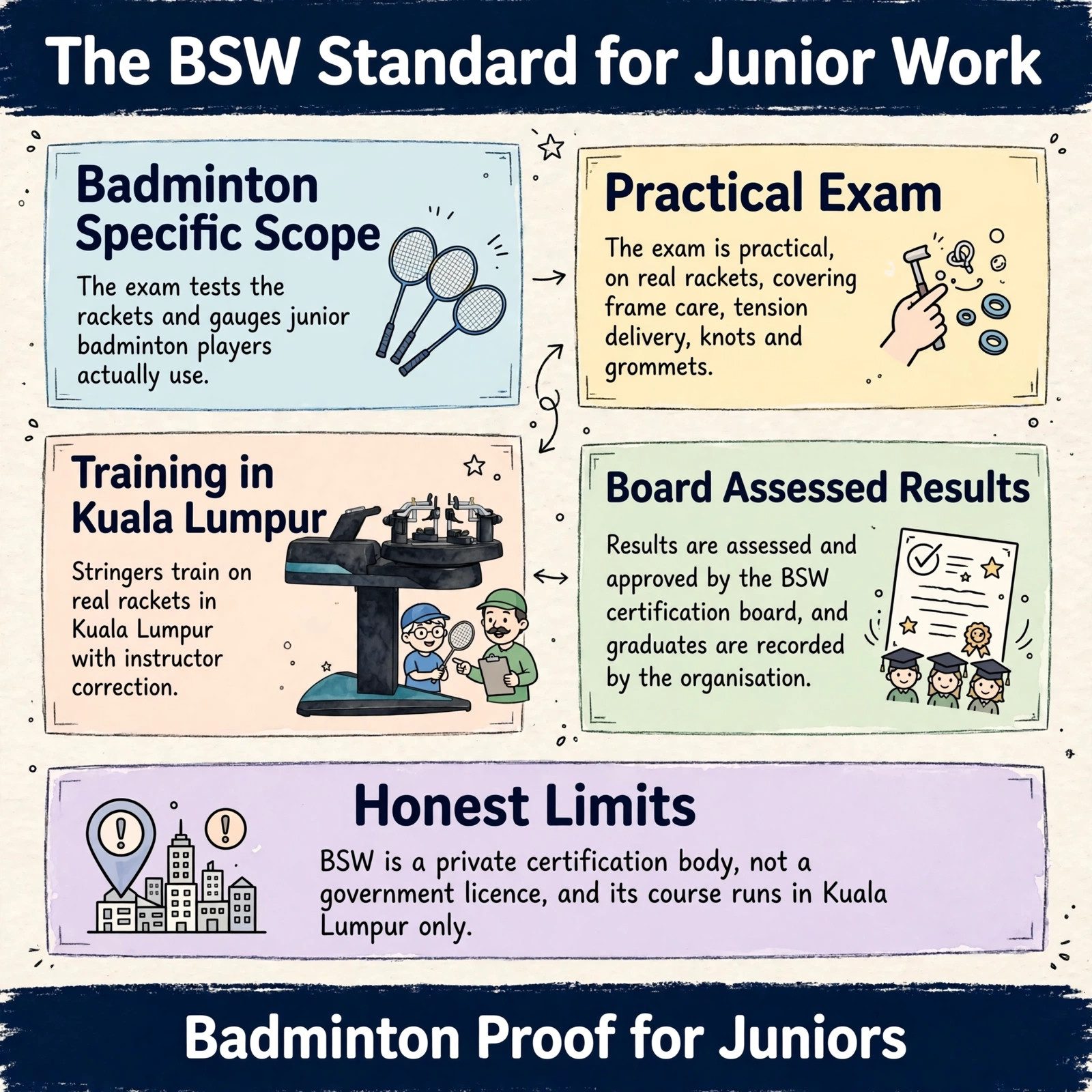
Hold the BSW standard to the same parent checks. Scope: badminton specific, so the exam tests the rackets and gauges junior badminton players actually use. Format: practical, on real rackets, covering frame care, tension delivery, knots and grommets. Verification: results are assessed and approved by the BSW certification board, and graduates are recorded by the organisation, so a parent or academy has a body to ask. Honest limits: BSW is a private certification body, not a government licence, and its course runs in Kuala Lumpur only.
Check the details. The training behind that standard runs 3 and a half days, with classes from 10am to 5pm and flexible timing, and the practical exam on the last day. Learners train on real rackets with instructor correction, including the frame reading and record habits junior work depends on. Founder Eric Chuar teaches from his Kuala Lumpur base, while the certification decision belongs to the BSW certification board as an organisation, not to one person.
Review the process. Where BSW does not lead, say it plainly. The older general bodies have longer histories and wider name recognition outside badminton, and a family centred on tennis may read their credentials more easily. For junior badminton, the tested work that matters is badminton work: light frames handled gently, thin string at junior suitable tensions set deliberately, and records kept as the player develops. That is the ground the BSW standard was built on.
Plan the next step. Parents do not need to take any body word for it. Ask how a pass can be verified, what the exam checks and what record a certified stringer keeps for a junior player. BSW answers enquiry questions before enrolment and its certified stringers work to that record standard. Judge every credential, BSW included, by how directly those parent questions are answered at the counter.
1.7 Guided Practice
What should parents ask before handing over a junior racket?
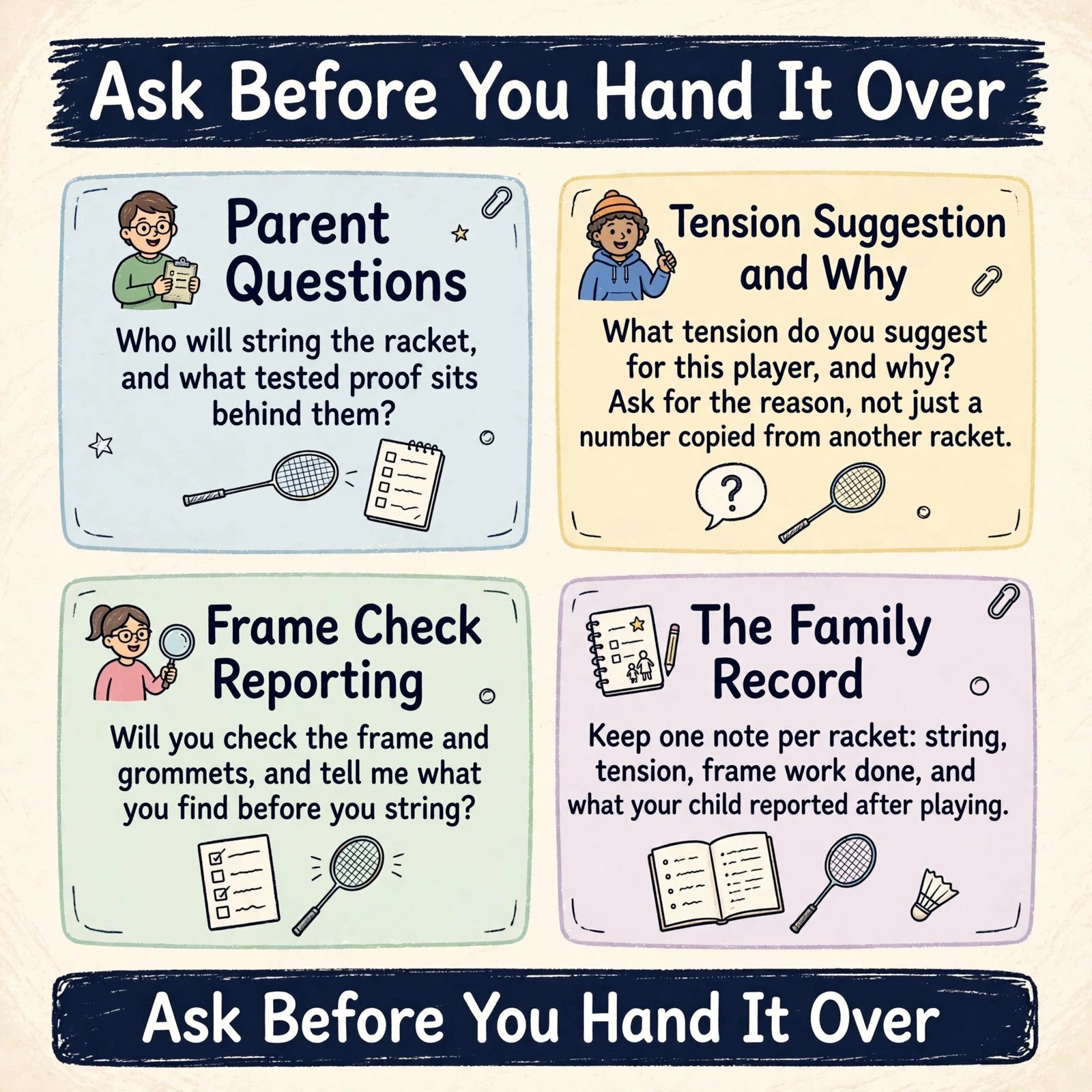
A good parent enquiry is short and direct. State that the racket is for a junior player, how often they play, what string and tension were used last time if you know them, and anything your child said felt wrong. Then ask the deciding questions. Who will string the racket, and what tested proof sits behind them? What tension do you suggest for this player, and why? Will you check the frame and grommets and tell me what you find? Will you record what was installed so we can adjust next time? Keep the answers with your restring record.
If you are asking a body or a training provider rather than a counter, ask the same shape of questions. What does the exam test on junior relevant work: frame care, tension accuracy, knots and grommets? Can a pass be verified? At BSW, training is in Kuala Lumpur only, classes run from 10am to 5pm, the course takes 3 and a half days with the exam on the last day, and timing is flexible. Any provider should describe its standard just as plainly.
Turn the answers into a simple family routine. Keep one note for the racket: string, tension, date in your own diary, and what your child reported after playing. Bring it to every restring. As your player grows and their game changes, that note is how a good stringer adjusts with them. Parents who keep it stop starting from zero, and their children get setups that grow with the player.
Certification and Junior Players Quick FAQ
Short answers to the questions parents ask first about junior rackets, tensions, tested proof and the BSW standard.
Why do parents ask who strung the racket?
Parents ask because the stringer chooses the tension, string handling and frame care behind a racket a young player cannot judge for themselves. Certification means a body has tested that stringer mounting, tension, knots, grommets and frame handling on real rackets.
What does the exam test that matters for juniors?
For junior rackets, the exam parts that matter most are frame inspection, gentle and firm mounting of light frames, delivered tension matching the set number, clean knots and careful grommet work, all tested on real badminton rackets under observation.
How does feedback training shape junior racket care?
Feedback training shapes junior care because an instructor corrects clamp pressure, frame reading and grommet habits while the learner works, and builds the record habit that lets each junior restring adjust as the player grows and changes.
What does a junior restring really commit a parent to?
A junior restring commits a parent to more than a handover at the counter. It commits to a string choice suited to the player, a tension set for that player rather than copied from an adult setup, and a turnaround that fits training and match days. It commits to keeping the record of what was installed, because the next decision depends on it. And where certification is involved, the wider costs sit behind the stringer: training and exam costs, machine and tools, practice materials and time, which is why tested stringers are not the same offer as untested ones. This page invents no fees for any of it.
How should parents compare stringers fairly?
Parents should compare stringers on tested proof, tension talk for the individual player, frame and grommet care, and record keeping. Compare bodies on badminton scope, practical exam format and whether a pass can be verified with the body itself.
How does the BSW standard measure up for juniors?
The BSW standard is badminton specific and practical: real rackets, frame care, tension delivery, knots and grommets tested in Kuala Lumpur, with training over 3 and a half days, classes from 10am to 5pm, flexible timing and the exam on the last day. Results are assessed and approved by the BSW certification board, which suits junior badminton work.
What should parents ask before handing over a racket?
A good parent enquiry is short and direct. State that the racket is for a junior player, how often they play, what string and tension were used last time if you know them, and anything your child said felt wrong. Then ask the deciding questions. Who will string the racket, and what tested proof sits behind them? What tension do you suggest for this player, and why? Will you check the frame and grommets and tell me what you find? Will you record what was installed so we can adjust next time? Keep the answers with your restring record.
What should parents keep from each junior restring?
Keep one record per junior racket: the string installed, the tension set, any frame or grommet work done, and what your child reported after playing. Bring it to each restring. As a growing player changes, that record is what lets the stringer adjust the setup from evidence instead of memory.
How can I start with BSW?
Start with an enquiry that states your child plays badminton, the racket involved and your questions about tension and care. BSW trains stringers in Kuala Lumpur only, with flexible timing, classes from 10am to 5pm over 3 and a half days and the practical exam on the last day. Results are assessed and approved by the BSW certification board.
Certification and Junior Players: Explore the Practical Decisions
Build a Clear Working Method
The method is simple: write the parent questions first, score every stringer and body against the same questions, and keep the junior record so each restring improves on the last.
| Parent Check | Rushed Approach | Planned Approach |
|---|---|---|
| Proof | Accept a confident claim at the counter | Ask for tested proof behind the stringing work |
| Tension | Copy an adult setup onto a junior racket | Set tension for the junior player in front of you |
| Record | Forget what was strung last time | Keep a record as the young player grows |
| Questions | Ask only how fast the racket returns | Ask what was tested, checked and recorded |
| Junior record | Choose a stringer from a shopfront claim alone | Write the parent questions and answers down |
| Next action | Rely on memory between restrings | Use the record to adjust as the player grows |
Trusted Junior Racket Care Starts with Best Stringer Worldwide
If you hand a junior racket over, hand it to hands that have been tested. Best Stringer Worldwide trains and certifies badminton stringers on real rackets in Kuala Lumpur, with classes from 10am to 5pm over 3 and a half days, flexible timing, and the practical exam on the last day. Results are assessed and approved by the BSW certification board. Send an enquiry stating your junior player needs and your tension questions, and start with the answers in writing.
