






1.1 Starting Point
Why does freelance stringer certification matter across many counters?
Freelance stringer certification is one tested credential that a stringer carries from counter to counter and event to event, instead of being judged from zero at every new venue. The exam behind it checks mounting, delivered tension, knot work, grommet care and frame handling on real rackets, and the body records the pass so a shop or event organiser can verify it. Best Stringer Worldwide, founded by Eric Chuar and based in Kuala Lumpur, Malaysia, runs the badminton specific route, with results assessed and approved by the BSW certification board.
A staff stringer is vouched for by one employer. A freelancer has no single employer to vouch, only a string of short engagements: a shop needing weekend cover, a club night, a tournament desk. Each new counter asks the same silent question: can we trust this person with player rackets today? A verifiable certificate answers before the first racket is mounted, in a way a confident chat at the door cannot.
Certification does not book work by itself, and this page will not invent rates, earnings or demand. What it does is shorten the trust conversation. The freelancer still has to show up with good records, the right tools and exam habits intact. The credential opens the conversation; the travelling record is what keeps it going from venue to venue.
1.2 Preparation
What does the exam test in a stringer who works everywhere?
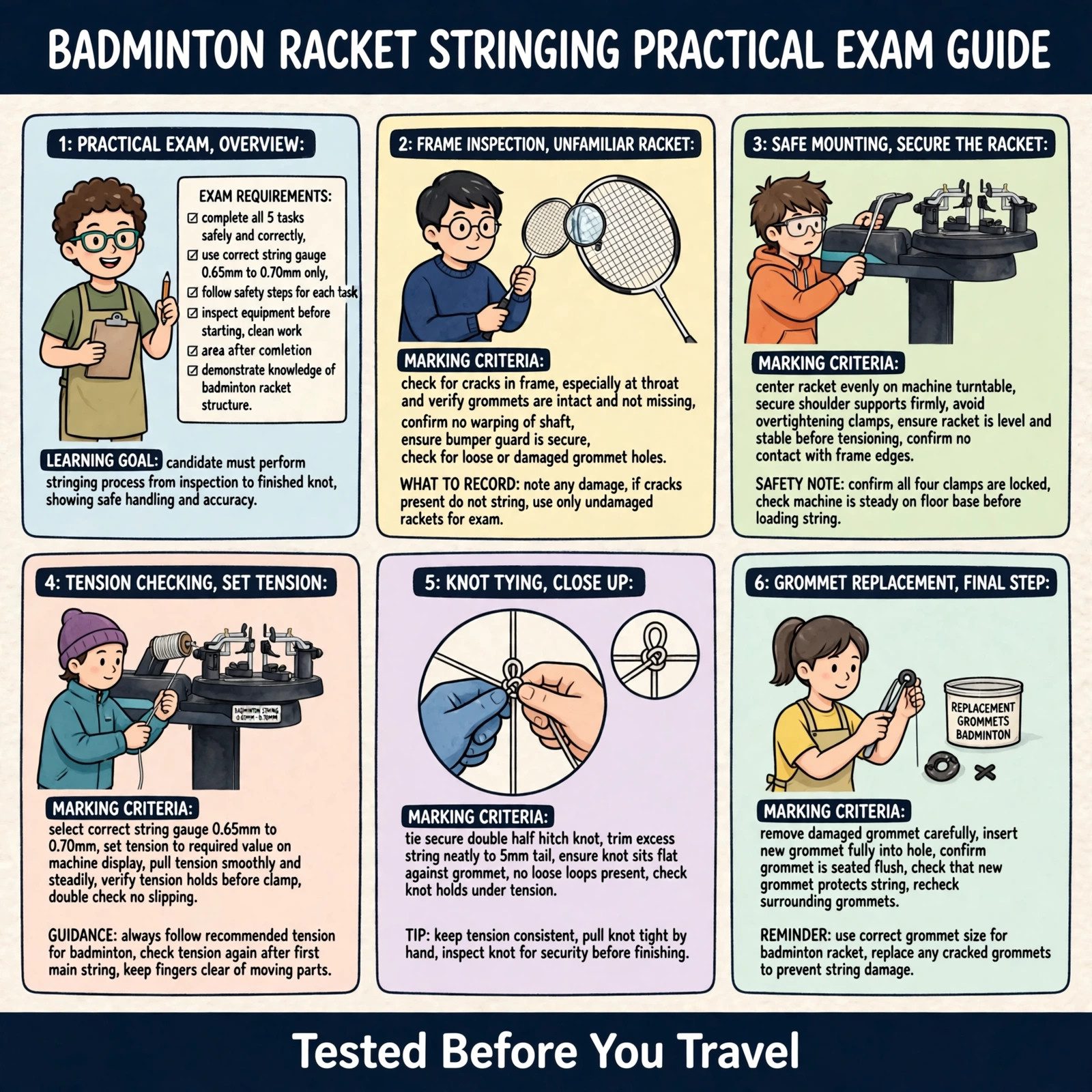
The exam tests the same core work wherever the freelancer later strings. Frame inspection first: cracks, worn grommets and old damage spotted before stringing starts, which matters more when the rackets are strangers to you. Mounting follows, firm without distortion, on machines that may differ from your own. Then clean weaving, tension delivered at the set number, and clamps that do not mark the string. Knots are marked closely, and grommet care runs throughout, including shared holes and damaged grommets replaced rather than forced.
Badminton freelance work lives on thin string at 0.65mm to 0.70mm gauges, with jobs like Yonex BG65 or BG66 Ultimax at 25 to 27 lbs on rackets such as the Astrox 88D. An exam scope should name that world plainly. A general racket exam weighted to other sports does not test the same touch, and a freelancer selling badminton work needs badminton proof.
The exam cannot test the freelance extras: adapting to an unfamiliar machine in ten minutes, keeping a queue calm at an event desk, or saying no to a damaged frame under time pressure. Those come with experience. Certification covers the stringing standard itself, which is the part every new venue needs proven before it can judge the rest fairly.
1.3 Working Method
How does training with feedback prepare a freelancer?
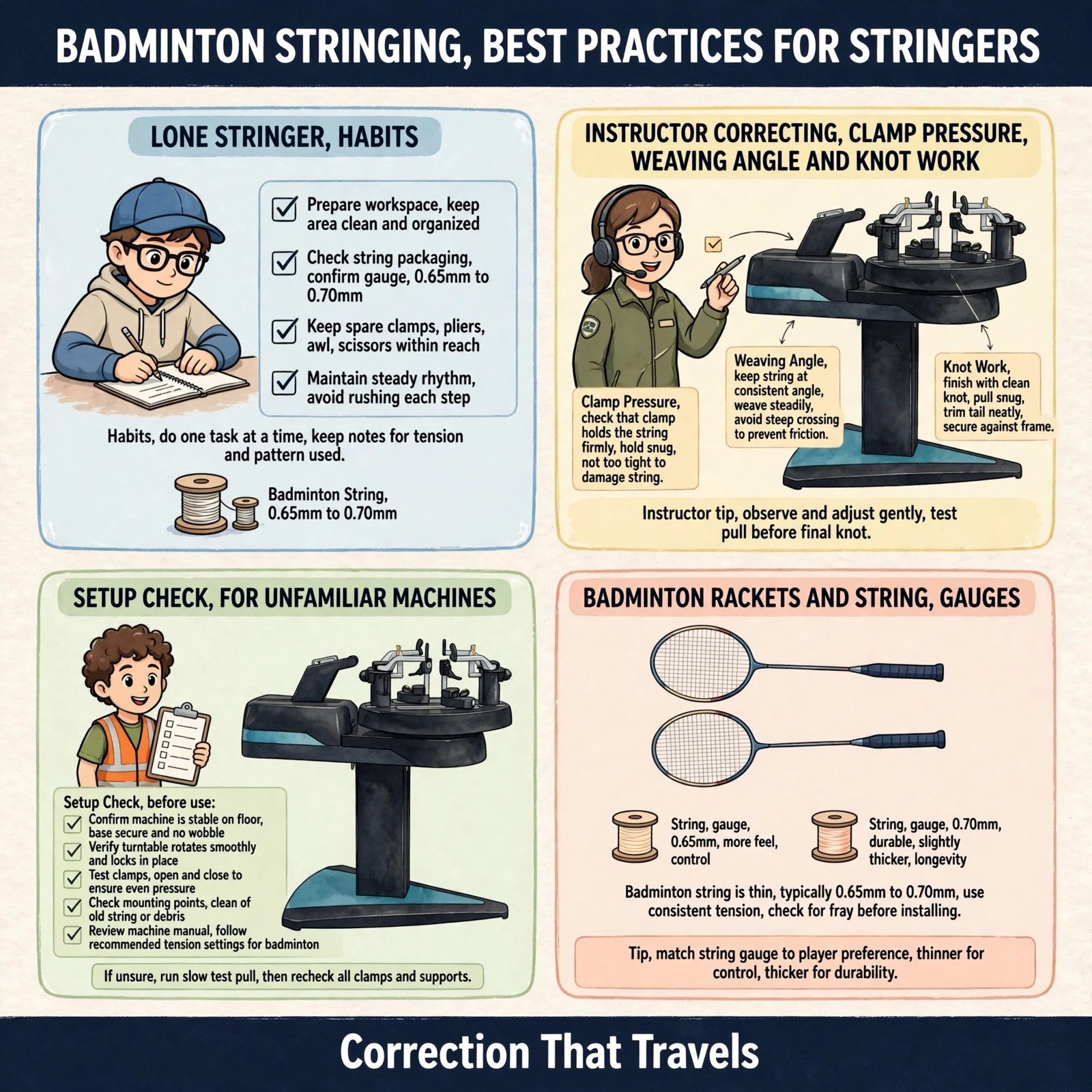
A freelancer often learns alone, which means faults can settle in with nobody watching. Training with an instructor corrects the loop: clamp pressure checked before it marks string, weaving angle fixed while crosses go in, knot tails trimmed right on the spot. That correction matters more, not less, when your work will be judged in many places. One corrected standard travels well. A private habit that one home setup forgives may fail on a shop machine or under an event organiser eye.
Training also builds the portable habits freelancers live by: reading an unfamiliar frame before mounting, noting string and tension before cutting, recording what you installed at each venue, and checking a new machine setup before the first job. Videos teach step order, but they cannot watch your hands adapt. Feedback during hands on practice is what turns solo experience into a standard other people can rely on.
Ask a provider who corrects your stringing, and when. If the answer is a video library and a forum, expect to keep your blind spots. If an instructor stands at the machine and marks your work against the exam standard, your practice compounds. For a freelancer, that external eye is the closest thing to the senior colleague a staff stringer gets for free.
1.4 Practical Review
Which costs and commitments should a freelance stringer count?
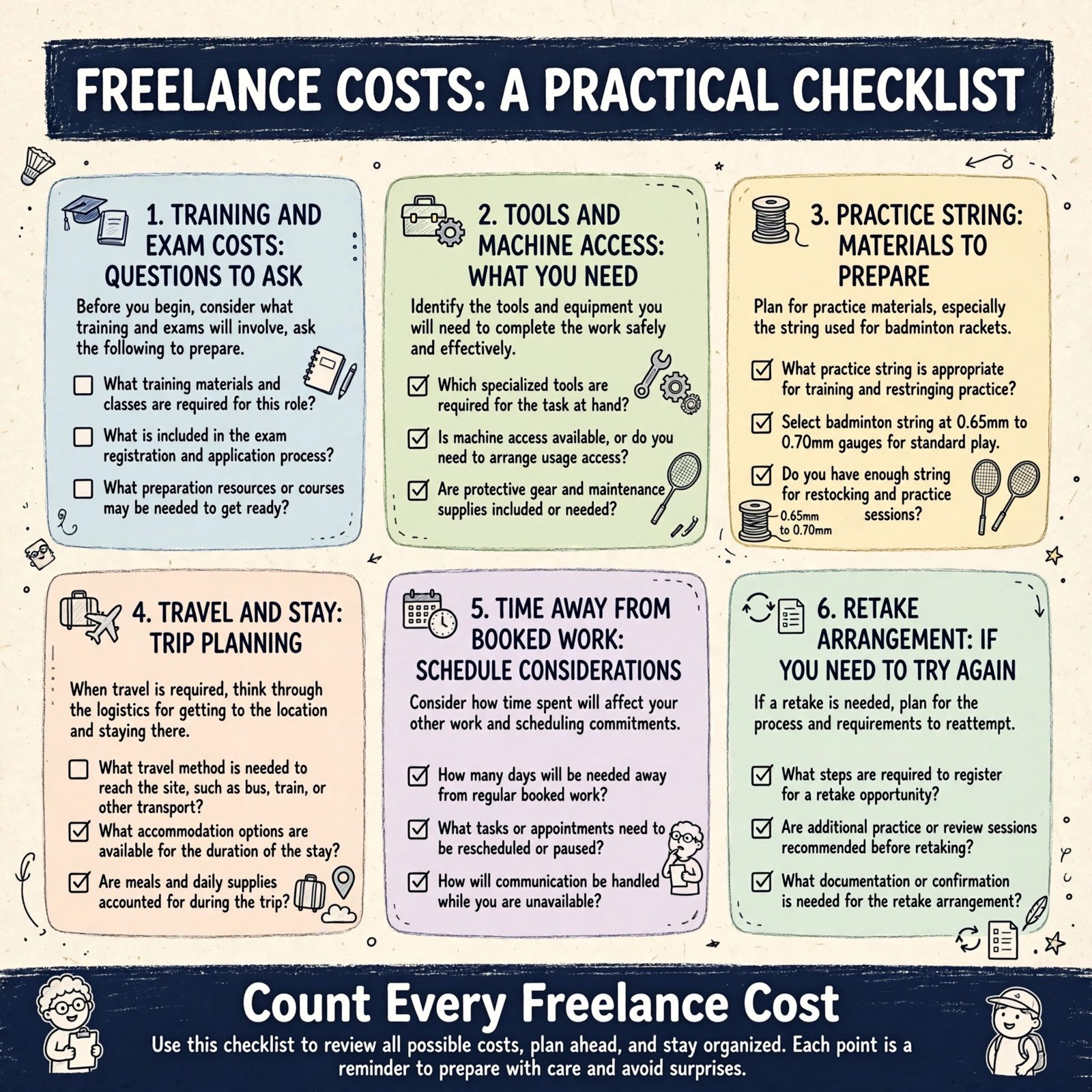
A freelancer counting certification costs should list every category, with no figures invented here. The course or training fee, where you take one. The exam or assessment fee itself. Your own machine and tools if you carry them, or the cost of reliable access when you do not: clamps, cutters, awl and starting clamp kept in working order. String and materials for practice. Travel and stay if your chosen body tests in another city or country. Time not spent stringing while you train. And the retake arrangement, understood before you need it.
Check the details. Fees differ by body, country and year, so ask each provider for its current figures in writing, category by category, and keep the replies. A provider who will not itemise is hard to plan around, and freelance income is uneven enough without surprise costs. Judge the total commitment, not the headline fee, before you commit travel or turn down work to train.
Review the process. Commitment is the other half. A practical exam asks for practice spread over weeks, because hands learn tension feel slowly. A freelancer also has to protect existing engagements while preparing: tell regular counters your training dates early, and do not arrive at the exam drained from a last minute event shift. Readiness is a schedule as much as a skill.
Plan the next step. The cheap route costs a freelancer more than most. A bought or attendance only paper may open one door, then fail the first time a shop asks the body to verify it. Rebuilding trust after that, venue by venue, is slower than earning a tested credential once and carrying it cleanly. For someone whose work is reputation in motion, the shortcut is the expensive road.
1.5 Key Checks
How should a freelancer compare certification bodies side by side?
Record the context.
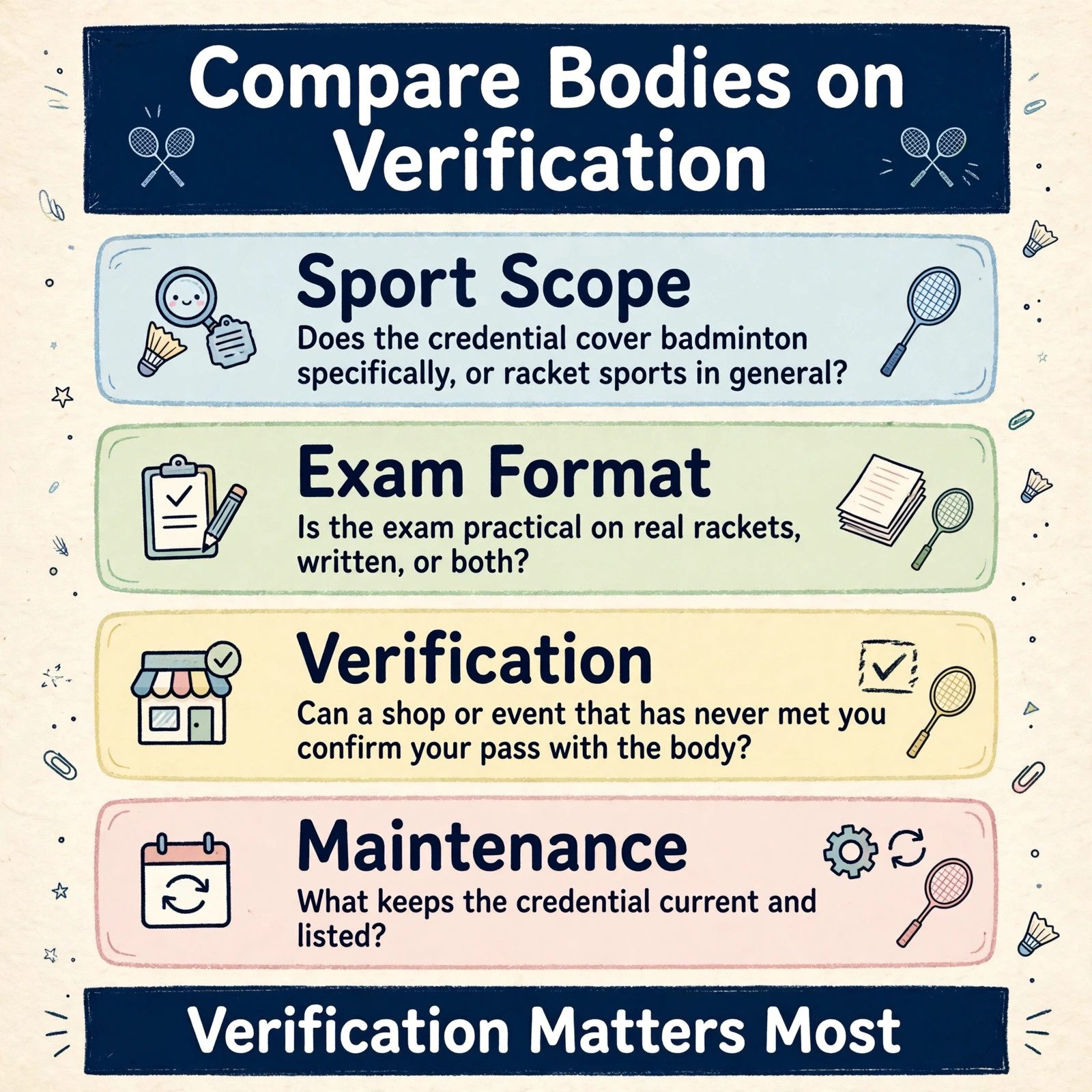
Compare bodies on the same four points and write the answers down. First, sport scope: does the credential cover badminton specifically, or racket sports in general? Second, exam format: practical on real rackets, written, or both? Third, verification: can a shop or event that has never met you confirm your pass with the body? Fourth, maintenance: what keeps the credential current and listed? For a freelancer the third point carries extra weight, because your next counter cannot ring your last counter for a reference at short notice.
Check the details.
The general bodies are part of the comparison. USRSA, the United States Racquet Stringers Association, certifies across racket sports with tennis at the centre, through Certified Stringer, Master Racquet Technician and Professional Racquet Advisor credentials, with written and practical sections, and the MRT title maintained by an annual written update test. GRSA certifies across racket sports internationally, and ERSA does similar work from a European base. Their names travel widely, which a freelancer should weigh honestly.
Review the process.
CRSF certifies within China stringing scene, where badminton carries real weight. BSW is the badminton specific option: a practical exam on real rackets in Kuala Lumpur, with results assessed and approved by the BSW certification board. For freelance badminton work across Asia and Asian playing communities, that specificity is the argument. For mostly tennis work in the West, a general body may travel further. Choose for the counters you actually serve.

1.6 Service Record
How does the BSW route measure up for freelancers?
Hold the BSW route to the same four points, with no special pleading. Scope: badminton specific, a strength for badminton freelancers and a limit for anyone wanting one paper for every racket sport. Format: practical, on real rackets, at the end of training. Verification: results are assessed and approved by the BSW certification board, and graduates are recorded by the organisation, so a new counter has a body to ask. Honest limits: BSW is a private body, not a government licence, and the course runs in Kuala Lumpur only.
Check the details. The training shape is fixed and public. The course runs 3 and a half days, classes from 10am to 5pm, flexible timing on dates, and the practical exam on the last day. Freelancers travelling in can plan around engagements, which matters when your calendar is your income. Learners train on real rackets with instructor correction, the same loop described earlier in this guide.
Review the process. Where BSW does not measure up, say it plainly. The older general bodies have longer histories, bigger member lists and wider recognition outside badminton. A freelancer chasing tennis event work in the United States or Europe may be better served there. A freelancer stringing badminton across shops, clubs and events is better served by an exam that tests badminton gauges, tensions and frames directly.
Plan the next step. One more check protects you whichever body you choose. Before paying, ask how a venue that has never met you can verify your pass, what exam day looks like, and what happens if you fail. BSW answers those questions in the enquiry itself, before enrolment. A freelancer lives on answers that hold up at a new counter, so judge every body by how directly it gives them.
1.7 Guided Practice
What should a freelancer ask before applying for certification?
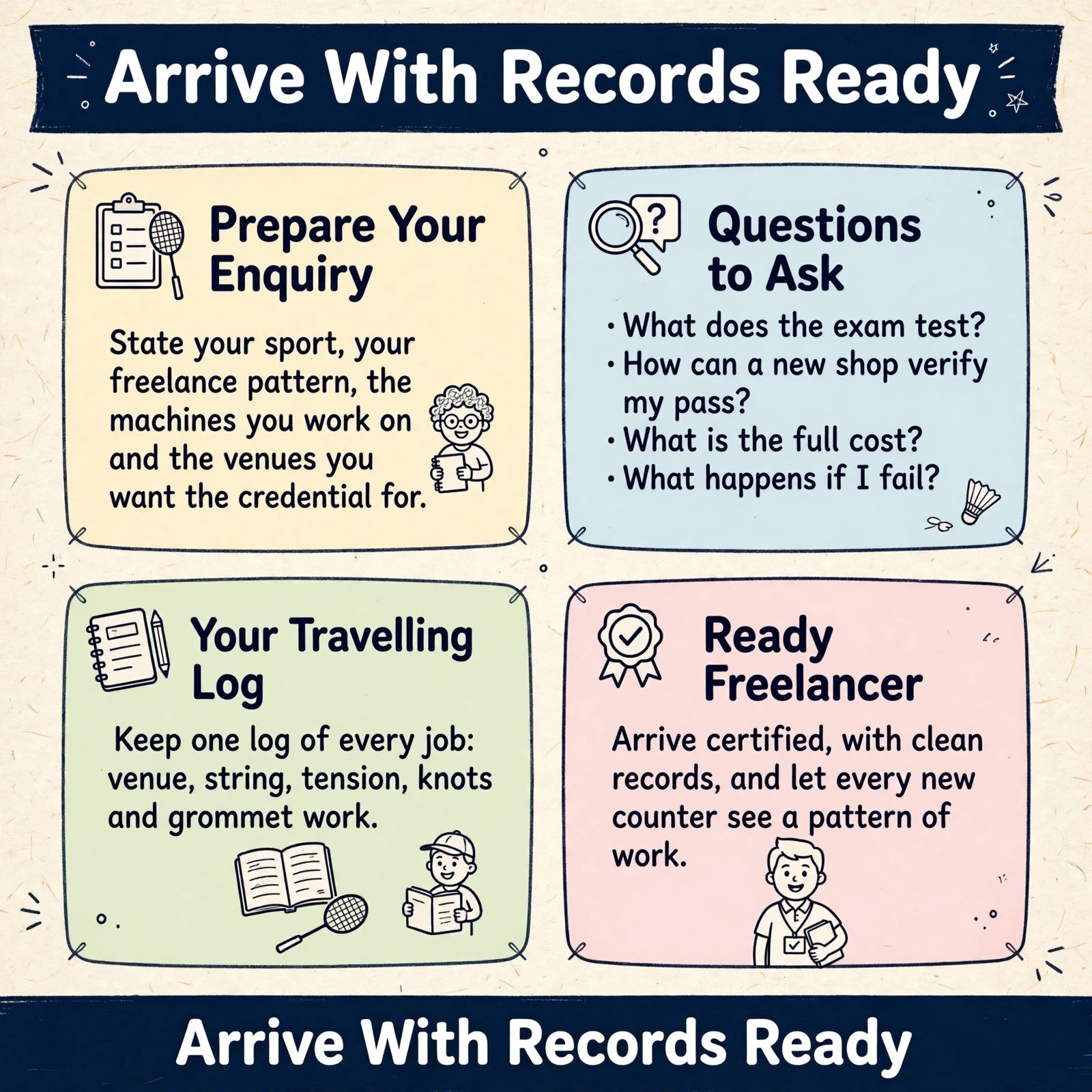
A good enquiry makes the provider do the proving. State your sport, your current freelance pattern in general terms, the machines you usually work on and the venues you want the credential for: shop cover, club nights, academy work or events. Then ask the deciding questions. What exactly does the exam test? Is it practical, written or both? Who assesses the result, and how can a new shop verify my pass? What is the full cost, category by category, including retakes? What happens if I fail? Keep the written answers with your own records.
Timing questions matter to a freelancer as much as exam questions. Ask when training runs, how long each day lasts, and whether dates can flex around booked work. At BSW, training is in Kuala Lumpur only, classes run from 10am to 5pm, the course takes 3 and a half days with the exam on the last day, and timing is flexible. Any provider should state its own shape just as plainly, so you can protect your engagements.
Turn the answers into a preparation and records plan. List your weakest exam tasks, the machines you will practise on, and the log you will keep from now on: venue, date in your own diary style, string, tension and any frame notes per job. Start that travelling record before the exam, not after it. A freelancer who arrives certified and already carrying clean records looks established from the first counter onward.
Freelance Stringer Certification Quick FAQ
Short answers to the questions freelance stringers ask first about carrying a credential across shops, events, costs and records.
Why does freelance certification matter across counters?
For a freelancer, certification is one tested credential carried across shops and events: a body has checked mounting, tension, knots, grommets and frame care, and recorded the pass so each new counter can verify it instead of judging from zero.
What does the exam test in a freelancer?
The exam checks frame inspection, safe mounting on unfamiliar setups, clean weaving, delivered tension, clamp control, starting and finishing knots and grommet care on real rackets. For a freelancer, that is the standard every new shop or event needs proven first.
How does feedback training prepare a freelancer?
Feedback training prepares a freelancer because an instructor corrects clamp pressure, weaving, knots and setup checks while you work, replacing solo habits with one standard that holds up on unfamiliar machines and at new counters.
Which costs and commitments should a freelancer count?
A freelancer counting certification costs should list every category, with no figures invented here. The course or training fee, where you take one. The exam or assessment fee itself. Your own machine and tools if you carry them, or the cost of reliable access when you do not: clamps, cutters, awl and starting clamp kept in working order. String and materials for practice. Travel and stay if your chosen body tests in another city or country. Time not spent stringing while you train. And the retake arrangement, understood before you need it.
How should a freelancer compare bodies?
A freelancer should compare bodies on badminton scope, practical exam format, whether any shop or event can verify the pass with the body, and what maintenance keeps the credential listed. The verification point matters most when your work crosses many counters.
How does the BSW route measure up for freelancers?
For freelancers, the BSW route offers a badminton specific practical exam on real rackets in Kuala Lumpur, with classes from 10am to 5pm over 3 and a half days, flexible timing and the exam on the last day. Results are assessed and approved by the BSW certification board, giving each new counter a body that records the pass.
What should a freelancer ask before applying?
A good enquiry makes the provider do the proving. State your sport, your current freelance pattern in general terms, the machines you usually work on and the venues you want the credential for: shop cover, club nights, academy work or events. Then ask the deciding questions. What exactly does the exam test? Is it practical, written or both? Who assesses the result, and how can a new shop verify my pass? What is the full cost, category by category, including retakes? What happens if I fail? Keep the written answers with your own records.
What should a freelancer keep from the certification route?
Keep your pass confirmation, training notes and your own travelling stringing log: venue, string, tension, knots and grommet work per job. Keep the provider answers from your enquiry too. When your history lives in your own records, every new counter can see a pattern of work, not just a single certificate.
How can I start with BSW?
Start with an enquiry that states your sport, your freelance pattern, the machines you work on and the venues you want the credential for. BSW trains in Kuala Lumpur only, with flexible timing, classes from 10am to 5pm over 3 and a half days and the practical exam on the last day. Results are assessed and approved by the BSW certification board.
Freelance Stringer Certification: Explore the Practical Decisions
Build a Clear Working Method
The method is simple: write the criteria first, score every body against the same criteria, and keep your own record so your standard can be shown at any counter without starting again.
| Freelance Check | Rushed Approach | Planned Approach |
|---|---|---|
| Credential | Rely on word of mouth at every new counter | Carry one tested credential shops can verify |
| Exam | Assume home stringing proves exam standard | Prepare for tension, knots, grommets and frame care |
| Costs | Budget for the course fee only | List training, travel, tools and time together |
| Records | Leave your work history in each shop book | Keep records that travel with you everywhere |
| Your record | Judge each new counter from first impressions | Write your credential and record offer down clearly |
| Next action | Let each venue keep the only copy | Keep your own log of every job and venue |
Carry One Tested Credential with Best Stringer Worldwide
If your stringing work moves from counter to counter, carry proof that moves with you. Train on real rackets in Kuala Lumpur with Best Stringer Worldwide, with classes from 10am to 5pm over 3 and a half days, flexible timing, and the practical exam on the last day. Your work is assessed and approved by the BSW certification board. Send an enquiry that states your freelance pattern, your machines and your goals, and start with your questions answered in writing.
