






1.1 Starting Point
What is USRSA certification and what does it cover?
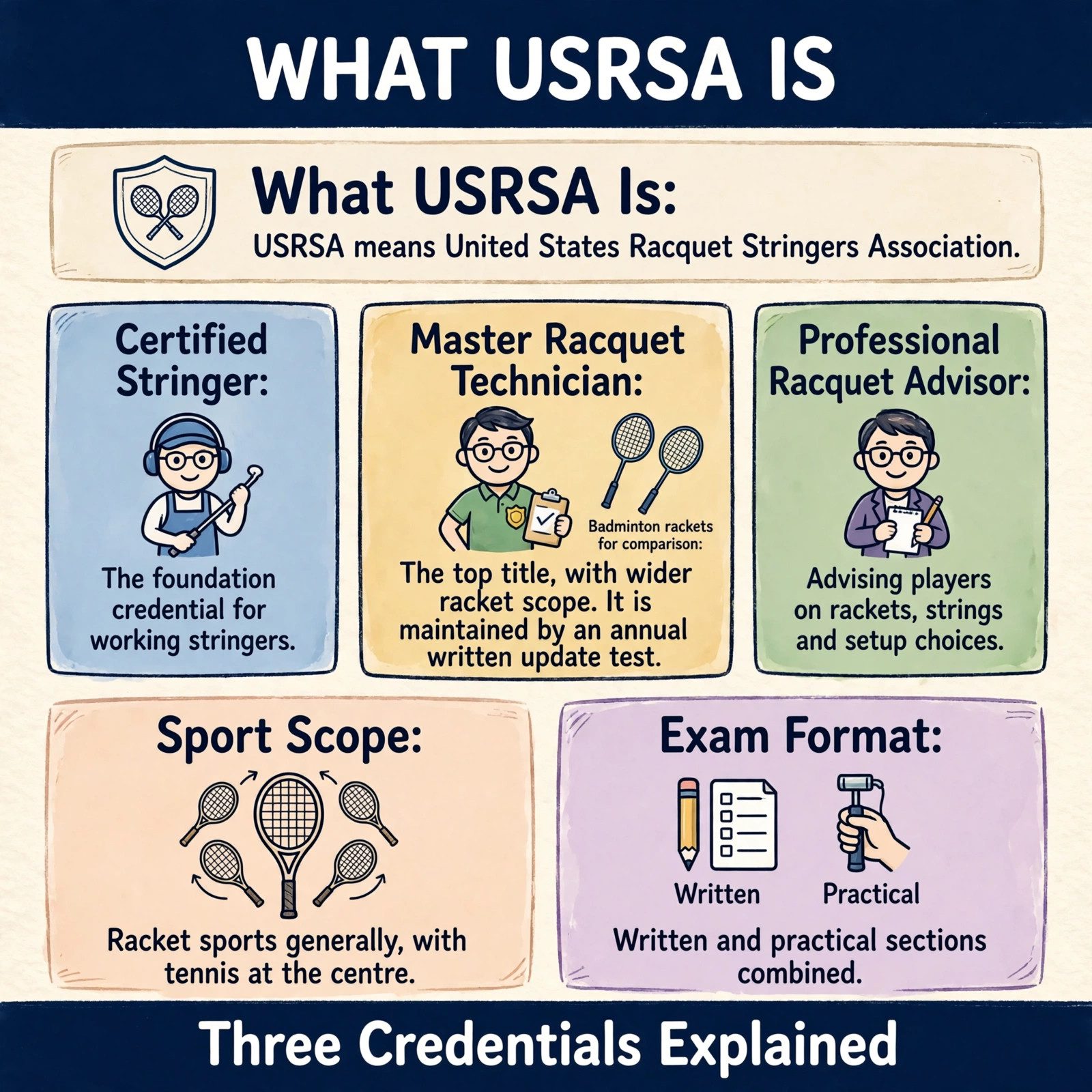
USRSA certification is the credential system run by the United States Racquet Stringers Association, the long established US body for racket stringers. It offers three credentials: Certified Stringer, Master Racquet Technician and Professional Racquet Advisor, tested through written and practical sections across racket sports, with tennis at the centre. This explainer sets out what each title means in plain terms. Best Stringer Worldwide, founded by Eric Chuar and based in Kuala Lumpur, Malaysia, appears later in this guide as the badminton specific comparison, with results assessed and approved by the BSW certification board.
Read the three titles as a ladder with different jobs. Certified Stringer is the foundation credential for working stringers. Master Racquet Technician, shortened to MRT, is the top title, covering wider racket work including customisation. Professional Racquet Advisor, shortened to PRA, focuses on advising players on rackets, strings and setup choices.
A USRSA title proves the holder passed that body set standard under exam conditions and was recorded by the body. It does not prove every future job will be perfect, and it is centred on general racket work rather than badminton alone. Knowing that scope clearly is what lets you judge whether it fits your own work.

1.2 Preparation
What do the USRSA exams actually test?
USRSA exams combine a written section with practical work, which is the first fact many short summaries miss. The practical side checks the stringing itself: frame inspection, safe mounting, clean weaving, delivered tension, clamp control, knots and grommet care on real rackets. The written side checks knowledge around the work: strings, racket technology and how to advise a player. At MRT level the scope widens beyond stringing alone into customisation and related racket work, and the title is then maintained by an annual written update test, so the knowledge check never really ends for MRT holders.
For a badminton stringer, the scope question sits inside the exam question. General racket exams are weighted toward the rackets most candidates bring, and tennis carries the most weight in the US system. Badminton work uses strings at 0.65mm to 0.70mm gauges on light frames at high tensions. Check how much of any exam scope names your actual daily rackets before you judge its value.
What no exam format can test also matters here. Written and practical sections cannot measure how a stringer handles a tournament rush, a damaged frame before a match, or a player who needs honest advice against a sale. Certification proves exam day standard. Your records and repeat players prove the rest of your working standard over time.

1.3 Working Method
How does training and feedback prepare USRSA candidates?
Candidates prepare for a written plus practical exam differently from a practical only one. The hands still need live correction: an instructor or experienced stringer watching clamp pressure, weaving angle, knot work and grommet habits, fixing faults while they happen rather than after a full racket is finished. On top of that, the written sections reward structured study: string types, racket technology and advice scenarios learned in a way that can be recalled under exam conditions. Videos and manuals help the study side well. They still cannot watch your hands, so practical feedback remains the part self study cannot replace.
Good preparation also builds checking habits that suit both sections. Record each practice racket: string, set tension, delivered result, knots used and grommet work done. Those records train the practical eye and give you concrete examples to reason from in written answers about real stringing decisions at the counter.
Ask any course or mentor one question before you rely on them: who corrects my stringing, and who checks my written knowledge? A route that answers both parts matches the USRSA format. A route that only sells video access leaves the practical half uncorrected, which is where most candidates carry their oldest habits.
1.4 Practical Review
Which costs and commitments come with USRSA certification?
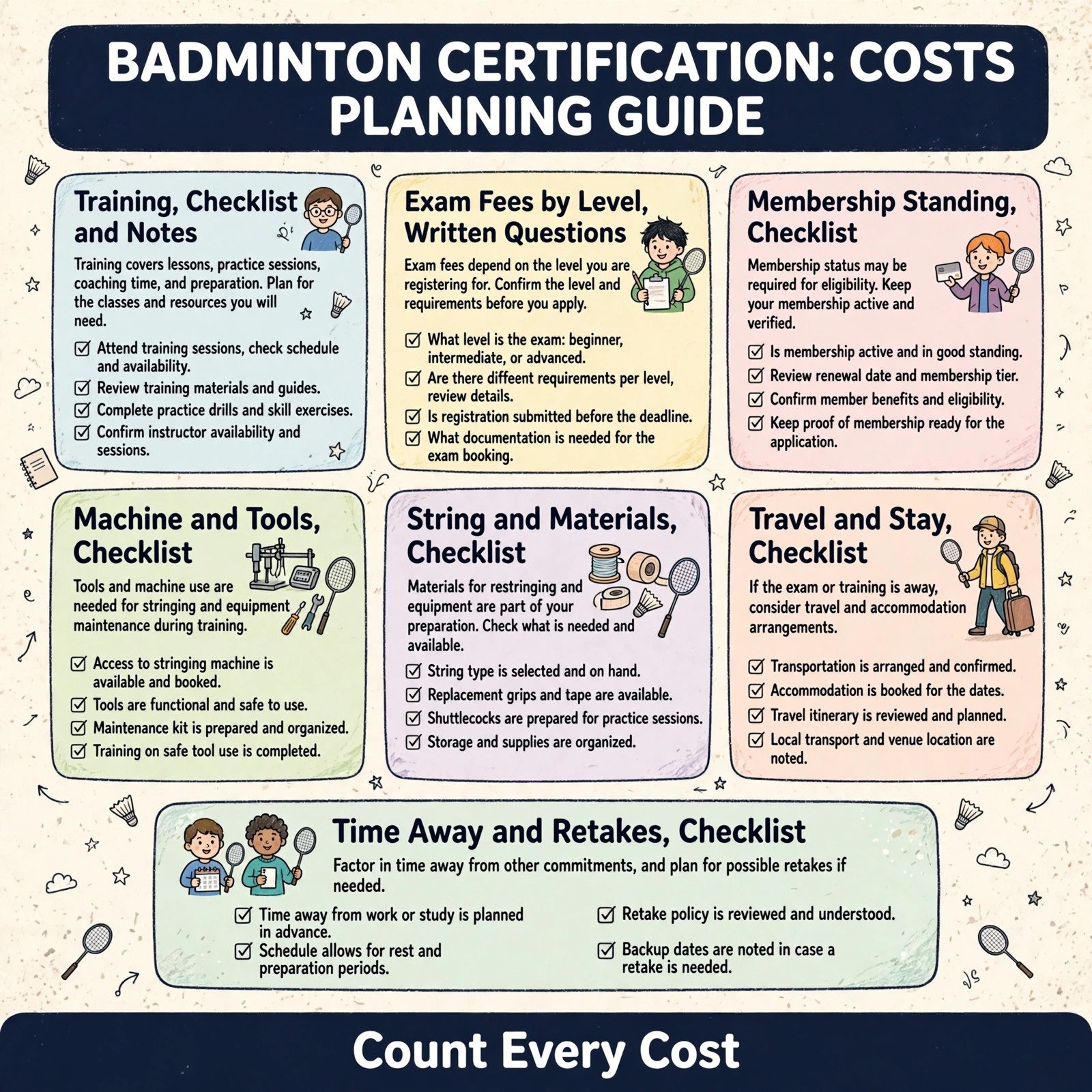
Plan USRSA certification as a full commitment, not a single exam fee. List every category first. Training or course costs where you prepare. The exam or assessment fees for the credential level you choose. Membership standing, since listings are tied to current membership. A machine and tools if you do not own them, plus string and materials for serious practice. Travel and stay if testing requires a trip. Time away from work or your own stringing queue. And for MRT holders, the ongoing annual written update test as a standing commitment, plus any retake arrangement understood before you need it.
Check the details. This guide states no figures for those categories, on purpose. Fees and arrangements differ by level and change over time, and a page quoting tidy totals without a date is guessing. Ask USRSA or your provider directly for current figures, category by category, in writing, and keep the answers with your records.
Review the process. Commitment also means calendar honesty. A written plus practical exam asks for study time and practice time running side by side over weeks. MRT candidates add wider customisation practice. If you string for a shop, arrange cover for training and exam days early, and arrive rested rather than straight from a full shift.
Plan the next step. The cheap shortcut has its usual price. A paper with no tested exam behind it may cost little now, then fail the first time a shop or tournament asks what was actually tested and who recorded it. Paying for a properly examined route once is normally cheaper than retraining your reputation later.
1.5 Key Checks
How does USRSA compare with the other bodies?
Record the context.
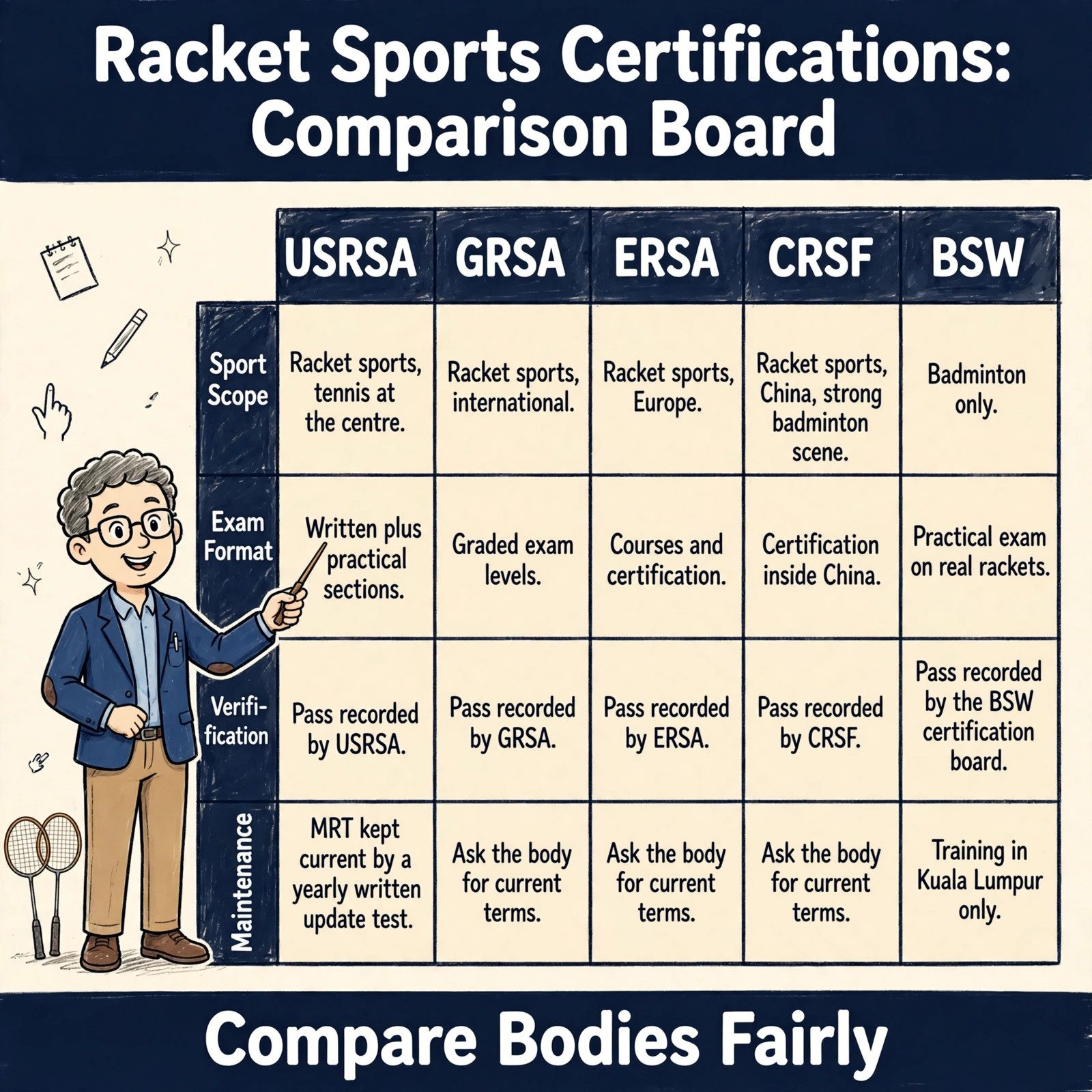
Compare USRSA with the other bodies on the same four points used throughout this cluster. Sport scope: USRSA covers racket sports generally, with tennis at the centre. Exam format: written and practical sections combined. Verification: passes are recorded by the association, with the Certified Stringer listing tied to current membership. Maintenance: the MRT title carries an annual written update test, while the Certified Stringer status itself has no expiry. Write those answers beside the other bodies and the real differences appear without any marketing language.
Check the details.
GRSA, the Global Racket Stringers Association, runs certification across racket sports for an international membership at graded levels. ERSA, the European Racket Stringers Association, is the European counterpart, running courses and certification again with tennis at the centre of gravity. Both share USRSA general racket model, so a badminton stringer reads their scopes the same careful way.
Review the process.
CRSF, the China Racquet Stringing Federation, certifies inside China, where badminton carries far more weight than in Western systems. BSW sits at the specialist end: badminton specific scope, a practical exam on real rackets, and results assessed and approved by the BSW certification board in Kuala Lumpur. General reach sits with USRSA and its peers. Badminton depth is the ground BSW was built on.
1.6 Service Record
How does the BSW route measure up beside USRSA?
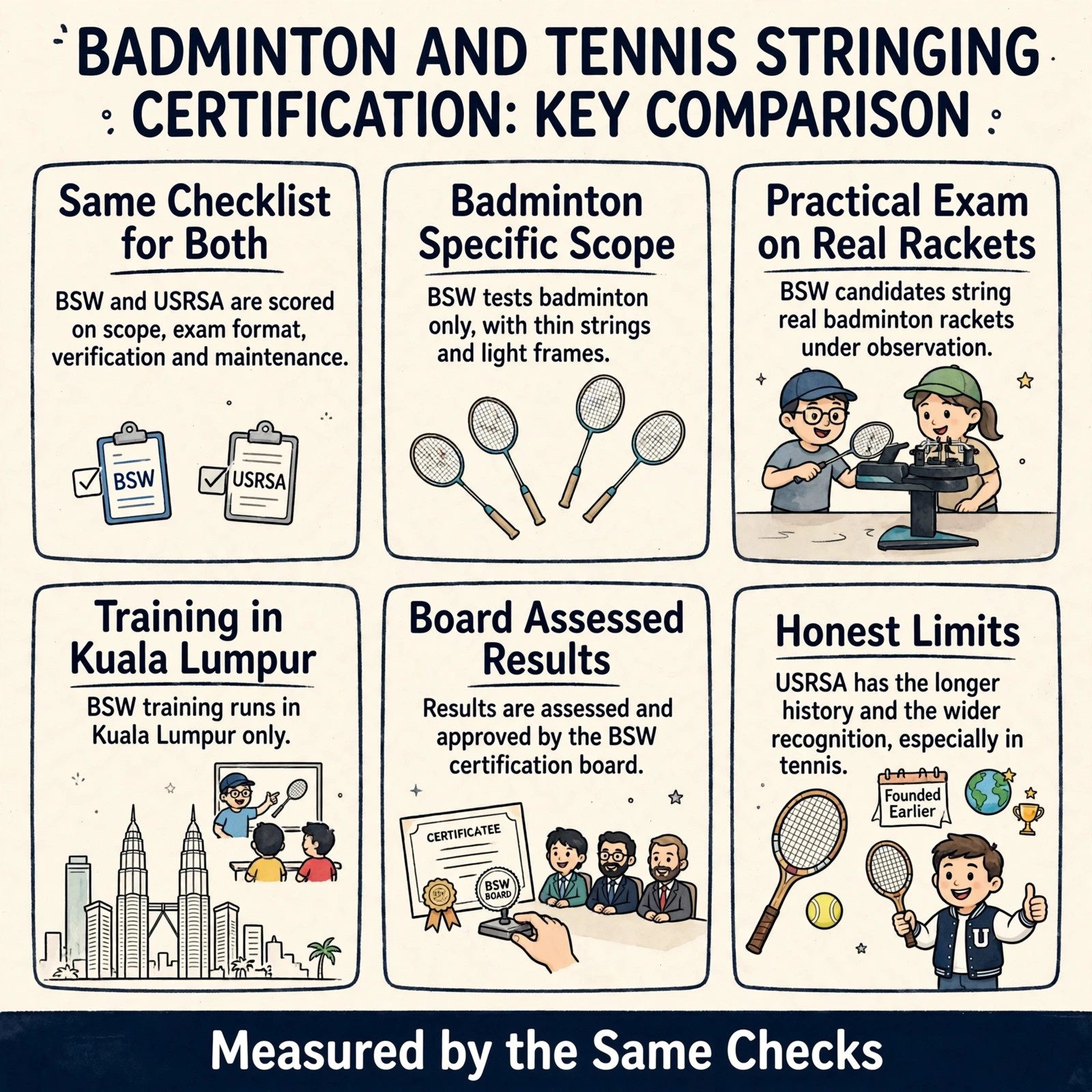
Hold BSW beside USRSA on the same four points, with no special pleading. Sport scope: BSW is badminton specific, narrower than USRSA and stronger exactly where a badminton stringer works. Exam format: BSW tests practically on real rackets, without the broad written and customisation scope of MRT. Verification: BSW results are assessed and approved by the BSW certification board and recorded by the organisation. Maintenance: BSW states its model plainly in the enquiry, and claims no government licence and no course outside Kuala Lumpur.
Check the details. The BSW training shape is fixed and public. The course runs 3 and a half days, classes from 10am to 5pm, flexible timing on dates, practical exam on the last day. Learners train on real rackets with instructor correction throughout. Founder Eric Chuar teaches from his Kuala Lumpur base, while the certification decision belongs to the BSW certification board as an organisation, not to one person.
Review the process. Where USRSA measures stronger, say it plainly. It has the longer history, the bigger member base and the wider name recognition, above all in tennis and in the United States. A stringer whose work is mostly tennis, or who wants the MRT customisation scope, is honestly better served there. A badminton stringer in Asia faces a different calculation, and that is the honest summary.
Plan the next step. One check protects you with either body. Ask how an employer verifies a pass, what exam day looks like, and what happens after a fail. Judge USRSA, BSW and every other body by how directly those questions are answered in writing. A credential you cannot question is a credential players and shops should not have to trust.

1.7 Guided Practice
What should you ask before applying for any certification?
A good enquiry makes any body do the proving, USRSA included. State your sport, your stringing volume, your machine and the work you want the credential for: shop counter, tournament team, academy or your own business. Ask which credential level fits that work, what the written and practical sections each test, who assesses the result, and how an employer verifies your pass. Ask the full cost category by category, including membership standing and retakes. Write every answer down and score it with the comparison method in this guide before committing money or travel.
Timing questions matter as much as exam questions. Ask when and where testing happens, how long preparation realistically takes, and what ongoing duties follow a pass, such as the MRT annual update test. At BSW, training is in Kuala Lumpur only, classes from 10am to 5pm, 3 and a half days with the exam on the last day, and flexible timing. Any body should state its own shape just as plainly.
Turn the answers into a preparation plan the same day. Split the plan into practical tasks to drill and written topics to study, list the rackets and string you will practise with, and keep records per racket. Candidates who prepare on both tracks from the start look calm on exam day, because nothing in the format is a surprise to them.
USRSA Certification Quick FAQ
Short answers on USRSA, its three credentials, its exam format, its update test, and how BSW compares beside it.
What is USRSA certification and what does it cover?
USRSA is the United States Racquet Stringers Association. Its certification has three credentials: Certified Stringer as the foundation, Master Racquet Technician as the top title, and Professional Racquet Advisor for player advice work. Exams combine written and practical sections across racket sports, with tennis at the centre.
What do the USRSA exams test?
USRSA exams combine written and practical sections. Practical work covers frame inspection, mounting, weaving, delivered tension, clamps, knots and grommet care. Written work covers strings, racket knowledge and player advice. MRT adds wider customisation scope and an annual written update test to stay current.
How does training prepare USRSA candidates?
USRSA preparation needs two tracks: live feedback on practical work, covering clamps, weaving, knots and grommets, plus structured study for the written sections on strings, rackets and player advice. Videos support study but cannot correct your hands, so observed practice still matters most.
Which costs come with USRSA certification?
Plan USRSA certification as a full commitment, not a single exam fee. List every category first. Training or course costs where you prepare. The exam or assessment fees for the credential level you choose. Membership standing, since listings are tied to current membership. A machine and tools if you do not own them, plus string and materials for serious practice. Travel and stay if testing requires a trip. Time away from work or your own stringing queue. And for MRT holders, the ongoing annual written update test as a standing commitment, plus any retake arrangement understood before you need it.
How does USRSA compare?
USRSA is US based and tennis centred, with written plus practical exams and three credentials. GRSA works internationally across racket sports, ERSA is the European counterpart, and CRSF works within China. BSW is badminton specific and practical only in focus, assessed in Kuala Lumpur by its certification board.
How does BSW measure up beside USRSA?
Beside USRSA, BSW is narrower and deeper: badminton specific scope instead of general racket coverage, a practical exam on real rackets instead of written plus practical sections across sports, and results assessed and approved by the BSW certification board. BSW training runs in Kuala Lumpur only, 3 and a half days, classes from 10am to 5pm, flexible timing, exam on the last day. USRSA has the longer history, larger membership and wider recognition, especially for tennis work in the United States. Choose by the rackets you actually string.
What should you ask before applying?
A good enquiry makes any body do the proving, USRSA included. State your sport, your stringing volume, your machine and the work you want the credential for: shop counter, tournament team, academy or your own business. Ask which credential level fits that work, what the written and practical sections each test, who assesses the result, and how an employer verifies your pass. Ask the full cost category by category, including membership standing and retakes. Write every answer down and score it with the comparison method in this guide before committing money or travel.
What should you keep from your certification route?
Keep your exam result record, the body confirmation of your pass, your membership standing details where a listing depends on them, and your own stringing records: string, tension, knots and grommet work per racket. Records keep a credential checkable long after exam day.
How can I start with BSW
Start with an enquiry stating your sport, experience, machine and the work you want certification for. BSW trains in Kuala Lumpur only, flexible timing, classes from 10am to 5pm over 3 and a half days, practical exam on the last day. Results are assessed and approved by the BSW certification board.
USRSA Certification: Explore the Practical Decisions
Build a Clear Working Method
The method is simple: write the criteria first, score USRSA and every other body against the same criteria, and keep the record so your choice can be explained to any shop or player.
| USRSA Check | Rushed Approach | Planned Approach |
|---|---|---|
| Credentials | Treat all three USRSA titles as the same | Separate Certified Stringer, MRT and PRA clearly |
| Exam | Assume USRSA testing is practical only | Check both written and practical sections |
| Costs | Budget for the exam fee only | List training, tools, travel and time together |
| Scorecard | Choose USRSA on name recognition alone | Score every body against the same criteria |
| Your record | Keep body comparisons in your head | Write each credential scope and exam format down |
| Next action | Judge a credential from the certificate design alone | Use the record to choose the route that fits your sport |
Compare Your Route with Best Stringer Worldwide
If badminton is your sport, weigh the badminton specific route beside the general one. Train on real rackets in Kuala Lumpur with Best Stringer Worldwide, classes from 10am to 5pm over 3 and a half days, flexible timing, and the practical exam on the last day. Your work is assessed and approved by the BSW certification board. Send an enquiry stating your experience, your machine and your goal, and compare the written answers side by side.
