






1.1 Starting Point
What is a Master Racquet Technician and what does MRT prove?
A Master Racquet Technician, shortened to MRT, is the top credential in the USRSA system, run by the United States Racquet Stringers Association. It sits above the foundation Certified Stringer title and tests more than stringing alone: stringing craft, customisation work and the knowledge needed to advise players, through written and practical sections. This guide explains what the title actually tests, in general terms, without invented marks or weightings. Best Stringer Worldwide, founded by Eric Chuar and based in Kuala Lumpur, Malaysia, is the badminton specific comparison later, assessed and approved by the BSW certification board.
The word Master in the title is a scope claim, and it should be read that way. An MRT is expected to handle the full counter: stringing to a standard, adjusting racket setup for a player, and explaining choices with reasons. That breadth is the point of the title, and also the reason its exam reaches beyond one stringing task list.
An MRT pass proves the holder met that wider standard on exam day and was recorded by USRSA. It does not prove badminton specialisation, because the system is built across racket sports with tennis at the centre. Players and shops should read the title for what it is: broad mastery, honestly tested, inside a general racket system.
1.2 Preparation
What does the MRT exam actually test?
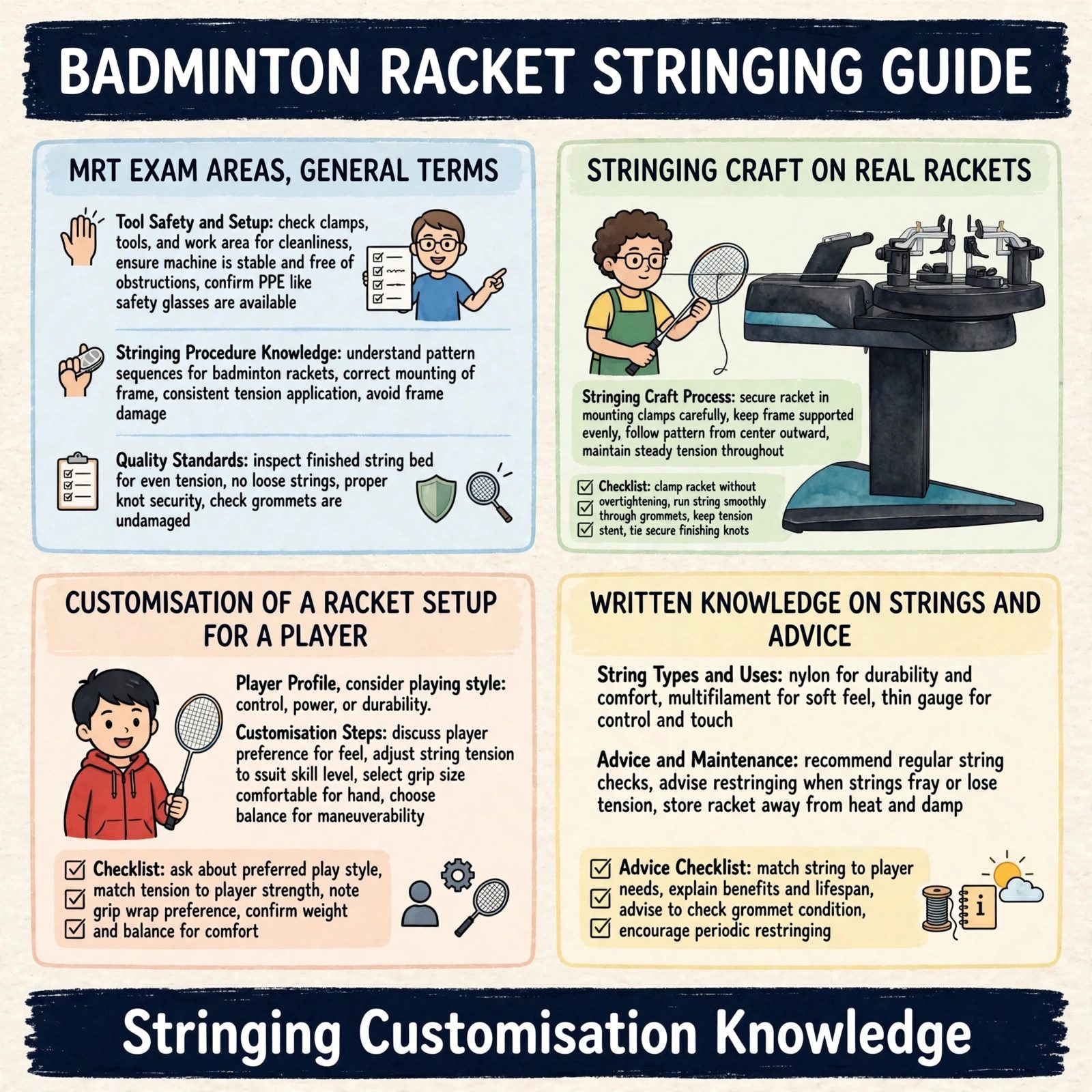
The MRT exam works in broad sections rather than one narrow task. The stringing section checks the craft itself: frame inspection, safe mounting, clean weaving, delivered tension, clamp control, knots and grommet care on real rackets. The customisation side covers adjusting a racket setup for a player, the kind of work a top counter technician does when a standard setup does not suit. The knowledge side is tested in writing: strings, racket technology and advice for players. This guide names the sections in general terms only, because honest explainers do not invent section marks, pass scores or weightings that the body has not put in front of them.
That breadth changes who the exam suits. A stringer who only restrings one sport to a high standard will find parts of MRT scope outside daily work, and will need deliberate study and practice to cover them. A counter technician who already customises setups and advises players daily starts much closer to the tested ground.
Badminton candidates should read the scope with their own rackets in mind. Badminton strings run at 0.65mm to 0.70mm gauges on light frames at high tensions, a touch quite different from heavier racket work. Ask how much examined customisation and stringing practice transfers to your frames, and what extra badminton specific checking you will still need at your own counter.

1.3 Working Method
How does serious preparation build MRT level skill?
MRT level skill is built by widening corrected practice, not by repeating one comfortable job. The stringing half still needs an experienced eye on your hands: clamp pressure, weaving, knots and grommet habits corrected live. The customisation half needs supervised reps too, adjusting real setups and explaining each change, because small setup changes have real effects a player can feel. The written half needs structured study that links theory to counter cases. A mentor who only watches stringing leaves two thirds of the exam uncorrected, so serious candidates plan feedback for all three areas from the start.
Records hold the three areas together. Log each job fully: frame, string, tension, knots, grommet work, any customisation change and the reason for it, plus what the player reported back. That log becomes your study material, your error pattern map and your evidence that your standard holds on ordinary Tuesdays, not only on rehearsed exam rackets.
Ask any preparation route one question per exam area: who corrects my stringing, who checks my customisation work, and who tests my written knowledge before exam day? Routes that answer all three honestly match the title. Routes that answer one and gesture at the others are selling the prestige of MRT without its preparation.

1.4 Practical Review
Which costs and commitments come with the MRT title?
The MRT route carries the full certification cost list plus its own standing duty. Count the categories before you commit. Preparation and training across stringing, customisation and study. The exam fees for the title. Membership standing with the association. Machine and tools, including the wider kit customisation work needs, plus string and materials for practice. Travel and stay where testing requires a trip. Time away from work. The retake arrangement, understood in advance. And after you pass, the annual written update test as a yearly commitment that keeps the title current.
Check the details. No figures are stated here, on purpose. Costs differ by route and change over time, and any exact total quoted without a source and a date would be invented. Ask USRSA and any training provider for current figures category by category, in writing, and file the answers with your certification records.
Review the process. Time is the largest hidden line. Broad scope means broad preparation: three areas to bring to standard together, over weeks or months of logged practice. If you work a shop counter, plan cover for study and exam time early. Candidates who treat MRT as a weekend decision usually discover its real size during preparation, not before it.
Plan the next step. Weigh that against the cost of the wrong title. A foundation credential is cheaper and faster, but it does not claim customisation mastery, and shops read titles accurately. Paying once for the title that matches the work you actually sell is cheaper than upgrading your proof under pressure later, or explaining a gap at a hiring counter.

1.5 Key Checks
How does MRT compare with the other credentials?
Record the context.
Compare MRT against the other credentials on the same four points. Sport scope: MRT is general racket scope at the highest USRSA level, tennis centred. Exam format: written and practical sections across stringing, customisation and knowledge. Verification: the pass is recorded by USRSA, the association behind the title. Maintenance: MRT stands out here, because the title is maintained by an annual written update test, a duty the foundation Certified Stringer status does not carry in the same way, since that status itself has no expiry and its listing is tied to current membership.
Check the details.
Inside the USRSA ladder, Certified Stringer proves foundation stringing competence, Professional Racquet Advisor focuses on player advice, and MRT combines the widest scope at the top. GRSA and ERSA run their own graded systems across racket sports internationally and in Europe, and CRSF certifies inside China. Each ladder should be read by its own scope, not by how grand a title sounds in isolation.
Review the process.
BSW is not a rung on the USRSA ladder and does not pretend to be. It is a separate badminton specific route: practical exam on real badminton rackets, results assessed and approved by the BSW certification board. A candidate choosing between MRT breadth and BSW depth is choosing a scope, and the right answer depends on the rackets waiting at their counter each week.

1.6 Service Record
How does the BSW route measure up beside MRT?
Hold BSW beside MRT on the same four points, honestly. Sport scope: BSW is badminton only, far narrower than MRT, and deeper on badminton gauges, tensions and frames. Exam format: BSW is a practical exam on real rackets, without MRT written and customisation breadth. Verification: BSW results are assessed and approved by the BSW certification board and recorded by the organisation. Maintenance and limits are stated plainly: BSW runs in Kuala Lumpur only, claims no government licence, and carries a shorter history than USRSA.
Check the details. The BSW training shape is fixed and public. Three and a half days, classes from 10am to 5pm, flexible timing on dates, practical exam on the last day, training on real rackets with instructor correction throughout. Founder Eric Chuar teaches from his Kuala Lumpur base, while the certification decision belongs to the BSW certification board as an organisation, not to one person judging alone.
Review the process. Where MRT measures stronger, say it without flinching. It is the recognised top title of a long established association, it proves customisation range no badminton only exam claims, and its annual update test is a public sign of maintained knowledge. A technician building a general racket career, above all in the United States, has real reasons to choose it.
Plan the next step. The deciding question is not which title sounds higher. It is which exam tests the work your players actually hand you. Ask both bodies how a pass is verified, what exam day covers and what duties follow a pass. Compare the written answers. Titles earn trust when their scope and your work match, and players can feel that match at the counter.

1.7 Guided Practice
What should you ask before applying for a top title?
Before applying for a top title, make the body prove the fit. State your sport mix, your stringing volume, whether customisation is part of your paid work, your machine and the jobs you want the title for. Ask what each exam section covers in general terms, who assesses it, and how an employer verifies a pass. Ask the full cost category by category, including the yearly update duty after MRT and the retake arrangement. Ask what happens if you fail one part. Write the answers down and score them with the comparison method in this guide before committing.
Timing questions protect your preparation. Ask how long candidates usually prepare, when testing runs, and what ongoing testing follows a pass. At BSW, training is in Kuala Lumpur only, classes from 10am to 5pm, the course takes 3 and a half days with the exam on the last day, and timing is flexible. Any body should be able to state its own demands, including update duties, just as plainly.
Build the preparation plan from the exam sections, not from hope. One block for stringing reps with feedback, one for customisation practice with reasons logged, one for written study, if your chosen title tests all three. Keep the job log running through all of it. By exam day, each section should feel familiar, because you have already worked it under watchful eyes.
Master Racquet Technician Quick FAQ
Short answers on the MRT title, what its exam covers, its yearly update test, and how the BSW route compares beside it.
What is a Master Racquet Technician and what does it prove?
Master Racquet Technician is the top USRSA credential. It tests stringing, customisation and player advice knowledge through written and practical sections, and it is maintained by an annual written update test. It covers racket sports generally, with tennis at the centre, rather than badminton alone.
What does the MRT exam test?
The MRT exam covers three broad areas in general terms: stringing craft on real rackets, customisation of racket setup for players, and written knowledge on strings, rackets and player advice. This guide invents no marks, scores or section weightings, because honest scope reading stops at what is established.
How does preparation build MRT skill?
MRT preparation needs corrected practice in all three tested areas: stringing craft with live feedback, customisation work on real player setups with reasons explained, and structured written study. Keeping a full job log links the areas and shows where your errors repeat before an examiner finds them.
Which costs come with the MRT title?
The MRT route carries the full certification cost list plus its own standing duty. Count the categories before you commit. Preparation and training across stringing, customisation and study. The exam fees for the title. Membership standing with the association. Machine and tools, including the wider kit customisation work needs, plus string and materials for practice. Travel and stay where testing requires a trip. Time away from work. The retake arrangement, understood in advance. And after you pass, the annual written update test as a yearly commitment that keeps the title current.
How does MRT compare?
MRT is the top USRSA title: general racket scope, written plus practical exams across stringing, customisation and knowledge, and an annual written update test. Certified Stringer is the foundation title in the same system. BSW is a different model: badminton specific and practical, assessed in Kuala Lumpur.
How does BSW measure up beside MRT?
Beside MRT, BSW trades breadth for badminton depth. MRT covers general racket stringing, customisation and written knowledge at the top USRSA level, maintained by a yearly written update test. BSW tests badminton practically on real rackets, with results assessed and approved by the BSW certification board. BSW training runs in Kuala Lumpur only, 3 and a half days, classes from 10am to 5pm, flexible timing, exam on the last day. If your work is broad racket customisation, MRT fits. If your work is badminton stringing, the specific exam fits.
What should you ask before applying?
Before applying for a top title, make the body prove the fit. State your sport mix, your stringing volume, whether customisation is part of your paid work, your machine and the jobs you want the title for. Ask what each exam section covers in general terms, who assesses it, and how an employer verifies a pass. Ask the full cost category by category, including the yearly update duty after MRT and the retake arrangement. Ask what happens if you fail one part. Write the answers down and score them with the comparison method in this guide before committing.
What should you keep from your certification route?
Keep your pass record, the body confirmation, your update test records where your title requires them, and your own job log: string, tension, customisation changes and reasons per racket. The log is what proves top title standard on ordinary working days.
How can I start with BSW
Start with an enquiry stating your sport, experience, machine and the work you want certification for. BSW trains in Kuala Lumpur only, flexible timing, classes from 10am to 5pm over 3 and a half days, practical exam on the last day. Results are assessed and approved by the BSW certification board.
Master Racquet Technician: Explore the Practical Decisions
Build a Clear Working Method
The method is simple: write the criteria first, score MRT and every other route against the same criteria, and keep the record so your choice can be explained to any employer.
| MRT Check | Rushed Approach | Planned Approach |
|---|---|---|
| Title | Treat MRT as a longer stringing course | Check the full scope the top title covers |
| Exam | Prepare only for the stringing tasks | Prepare for customisation, stringing and knowledge |
| Costs | Budget for the exam fee only | List training, tools, travel and update duties |
| Scorecard | Choose MRT on prestige alone | Score every route against the same criteria |
| Your record | Keep credential comparisons in your head | Write each title scope and duties down |
| Next action | Judge a title from its name alone | Use the record to choose the title that fits your work |
Compare Your Route with Best Stringer Worldwide
If badminton is your sport, weigh depth beside breadth before you choose a top title. Train on real rackets in Kuala Lumpur with Best Stringer Worldwide, classes from 10am to 5pm over 3 and a half days, flexible timing, and the practical exam on the last day. Your work is assessed and approved by the BSW certification board. Send an enquiry stating your experience, your machine and your goal, and compare the answers in writing.
