






1.1 Starting Point
What does tournament stringer certification say about event readiness?
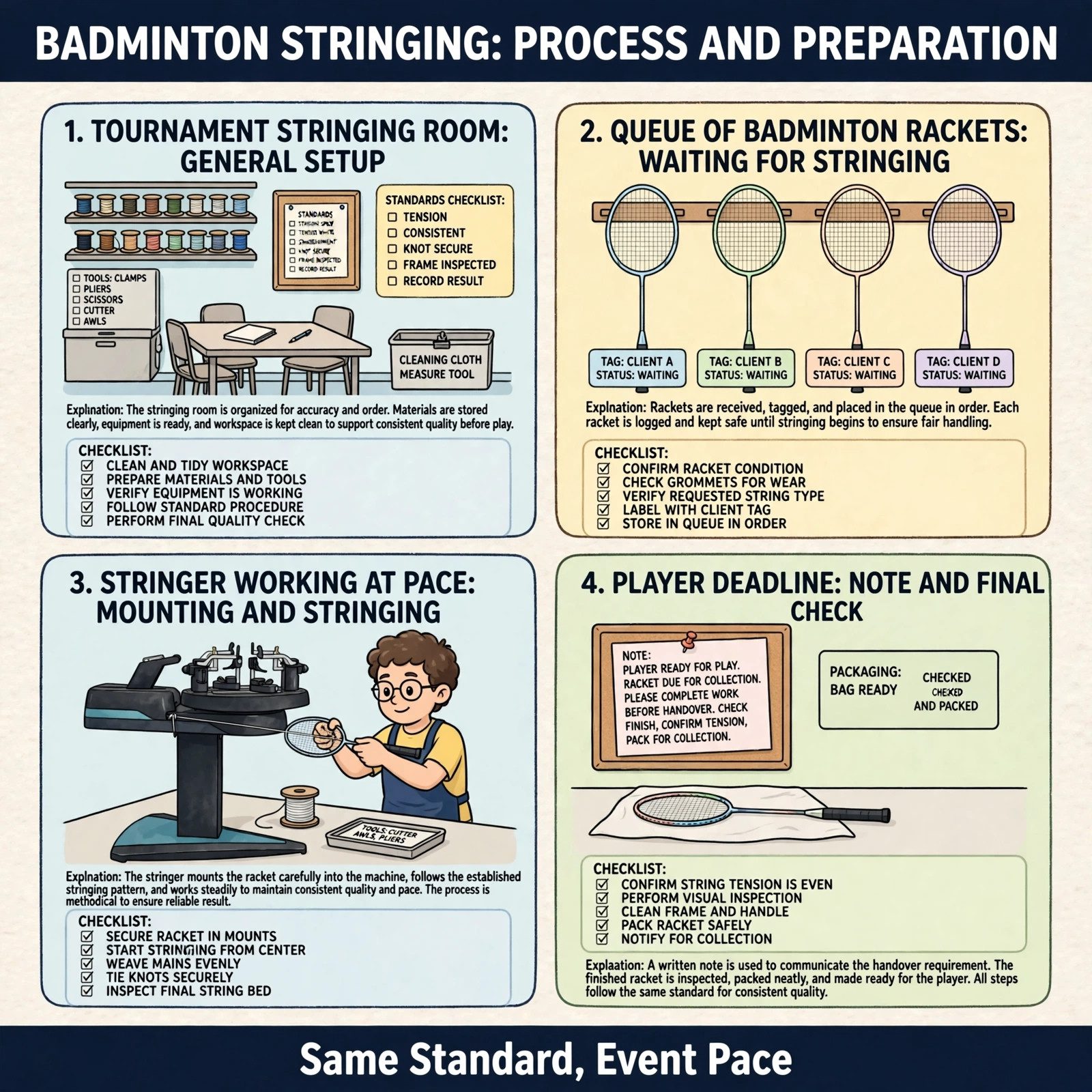
Tournament stringer certification matters because event stringing is ordinary stringing under extraordinary pressure. A tournament room asks for the same things a good shop asks for, delivered tension, clean knots, cared for grommets and safe frames, but it asks for them at pace, in a queue, against player deadlines, on machines that must be checked before the rush starts. Certification speaks to that room because it proves the stringer’s standard was tested under observation, not just claimed at a counter. Best Stringer Worldwide, founded by Eric Chuar and based in Kuala Lumpur, Malaysia, runs a badminton specific practical exam, with results assessed and approved by the BSW certification board.
No certificate strings the racket for you, and this guide does not pretend otherwise. What a tested credential tells an event organiser is narrower and more useful: this stringer has mounted, woven, tensioned and finished real rackets to a set standard while someone marked the work. In a room where a team may hand over a stack of rackets between matches, that proof is the difference between a hopeful volunteer and a known quantity.
Players feel tournament stringing directly. A racket that comes back late, soft or with a knot already slipping can cost a match the player trained months for. That is why events care who strings, why deadlines in the stringing room are treated as seriously as the draw, and why certification, records and machine discipline travel together in every serious event setup.

1.2 Preparation
What does the exam test that tournament rooms depend on?
The exam tasks behind tournament work are the familiar ones, tested in the order the room will demand them. Frame inspection comes first, because event rackets arrive with worn grommets, old damage and no time for surprises. Mounting follows, firm and distortion free, because a frame bent in the machine helps nobody’s match. Weaving and delivered tension are marked closely, since a bed that feels wrong sends the player straight back to your table. Knots and grommet care close the job: shared holes handled patiently, damaged grommets replaced, and a finish check before the racket leaves, every time, however long the queue behind it.
Badminton sharpens every one of those tasks at events. Strings run thin, at 0.65mm to 0.70mm gauges, players ask for high tensions on light frames, and a mishit near the edge can end a bed mid match, which is when the room gets busy. A stringer whose exam covered badminton gauges and frames has already shown the touch those moments need. A general paper weighted toward other sports may still belong to a fine stringer, but the event organiser is guessing about the badminton half.
What the exam cannot test is the room itself. It cannot test your calm when three players need rackets before the next session, or your honesty when a frame arrives cracked and its owner begs you to string it anyway. Certification proves exam day standard. Your event record, built racket by racket and kept in writing, proves the rest, and organisers who run good rooms ask for both.
1.3 Working Method
How does training build speed without losing accuracy?
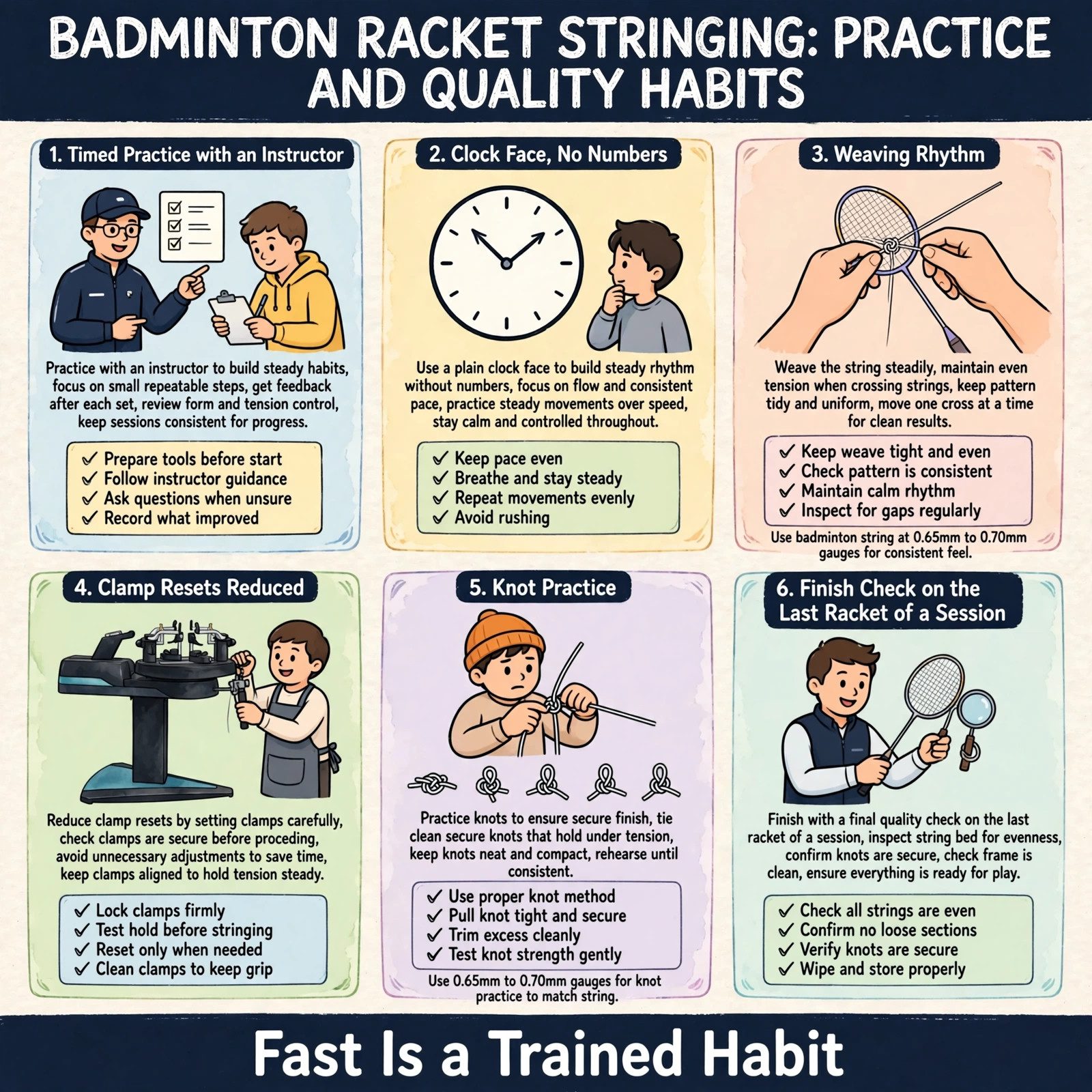
Speed in a tournament room is not a talent, it is a trained habit stack. The stringers who look fast are doing fewer wasted movements: frame read before mounting, string measured and ready, clamps set right the first time, crosses woven in a steady rhythm, knots tied the same way on every racket. Training builds that stack under a watchful eye. An instructor timing your rackets can see where your minutes leak, a hesitation at the shared holes, a clamp reset three times, a knot retied, and correct the movement while it is still cheap to fix.
Accuracy has to survive the pace, and that is the real training target. Anybody can string quickly by skipping the finish check. Event standard means the last racket of a long session is inspected like the first: tension felt across the bed, crosses straightened, grommets glanced over, frame checked again before it is bagged. Practice that ends when you are tired, not when you feel fresh, is the practice that prepares you for the room as it actually is.
Ask any provider one question before you enrol: will my practice be timed and corrected, or only watched? Videos can show you a fast stringer’s hands, and they are worth studying, but they cannot time yours or spot your leak. If an instructor stands at the machine, clocks your rackets and marks your work against the exam standard, your pace and your accuracy grow together, which is the only kind of fast an event can use.

1.4 Practical Review
Which costs and commitments come with tournament level certification?
Tournament level certification carries the same full set of costs as any serious certification, and honest planning lists every category before you commit. The course or training fee, where you take one. The exam or assessment fee itself. A machine and tools you can trust at pace, if you do not already own them: a reliable machine, clamps, cutters, awl and starting clamp. String and materials for timed practice, because event pace takes real rackets and real string to learn. Travel and stay if your chosen body tests in another city or country. Time away from work. And the retake arrangement, understood before you need it.
Check the details. This guide puts no figures on those categories, on purpose. Fees differ by body, by country and by year, and any page that quotes you a tidy total without naming the body and the date is guessing. Event work itself is usually arranged directly between stringers and organisers, so ask organisers you hope to serve what they ask for and how their rooms are staffed, in general terms, before you price your own route.
Review the process. Commitment is the heavier half for tournament hopefuls. Timed practice has to become a weekly habit, not a pre exam cram, because pace fades faster than knowledge. You also commit to machine discipline: checking your machine’s calibration and clamps before sessions, keeping spares and tools organised, and arriving at any event room ready to check an unfamiliar machine before trusting it with a player’s racket.
Plan the next step. There is also a cost to chasing event work untested, and it is paid in one bad evening. A stringer who folds under a deadline queue, or sends out beds that feel wrong, is remembered by exactly the organisers and players he hoped to impress. A tested standard, plus a practice record you can show, costs more up front and protects the reputation the whole plan depends on.

1.5 Key Checks
How do you judge a credential for event stringing work?
Record the context.
Judge any credential for tournament work the way a good organiser would. First, exam reality: was the stringer tested on real rackets, under observation, on the tasks the room depends on? Second, sport depth: for badminton events, did the exam use badminton gauges, tensions and frames? Third, verification: can the organiser confirm the pass with the body before handing over a queue of rackets? Fourth, maintenance: does the credential stay current through update tests or membership standing? Write the answers down for each body you are considering, and keep your own timed practice record beside them.
Check the details.
The established bodies each bring something to this sheet. USRSA certifies across racket sports through Certified Stringer, Master Racquet Technician and Professional Racquet Advisor credentials, with written and practical sections, and its MRT title is maintained by an annual written update test. GRSA and ERSA certify across racket sports internationally and in Europe, and CRSF works within China’s large badminton scene. Event stringing in tennis heavy markets leans on those names, and this guide does not pretend otherwise.
Review the process.
Machine checks belong on the same sheet, because events are where unfamiliar machines appear. A certified stringer should arrive able to check a machine before the rush: clamps holding without marking string, tension pulling true, turntable and mounts secure, tools complete. Certification does not calibrate the machine for you. It should have trained the habit of checking, and your record should show you do it every session, at home and away.

1.6 Service Record
How does the BSW route measure up for tournament hopefuls?
Now hold the BSW route against the same event checks, with no special pleading. Exam reality: practical, on real badminton rackets, covering the tasks a badminton room depends on. Sport depth: badminton only, which suits badminton events and says nothing about tennis rooms. Verification: results are assessed and approved by the BSW certification board, and graduates are recorded by the organisation. Setting: Kuala Lumpur only, stated openly, with flexible timing for learners travelling in to train.
Check the details. The training shape is fixed and public. The course runs 3 and a half days, with classes from 10am to 5pm and flexible timing on dates, and the practical exam sits on the last day. Learners train on real rackets with instructor correction, building the checking habits the training section of this guide describes. Founder Eric Chuar teaches from his own stringing and coaching base in Kuala Lumpur, while the certification decision itself belongs to the BSW certification board as an organisation, not to one person.
Review the process. Where does BSW not measure up for events? Say it plainly. BSW is a certification body, not an event staffing agency: it does not place graduates in tournament rooms, and no honest body can promise that a pass becomes event work. The older general bodies also carry wider recognition in tennis centred event markets. What BSW gives a badminton hopeful is the tested standard and the training habits; the event record still has to be earned room by room, starting wherever a first organiser says yes.
Plan the next step. One more check protects you whichever body you choose. Before paying anything, ask what the exam day looks like task by task, how an organiser could verify your pass, and what happens if you fail. BSW answers those questions in the enquiry itself, before enrolment. Judge every body, BSW included, by how directly it answers. Tournament rooms run on trust that can be checked, and your credential should work the same way.
1.7 Guided Practice
What should you ask before aiming at tournament stringing work?
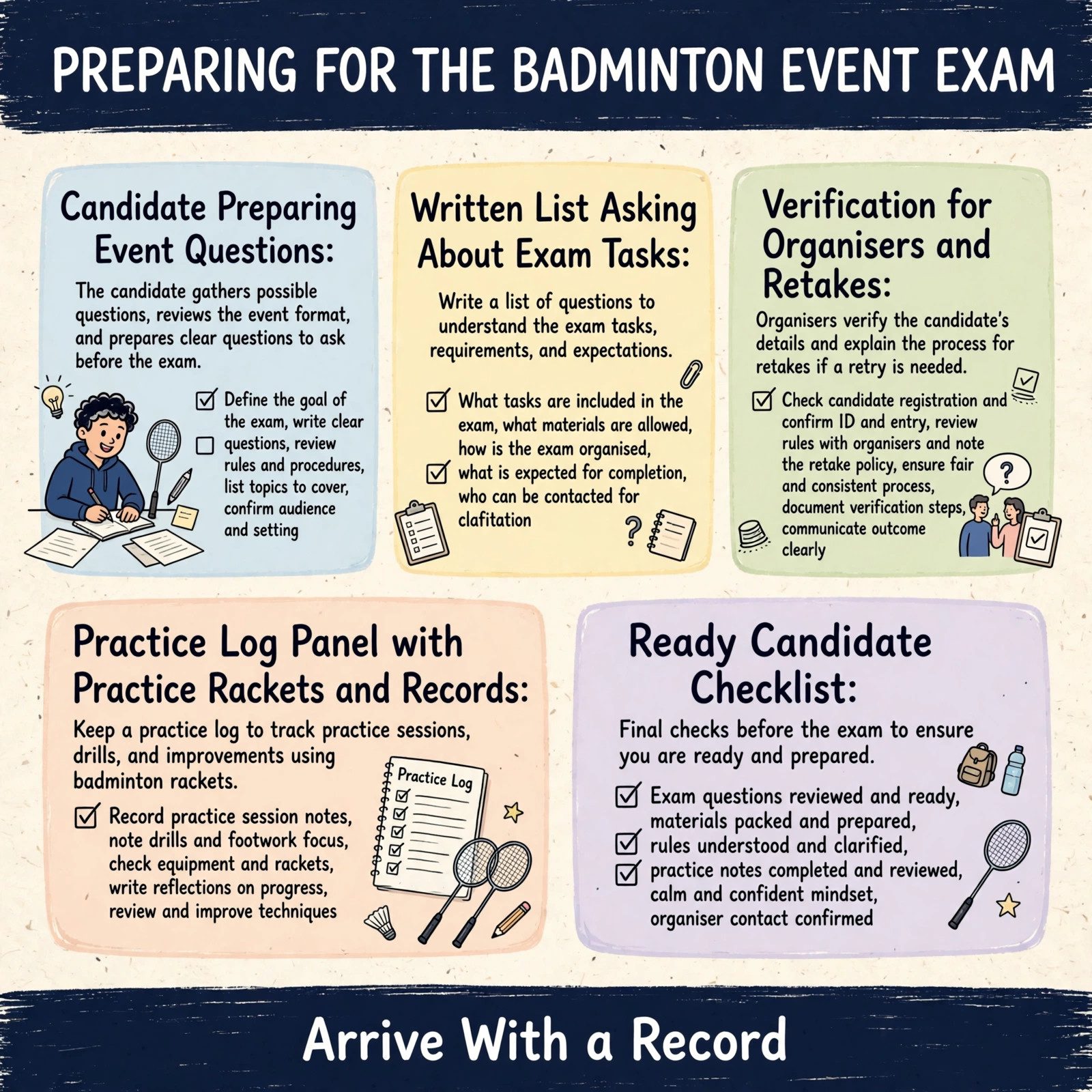
A good enquiry makes the provider prove its standard fits event ambitions. State your sport, your current stringing volume, the machine you use and the work you want the credential for: shop counter, tournament team, academy or your own business. Then ask the deciding questions. Is the exam practical on real rackets, and which tasks does it mark? Does it cover badminton gauges and tensions in depth? Who assesses the result, and can an organiser verify my pass afterwards? What does the full cost look like, category by category, including retakes? What happens if I fail? Write the answers down and score them with the comparison method from this guide before you commit money or travel.
Timing questions matter as much as exam questions. Ask when training runs, how long it lasts each day, and whether dates can flex around your work. At BSW, training is in Kuala Lumpur only, classes run from 10am to 5pm, the course takes 3 and a half days with the exam on the last day, and timing is flexible so learners travelling in can plan around flights and work. Any provider should be able to state its own shape just as plainly.
Turn the answers into a preparation plan the same day. Set timed practice sessions, record your pace and your fault list together, and rehearse your machine checks until they are automatic: clamps, tension, mounts, tools. By exam day your log should show standard held at pace, not once but repeatedly. That log, kept after you pass, is the document that turns a certificate into a first event conversation.
Tournament Stringer Certification Quick FAQ
Short answers to the questions stringers ask first about tournament work, event pace, deadlines and machine checks.
What does tournament certification say about readiness?
Tournament work demands the shop standard at pace: delivered tension, clean knots, grommet care and safe frames, against player deadlines and in a queue. Certification helps because it proves that standard was tested under observation before the event ever trusted the stringer.
What does the exam test for event work?
The exam tests frame inspection, distortion free mounting, clean weaving, delivered tension, clamp control, starting and finishing knots and grommet care on real rackets. For badminton events, thin 0.65mm to 0.70mm string and light frames make each of those tasks sharper.
How does training build speed with accuracy?
Speed with accuracy is built by timed practice with correction: an instructor watches your weaving rhythm, clamp work and knots while the clock runs, and fixes the habits that cost seconds or accuracy. Speed built on skipped checks collapses in a real tournament queue.
Which costs and commitments come with it?
Tournament level certification carries the same full set of costs as any serious certification, and honest planning lists every category before you commit. The course or training fee, where you take one. The exam or assessment fee itself. A machine and tools you can trust at pace, if you do not already own them: a reliable machine, clamps, cutters, awl and starting clamp. String and materials for timed practice, because event pace takes real rackets and real string to learn. Travel and stay if your chosen body tests in another city or country. Time away from work. And the retake arrangement, understood before you need it.
How do you judge a credential for events?
Judge a credential for event work on four points: whether its exam is practical on real rackets, whether it covers your sport in depth, whether an organiser can verify the pass, and whether your own timed practice record backs the paper. Event trust is paper plus record, never paper alone.
How does the BSW route measure up?
Measured against the same event checks, the BSW route gives a tournament hopeful a badminton specific practical standard: an exam on real badminton rackets covering tension accuracy, knots, grommet care and light frame handling, assessed and approved by the BSW certification board. Training is hands on in Kuala Lumpur, running 3 and a half days with classes from 10am to 5pm and the exam on the last day. BSW does not place stringers at events or promise event work, and it runs in Kuala Lumpur only.
What should you ask before aiming at events?
A good enquiry makes the provider prove its standard fits event ambitions. State your sport, your current stringing volume, the machine you use and the work you want the credential for: shop counter, tournament team, academy or your own business. Then ask the deciding questions. Is the exam practical on real rackets, and which tasks does it mark? Does it cover badminton gauges and tensions in depth? Who assesses the result, and can an organiser verify my pass afterwards? What does the full cost look like, category by category, including retakes? What happens if I fail? Write the answers down and score them with the comparison method from this guide before you commit money or travel.
What should you keep from your tournament preparation?
Keep your exam result record, the body’s confirmation of your pass, your training notes and a timed practice log: string, tension, knots, grommet work and your time per racket. That log is the evidence you show an organiser alongside the certificate when you ask for a first event chance.
How can I start with BSW?
Start with an enquiry that states your sport, your stringing experience, your machine and the event work you are aiming for. BSW trains in Kuala Lumpur only, with flexible timing, classes from 10am to 5pm over 3 and a half days and the practical exam on the last day. Your result is assessed and approved by the BSW certification board.
Tournament Stringer Certification: Explore the Practical Decisions
Build a Clear Working Method
The method is simple: judge every credential against the room it claims to prepare you for, score the answers on the same sheet, and keep your timed record so your readiness can be shown, not just said.
| Tournament Check | Rushed Approach | Planned Approach |
|---|---|---|
| Standard | Hope fast hands are enough for event work | Hold exam standard at tournament pace |
| Exam | Practise only slow, careful stringing | Prepare tension, knots and checks under time pressure |
| Costs | Budget for the course fee only | List training, tools, travel and time together |
| Scorecard | Choose the credential with the boldest claim | Score routes on event readiness and verification |
| Your record | Keep event readiness in your head | Write your pace, accuracy and machine checks down |
| Next action | Judge event readiness from one relaxed restring | Use timed practice records to prove your standard |
Build Event Ready Stringing Standard with Best Stringer Worldwide
If tournament badminton is your aim, build the standard the room depends on. Train on real rackets in Kuala Lumpur with Best Stringer Worldwide, with classes from 10am to 5pm over 3 and a half days, flexible timing, and the practical exam on the last day after your training is complete. Your work is assessed and approved by the BSW certification board. Send an enquiry that states your experience, your machine and your goal, and start with your questions answered in writing.
