






1.1 Starting Point
What are the stringer certification requirements to check before you apply?
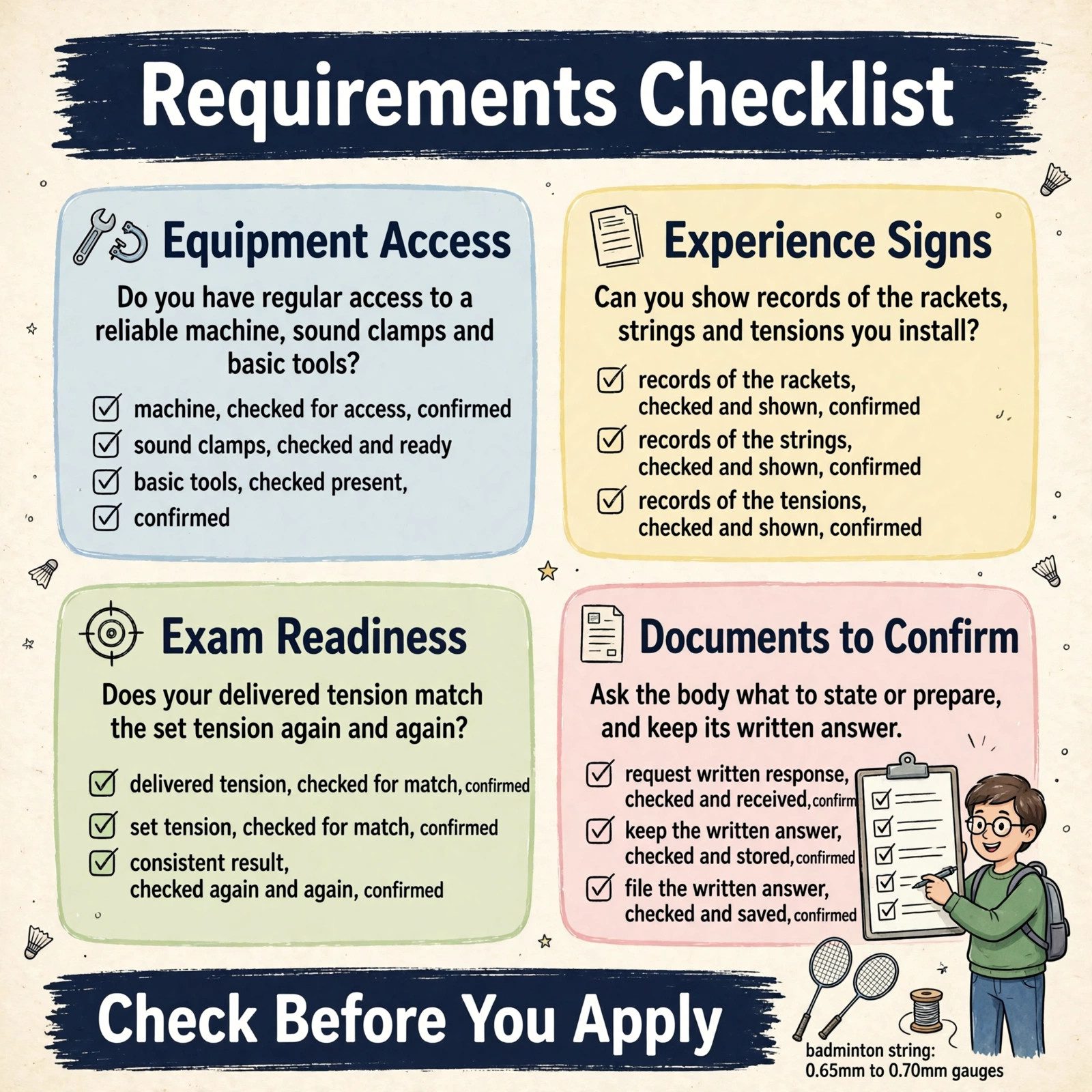
Stringer certification requirements are not one universal list, and any page that gives you a single fixed list for every body is guessing. What you can do before you apply is work through one honest checklist: the equipment you can access, the signs that your stringing is near exam standard, your readiness for the tasks an exam checks, and the documents and questions each body asks you to confirm with it directly. Best Stringer Worldwide, founded by Eric Chuar and based in Kuala Lumpur, Malaysia, states its own shape plainly: training on real rackets in Kuala Lumpur, then a practical exam assessed and approved by the BSW certification board.
Start with the idea that requirements split into two kinds. The first kind is practical and sits in your hands: you can mount a frame safely, deliver the set tension, tie clean knots and care for grommets on real rackets. The second kind is administrative and sits with the body: what it asks you to state, bring or confirm before it books your exam. A serious candidate checks both kinds early, not the week before the exam.
Treat every item on the checklist in this guide as a question to confirm with the body you choose, not as that body’s official rule. Bodies differ in scope and format, and their current wording is the only wording that counts. Your job before applying is to arrive with clear answers, written down, so nothing about exam day is a surprise to you or to the examiner.

1.2 Preparation
Which readiness signs show your stringing is near exam standard?
Exam readiness is judged by signs, not by how confident you feel. The signs examiners look for are plain to see in practice. Your delivered tension matches the set tension again and again, not once in a while. Your starting and finishing knots look the same on every racket and hold without slipping. You spot worn or damaged grommets before stringing, not after a string breaks. You mount frames firmly without distortion, weave crosses cleanly without burning the mains, and finish a racket you would hand to a player without a quiet apology.
Experience signs are different from experience claims. Saying you have strung for years tells a body very little. Showing records helps far more: the strings and tensions you install, the racket models you meet, the grommet jobs you have done and the mistakes you have learned to catch. A candidate with honest records can point to readiness. A candidate with only years has to hope the examiner believes the story.
Badminton sets its own readiness bar inside that list. Strings run thin, at 0.65mm to 0.70mm gauges, and tensions run high for such light frames, so rough clamping, dragged crosses and lazy knot tails show up fast. Practise on the gauges, tensions and frame sizes you will actually meet, with rackets such as the Yonex 100ZZ and Astrox 88D in mind, rather than on whatever happens to be lying around the shop.

1.3 Working Method
What equipment access do you need before you apply?
Equipment access is a requirement candidates often leave too late. You do not need to own every tool before you apply, but you do need regular access to a reliable stringing machine, sound clamps, cutters, an awl and a starting clamp, plus string and practice rackets to work on. Access that disappears the week before the exam is not access. If you string at a shop, agree your practice time with the shop early. If you rely on a friend or a club machine, confirm the arrangement in plain words.
Check the machine itself as part of your readiness. Clamps should hold without marking string. The tension head should pull consistently. Mounting points should hold a light badminton frame firmly without squeezing it out of shape. Practising for months on a machine that drifts teaches your hands the wrong feel, and exam day on a different machine then feels harder than it should.
Training with feedback closes the gap between access and readiness. An instructor watching your work can correct clamp pressure, weaving angle and knot habits while they are still habits in formation. Videos can show the order of steps, but they cannot see your hands. Before you apply, arrange at least some watched practice, so your checklist rests on correction and not only on repetition.

1.4 Practical Review
Which documents and details should you confirm with each body?
Documents and paperwork are the part of the requirements you confirm body by body, because no two bodies ask for exactly the same things in exactly the same way. In general terms, expect to state who you are, what stringing experience you have, what work you want the credential for and which exam or level you are applying for. A body may ask for training records, practice records or proof of earlier qualifications where those apply. None of that should be guessed. Ask the body what it wants, in writing, and keep its answer with your application notes.
Check the details. The same confirm first habit covers the money and time side. Ask for the current course, exam, materials, travel and retake arrangements as categories, in writing, rather than accepting a single tidy total. This guide states no figures for any body, because figures change and only the body’s current answer counts on the day you apply.
Review the process. Timing belongs on the checklist too. Confirm how long training runs, what hours each day holds and whether dates can move around your work. At BSW the shape is public: Kuala Lumpur only, classes from 10am to 5pm, 3 and a half days with the practical exam on the last day, and flexible timing on dates.
Plan the next step. Leave margin in every part of the plan. Practice rackets take longer to arrange than you expect. Travel eats rest if you cut it fine. A candidate who arrives rested, with documents confirmed and equipment access settled, starts the exam ahead of a stronger stringer who sorted everything in a rush the night before.
1.5 Key Checks
How do you compare requirements across certification bodies fairly?
Record the context.
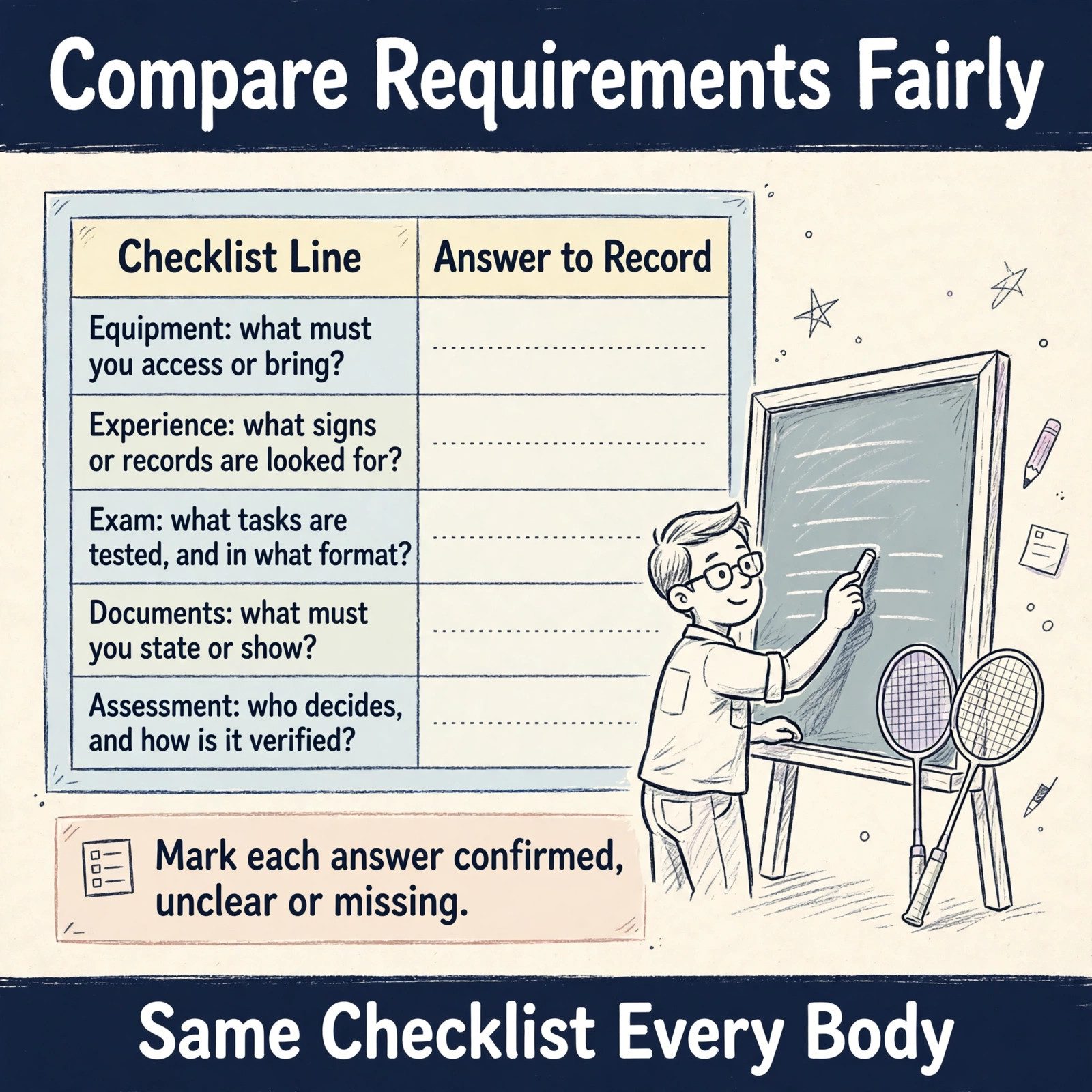
The comparison method for requirements is simple: build one checklist, then ask every body the same questions against it and write the answers side by side. Equipment: what must you access or bring? Experience: what signs or records does the body look for? Exam: what tasks are tested, in what format, on what rackets? Documents: what must you state or show? Standing: who assesses the result and how can it be verified later? A body that answers each line clearly is easy to prepare for. A body that answers none of them is asking you to apply on trust.
Check the details.
Use public facts where they exist and general terms where they do not. USRSA, for example, runs credentials named Certified Stringer, Master Racquet Technician and Professional Racquet Advisor, with written and practical sections, while GRSA and ERSA certify stringers across racket sports in international and European settings and CRSF works within China, where badminton carries real weight. Their current application details are theirs to state, so ask each body directly rather than copying a summary page.
Review the process.
Mark each answer on your checklist as confirmed, unclear or missing. Confirmed answers shape your preparation plan. Unclear answers get one follow up question. Missing answers are a warning, especially on exam scope and on what happens after a fail. Do not let a smart looking certificate design fill a gap that only a written answer should fill.
1.6 Service Record
How does the BSW route state its requirements on the same checklist?
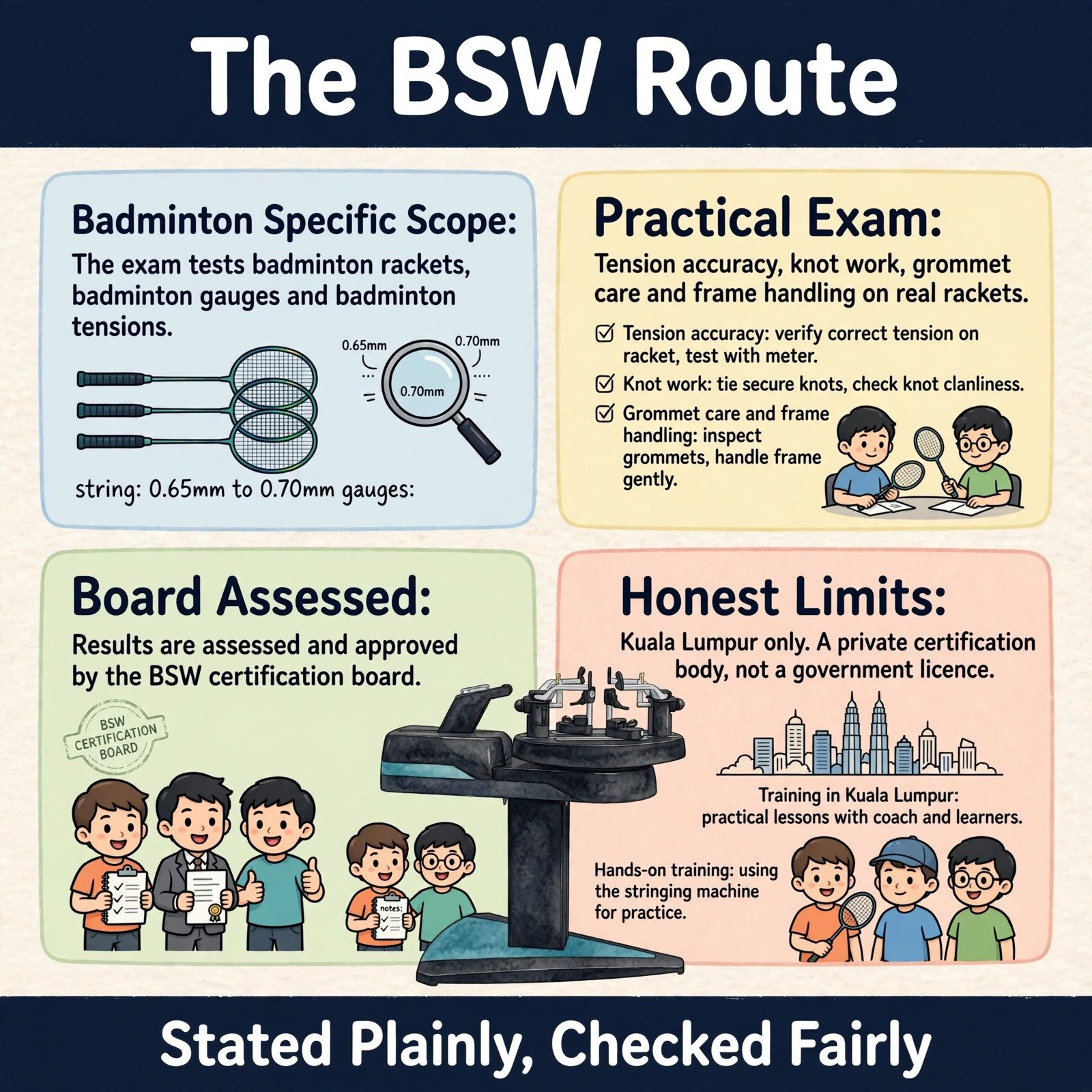
Hold the BSW route against the same checklist, with no special pleading. Equipment and practice: learners train on real rackets during the course, and candidates do well to arrive with regular machine access behind them. Exam scope: practical and badminton specific, covering tension accuracy, knot work, grommet care and frame handling. Assessment: results are assessed and approved by the BSW certification board as an organisation. Place and timing: Kuala Lumpur only, classes from 10am to 5pm over 3 and a half days, the practical exam on the last day and flexible timing on dates.
Check the details. What BSW asks you to confirm in the enquiry is equally plain. State your stringing experience, the machine you use, the rackets you string most and the work you want certification for. Those details let the board’s team answer your readiness questions honestly, including whether more practice should come before an exam attempt rather than after a failed one.
Review the process. The honest limits belong on the checklist too. BSW is a private certification body, not a government licence, and it offers no course outside Kuala Lumpur. Its scope is badminton, which is a strength for badminton stringers and a limit for anyone who wants one credential to cover every racket sport. Older general bodies carry wider name recognition, especially in tennis, and that may matter more for some shop jobs.
Plan the next step. Judge the requirements conversation itself as a test of the body. BSW answers checklist questions in the enquiry, before enrolment and before money moves. Expect the same directness from any body you approach. A provider who will not say what it requires is unlikely to mark your exam against a clear standard either, and players can sense that kind of vagueness at the counter.
1.7 Guided Practice
What should your application enquiry confirm before you enrol?
Your application enquiry is where the checklist becomes action. State your sport, your current stringing volume, the machine you can access, the strings and tensions you install most, strings such as Yonex BG65, BG66 Ultimax and BG80 or KIZUNA Z61 at 25 to 27 lbs for example, and the work you want the credential for. Then ask the body to confirm its requirements line by line: equipment, experience signs, exam tasks, documents, costs by category and the retake arrangement. Keep every answer. The written set you collect is your preparation plan in waiting.
Timing questions sit beside the exam questions. Ask how long training runs, what the daily hours are and how flexible the dates are around your work and travel. BSW trains in Kuala Lumpur only, from 10am to 5pm, over 3 and a half days with the exam on the last day, and timing is flexible. Any serious body should state its own shape just as clearly when asked directly.
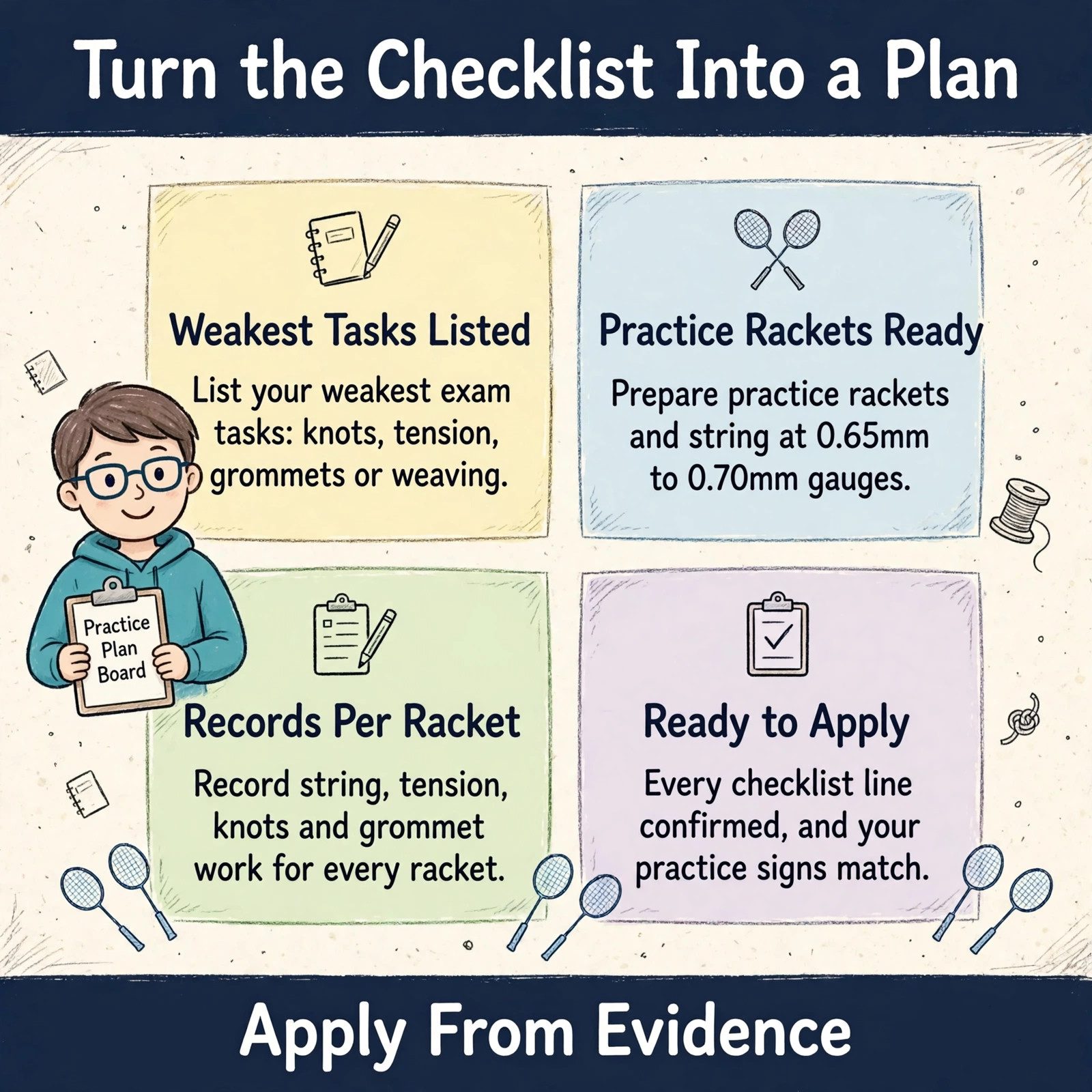
Turn the confirmed answers into a dated practice plan the same week. List your weakest exam tasks, the rackets and string you will practise with, the records you will keep and the date you will review the checklist again. When every line reads confirmed and your practice signs match the readiness list, you are applying from evidence. That is the position strong candidates apply from, and examiners can tell.
Stringer Certification Requirements Quick FAQ
Short answers to the questions candidates ask first about stringer certification requirements, readiness, equipment, documents and confirming the details with each body.
What are the stringer certification requirements to check before you apply?
There is no single global list of stringer certification requirements. Work through equipment access, signs of stringing experience, exam readiness and the documents and questions each body asks you to confirm with it directly, and treat the body’s own current answers as the rule.
Which readiness signs show your stringing is near exam standard?
Readiness shows in repeatable signs: delivered tension matching the set tension, consistent knots, grommet problems spotted before stringing, safe mounting and clean weaving on real rackets. Records of your work prove those signs better than a claim about years spent stringing.
What equipment access do you need before you apply?
You need regular, confirmed access to a reliable machine, sound clamps and basic tools, plus string and practice rackets. Check the machine holds tension and clamps cleanly, and arrange some watched practice so an instructor can correct your habits before you apply.
Which documents and details should you confirm with each body?
Documents and paperwork are the part of the requirements you confirm body by body, because no two bodies ask for exactly the same things in exactly the same way. In general terms, expect to state who you are, what stringing experience you have, what work you want the credential for and which exam or level you are applying for. A body may ask for training records, practice records or proof of earlier qualifications where those apply. None of that should be guessed. Ask the body what it wants, in writing, and keep its answer with your application notes.
How do you compare requirements across certification bodies fairly?
Build one checklist covering equipment, experience signs, exam tasks, documents and who assesses the result. Ask every body the same questions, write the answers side by side, and mark each one confirmed, unclear or missing before you commit.
How does the BSW route state its requirements on the same checklist?
Against the same checklist, BSW states its shape plainly: badminton specific practical training on real rackets in Kuala Lumpur, classes from 10am to 5pm over 3 and a half days, the exam on the last day, and results assessed and approved by the BSW certification board. Confirm your own readiness details in the enquiry before enrolling.
What should your application enquiry confirm before you enrol?
Your application enquiry is where the checklist becomes action. State your sport, your current stringing volume, the machine you can access, the strings and tensions you install most, strings such as Yonex BG65, BG66 Ultimax and BG80 or KIZUNA Z61 at 25 to 27 lbs for example, and the work you want the credential for. Then ask the body to confirm its requirements line by line: equipment, experience signs, exam tasks, documents, costs by category and the retake arrangement. Keep every answer. The written set you collect is your preparation plan in waiting.
What should you keep from your certification route?
Keep the body’s written answers to your checklist, your practice records with strings, tensions, knots and grommet work per racket, your training notes and any documents the body asked you to prepare. Together they show what you confirmed, how you prepared and what standard your work had reached before exam day.
How can I start with BSW?
Start with an enquiry that states your experience, your machine access and the work you want certification for, and ask BSW to confirm its requirements with you. BSW trains in Kuala Lumpur only, with flexible timing, classes from 10am to 5pm over 3 and a half days and the practical exam on the last day. Your result is assessed and approved by the BSW certification board.
Stringer Certification Requirements: Explore the Practical Decisions
Build a Clear Working Method
The method is simple: write the checklist first, ask every body the same questions against it, and keep the written answers so your application rests on confirmed facts, not on memory or marketing.
| Requirements Check | Rushed Approach | Planned Approach |
|---|---|---|
| Checklist | Apply from a vague idea of the requirements | Work through one written checklist before applying |
| Readiness | Judge readiness by years claimed and confidence | Judge readiness by repeatable signs on real rackets |
| Documents | Guess what each body wants you to prepare | Confirm documents and details with the body in writing |
| Compare | Compare bodies from their marketing pages alone | Score every body against the same checklist lines |
| Your checklist | Keep each body’s answers in your head | Write each body’s confirmed answers side by side |
| Next action | Rely on memory once you have applied | Use the record to close each open checklist line |
Start Your Requirements Checklist with Best Stringer Worldwide
If your checklist is nearly complete, take the route that states its requirements plainly. Train on real rackets in Kuala Lumpur with Best Stringer Worldwide, with classes from 10am to 5pm over 3 and a half days, flexible timing, and the practical exam on the last day after your training is complete. Your work is assessed and approved by the BSW certification board. Send an enquiry that states your experience, your machine access and your goal, and confirm every requirement in writing before you enrol.
