






1.1 Starting Point
Can you get stringer certification without a course through exam only routes?
Can you get stringer certification without taking a course? Sometimes, yes: some certifying bodies offer exam only or challenge routes where an experienced stringer sits the assessment without first completing that body training. The details differ by body and change over time, so treat every route in this guide as something to confirm with the body itself, in writing, before you rely on it. The exam standard does not drop on these routes. Best Stringer Worldwide, founded by Eric Chuar and based in Kuala Lumpur, Malaysia, assesses results through the BSW certification board, and this guide explains who exam only routes suit, what evidence bodies commonly ask for and why most candidates still train first.
Exam only does not mean exam easy, and it never means certification without an exam. It means the preparation is your own responsibility: your years at the machine, your habits and your records must already meet the published standard on the day. A challenge route is a test of existing skill, offered for stringers who can already show the work, not a shortcut around learning the work in the first place.
The honest question is not whether a course is compulsory. It is whether your current stringing would pass today, unseen habits and all. Experienced stringers with tidy knots, checked tensions, proper grommet care and real records are the natural candidates for exam only routes. Stringers who have never been watched, corrected or marked against a standard are usually guessing about their readiness, and an exam fee is an expensive way to find out.

1.2 Preparation
What do exam only routes actually test and require?
An exam only route tests the same work as any other route: frame inspection, safe mounting, clean weaving, delivered tension at the set number, clamp control, starting and finishing knots and grommet care, on real rackets under observation. Bodies commonly ask for evidence before accepting a challenge candidate, and the exact list is theirs to confirm. In general terms, expect questions about your stringing history, the volume and type of rackets you string, the machine you work on and any prior training, shop work or tournament experience you can document honestly.
Badminton scope matters inside that evidence. A long tennis stringing history shows machine skill, but badminton asks for its own touch: thin string at 0.65mm to 0.70mm gauges, light frames at high tensions and patient shared hole work. A body may reasonably want to see badminton rackets in your record, not only racket sport years in general. If your evidence is mostly another sport, say so plainly and ask what the body needs to see from you.
Some bodies add a written section on string knowledge and player advice, and an exam only candidate meets that section with no course notes to lean on. Ask whether written material exists, what topics it covers and how a challenge candidate is expected to prepare. A route that looks simple from outside can carry quiet requirements that only appear when you ask the body directly, which is why written confirmation comes before travel, fees or announcements.

1.3 Working Method
Why do most candidates still train first before the exam?
Most candidates still train first for one plain reason: nobody has ever corrected their stringing. A self taught or shop taught stringer can string for years with a knot that slips slightly, a clamp habit that marks thin string or a grommet shortcut that players feel as early breakage. Training with an instructor puts those habits on the table while they are still cheap to fix. Videos and manuals teach the order of steps, but they cannot watch your hands. Exam only routes remove the correction stage entirely, so they reward candidates whose habits were corrected somewhere else, earlier.
Training also teaches the body own standard from inside. Every body phrases its marking slightly differently: what counts as a clean finish, how tension is checked, what grommet condition passes. A course candidate practises against those exact expectations for days. A challenge candidate must extract the same expectations from published documents and questions, then translate them into practice alone. Skilled stringers can do that translation. Many discover, honestly, that a short training route costs less effort than doing it solo.
There is a confidence difference too. Candidates who trained arrive knowing the exam order, the room habits and the way marking feels. Challenge candidates meet all of that on the day itself, while also being marked. None of this makes exam only routes wrong. It makes them a route for the already standardised stringer, which is a smaller group than the group that first asks about them. Honest self assessment is the entry requirement nobody prints.

1.4 Practical Review
What does an exam only route cost in money and preparation?
Exam only looks cheaper, and sometimes it is, but count the full categories before deciding. You save the training fee where a body charges one separately. You still carry the exam fee itself, your machine and tools in proper order, string and materials for serious practice at volume, travel and stay if the body tests in another city or country, time away from work and the retake arrangement. The hidden category is preparation risk: an uncorrected fault that a course would have caught can turn one exam fee into two, plus a second trip.
Check the details. This guide invents no figures for any body or route, on purpose. Whether a challenge route exists, what it costs and what evidence it needs are facts only the body can give you for your situation and your dates. Ask in writing, keep the answer and price your own practice, travel and retake risk onto the same worksheet you would use for a course route. Only then is the saving real instead of imagined.
Review the process. Practice volume deserves its own honest line. A challenge candidate preparing alone should string complete rackets in exam order, check delivered tension, review knots and grommets and keep a record, over weeks rather than days. That string, those grommets and those hours are a cost of the exam only route just as surely as a course fee is a cost of the training route. Cheap routes that skip practice are not cheap. They are unprepared routes with a fee attached.
Plan the next step. There is also a cost to choosing exam only for the wrong reason: pride. Skipping training to prove you never needed it can end with a fail that a short course would have prevented, and the retake, the travel and the dented confidence cost more than the training did. Choose the route that fits your evidence, not your ego. Examiners mark rackets, not reasons, and the certificate reads the same whichever route a ready candidate took.

1.5 Key Checks
How do you compare exam only routes between bodies fairly?
Record the context.
Compare exam only routes between bodies on the same points you would use for any route, plus two extra questions. The base points: sport scope, exam format on real rackets or paper, whether a pass can be verified with the body afterwards and what maintenance the credential needs. The extra questions for challenge routes: what evidence the body asks for before accepting you, and whether the resulting certificate is the same credential course candidates earn or a different one. Write every answer down. A route a body will not describe in writing is a route you cannot prepare for fairly.
Check the details.
Use the established bodies as your comparison frame, in general terms. USRSA runs Certified Stringer, Master Racquet Technician and Professional Racquet Advisor credentials with written plus practical sections, and its Master Racquet Technician title is maintained by an annual written update test. GRSA and ERSA certify across racket sports, and CRSF works within China. Which of these, if any, offers a challenge route at your level is a question for each body directly, because routes open, close and change conditions.
Review the process.
Score honesty as part of the comparison. A body that tells you its exam only route suits experienced stringers only, names its evidence plainly and warns you the standard is unchanged is treating you fairly. A seller who markets exam free or guaranteed certification to anyone is not describing a challenge route at all. That is the bought paper problem wearing a new label, and it fails the first time a shop checks what was actually tested.

1.6 Service Record
How does the BSW route handle experienced candidates honestly?
Hold the BSW route against the same questions, plainly. BSW route as published is training plus practical exam together in Kuala Lumpur: 3 and a half days, classes from 10am to 5pm, flexible timing, and the practical exam on the last day, with results assessed and approved by the BSW certification board. This guide does not invent a separate BSW exam only scheme. An experienced stringer who believes their work already meets the standard should say exactly that in the enquiry, describe their evidence and ask the board what route, if any, fits. The written answer is the fact. This page is not.
Check the details. That caution protects experienced candidates rather than slowing them down. A stringer with years of badminton work, clean records and tournament or shop evidence may have a shorter honest conversation with the board than a beginner does, because the questions are about verification, not basics. Founder Eric Chuar teaches from his Kuala Lumpur base, while the certification decision belongs to the BSW certification board as an organisation, so route questions are answered by the body, not promised by a person in a chat.
Review the process. Where does the training route beat exam only for a BSW candidate? In correction and calibration. Even strong stringers carry one or two habits a badminton specific examiner will mark down, and 3 and a half days of watched practice finds them before the exam does. If your work is badminton in Asia or with Asian playing communities, a badminton specific standard tested on your actual gauges and frames is worth more than a general pass earned faster elsewhere.
Plan the next step. One check applies whichever body and route you choose. Before paying anything, ask how an employer can verify your pass, what the exam day looks like and what happens if you fail. BSW answers those questions in the enquiry itself, before enrolment. Judge every body, BSW included, by how directly it answers in writing. A real challenge route survives direct questions easily. A paper seller avoids them, and that avoidance is your answer.
1.7 Guided Practice
What should you confirm with each body before choosing exam only?
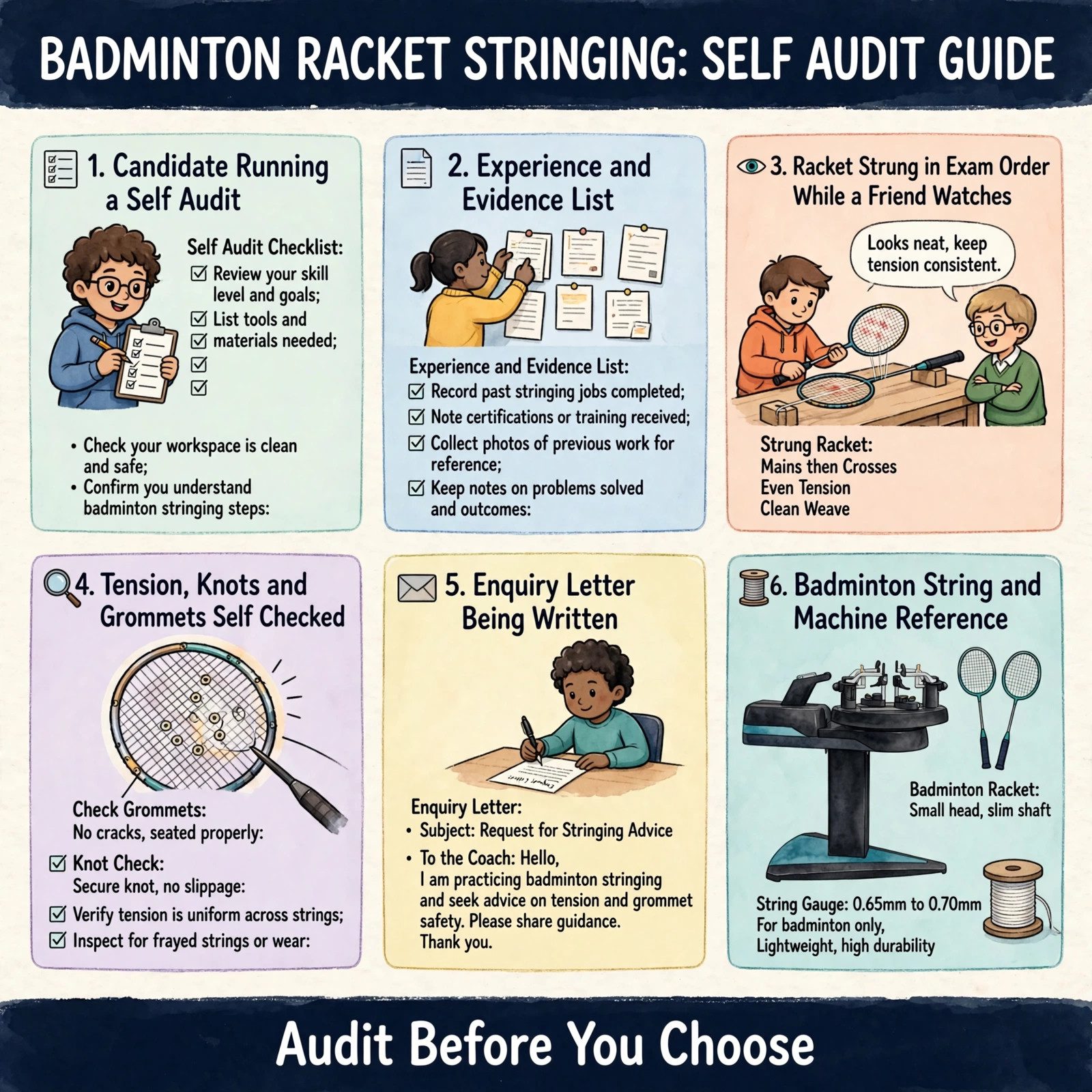
Before choosing exam only, run a written self audit and send a proper enquiry. The audit: list your stringing years, weekly racket volume, sports covered, machine used and any training, shop or tournament evidence you can document. Then string one complete racket in exam order while someone watches, check the delivered tension, inspect your own knots and grommets against the body published standard and write down what you find. If the audit shows gaps, training is not an insult. It is the cheaper route to the same certificate, taken before the exam fee is spent.
The enquiry itself should state your sport, your experience, your machine and the work you want certification for, then ask the route questions directly. Does an exam only or challenge route exist for my level? What evidence do you ask for? Is the certificate the same credential? What are the exam tasks, the retake arrangement and the full cost categories, in writing? At BSW, training runs in Kuala Lumpur only, 10am to 5pm over 3 and a half days with the exam on the last day and flexible timing.
Turn the written answers into a preparation plan the same week. If the body confirms a challenge route and your audit is clean, plan practice rackets, evidence documents and travel around the exam date. If the answers show a training route fits better, book it without treating it as a defeat. Both paths end at the same marked racket. The only wrong route is the one chosen on a guess, and guesses are what written enquiries exist to remove.
Stringer Certification Without a Course Quick FAQ
Short answers to the questions experienced stringers ask about exam only routes, challenge entry, evidence and training first.
Can you get certification without a course?
Some bodies offer exam only or challenge routes for experienced stringers, but availability and rules differ by body and must be confirmed with each body in writing. The exam standard stays the same, so these routes suit stringers whose current work already meets the published standard.
What do exam only routes require?
Exam only routes test the same practical tasks as course routes and usually ask for evidence first: stringing history, racket volume, machine used and documented shop or tournament experience. Exact evidence lists differ by body, so confirm them with the body in writing.
Why do candidates train first anyway?
Most candidates train first because training corrects unseen habits and teaches the body exact standard from inside. Exam only routes remove that correction stage, so they suit stringers whose habits were already corrected and checked somewhere else, not stringers guessing at their readiness.
What does exam only really cost?
Exam only looks cheaper, and sometimes it is, but count the full categories before deciding. You save the training fee where a body charges one separately. You still carry the exam fee itself, your machine and tools in proper order, string and materials for serious practice at volume, travel and stay if the body tests in another city or country, time away from work and the retake arrangement. The hidden category is preparation risk: an uncorrected fault that a course would have caught can turn one exam fee into two, plus a second trip.
How do you compare routes fairly?
Compare exam only routes on sport scope, exam format, verification and maintenance, plus the evidence the body requires from challenge candidates and whether the certificate earned is the same credential. Get every answer in writing before relying on the route.
How does BSW handle experience?
BSW presents its Kuala Lumpur training and practical exam as one route: 3 and a half days, classes from 10am to 5pm, flexible timing, exam on the last day, results assessed and approved by the BSW certification board. Experienced candidates should ask in their enquiry what evidence of prior stringing helps and what the board expects, and confirm any arrangement in writing.
What should you confirm before choosing?
Before choosing exam only, run a written self audit and send a proper enquiry. The audit: list your stringing years, weekly racket volume, sports covered, machine used and any training, shop or tournament evidence you can document. Then string one complete racket in exam order while someone watches, check the delivered tension, inspect your own knots and grommets against the body published standard and write down what you find. If the audit shows gaps, training is not an insult. It is the cheaper route to the same certificate, taken before the exam fee is spent.
What should you keep from your certification route?
Keep the body written route confirmation, the evidence you submitted, your self audit notes and a practice record for every preparation racket: string, set and checked tension, knots and grommet work. Keep your pass confirmation with them. These papers prove how you earned the credential if a shop ever asks about your route.
How can I start with BSW?
Start with an enquiry that states your sport, your stringing experience, your machine and the work you want certification for, and ask what route fits your evidence. BSW trains in Kuala Lumpur only, with flexible timing, classes from 10am to 5pm over 3 and a half days and the practical exam on the last day. Your result is assessed and approved by the BSW certification board.
Stringer Certification Without a Course: Explore the Practical Decisions
Build a Clear Working Method
The method is simple: audit your own work honestly, ask each body for its route and evidence in writing, and choose the route your evidence supports rather than the route your pride prefers.
| Route Check | Rushed Approach | Planned Approach |
|---|---|---|
| Route | Assume exam only exists and book travel | Confirm the route and evidence in writing first |
| Exam | Expect an easier test for experience | Prepare for the same tasks and standard |
| Costs | Count only the saved training fee | Count practice, travel, time and retake risk |
| Compare | Choose the route that sounds fastest | Score bodies on written route answers |
| Your record | Keep route claims from sellers in your head | Write each body route and evidence answers down |
| Next action | Repeat a route claim without confirmation | Use the written answers to choose your route |
Start Your Route with Best Stringer Worldwide
Whether your honest route is training first or a confirmed challenge entry, start with an enquiry that shows your evidence. Train on real rackets in Kuala Lumpur with Best Stringer Worldwide, with classes from 10am to 5pm over 3 and a half days, flexible timing, and the practical exam on the last day. Your work is assessed and approved by the BSW certification board. Send an enquiry stating your experience, your machine and your goal, and ask in writing what route fits you.
