






1.1 Starting Point
Is stringer certification hard and where do candidates struggle?
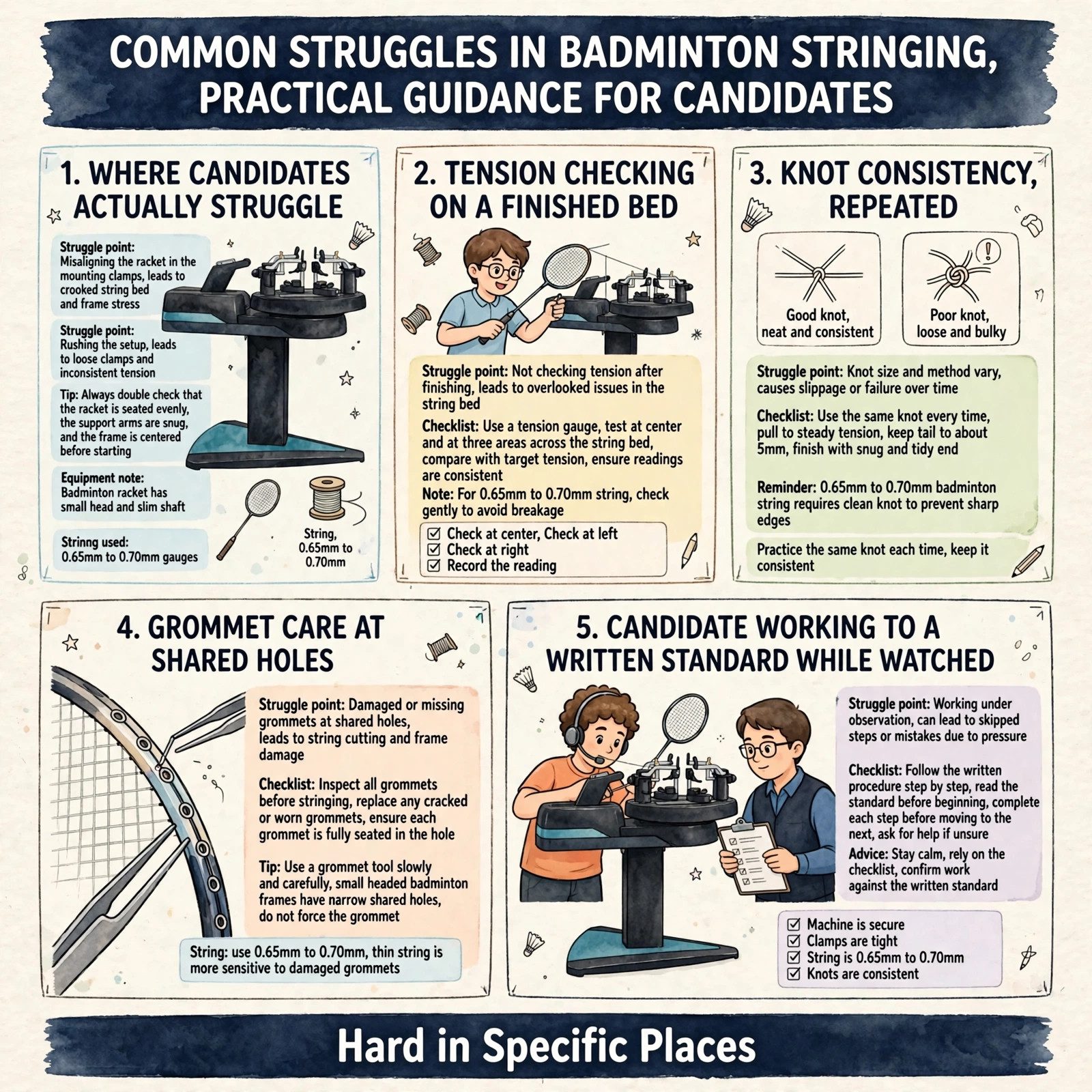
Is stringer certification hard? Honestly, yes in specific places, and no in the way most candidates fear. The exam does not ask for rare talent. It asks for ordinary stringing tasks done to a set standard while an examiner watches: tension delivered accurately, knots tied consistently, grommets cared for, frames handled safely. Candidates struggle where habit replaces standard, because home stringing rewards speed and familiarity while an exam rewards repeatable accuracy. Best Stringer Worldwide, founded by Eric Chuar and based in Kuala Lumpur, Malaysia, runs a practical badminton exam assessed and approved by the BSW certification board, and its difficulty sits in exactly those four places.
No honest page invents a pass rate or a mark scheme to make the exam sound easy or frightening, and this guide does neither. Difficulty depends on the gap between how you string now and the standard the body publishes. A careful club stringer with tidy habits may find the exam demanding but fair. A fast stringer with loose knots may find the same exam surprisingly hard, because speed was never the thing being marked.
Read difficulty as information, not as a warning. Each struggle point in this guide names a skill you can practise before exam day: checking delivered tension, repeating one knot standard, inspecting grommets properly and working to a written order instead of memory. Candidates who train those points directly usually stop asking whether the exam is hard and start asking whether they are ready, which is the better question.

1.2 Preparation
Which exam tasks separate habits from standards?
Tension accuracy under observation is the first struggle point. At home, a stringer trusts the machine setting and moves on. In an exam, the delivered tension on the finished bed is what counts, and nerves, rushing and small machine habits all show. Knot consistency is the second point: one tidy finishing knot proves little, while the same knot, tied the same way on every racket, is what examiners look for. Grommet care is the third: shared holes handled patiently, damaged grommets spotted and replaced, no string dragged across sharp edges on thin 0.65mm to 0.70mm string.
Frame handling ties the list together. Safe mounting without distortion, clamps placed without marking string, and a calm inspection before stringing starts are easy skills to describe and surprisingly easy to drop under time pressure. Badminton frames are light and tensions run high for their size, so small handling errors carry bigger consequences than many tennis trained candidates expect when they first meet badminton gauges.
Working to a standard rather than a habit is the deepest difficulty, because it is mental as much as manual. The exam asks you to string the body way, in the body order, even when your own shortcut feels faster. Candidates who argue silently with the standard in their heads string two methods at once and do neither cleanly. Accept the standard for exam day, practise it until it feels normal, and the difficulty drops sharply.

1.3 Working Method
How does corrected practice close the difficulty gap?
Corrected practice closes the difficulty gap because most exam faults are habits, and habits change when someone watches and corrects them early. An instructor sees the clamp pressure that marks string, the weaving angle that will slow the crosses, the knot tail cut too short and the grommet you were about to string over. Each correction on a practice racket removes one exam fault before it costs you. Videos teach the order of steps and are worth studying, but they cannot see your hands, so uncorrected repetition can make a fault feel more natural every week.
Good practice also builds checking habits that examiners quietly reward. Read the frame before mounting, note the old string and tension before cutting, record what you installed and check the finished bed before calling it done. These habits feel slow in week one. By exam day they separate the candidate who hopes the work is right from the candidate who can show why it is right, and that confidence lowers the felt difficulty of the whole day.
Practise under mild pressure on purpose. String a full racket in exam order without pausing to restart, let a friend watch, and mark your own work afterwards with the exam list: tension, knots, grommets, frame care, finish. The first observed practice racket feels awkward for almost everyone. The fifth feels like work. Observation itself is a trainable difficulty, not a fixed trait.

1.4 Practical Review
What does preparation really commit in time and rackets?
Honest preparation commits weeks of practice, real rackets and real string, not one weekend of cramming. Count the categories plainly: training or course time where you take it, the exam arrangement itself, string and materials at practice volume, grommets and tools in good order, travel and stay if your body tests elsewhere, time away from work and the retake arrangement understood in advance. This guide invents no figures for any category. Ask each body for its current written figures and price your own practice honestly from your own suppliers.
Check the details. The time commitment is where difficulty is really decided. Hands learn tension feel slowly, and knot consistency comes from spaced repetition, not from one long day. A candidate who strings a few practice rackets every week for a season arrives with habits already changed. A candidate who crams the same total hours into one week arrives tired, with old habits merely tired too, and finds the exam harder than it needed to be.
Review the process. Rest is part of preparation, not a reward after it. If you travel for the exam, arrive with time to sleep. If you string for a shop, arrange cover so exam week is not your busiest week. Many candidates who call an exam brutally hard were really describing exhaustion layered on top of a fair test. Remove the exhaustion and the same exam becomes the honest challenge it was designed to be.
Plan the next step. There is a cost to avoiding the difficulty altogether, and it is paid later. An easy bought paper removes exam stress this month, then fails the first time a shop or player checks what you can actually do at a machine. Facing a fair exam once, prepared, is cheaper in money and reputation than rebuilding trust after an empty credential is exposed at the counter.

1.5 Key Checks
How do you judge difficulty fairly between different bodies?
Record the context.
Judge difficulty fairly between bodies by comparing what is actually tested, not by comparing stories. Use the same four points for each body: sport scope, exam format on real rackets or on paper, the tasks named in the scope such as tension, knots and grommets, and whether the standard is published clearly enough to practise against. A written only test can feel easy and still leave your practical skill unproven. A practical exam can feel harder and be the fairer test, because it marks the work players will actually feel.
Check the details.
Bodies differ in ways that change difficulty honestly. USRSA credentials, Certified Stringer, Master Racquet Technician and Professional Racquet Advisor, combine written and practical sections, with the Master Racquet Technician title maintained by an annual written update test. GRSA and ERSA certify across racket sports, and CRSF works within China where badminton is strong. A tennis centred scope feels different to a badminton stringer than a badminton specific scope, and neither feeling alone proves one exam better.
Review the process.
Beware two false signals. A body that will not describe its exam tasks is not necessarily rigorous; it may simply be vague, and vague exams are hard to prepare for fairly. A body that describes every task plainly is not necessarily easy; it may be confident that its standard, practised properly, still separates ready candidates from unready ones. Published tasks plus observed practical marking is the combination a candidate can trust and train for.

1.6 Service Record
How does the BSW exam test difficulty honestly?
Hold the BSW exam against the same difficulty points, plainly. It is practical and badminton specific, on real rackets, so the struggle points are the real ones: delivered tension on thin string, consistent knots, grommet care and safe handling of light frames at high tensions. Training and exam sit in one route in Kuala Lumpur, 3 and a half days with classes from 10am to 5pm and flexible timing, the exam on the last day, and results assessed and approved by the BSW certification board as an organisation.
Check the details. The training shape is designed to reduce unfair difficulty, not real difficulty. Learners practise on real rackets with instructor correction before they are marked, so the exam tests habits they have had the chance to fix. Founder Eric Chuar teaches from his Kuala Lumpur stringing and coaching base, while the certification decision belongs to the board. What the exam does not do is soften its standard because training felt friendly. Friendly correction first, honest marking after: that order is the fairness.
Review the process. Where is BSW the harder choice? Say it plainly. If your background is tennis stringing, a badminton specific practical exam will expose gauge and frame habits a general exam might pass over, and travelling to Kuala Lumpur adds effort a local test would not. If your work is badminton every week, that same strictness is the point: the exam is hard in exactly the places your players will feel, and easy nowhere that matters less.
Plan the next step. Before enrolling anywhere, ask the body to describe its exam tasks, its retake arrangement and how an employer can verify your pass. BSW answers those questions in the enquiry itself. A body confident in its standard describes its difficulty openly, because prepared candidates are good for its name. A body that hides its tasks and sells ease is telling you the paper, not the skill, is the product.
1.7 Guided Practice
What should you practise first if the exam feels hard?
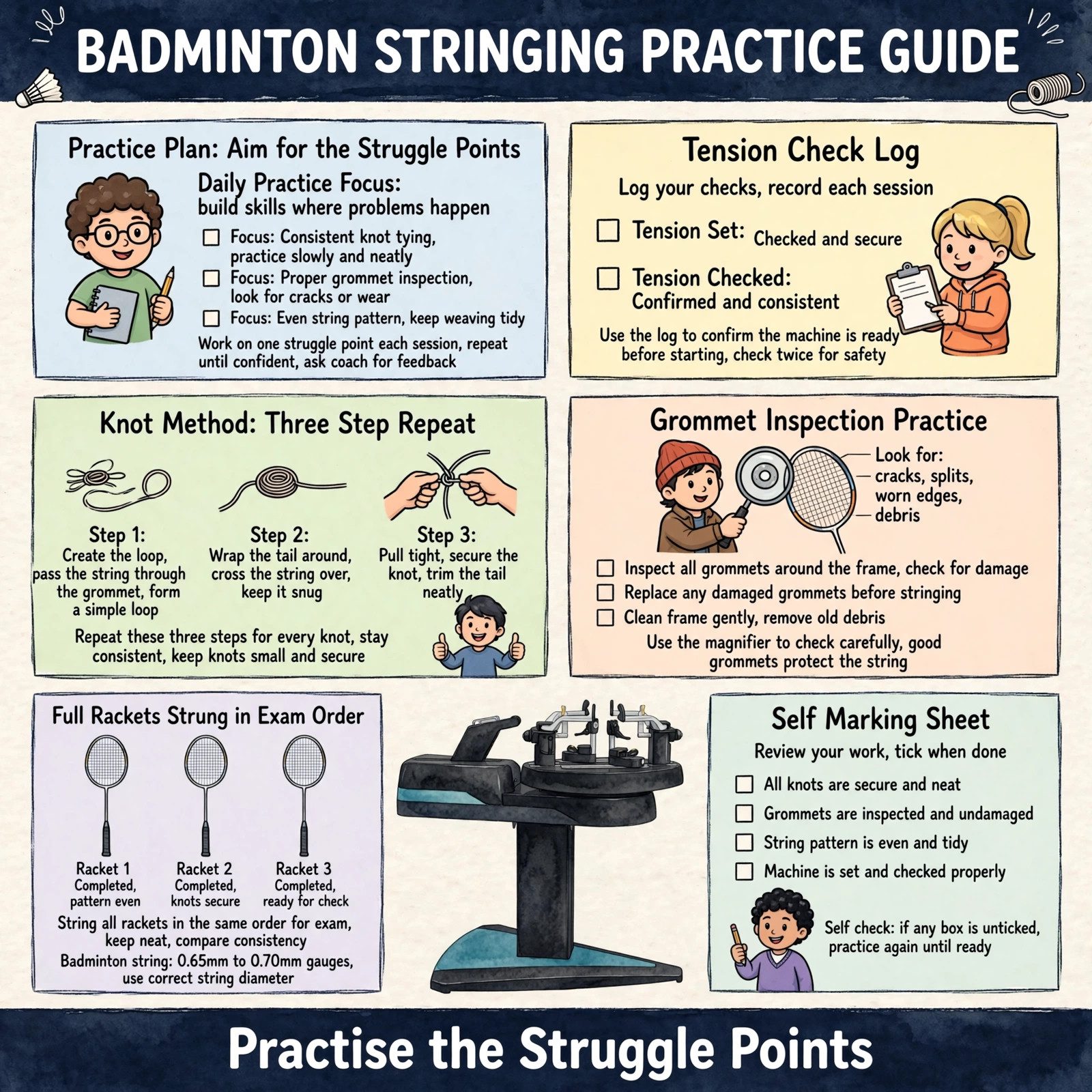
If the exam feels hard, start practice at the struggle points in order. First, tension: string practice rackets at set tensions and check the delivered result honestly, noting machine habits that shift it. Second, knots: pick the standard knot method and repeat it identically until your hands stop improvising. Third, grommets: inspect every practice frame, replace damaged grommets and slow down at shared holes. Fourth, order: work the full exam sequence on complete rackets while someone watches, and mark yourself with the exam list after each one.
Ask timing and format questions in your enquiry, because preparation depends on them. At BSW, training is in Kuala Lumpur only, classes run from 10am to 5pm, the course takes 3 and a half days with the exam on the last day, and timing is flexible so travelling learners can arrive rested. Any provider should state its own shape, its exam tasks and its retake arrangement just as plainly, in writing, before you commit.
Turn the answers into a weekly practice plan and keep a record for every practice racket: string, set tension, delivered check, knot notes and grommet work. Review the record every few weeks and move your practice time toward the weakest point it shows. Readiness is visible in that record long before exam day, and candidates who can see their own progress stop fearing difficulty and start managing it.
Is Stringer Certification Hard Quick FAQ
Short answers to the questions candidates ask first about how hard stringer certification is and where the struggle points sit.
Is stringer certification hard in practice?
Stringer certification is hard in specific, practisable places: tension accuracy under observation, knot consistency, grommet care and working to a set standard rather than a personal habit. It does not require rare talent. The gap between your current habits and the published standard decides how hard it feels.
Which exam tasks are hardest?
Candidates struggle most with delivered tension accuracy under observation, tying the same knot standard on every racket, patient grommet care on thin badminton string, safe frame handling under pressure and following the set standard instead of personal shortcuts and habits.
How does corrected practice help?
Corrected practice reduces exam difficulty because most faults are habits: clamp pressure, weaving angle, knot length and grommet shortcuts. Instructor feedback fixes them on practice rackets, and practising in exam order while someone watches makes observation itself feel normal.
What preparation does it take?
Honest preparation commits weeks of practice, real rackets and real string, not one weekend of cramming. Count the categories plainly: training or course time where you take it, the exam arrangement itself, string and materials at practice volume, grommets and tools in good order, travel and stay if your body tests elsewhere, time away from work and the retake arrangement understood in advance. This guide invents no figures for any category. Ask each body for its current written figures and price your own practice honestly from your own suppliers.
How do you judge difficulty fairly?
Compare difficulty by what is tested: sport scope, practical or written format, the named tasks such as tension, knots and grommets, and whether the standard is published clearly enough to practise against. A harder feeling practical exam can be fairer than an easy paper test.
How does the BSW exam test you?
The BSW exam is a practical badminton exam on real rackets at the end of training in Kuala Lumpur: 3 and a half days, classes from 10am to 5pm, flexible timing, exam on the last day, results assessed and approved by the BSW certification board. Its difficulty sits in tension accuracy, knots, grommets and frame care, with no invented pass marks published here.
What should you practise first now?
If the exam feels hard, start practice at the struggle points in order. First, tension: string practice rackets at set tensions and check the delivered result honestly, noting machine habits that shift it. Second, knots: pick the standard knot method and repeat it identically until your hands stop improvising. Third, grommets: inspect every practice frame, replace damaged grommets and slow down at shared holes. Fourth, order: work the full exam sequence on complete rackets while someone watches, and mark yourself with the exam list after each one.
What should you keep from your certification route?
Keep your practice record for every racket: string, set and checked tension, knot notes and grommet work, plus your self marking notes against the exam task list. Keep the body written exam scope and retake arrangement with it. These records show your readiness honestly and guide practice after any retake.
How can I start with BSW?
Start with an enquiry that states your sport, your stringing experience, your machine and the work you want certification for, and ask for the exam tasks in writing. BSW trains in Kuala Lumpur only, with flexible timing, classes from 10am to 5pm over 3 and a half days and the practical exam on the last day. Your result is assessed and approved by the BSW certification board.
Is Stringer Certification Hard: Explore the Practical Decisions
Build a Clear Working Method
The method is simple: name the struggle points, practise each one directly with correction, keep the record, and judge every body by its published tasks rather than by stories.
| Difficulty Check | Rushed Approach | Planned Approach |
|---|---|---|
| Difficulty | Ask if the exam is easy and hope for yes | Name the struggle points and practise each one |
| Tasks | Assume speed is what examiners reward | Prepare tension, knots, grommets and frame care |
| Preparation | Cram practice into one long weekend | Spread practice rackets over weeks and arrive rested |
| Comparison | Judge bodies by stories and pass claims | Compare published tasks and exam formats fairly |
| Your record | Keep difficulty judgements in your head | Write each body tasks and format side by side |
| Next action | Repeat practice without reviewing faults | Use the practice record to target the weakest point |
Start Your Route with Best Stringer Worldwide
If you want an exam that is hard in the places your players will feel, take the badminton specific route. Train on real rackets in Kuala Lumpur with Best Stringer Worldwide, with classes from 10am to 5pm over 3 and a half days, flexible timing, and the practical exam on the last day. Your work is assessed and approved by the BSW certification board. Send an enquiry stating your experience, your machine and your goal, and start practising the struggle points early.
