






1.1 Starting Point
Online stringer certification: how remote assessment of a practical skill works
Online stringer certification raises an assessment question before it raises a course question: how can a body check a practical skill it cannot touch? Remote assessment usually combines video evidence, live observed stringing over a camera, and submitted racket records. Each method sees some things well and other things badly. Best Stringer Worldwide, founded by Eric Chuar and based in Kuala Lumpur, Malaysia, runs its established certification in person, with results assessed and approved by the BSW certification board. This guide explains what remote checks can and cannot see, in general terms, so candidates can judge any online claim fairly.
Video evidence shows sequence and finish. An examiner can watch mounting order, weaving pattern, knot placement and the completed bed, and can pause and replay. What video cannot easily show is feel: clamp pressure on the string, small frame flex under load, or whether a grommet edge was sharp under the string.
Live observation adds pressure and honesty. The candidate strings in real time, answers questions while working, and cannot edit out mistakes. Even then, a camera angle decides what the examiner sees. A remote pass therefore proves what the setup could check, and a careful body states those limits instead of hiding them.
1.2 Preparation
What can a remote exam scope actually check on camera?
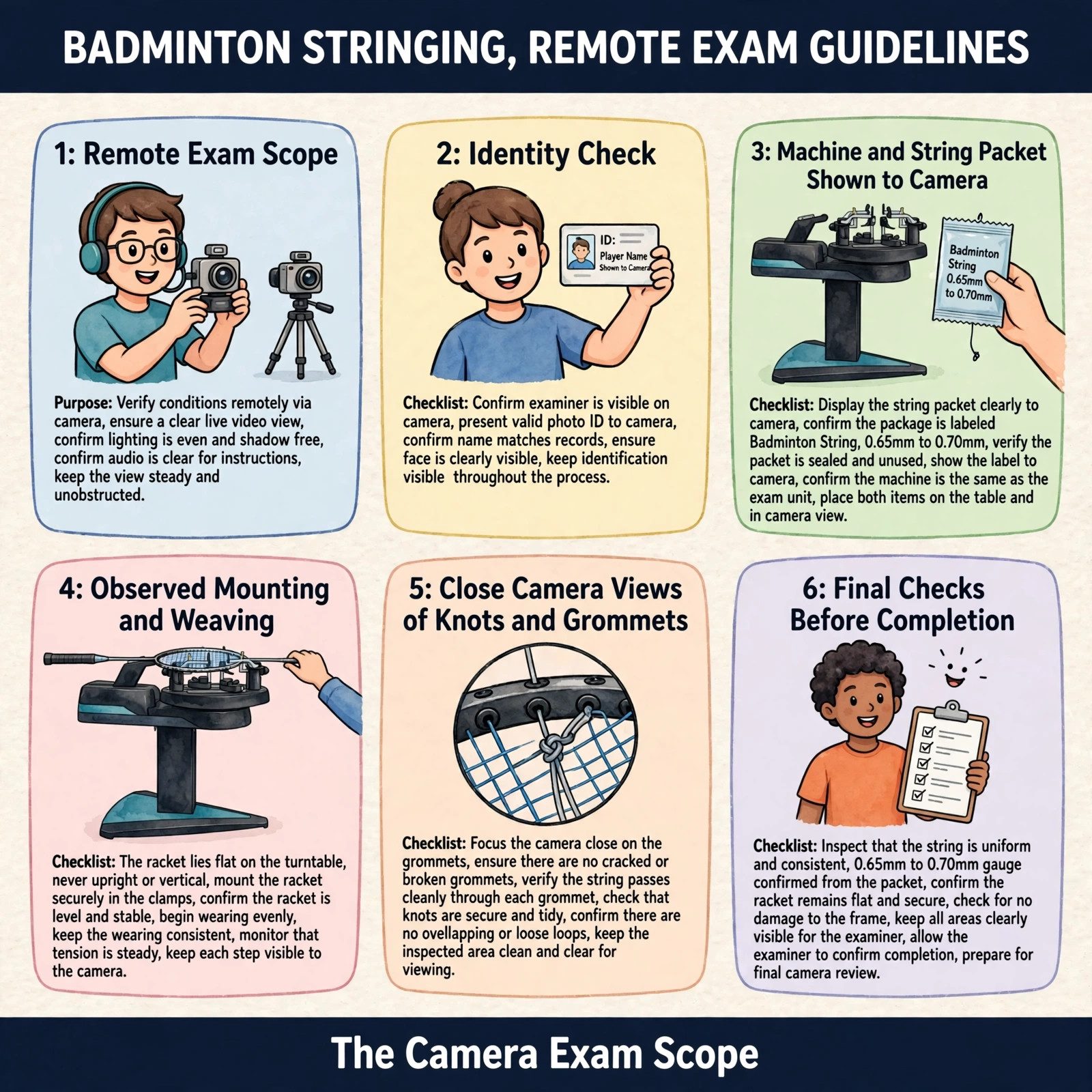
A remote exam scope has to be designed, not just filmed. Identity comes first: the body must know the person stringing is the candidate. The machine and tools are shown on camera before work starts, including the racket, string packet and tension setting. Then the stringing itself is observed: frame inspection spoken aloud, safe mounting, mains and crosses woven cleanly, knots tied where the camera can see them, and the finished racket held up for close views of knots, grommets and the string bed. A written or spoken section can test string knowledge alongside.
Badminton detail matters on camera. Thin string at 0.65mm to 0.70mm gauges is hard to read on a compressed video feed, and small knot errors can vanish at low resolution. A serious remote scope therefore asks for close camera passes over knots and shared holes, and states the delivered tension check method instead of trusting a machine display alone.
What remote scope cannot include matters as much. The examiner cannot pick up the racket, feel the bed, test knot tails by hand or inspect grommet wear by touch. If a body claims its online exam checks everything an in person exam checks, that claim itself is a warning sign. Honest scopes list the blind spots.
1.3 Working Method
How does recorded practice and review build remote exam skill?
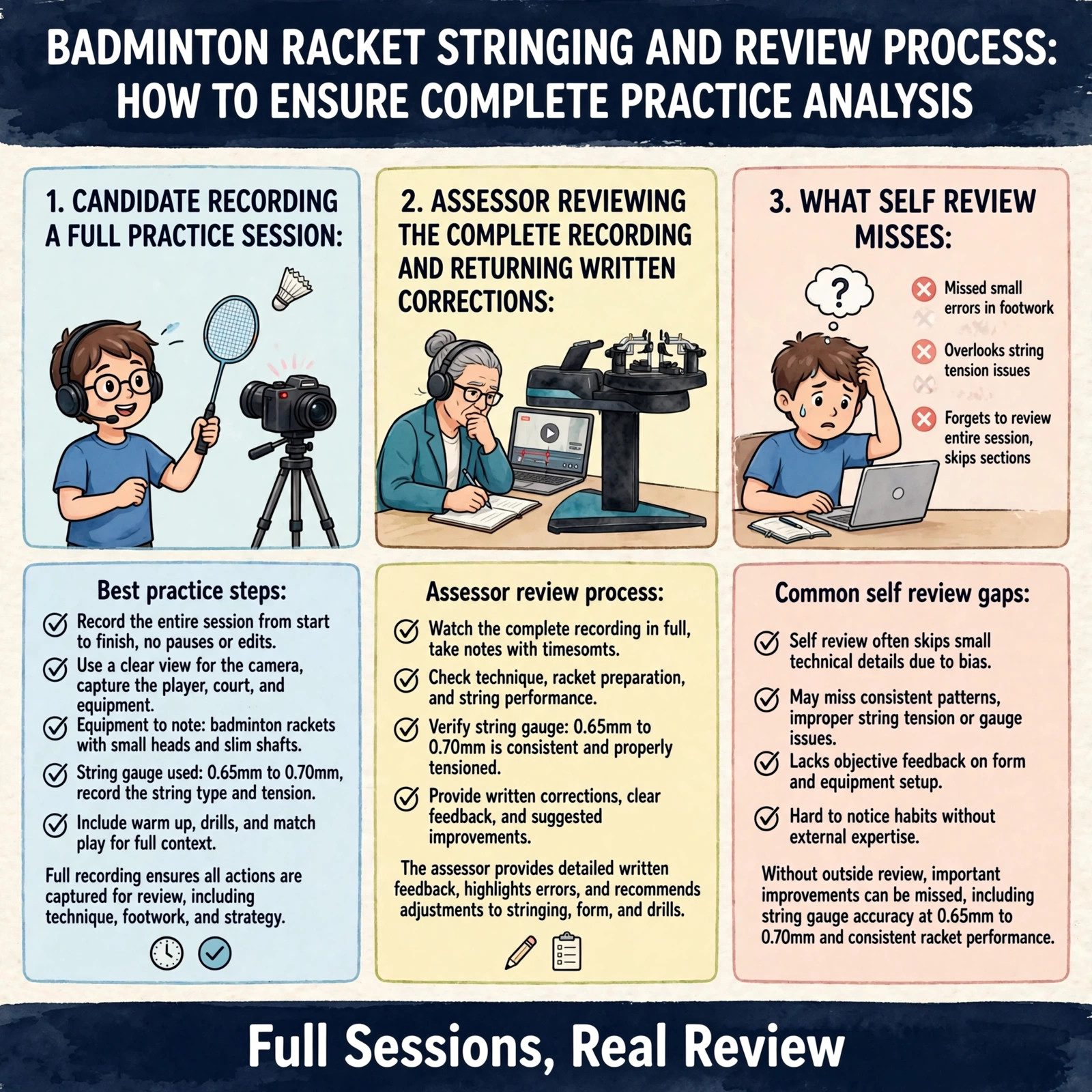
Learning for a remote exam still needs real correction. Watching videos teaches the order of stringing steps, and recording your own practice is genuinely useful: you see your weaving angle, your pauses and your knot routine more clearly than you feel them. But self review has a ceiling. You cannot spot a mistake you do not know is a mistake. A remote tutor who reviews your full unedited practice videos and marks them against the exam scope closes part of that gap, though never the hands on part.
Good remote preparation builds checking habits early. Candidates learn to narrate frame inspection aloud, to show each knot to the camera, to record string, tension and grommet notes per racket and to keep the unedited files. Those habits are not exam tricks. They are the evidence trail that lets an examiner trust work they cannot touch.
Ask any online provider one question: who watches my full stringing, and what exactly do they mark? If the answer is automated checks or short highlight clips, the feedback loop is weak. If a named assessor reviews complete sessions and returns written corrections, your practice hours are at least being read properly.
1.4 Practical Review
Which costs and commitments come with online assessment?
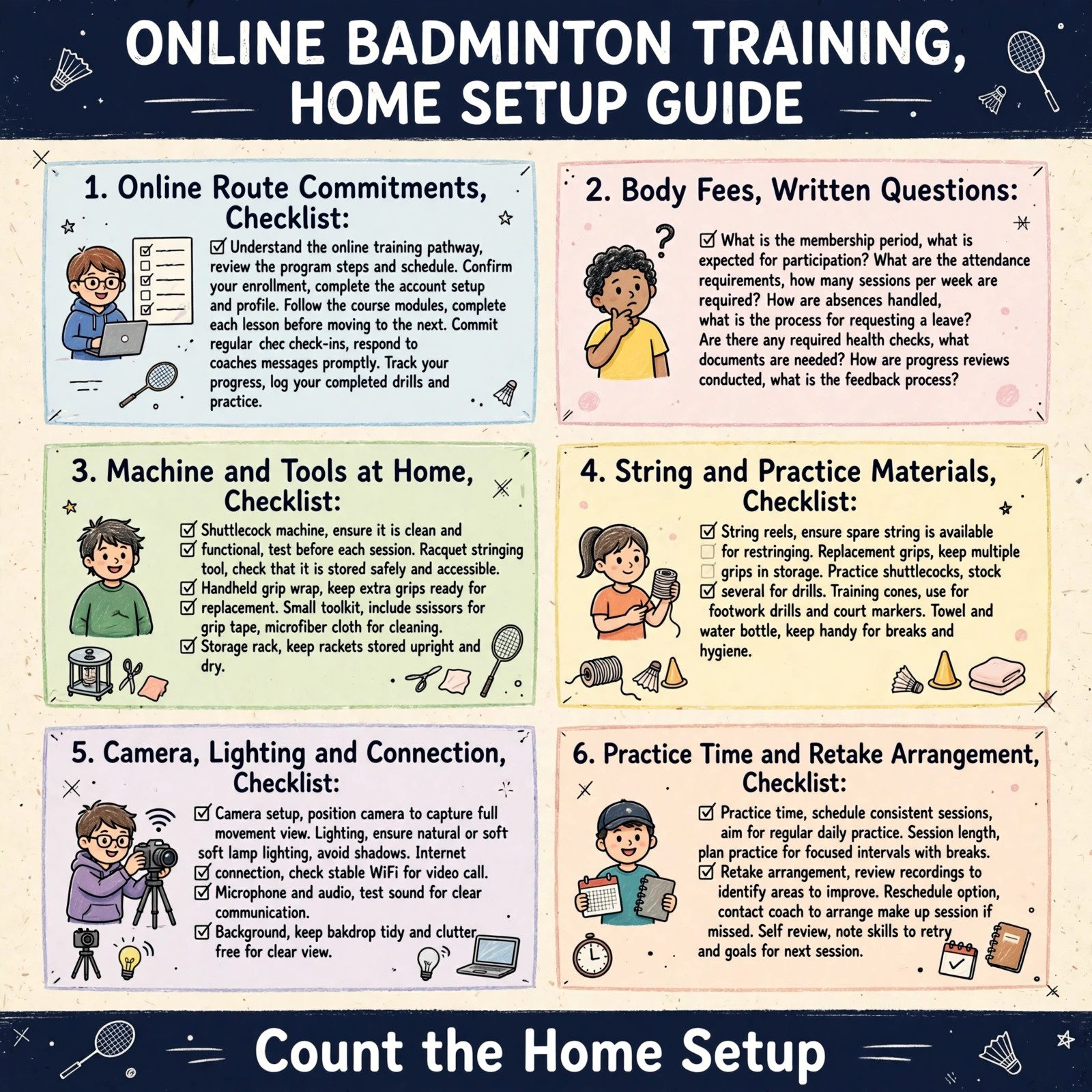
Online routes carry their own cost list, and it is longer than the course fee. Training or assessment fees charged by the body. A suitable machine and tools at your location, since no centre provides them. String and materials for repeated recorded practice. A camera, lighting and connection good enough for an examiner to read knots and grommets. Travel avoided is a real saving, but time is not: recorded practice, retakes and waiting for assessment all take days. And the retake arrangement matters, because one poor connection on exam day should not end a candidacy.
Check the details. No figures are given here, on purpose. Online fees and equipment costs vary too widely to quote honestly without naming a body and a date. Ask each provider for every category in writing, including what happens if the technology fails during assessment and who pays for a rescheduled session.
Review the process. Commitment also includes honesty costs. Remote assessment asks you to work unedited, in one take, with your setup visible. Candidates used to pausing and restarting practice need weeks of full run practice before exam day. Count those practice rackets and hours as part of the price, just as you would for an in person exam.
Plan the next step. The cheap online route has a familiar trap: a certificate issued after a short quiz or a single uploaded photo. It costs little and proves little, and it fails the first time a shop asks how the practical work was observed. Paying again for a properly observed assessment costs more than choosing the observed route first.

1.5 Key Checks
How do online offers compare side by side on observation and honesty?
Record the context.
Compare remote offers on the same four points. First, observation: is the stringing live, recorded in full, or only sampled in clips? Second, identity and setup: how does the body know who strung the racket and on what machine? Third, scope honesty: does the body state what remote checks cannot see? Fourth, verification: can a shop or player confirm the result afterwards, and does the listing state that assessment was remote? Write the answers side by side and the weak offers separate themselves.
Check the details.
Public examples help calibrate. Established bodies in racket stringing built their names on in person practical exams, with written sections beside them. Newer remote offers vary widely, which is exactly why the four point check matters more than the label online. The word online describes delivery, not standard.
Review the process.
Watch for scope drift in marketing. A body may assess string knowledge online very well and practical stringing online only partly, then sell both under one certificate name. Ask which parts of the scope were observed live, which were recorded, and which were not assessed at all. Keep the written answer with your certificate.

1.6 Service Record
Where does BSW stand on online certification?
Place BSW honestly inside the remote picture. The established BSW route is in person: badminton specific training on real rackets in Kuala Lumpur, 3 and a half days, classes from 10am to 5pm, flexible timing, practical exam on the last day, results assessed and approved by the BSW certification board. That in person shape is precisely why its practical checking can include touch, tension feel and close grommet inspection by hand. That contrast is not an argument against remote assessment in general. It is an argument for reading every remote claim by what was observed, and for valuing an in person exam where touch itself is part of the standard being tested.
Check the details. BSW online provision is still being set up, and this guide does not present an online BSW certification as available. BSW has also been plain that accreditation through an online route is hard, because the hardest parts of stringing to check are the physical ones. Any candidate who needs certification now should plan around the in person Kuala Lumpur route and its flexible timing.
Review the process. That honesty is the comparison point. A body that admits remote limits, or admits its online route is not ready, is easier to trust than a body selling instant online certification for a hands on trade. If BSW later adds remote assessment, judge it by this same guide: live observation, identity checks, stated blind spots and verifiable results.
Plan the next step. Whichever body you choose, ask how an employer can verify your pass, whether the listing shows the assessment was remote, and what the exam day setup requires from you. Keep the answers in writing. A remote credential you cannot explain is a credential a shop will not trust, and the explanation starts with what was actually observed.

1.7 Guided Practice
What should you ask before applying for online certification?
A good enquiry about online certification asks assessment questions, not format questions. State your sport, your stringing experience, your machine and camera setup and the work you want the credential for. Then ask: is my stringing observed live or reviewed from recordings, and in full or in clips? How is identity checked? Which exam tasks cannot be assessed remotely, in your own list? How is delivered tension verified? Can an employer confirm my result, and will the listing show the remote method? Write every answer down before paying.
Timing and logistics questions follow. Ask what connection, lighting and camera positions the assessment needs, what happens if the link fails, and how retakes are arranged. For in person comparison, note the BSW shape: Kuala Lumpur only, classes from 10am to 5pm, 3 and a half days, exam on the last day, flexible timing on dates.
Prepare like a remote candidate from day one. Practise in full unedited runs, narrate your inspection aloud, show knots to the camera as a habit and keep a record per racket: string, tension, knots and grommet notes. If you later sit an in person exam instead, those same habits still serve you, because examiners reward candidates whose work is easy to check.
Online Stringer Certification Quick FAQ
Short answers to the questions candidates ask first about remote assessment of a hands on stringing skill.
How does remote assessment work for stringing?
Online certification assesses a practical skill through video evidence, live observed stringing and submitted records. It can check sequence, weaving, knots and finished work on camera. It struggles with touch based checks such as clamp pressure and frame feel, so honest bodies state what their remote setup can and cannot see.
What can a remote scope check on camera?
A remote scope covers identity checks, machine and materials shown on camera, observed mounting, weaving, knots and grommet views, plus string knowledge questions. It cannot include hands on feel of the finished bed or knot tails. A trustworthy body publishes both halves of that list before candidates pay.
How does recorded practice build skill?
Remote learning works best when full practice sessions are recorded and reviewed by an assessor against the exam scope, not when candidates watch videos alone. Self recording helps you see your own habits, but only outside correction catches the mistakes you do not know you are making.
Which costs and commitments come with online routes?
Online routes carry their own cost list, and it is longer than the course fee. Training or assessment fees charged by the body. A suitable machine and tools at your location, since no centre provides them. String and materials for repeated recorded practice. A camera, lighting and connection good enough for an examiner to read knots and grommets. Travel avoided is a real saving, but time is not: recorded practice, retakes and waiting for assessment all take days. And the retake arrangement matters, because one poor connection on exam day should not end a candidacy.
How do online offers compare fairly?
Compare online offers on observation method, identity and setup checks, honesty about remote limits, and later verification. Live full session observation with stated blind spots is the strong end. A quiz or photo upload with no observed stringing is not practical assessment, whatever the certificate calls itself.
Where does BSW stand online?
Measured honestly, the BSW position is plain. Its established route is in person in Kuala Lumpur, over 3 and a half days with classes from 10am to 5pm, flexible timing and a practical exam on the last day, assessed and approved by the BSW certification board. BSW online provision is still being set up, and accreditation through an online route is hard for a practical skill, so no BSW online certification is promised here as available. Any future remote assessment would need live observation, identity checks and a verifiable racket record to carry weight.
What should you ask before applying online?
A good enquiry about online certification asks assessment questions, not format questions. State your sport, your stringing experience, your machine and camera setup and the work you want the credential for. Then ask: is my stringing observed live or reviewed from recordings, and in full or in clips? How is identity checked? Which exam tasks cannot be assessed remotely, in your own list? How is delivered tension verified? Can an employer confirm my result, and will the listing show the remote method? Write every answer down before paying.
What should you keep from a remote route?
Keep your assessment recordings, the body written scope showing what was and was not checked remotely, your pass confirmation and your per racket practice records. For a remote credential, that evidence trail is part of the proof, because it shows exactly how your work was observed.
How can I start with BSW?
Start with an enquiry stating your experience, machine and goal, and ask about route availability honestly. BSW established route is in person in Kuala Lumpur only, flexible timing, classes from 10am to 5pm over 3 and a half days, exam on the last day, assessed and approved by the BSW certification board. Its online course is still being set up.
Online Stringer Certification: Explore the Practical Decisions
Build a Clear Working Method
The method is simple: write the observation, identity, honesty and verification criteria first, score every remote offer against them, and keep the written answers with your certificate.
| Remote Check | Rushed Approach | Planned Approach |
|---|---|---|
| Observation | Trust clips and highlights as full proof | Ask whether stringing is observed live and in full |
| Scope | Assume remote checks see everything hands feel | List what remote checks can and cannot see |
| Costs | Budget for the online fee only | Count machine, camera, string, time and retakes |
| Scorecard | Choose the fastest online certificate offered | Score observation, identity, honesty and verification |
| Your record | Keep online offer claims in your head | Write observation and identity answers down |
| Next action | Keep only the certificate file itself | Keep recordings, scope and pass record together |
Start Your Stringer Certification Route with Best Stringer Worldwide
If you need a practical credential now, take the route where the checking is hands on. Train on real rackets in Kuala Lumpur with Best Stringer Worldwide, classes from 10am to 5pm over 3 and a half days, flexible timing, and the practical exam on the last day. Your work is assessed and approved by the BSW certification board. Send an enquiry stating your experience, machine and goal, and ask your assessment questions in writing.
