






1.1 Starting Point
Apprenticeship vs certification: two routes into professional stringing compared
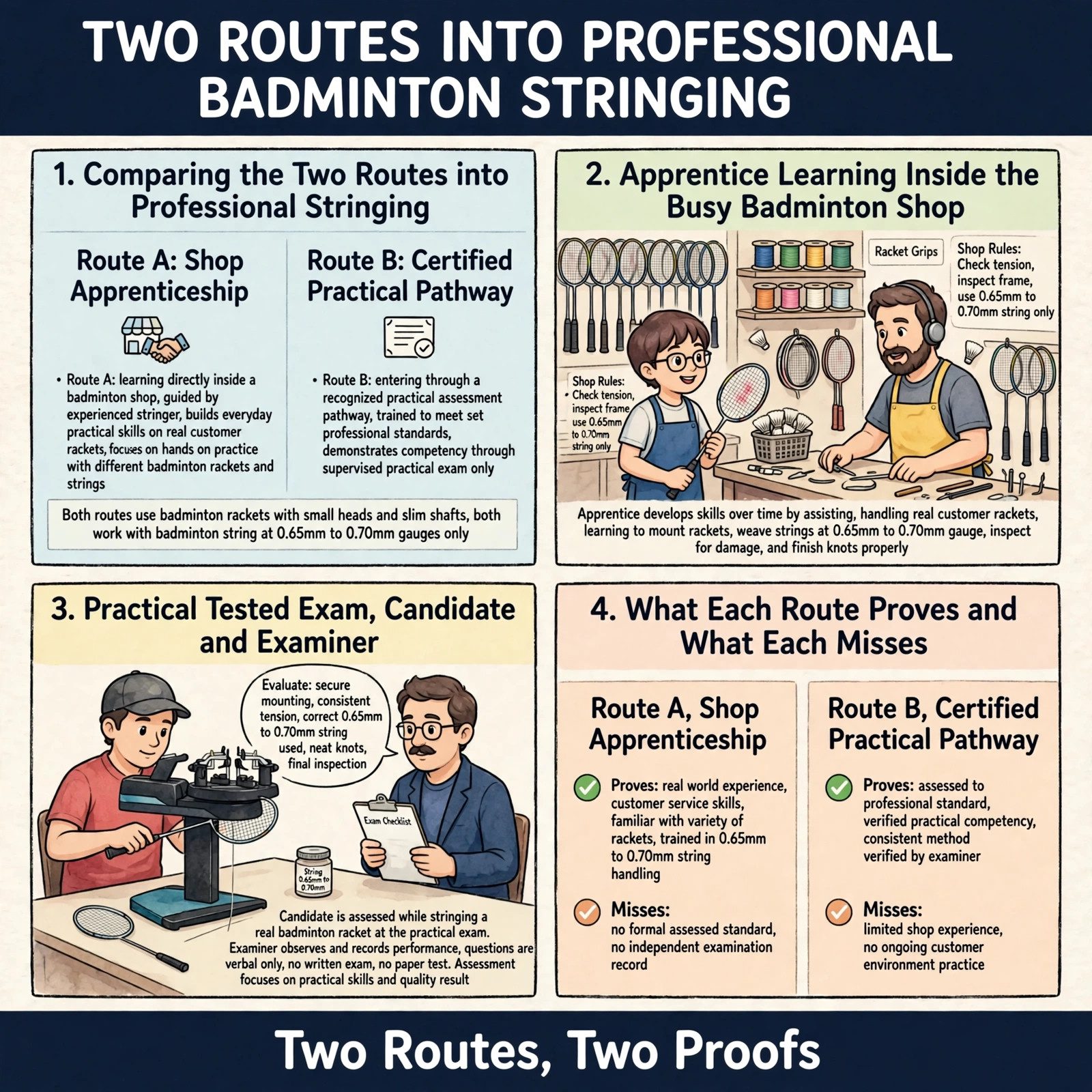
Apprenticeship and certification are two different routes into professional stringing, and they prove different things. An apprenticeship means learning inside a working shop over months or years, picking up habits from senior stringers while real player rackets pass through your hands. Certification means training toward a set standard and passing a tested exam run by a named body. Best Stringer Worldwide, founded by Eric Chuar and based in Kuala Lumpur, Malaysia, runs the badminton specific certification route, with results assessed and approved by the BSW certification board. Many strong stringers use both routes, in either order.
The apprenticeship route proves endurance and exposure. You have seen busy Saturdays, broken strings before matches, odd player requests and frames in poor condition. What it rarely proves on its own is whether your tension, knots and grommet work meet a written standard, because nobody outside the shop has tested them against one.
The certification route proves a narrower thing, and proves it clearly. On exam day, under observation, your mounting, weaving, delivered tension, knots and frame care met the standard the body published. It does not prove years of counter experience. Reading the two routes honestly means asking what each one can show, and what each one leaves unshown.

1.2 Preparation
What does each route actually check while you learn to string?
Look at what each route actually checks while you learn. In a good apprenticeship, a senior stringer checks your finished rackets, corrects your clamp marks, watches your knots and teaches you how the shop handles complaints and rush jobs. The checking is real, but it is private to that shop and it follows that shop habits, good or bad. In certification training, the checking follows the exam scope: frame inspection, safe mounting, clean weaving, delivered tension at the set number, starting and finishing knots and grommet care on real rackets. The standard is written down before you start, so you know what will be marked.
Badminton sharpens the difference. Shop habits formed on mixed work may not test thin string at 0.65mm to 0.70mm gauges or the high tensions light badminton frames carry. A badminton specific exam names those gauges and frames directly. An apprenticeship in a busy badminton shop may cover them daily. Ask which rackets, gauges and tensions each route actually puts in your hands.
Neither route checks everything. An apprenticeship may never test you under timed exam pressure. A certification exam cannot test how you handle a long queue or a difficult player at the counter. When you compare routes, list what is checked, who checks it, and whether the check is recorded anywhere outside one person memory.

1.3 Working Method
How does skill grow differently on each stringing route?
Skill grows differently on each route. Apprenticeship learning is slow and wide: you absorb player talk, shop systems, string choices for different playing styles and the feel of many frame types, week after week. The risk is copying one shop shortcuts as if they were standards. Certification training is short and focused: an instructor watches your hands, corrects clamp pressure, weaving angle and knot work on the spot, and points every session at the exam tasks. The risk there is narrowness, because a short course cannot show you every player problem a shop meets in a year.
Feedback quality decides both routes. A senior stringer who explains why a knot slipped teaches more in one afternoon than months of silent repetition. An instructor who only demonstrates and never marks your rackets leaves the same gap. On either route, ask who watches your work, how often, and what they correct in writing or in person.
Order matters less than honesty about gaps. Some stringers apprentice first, then certify to prove what they already do. Others certify first to learn clean habits, then build shop experience without unlearning shortcuts. Both orders work when the learner names the missing half and goes looking for it on purpose.

1.4 Practical Review
Which costs and commitments come with each route?
Count the full commitment of each route before you choose. An apprenticeship costs time above all: months or years of junior work, often at junior pay, tied to one shop timetable and one shop way of working. Certification costs course and exam fees where you train, a machine and tools if you do not own them, string and materials for practice, travel and stay if the body tests in another city, time away from work, and the retake arrangement if exam day goes badly. Neither route is free. One spreads the cost over years, the other gathers it into weeks.
Check the details. This guide puts no figures on either route, on purpose. Shop arrangements differ too much, and body fees change by year and country. Ask the shop what an apprenticeship pays and demands, in writing. Ask the body for every fee category, in writing. Vague answers on either side predict vague treatment later.
Review the process. Opportunity cost cuts both ways. Years spent apprenticing in the wrong shop can lock in habits you later pay to unlearn. Money spent certifying before you have basic hand speed can mean an exam taken before you were ready. Match the route to your starting point, not to the route a friend took.
Plan the next step. There is also a cost to drifting with neither route: years of stringing with no tested proof and no senior correction. Players and shops then judge you on claims alone. Whichever route you pick, pick one that leaves evidence: a recorded exam result, a senior reference, or a racket record that shows your standard over time.
1.5 Key Checks
How do the two routes score side by side on the same points?
Record the context.
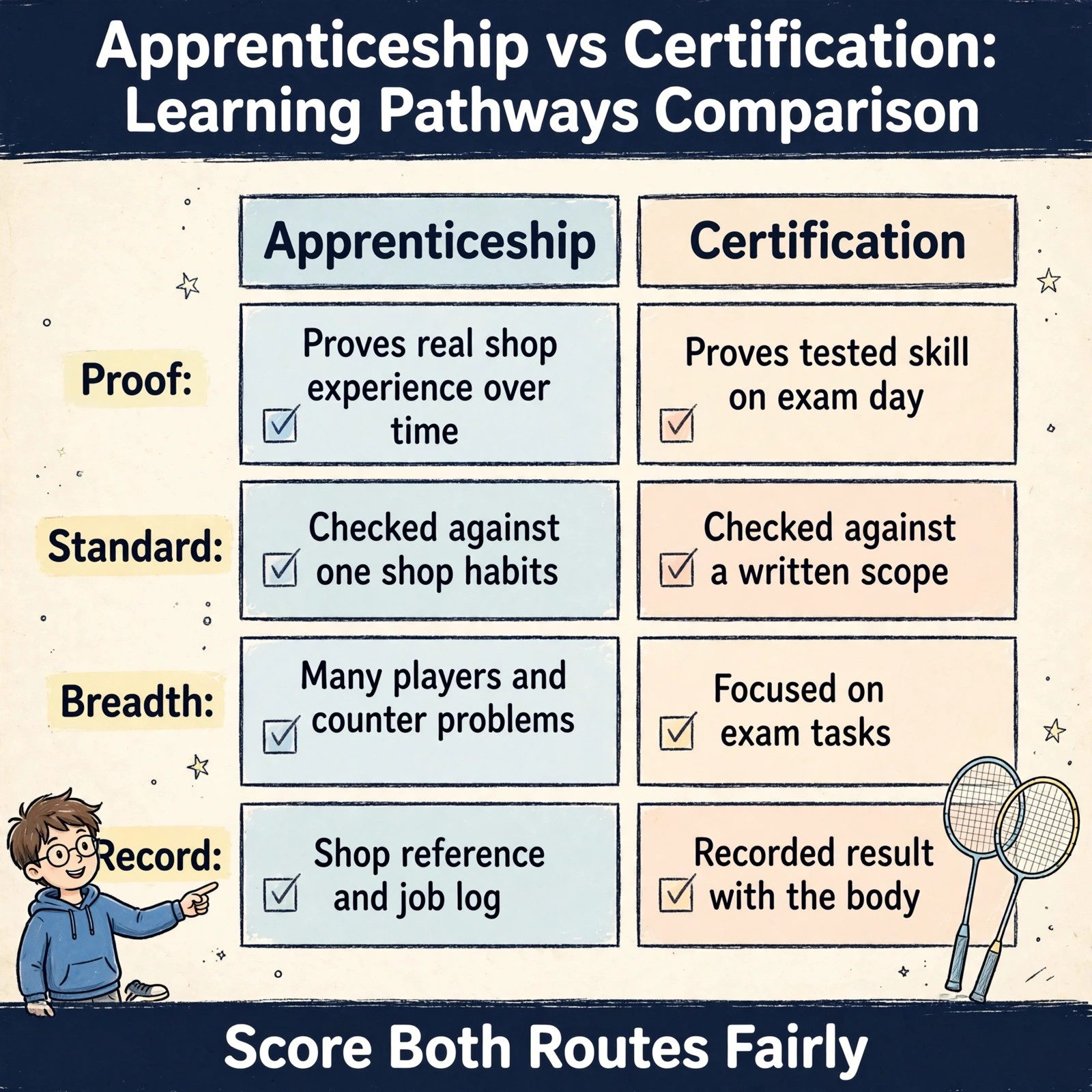
Compare the two routes on the same four points. First, proof: what can you show a player, shop or tournament afterwards? Second, standard: was your work checked against a written scope or against one shop custom? Third, breadth: how many racket types, players and problems did you meet? Fourth, record: can anyone verify your claim later? An apprenticeship scores high on breadth and low on outside verification. Certification scores high on proof and record, and lower on breadth unless you add shop time after it.
Check the details.
Consider two honest examples. A stringer with five years in a strong badminton shop may need only the exam to convert private skill into public proof. A new learner with no shop access may need certification training first to learn correct habits, then shop time to widen them. Same destination, opposite starting points, different first steps.
Review the process.
Beware the weak versions of both routes. An apprenticeship where nobody corrects you is just repetition with a job title. A certificate handed out for attendance is just paper with a logo. Judge the real version in front of you: who checks the work, against what standard, and what record survives afterwards.
1.6 Service Record
Where does the BSW route sit in this comparison?
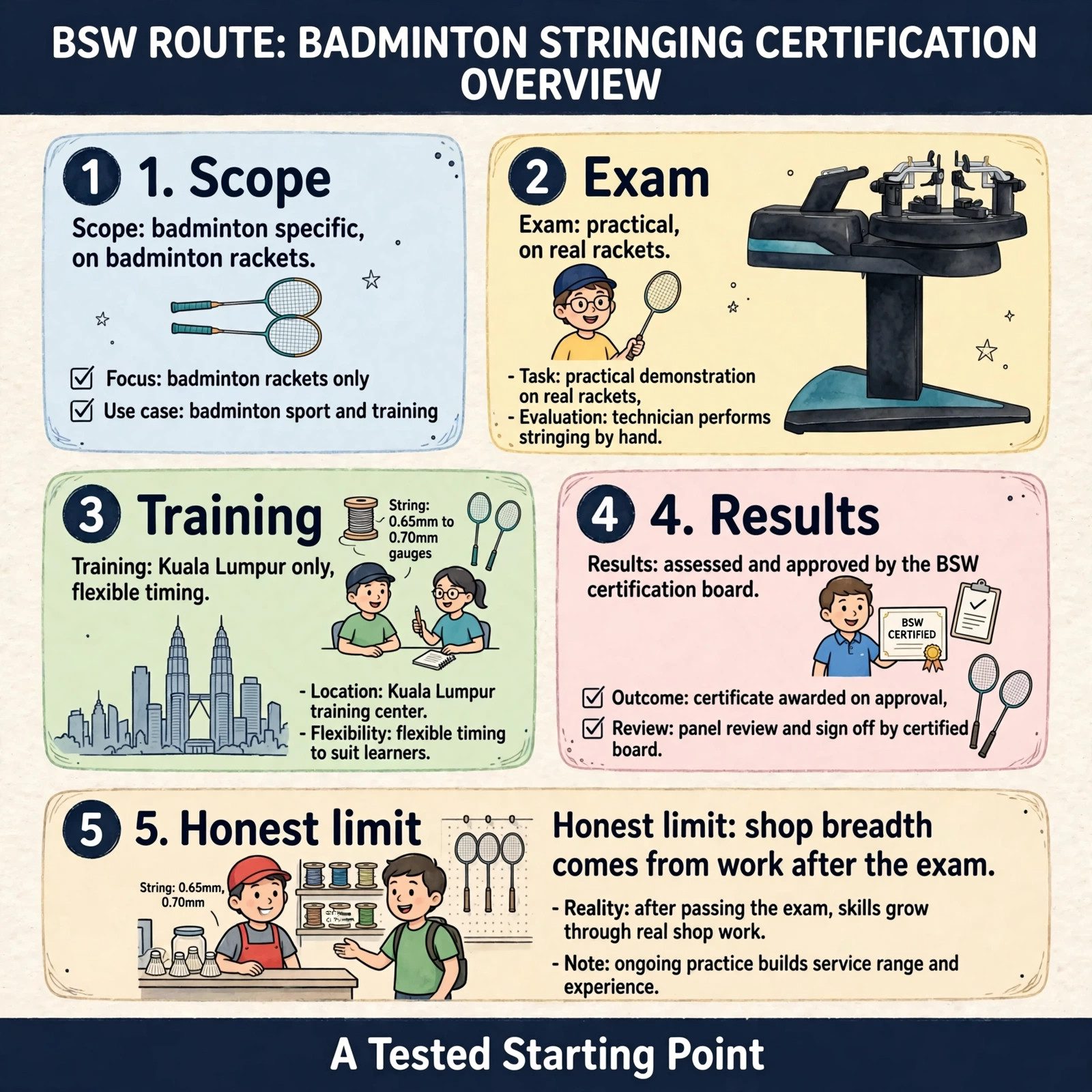
Now place the BSW route inside this comparison, with no special pleading. BSW is the certification side of the pair: badminton specific training on real rackets in Kuala Lumpur, over 3 and a half days with classes from 10am to 5pm, flexible timing, and a practical exam on the last day. Results are assessed and approved by the BSW certification board. It gives a learner without a shop apprenticeship a tested starting standard, and it gives an experienced shop stringer a way to prove existing skill in badminton terms.
Check the details. What BSW does not do is run your apprenticeship for you. The course is short by design, so the wide shop judgement that years at a counter build still has to come from work after the exam, or from shop time you already hold. BSW states its shape plainly: Kuala Lumpur only, no course in other cities, and no promise that a pass alone brings employment.
Review the process. For an apprentice trained mostly on tennis or mixed racket work, the badminton specific exam is the honest test of transfer. Thin gauges, light frames and high tensions punish habits that pass unnoticed elsewhere. Passing shows your badminton work itself was checked, not assumed from general stringing years.
Plan the next step. Judge BSW by the same four points as any route: proof, standard, breadth and record. Proof is a practical exam result. Standard is the published badminton scope. Breadth is the honest limit, answered by shop work after. Record is the board held result an employer can ask about. On that scoring, BSW is a strong first half of a career, not a claim to the whole career.

1.7 Guided Practice
What should you ask before choosing your stringing route?
Your enquiry should state which route you are really choosing between. Tell the shop or the body your current stringing volume, the machine you use, the rackets you string most and the work you want next: shop counter, tournament team or your own customers. Ask a shop offering apprenticeship who will correct your work and what standard they string to. Ask a certifying body what the exam tests task by task, who assesses it, how a pass is verified later and what a retake involves. Write both sets of answers down before deciding.
Timing answers help you sequence the routes. At BSW, training is in Kuala Lumpur only, classes run from 10am to 5pm, the course takes 3 and a half days with the exam on the last day, and timing is flexible. A learner can therefore certify first, then seek shop work with proof in hand, or take leave from a shop job to certify mid apprenticeship.
Turn your choice into a plan with dates you set yourself. List the gap the chosen route leaves open, the practice rackets you will string, and the record you will keep for each one: string, tension, knots and grommet notes. Review the plan monthly. Routes fail when they stay vague. They work when each month closes one named gap.
Apprenticeship vs Certification Quick FAQ
Short answers to the questions learners ask first when weighing shop apprenticeship against tested certification.
What do apprenticeship and certification each prove?
An apprenticeship proves time served and real shop exposure over months or years. Certification proves tested skill on exam day against a written standard set by a named body. One shows experience, the other shows checked technique. The strongest stringers often carry both, because the two proofs answer different questions.
What does each route check while you learn?
An apprenticeship is checked privately inside one shop, following that shop habits. Certification is checked against a written exam scope covering frame inspection, mounting, weaving, delivered tension, knots and grommet care. The difference is not effort. It is whether the standard was published and the result recorded.
How does skill grow on each route?
Apprenticeship builds wide shop judgement slowly, with the risk of copying local shortcuts. Certification training builds checked technique quickly, with the risk of narrow experience. On both routes the deciding factor is feedback: someone skilled watching your rackets and correcting your work while you can still change it.
Which costs and commitments come with each route?
Count the full commitment of each route before you choose. An apprenticeship costs time above all: months or years of junior work, often at junior pay, tied to one shop timetable and one shop way of working. Certification costs course and exam fees where you train, a machine and tools if you do not own them, string and materials for practice, travel and stay if the body tests in another city, time away from work, and the retake arrangement if exam day goes badly. Neither route is free. One spreads the cost over years, the other gathers it into weeks.
How do the routes compare on the same points?
Score both routes on proof, standard, breadth and record. Apprenticeship usually wins on breadth of real shop problems. Certification usually wins on written standard, tested proof and a result others can verify. The comparison shows most stringers need elements of both, sequenced to fit their starting point.
Where does the BSW route sit?
Measured against the same checks, the BSW route suits a learner who wants the tested part done early and clearly. Training runs in Kuala Lumpur only, over 3 and a half days with classes from 10am to 5pm and flexible timing, and the practical exam sits on the last day. You train on real rackets with correction, then your work is assessed and approved by the BSW certification board. What it does not replace is years of shop judgement built after the exam. The honest reading is simple: certification gives you a tested starting point, and shop time after it builds depth.
What should you ask before choosing?
Your enquiry should state which route you are really choosing between. Tell the shop or the body your current stringing volume, the machine you use, the rackets you string most and the work you want next: shop counter, tournament team or your own customers. Ask a shop offering apprenticeship who will correct your work and what standard they string to. Ask a certifying body what the exam tests task by task, who assesses it, how a pass is verified later and what a retake involves. Write both sets of answers down before deciding.
What should you keep from both routes?
Keep records from both routes: shop references and job logs from apprenticeship time, plus your exam result record, training notes and a per racket stringing record showing string, tension, knots and grommet work. Together they prove breadth and standard, which is stronger than either paper or memory alone.
How can I start with BSW?
Start with an enquiry that states your experience, whether you have shop time behind you, your machine and the work you want. BSW trains in Kuala Lumpur only, with flexible timing, classes from 10am to 5pm over 3 and a half days and the practical exam on the last day, assessed and approved by the BSW certification board.
Apprenticeship vs Certification: Explore the Practical Decisions
Build a Clear Working Method
The method is simple: write the same four criteria for both routes, score each route honestly against them, and keep the answers so your choice can be explained to any shop or player who asks.
| Route Check | Rushed Approach | Planned Approach |
|---|---|---|
| Proof | Call years at a counter tested proof | Name what each route can actually prove |
| Checks | Assume shop habits were checked to a standard | List who checks the work and against what scope |
| Costs | Count only the course or exam fee | Count time, tools, travel and retakes together |
| Scorecard | Choose the route a friend happened to take | Score both routes on proof, standard, breadth and record |
| Your record | Keep the route comparison in your head | Write each route proof and limits down |
| Next action | Rely on memory of shop years alone | Keep exam results and racket records together |
Start Your Tested Route with Best Stringer Worldwide
If you want the tested half of the pair in place, train on real rackets in Kuala Lumpur with Best Stringer Worldwide, with classes from 10am to 5pm over 3 and a half days, flexible timing, and the practical exam on the last day. Your work is assessed and approved by the BSW certification board. Send an enquiry stating your shop experience, your machine and your goal, and bring your route questions with you.

