






1.1 Starting Point
Is a stringing certificate worth it for shop owners?
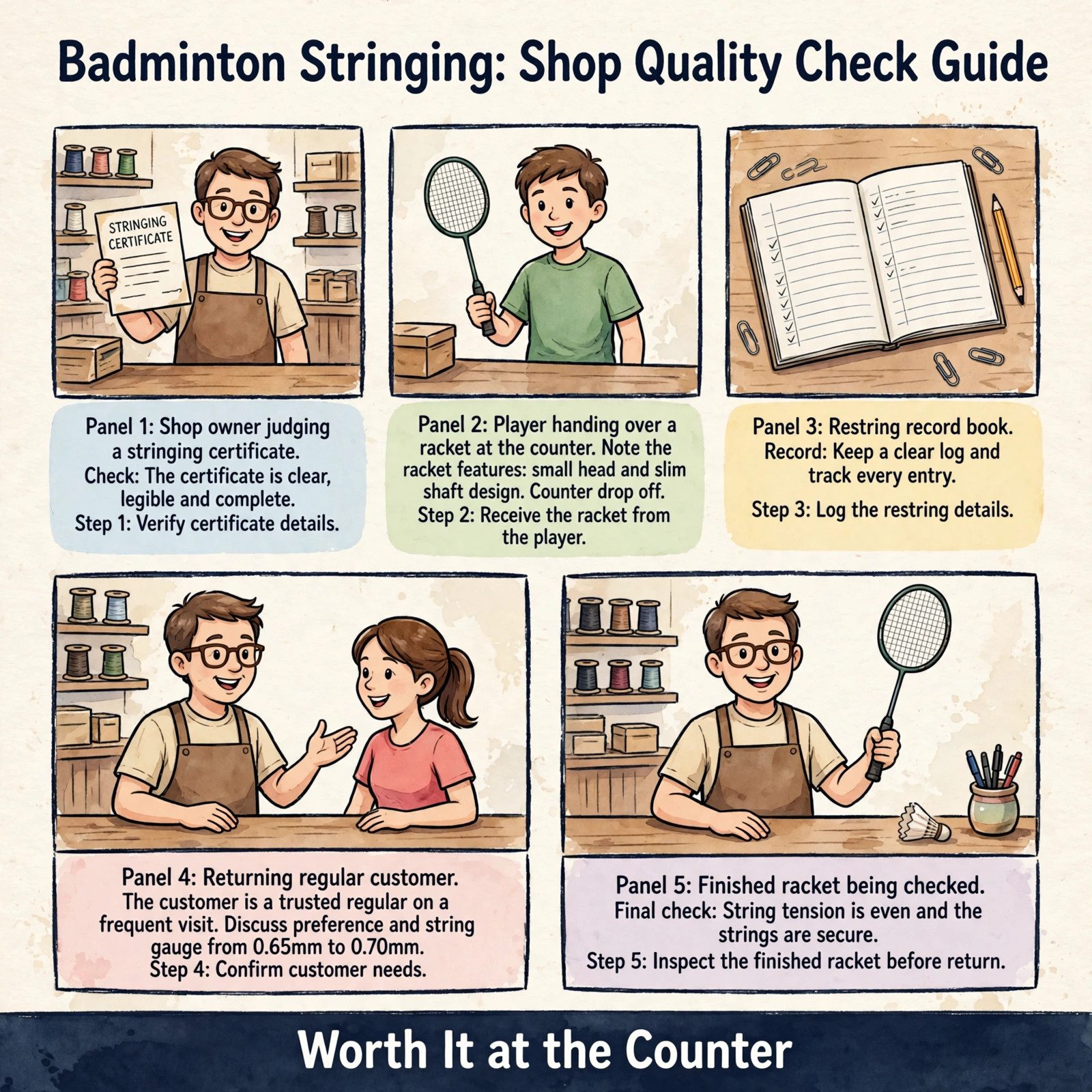
For most shop owners, a stringing certificate is worth it only when it changes what happens at the counter. The paper on the wall earns nothing by itself. What earns is the standard behind it: a player hands over a racket, gets the tension asked for, and comes back because the second and third restring feel the same. Judge the certificate by four shop outcomes. Does it build trust with players who cannot check the work themselves? Does it bring repeat custom? Does it make every staff member string to one standard? And does it cut the complaints and comebacks that eat counter time? If it does those, it is working.
Start with the problem the certificate is meant to solve in your shop. If one experienced stringer carries the quality and everyone else is guessing, the certificate is a consistency tool. If players already trust your counter, it may be a smaller gain. Name the problem first, then judge.
Be honest about what a certificate cannot do. It cannot fix a worn machine, a poor string range or a rushed handover. It supports good work; it does not replace it. An owner who expects the framed paper alone to lift the shop will be disappointed, and the certificate will get the blame.

1.2 Preparation
What does the practical exam prove to a shop?
Before you value any certificate, ask what its exam actually proved. A practical stringing exam that matters to a shop checks the finished racket and the habits behind it: tension accuracy against the setting given, clean starting and finishing knots, grommet care, a straight and even string bed, and the same result produced more than once. Those are the exact points your customers feel. A racket strung at 25 to 27 lbs that plays as asked, with no damaged grommets and no loose finishing knot, is the product your shop sells every day.
Ask the provider to describe the marking in plain terms. What is checked, how is it checked, and what does a fail look like? An owner who cannot get that answer cannot explain the certificate to a player either, and a certificate nobody can explain is decoration, not proof.
Notice what a shop exam should not reward. Speed on one racket is not the standard your counter needs. Your busiest day needs the tenth racket to match the first. Repeatability under normal working conditions is the point, because that is what keeps a squad of regulars coming back.

1.3 Working Method
How does corrected training change staff consistency?
Certificates do not create consistency; corrected training does, and the certificate confirms it. In a shop, inconsistency usually hides in small habits: one staff member pulls knots differently, another rushes the crosses, a third never checks grommet wear before stringing. An instructor watching hands on real rackets catches those habits and fixes them on the spot. Shadowing a senior stringer can pass the habits on, good and bad alike, because nobody is marking the work. Videos can show the order of steps, but they cannot see your staff member’s hands.
Ask how training sessions run for shop staff. How many rackets does each person string themselves, on strings like BG65 and BG66 Ultimax and rackets like the Astrox 88D? Who corrects the work, and how is a mistake shown and put right before it becomes the shop way?
Bring the standard home with you. After training, set one shop method for knots, grommet checks and recording tension, and have staff string to it even when the counter is busy. The certificate starts the standard; the shop routine is what keeps every restring alike.

1.4 Practical Review
Which costs and commitments should an owner list first?
List the full commitment before you decide what the certificate costs your shop. On one side: the course, the exam, a machine and tools if yours need upgrading, and string and materials for practice. On the other side, the lines owners forget: the staff member’s time away from the counter, cover for the shop while they train, travel and stay if training is away from home, and the retake arrangement if the first exam attempt goes badly. A certificate that looks cheap can cost the shop more once cover and a second trip are counted, so write every line down first.
Check the details. Give each item its own line: course, exam, machine and tools, string and materials, travel and stay, staff time away, and cover at the shop. Add who carries each line, you or the staff member, so there is no argument about it later.
Review the process. Read the list against your busiest periods. Training a key stringer during your peak restring weeks costs more than the same training in a quiet month, even when every other line is identical. Timing is a real part of the commitment for a shop.
Plan the next step. Use the same lines for every option you compare, and mark any line a provider has not answered as a question, not as zero. When a provider will not state the retake arrangement or what the exam covers in writing, that silence belongs in your decision too.
1.5 Key Checks
How should an owner compare certificate options fairly?
Record the context.
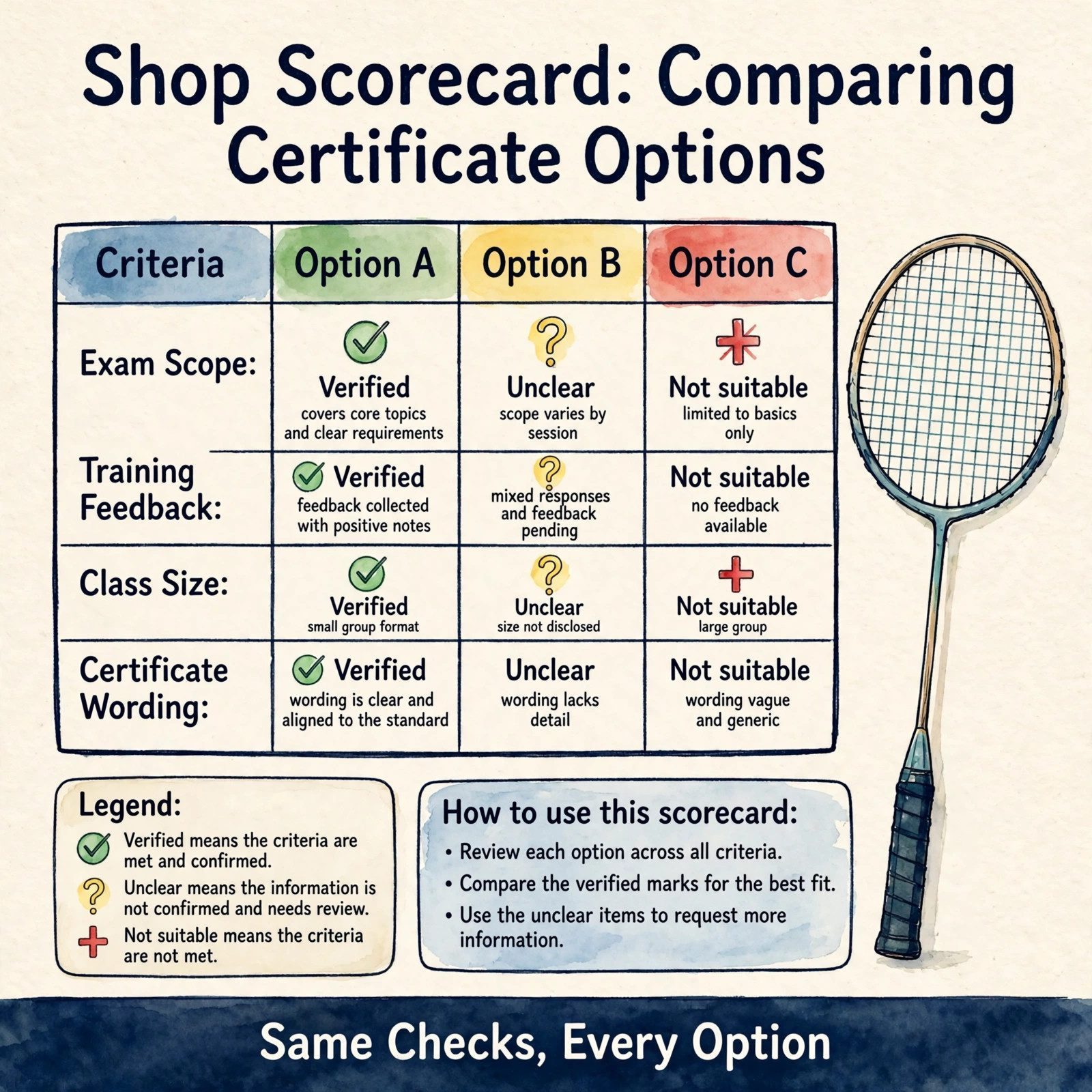
Compare certificate options the way you would compare two restring jobs: same checks, same standard. Build a short shop scorecard: what the exam marks, how training feedback works, class size, syllabus in writing, the full commitment list including staff cover, and what the certificate actually states. For each line, record verified, unclear or not suitable for your shop. A certificate is only better than another when it scores better on the same lines, and a famous name or a smart frame does not score any points by itself.
Check the details.
Weight the lines by your problem from section one. A shop losing work to comebacks should weight the exam scope and grommet care highest. A shop training new staff should weight the feedback and the syllabus. The scorecard serves your shop, not a general ranking.
Review the process.
Date every answer and keep the sheet. When a second staff member trains later, you start from the recorded decision instead of re-arguing it. Check the sheet against your counter records too: if comebacks mention tension, the exam line matters more than the frame.

1.6 Service Record
How does the BSW route measure up for a shop?
Apply your scorecard to the BSW route the same way. Best Stringer Worldwide (BSW) runs its badminton stringing course with certification in Kuala Lumpur, Malaysia, under founder Eric Chuar. Your staff member trains on real rackets with correction, then sits the practical certification exam the day after training. Certification results are assessed and approved by the BSW certification board, so a pass states that the work met the board standard on a badminton racket at real playing tensions, which is the claim your shop can honestly repeat to players.
Check the details. Score BSW on the same lines as everyone else: exam scope, training feedback, class size, syllabus, commitments and certificate wording. A provider that teaches owners to build a scorecard should have no trouble being measured by one, and BSW publishes its course and certification information for that review.
Review the process. Timing is flexible, and the course runs in Kuala Lumpur only, so plan the trip around your shop calendar: training days, the exam day that follows, and cover at the counter while your stringer is away. For a Malaysian shop that is usually one planned trip, not separate visits.
Plan the next step. Where a line stays unclear, ask about that line only. Ask how the training would cover the strings and tensions your shop strings most, what your staff member should practise before arriving, and what happens on a retake. Fill the answers into the scorecard and judge the whole sheet.

1.7 Guided Practice
What should an owner ask before sending staff to train?
Tell the provider about your shop: how many rackets you restring in a normal week, which strings and tensions you use most, who you want to train and what that person strings now. Send that summary with the questions still open on your scorecard. The questions that earn their place are the ones that change your decision: what the exam marks, who corrects your staff member during training, the full commitment list including time away, and the retake arrangement if the first attempt fails.
Before you send, cut every question that does not change a decision. Ask about the exam, the training and the commitments. A short, sharp enquiry from a shop owner gets a useful answer; a vague one gets a brochure back, and your counter time is too valuable for that.
Turn the replies into a shop plan: who trains first, when the shop can spare them, what they practise before the trip, and the shop method they bring back for knots, grommet checks and records. That plan is how a certificate becomes a standard the whole counter follows.
Is a Stringing Certificate Worth It Quick FAQ
Straight answers for shop owners on what a stringing certificate proves, what it commits the shop to, and how to judge the BSW route.
Is a stringing certificate worth it for a shop?
Yes, when the standard behind it is real: players get the tension they asked for, staff string to one standard, and comebacks fall. The paper alone earns nothing; the tested work behind it is what customers feel and return for.
What does the practical exam prove?
It should prove tension accuracy, clean knots, grommet care, an even string bed and the same result repeated, all on a badminton racket. That is the work your customers judge, so it is what the exam behind the certificate must mark.
How does corrected training help staff consistency?
An instructor watches each staff member’s hands and fixes knots, weaving and grommet care while they string real rackets. Shadowing and videos pass on habits without marking them; correction is what turns individual habits into one shop standard.
Which costs and commitments should an owner list?
List the full commitment before you decide what the certificate costs your shop. On one side: the course, the exam, a machine and tools if yours need upgrading, and string and materials for practice. On the other side, the lines owners forget: the staff member’s time away from the counter, cover for the shop while they train, travel and stay if training is away from home, and the retake arrangement if the first exam attempt goes badly. A certificate that looks cheap can cost the shop more once cover and a second trip are counted, so write every line down first.
How should an owner compare certificate options?
Score every option against the same shop criteria: exam scope, training feedback, class size, syllabus in writing, full commitments including staff cover, and certificate wording. Mark each verified, unclear or not suitable for your shop.
How does the BSW route measure up?
For a shop, the BSW route is judged the same way as any other option. Best Stringer Worldwide is based in Kuala Lumpur, Malaysia, founded by Eric Chuar. Staff train on real rackets with an instructor correcting their work, then sit the practical certification exam the day after training. Certification is assessed and approved by the BSW certification board, so a pass states a tested standard your counter can stand behind. Run it through your shop scorecard: exam scope, training feedback, how staff time and cover are handled, full commitments and certificate wording, and ask about any line that stays unclear before you commit a staff member.
What should an owner ask before sending staff?
Tell the provider about your shop: how many rackets you restring in a normal week, which strings and tensions you use most, who you want to train and what that person strings now. Send that summary with the questions still open on your scorecard. The questions that earn their place are the ones that change your decision: what the exam marks, who corrects your staff member during training, the full commitment list including time away, and the retake arrangement if the first attempt fails.
What records should a shop keep after certification?
A simple restring record for every job: player, racket, string, tension, date and who strung it, plus a note of any comeback and why. That record shows whether comebacks fall after certification and gives the next staff member the shop standard in writing.
How can a shop proceed with BSW?
State your shop’s weekly restring volume, your main strings and tensions, and who you want to train. Then start the route: train on real rackets in Kuala Lumpur and sit the certification exam the day after training, with cover planned at your counter.
Is a Stringing Certificate Worth It: Explore the Practical Decisions
Build a Clear Working Method
Use the sections, questions and interactive comparison to judge the certificate for your shop. Keep your scorecard and your comeback records together when you choose the next step.
| Shop Check | Rushed Approach | Planned Approach |
|---|---|---|
| Trust | Hang a certificate and hope customers believe it | Back the certificate with work customers can feel |
| Exam | Ask only whether the holder passed | Check what the practical exam actually marked |
| Costs | Budget for the course fee only | List staff time, cover and every other commitment |
| Scorecard | Compare certificates by how they look framed | Score each option against the same shop criteria |
| Shop record | Decide from memory after a busy day at the counter | Write the shop criteria and the answers down |
| Next action | Repeat the same habits without reviewing comebacks | Use restring records to choose the next fix |
Judge the Certificate for Your Shop with Best Stringer Worldwide
Ready to judge whether a stringing certificate is worth it for your shop, using evidence instead of a framed promise? Tell Best Stringer Worldwide about your shop, your restring volume and the staff member you want to train. Bring your scorecard or one specific question so the discussion stays on your counter. Train on real rackets in Kuala Lumpur, then take the practical certification exam the day after training, assessed and approved by the BSW certification board.

