






1.1 Starting Point
What does a beginner stringing course teach you first?
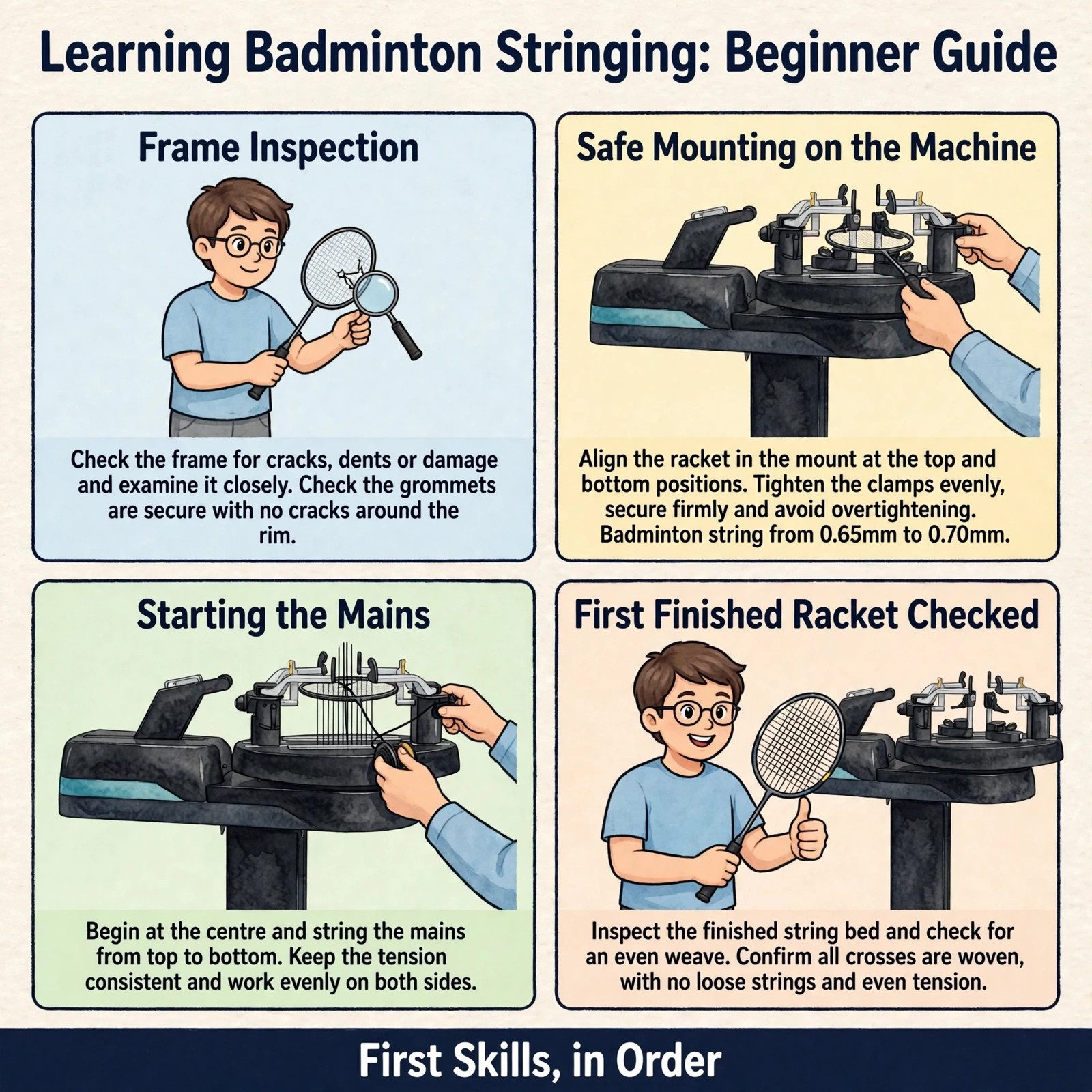
A beginner badminton stringing course should assume nothing and teach the craft in the order your hands need it. Start from zero means exactly that: you do not need experience, your own machine, or a playing background to begin. The first skills are plain and physical. Learn to inspect a frame before you touch it, mount it safely on the machine, start the mains, weave the crosses evenly, tie clean starting and finishing knots, and check your own finished racket honestly. A good beginner course teaches those steps one at a time, on real rackets, and tells you clearly what good looks like at each step.
Judge a beginner course by how it treats your first rackets. Are you stringing real frames yourself from the start, or watching someone else string while you take notes? Beginners learn with their hands. Watching has a place, but your first knots and your first weave need to be yours.
Do not be put off by the word certification at the end of the route. The exam is simply the check that the beginner skills were learned properly. Nobody is promised a result in advance; you train, you are corrected, and the exam shows what your work can do on the day.
1.2 Preparation
What does the practical exam check for a beginner?
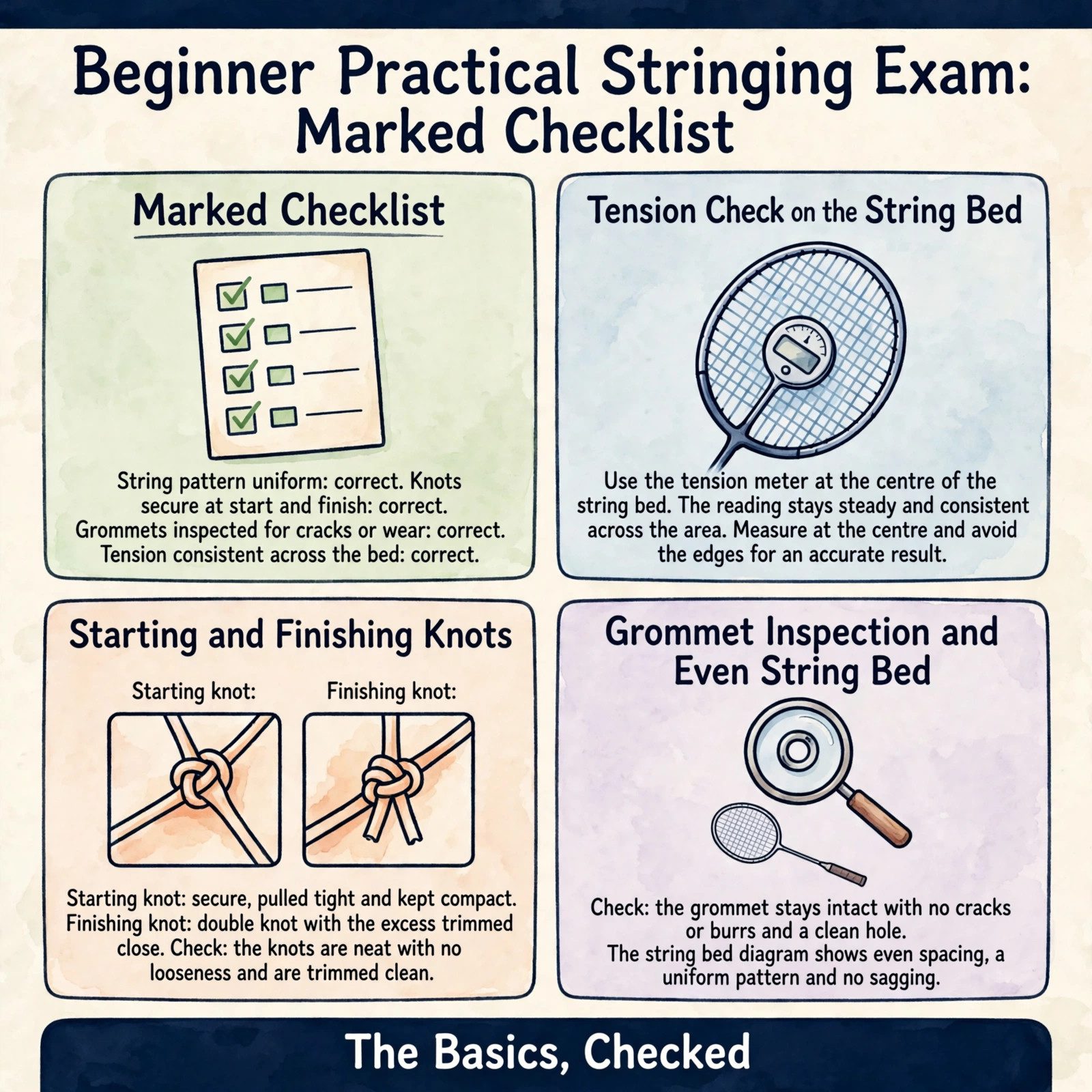
The practical exam at the end of a beginner route checks the basics you were taught, nothing hidden. It marks tension accuracy against the setting you were given, clean starting and finishing knots, grommet care, a straight and even string bed, and the same result produced more than once, all on a badminton racket at real playing tensions such as 25 to 27 lbs. For a beginner, that list is good news. It is the same list you practise from the first session, so the exam holds no surprises for someone who trained on the real tasks.
Ask any course to describe the exam marking before you enrol, in words a beginner can follow. What is checked, how is it checked, and what does a fail look like? A course that answers plainly is teaching toward a real standard. A vague answer leaves a beginner guessing.
Notice what the exam does not ask of a beginner. It does not reward raw speed, and it does not expect the polish of a stringer with years at a shop counter. It asks for correct basics, done carefully and repeated. That is a fair target for a first course.
1.3 Working Method
Why does correction matter so much at the start?
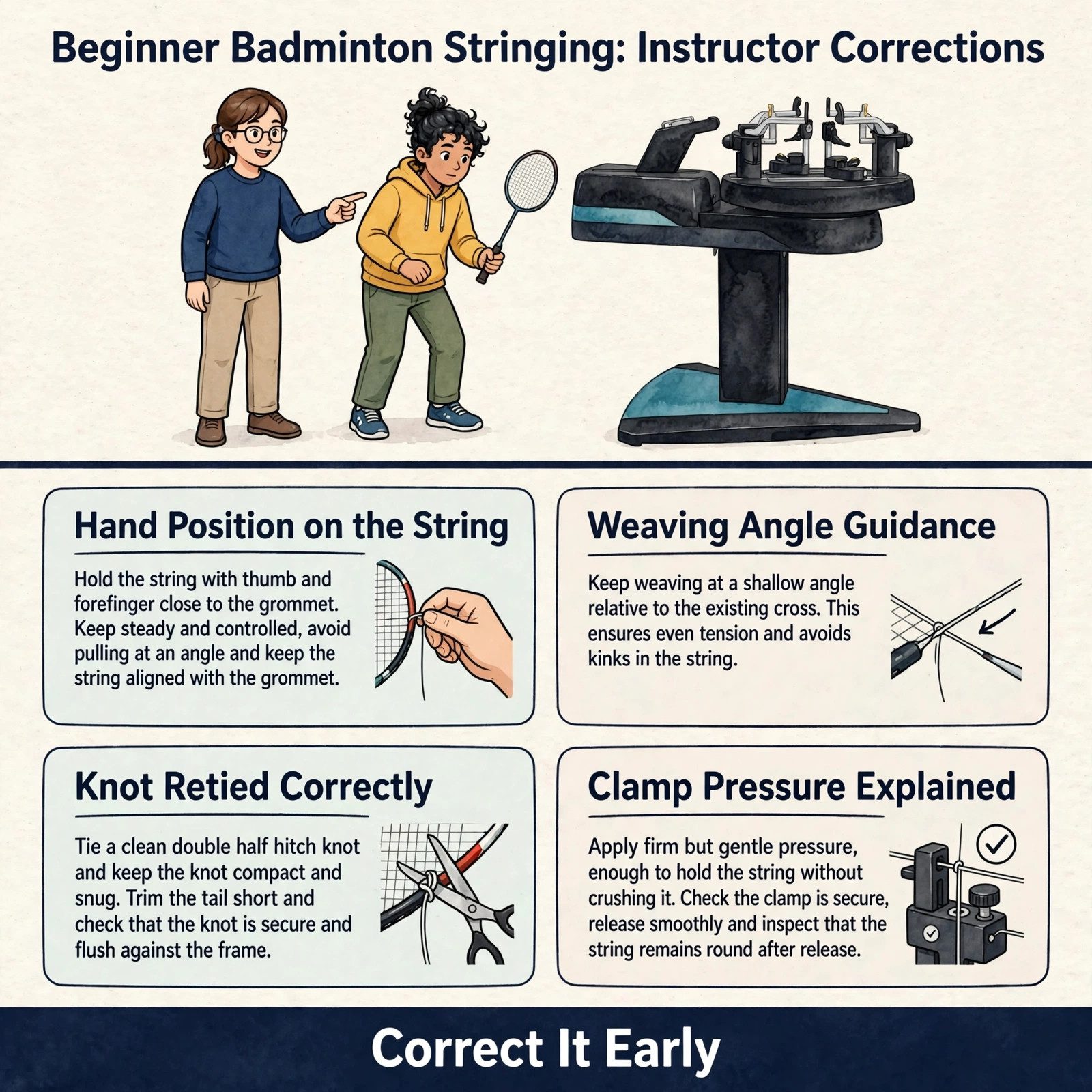
Beginners improve fastest when mistakes are corrected early, before they harden into habits. A knot tied the wrong way fifty times takes real work to undo; the same knot corrected on your second racket is simply how you string from then on. That is why hands on correction matters more for beginners than for anyone else. An instructor beside you can fix your grip on the string, your weaving angle and your clamp pressure as you work. Videos and manuals can show the order of the steps, but they cannot see your hands, so they cannot catch the small errors a beginner cannot yet spot.
Ask how a beginner session actually runs. How many rackets do you string yourself, on strings like BG65 and BG66 Ultimax? Who watches your first knots, and how is a mistake shown and put right? How much of the session is your hands on the machine, guided step by step?
Between sessions, practise the basics slowly and write down what went wrong each time: a crossed weave, a soft knot, a missed grommet check. A beginner with a short honest log improves faster than one who strings many rackets and remembers none of the errors.
1.4 Practical Review
Which costs and commitments should a beginner list?
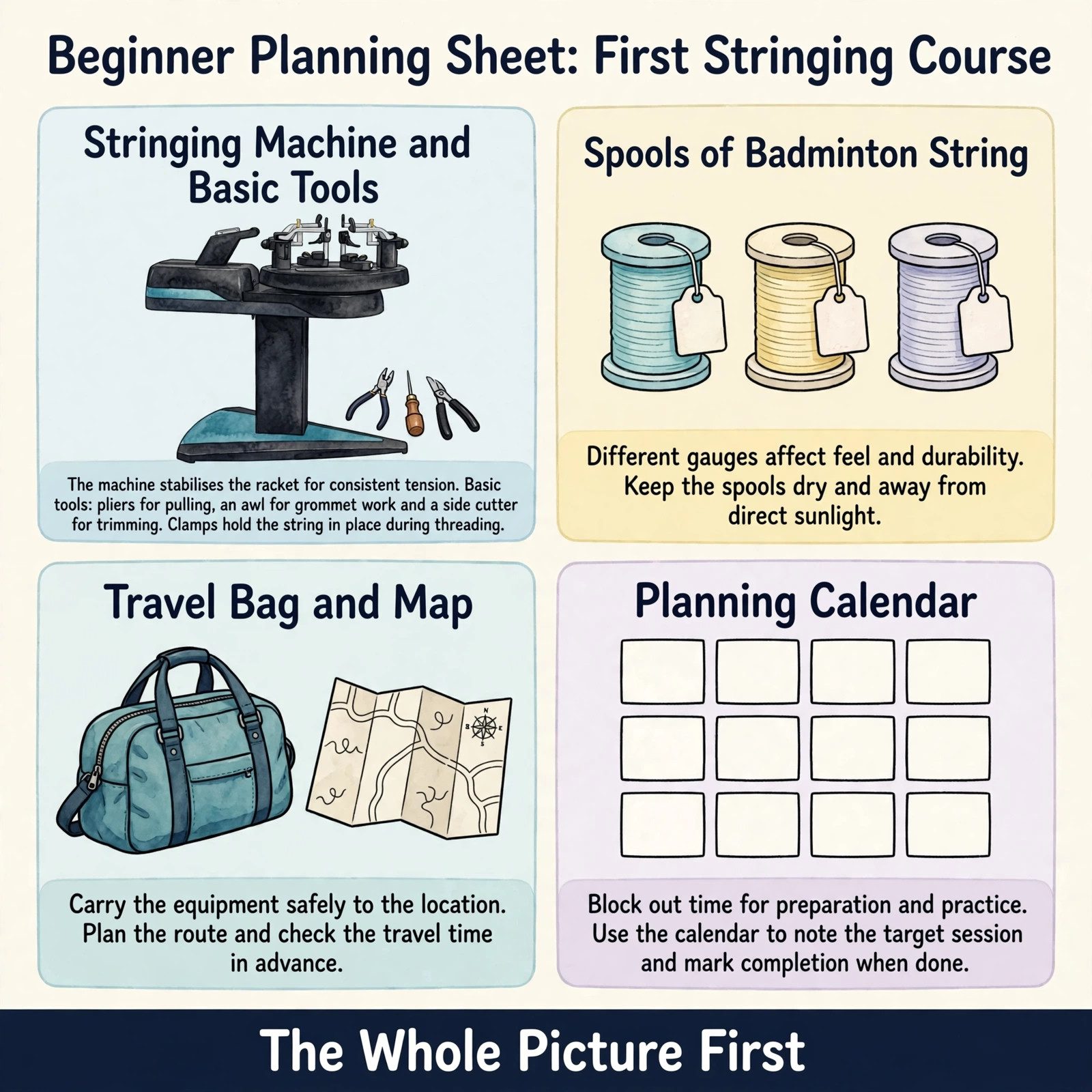
List the full commitment before you judge a beginner course by any single figure. On one side: the course, the exam, a machine and tools if you plan to buy your own later, and string and materials for practice. On the other side: travel and stay if you train away from home, time away from work or study, and the retake arrangement if the first exam attempt goes badly. None of that should scare a beginner off. It simply means the decision is made with the whole picture in front of you, written down, rather than discovered piece by piece later.
Check the details. Give each item its own line: course, exam, machine and tools, string and materials, travel and stay, and time away. Add a note on what you already own or can borrow, because a beginner often needs less equipment at the start than a course list suggests.
Review the process. Read the list before you compare courses. A course that includes supervised practice rackets and strings can suit a beginner better than a cheaper one that expects you to arrive fully equipped. The lines only make sense read together, as one commitment.
Plan the next step. Use the same lines for every option, and mark any line a provider has not answered as a question to resolve, not as zero. When a provider will not explain the retake arrangement or what a beginner needs to bring, that silence is part of the comparison too.
1.5 Key Checks
How should a beginner compare stringing courses fairly?
Record the context.
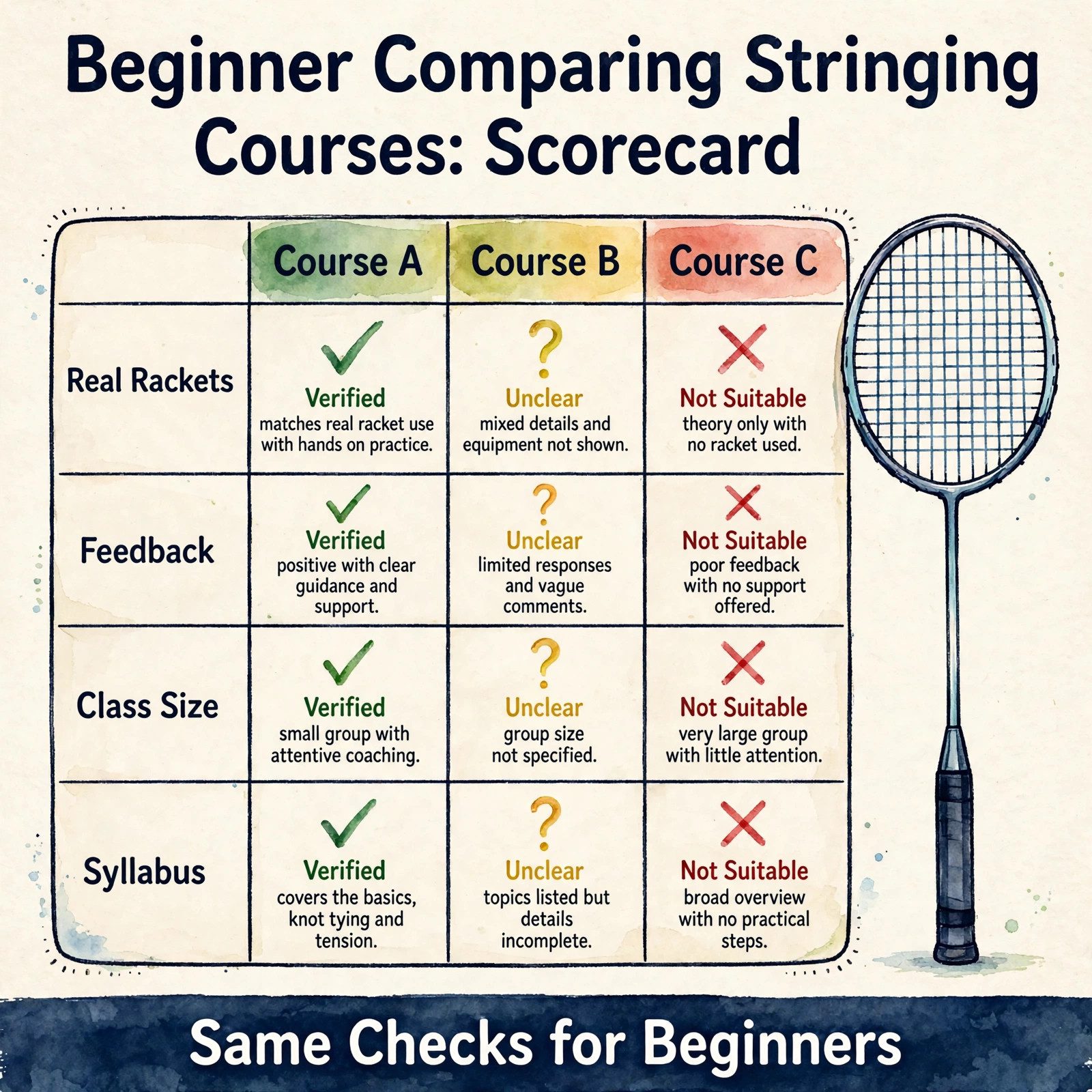
Compare beginner courses with the same scorecard, not by the friendliest advert. Score each option on: real rackets from the first session, feedback on your own hands, class size small enough for a beginner to be seen, syllabus in writing, the full commitment list, and a practical exam that checks the basics. For each line record verified, unclear or not suitable for you. A course is only better than another when it scores better on the same lines, judged the same way, and a beginner needs those lines in writing because everything is new.
Check the details.
Weight the lines the way a beginner should. Early correction and real rackets matter most at the start, because they decide whether your first habits are right. Fancy extras and advanced topics can wait; the basics carry every racket you will ever string.
Review the process.
Date every answer and write the exact question that would clear each unclear mark. Keep the scorecard with your practice log. When you are ready to enquire, the sheet turns into a short list of sharp questions instead of a beginner’s guesswork.

1.6 Service Record
How does the BSW route work for a complete beginner?
Apply the finished scorecard to the BSW route first. Best Stringer Worldwide (BSW) runs its badminton stringing course with certification in Kuala Lumpur, Malaysia, under founder Eric Chuar, and beginners start from zero there: no experience is assumed. You train on real rackets with an instructor correcting your hands from the first session, then sit the practical certification exam the day after training. Certification results are assessed and approved by the BSW certification board, so the result states what your beginner work showed against the standard on the day.
Check the details. Score BSW on the same lines as everyone else: real rackets, early feedback, class size, syllabus, commitments and the exam. A provider that teaches beginners to use a scorecard should have no trouble being measured by one, and BSW publishes its course and certification information for exactly that review.
Review the process. Timing is flexible, and the course runs in Kuala Lumpur only, so plan travel around the training days and the exam day that follows. If you are travelling in, that is one trip: learn the basics properly, settle overnight, then sit the exam while the corrections are still fresh in your hands.
Plan the next step. Where a line stays unclear, ask about that line only. Ask what a complete beginner should bring, what to practise if you have access to a machine before arriving, and how the first session starts for someone who has never strung a racket. Fill the answers into the scorecard.

1.7 Guided Practice
What should a beginner ask and prepare before enrolling?
Tell the provider you are a complete beginner, plainly and without dressing it up. Add what equipment you have access to, whether you play badminton yourself, and what you hope to string for: your own rackets, your club, or paid work later. Send that summary with the questions still open on your scorecard. The questions that earn their place are the ones that change your preparation: what the exam checks, who corrects your work, what to bring, and what happens if the first exam attempt needs a retake.
Before you send, cut every question that does not change a decision. Ask about the first skills, the correction and the commitments. A short enquiry that admits you are starting from zero gets a useful, honest answer; pretending to know more only gets you the wrong advice.
Turn the replies into a simple preparation plan: any basic terms to learn, strings and rackets to look at if you can practise first, and the exam checklist pinned where you can see it. Arrive knowing the order of the steps, and let the training build the skill itself.
Badminton Stringing Course for Beginners Quick FAQ
Honest answers for complete beginners on first skills, early correction, preparation, and how the BSW route in Kuala Lumpur works.
What does a beginner course teach first?
The first skills are holding and inspecting a frame, mounting it safely, starting the mains, weaving the crosses evenly, tying clean knots and checking your own finished work. You learn them in order, on real rackets, with each step checked before you move on.
What does the practical exam check for a beginner?
It checks tension accuracy, clean starting and finishing knots, grommet care, a straight and even string bed and the same result repeated, all on a badminton racket. For a beginner it proves your basic habits were built correctly, not self taught.
Why does early correction matter?
An instructor watches your hands from the first racket and corrects grip, weaving and knots before a wrong habit sets in. Videos show the steps but cannot see your work, so early mistakes practised alone become the habits you later have to unlearn.
Which costs and commitments should a beginner list?
List the full commitment before you judge a beginner course by any single figure. On one side: the course, the exam, a machine and tools if you plan to buy your own later, and string and materials for practice. On the other side: travel and stay if you train away from home, time away from work or study, and the retake arrangement if the first exam attempt goes badly. None of that should scare a beginner off. It simply means the decision is made with the whole picture in front of you, written down, rather than discovered piece by piece later.
How should a beginner compare courses?
Score every beginner course against the same criteria: real rackets from the start, feedback on your hands, class size, syllabus in writing, full commitments, and a practical exam at the end. Mark each verified, unclear or not suitable for you.
How does the BSW route work for beginners?
For a beginner, the BSW route is judged by the same beginner checklist. Best Stringer Worldwide is based in Kuala Lumpur, Malaysia, founded by Eric Chuar. You train on real rackets with an instructor correcting your work from the first session, then sit the practical certification exam the day after training. Certification is assessed and approved by the BSW certification board, so the result states what your work showed on the day. Run it through the same scorecard as any other course: real rackets, early correction, class size, syllabus in writing, full commitments and the exam, and ask about any line that stays unclear.
What should a beginner ask before enrolling?
Tell the provider you are a complete beginner, plainly and without dressing it up. Add what equipment you have access to, whether you play badminton yourself, and what you hope to string for: your own rackets, your club, or paid work later. Send that summary with the questions still open on your scorecard. The questions that earn their place are the ones that change your preparation: what the exam checks, who corrects your work, what to bring, and what happens if the first exam attempt needs a retake.
What should a beginner keep from the course?
Your practice log from the first racket onward: string, tension, what went wrong, and what the correction was, plus your exam feedback at the end. That log shows a beginner’s progress in writing and tells you exactly what to practise next.
How can a beginner start with BSW?
Say plainly that you are starting from zero and ask what to prepare before you arrive. Then start the route: train on real rackets in Kuala Lumpur with correction from the first session, and sit the certification exam the day after training.
Badminton Stringing Course for Beginners: Explore the Practical Decisions
Build a Clear Working Method
Use the sections, questions and interactive comparison to plan your first steps as a beginner. Keep your practice log and use instructor feedback to choose what to practise next.
| Beginner Check | Rushed Approach | Planned Approach |
|---|---|---|
| First Skills | Jump to advanced work before the basics hold | Learn the first skills in order on real rackets |
| Exam | Treat the exam as a surprise at the end | Prepare for the basics the exam actually marks |
| Costs | Budget for the course fee only | List every cost and commitment before judging |
| Scorecard | Choose the friendliest advert you saw | Score every course against the same criteria |
| Practice log | Keep the course promises in your head | Write the criteria and the answers down |
| Next action | String many rackets and remember none of the errors | Use your practice log to choose the next drill |
Start Stringing From Zero with Best Stringer Worldwide
Ready to start from zero with badminton stringing taught on real rackets, with correction from the first session? Tell Best Stringer Worldwide that you are a complete beginner, what equipment you have access to, and what you hope to string for. Bring one specific question so the discussion fits your starting point. Train on real rackets in Kuala Lumpur, then take the practical certification exam the day after training, assessed and approved by the BSW certification board.

