






1.1 Starting Point
What happens after stringer certification and how is trust built?
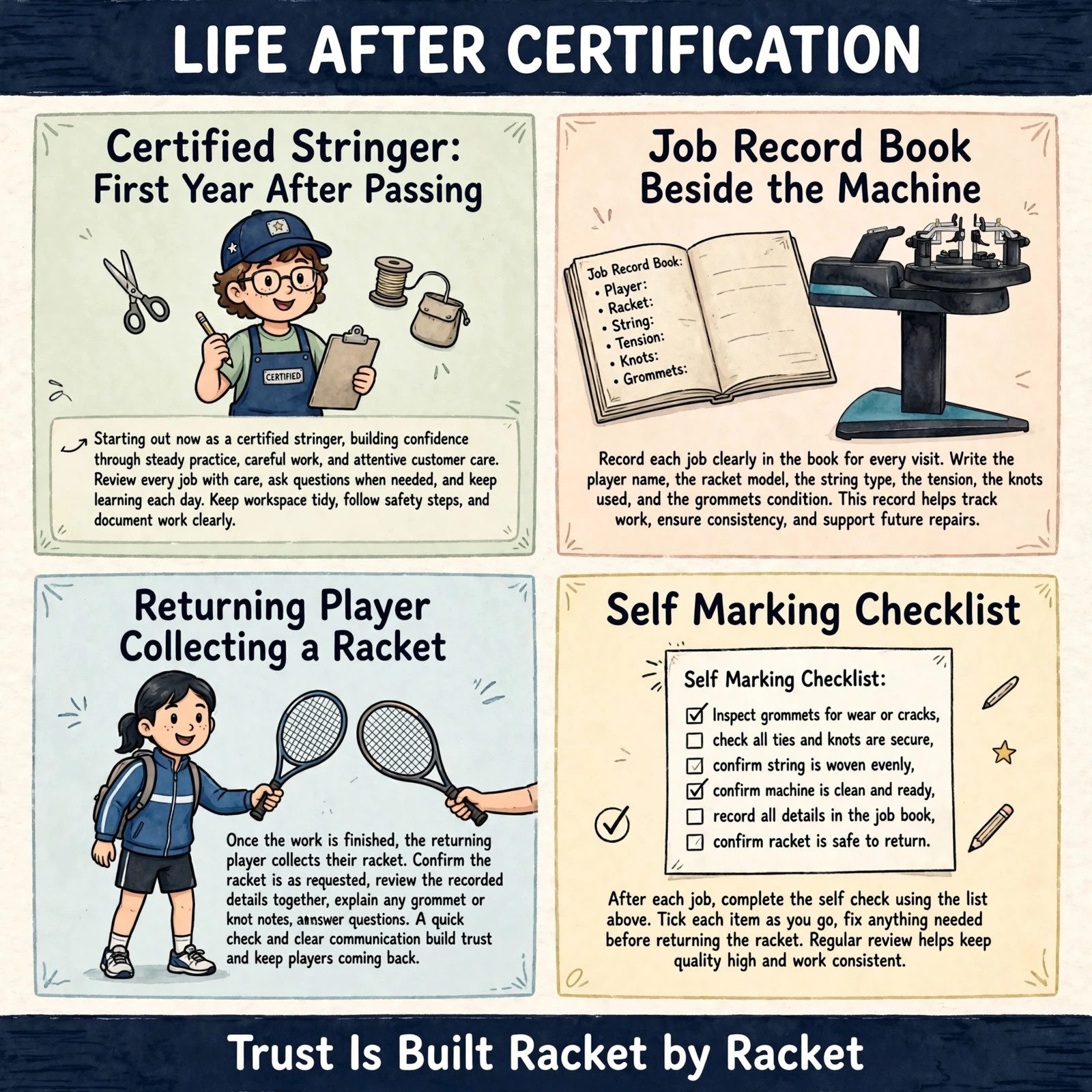
After stringer certification, the real test begins: keeping exam standard when nobody is marking your work. Passing proves that on one day, under observation, your tension accuracy, knot work, grommet care and frame handling met a set standard. The first year after passing turns that single result into a track record players trust, built from honest records, repeat players and reviews earned one racket at a time. Best Stringer Worldwide, founded by Eric Chuar and based in Kuala Lumpur, Malaysia, assesses and approves results through the BSW certification board, and its graduates build their standing the same slow way: racket by racket, record by record.
A track record is not the certificate on the wall. It is the pattern players can see over months: rackets returned on time, tensions that feel as promised, knots that hold, grommets replaced before they cut string, and problems admitted early instead of hidden. One good exam day opens the door. A year of steady work is what keeps players walking through it.
Players trust what they can check. They remember whether the second restring felt like the first, whether you noted their string and tension without being asked, and whether you warned them about a worn grommet before it failed mid match. Trust after certification is a record keeping habit made visible at the counter, not a title repeated loudly.

1.2 Preparation
Which exam habits must survive the first year?
The exam habits worth keeping are plain to list and easy to drop. Inspect every frame before mounting, even familiar rackets, because cracks and worn grommets do not announce themselves. Mount the frame firmly without distortion. Weave mains and crosses cleanly, deliver the tension you promised rather than the tension the machine dial suggests, and place clamps without marking thin string at 0.65mm to 0.70mm gauges. Tie starting and finishing knots the exam way every time, check shared holes patiently, and replace damaged grommets instead of stringing over them and hoping.
The habit that fades first is usually inspection, because it feels slow when a queue is waiting. The habit that protects you most is the same one. A two minute frame check catches the crack that would otherwise become your fault in the player mind, and a short note on the job card proves you looked before you strung.
Speed belongs after accuracy, never before it. Exam day taught a working order: inspect, mount, weave, tension, knot, finish, check. Keep that order on busy days and the work stays even. Skip steps to save minutes and small faults stack up quietly until a broken string or a twisted frame tells the story for you.

1.3 Working Method
How do records and repeat players build a track record?
Records turn single jobs into a track record. For every racket, write the player name, the racket model, the string and gauge, the tension requested, the tension delivered, knot notes and any grommet work done. When the player returns, you can repeat what worked or adjust one thing at a time with reasons. Repeat players are built this way: not by discounts or slogans, but by the quiet confidence of a stringer who remembers their game better than they do and can show the notes to prove it.
Reviews follow the same pattern. Players recommend stringers whose work they can describe: consistent feel, honest advice, problems fixed without argument. Ask satisfied repeat players to share their experience in their own words, and never script, buy or inflate what they say. One honest review naming your tension consistency is worth more than ten vague compliments.
Feedback after certification comes from players instead of instructors, so learn to read it properly. A player who says the bed felt dead may mean tension loss, old string or a knot slipping. Ask questions, check your record for that racket, and test your own work before blaming the string. Correction did not end at the exam. It changed teachers.

1.4 Practical Review
What does the first year after passing really cost in effort?
The first year costs effort more than money, and honest planning counts both. There is the cost of string and materials used properly on every job, including grommets replaced instead of reused. There is time: records take minutes per racket, frame checks take minutes more, and rushed shortcuts are refused even when the queue is long. There is the cost of putting faults right when your work falls short. And there is the slower cost of turning down bought reviews, inflated claims and quick papers that would undo the standard your certificate stands for.
Check the details. Budget for the tools of consistency as well. A machine that holds calibration, clamps that grip without marking, cutters, an awl and a starting clamp all protect the standard you were marked on. Letting tools wear out while advertising exam standard is a quiet form of dishonesty players eventually feel in the string bed.
Review the process. Time away from the machine matters too. Review your records monthly. Count repeat players, note complaints and their causes, and pick one weak habit to fix next. That review hour is part of the commitment you accepted when you chose a tested credential over a bought one.
Plan the next step. There is also a cost to drifting, and it is paid in trust. One season of loose knots and skipped checks can erase a certificate in the minds of local players, because players judge the last restring, not the exam day. Protecting your record is cheaper than rebuilding it, in money, in time and in reputation.

1.5 Key Checks
How do you judge your own work when nobody is marking?
Record the context.
Judge your own work with the same scorecard an examiner would use, because after certification you are the only marker in the room. Score each finished racket on frame care, mounting, weaving, delivered tension, knot quality and grommet condition. Write the scores down weekly on a sample of your own jobs, including ordinary club rackets, not only tournament work. Where a score drops, name the cause honestly: rushing, worn clamps, skipped inspection or poor light at the machine. A written self check keeps standards visible when no examiner is watching.
Check the details.
Compare months, not days. A single busy weekend tells you little, while a season of records shows whether tension consistency is holding, whether one knot style keeps slipping and whether grommet replacements are rising because you check better or falling because you stopped looking. Patterns in your own notes are the honest version of progress after certification.
Review the process.
Let players into the scorecard where it helps them. Show a returning player their tension history, explain why you suggest a grommet change, and admit when a restring felt off and you want to redo it. Players who see you marking yourself strictly trust your certificate more, not less, because the paper and the practice finally match.

1.6 Service Record
How does the BSW graduate route support life after the exam?
Measured against that same scorecard, the BSW route prepares graduates for life after the exam in specific ways. Training in Kuala Lumpur runs 3 and a half days with classes from 10am to 5pm, flexible timing, and the practical exam on the last day, assessed and approved by the BSW certification board. Learners train on real rackets with instructor correction, and the record habit is taught as part of the work: noting string, tension, knots and grommet jobs per racket from the first training day onward.
Check the details. What BSW does not do after you pass matters as much. It does not promise work, players or reviews, and it does not claim a government licence. A graduate leaves with a tested result, a record system and a standard to defend. Building the local track record, shop by shop and club by club, remains the graduate own work, done in their own town and in their own name.
Review the process. That honesty is deliberate. A body that oversells life after certification sets graduates up to oversell themselves, and players punish inflated claims quickly. BSW graduates are told plainly that the certificate starts the argument and their next hundred rackets finish it. Repeat players, not launch announcements, are the measure of the first year.
Plan the next step. One more support is simple and practical: keep asking the body how employers and players can verify your pass, and keep your result record safe. Best Stringer Worldwide records its graduates through the organisation, so a shop checking your claim has somewhere real to ask. Verification plus records plus steady work is the full package a trusted track record is built from.
1.7 Guided Practice
What should you do first after you pass?
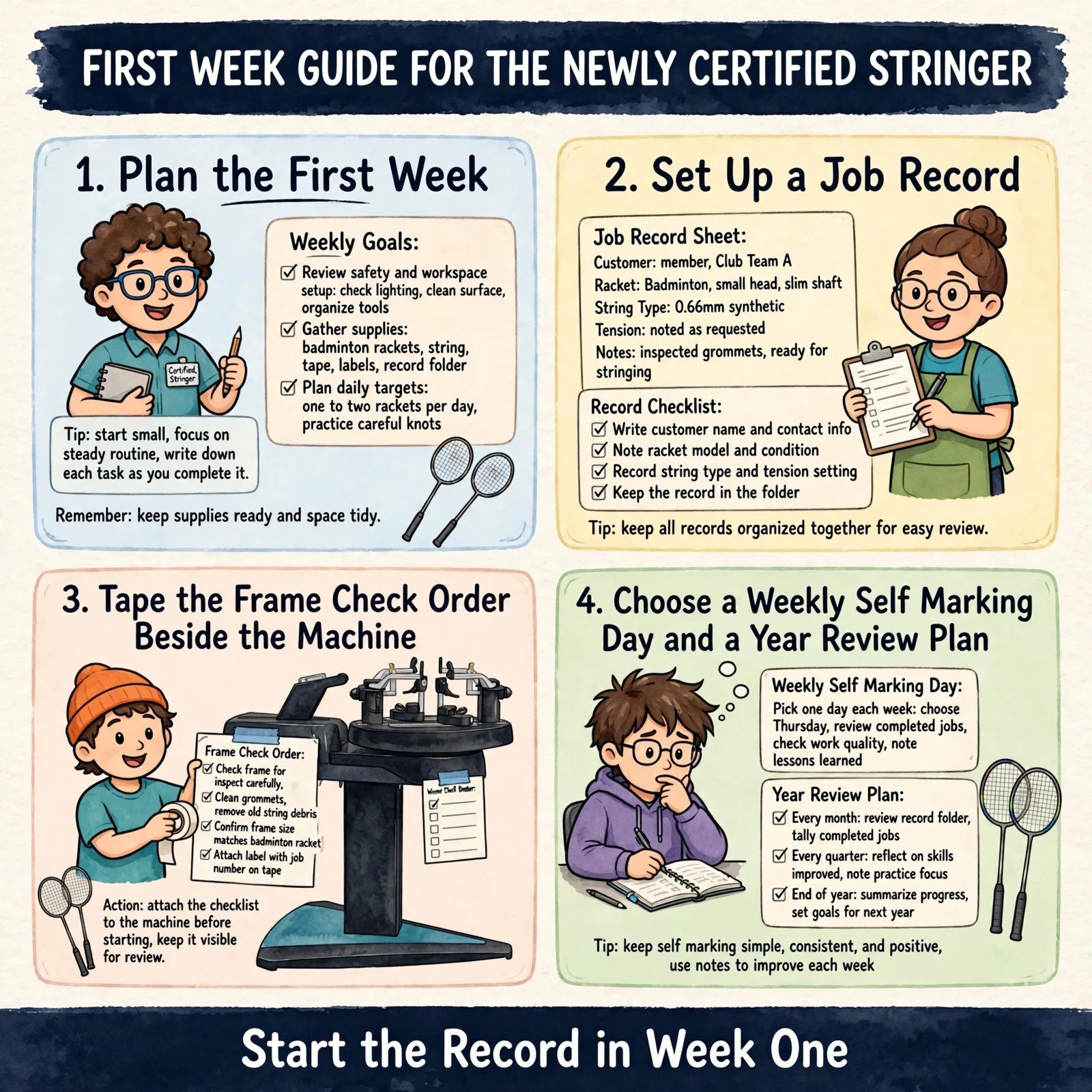
Start the first year with a plan written in the first week, while exam habits are still fresh. Set up your job record before the first paying racket arrives, with fields for player, racket, string, tension requested and delivered, knots and grommets. Decide your frame check order and tape it beside the machine. Choose one sample day each week for self marking. Then tell your first players plainly what you were tested on and what you record for them, without promising results no stringer can promise.
If you are choosing a certification route now, ask the questions that protect your first year. Who assesses the result, and can a player or shop verify my pass afterwards? What record habits does the training teach? At BSW, training is in Kuala Lumpur only, classes run from 10am to 5pm over 3 and a half days with the exam on the last day, and timing is flexible for learners travelling in.
Review the plan at three points in the year: after the first month, after the first busy season and at the year end. Count repeat players, read every complaint twice, and compare your self marking scores across the year. A rising repeat rate with honest notes is the clearest sign that certification became a track record, and that is the result worth showing the next player who asks.
After Stringer Certification Quick FAQ
Short answers to the questions newly certified stringers ask about records, repeat players, reviews and keeping exam standard.
What happens after stringer certification?
After stringer certification, a stringer builds trust through steady work: accurate tensions, clean knots, grommet care, honest records and repeat players who return because the last restring felt right. The certificate proves exam day standard. The first year of work proves whether that standard survives daily pressure.
Which exam habits matter most afterwards?
Keep the full exam order on every job: frame inspection, safe mounting, clean weaving, delivered tension checked, careful clamps, tidy starting and finishing knots and honest grommet care. The habits examiners marked are the same habits players feel, even when players cannot name them.
How do records build repeat players?
Keep a record for every racket: player, racket, string, gauge, requested and delivered tension, knots and grommet work. Records let you repeat what worked, adjust with reasons and earn repeat players and honest reviews based on consistent work rather than claims.
What commitments come in year one?
The first year costs effort more than money, and honest planning counts both. There is the cost of string and materials used properly on every job, including grommets replaced instead of reused. There is time: records take minutes per racket, frame checks take minutes more, and rushed shortcuts are refused even when the queue is long. There is the cost of putting faults right when your work falls short. And there is the slower cost of turning down bought reviews, inflated claims and quick papers that would undo the standard your certificate stands for.
How do you judge yourself without an examiner?
Use the examiner scorecard on your own work: frame care, mounting, weaving, delivered tension, knots and grommets, scored in writing on a sample of jobs each week. Honest self marking is how exam standard survives when no examiner is present.
How does BSW support graduates?
The BSW route teaches the record habit during training in Kuala Lumpur, tests the practical exam on real rackets on the last day of the 3 and a half day course, and records results assessed and approved by the BSW certification board. BSW promises no work or players after a pass. Graduates build their track record through records, repeat players and honest reviews, racket by racket.
What should you do first after passing?
Start the first year with a plan written in the first week, while exam habits are still fresh. Set up your job record before the first paying racket arrives, with fields for player, racket, string, tension requested and delivered, knots and grommets. Decide your frame check order and tape it beside the machine. Choose one sample day each week for self marking. Then tell your first players plainly what you were tested on and what you record for them, without promising results no stringer can promise.
What should you keep from your certification route?
Keep your pass confirmation, your training notes and a job record for every racket you string: player, racket, string, tension requested and delivered, knots and grommet work. Add your weekly self marking notes. These records are the evidence behind your track record when players and shops ask what your certificate means in daily work.
How can I start with BSW?
Start with an enquiry that states your sport, your stringing experience, your machine and the work you want certification for. BSW trains in Kuala Lumpur only, with flexible timing, classes from 10am to 5pm over 3 and a half days and the practical exam on the last day. Your result is assessed and approved by the BSW certification board.
After Stringer Certification: Explore the Practical Decisions
Build a Clear Working Method
The method is simple: use the examiner scorecard on your own rackets, keep the record for every job, and let repeat players and honest reviews be the report card for your first year.
| Track Record Check | Rushed Approach | Planned Approach |
|---|---|---|
| Record | Frame the certificate and stop keeping notes | Record every racket, string, tension and grommet job |
| Habits | Drop exam checks when the queue gets busy | Keep inspection, knots and grommet care on every job |
| Commitment | Count only the exam fee as the cost | Count time, materials, tool upkeep and fault repair |
| Scorecard | Assume passing means the standard holds itself | Score your own rackets weekly like an examiner |
| Your record | Judge the year from memory and compliments | Write the scorecard and review the records monthly |
| Next action | Repeat the same habits without review | Use the record to choose the next habit to fix |
Build Your Record After Certification with Best Stringer Worldwide
If you want a certificate that still means something a year later, take the route that teaches the habits behind it. Train on real rackets in Kuala Lumpur with Best Stringer Worldwide, with classes from 10am to 5pm over 3 and a half days, flexible timing, and the practical exam on the last day. Your work is assessed and approved by the BSW certification board. Send an enquiry stating your experience, your machine and your goal, and start building the record players will trust.
