1.1 Equipment Maintenance
When and Why to Restring a Tennis Racquet
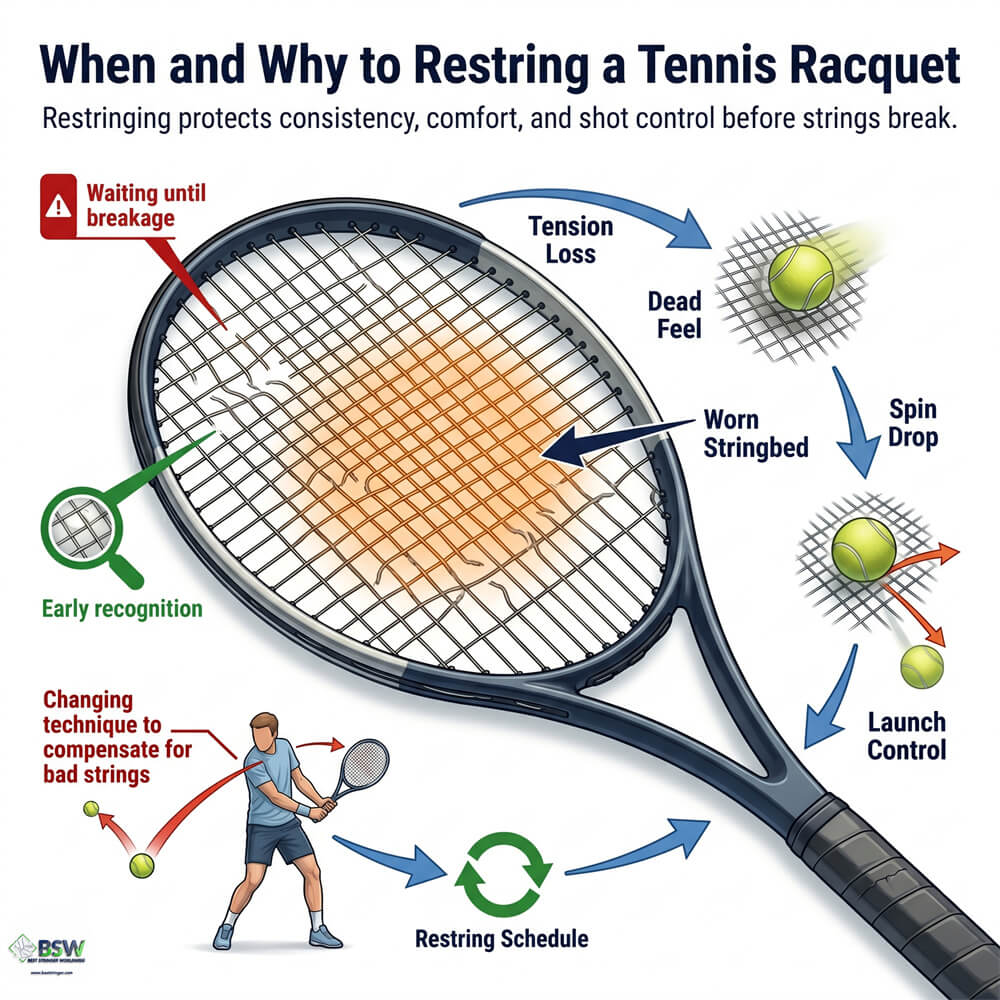
Restring a tennis racquet when the string breaks, shows substantial notching or fraying, or when a recorded change in feel, control or string movement makes the setup unsuitable for you. Time alone is not the only signal: playing frequency and intensity, string material and gauge, weather and storage, the racquet, and the player’s consistency needs all affect timing.
Strings begin changing after installation, even while a racquet is stored. Rather than waiting for a universal deadline, record the string, reference tension, date and playing hours, then compare wear and response over time. If you are also learning the installation process, use the step-by-step tennis racquet restringing guide and the exact manufacturer pattern for your frame.
This page gives a practical decision framework: inspect visible wear, assess changes during play, consider the string material and usage, and use repeatable records to decide when to restring.
1.2 Visual & Tactile Signs
Clear Signs It Is Time to Restring
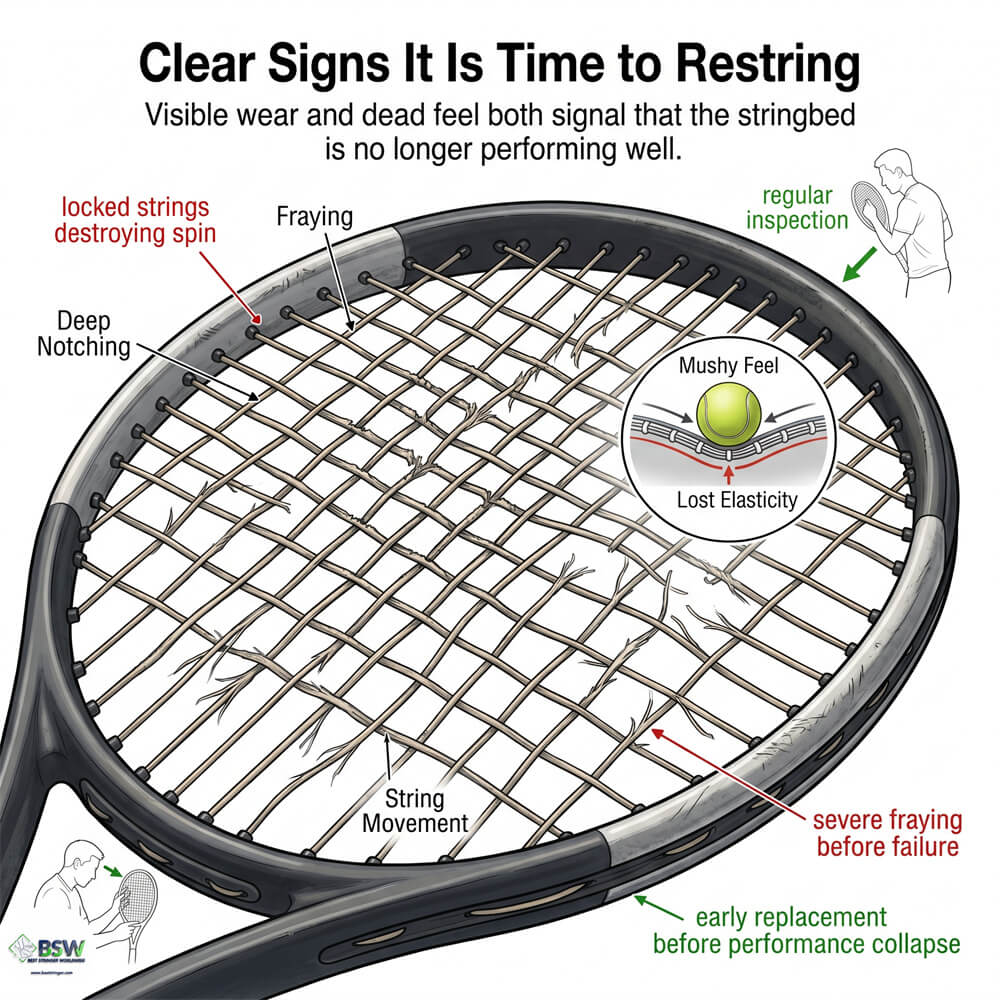
Inspect the stringbed under good light. Deep notching at main/cross intersections and substantial fraying on multifilament or natural-gut strings are useful wear signals. A damaged grommet, sharp frame contact or an isolated cut also deserves attention because it can cause premature breakage.
During play, note whether strings stop returning as expected or whether feel and depth control change compared with your recorded baseline. These observations can support a restringing decision, but they do not prove that tension is completely gone or identify the only cause of a performance change.
If the frame, grommets or string condition is uncertain, ask an experienced stringer to inspect the racquet before continuing to play or installing a new stringbed.
1.3 The Physics of Tension
Understanding Tennis String Tension Loss
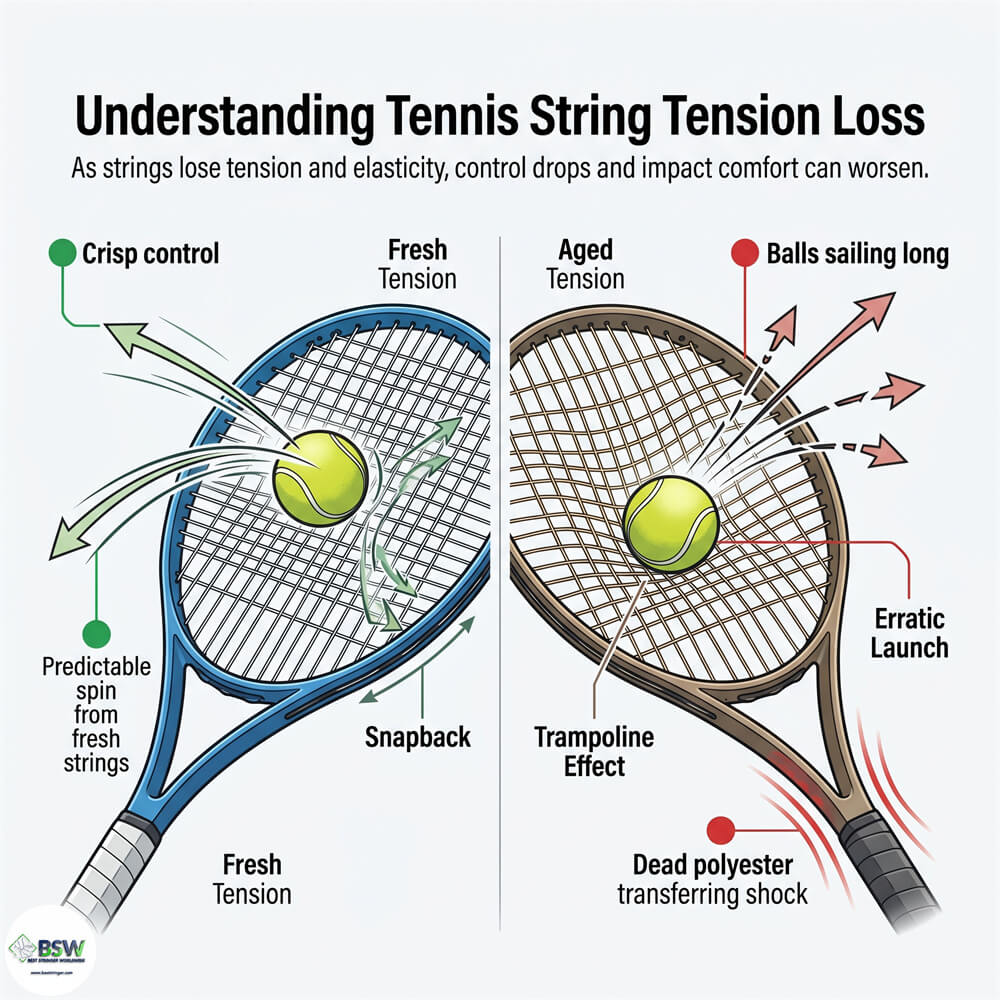
String tension changes after installation through material relaxation, repeated impacts and environmental exposure. The rate and the playing effect vary with string construction, gauge, reference tension, pattern, racquet, machine and use.
A changed stringbed can alter launch, feel and string movement, but the direction and size of the change are not identical for every setup. Compare observations with the same racquet, ball, conditions and player where possible instead of assuming that every loose or aged stringbed behaves in one fixed way.
Polyester, multifilament, synthetic gut and natural gut do not age identically. Wilson’s current tennis restringing guide also treats frequency, string material, environment and playing style as separate factors. Equipment information is not medical advice; persistent arm or shoulder symptoms should be assessed by a qualified healthcare professional.
1.4 Playstyle Variables
Factors Affecting Restringing Frequency
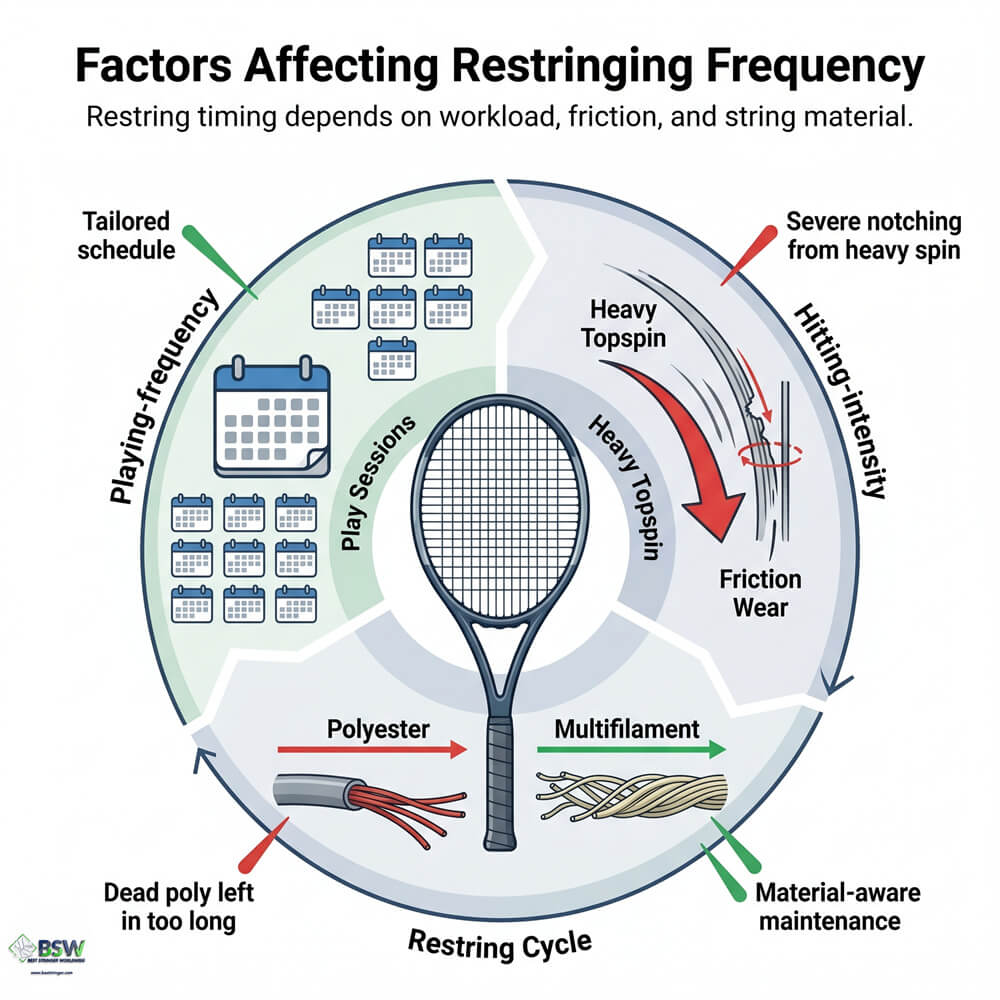
There is no universal answer to exactly how often you should restring, because different players subject their equipment to vastly different stress levels.
Playing frequency and consistency needs. More playing hours create more impacts and wear, but session count alone cannot set the right date. The old “times per year as sessions per week” rule is only a rough historical prompt; Wilson notes that it does not cover every player and may be too infrequent. Use it only alongside observed wear, material, hours and response.
Hitting intensity and spin. Repeated string movement and friction can accelerate notching and breakage, especially for players who hit frequently or with substantial spin. Track actual wear and playing hours rather than assigning every player the same “few weeks” interval.
String material and gauge. Polyester can remain unbroken while its playing characteristics change, whereas multifilament and natural gut may show fraying. Gauge, construction, moisture, heat and storage also matter. Recommend replacement from the recorded setup and observed condition; do not promise that one schedule preserves health or control.
1.5 Player Self-Evaluation
A Simple Way to Check Your Strings
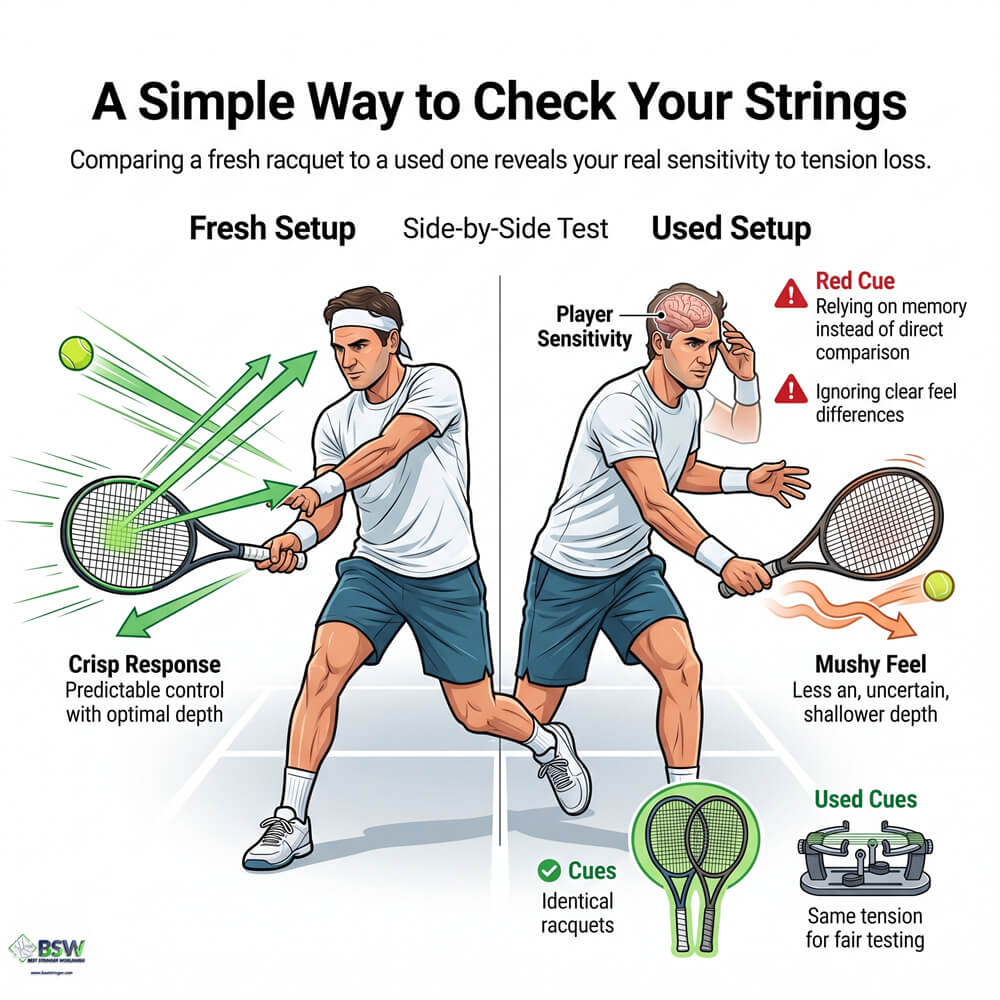
Compare repeatable setups.
If you own two matching racquets, record the model, string, gauge, reference tension, machine, date and playing hours for each. A side-by-side comparison can reveal a difference, but an unused backup also changes over time and is not a laboratory control.
Observe under similar conditions.
Compare the racquets during the same session with similar balls and strokes. Record feel, depth control, string movement and visible wear. Treat the result as player feedback, not proof that every fresh setup must feel crisp or every older setup must feel erratic.
Build your own baseline.
Players notice changes at different times. A dated service record and short notes after play help the player and stringer identify a useful maintenance interval without assuming that skill level alone determines sensitivity.
1.6 Professional Guidance
Practical Tips for Players and Stringers
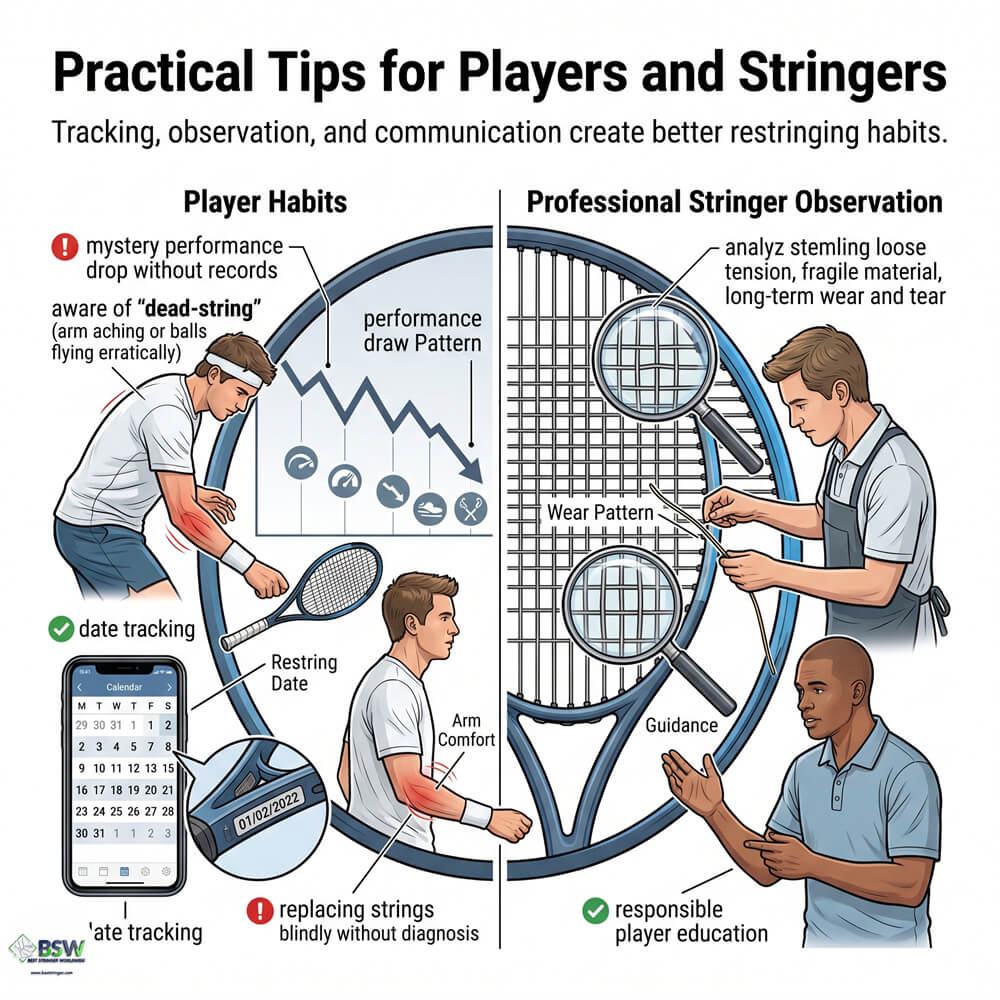
Record each restring date, string, gauge, reference tension, machine and approximate playing hours. When feel or control changes, the record helps determine whether string age or wear may be one factor; technique, fatigue, balls, court and weather can also affect the result.
Stringers should inspect the old stringbed, frame and grommets, ask about playing frequency and concerns, and document the previous setup. Wear patterns can inform a discussion, but they do not by themselves prove the original reference tension was wrong or diagnose the player’s technique.
Explain that an unbroken stringbed can still change in tension, movement and feel. Offer options and limitations rather than claiming that restringing prevents injury. Refer pain, numbness or persistent physical symptoms to an appropriate healthcare professional.
1.7 Further Learning
The Value of Racquet Stringing Education
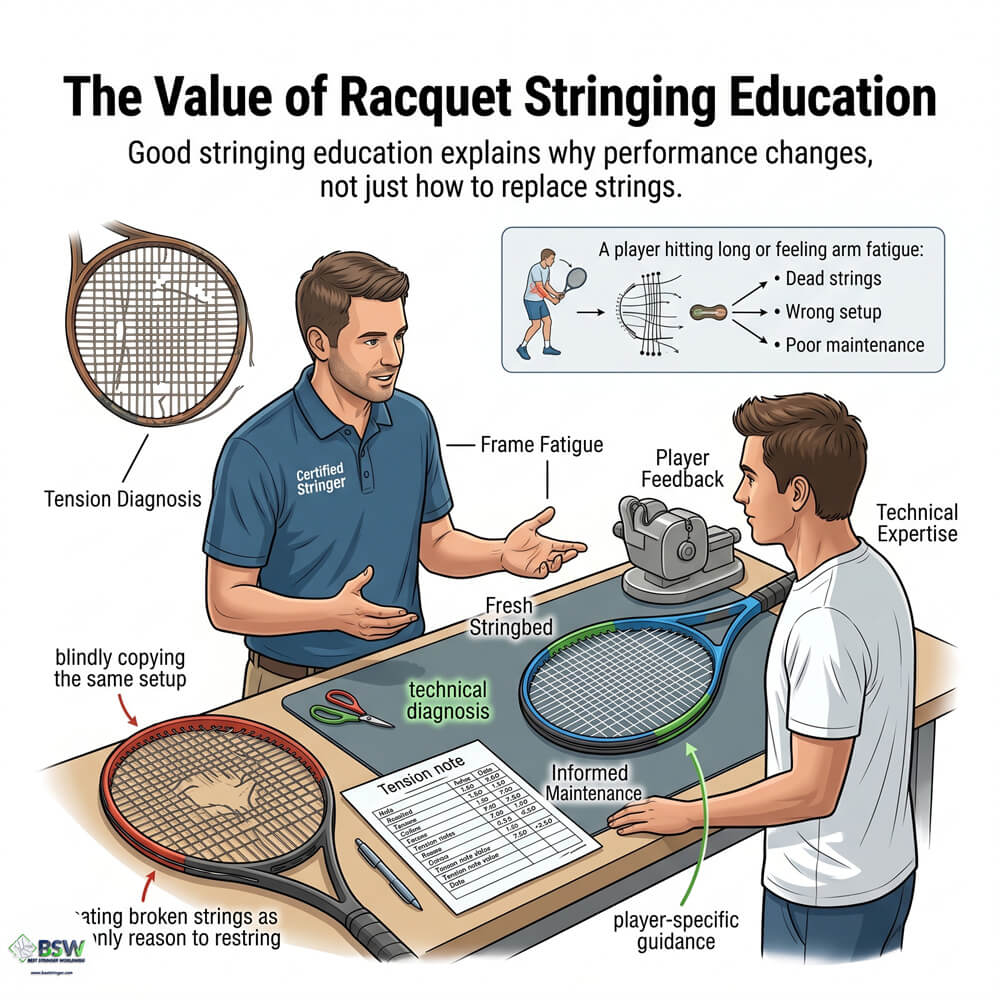
Structured racquet stringing education can cover material behaviour, inspection, pattern reading, machine checks, service records and player consultation. These skills support better maintenance decisions without turning visual inspection into a medical or performance diagnosis.
BSW certification records the outcome of the applicable knowledge and practical assessment. A stringer can discuss equipment observations and player feedback but should not diagnose technique, injury or the medical cause of arm fatigue. Review the tennis stringing certification pathways for current scope.
Players and aspiring stringers can use documented setups, careful inspection and structured practice to make better-informed decisions. No course, credential or restringing job guarantees a particular playing result.
Tennis Restringing Quick FAQ
Clear, honest answers about when and why a tennis player should restring their racquet.
How often should I restring a tennis racquet?
There is no universal interval. Track playing hours, string material and gauge, notching, fraying, breakage, string movement and changes in feel or control. The traditional sessions-per-week rule is only a rough prompt, not a schedule for every player.
Do I need to restring if strings haven’t broken?
Yes, an unbroken stringbed can still be replaced when wear or a documented change makes it unsuitable. Restringing may restore a familiar setup, but equipment advice cannot predict or prevent injury; seek medical advice for persistent symptoms.
What are the signs of worn or dead strings?
Look for deep notching, substantial fraying, damage near a grommet, breakage or persistent string movement. A changed sound, feel or depth control can be another signal, but it does not prove that all tension is gone.
How does tension loss affect power and control?
Tension and material changes can affect stringbed stiffness, launch, feel and string movement. The result depends on the complete racquet-and-string setup and does not guarantee either extra power or lost control.
Why do some players restring more often?
Frequent play, high impact, substantial string movement and abrasive contact can accelerate wear. Individual players also differ in how soon they notice changes, so use actual observations and records rather than skill labels alone.
Can old tennis strings cause arm discomfort?
Some players report a firmer or less comfortable feel as a stringbed changes, particularly with polyester setups. That observation does not establish the medical cause of elbow or shoulder pain. Stop playing and consult a qualified healthcare professional if symptoms persist or worsen.
How can I test if I need a restring?
Compare two documented setups under similar conditions and inspect the used stringbed for wear. If the difference matters to the player or damage is visible, discuss replacement; remember that even an unused backup changes with time.
Why does this matter for a certified stringer?
Stringer certification can assess material knowledge, inspection, service records and player communication. Stringers should explain maintenance options accurately and keep health claims within the limits of equipment guidance.
Should stringers guide restringing habits?
Yes. Stringers can document the setup, inspect wear and discuss a maintenance interval based on the player’s use and feedback. They should not guarantee optimal control, safety or injury prevention.
The Physics of Tension Loss: How Dead Strings Affect Play
String Elasticity & The “Dead String” Effect
Tennis strings change after installation through material relaxation and repeated use. Those changes can affect stringbed stiffness, movement and feel. The interactive comparison below is a qualitative illustration, not a laboratory measurement; it does not provide verified COR, tension-loss or arm-shock values and should not be used for medical conclusions.
Example: Recently Strung Stringbed
Example: Aged or Worn Stringbed
Practical Maintenance Checks
A practical maintenance decision uses the string and gauge, reference tension, installation date, playing hours, visible wear and player feedback. It does not rely on invented laboratory numbers or promise consistency, safety or performance.
| Performance Trait | Aged / Dead Strings | Freshly Strung Racquet |
|---|---|---|
| Predictability & Control | Erratic launch angles; balls often fly unpredictably long. | High consistency and predictable ball launch upon impact. |
| Impact Feel & Response | Mushy, dead, or hollow sensation upon contact. | Crisp, responsive, and directly connected to your swing path. |
| Spin Generation (Snapback) | Strings get stuck out of place, drastically reducing spin. | Strings snap back instantly to impart heavy rotation on the ball. |
| Arm Comfort & Health | Dead strings transfer harsh vibrations directly to the arm. | Proper elasticity absorbs shock efficiently, protecting joints. |
| String Movement | Strings constantly shift and must be straightened manually. | Strings remain locked safely in their intended grid pattern. |
| Stringer Recommendations | Replace immediately to avoid building bad mechanical habits. | Ideal state to play competitive matches with confidence. |
Master Racquet Maintenance with Best Stringer Worldwide
Best Stringer Worldwide makes racquet stringing education and certification pathways available worldwide. Delivery format, dates, practical arrangements and places vary by intake. Check the current course schedule and submit the course application; certification is issued only after the applicable requirements and assessment are passed.