1.1 Stringing Fundamentals
How to Restring a Tennis Racquet Properly
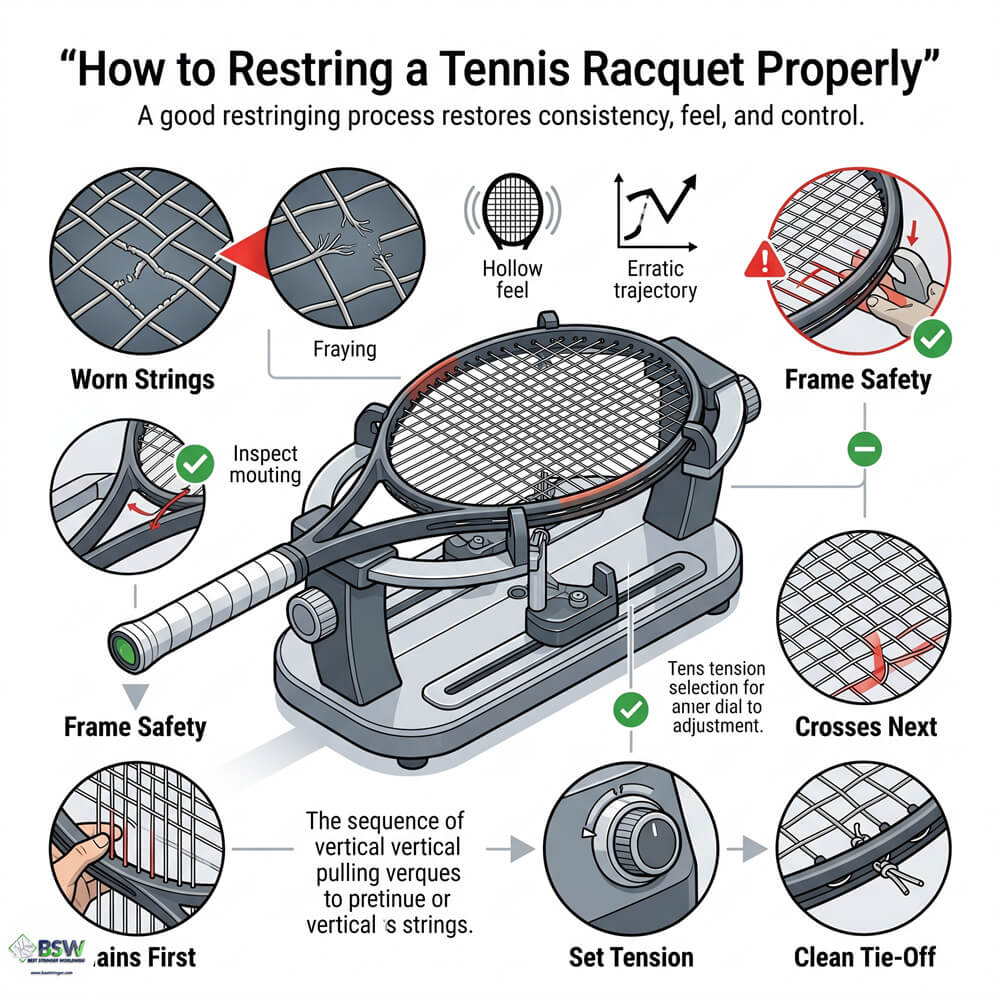
This guide explains how to restring a tennis racquet using a stringing machine: identify the exact frame pattern, inspect the frame and grommets, mount it securely, install the mains and crosses, tension each pull, tie off at the specified holes and check the finished stringbed.
Strings lose tension and wear at different rates. Deep notching, fraying, breakage, a material change in feel or difficulty controlling depth can justify an earlier restring. Use your playing frequency, string material and condition as signals rather than a fixed calendar rule; see the tennis restringing frequency guide for a fuller decision framework.
Before cutting or pulling string, locate the manufacturer’s pattern and recommended tension range for the exact racquet model. Do not restring a cracked or structurally damaged frame. If the pattern, tie-off holes, mounting method or machine operation is uncertain, stop and consult the relevant manual or an experienced stringer.
1.2 Tools and Materials
Essential Tools for Restringing
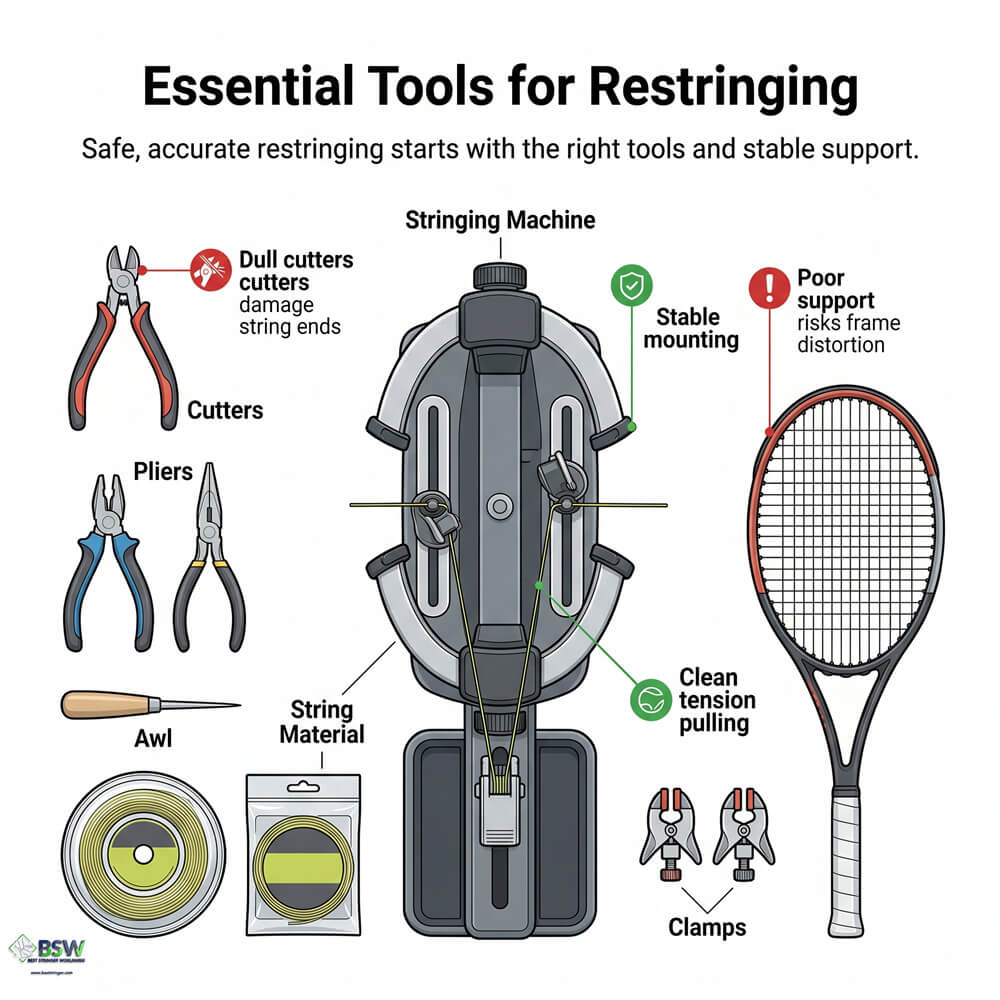
A basic setup includes a stringing machine with secure frame supports, compatible clamps, cutters, suitable pliers and the correct amount of string for the selected one-piece or two-piece pattern. Use the machine manufacturer’s operating and calibration instructions; drop-weight, lockout and electronic machines do not all produce or display tension in the same way.
Inspect tools before use and keep cutters away from the frame. A pathfinder awl or other specialist tool may help with a blocked grommet, but forcing a sharp tool beside a tensioned string can damage the string or grommet. Confirm the intended string path instead of enlarging a hole or improvising a tie-off.
Select string material and gauge with the racquet’s specifications, player preferences, prior setup and physical comfort in mind. Record the requested string, reference tension, pattern and any pre-existing frame or grommet damage before starting.
1.3 Preparation Stage
Preparing the Racquet and Grommets
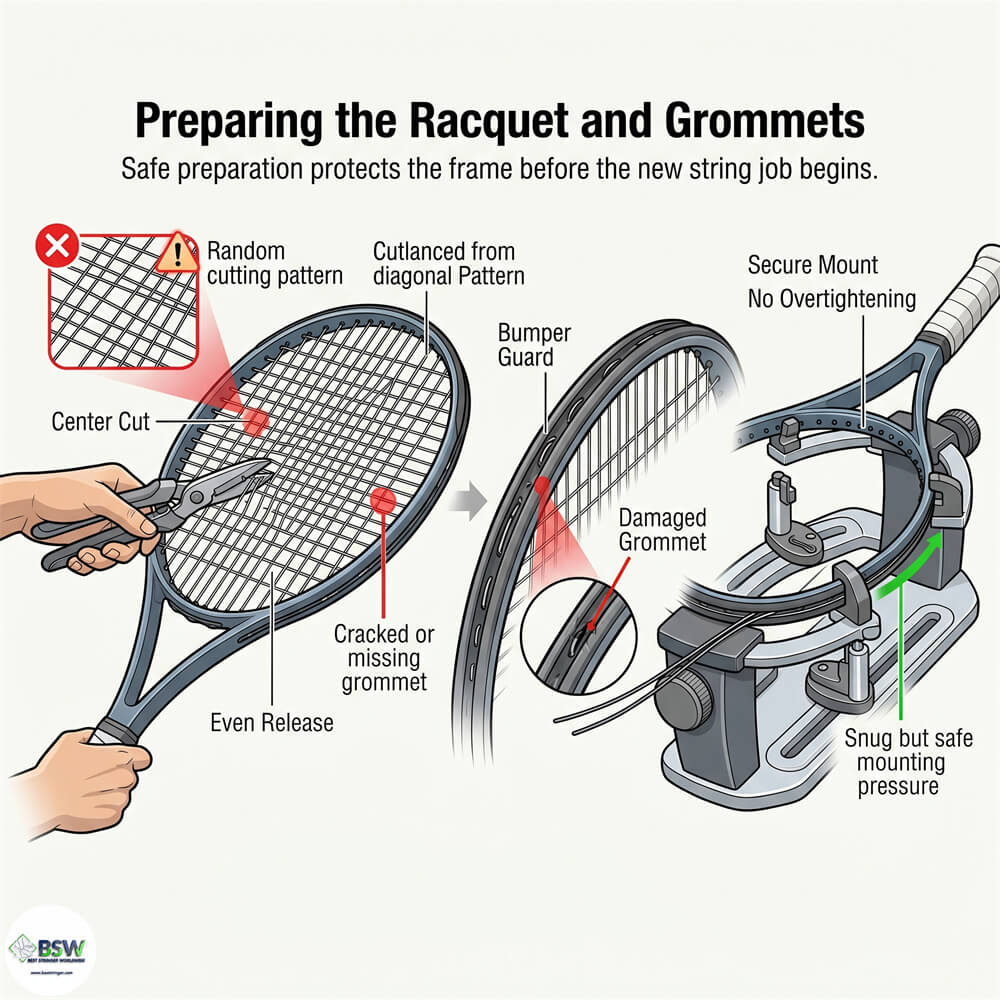
Remove the old string in small, alternating cuts so tension is released progressively rather than from one isolated side. If the frame is cracked, severely distorted or making unusual sounds, stop instead of continuing.
With the string removed, inspect the frame, bumper and every grommet. Replace or protect split, sharp or missing grommets before installing new string; otherwise the string can contact the frame edge and fail prematurely.
Mount the racquet according to the stringing-machine instructions. Supports should stabilize the frame without crushing or distorting it. Confirm the racquet is centred and secure before applying tension.
1.4 The Stringing Process
Stringing the Mains and Crosses
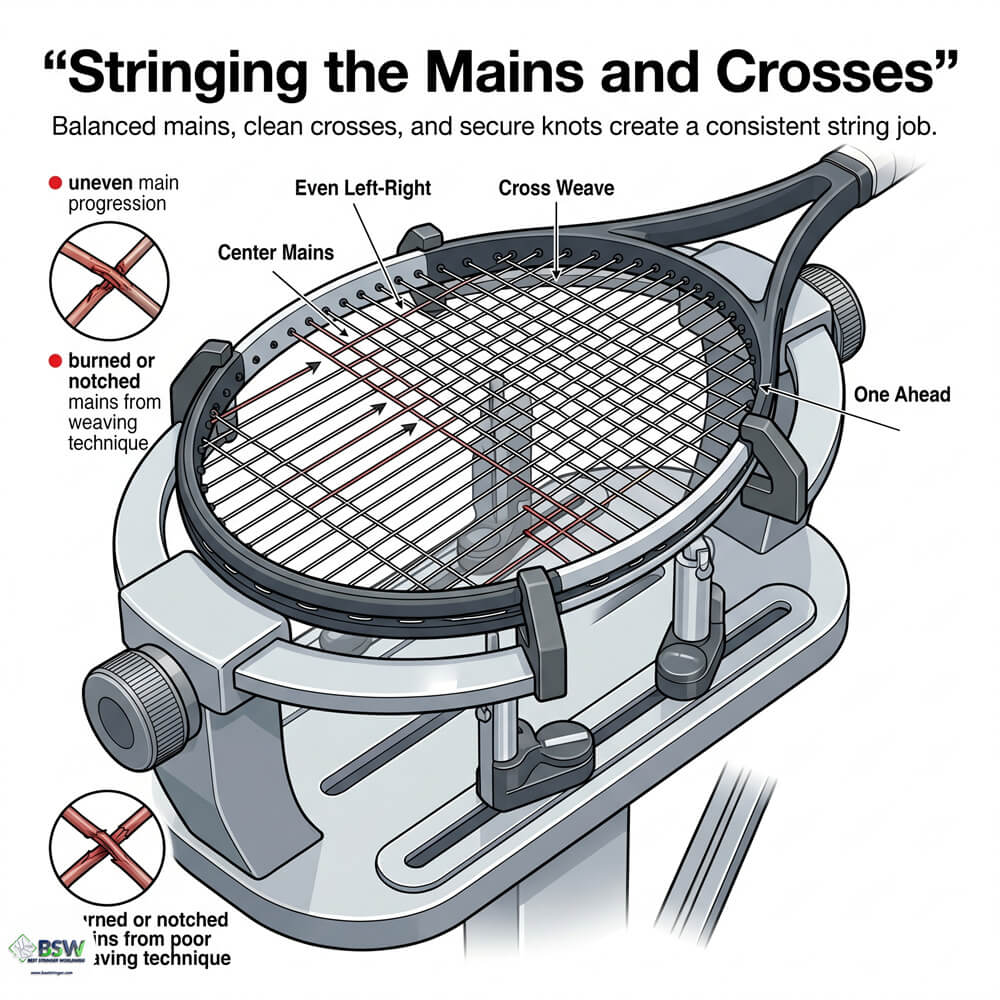
The core of tennis racquet stringing involves two phases: the mains (vertical strings) and the crosses (horizontal strings). Following the specific string pattern for your racquet model is vital.
Stringing the Mains. Follow the exact pattern for the racquet model, including the starting end, main-string sequence, skipped holes and designated tie-offs. Many patterns begin at the centre and alternate outward, but do not assume that every frame uses identical holes or one-piece/two-piece instructions. Pull and clamp consistently without exceeding the frame’s recommended range.
Weaving the Crosses. The cross strings require careful over-and-under weaving. A good racquet stringer knows to weave one string ahead to reduce friction, which prevents burning or notching the mains during the pull. Friction management is especially important when using soft multifilament or natural gut strings.
Tying Off Safely. Use an appropriate finishing knot at the manufacturer-designated tie-off hole. Tighten the knot without pulling it into or crushing the grommet, then trim the tail while protecting the frame. The knot should be secure and compact; no single knot choice corrects an incorrect pattern, damaged grommet or inconsistent pull.
1.5 Tension & Performance
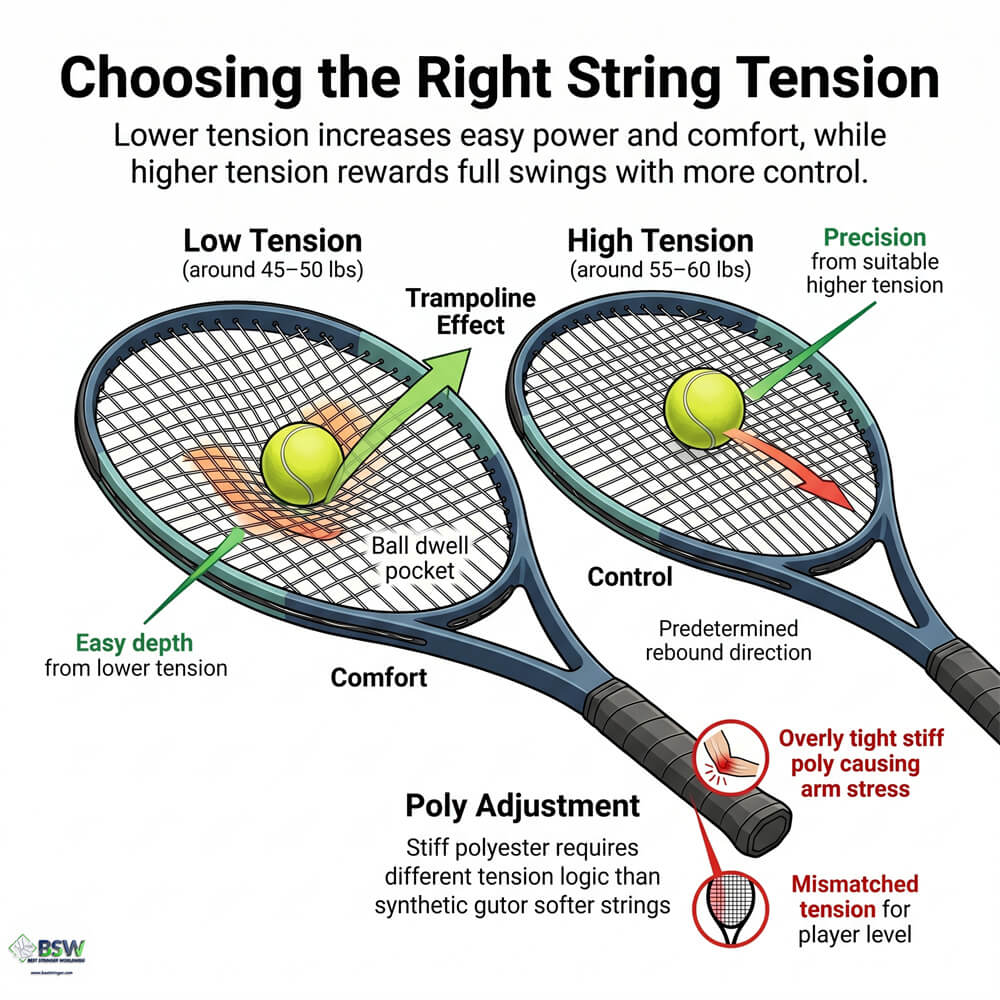
Choosing the Right String Tension
Lower tension within the frame’s recommended range.
A lower reference tension generally produces a more compliant stringbed and may change launch angle, depth and feel. The result depends on the racquet, string material, gauge, machine and player; it is not automatically the correct or safest choice for every beginner.
Higher tension within the frame’s recommended range.
A higher reference tension generally produces a firmer stringbed and can change launch angle and perceived control, but it does not guarantee precision. Never exceed the racquet or string manufacturer’s limits to chase a particular result.
Match tension to the string and frame.
String material and gauge matter. Polyester is typically less elastic than nylon, multifilament or natural gut, so copying a previous nylon reference tension may produce an unexpectedly firm setup. Start with the exact frame recommendation and string-maker guidance; Wilson’s string-tension guide, for example, separates nylon/gut, hybrid and polyester ranges rather than prescribing one universal number. Equipment advice is not medical treatment; persistent arm pain should be assessed by a qualified healthcare professional.
1.6 Exploring String Types
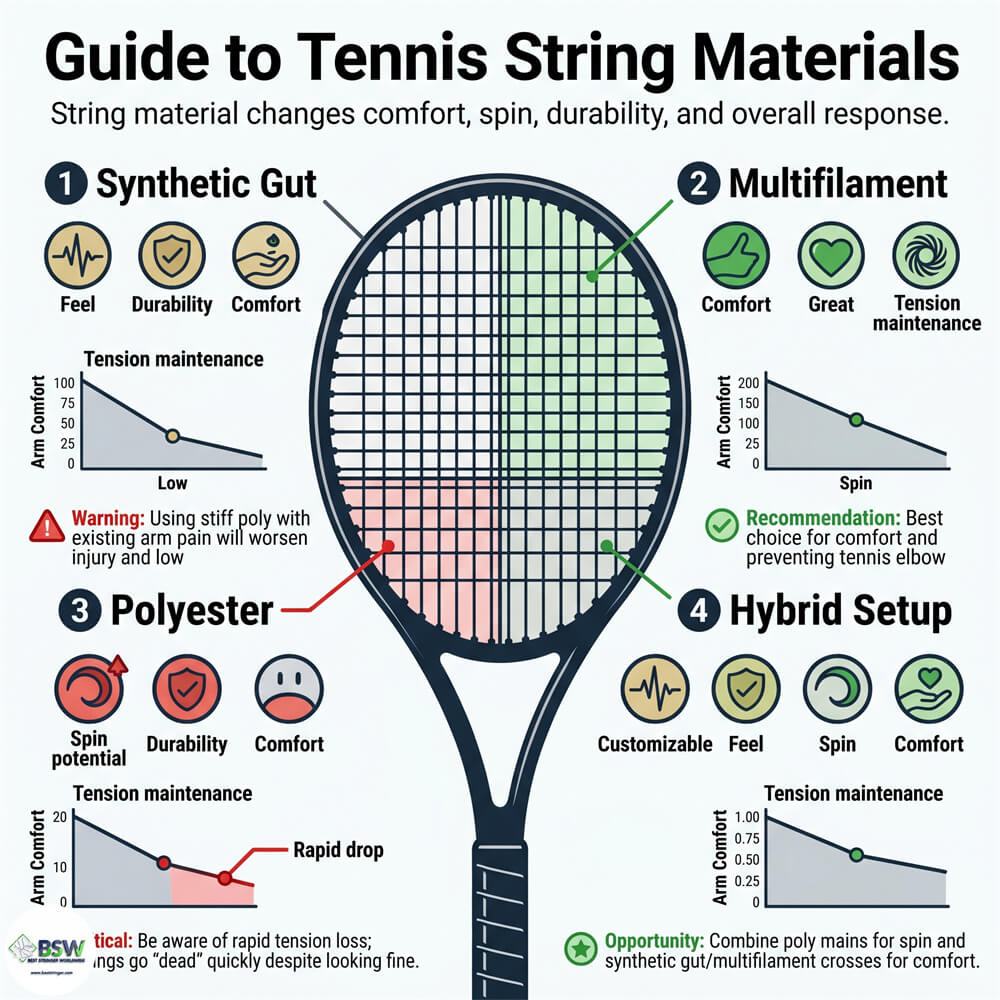
Guide to Tennis String Materials
The string material, gauge, tension and installation quality all influence how the finished stringbed feels and changes during use.
Synthetic Gut & Multifilament. Synthetic gut offers an affordable, balanced performance for beginners. Multifilament strings mimic the soft feel of natural gut, providing excellent arm comfort and power. These are highly recommended for players experiencing elbow discomfort.
Polyester (Poly). Polyester strings can provide durability and snapback characteristics for some players, but they are typically firmer and can lose useful playing characteristics before they break. Selection should depend on the player, racquet, gauge, reference tension and restringing plan rather than skill level alone.
Hybrid Setups. A hybrid setup combines two strings, such as polyester mains with multifilament or natural-gut crosses. Main/cross placement, tension and material affect the result, so document the exact setup and change one variable at a time when comparing feel or durability.
1.7 Maintenance & Aftercare
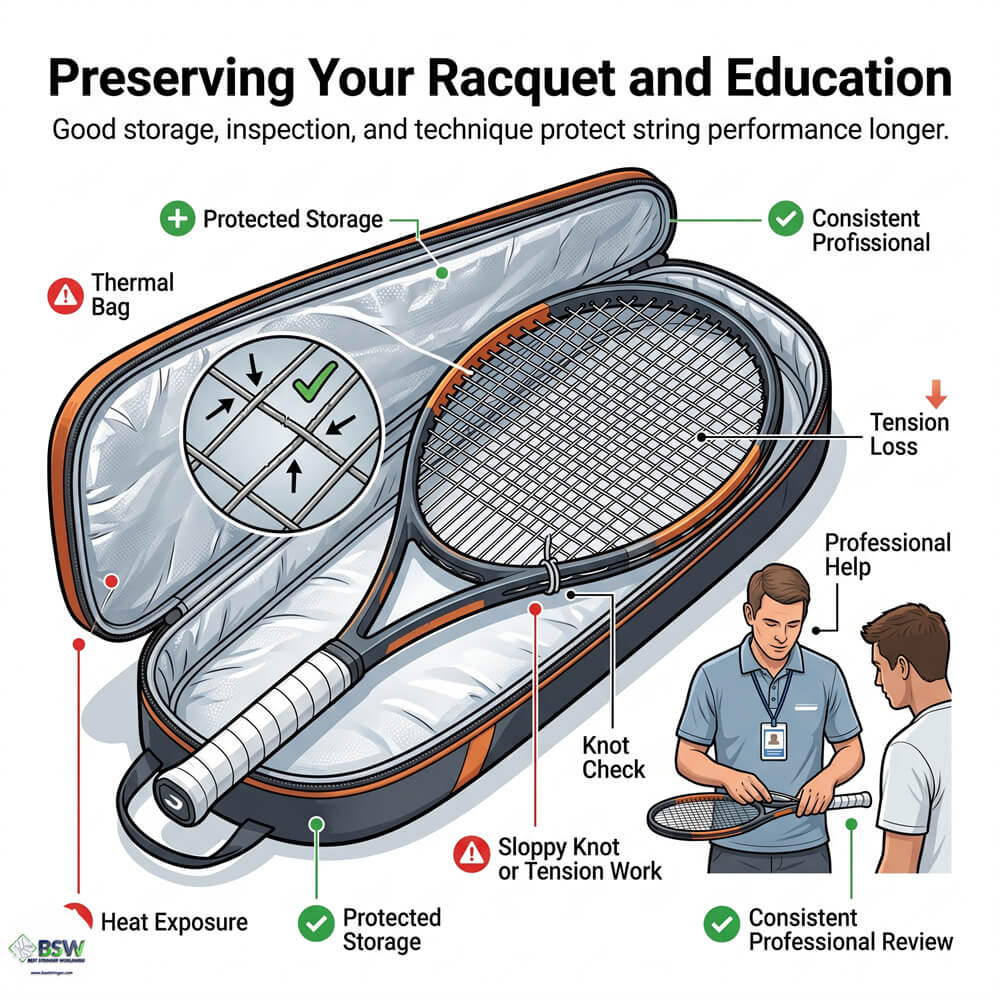
Preserving Your Racquet and Education
After restringing, record the string, gauge, reference tension, date and machine used. Avoid prolonged exposure to high heat, inspect the stringbed for notching or fraying, and check the frame and grommets after impacts. These observations help determine when the setup is no longer suitable; no bag or storage method prevents normal tension change and wear.
Learning to string can be rewarding, but stop when the pattern, mounting, grommet condition, tie-off or machine operation is unclear. An experienced stringer can inspect the frame and document a repeatable setup, although no service can guarantee a particular performance outcome or eliminate every risk of damage.
Structured education can help learners practise pattern reading, frame inspection, mounting, clamp use, tension measurement, knots and quality-control records. BSW certification is awarded only after the applicable requirements and assessment are completed; training or a credential does not guarantee a perfect setup for every racquet or player. Review the tennis stringing certification pathways for the current scope.
Tennis Restringing Quick FAQ
Clear, honest answers about the tennis racquet restringing process and setup choices.
How often should I restring a tennis racquet?
There is no single schedule for every player. Consider playing frequency and intensity, string material, breakage, notching, tension change, control and feel. Record each setup and restring when wear or changed response makes it unsuitable for the player.
What are the signs that my racquet needs restringing?
Common signs include deep notching where the strings cross, severe fraying (especially on multifilaments), strings that move out of place easily, a hollow sound on impact, or a noticeable lack of control and tension loss.
What tools do I need to restring a racquet?
You need a reliable stringing machine with stable mounts, diagonal cutters to remove old string, needle-nose or starting pliers to pull knots tight, and an awl to carefully navigate blocked grommet holes.
What is the difference between main and cross strings?
Main strings run vertically down the racquet face and are primarily responsible for spin generation and durability. Cross strings run horizontally, woven through the mains, and significantly influence the stringbed’s overall comfort and feel.
How do I choose the right string tension?
Start inside the manufacturer’s recommended range for the exact racquet, then account for string material, gauge, machine type, previous setup and player feedback. Lower or higher reference tension can change feel and launch, but neither guarantees power, control or comfort.
Which tennis string type is best for comfort?
Natural gut and multifilament are generally more elastic than polyester and are often considered when a softer feel is preferred. Players with pain or injury symptoms should seek qualified medical advice; string selection alone is not a diagnosis or treatment.
Can I restring it myself or use a professional?
You can learn with a suitable machine, the exact racquet pattern, the machine manual and supervised practice. An experienced stringer may provide a more repeatable process, but professional service does not eliminate every risk; existing frame damage and requested setup should be recorded before work begins.
Why does stringing knowledge matter for certification?
A certified stringer must understand more than just pulling clamps. Stringer certification requires knowledge of frame integrity, tension dynamics, and string material interactions, allowing them to advise players safely and effectively.
Should I take a racquet stringing course?
A course can provide structured practice in pattern reading, mounting, weaving, knots, machine checks and quality control. Applicants should compare the current curriculum, practical requirements and assessment pathway; participation does not guarantee certification or a performance result.
The Physics of Tension: How String Setup Affects Play
Mounting the Frame
Secure the racquet using a 6-point mounting system. Proper mounting prevents the frame from warping or cracking under immense tension during the stringing process.
Equipment and Pattern Checks
A defensible setup starts with the exact racquet pattern, the frame manufacturer’s recommended tension range, the string and machine instructions, a pre-work inspection and a written service record. Do not copy an unnamed professional setup or treat a generic tension range as proof that it suits another player.
| Racquet & Setup Trait | Lower Tension (E.g., 45-50 lbs) | Higher Tension (E.g., 55-60 lbs) |
|---|---|---|
| Power & Depth | Maximizes trampoline effect for easy depth. | Reduces trampoline effect, requiring more player power. |
| Control & Precision | Balls can fly long if swings are too big. | Excellent precision for players with fast, full swings. |
| Arm Comfort & Feel | Softer, highly forgiving on the arm and joints. | Stiffer stringbed, transmits more shock to the arm. |
| Sweet Spot Size | Expands the effective forgiving zone of the stringbed. | Shrinks the sweet spot, requiring accurate ball contact. |
| String Durability | Strings move more, potentially notching and snapping faster. | Strings stay locked in place longer, extending physical lifespan. |
| Advice from a Certified Stringer | Ideal for beginners or players needing free power. | Recommended for advanced baseline hitters craving control. |
Master Racquet Setup with Best Stringer Worldwide
Best Stringer Worldwide makes racquet stringing education and certification pathways available worldwide. Delivery format, dates, practical arrangements and places vary by intake. Check the current course schedule and submit the course application; certification is issued only after the applicable requirements and assessment are passed.