1.1 Introduction
5 Popular Badminton Stringing Methods Explained
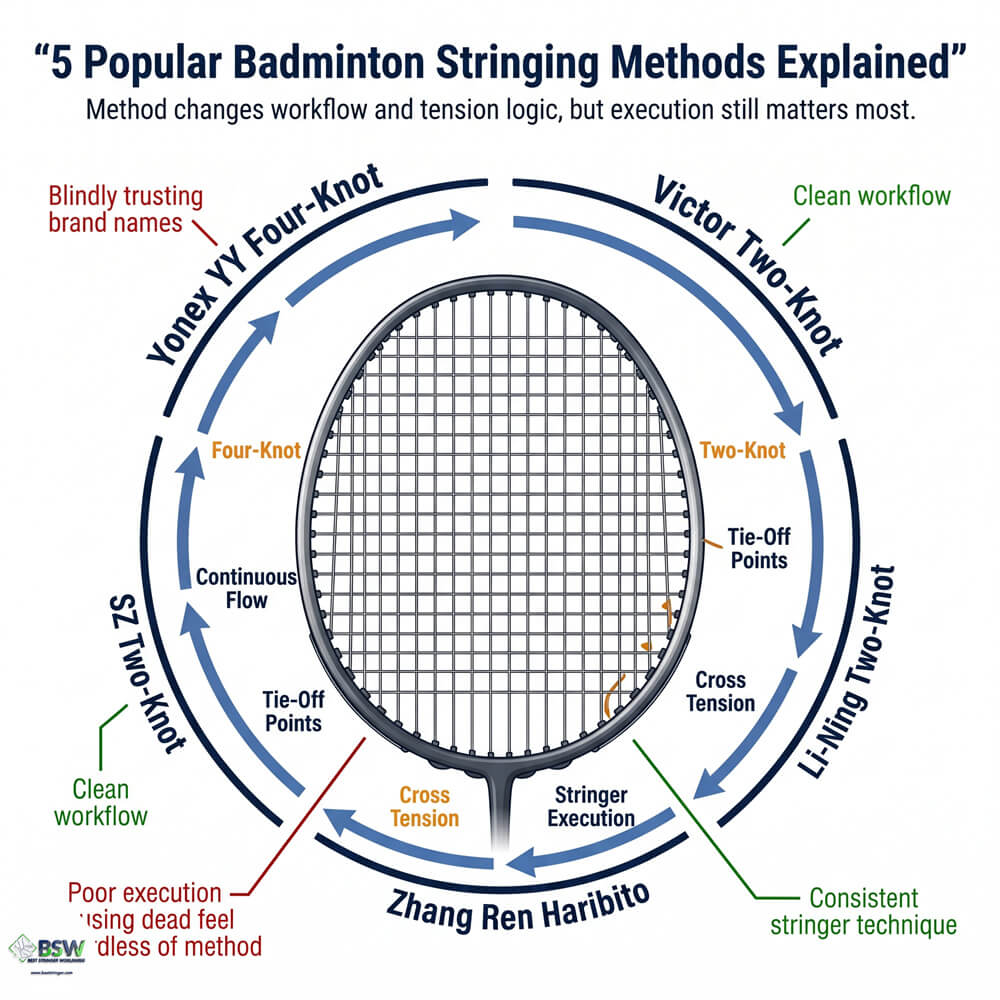
Badminton players often hear different method names discussed in shops and forums, but rarely fully understand what those names mean in practice. Understanding the best badminton stringing method for your setup involves looking past the brand labels. Method choice dictates the overall string flow, how knots are applied, and how tension is managed across the frame.
The five most widely discussed approaches are the Yonex stringing method (YY Four-Knot), the Victor stringing method (Two-Knot), the Li-Ning stringing method (Two-Knot), the Zhang Ren Haribito stringing method, and the SZ Two-Knot method. While each has distinct structural logic, none is a magical solution that works perfectly without proper stringer execution.
This guide breaks down each badminton racket stringing pattern. Step 1: Learn how knot count and continuous flow differentiate the methods. Step 2: Understand how cross tension and main tension interact in different setups. Step 3: Discover why a certified stringer’s technical consistency will always matter more than the specific method chosen.
1.2 The Basics
Why Proper Stringing Matters
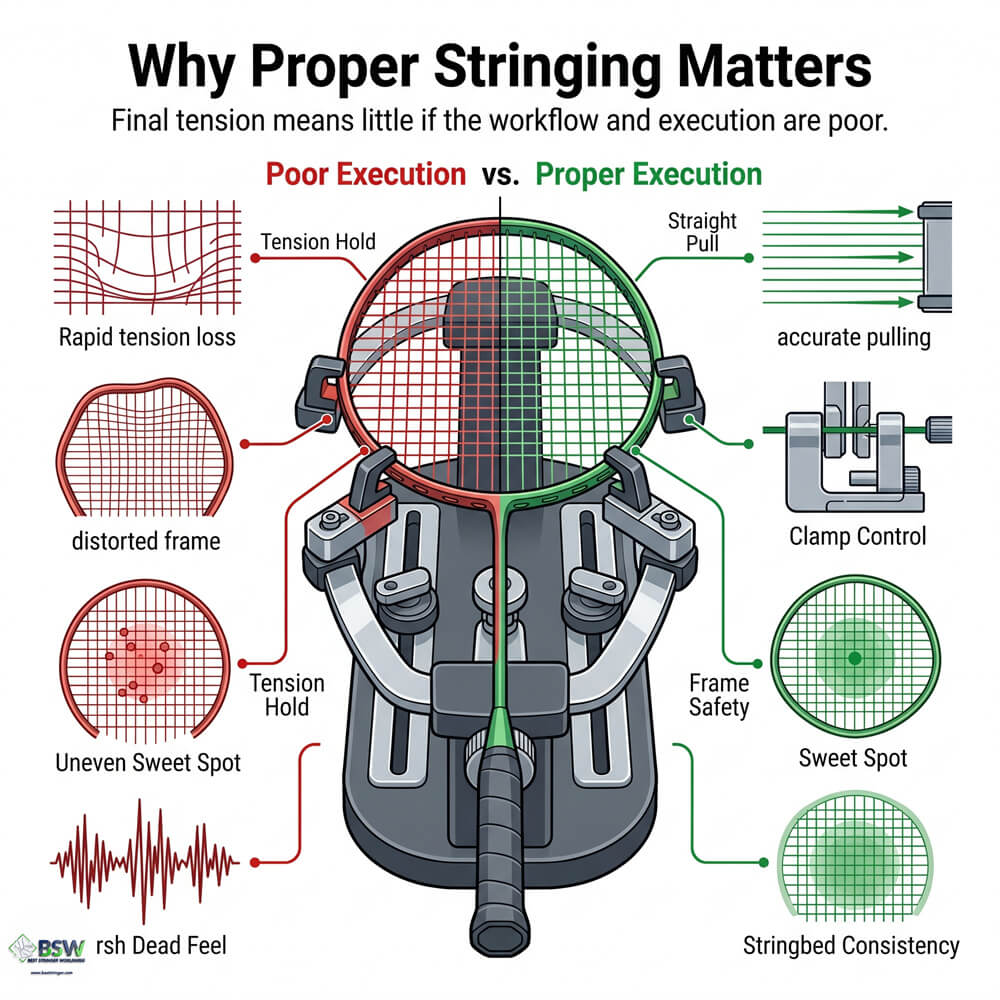
Proper stringing dictates how a racket performs, yet many players solely look at the final tension number. Badminton string bed consistency relies heavily on the stringer’s technique and the chosen workflow. Poor stringing execution can lead to rapid tension loss, distorted frame shape, and an unpredictable sweet spot.
When a badminton player requests a specific pattern, they are essentially choosing how the tension will be distributed and locked in. A sloppy stringing job will cause the strings to feel dead and harsh, regardless of how prestigious the method name is. Whether a stringer is using a two-knot or four-knot approach, meticulous clamping and straight string pulling are non-negotiable.
This is exactly why formal badminton stringing knowledge is vital. A high-quality badminton stringing course teaches technicians not just to memorize holes, but to understand frame safety and tension holding. A certified stringer knows that flawless execution elevates any method from theoretical to practical perfection.
1.3 Method One
Yonex Stringing Method (YY Four-Knot)
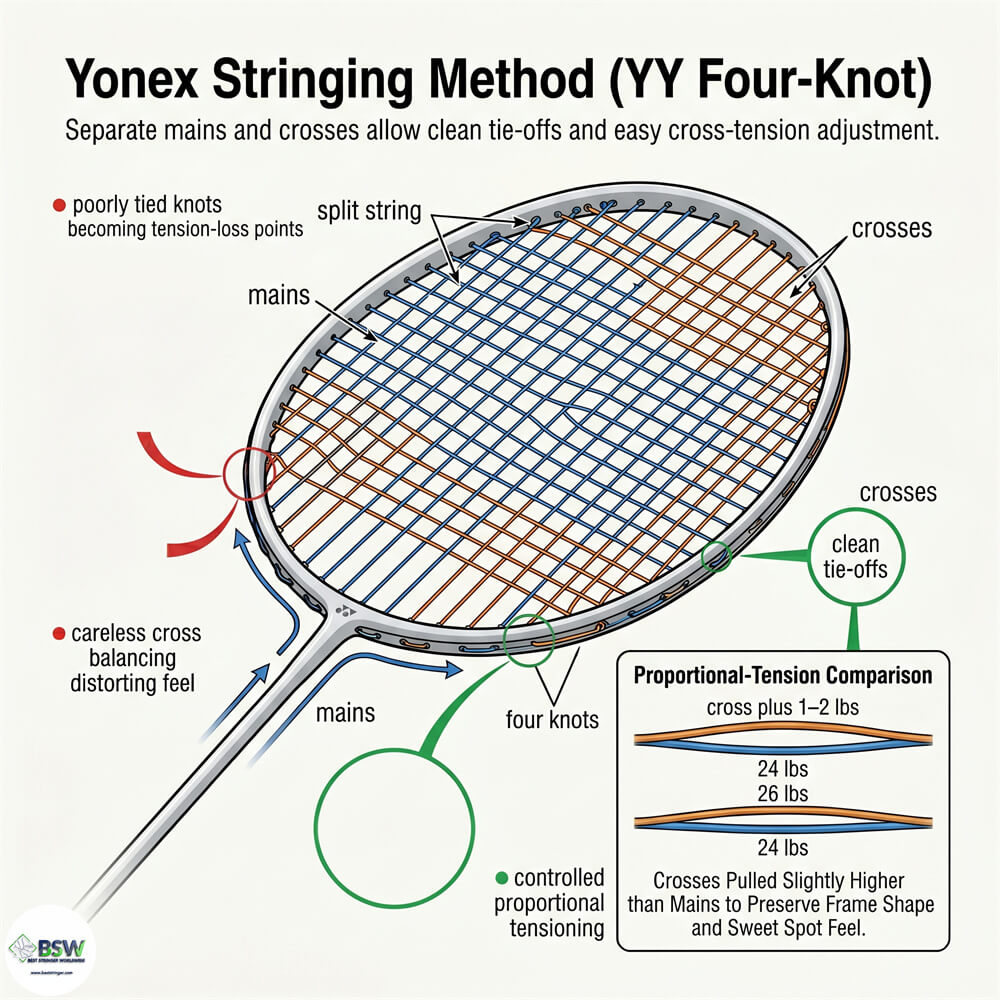
The Yonex stringing method, commonly known as the YY four-knot system, is perhaps the most universally recognized pattern. It utilizes a split-string approach, meaning the main strings and cross strings are cut and tensioned separately. This requires tying off four distinct knots around the frame.
A defining characteristic of this method is the ability to easily apply proportional tensioning. Stringers frequently add a slight tension increase on the cross strings (often 1-2 lbs higher) to balance the frame’s shape and maintain a highly consistent sweet spot feel. It is trusted and widely taught as a reliable standard in the industry.
However, while the YY four-knot is robust, it is not an absolute rule for every player. A poorly tied knot in a four-knot system introduces four potential points of tension loss. A professional stringer ensures that this method is executed cleanly, protecting the racket while maximizing the crispness that advanced players expect.
1.4 Method Two
Victor Stringing Method (Two-Knot)
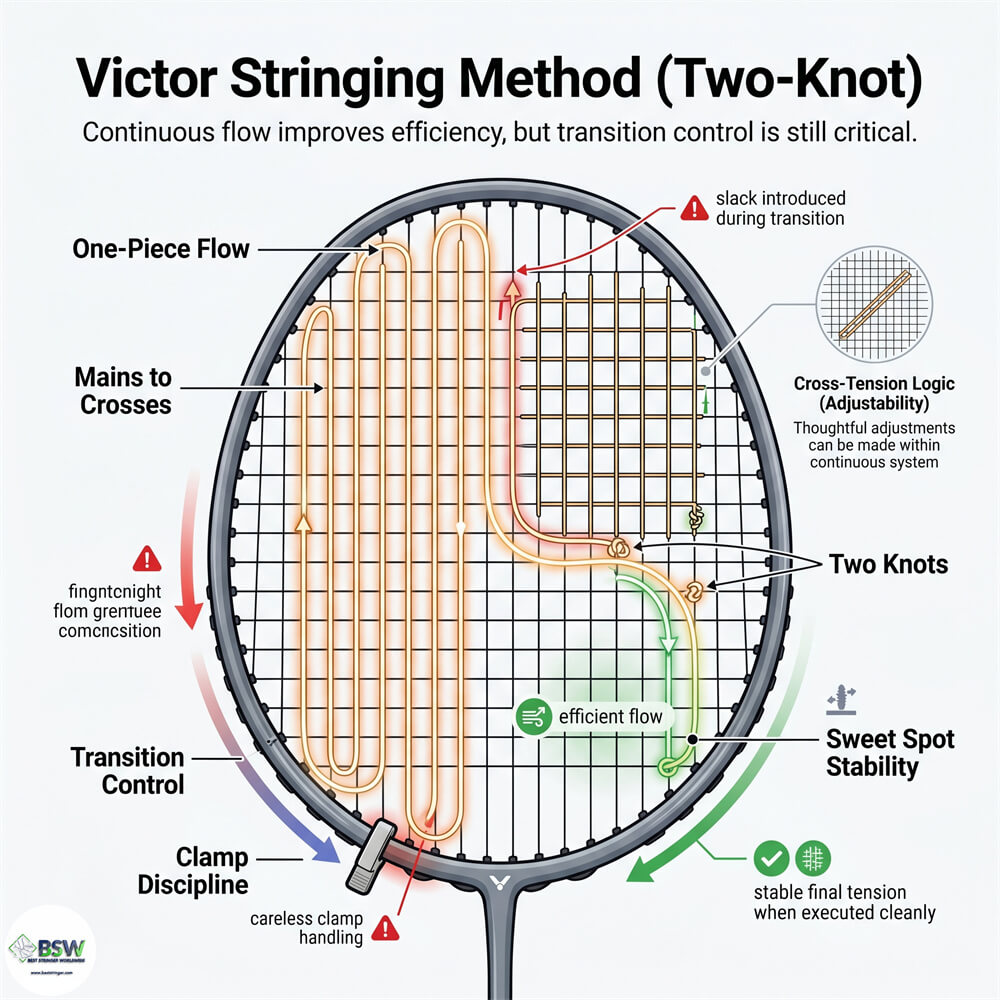
The Victor stringing method is fundamentally built around a continuous-string workflow. By utilizing a single, undivided piece of string, this system effectively transitions from the mains directly into the crosses, concluding with only a two-knot structure.
Efficiency and Flow. Badminton stringers frequently appreciate this approach because the continuous flow can improve stringing speed. It simplifies the overall weaving process without the interruption of measuring and tying off intermediate knots.
Tension Adjustment. Even within this continuous system, the method typically incorporates thoughtful cross tension adjustments to optimize sweet spot stability and frame integrity.
Execution Reality. A simpler pattern does not mean the stringer can rush. Quality execution is paramount. A badminton stringing certification program will emphasize that two-knot patterns demand strict clamp management; any slack introduced during the transition between mains and crosses will significantly hurt the final tension.
1.5 Method Three
Li-Ning Stringing Method (Two-Knot)
Continuous Logic.
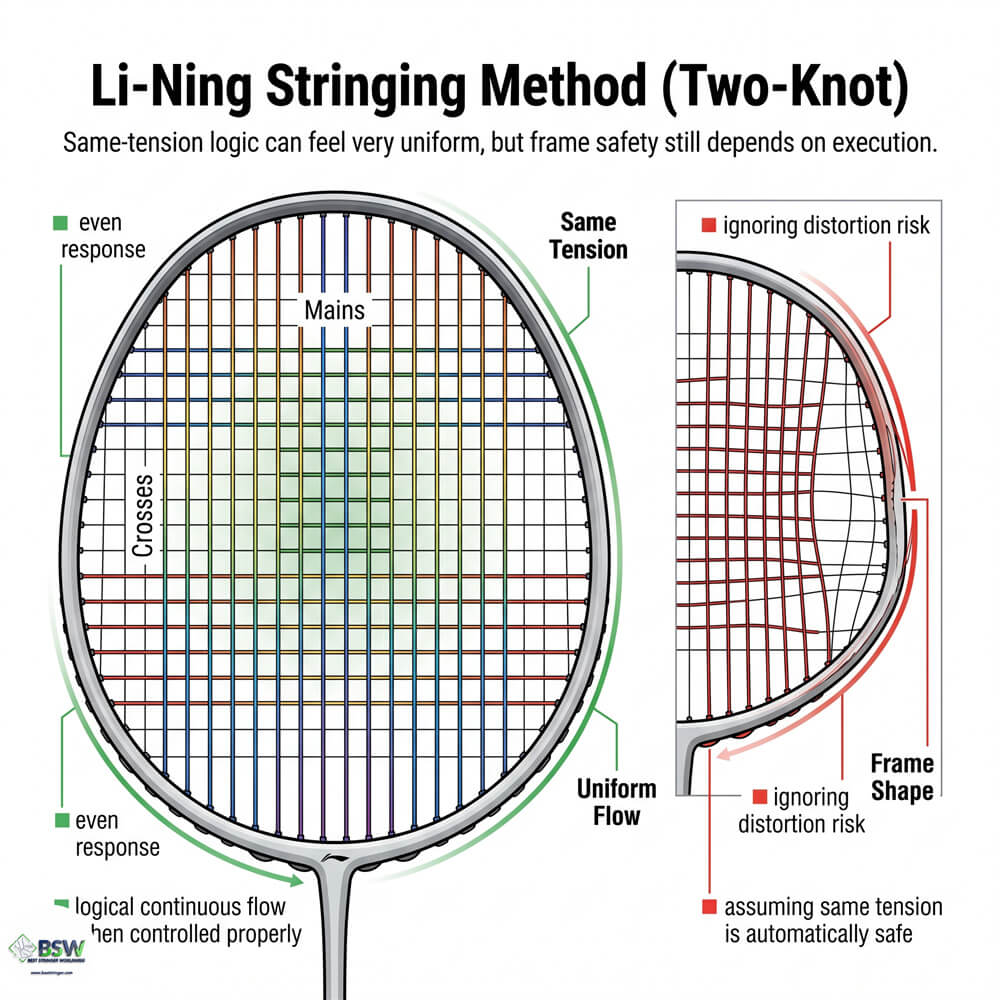
Similar to the Victor system, the Li-Ning stringing method relies on a straightforward two-knot continuous flow. By maintaining a single string path, it creates a very distinct feel that many players find highly uniform.
Same-Tension Approach.
This method is often characterized by keeping the main and cross tension exactly the same, avoiding the standard cross-tension increase found in four-knot styles. This provides a specific, clean stringbed response that prioritizes an even, predictable feel across the center of the frame.
Practical Learning.
Because of its highly logical, uniform flow, learners often grasp the Li-Ning method quickly. However, a stringer certification path will clarify that applying same-tension mains and crosses requires acute awareness of frame distortion. Quality execution is vital to ensure the racket remains perfectly safe during pulling.
1.6 Method Four
Zhang Ren Haribito Stringing Method
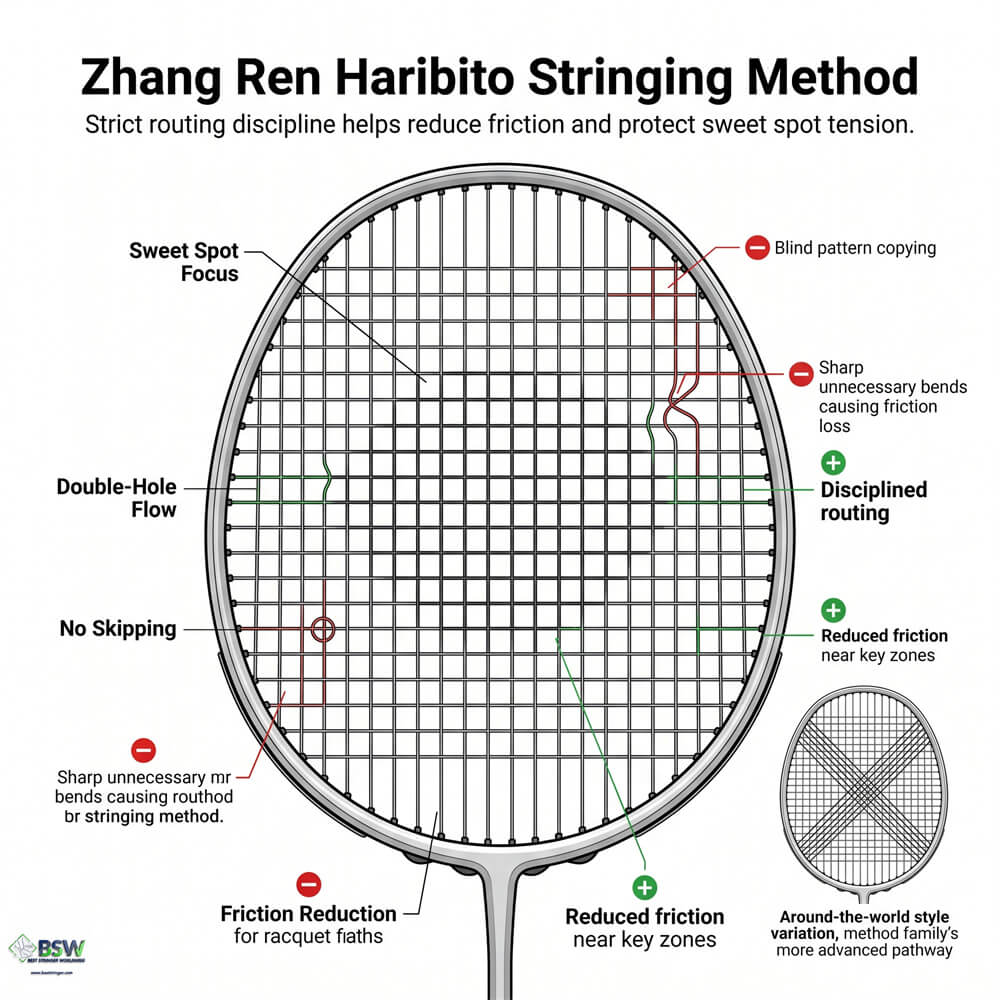
The Zhang Ren Haribito stringing method originates from a deeply respected family of techniques uniquely focused on sweet spot optimization. Ranging from a clean basic approach to a highly professional “around-the-world” variation, this method stands out technically.
Stringers admire Haribito for its strict logic, often utilizing a double-hole flow and a no-skipping-hole philosophy. By carefully routing strings to minimize sharp bends and friction, the method aims to lock in tension tightly right where the badminton player hits most frequently.
Because of its complexity, the Haribito approach demands true understanding rather than just blind copying of a pattern diagram. A certified stringer utilizing this method must be deeply proficient in tension management and friction reduction to truly provide the premium feel the pattern promises.
1.7 Method Five
SZ Two-Knot Method
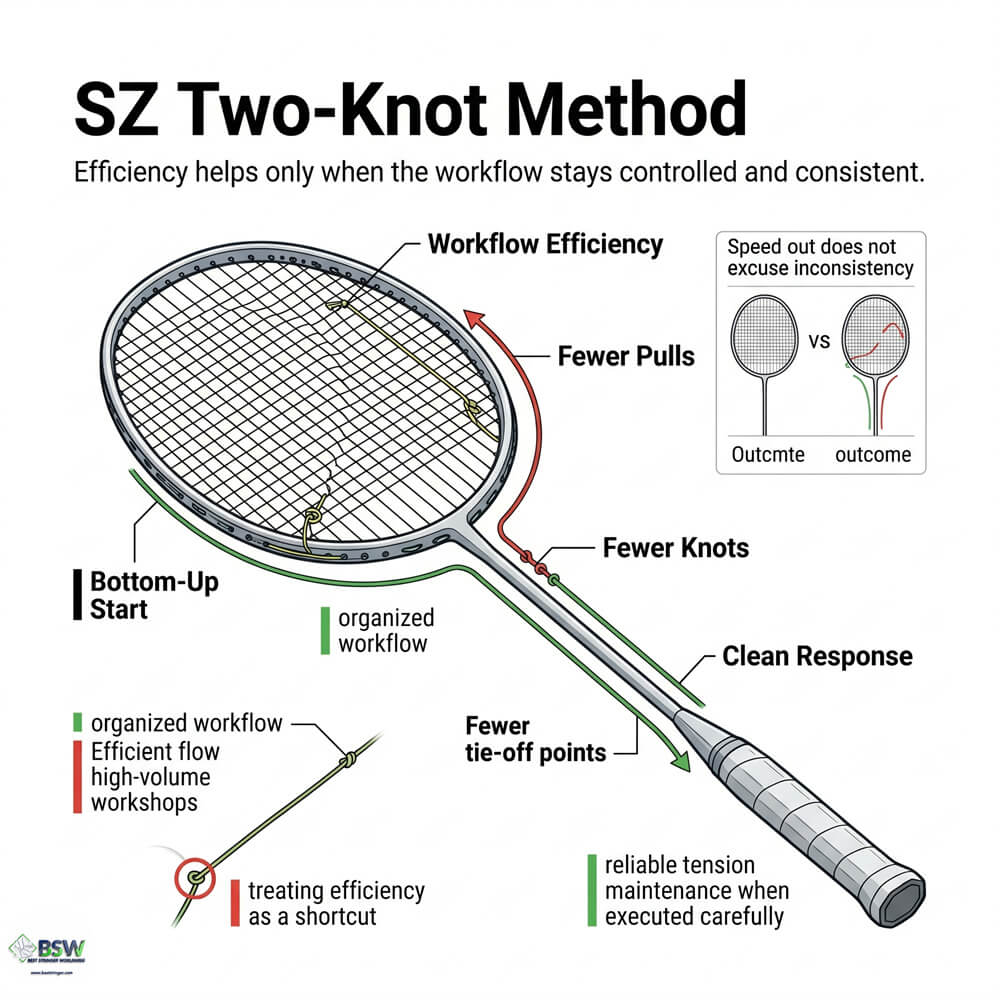
Heavily influenced by the Haribito stringing philosophy, the SZ Two-Knot method is designed around workflow efficiency. This method often initiates from a bottom-up start and is engineered to minimize the total number of clamp movements and string pulls required.
This streamlined efficiency makes the SZ Two-Knot extremely popular in high-volume workshops. By reducing handling time, stringers believe they can offer better, more reliable tension maintenance while completing rackets faster.
However, players and technicians should remember that no single method is magically superior. The SZ Two-Knot provides a very clean stringbed response when performed correctly, but comprehensive stringer training ensures that technicians maintain rigorous consistency rather than just taking shortcuts for speed.
The Mechanics of Stringing: How Workflow Affects Stringbed Feel
Shuai Zhu (SZ) Stringing Pattern (72 Hole Racquet)
Progress Controls
- Overall Progress
- Left String Progress
- Right String Progress
Display Options
- Left String
- Right String
- Hole Labels
- String Direction
Method Comparison Quick FAQ
Clear, direct answers about badminton stringing methods and practical player choices.
Which stringing method is easiest to understand?
The standard two-knot methods, like Li-Ning or Victor, often have a more continuous, logical flow. This continuous string path helps new stringers in a badminton stringing course grasp the basic mechanics of weaving and pulling tension before tackling complex four-knot setups.
Is a four-knot method always the best?
No. A cleanly executed two-knot pattern will always outperform a poorly tied four-knot pattern. The technique, care, and consistency of the badminton stringer matter far more than the absolute number of knots on the frame.
How much does cross tension matter?
Adjusting cross tension is a critical tool for preserving racket shape and modifying the stringbed feel. Methods like the Yonex YY four-knot specifically utilize proportional cross tension increases to balance the frame safely.
Which method features around-the-world flow?
The Zhang Ren Haribito stringing method includes a highly regarded professional around-the-world variation. This is deliberately designed to optimize the sweet spot and minimize tension loss near the delicate frame edges.
How do I pick the right method for me?
A badminton player should consult a certified stringer to discuss their specific racket model, string choice, and preferred feel. Often, the clean execution of the string job matters far more than strictly demanding a specific brand name pattern.
Does method matter more than stringer consistency?
Absolutely not. Impeccable clamping, straight pulls, and proper knot tying will dictate the final quality and tension hold of the stringbed, regardless of which official method or sequence is chosen.
Why learn multiple methods for certification?
A high-level stringer certification ensures the technician understands the “why” behind the patterns. Knowing how tension flows through YY Four-Knot versus SZ Two-Knot allows them to provide safe, responsible equipment advice tailored to the frame.
Should stringers strictly use one method?
While many stringers have a preferred primary method for daily efficiency, professional training guarantees they remain adaptable. A top-tier badminton stringer can execute multiple patterns cleanly depending on a client’s specific requirements or racket constraints.
Do methods affect tension loss?
Yes. Methods with fewer knots, like the SZ Two-Knot, are often favored to minimize tension loss at tie-off points. However, a certified stringer knows that proper pulling technique and secure knot-tying matter much more than the method’s name.
Proven Specifications
Our stringing approach is based on understanding how different patterns physically alter your game. We prioritize clean execution to ensure player consistency, tension maintenance, and true performance across every frame.
| Method / Technique | Primary Structure | Practical Considerations |
|---|---|---|
| Yonex Method (YY Four-Knot) | Four knots, split strings (mains & crosses separate). | Allows easy proportional cross tensioning; widely taught and trusted standard. |
| Victor Method (Two-Knot) | Two knots, continuous string flow. | Efficient workflow; typically incorporates specific cross tension adjustments. |
| Li-Ning Method (Two-Knot) | Two knots, straightforward continuous flow. | Often uses a same-tension approach; excellent uniform feel when executed cleanly. |
| Zhang Ren Haribito | Sweet-spot focused, basic to around-the-world variations. | No-skipping-hole logic; highly respected for tension holding and clean execution. |
| SZ Two-Knot | Bottom-up start, minimal clamp movements. | High efficiency and reliable tension maintenance; popular in busy stringing workshops. |
| Execution Quality | The actual skill of the certified stringer. | Matters more than the pattern name; consistent clamps and straight pulls are paramount. |
Master Stringing Methods with Best Stringer Worldwide
Ready to elevate your equipment knowledge? Best Stringer Worldwide offers professional stringing consultation and education to help you understand knot patterns, tension flow, and method execution. We serve badminton players worldwide, especially in Singapore, Hong Kong, Malaysia, Indonesia, UK, France, and Europe. Gain a prestigious stringer certification to confidently select and execute the right methods for players everywhere.



Pattern Notes