1.1 Introduction to Tension Systems
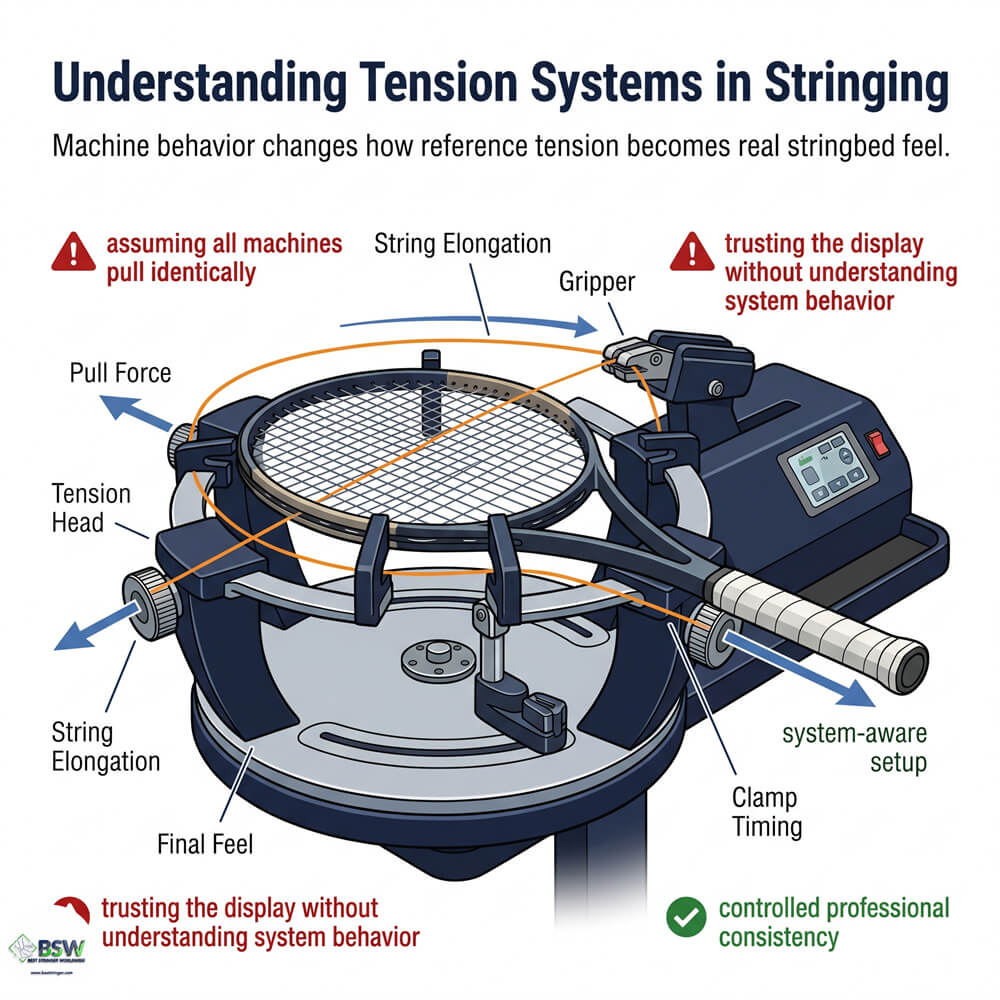
Understanding Tension Systems in Stringing
The tension system is the working core of any stringing machine. It determines exactly how pull force is applied to the string, how string elongation is managed, and ultimately, how consistent your final stringbed will be. For any serious racquet stringer, whether handling badminton or tennis frames, understanding machine behavior is just as critical as mastering weaving technique.
A common misconception is that setting the same reference tension on two different machines will yield the exact same feel on the court. In reality, the mechanical approach specifically whether the machine uses a lock-out tension system or a constant-pull tension system significantly influences the actual stiffness and playability of the racquet.
Step 1: Understand how different systems manage string stretching. Step 2: Learn how tension head design impacts friction and safety. Step 3: Discover why a certified stringer relies on calibration and system knowledge to provide professional consistency, rather than assuming the machine does all the thinking.
1.2 The Two Main Categories
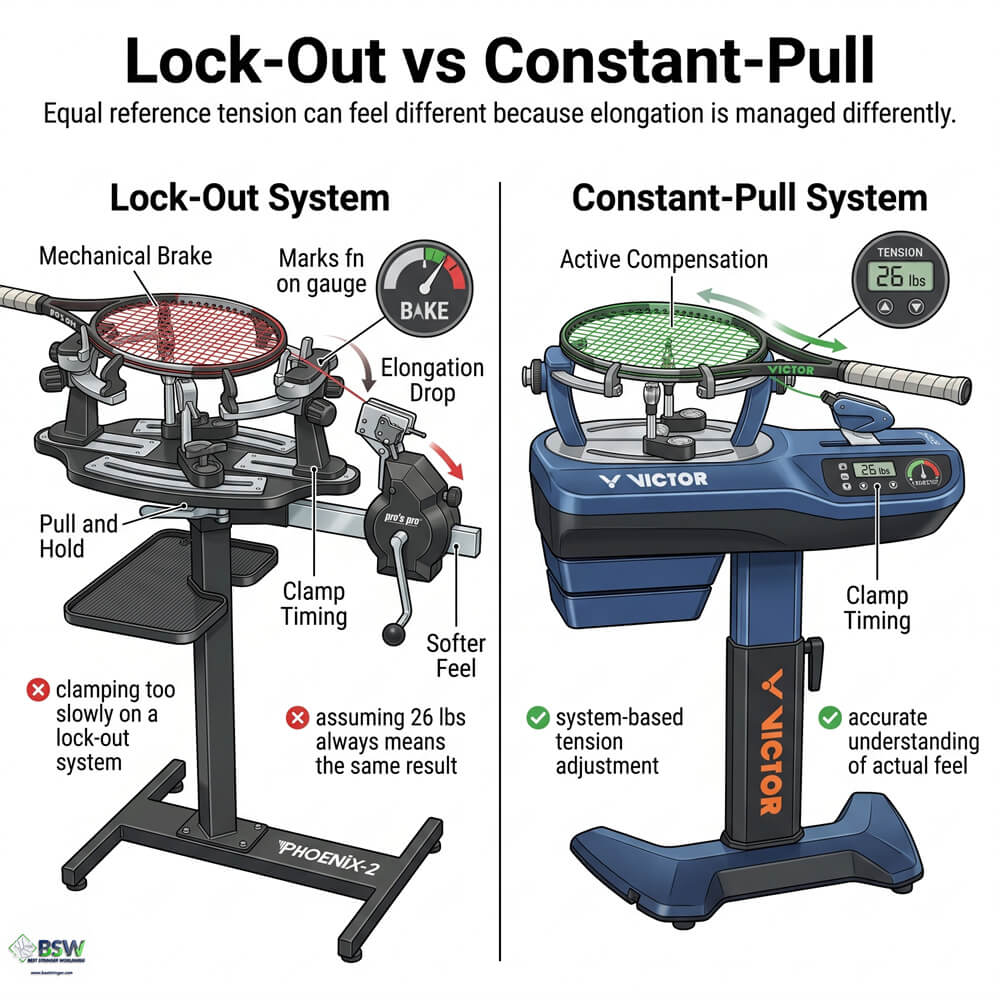
Lock-Out vs Constant-Pull
A lock-out tension system operates on a “pull and hold” mechanic. The machine pulls the string until it reaches the exact reference tension you set, then a mechanical brake locks the head in place. Once locked, the machine stops pulling. Because strings naturally stretch (elongate) under stress, the tension immediately begins to drop while you secure the clamp. Lock-out systems are generally faster and more affordable, but require a skilled stringer to manage consistent clamping speeds.
A constant-pull tension system operates differently. When it reaches the reference tension, it does not permanently lock. Instead, as the string elongates and the tension drops slightly, the machine’s electronic sensors detect the loss and continue pulling briefly to maintain the exact set tension until you clamp it. This results in less initial tension loss.
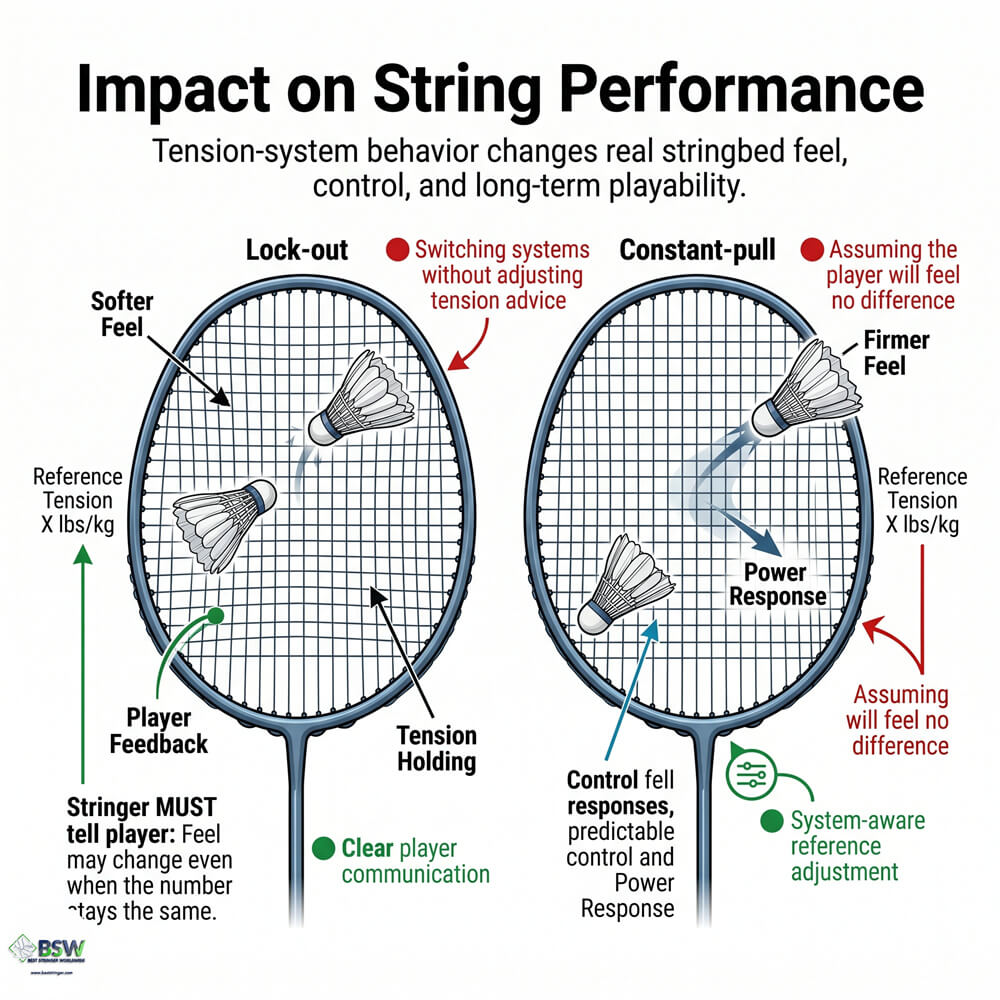
Neither system is universally ‘better’ or ‘worse’, but they require different practical adjustments. A racquet strung at 26 lbs on a lock-out machine may feel slightly softer than one strung at 26 lbs on a constant-pull machine. In a professional racquet stringing course, stringers learn to adjust their reference settings depending on which system they are operating.
1.3 Tension Heads
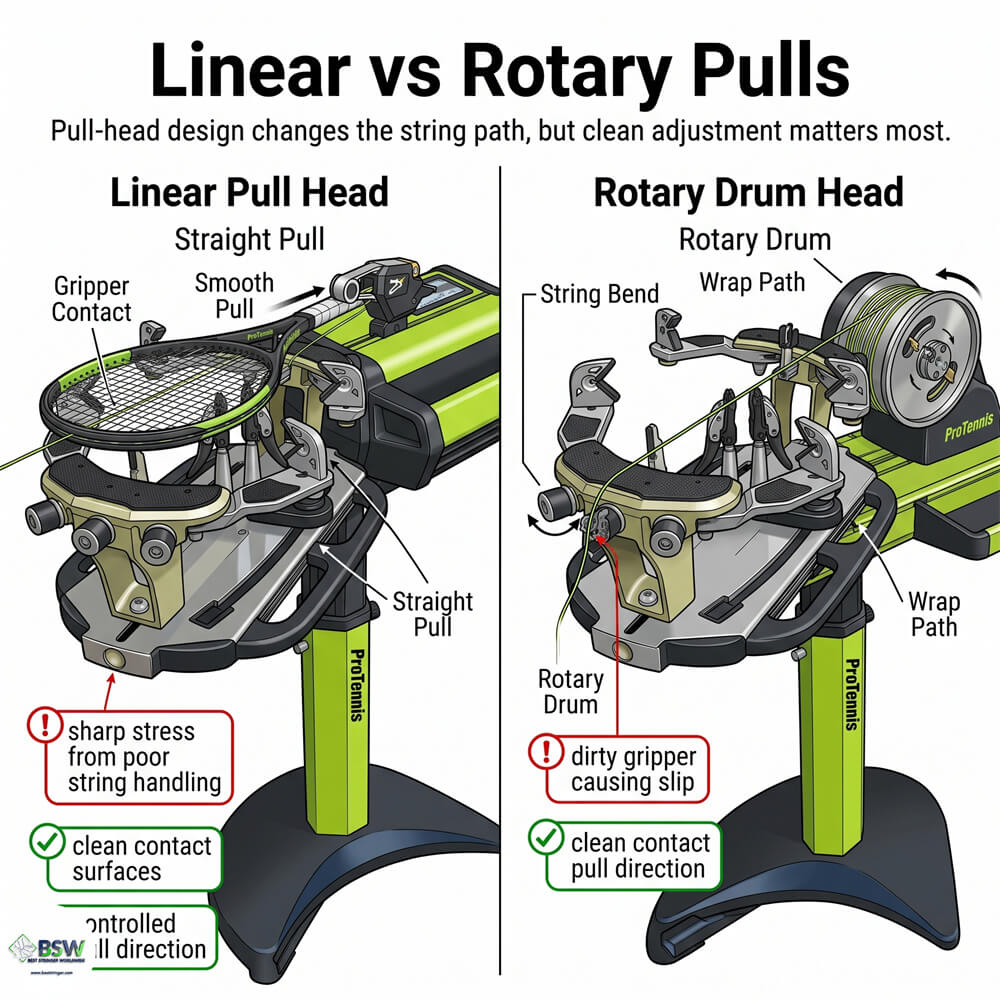
Linear vs Rotary Pulls
Beyond the core tensioning logic, the physical tension head itself changes how the string is handled. The two primary designs are linear pull tension heads and rotary tension heads.
A linear pull tension head moves the string backward in a straight line away from the racquet frame. Because there is no wrapping involved, many stringers find this intuitive, and it minimizes sharp bends that can stress fragile strings. A rotary tension head, often seen on classic manual machines and some high-end electronic units, pulls the string by wrapping it around a rotating drum or wheel. This distributes the pull force smoothly, which is excellent for longevity.
Neither head type is universally superior. A professional stringer understands that maintaining a clean string gripper clamp is far more important than debating linear versus rotary designs. If your gripper is dirty or poorly adjusted, slippage will damage the string, regardless of how advanced the tension head is.
1.4 Supporting Features
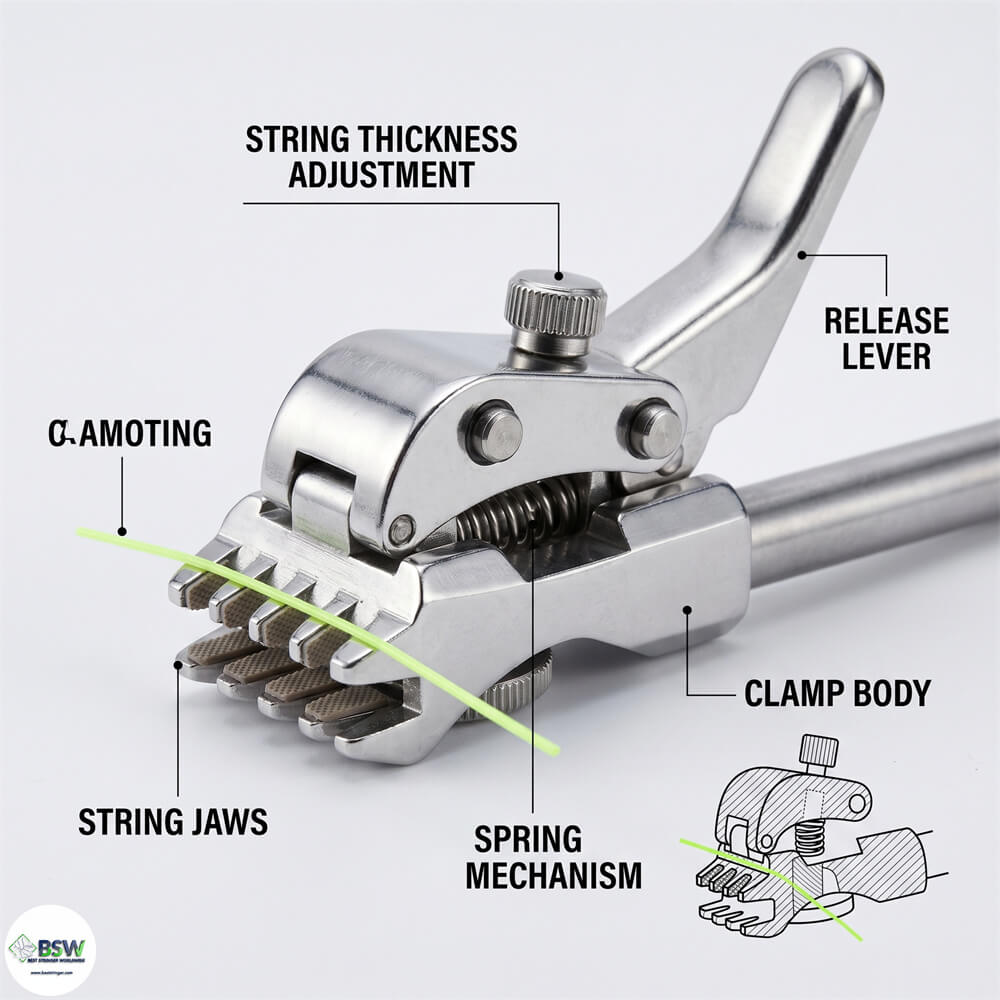
Grippers & Pre-Stretch
Modern stringing machine tension systems feature advanced functions to optimize stringbed performance and preserve the string’s integrity.
1. String Gripper Clamps. The gripper is the specific component on the tension head that holds the string during the pull. If the gripper plates are dirty with string wax or adjusted too loosely, the string will slip, resulting in severe tension loss. If adjusted too tightly, it will crush the string core, leading to premature breakage on the court.
2. Pre-Stretch Function. Many electronic constant-pull machines include a pre-stretch function. When activated (often at 10% or 15%), the machine pulls the string past the reference tension briefly, then settles back down to the target. This helps remove initial slack and elongation, reducing the rate of tension loss over the first few days of play.
3. Practical Application. Pre-stretch is not a universal rule. Some soft multi-filament tennis strings or ultra-thin badminton strings may snap if pre-stretched aggressively. A badminton stringing certification teaches stringers to evaluate the string’s properties before blindly engaging extra tensioning features.
1.5 Accuracy
Calibration & Machine Accuracy
The Core of Professionalism.
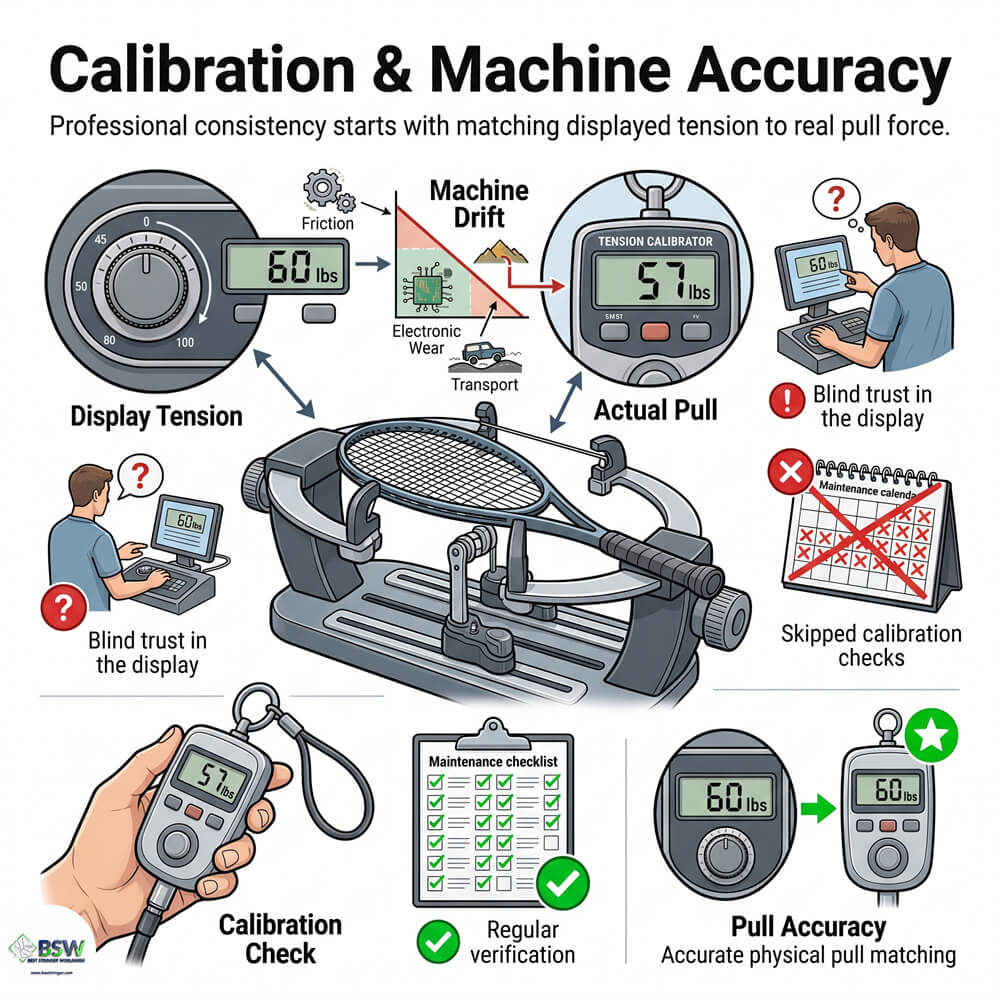
A tension system is completely useless if it is inaccurate. Stringing machine calibration is the process of measuring the physical pull force of the tension head and matching it to the displayed reference number. If a stringer neglects calibration, their setups will be fundamentally inconsistent.
Drift and Maintenance.
All systems, whether they are mechanical lock-out systems or high-end electronic constant-pull machines, experience drift over time due to friction, electronic wear, or transport. Regular verification using a reliable digital tension calibrator is a mandatory habit for any serious professional stringer.
Stringer Responsibility.
A badminton stringer must never blindly trust the machine’s display. In any respected stringer certification path, participants are taught that executing an accurate pull is a combination of a calibrated machine, clean grippers, and meticulous clamping, not just setting a number and hitting a button.
1.6 Practical Application
Choosing the Right System
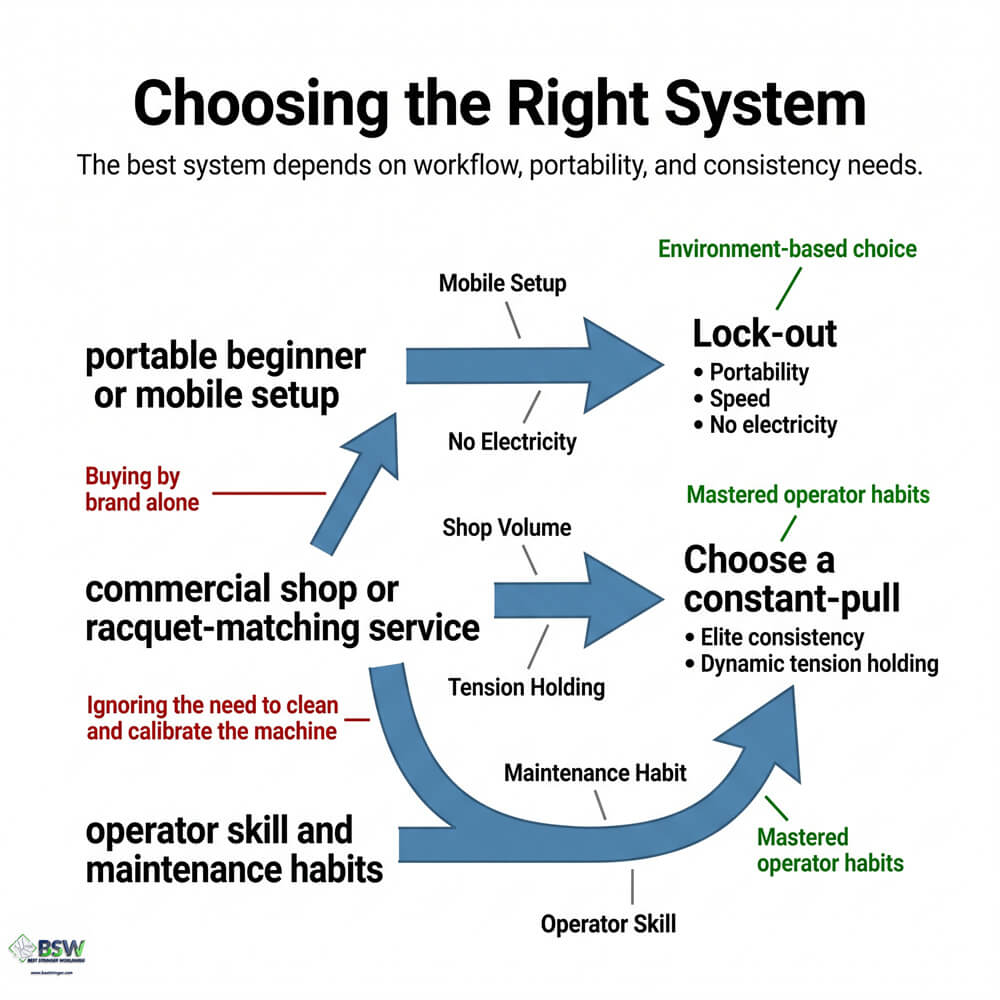
When selecting or utilizing a tension system, a stringer must balance workflow efficiency, portability, and desired consistency. There is no one-size-fits-all answer.
Step 1: Evaluate Your Environment. A lock-out system on a crank machine is highly portable, does not require electricity, and strings extremely fast. This makes it an excellent choice for beginner stringers or mobile setups, provided the stringer maintains a consistent pulling rhythm.
Step 2: Assess Your Consistency Needs. An electronic constant-pull tension system provides superior dynamic tension holding, making it the preferred choice for commercial shops and advanced stringers where precise racquet matching is expected daily.
Step 3: Master the Machine. The equipment is only as good as the operator. A certified stringer understands that adopting the best practices like regular cleaning of the tension head and accurate calibration matters more than the brand name stamped on the side of the machine.
1.7 Professional Growth
Impact on String Performance
The tension system directly influences how a racquet performs on the court. An even, fully compensated pull creates a stringbed that holds its tension longer, providing players with more predictable control and power.
When a stringer upgrades from a lock-out system to a constant-pull system, they often need to advise players that the new stringbeds may feel slightly tighter than before at the same reference tension, due to the machine compensating for elongation.
This is where badminton stringing course education truly shines. A professional string tension knowledge base ensures that technicians don’t just blindly pull strings; they interpret the machine’s behavior and translate it into verifiable, elite-level racquet performance for their clients.
Tension Systems Quick FAQ
Clear, direct answers about understanding and operating racquet stringing machine tension systems.
What is the difference between lock-out and constant-pull?
A lock-out system pulls to the target tension and stops completely, allowing the string to relax slightly before clamping. A constant-pull system briefly continues to pull after reaching the target to compensate for that natural string elongation.
Does the same tension setting always mean the same result?
No. Setting a machine to 26 lbs on a lock-out crank will typically yield a slightly softer final stringbed than setting 26 lbs on an electronic constant-pull machine, due to how elongation is managed.
What does a pre-stretch function actually do?
The pre-stretch function tells the electronic tension head to over-pull the string by a set percentage (like 10%) before dropping back to the reference tension. This removes initial slack and reduces tension loss during play.
What is the difference between a system and a tension head?
The tension ‘system’ is the mechanical or electronic brain dictating how the machine reacts to string stretching (e.g., constant-pull). The tension ‘head’ is the physical moving part that actually grabs and pulls the string (e.g., linear or rotary).
Why does calibration matter so much?
If the tension head drifts over time, the machine will not pull the correct force. Stringing machine calibration ensures your reference setting matches the physical reality, maintaining professional consistency across every racquet.
Is an electronic constant-pull required for good results?
No. A skilled stringer utilizing a well-calibrated manual lock-out machine can produce excellent, highly playable results. An expensive electronic system provides convenience and superior tension maintenance, but it does not replace core stringing technique.
Why keep the string gripper clean?
The string gripper clamp holds the string directly during the high-tension pull. If it accumulates dirt or string wax, the string will slip, ruining the tension pull and potentially scraping the outer coating off delicate strings.
Why learn this for stringer certification?
A certified stringer must guarantee consistency. By understanding exactly how tension systems manage pull force, elongation, and calibration, you can deliver precise setups that players trust, regardless of the specific machine you are using.
Does linear or rotary matter more?
Both designs can be exceptionally effective. Some stringers prefer the straight pull of a linear head to reduce bending stress, while others prefer the smooth mechanical wrapping of a rotary head. Cleanliness and adjustment matter far more than the format itself.
Tension System Simulator: Lock-Out vs Constant-Pull
Tension Systems Simulator
Observe how different mechanics manage pull force & string elongation
Verified Tension Consistency
Our training emphasizes practical machine knowledge over marketing claims. We prioritize proper system understanding, tension calibration, and reliable handling of string elongation to ensure professional results for every stringer.
| Tension System Feature | Primary Characteristics | Practical Role in Stringing |
|---|---|---|
| Lock-Out System | Pulls to target tension and applies a mechanical brake. | Fast, highly portable, and affordable; stringers must adjust for elongation. |
| Constant-Pull System | Electronically adjusts to maintain target tension continuously. | Superior dynamic tension holding; preferred for high-volume, elite customization. |
| Linear Pull Head | Moves string backward in a straight line without wrapping. | Intuitive workflow; minimizes friction and sharp bending stress on the string. |
| Rotary Pull Head | Wraps the string around a rotating drum or wheel. | Distributes pull force exceptionally smoothly; common on high-end electronic models. |
| Pre-Stretch Function | Over-pulls string by a set percentage before settling. | Removes initial slack; extremely useful for reducing tension loss in soft strings. |
| Tension Calibration | Verifies actual machine pull force against displayed settings. | Absolutely vital for all machines; an uncalibrated machine ruins stringing consistency. |
Master Tension Systems with Best Stringer Worldwide
Ready to elevate your stringing professionalism? Best Stringer Worldwide offers advanced education to help you understand lock-out vs. constant-pull systems, tension head behavior, pre-stretch applications, and strict calibration protocols. We serve racquet stringers worldwide, including in Singapore, Hong Kong, Malaysia, Indonesia, UK, and Europe. Gain a prestigious stringer certification to confidently navigate machine differences and deliver flawless, customized service.