1.1 Introduction to Clamp Systems
Understanding Clamp Systems in Stringing
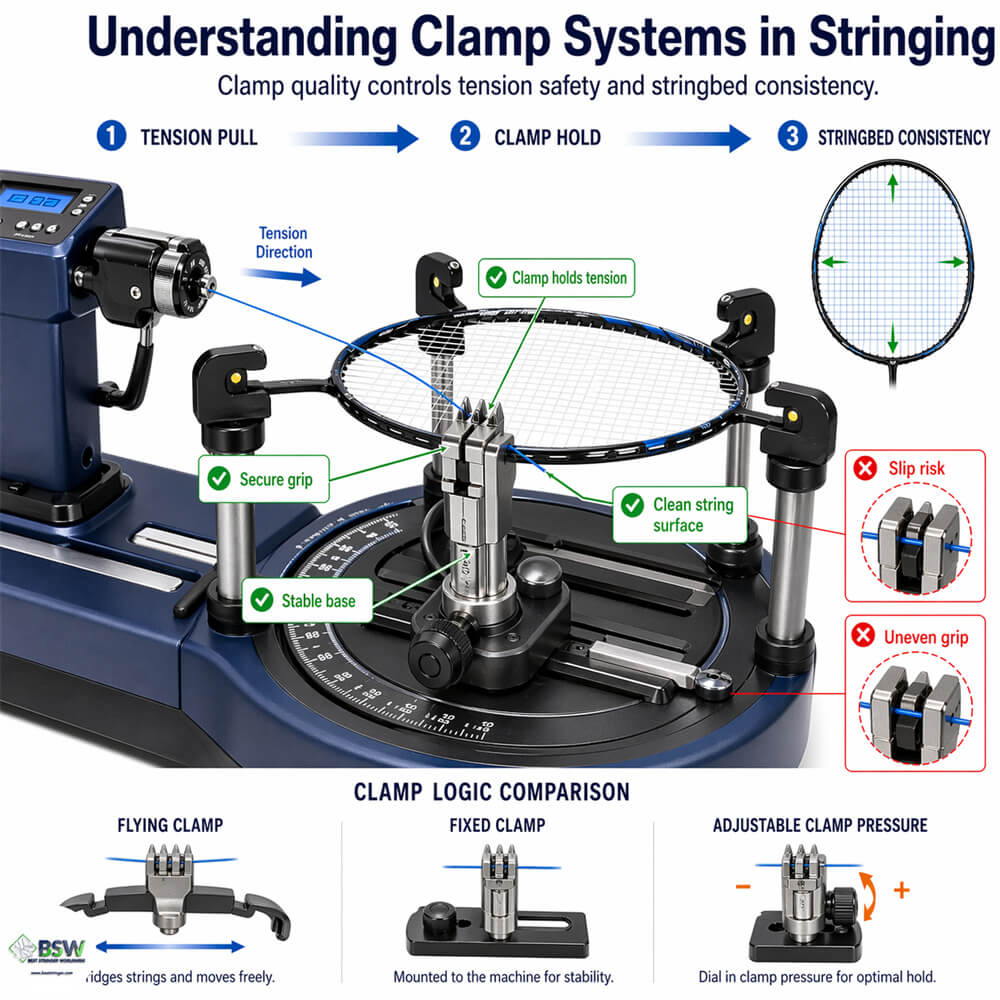
The clamp system is arguably the most critical component of any racquet stringing machine regarding string safety and tension maintenance. Once the tension head pulls the string, the clamp’s job is to hold that tensioned string securely in place. If the clamp slips, grips unevenly, or is mismanaged, the final tension drops significantly, and the string’s outer surface can be severely damaged.
A common mistake is assuming that all clamps perform equally. The mechanical design whether the machine uses flying clamps, rotational fixed clamps, or non-rotational fixed clamps drastically changes workflow efficiency and stringbed consistency. High-quality clamp usage is what separates an amateur job from a professional one.
Step 1: Understand how different clamp types interact with the string and the machine base. Step 2: Learn why adjustable clamp tension and advanced jaw surfaces protect your strings. Step 3: Discover why a certified stringer relies on rigorous clamp maintenance to provide reliable, damage-free consistency.
1.2 Clamp Variations
Types of Clamp Systems
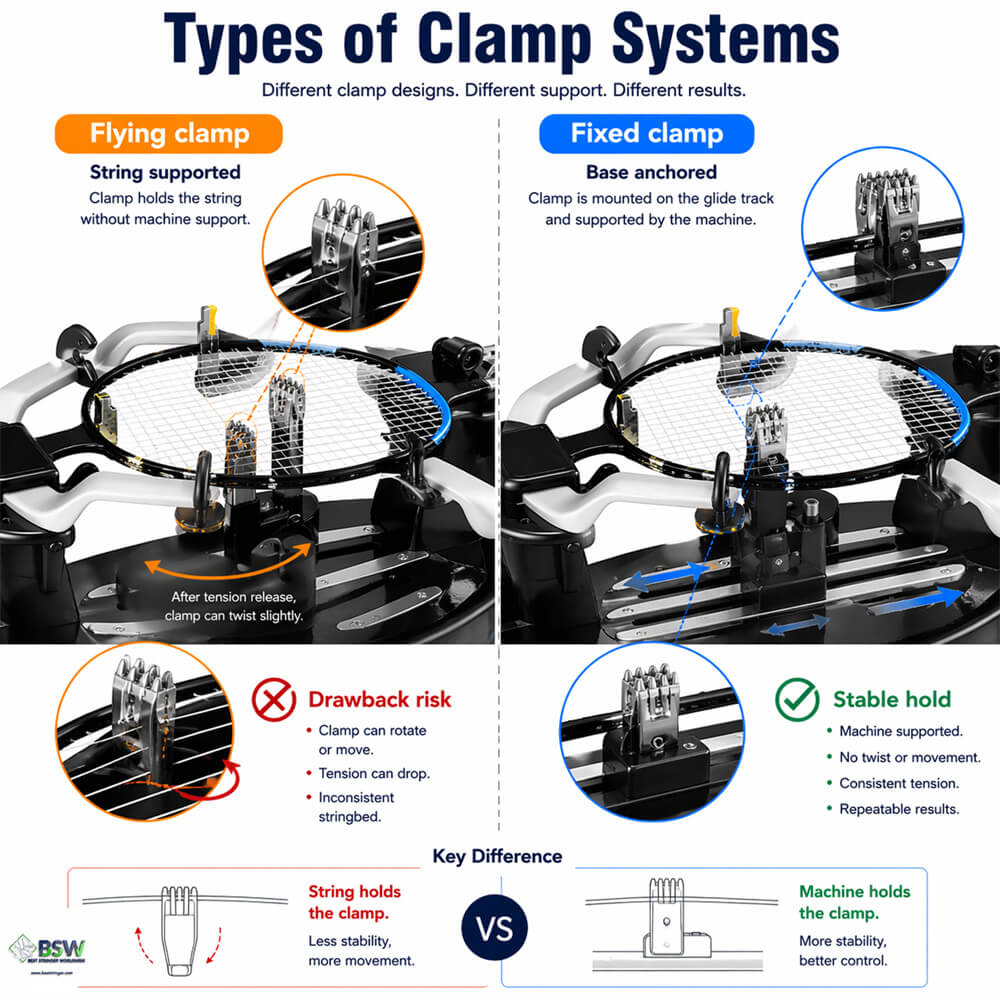
Machine clamps fall into two broad categories: flying clamps and fixed clamps. Fixed clamps are physically attached to the stringing machine’s base, holding the string relative to the unmoving turntable. Flying clamps, conversely, are completely unattached to the machine; instead, they grip one tensioned string and clamp it to an adjacent string to maintain tension.
The fundamental difference lies in how they handle drawback. Because a flying clamp is supported only by the stringbed itself, it naturally experiences a slight “drawback” or twisting when the tension head releases. Fixed clamps anchor directly to the heavy machine base, drastically reducing this tension loss.
A professional racquet stringer needs to understand these behavioral differences. For badminton stringers using travel setups, flying clamps are highly practical. However, in professional workshop environments, fixed systems provide the rigid stability necessary for elite-level racquet matching and repeatability.
1.3 Portable Solutions
Understanding Flying Clamps
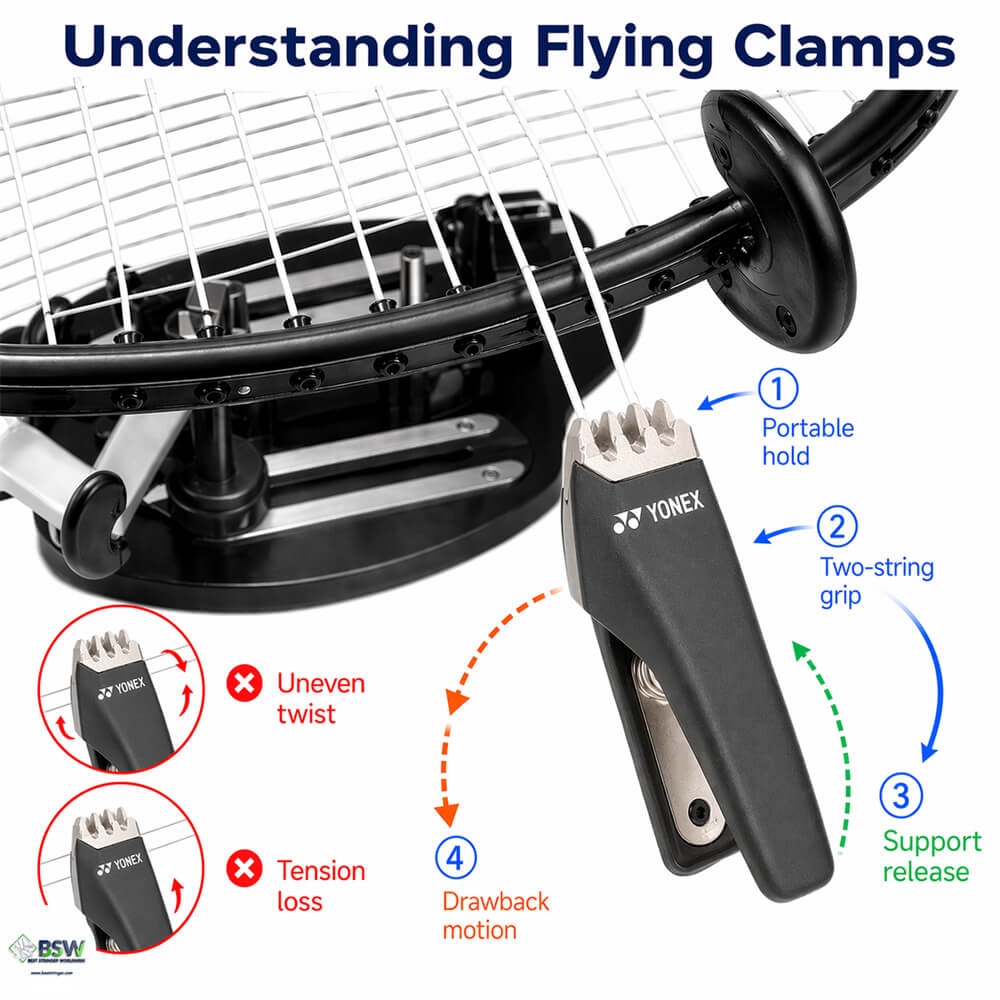
Flying clamps are lightweight, portable, and often supplied with entry-level drop-weight machines. Because they grip two strings together, they require the stringer to pull tension on one string, clamp it to the previously tensioned string, and then release the machine head. This makes them highly versatile for tight spaces near the frame.
The major trade-off with flying clamps is drawback. Since the clamp relies on the stringbed itself for support, the two clamped strings will naturally twist and pull back slightly towards the tensioned side when released. This leads to a small, unavoidable loss of tension.
While they are less consistent than fixed systems, a knowledgeable stringer can still produce very playable results. Badminton stringing certification often covers how to manage this drawback by carefully supporting the clamp during release, ensuring beginners understand how to maximize the quality of portable systems.
1.4 360-Degree Freedom
Rotational Fixed Clamps
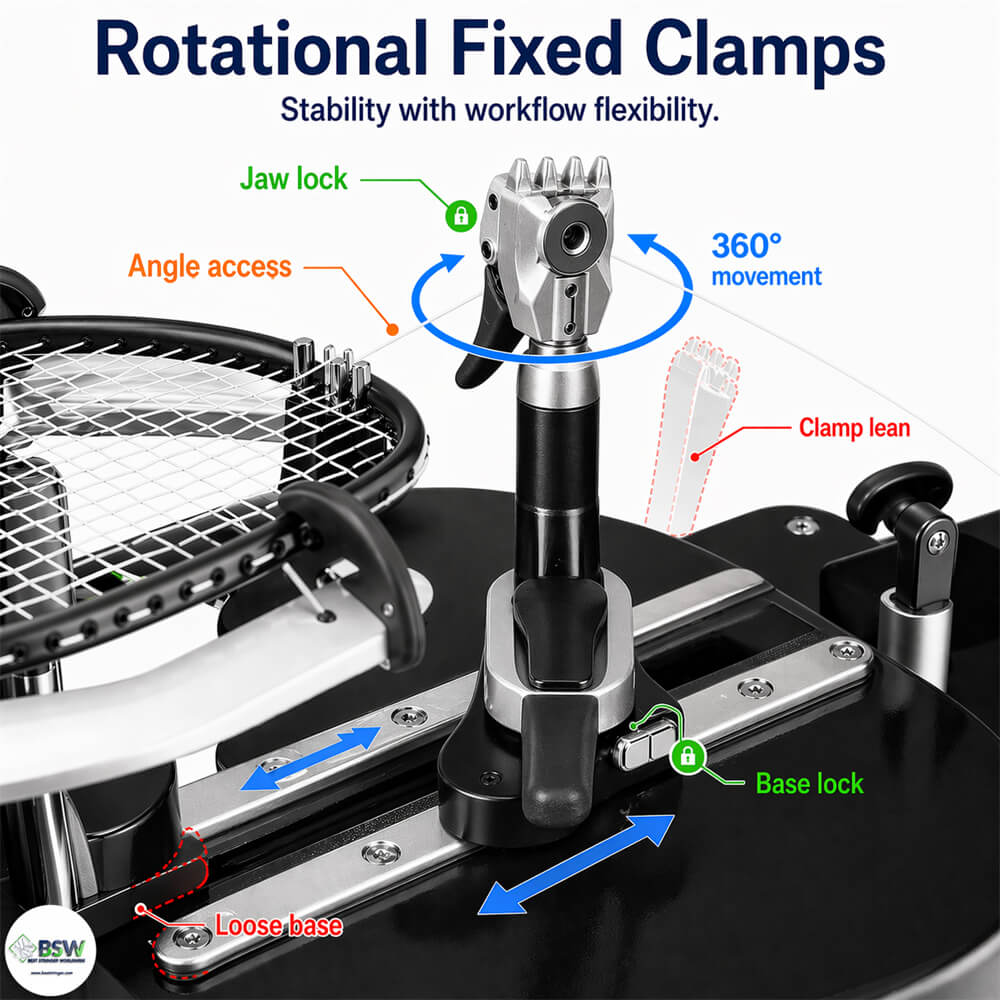
Rotational fixed clamps represent the modern standard for professional stringing machines. They combine robust machine-anchored stability with incredible workflow flexibility.
Design and Movement. These clamps sit on a sliding post that glides smoothly across a semi-circular or straight base track. The clamp head itself rotates a full 360 degrees. This allows the stringer to secure strings at almost any angle, accommodating various fan patterns and tight spaces near the racquet frame effortlessly.
Dual Locking Action. Operating them requires a dual locking motion: locking the base securely to the track, and locking the jaws securely onto the string. If either lock is loose, the clamp will lean or slip, causing tension loss.
Professional Mastery. Because of their versatility, they are universally preferred in high-volume environments. A certified stringer must master the fluid coordination of locking the base and the jaws simultaneously to ensure rapid, damage-free execution.
1.5 Classic Designs
Non-Rotational Fixed Clamps
Glide Bar Mechanics.
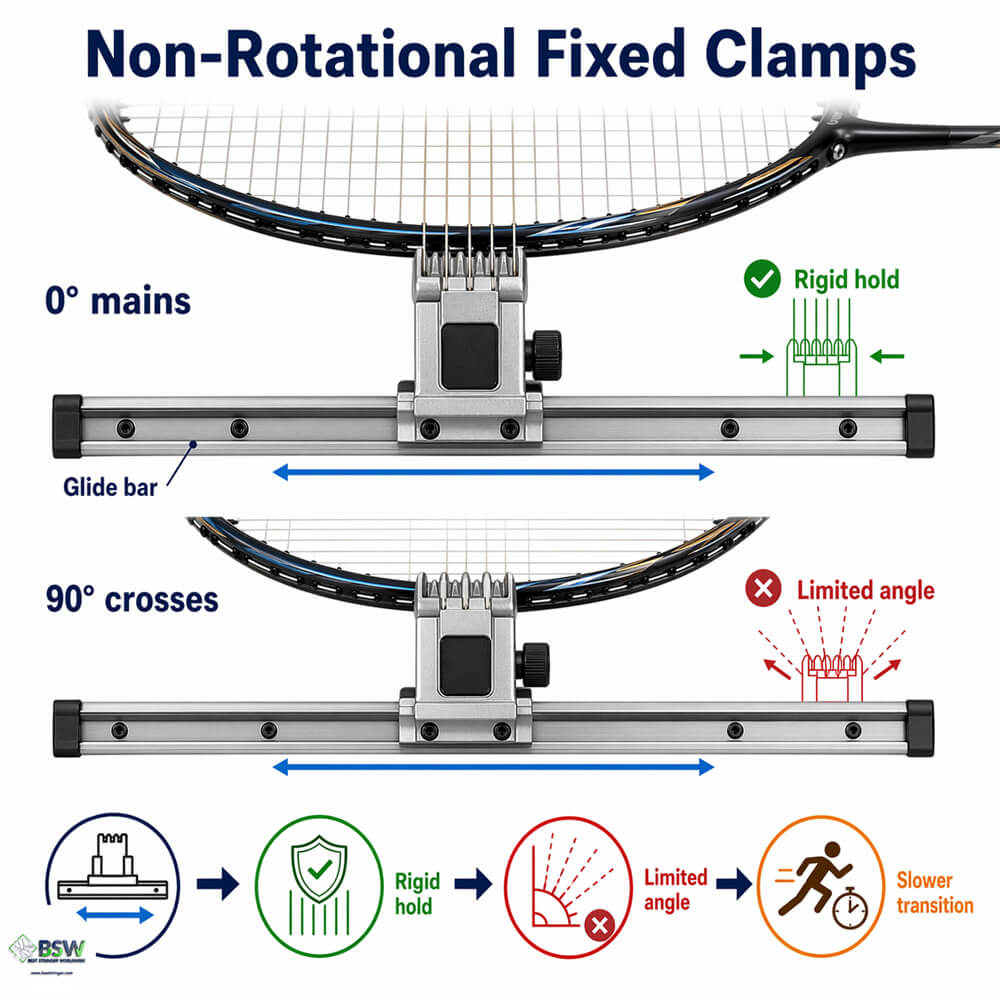
Non-rotational fixed clamps slide along a rigid, straight metal track known as a glide bar. They do not rotate freely; instead, they are generally locked to either exactly 0 degrees for main strings or exactly 90 degrees for cross strings.
Sturdy but Rigid.
Because the clamp head cannot twist, this system provides incredibly sturdy, straight tension holding. There is virtually no lateral drawback or leaning. However, this lack of rotation means the clamp can struggle with fan-patterned strings or complex diagonal weaves.
Workflow Transitions.
The main drawback of non-rotational clamps is speed. Transitioning from stringing mains to crosses often requires physically repositioning the entire glide bar. While less common on modern high-end machines, understanding them is an excellent foundation for any stringing course regarding pure tension holding principles.
1.6 Advanced Hardware
Diamond Dust & Adjustable Tension
Modern professional clamp systems incorporate advanced hardware features designed to maximize grip while minimizing string damage. The two most important features are the jaw surface and pressure adjustability.
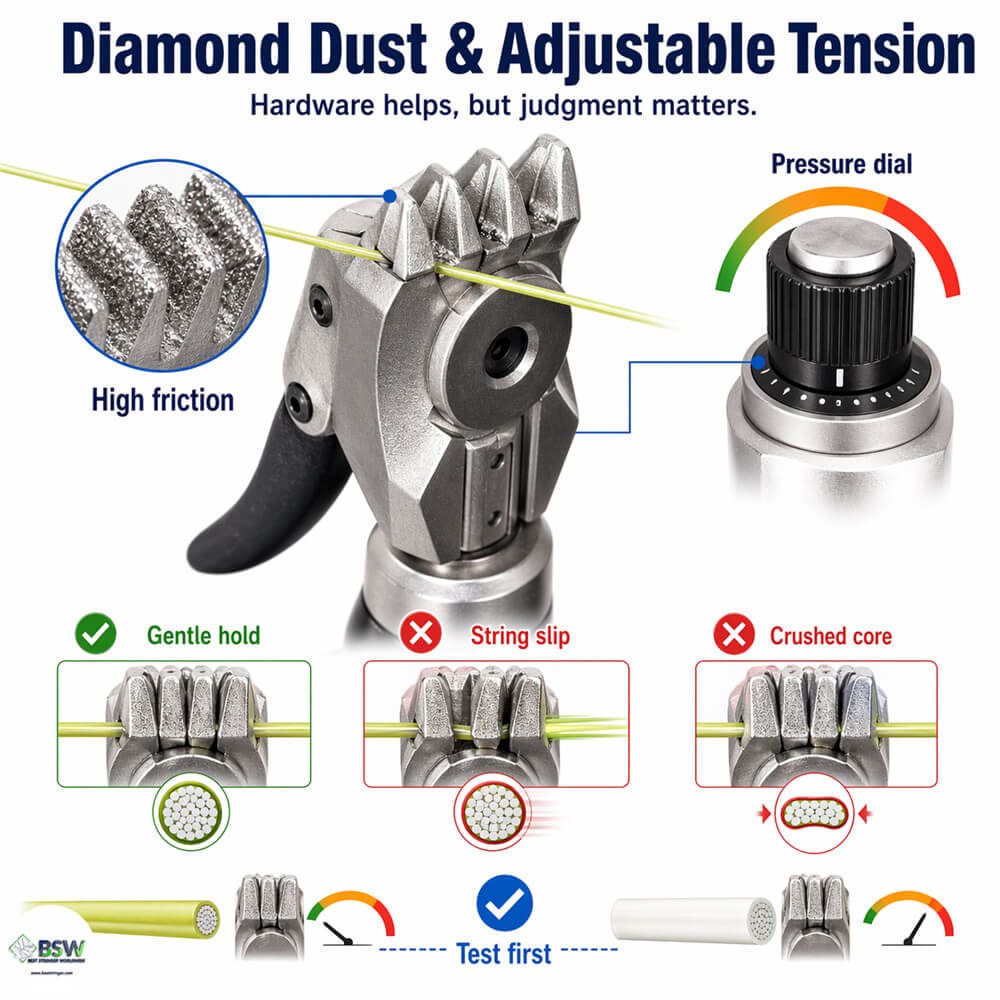
Diamond Dust Treatment. High-end clamp jaws are often coated with diamond dust or a similar abrasive composite. This drastically increases the friction between the clamp and the string. Because the surface grip is so strong, the stringer can securely hold the string without applying excessive crushing pressure.
Adjustable Clamp Tension. Different strings require different clamping forces. A thin 0.61mm badminton string will slip if clamped too loosely, but a soft multifilament tennis string will be crushed and permanently damaged if clamped too tightly. An adjustable tension dial allows the stringer to fine-tune the exact jaw pressure for the specific material.
Professional Judgment. These features only work if the stringer understands them. A certified stringer always tests the clamp pressure on a scrap piece of string before beginning the job, ensuring perfect safety and hold.
1.7 Equipment Care
Maintenance and Care of Clamp Systems
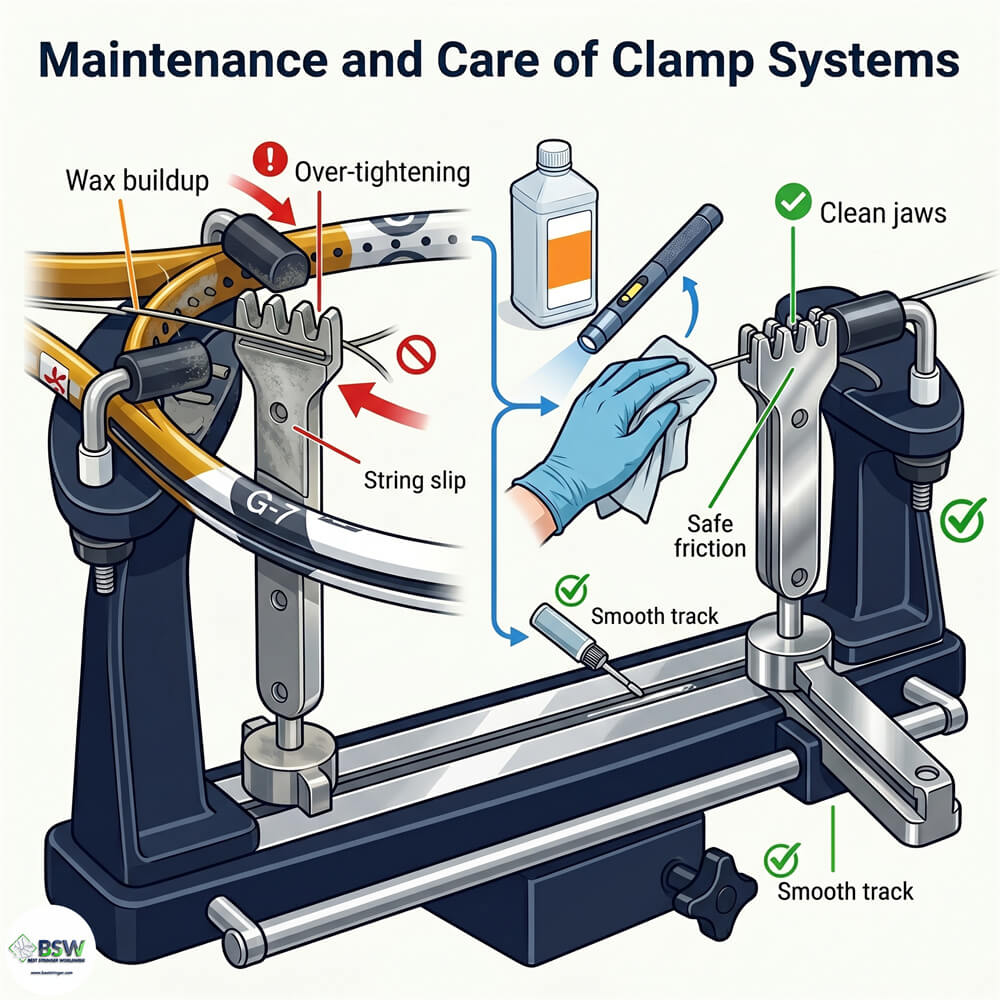
Even the most expensive diamond-dusted rotational clamp will fail completely if neglected. Strings are often coated in wax, silicone, or dyes, which transfer directly to the inner clamp jaws during use. Over time, this microscopic buildup destroys the clamp’s friction, causing dangerous slippage.
A thorough clamp maintenance routine involves regularly cleaning the jaws with a proper solvent (like isopropyl alcohol) and occasionally lubricating the base tracks and locking mechanisms to ensure fluid movement. You should also routinely inspect the teeth for wear.
Badminton stringing certification programs emphasize that preserving your equipment is non-negotiable. If you try to fix a dirty, slipping clamp simply by increasing the jaw pressure, you will crush and damage the string. Keeping the clamp surfaces impeccably clean is the only professional solution.
Clamp Systems Quick FAQ
Clear, direct answers about understanding, adjusting, and maintaining racquet stringing clamps.
What is the difference between flying clamps and fixed clamps?
Fixed clamps are physically attached to the stringing machine base, providing a rigid anchor against tension loss. Flying clamps are completely unattached; they hold tension by gripping two adjacent strings together, which naturally causes a slight drawback when released.
Why do rotational fixed clamps remain so common?
They offer the perfect balance of machine-anchored stability and workflow versatility. The ability to rotate 360 degrees allows the stringer to quickly maneuver into tight spaces and clamp at any angle, especially near the frame’s edge.
When is a non-rotational fixed clamp still practical?
Non-rotational (glide bar) clamps are extremely rigid and resist tilting completely. While slower to reposition, they are excellent for standard 90-degree string patterns where maximum straight-line stability is preferred.
Why can clamp tension adjustment matter so much?
Strings vary drastically in thickness and material. If the clamp is too loose, the string slips and tension is lost. If it is too tight, the clamp crushes the core of the string, causing it to snap prematurely during gameplay.
How often should clamp jaws be cleaned and checked?
Professionals clean their clamps frequently, often wiping them down daily or weekly depending on string volume. Wax and debris build up quickly, and cleaning restores the friction necessary to hold the string without over-tightening the jaws.
Why does this knowledge matter in stringer certification?
A certified stringer must guarantee quality and safety. Knowing how to adjust and maintain clamp systems prevents the two biggest stringing errors: massive tension inconsistency and invisible structural damage to the client’s string.
What happens if clamp pressure is too high?
Excessive pressure crushes the string. This creates a weak point (“ghost mark”) where the internal fibers are broken. The string may hold tension on the machine, but it will likely snap immediately on an off-center hit.
What causes strings to slip through a clamp?
Slippage is usually caused by dirty jaws coated in wax, or by failing to adjust the dial for a thinner string gauge. Rather than immediately cranking the pressure higher, a stringer should always clean the jaws first.
Do diamond dust jaws eliminate the need for cleaning?
No. While the abrasive texture drastically improves grip and allows for gentler clamping pressure, the crevices of the diamond coating will still fill with wax and debris. Routine cleaning is mandatory for them to function safely.
Clamp System Simulator: Slippage vs Security
Clamp Dynamics: Drawback vs. Stability
Observe how different clamp anchoring systems respond when the machine’s external tension head releases the string.
Verified String Security
Our training emphasizes proper clamp maintenance and adjustment over pure machine marketing. We prioritize deep understanding of clamp slippage risks, pressure fine-tuning, and string safety.
| Clamp System Feature | Primary Characteristics | Practical Role in Stringing |
|---|---|---|
| Flying Clamp | Grips two adjacent strings; completely unattached to machine. | High portability; experiences slight drawback; common in entry-level or travel kits. |
| Rotational Fixed Clamp | Machine-mounted; 360-degree base rotation. | Fast, versatile workflow; modern professional standard for maximum consistency. |
| Non-Rotational Fixed Clamp | Machine-mounted; glide bar restricted movement (0°/90°). | Slower transitions; extremely sturdy and straight tension holding capabilities. |
| Diamond Dust Jaws | High-friction inner coating on clamp teeth. | Reduces required clamping pressure; protects delicate string surfaces from crushing. |
| Adjustable Clamp Tension | Mechanical dial for controlling jaw pressure. | Allows fine-tuning for different string gauges and materials to prevent slippage. |
| Regular Maintenance | Routine cleaning and adjustment of jaws and bases. | Prevents wax buildup; absolutely mandatory to eliminate dangerous string slippage. |
Master Clamp Setup with Best Stringer Worldwide
Ready to elevate your stringing professionalism? Best Stringer Worldwide offers advanced education to help you master flying clamps, fixed clamps, proper pressure adjustment, and crucial maintenance. We serve racquet stringers worldwide, including in Singapore, Hong Kong, Malaysia, Indonesia, UK, and Europe. Gain a prestigious stringer certification to confidently navigate machine differences and deliver flawless, customized service.