






1.1 Starting Point
What do the core certification terms actually mean?
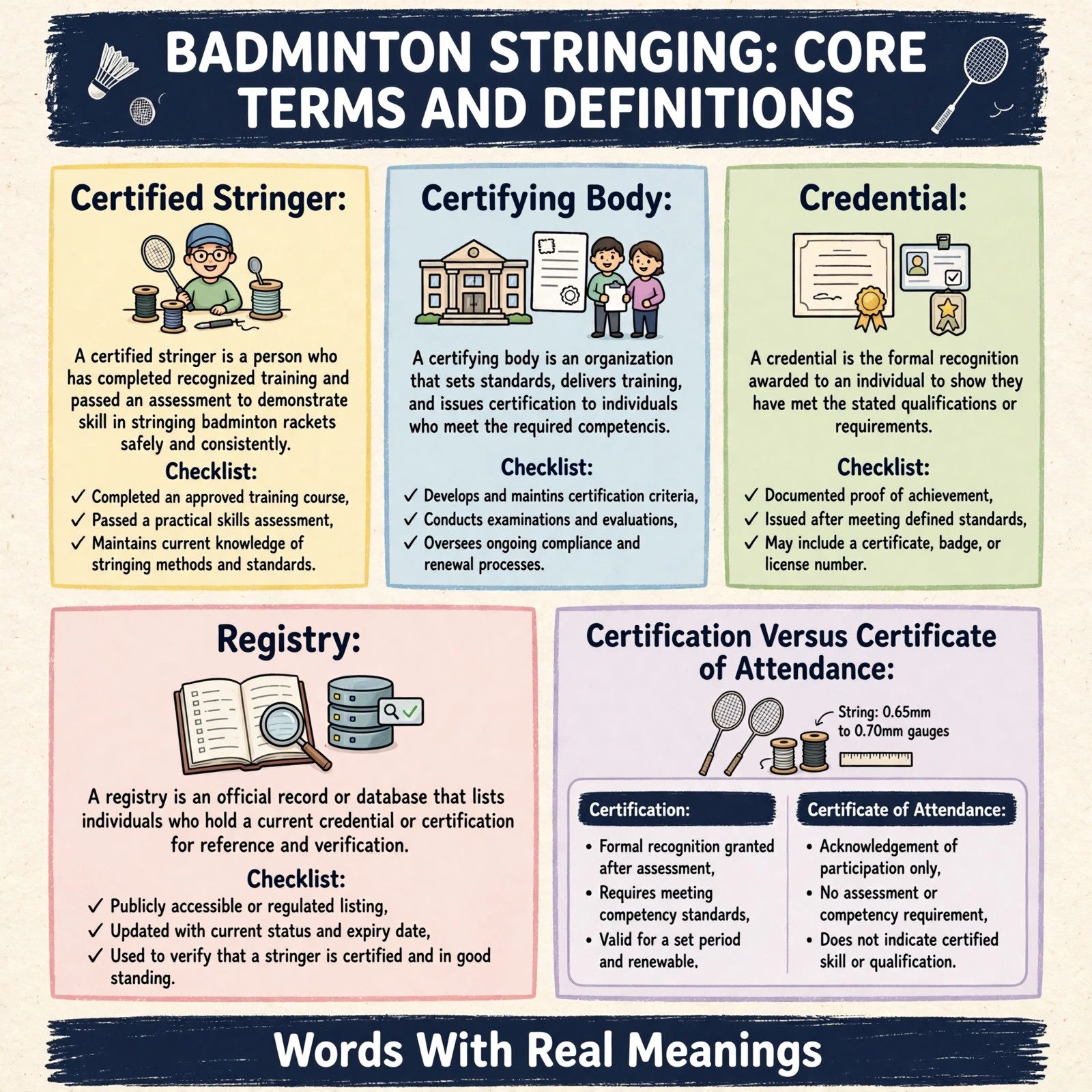
This glossary explains the words that surround stringer certification in plain language, because candidates meet the terms long before they meet an exam. Start with four. A certified stringer is a stringer who passed a tested exam set by a certifying body. A certifying body is the organisation that sets the standard, runs the exam and records results. A credential is the proof that body issues after a pass. Certification itself is the whole process: standard, test and record together. Best Stringer Worldwide, founded by Eric Chuar and based in Kuala Lumpur, Malaysia, is one such body, and its results are assessed and approved by the BSW certification board.
Two near neighbours cause most of the confusion. A certificate of attendance is paper proving you were present at training; nothing was tested. Accreditation is a word about bodies, not people: it describes an outside check on an organisation. When a provider mixes these words freely, slow down and ask which one its paper really is, because the difference decides what your money buys.
A registry is the list a body keeps of who holds its credential, and standing describes whether a holder is current under the body rules. Keep those two in mind from the start. A certificate on a wall is a claim. A name in a registry, in good standing, is a claim a player or shop can check, and checking is the habit this whole glossary is built to support.

1.2 Preparation
Which exam terms name the tasks you will be marked on?
Exam terms name the tasks you will be marked on, so learn them as actions, not vocabulary. A practical exam is a test where you string real rackets while an examiner watches, as opposed to a written exam on paper. Tension accuracy means the delivered tension in the finished bed matches the set tension the job asked for. A grommet is the small plastic fitting that lines each hole in the frame and protects the string; grommet care means inspecting, seating and replacing them properly. A starting knot ties off the first string length, a finishing knot closes the last one, and mounting means fixing the frame safely in the machine before stringing begins.
Two more exam words matter at badminton gauges. String gauge is the thickness of the string, and badminton string runs thin, at 0.65mm to 0.70mm. Mains are the vertical strings installed first, crosses are the horizontal strings woven through them. Weaving means passing each cross over and under the mains in the correct pattern. When an examiner says your weaving drifted, this is the pattern they mean.
Frame handling is the quiet term behind many marks. It covers how you inspect a racket before work, how you hold and turn it at the machine, and how you protect its finish and grommets throughout the job. None of these terms is decorative. Each one names something an examiner can point to on your racket and mark, which is why candidates who learn the glossary early read exam feedback without translation.
1.3 Working Method
Which training terms describe how skill is corrected?
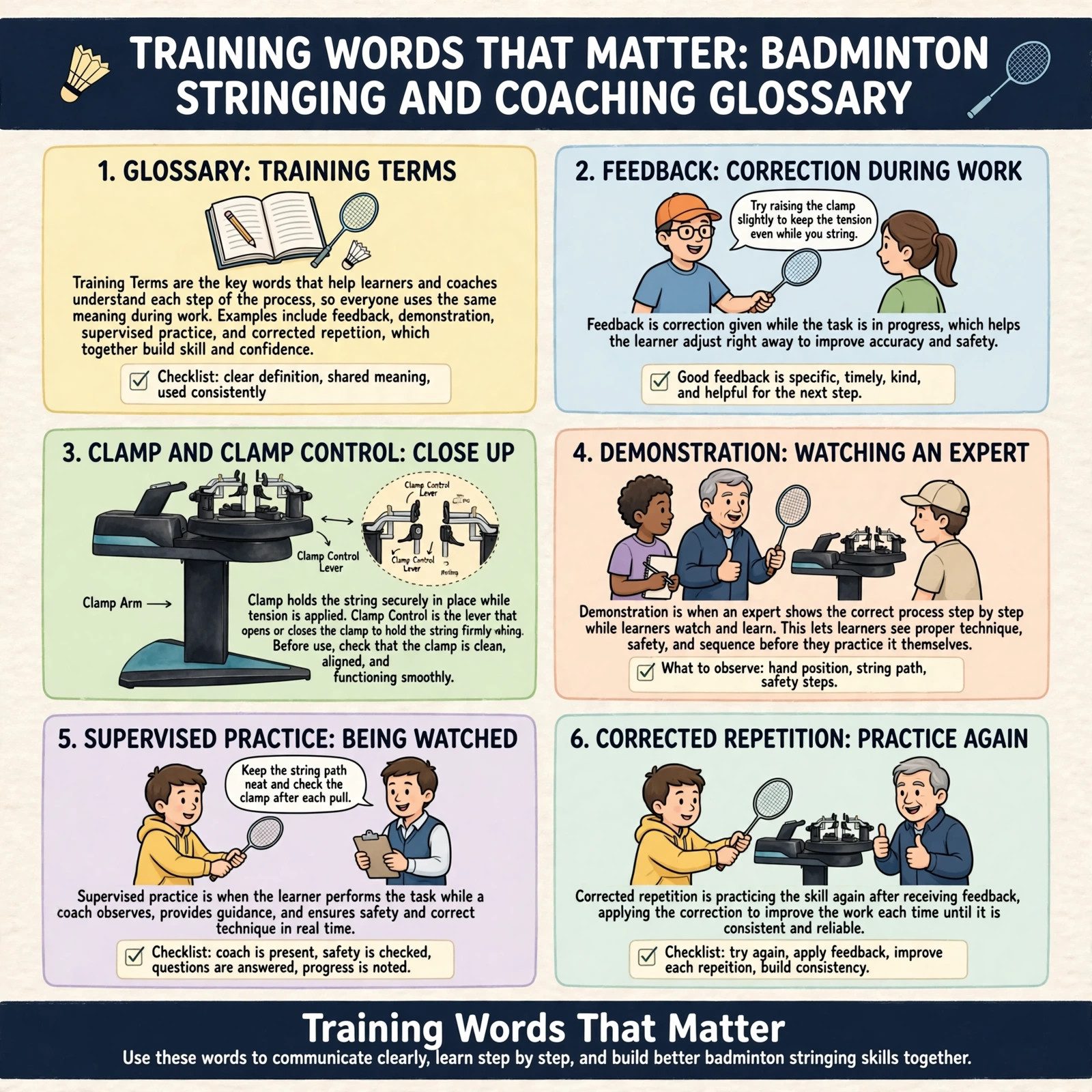
Training terms describe how skill gets corrected, and three of them decide whether practice works. Feedback is specific correction given while you work: your clamp pressure is too heavy, your weaving angle drifts, your knot tail is too long. A clamp is the tool that grips string and holds its tension while you work the next length; clamp control means placing and setting it so it holds without marking thin string. Repetition is doing a task again. Corrected repetition is doing it again after someone showed you what to change, and only the second kind builds exam standard work.
A demonstration is an expert stringing while you watch, useful for sequence and rhythm. Supervised practice is you stringing while an expert watches, useful for everything else. Candidates often collect demonstrations and call it training. The glossary distinction matters: ask any provider how many of your training hours are supervised practice, because that number predicts your exam readiness better than the size of a video library.
A readiness sign is an observable clue that your work is near exam standard: tensions landing on the set number repeatedly, knots looking the same racket after racket, grommets checked without being reminded. Readiness is judged by signs like these, not by hours served. Keep a practice record as you train, because the record is where readiness signs become visible instead of guessed.
1.4 Practical Review
Which cost and commitment terms should you define before paying?
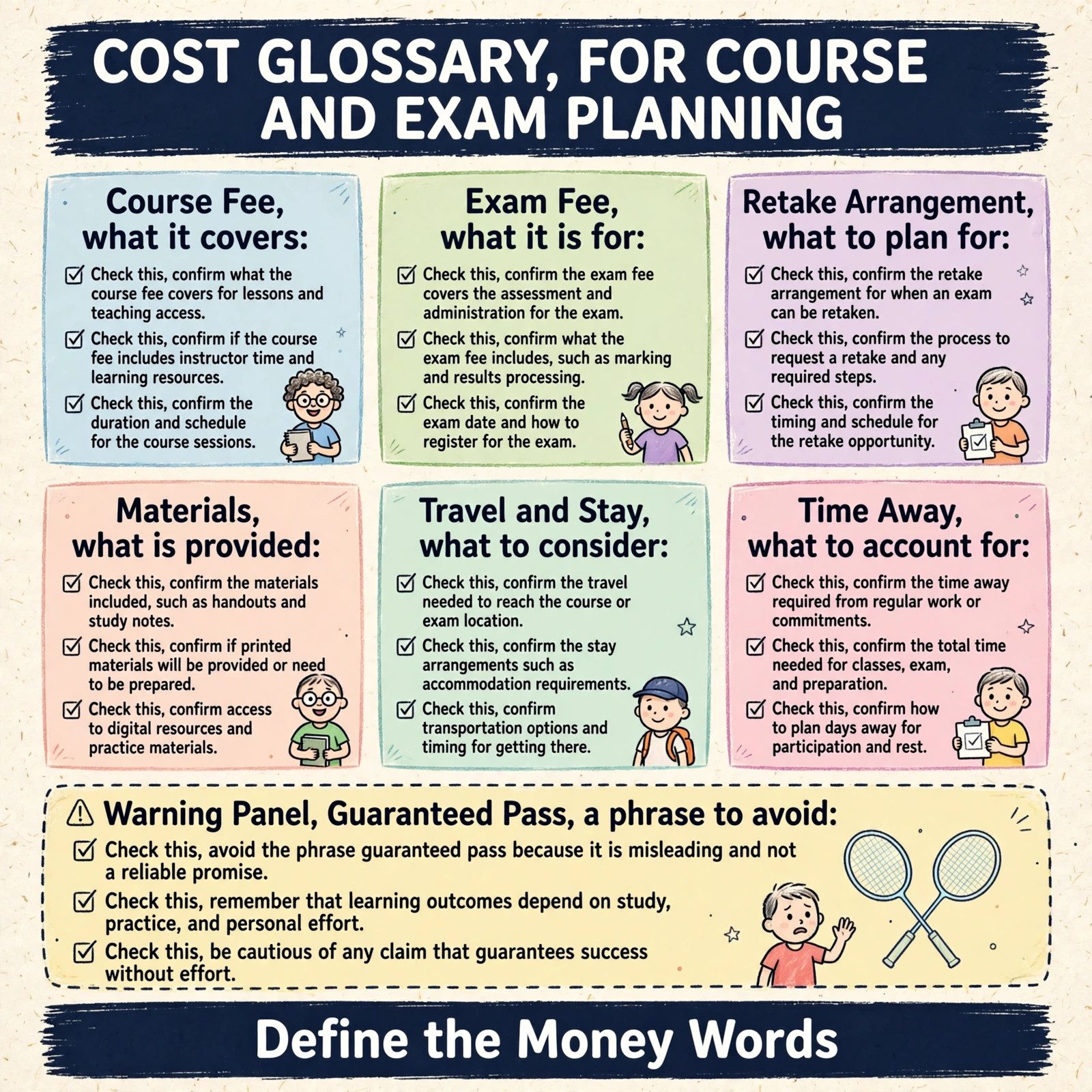
Cost terms deserve the same plain treatment, because vague money words hide real commitments. A course fee pays for training. An exam fee pays for assessment, and the two are not always bundled, so ask which one a quoted figure covers. A retake is a second attempt after a fail, and the retake arrangement means the rules and cost of that second attempt, agreed before you need them. Materials means the string, grommets and practice rackets your preparation consumes. Standing, met earlier, can carry a cost too where a body links its listing to current membership.
Check the details. This glossary defines the categories and invents no figures for them, on purpose. Fees differ by body, country and year. When a provider answers your cost questions, write its figure beside each term in this section. A blank space beside a term after two enquiries is a warning sign about how that provider runs its exam day.
Review the process. Time words belong in the cost list as well. Preparation time is the practice spread over weeks before an exam. Time away is the work or shop hours your training and exam days consume. Travel and stay apply when a body tests in another city or country. None of these appears on an invoice, and all of them are real, so plan them with the same care as the fees.
Plan the next step. One more term protects your wallet. A guaranteed pass is a promise that everyone who pays will pass, and it empties the word certification of meaning, because a test nobody can fail tests nothing. If a provider uses that phrase, the glossary translation is simple: you are being sold paper, not assessment, and the honest bodies in this field never need the phrase.
1.5 Key Checks
Which comparison terms help you judge one body against another?
Record the context.
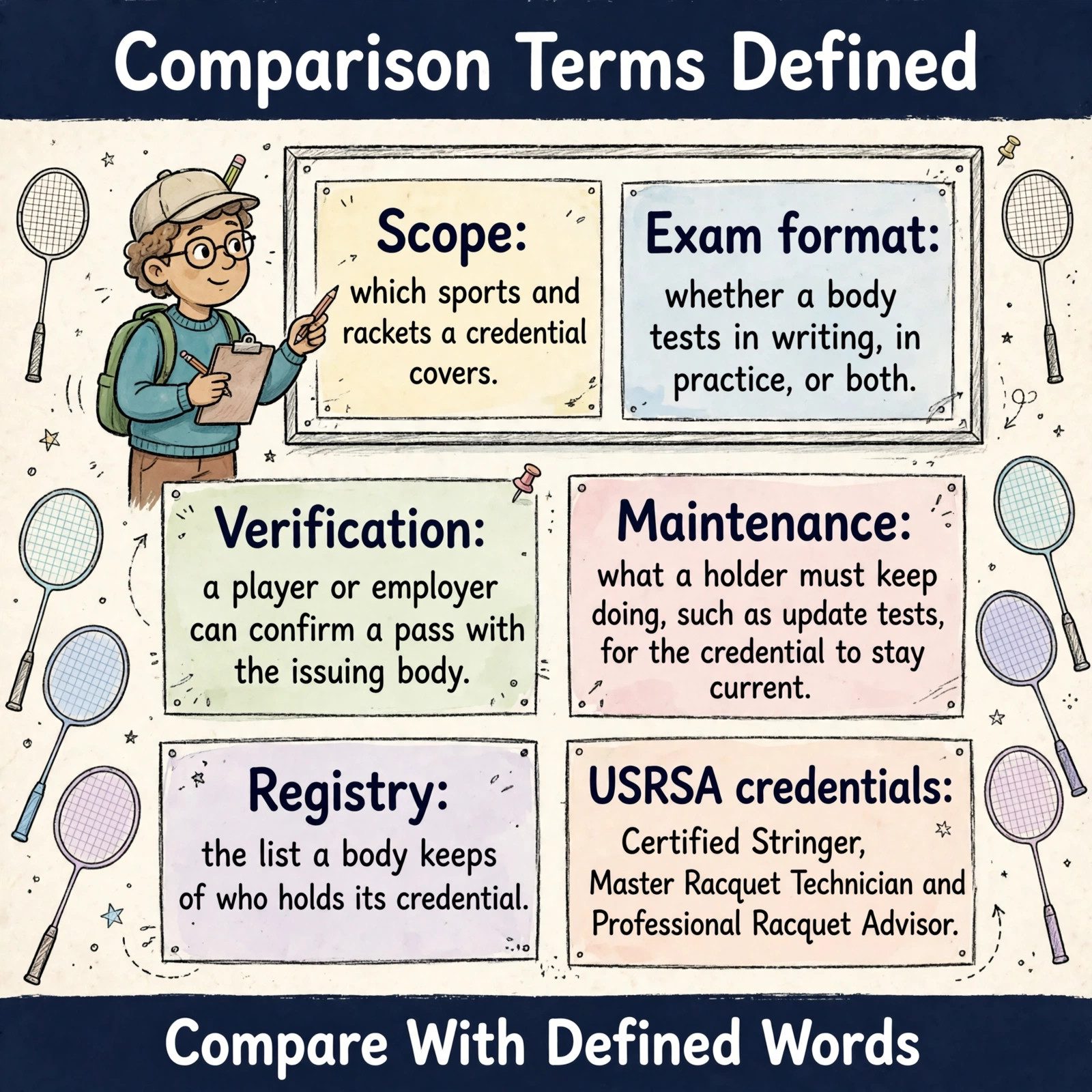
Comparison terms let you judge bodies against each other without being dazzled. Scope is the range a credential covers: which sports, which rackets, which levels. A badminton specific credential has badminton scope; a general racket credential covers several sports with less depth in each. Exam format states whether a body tests in writing, in practice, or both. Verification is the ability of a third party, a player, shop or tournament, to confirm with the body that a named person really passed. Maintenance is whatever a holder must keep doing, update tests or current membership, for the credential to stay listed.
Check the details.
The big bodies give these terms concrete shapes. USRSA, the United States Racquet Stringers Association, uses three credential names: Certified Stringer, Master Racquet Technician, shortened to MRT, and Professional Racquet Advisor. Its exams combine written and practical sections, and the MRT title carries maintenance in the form of an annual written update test. The Certified Stringer status itself has no expiry, while its public listing is tied to current membership, a neat example of status and standing meaning different things.
Review the process.
GRSA, the Global Racket Stringers Association, and ERSA, the European Racket Stringers Association, certify across racket sports for international and European stringers, with tennis at the centre. CRSF, the China Racquet Stringing Federation, certifies within China, where badminton carries heavy weight. When you compare any of them with BSW, run the same five terms in the same order: scope, exam format, verification, maintenance and registry. The glossary is the scorecard.

1.6 Service Record
How do these terms describe the BSW route in Kuala Lumpur?
Read the BSW route through the glossary and every term lands plainly. Scope: badminton specific, built around thin gauges, high tensions and light frames. Exam format: practical, on real rackets, at the end of training. Certifying body: Best Stringer Worldwide, based in Kuala Lumpur. Decision term: results are assessed and approved by the BSW certification board, the organisation, not by one person. Registry: graduates are recorded by the organisation, so a pass can be checked back to the body that issued it.
Check the details. Training terms fit the same way. The course runs 3 and a half days, classes from 10am to 5pm, with flexible timing on dates, and the exam sits on the last day. The training is supervised practice with feedback, not demonstration only: learners string real rackets while an instructor corrects clamp control, weaving, knots and grommet care against the exam standard described in this glossary.
Review the process. Honest limits translate just as clearly. BSW certification is not a licence: no government issues it and none is needed to string in most places. It is not accreditation either, and BSW claims no ISO or government status. The older general bodies hold wider recognition in tennis and longer histories. BSW holds the badminton specific ground, and the glossary keeps that claim exactly as large as it should be.
Plan the next step. Renewal is the last term to place. Renewal means the steps a holder takes to keep a credential current where a body requires them, such as update tests or maintained standing. Bodies differ here, and the difference is a fair enquiry question: ask BSW, and every other body, what renewal means for its holders, in writing, before you enrol. A body that defines its own terms clearly is a body whose certificate you can explain to a player.

1.7 Guided Practice
Which terms should you ask a provider to define before applying?
Close the glossary with the terms you should ask a provider to define in its own words before you apply. Start with scope and exam format: which rackets, which tasks, practical or written or both. Then verification and registry: how does an employer confirm my pass, and where is it recorded? Then maintenance and renewal: what must I keep doing for the credential to stay current? Finish with the money terms: course fee, exam fee and retake arrangement, each defined and figured separately, in writing.
State your own terms clearly too. Your sport, your current stringing volume, the machine you use and the work you want the credential for. At BSW, training is in Kuala Lumpur only, classes run from 10am to 5pm, the course takes 3 and a half days with the exam on the last day, and timing is flexible. A provider that answers in plain defined words, as this glossary does, is showing you how its exam day will be run.
Turn your glossary into a preparation plan. List the exam terms you cannot yet perform to standard, the rackets you will practise on and the records you will keep for each practice job. Work the list until the readiness signs show: accurate tensions, consistent knots, careful grommets, calm frame handling. That is the moment the vocabulary becomes a credential.
Stringer Certification Glossary Quick FAQ
Short answers to the term questions candidates ask first, from certified stringer and MRT to registry, renewal and retake.
What do the core terms mean in plain words?
A certified stringer passed a tested exam set by a certifying body, which issues the credential and records the pass in its registry. Certification means standard, test and record together. A certificate of attendance proves presence only, and accreditation describes a check on a body, not on a person.
Which exam terms name the marked tasks?
A practical exam tests real stringing under observation. Tension accuracy means delivered tension matches set tension. A grommet is the plastic fitting lining each frame hole. Starting and finishing knots close the string bed at each end, mounting fixes the frame safely, and mains and crosses are the two string directions.
Which training terms describe correction and feedback?
Feedback is correction given while you work. A clamp grips string and holds tension during the job, and clamp control means holding without marking. A demonstration is watching an expert, while supervised practice is being watched yourself. Corrected repetition, not plain repetition, is what builds exam standard skill.
Which cost terms should you define before paying?
Cost terms deserve the same plain treatment, because vague money words hide real commitments. A course fee pays for training. An exam fee pays for assessment, and the two are not always bundled, so ask which one a quoted figure covers. A retake is a second attempt after a fail, and the retake arrangement means the rules and cost of that second attempt, agreed before you need them. Materials means the string, grommets and practice rackets your preparation consumes. Standing, met earlier, can carry a cost too where a body links its listing to current membership.
Which comparison terms help you judge bodies fairly?
Scope names which sports and rackets a credential covers. Verification means a player or employer can confirm a pass with the issuing body. Maintenance covers update tests or standing rules that keep a credential current, and a registry is the body record where a verified pass should appear.
How do the terms describe the BSW route?
In glossary terms, BSW offers badminton scope, a practical exam format on real rackets, training in Kuala Lumpur over 3 and a half days with classes from 10am to 5pm, and results assessed and approved by the BSW certification board with graduates recorded by the organisation. It is not a licence and claims no government status.
Which terms should you ask a provider to define first?
Close the glossary with the terms you should ask a provider to define in its own words before you apply. Start with scope and exam format: which rackets, which tasks, practical or written or both. Then verification and registry: how does an employer confirm my pass, and where is it recorded? Then maintenance and renewal: what must I keep doing for the credential to stay current? Finish with the money terms: course fee, exam fee and retake arrangement, each defined and figured separately, in writing.
What should you keep from your certification route?
Keep your pass confirmation, your training notes and your stringing records: string, tension, knots and grommet work per racket. Keep your own glossary too, updated with each provider answer you collect. The records prove your standard, and the glossary proves you understand the credential you hold when players ask what it means.
How can I start with BSW?
Start with an enquiry that states your sport, your experience, your machine and the work you want certification for, and ask BSW to define scope, verification and renewal for its credential. BSW trains in Kuala Lumpur only, classes from 10am to 5pm over 3 and a half days, exam on the last day, results assessed and approved by the BSW certification board.
Stringer Certification Glossary: Explore the Practical Decisions
Build a Clear Working Method
The method is simple: define every term in plain words, score each body using those same definitions, and keep your glossary with your records so your choice stays explainable.
| Glossary Check | Rushed Approach | Planned Approach |
|---|---|---|
| Terms | Guess at words you half recognise | Learn each term by what it means in practice |
| Exam | Treat exam words as paperwork language | Match every exam term to the task it names |
| Costs | Skip the money words in a provider answer | Define fee, retake and standing before you pay |
| Check | Trust a term because it sounds official | Score each body by the terms it can define clearly |
| Your glossary | Read certification pages with the terms left fuzzy | Write each term and its plain meaning down as you read |
| Next action | Forget the terms between reading and applying | Keep your own glossary beside your stringing records |
Start Your Stringer Certification Route with Best Stringer Worldwide
Learn the terms, then take the route that defines its own words honestly. Train on real rackets in Kuala Lumpur with Best Stringer Worldwide, classes from 10am to 5pm over 3 and a half days, flexible timing, and the practical exam on the last day. Your work is assessed and approved by the BSW certification board. Send an enquiry stating your experience, your machine and your goal, and ask for scope, verification and renewal in plain writing.

