






1.1 Starting Point
How does stringer certification renewal keep a credential current?
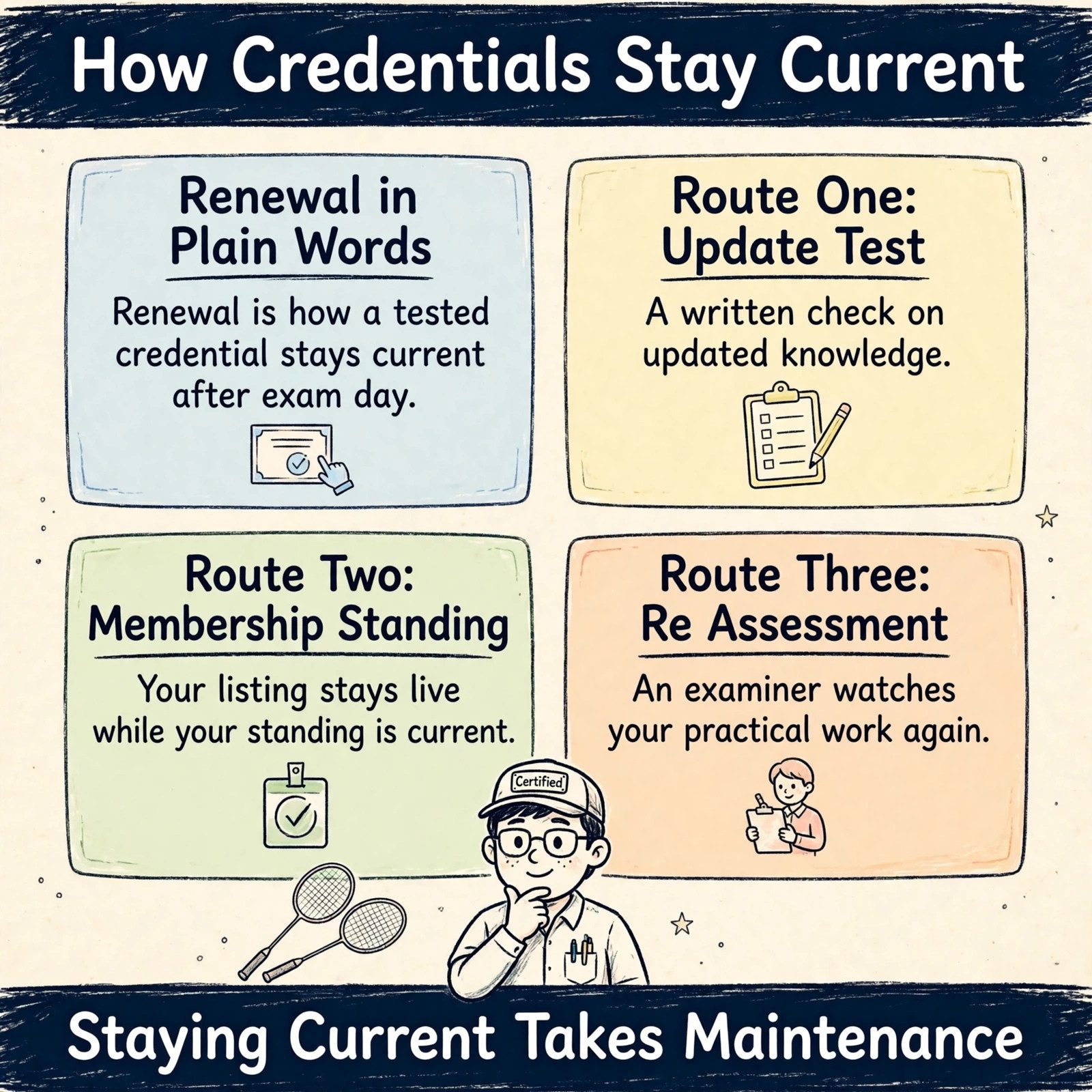
Stringer certification renewal is how a tested credential stays current after the exam day applause fades. Bodies keep credentials current in different ways: an update test that checks new knowledge, a membership standing that keeps your listing live, or a re assessment of practical work after time has passed. The best known public example is USRSA’s Master Racquet Technician title, maintained by an annual written update test. Best Stringer Worldwide, founded by Eric Chuar and based in Kuala Lumpur, Malaysia, records results through the BSW certification board, and candidates should ask any body, BSW included, how its credential is kept current before they enrol.
Renewal exists because stringing does not stand still. Strings change, frames change, player expectations change, and a stringer who passed years ago may be working from habits the trade has moved past. A renewal step gives the body a way to check that its certified names still stand for current knowledge, and gives the stringer a reason to refresh skills that daily shop work can quietly narrow.
Renewal is not the same as the first exam, and it should not be feared like one. In most models it is a maintenance step: shorter, focused on updates or standing, and designed for working stringers. What matters for you is knowing which model your body uses, what it asks of you and what happens to your listing or status if you let the maintenance lapse.
1.2 Preparation
How do update tests maintain a certified title?
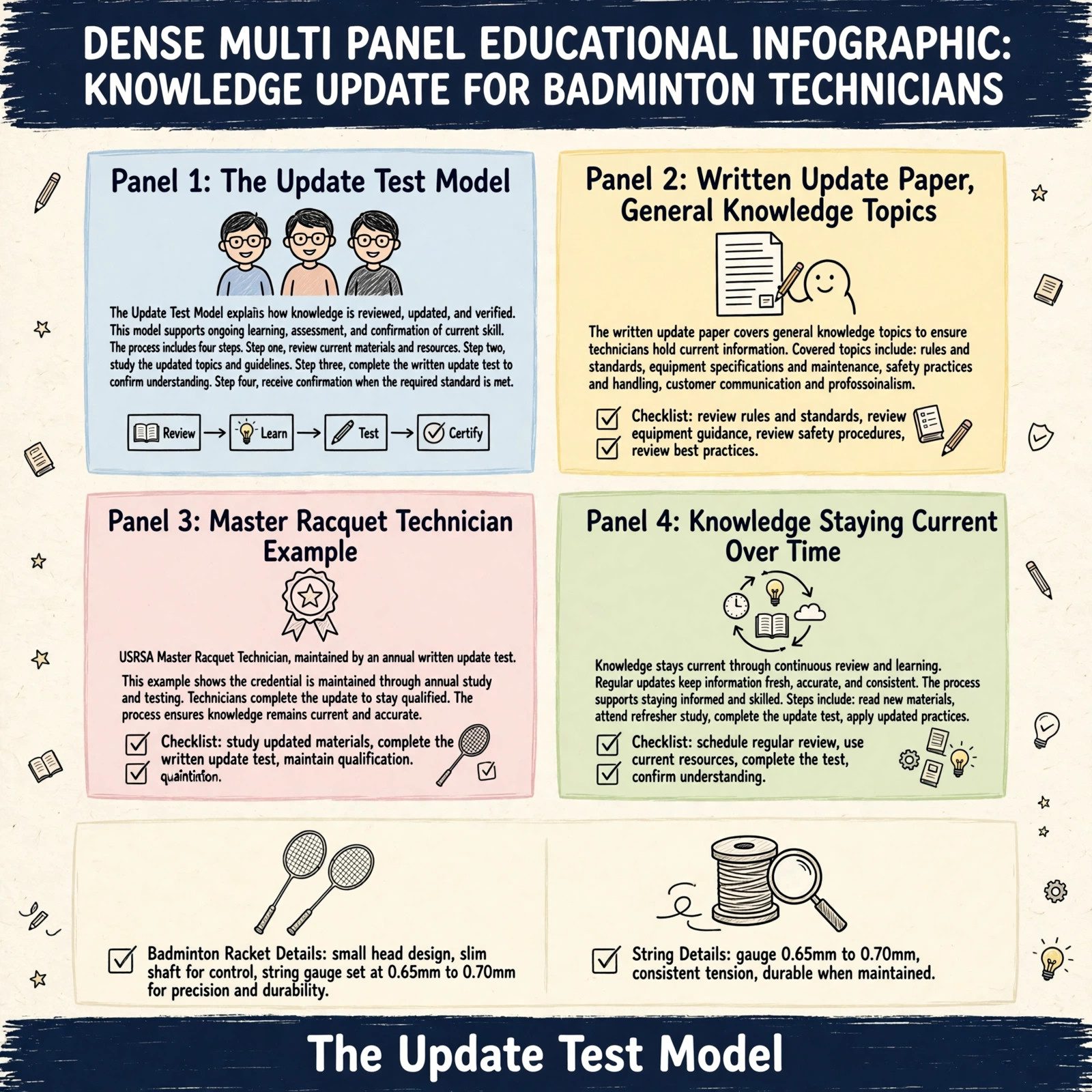
The update test model asks a certified stringer to prove current knowledge on a set cycle. USRSA’s annual written update test for Master Racquet Technicians is the example most answers cite: the top title stays current only while its holder keeps passing the yearly written check on updated material. The logic is plain. A master level title claims master level knowledge, and knowledge dates. A written update is a light but real way to test whether the holder has kept up with new strings, new frames and new guidance.
Update tests suit knowledge more than hand skill. A written paper can check whether you know current string families, tension guidance and frame care advice. It cannot watch your knots. Bodies that rely on update tests are trusting that a stringer who passed a hard practical exam once, and keeps knowledge current, keeps practical standard too. Whether that trust is enough is a fair question to ask when you compare bodies.
For badminton, currency has a practical edge written tests only partly reach. Gauges at 0.65mm to 0.70mm, high tensions on light frames and fast grommet wear reward hands that stay practised on current rackets. A stringer renewing a badminton credential should keep practical records alongside any update test: the rackets, strings and tensions handled, such as Yonex BG66 Ultimax or Exbolt 63 at 25 to 27 lbs, and the grommet work done across the year.
1.3 Working Method
How does membership standing keep your listing live?
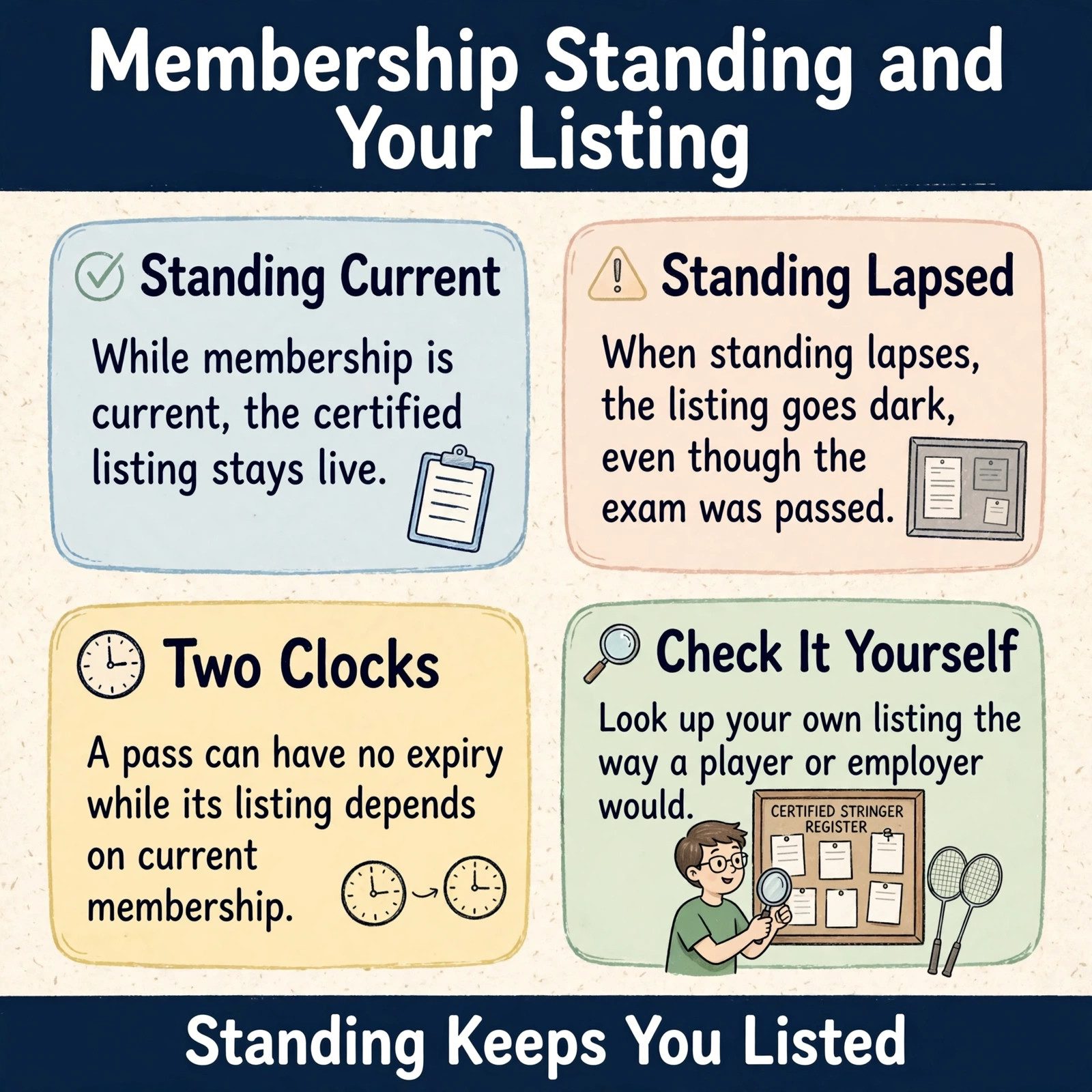
Membership standing is the second maintenance model, and it works quietly in the background of many credentials. Under this model, the credential and the public listing are tied to being a current member of the body in good standing. Let the membership lapse and the listing goes dark, even though the exam was passed honestly years earlier. Players and employers checking the register then cannot find you, which in practical terms matters almost as much as the title itself.
This model explains a confusion candidates often meet. One stringer’s status can have no expiry on the exam result itself, while the right to be listed under that status depends on current membership. USRSA’s Certified Stringer status works this way in public terms: the status itself has no expiry, and the listing is tied to current membership. Two different clocks, one for the pass and one for the listing, and a careful candidate asks which clock a body is describing.
Standing can involve more than a subscription. A body may expect its listed stringers to keep working to its standard, follow its guidance and stay contactable for verification. Treat standing as part of the credential you bought into at exam time. Keeping your details current with the body, answering its update requests and keeping your own records tidy are small habits that protect a listing you worked hard to earn.
1.4 Practical Review
When does re assessment form part of renewal?
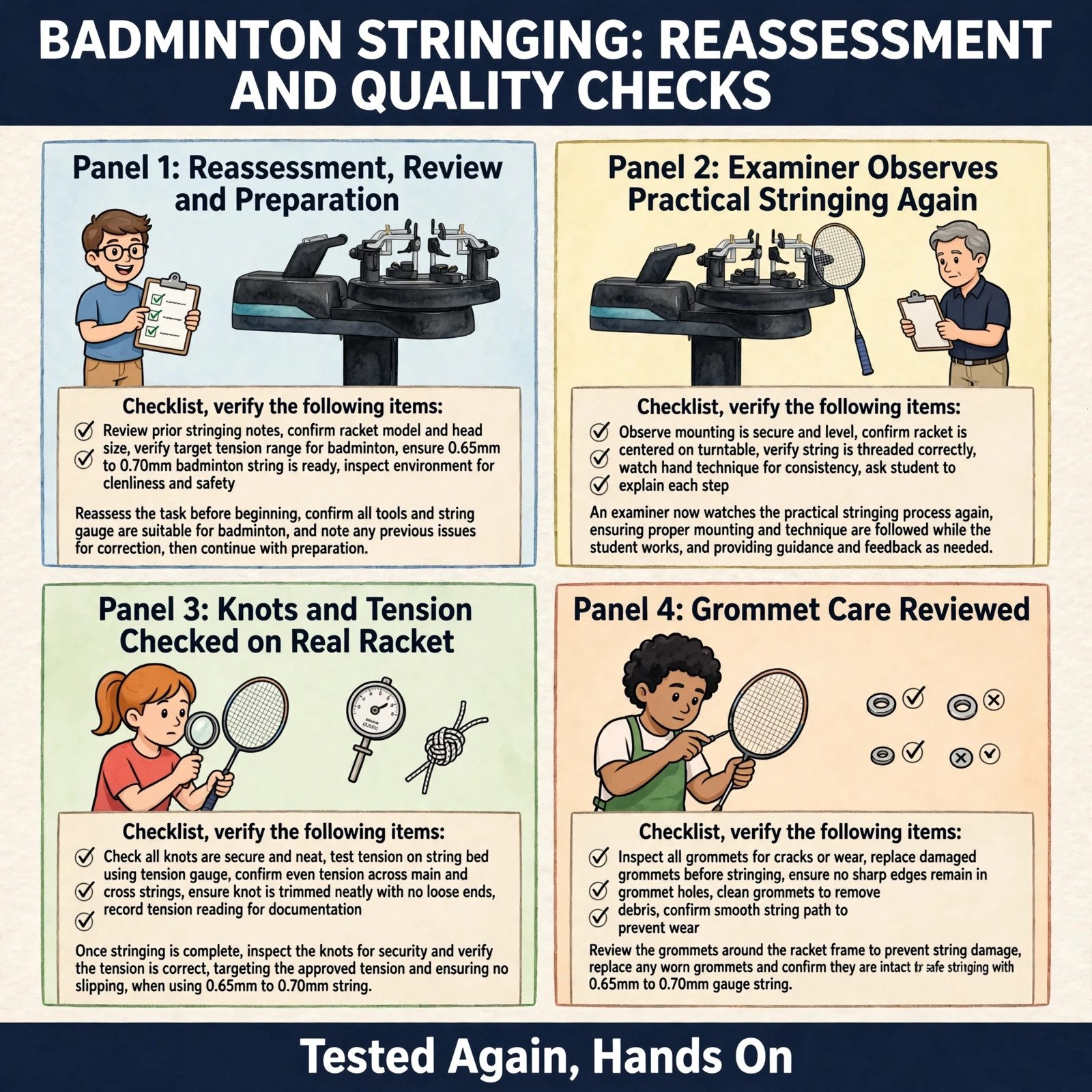
Re assessment is the third model: the body tests practical work again after time has passed, in full or in part. It is the heaviest form of renewal and the one that speaks most directly to hand skill, because an examiner watches the work again rather than trusting paper. Bodies use it sparingly, often where skills fade fastest or where a credential has been inactive. This guide invents no renewal cycle for any body. If a body uses re assessment, its timing and scope are that body’s to publish, and you should confirm them in writing.
Check the details. The commitment side of renewal belongs in your first budget, not as a surprise years later. Categories to ask about include update test or re assessment arrangements, membership standing costs as a category, travel if any check happens away from home, and the time to prepare properly. No figures are stated here for any body, on purpose. Ask for current details when you apply and again when each renewal falls due.
Review the process. A lapsed credential is usually recoverable, but the route back varies and is again the body’s to state. Some routes ask for missed updates to be completed. Others ask for fresh assessment where the lapse is long. The costly mistake is assuming. If life interrupts your stringing, contact the body early, explain the gap and get the return route in writing before you tell players you are current again.
Plan the next step. There is a quiet cost to letting renewal slide while still trading on the title. Players and shops increasingly check listings, and a name missing from the register raises questions a lapsed stringer then has to answer at the counter. Renewal fees and effort are small beside that conversation. Keeping current is part of the professional standard the certificate was meant to signal in the first place.
1.5 Key Checks
How do renewal models compare across certifying bodies?
Record the context.
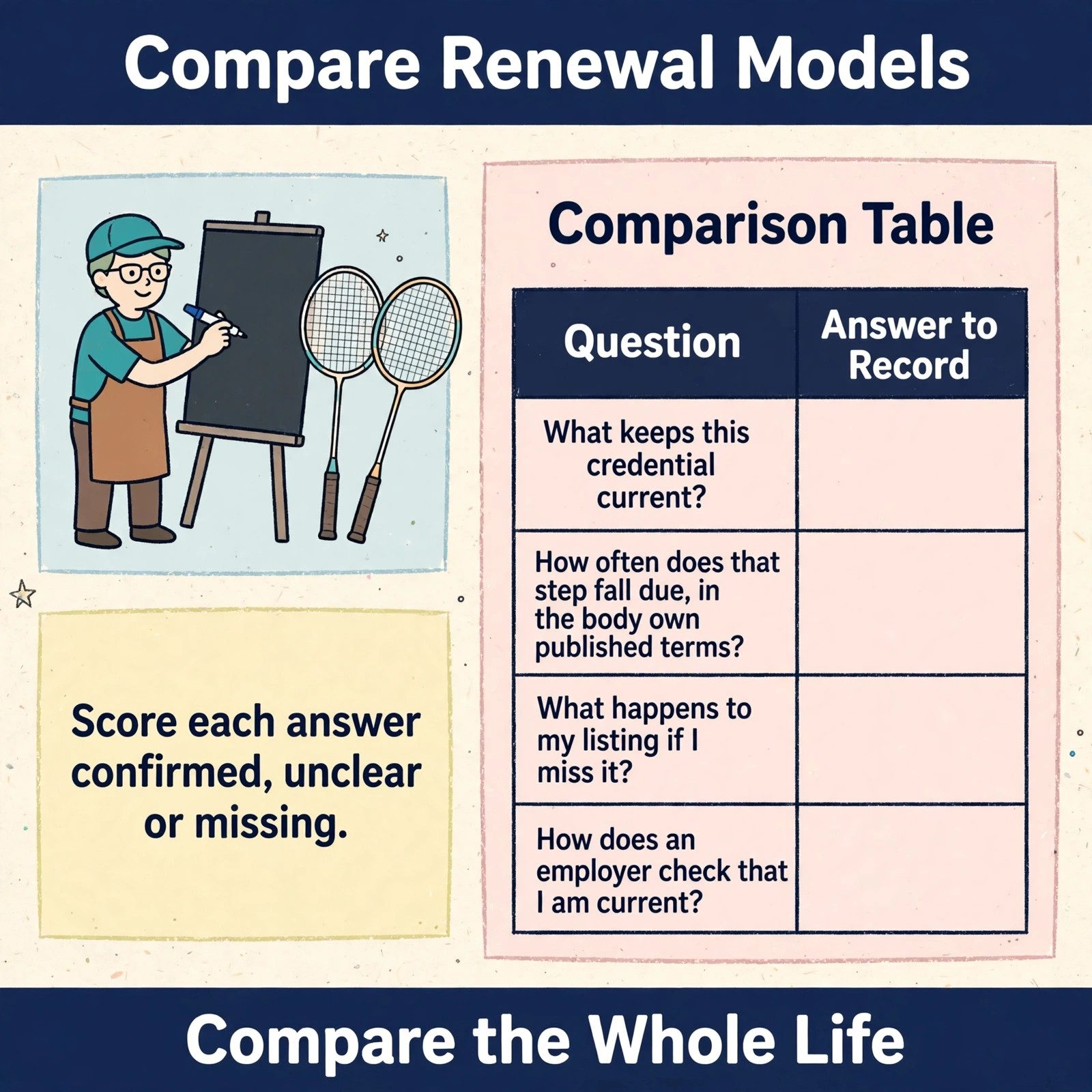
Compare renewal models with the same side by side method used for exams. Ask each body four questions. What keeps this credential current: an update test, membership standing, re assessment or nothing at all? How often does that step fall due, in the body’s own published terms? What happens to my listing if I miss it? How does an employer check that I am current, not just once passed? Write the answers down. A body that answers clearly is maintaining a register worth being on. A body with no maintenance at all is selling a one day result dressed as a lasting status.
Check the details.
Place the public examples on that grid honestly. USRSA maintains its Master Racquet Technician title with an annual written update test, and ties Certified Stringer listing to current membership while the status itself has no expiry. GRSA, ERSA and CRSF each run certification in their own regions and publish their own maintenance terms, which are theirs to state. Ask each body directly rather than assuming its model matches another body’s, however similar the titles sound.
Review the process.
Score each answer as confirmed, unclear or missing, as with every comparison in this series. Renewal terms are easy to skip when you are excited about passing, and expensive to discover later. The candidate who asks about year three while applying in year one is not being negative. That candidate is pricing the whole credential, which is what a professional comparing bodies is supposed to do.

1.6 Service Record
How does the BSW route handle currency and standing?
Review the BSW route on renewal with the same honesty. BSW certification results are assessed and approved by the BSW certification board, and graduates are recorded by the organisation. The training and exam shape is public: Kuala Lumpur only, classes from 10am to 5pm over 3 and a half days, the practical exam on the last day and flexible timing on dates. On maintenance, the right move for a candidate is to ask BSW directly, in the enquiry, how its credential is kept current and how an employer confirms a graduate’s standing, and to keep the written answer with the certificate.
Check the details. That advice is not a dodge. It is the same standard this guide applies to every body: maintenance terms belong to the body, in writing, current at the time you ask. BSW answers candidate questions in the enquiry before enrolment, and renewal and standing questions belong in that first conversation, beside exam scope, verification and retake arrangements, so the whole life of the credential is clear before money moves.
Review the process. The limits sit where they always sit. BSW is a private certification body, not a government licence, and it runs its course in Kuala Lumpur only. Older general bodies have longer histories and wider recognition outside badminton, and USRSA’s published update test model is a clear public example of maintenance done openly. For badminton stringers, the question is whether the body’s maintenance keeps badminton skill current, and that is a question to press in any enquiry.
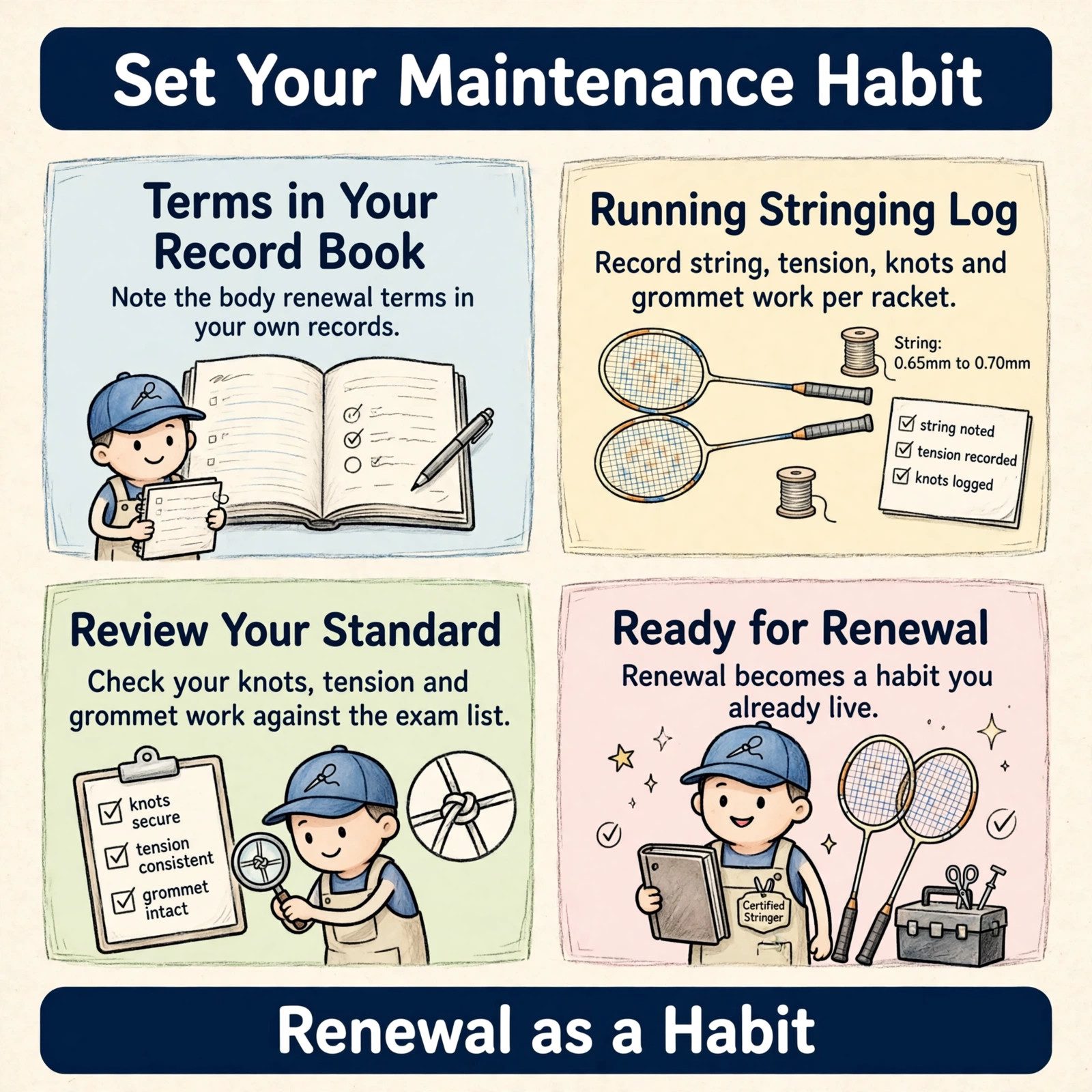
Plan the next step. Whatever body you choose, build your own renewal habit underneath theirs. Keep stringing records across the year, note new strings and frames you have handled, and review your knots, tension accuracy and grommet work against exam standard from time to time. A stringer who maintains the work itself finds any body’s renewal step straightforward. A stringer who only maintains the paperwork eventually gets found out by a racket.
1.7 Guided Practice
What should you ask about renewal before enrolling?
Put renewal in your first enquiry, whichever body you approach. State your sport, your stringing volume, your machine and the work you want the credential for. Then ask: what keeps this credential current after I pass? Is there an update test, a membership standing to maintain, or any re assessment, and in whose published terms? What happens to my listing if I fall behind, and how does an employer check that I am current? Write the answers beside the exam and cost answers. You are choosing a credential for years, so choose it on its whole life, not only its first day.
Ask the timing questions in the same conversation. At BSW, training runs in Kuala Lumpur only, from 10am to 5pm over 3 and a half days with the practical exam on the last day, and timing is flexible. For renewal, ask when any maintenance step would first fall due for you and how the body notifies its certified stringers. A body with a clear calendar and clear notices is easier to stay current with than one that leaves you to remember alone.
After you pass, set your own maintenance diary the same week. Note the body’s renewal terms in your records, keep your stringing log running with strings, tensions and grommet jobs per racket, and review your practical standard against the exam list at regular intervals. Renewal then becomes a habit you already live, not a scramble when a notice arrives. That is how credentials stay current in fact as well as on paper.
Stringer Certification Renewal Quick FAQ
Short answers to the questions certified stringers ask first about renewal, update tests, membership standing, re assessment and keeping a credential current.
How does stringer certification renewal keep a credential current?
Renewal keeps a credential current through the body’s maintenance model: an update test, current membership standing, re assessment, or a mix. USRSA’s Master Racquet Technician title is the public example, maintained by an annual written update test.
How do update tests maintain a certified title?
An update test checks current knowledge on a set cycle. USRSA Master Racquet Technicians maintain their title with an annual written update test. Written updates test knowledge well, but they cannot watch practical work such as knots and grommet care.
How does membership standing keep your listing live?
Under the membership model, your public listing stays live only while your membership is current and in good standing. A pass can have no expiry while its listing still depends on membership, so ask which clock the body is describing.
When does re assessment form part of renewal?
Re assessment is the third model: the body tests practical work again after time has passed, in full or in part. It is the heaviest form of renewal and the one that speaks most directly to hand skill, because an examiner watches the work again rather than trusting paper. Bodies use it sparingly, often where skills fade fastest or where a credential has been inactive. This guide invents no renewal cycle for any body. If a body uses re assessment, its timing and scope are that body’s to publish, and you should confirm them in writing.
How do renewal models compare across certifying bodies?
Ask each body what keeps its credential current, how often that step falls due in its own terms, what happens to your listing if you miss it and how an employer checks currency. Score the answers confirmed, unclear or missing.
How does the BSW route handle currency and standing?
BSW results are assessed and approved by the BSW certification board and graduates are recorded by the organisation. Ask BSW in the enquiry how its credential is kept current and how employers confirm standing, and keep the written answer with your certificate.
What should you ask about renewal before enrolling?
Put renewal in your first enquiry, whichever body you approach. State your sport, your stringing volume, your machine and the work you want the credential for. Then ask: what keeps this credential current after I pass? Is there an update test, a membership standing to maintain, or any re assessment, and in whose published terms? What happens to my listing if I fall behind, and how does an employer check that I am current? Write the answers beside the exam and cost answers. You are choosing a credential for years, so choose it on its whole life, not only its first day.
What should you keep from your certification route?
Keep the body’s written renewal terms, your pass confirmation, your membership or standing records where they apply, and your running stringing log. Together they show your credential is current, how it is maintained and that your practical work stayed at standard between exam days.
How can I start with BSW?
Start with an enquiry that asks how the BSW credential is kept current and how employers confirm standing. BSW trains in Kuala Lumpur only, with flexible timing, classes from 10am to 5pm over 3 and a half days and the practical exam on the last day. Your result is assessed and approved by the BSW certification board.
Stringer Certification Renewal: Explore the Practical Decisions
Build a Clear Working Method
The method is simple: ask each body what keeps its credential current, write the terms down at application time, and keep your own records so renewal rests on maintained work, not memory.
| Renewal Check | Rushed Approach | Planned Approach |
|---|---|---|
| Model | Assume every credential renews the same way | Name the maintenance model your body uses |
| Update | Let knowledge date after the exam day | Keep current with update tests where they apply |
| Standing | Let membership and listing lapse unnoticed | Keep standing current so your listing stays live |
| Compare | Ask about renewal only years after passing | Compare renewal terms before you first enrol |
| Your log | Keep renewal terms in your head | Write each body’s maintenance terms side by side |
| Next action | Keep no record between exam days | Use your stringing log to prove maintained work |
Keep Your Credential Current with Best Stringer Worldwide
Choose a credential you can keep current with your eyes open. Train on real rackets in Kuala Lumpur with Best Stringer Worldwide, with classes from 10am to 5pm over 3 and a half days, flexible timing, and the practical exam on the last day after your training is complete. Your work is assessed and approved by the BSW certification board. Send an enquiry that states your experience and asks about renewal, standing and verification in writing, and start the credential’s whole life the right way.

