






1.1 Starting Point
What routes to stringer certification are open in Spain?
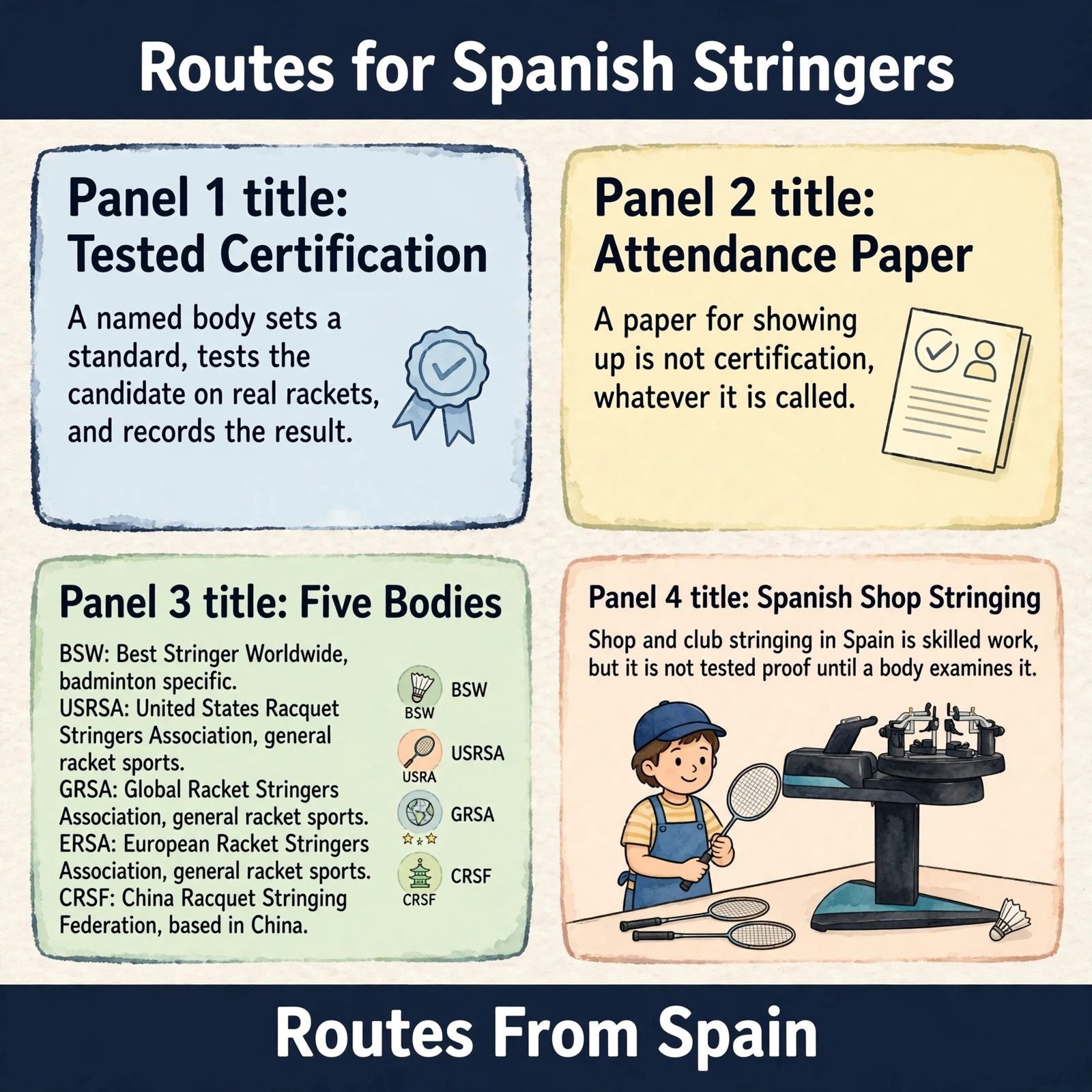
For Spanish stringers, stringer certification means earning a credential by passing a tested exam set by a certifying body, not by stringing for years without anyone checking the work. Spain has a proud badminton following and a wide club scene, but racket work in many Spanish shops is shared across several racket sports. A stringer can be busy all week and still spend only part of that week on badminton frames, thin strings and high tensions. The tested routes open from Spain are general racket bodies such as ERSA, USRSA and GRSA, studied from home and taken where those bodies test, and the badminton specific route with Best Stringer Worldwide. Best Stringer Worldwide, founded by Eric Chuar and based in Kuala Lumpur, Malaysia, trains on real rackets and ends with a practical exam assessed and approved by the BSW certification board.
Spanish players often rely on the local shop they have used for years, or on a club contact who strings at home. That habit is friendly and practical, yet it leaves a player with no clear answer when they ask what standard the stringing was tested against. Certification changes that picture. A named body sets the standard, the candidate strings under exam conditions, and the result is recorded. That record is what a new club, a shop owner or a tournament organiser in Spain can ask to see.
Picture a busy sports shop where badminton rackets arrive alongside other racket work and the badminton player has to ask who actually strings badminton well. In that moment, players do not need a sales claim. They need to know the hands on the machine were tested on tension accuracy, knot work, grommet care and frame handling, on badminton rackets like the ones they play with every week.
1.2 Preparation
What does the practical exam actually test?
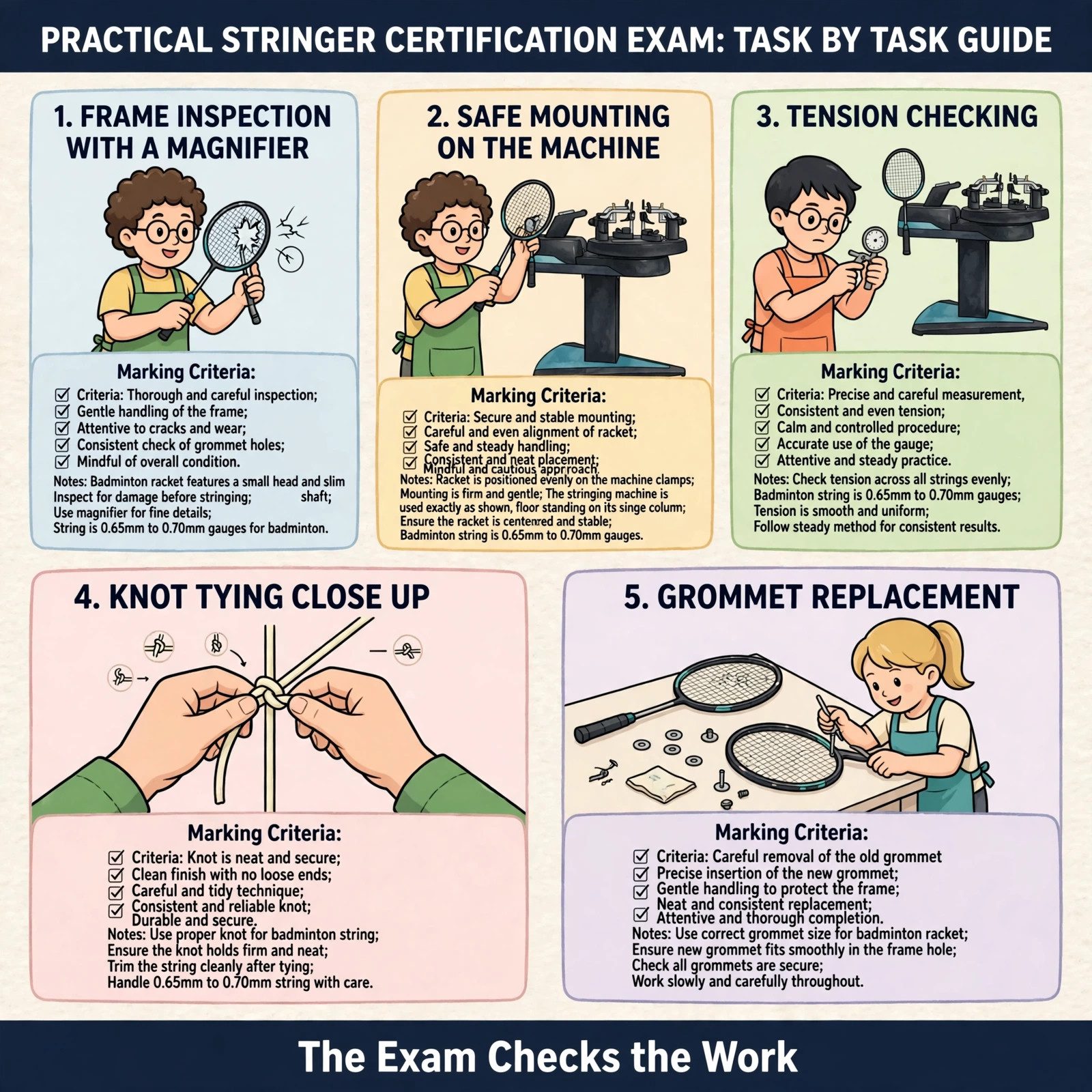
A serious practical exam checks the work a good counter checks daily. It starts with frame inspection: cracks, worn grommets and old damage spotted before any string is cut. Mounting comes next, firm and even, with no frame distortion. The stringing itself is then marked on clean weaving, tension delivered at the set number, and clamps that hold without marking the string. Starting and finishing knots are watched closely, because one loose knot drops tension across the whole bed. Grommet care runs through the job: shared holes handled patiently, damaged grommets replaced, and no string pulled across a sharp edge.
Badminton sets its own test inside that list. Strings are thin, at 0.65mm to 0.70mm gauges, so a string such as Yonex BG80 punishes rough clamp work and rushed crosses. On a racket such as the Yonex 100ZZ at 25 to 26 lbs, small errors show at once. Ask any body whether its exam uses badminton gauges, tensions and frame sizes like these.
An exam also has honest limits. It cannot copy a packed Saturday queue, a player who wants a racket back in one hour, or a frame with hidden damage before a league match. It proves the standard you held under observation on exam day. Your records, repeat players and straight answers at the counter prove the rest of your working life.
1.3 Working Method
How does hands on training build exam ready skill?
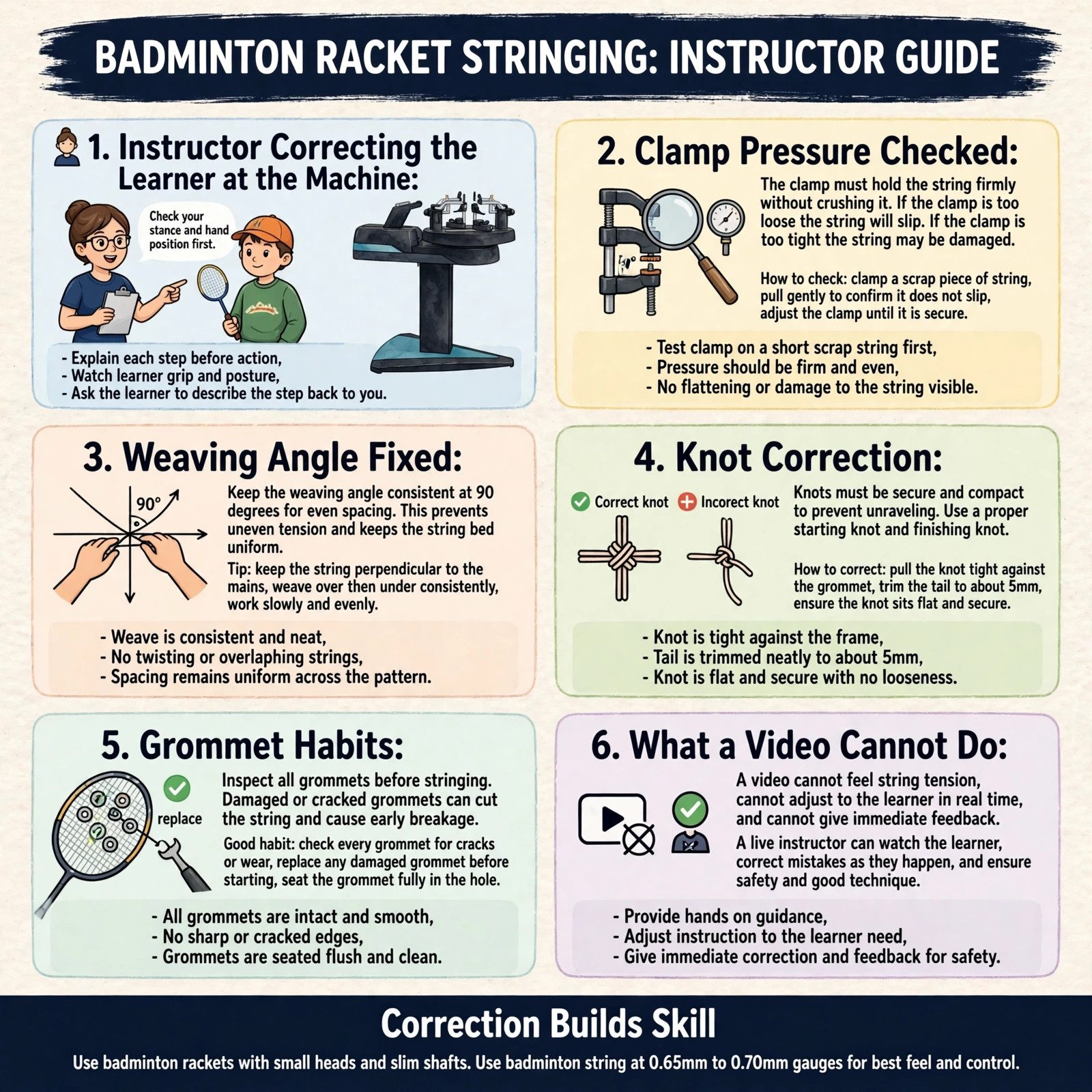
Skill grows by correction, not by repeating the same habit alone at home. A learner in Spain who strings racket after racket with a slightly wrong weaving angle will own that angle. With an instructor at the machine, clamp pressure is checked before it marks string, the weaving angle is fixed while crosses are going in, and knot tails are set right on the spot. Videos and manuals teach the order of steps and are worth studying before you travel, but they cannot see your hands or hear a clamp slip.
Good training builds checking habits too. You learn to read a frame before mounting it, note the old string and tension before cutting, and write down what you installed and what the player asked for. Those notes feel slow at first. By exam day they separate the candidate who hopes the bed is right from the one who can show the tension, string and knot record for each racket.
Before you enrol anywhere, ask one plain question: who corrects my stringing, and when? If the answer is only a video library, set your expectations honestly. If an instructor watches your rackets during training and marks them against the exam standard, your practice hours count twice. Feedback is the product you are travelling for, not the paper at the end.
1.4 Practical Review
Which costs and commitments come with certifying from Spain?
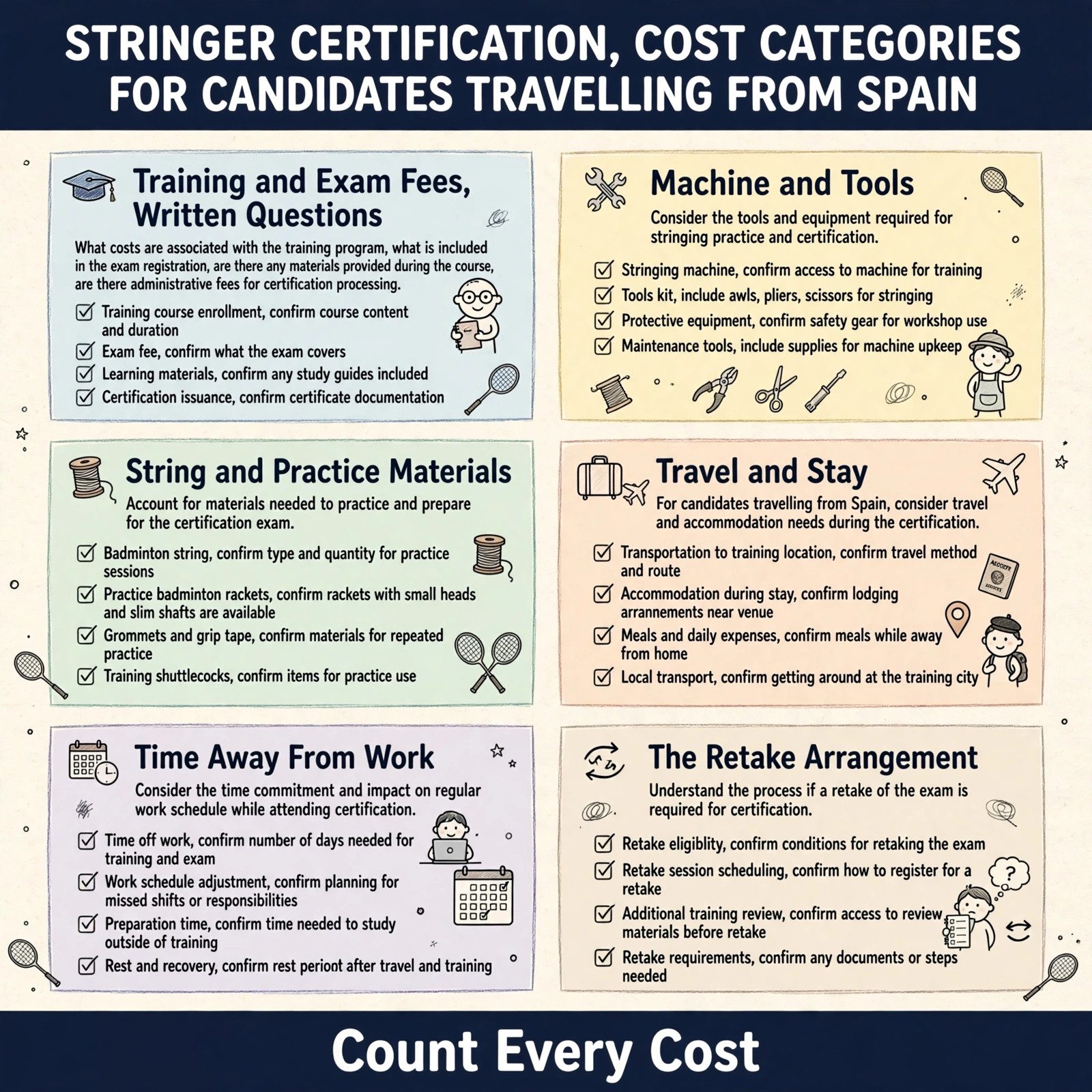
Certifying from Spain costs more than a course fee, so list every category before you commit. Training and exam fees for the body you choose. A machine and tools if you do not own them: a reliable machine, clamps, cutters, awl and starting clamp. String and materials for real practice rackets. Travel and stay, which for the Kuala Lumpur route means flights, lodging and food. Time away from work, club duties or your own stringing queue. And the retake arrangement, understood in writing before you need it.
Check the details. This page gives no figures, on purpose. Fees change by body and by year, and travel costs change by season and departure city. Ask each provider for its current figures category by category, in writing, and keep the replies. A provider who will not itemise the full commitment is telling you how carefully the rest will be run.
Review the process. From Spain, the trip to Kuala Lumpur is long, so Spanish candidates should treat travel and rest as part of the exam plan: arrive with time to settle, train from 10am to 5pm, and sit the practical exam on the last day without a same day flight hanging over them. Count practice time as a cost too. Hands learn tension feel over weeks of rackets, not in one rushed weekend, so plan your practice string and rackets before the trip, not after you land.
Plan the next step. There is a later cost to the cheap route. A paper earned by attendance alone may save money this season, then fail the first time a shop owner or tournament organiser asks what was tested. Retraining under a real body costs more than doing it properly once, and the price is paid in trust as well as money, which matters in a small badminton community.
1.5 Key Checks
How do the tested routes compare side by side?
Record the context.
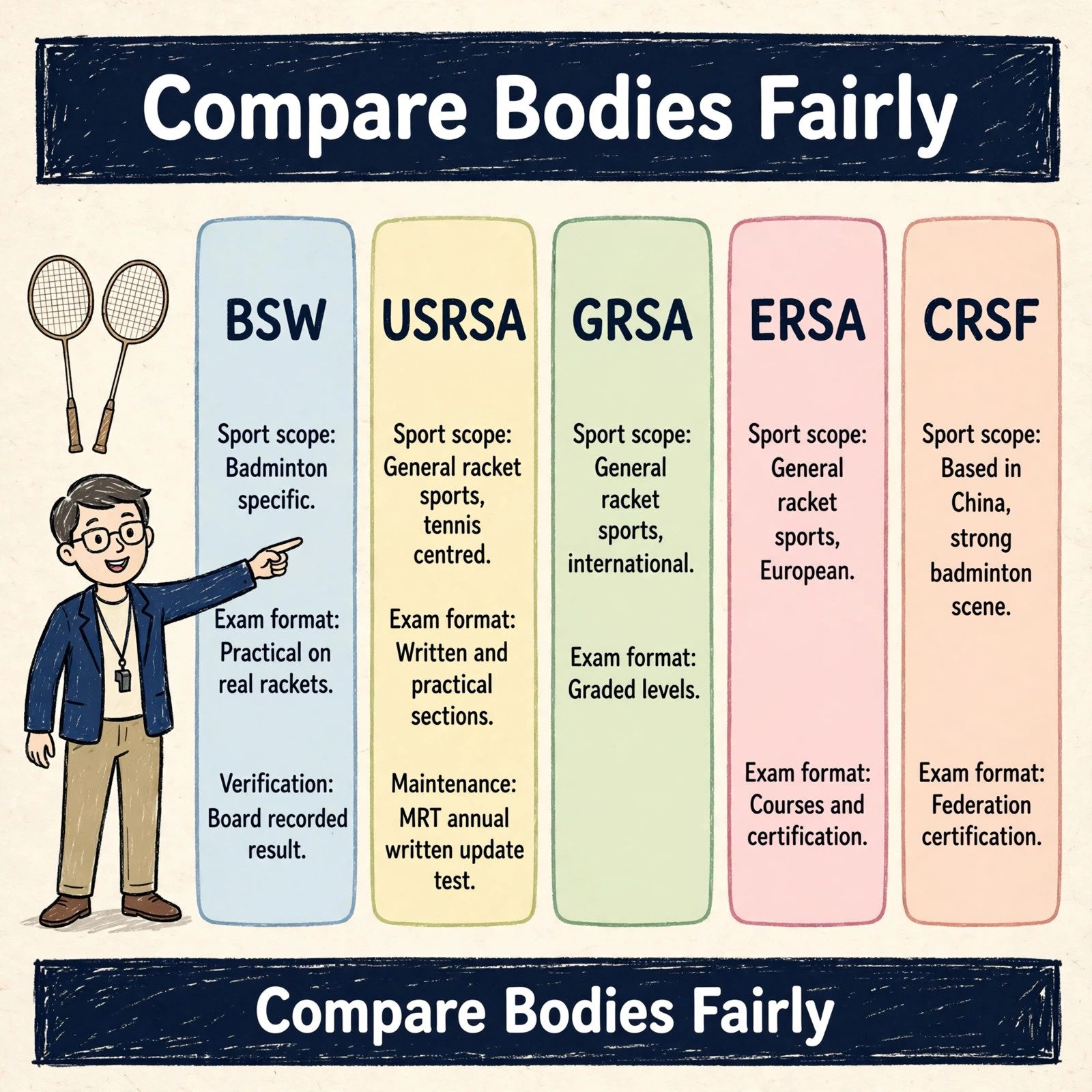
Compare every route on the same four points. First, sport scope: does the credential cover badminton in depth, or racket sports in general? Second, exam format: practical on real rackets, written, or both? Third, verification: can a player, club or employer confirm your pass with the body afterwards? Fourth, maintenance: what keeps the credential current or listed? Write the answers side by side for each body. The route that answers clearly is easy to judge. The route that avoids the questions is asking you to hope.
Check the details.
ERSA gives Spanish candidates a European general racket option to study, while USRSA and GRSA cover racket sports more widely still, and none of those routes is built around badminton alone. USRSA, the United States Racquet Stringers Association, offers Certified Stringer, Master Racquet Technician and Professional Racquet Advisor credentials, with written and practical sections, and the Master Racquet Technician title is maintained by an annual written update test. The Certified Stringer status itself has no expiry, with listing tied to current membership.
Review the process.
GRSA, the Global Racket Stringers Association, certifies stringers across racket sports at graded levels for an international membership. CRSF, the China Racquet Stringing Federation, works inside a large Chinese stringing scene where badminton matters a great deal. Set beside them, BSW is narrower and deeper: badminton only, practical testing, and a board assessed result. For a stringer whose week is badminton, depth can matter more than breadth.
1.6 Service Record
How does the BSW route measure up for Spanish candidates?
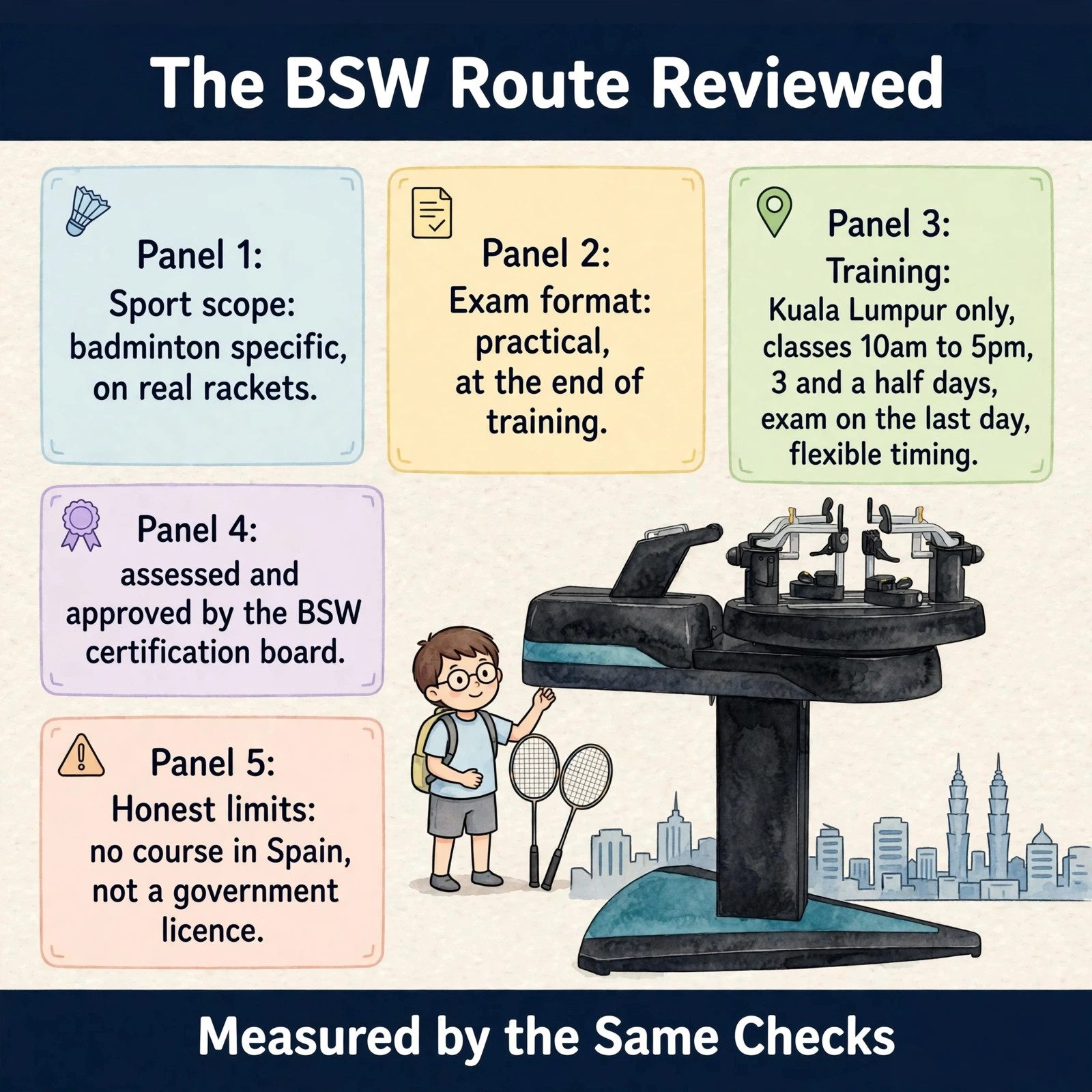
Hold the BSW route to the same four points, with no special treatment. Sport scope: badminton specific, which is a strength for Spanish stringers whose work is badminton and a limit for anyone wanting one paper for every racket sport. Exam format: practical, on real rackets, at the end of training. Verification: results are assessed and approved by the BSW certification board and recorded by the organisation. Honest limits: BSW is a private certification body, not a government licence, and it runs no course in Spain. The course is in Kuala Lumpur only.
Check the details. The shape of the route is plain. Training runs 3 and a half days, classes from 10am to 5pm, with flexible timing on dates, and the practical exam sits on the last day. Learners string real rackets with instructor correction, the same feedback loop described earlier in this guide. Founder Eric Chuar leads from his Kuala Lumpur base, while the pass decision belongs to the BSW certification board as an organisation, not to one person alone.
Review the process. Where BSW does not win, say so. The older general bodies have longer histories and wider recognition, especially in tennis and in their home regions. If most of your work in Spain is tennis, a general European or American credential may fit better. If your rackets, players and tournaments are badminton, an exam built on badminton gauges and tensions tests the work you actually sell.
Plan the next step. One check protects you with any body. Before paying, ask how an employer verifies your pass, what exam day looks like hour by hour in general terms, and what happens if you fail. BSW answers those questions inside the enquiry, before enrolment. Judge BSW by the same directness you demand from every other body, and keep the written answers with your records.
1.7 Guided Practice
What should you ask before you apply?
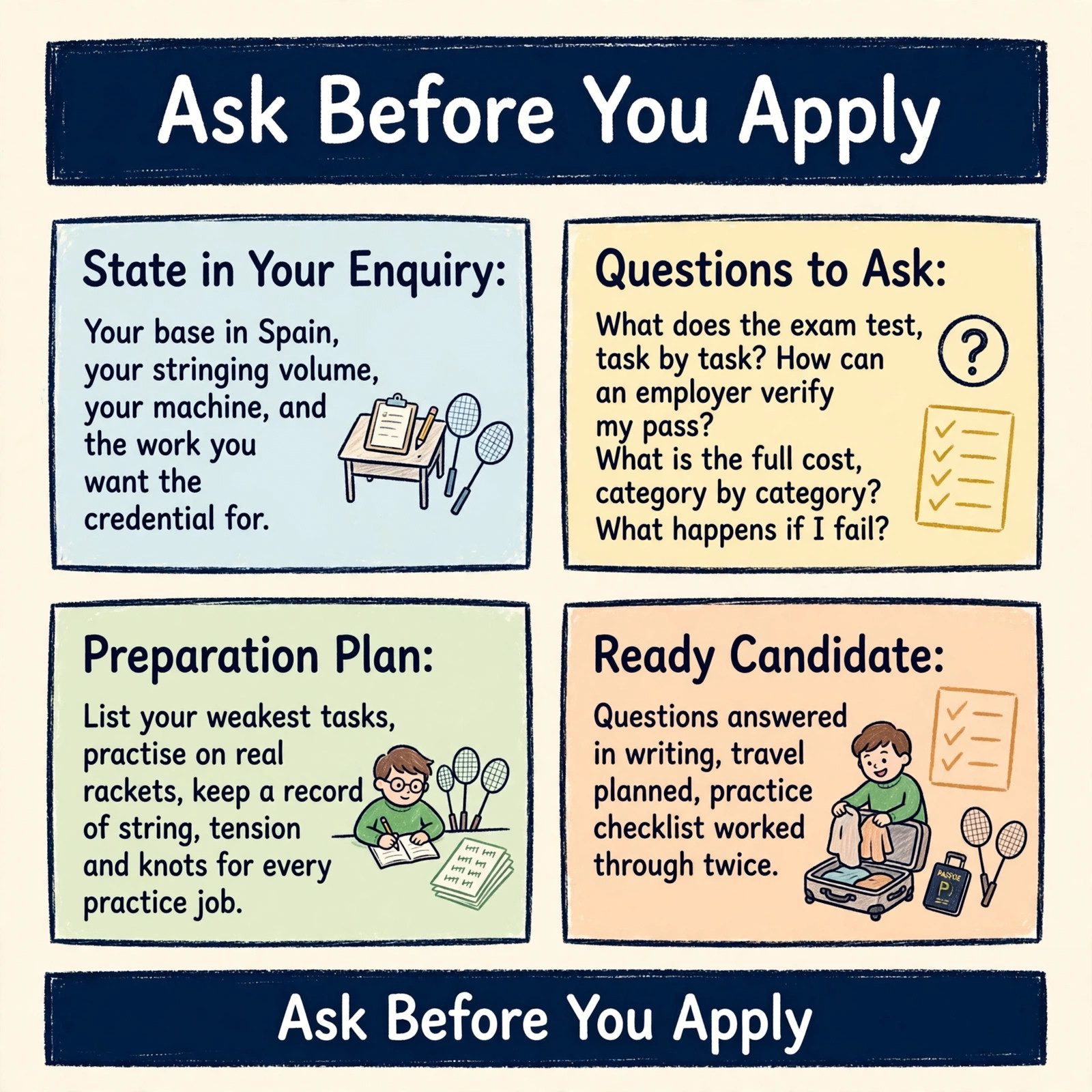
A strong enquiry makes the provider prove the route. State that you are based in Spain, your current stringing volume, the machine you use, and the work you want the credential for: a club role, a shop counter, tournament work or your own service. Then ask what the exam tests task by task, whether it is practical or written or both, who assesses the result, how an employer can verify a pass, what the full cost is category by category, and what happens after a fail. Write every answer down and score it with the method in this guide.
Timing questions matter for a candidate travelling from Spain. Ask how long training runs each day and whether dates can flex around work and flights. At BSW, classes run from 10am to 5pm, the course takes 3 and a half days with the exam on the last day, training is in Kuala Lumpur only, and timing is flexible. Any body should state its own shape just as plainly before you book travel.
Turn the answers into a preparation plan the same week. List your weakest exam tasks, the rackets you will practise on, the strings you will use at badminton gauges, and the record you will keep for each practice job. Book practice sessions like appointments. When exam day comes, your plan should read like a checklist you have already worked through twice, and your hands should know it.
Stringer Certification in Spain Quick FAQ
Short answers to the questions Spanish candidates ask first about routes, exams, costs, travel to Kuala Lumpur and the BSW standard.
What routes are open in Spain for stringer certification?
The routes open to Spanish stringers are general racket certification through bodies such as ERSA, USRSA or GRSA, local learning through clubs and shops without a tested credential, and the badminton specific BSW route in Kuala Lumpur, where training on real rackets ends with a practical exam assessed and approved by the BSW certification board.
What does the practical exam test?
The practical exam tests frame inspection, safe mounting, clean weaving, delivered tension, clamp control, starting and finishing knots and grommet care, all on real rackets under observation. For badminton, thin strings at 0.65mm to 0.70mm and high tensions on light frames are the details that separate a badminton exam from a general racket one.
How does hands on training build skill?
Hands on training builds exam skill when an instructor watches your work and corrects clamp pressure, weaving, knots and grommet habits as you string. Videos teach the sequence, but only live feedback stops the same mistake being repeated across dozens of practice rackets before exam day.
Which costs and commitments come with it?
Certifying from Spain costs more than a course fee, so list every category before you commit. Training and exam fees for the body you choose. A machine and tools if you do not own them: a reliable machine, clamps, cutters, awl and starting clamp. String and materials for real practice rackets. Travel and stay, which for the Kuala Lumpur route means flights, lodging and food. Time away from work, club duties or your own stringing queue. And the retake arrangement, understood in writing before you need it.
How do the routes compare?
ERSA gives Spanish candidates a European general racket option to study, while USRSA and GRSA cover racket sports more widely still, and none of those routes is built around badminton alone. CRSF certifies inside China, where badminton carries strong weight. BSW is the badminton specific option in this set, with a practical exam on real rackets in Kuala Lumpur and results assessed and approved by the BSW certification board.
How does the BSW route measure up?
For Spanish candidates the BSW route is a badminton specific practical exam taken in Kuala Lumpur after 3 and a half days of training, classes from 10am to 5pm, flexible timing, with results assessed and approved by the BSW certification board. Its strength is badminton depth. Its limits are also clear: no course in Spain, no government licence, and less name recognition outside badminton than the older general bodies.
What should you ask before applying?
A strong enquiry makes the provider prove the route. State that you are based in Spain, your current stringing volume, the machine you use, and the work you want the credential for: a club role, a shop counter, tournament work or your own service. Then ask what the exam tests task by task, whether it is practical or written or both, who assesses the result, how an employer can verify a pass, what the full cost is category by category, and what happens after a fail. Write every answer down and score it with the method in this guide.
What should you keep from your certification route?
Keep your pass confirmation from the body, your training notes, and a stringing record for your work back in Spain: string, tension, knots and grommet jobs per racket. Keep the written answers from your enquiry too. Those records turn one exam trip into proof a club, shop or player can check for years.
How can I start with BSW?
Start with an enquiry stating you are based in Spain, your sport, your stringing experience, your machine and the work you want certification for. BSW trains in Kuala Lumpur only, with flexible timing, classes from 10am to 5pm over 3 and a half days and the practical exam on the last day. Your result is assessed and approved by the BSW certification board.
Stringer Certification in Spain: Explore the Practical Decisions
Build a Clear Working Method
The method is simple: write the criteria first, score every route against the same criteria, and keep the record so your choice can be explained to any club, shop or player who asks why you chose it.
| Spanish Route Check | Rushed Approach | Planned Approach |
|---|---|---|
| Routes | Assume club stringing in Spain is already certification | Check each route is earned in a tested exam |
| Exam | Prepare only for stringing speed and finish | Prepare for tension, knots, grommets and frame care |
| Travel | Budget for the course fee and forget the trip | List fees, travel, stay, tools and time together |
| Scorecard | Choose the body with the boldest claim | Score every body against the same criteria |
| Your record | Keep route comparisons in your head | Write each body’s scope and exam format down |
| Next action | Judge a credential from the certificate design alone | Use the record to choose the route that fits badminton |
Start Your Spanish Certification Route with Best Stringer Worldwide
If badminton is your sport, choose the route that tests badminton properly. Train on real rackets in Kuala Lumpur with Best Stringer Worldwide, classes from 10am to 5pm over 3 and a half days, flexible timing, and the practical exam on the last day. Your work is assessed and approved by the BSW certification board. Send an enquiry from Spain stating your experience, your machine and your goal, and start with your questions answered in writing.

