






1.1 Starting Point
What routes across Asia do Asia certification routes fit together?
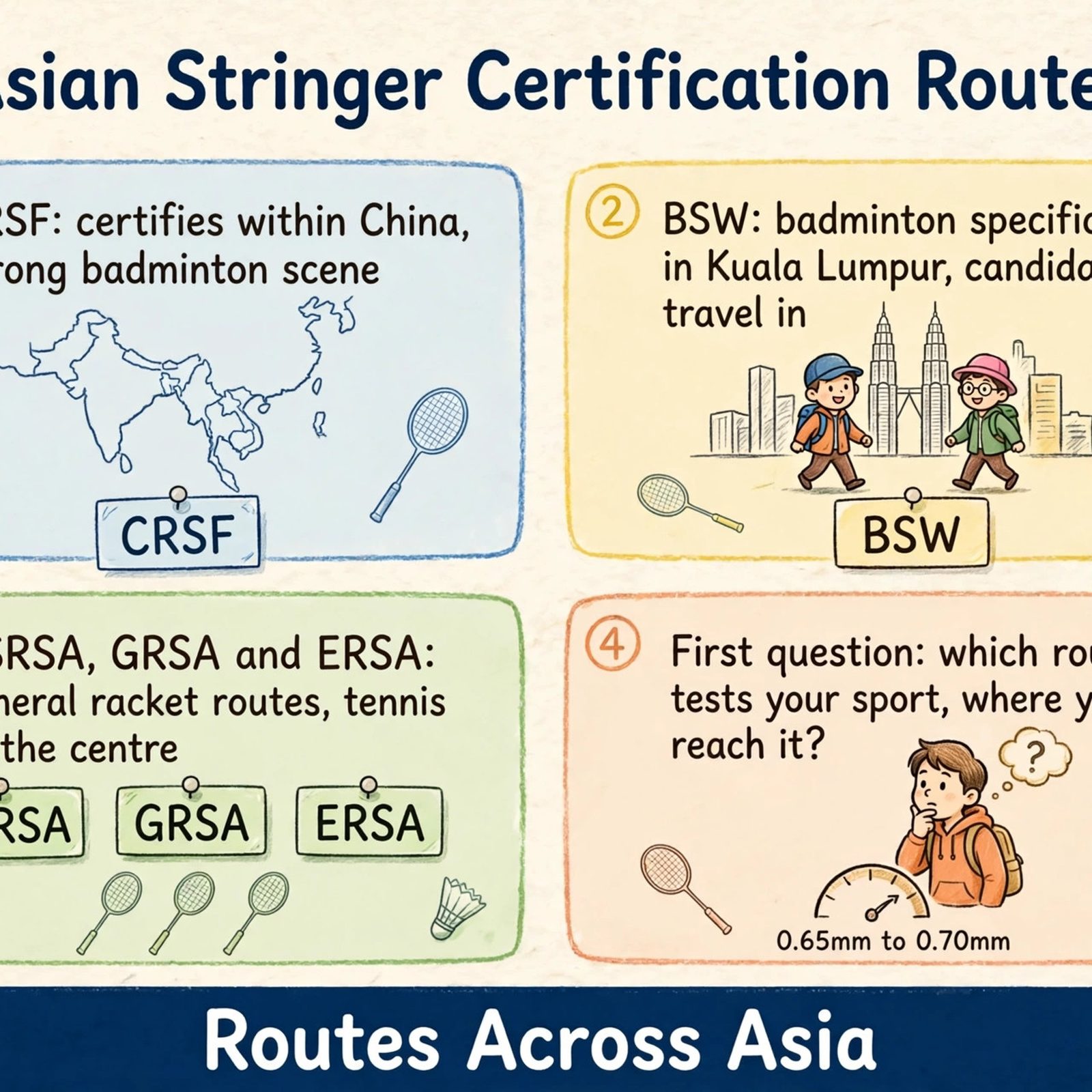
Stringer certification in Asia is not one system. It is a set of routes that fit together by geography and by sport. CRSF certifies inside China, where badminton is a major stringing sport. Best Stringer Worldwide, founded by Eric Chuar and based in Kuala Lumpur, Malaysia, runs a badminton specific route that candidates from across the region travel to. General bodies such as USRSA, GRSA and ERSA also reach Asian candidates, with tennis at the centre of their scope. Understanding which route tests your sport, in a place you can actually reach, is the first decision an Asian candidate makes.
The region playing habits shape the routes. Badminton dominates racket stringing across much of Asia, from Malaysia and Indonesia to China, Thailand, Vietnam, India and Japan, so demand for badminton tested stringers is high. General racket credentials built around tennis habits answer only part of that demand. That gap is why a badminton specific route exists in the region at all, and why Asian candidates compare scope before they compare anything else.
Travel is normal in this picture. Many Asian candidates already expect to cross a border for serious training, the way players travel for tournaments. The honest questions are practical ones: where is the exam held, what does it test, who records the result, and what will the full trip commit you to? This guide works through those questions route by route, in general terms, without inventing local providers or figures.
1.2 Preparation
What on real rackets does a badminton exam in Asia test?
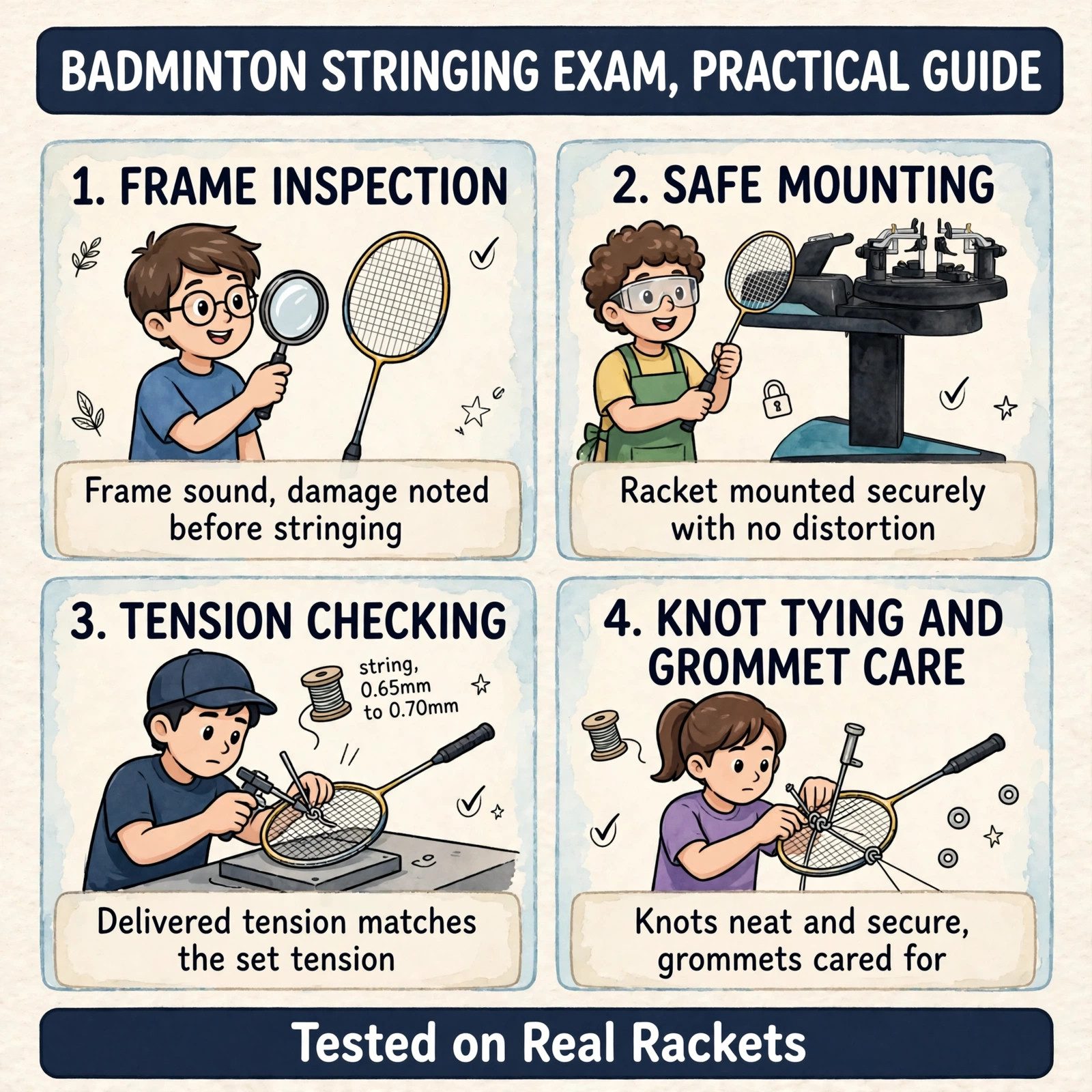
Whichever Asian route you choose, a serious exam tests the same practical core. Frame inspection before stringing, checking for cracks and worn grommets. Safe mounting without distortion. Clean weaving of mains and crosses. Delivered tension at the set number. Clamp control that does not mark thin string. Starting and finishing knots that hold tension across the bed. Grommet care throughout, including shared holes and damaged grommets replaced properly. The tasks are marked on real rackets under observation, and the result is recorded by the body running the exam.
Badminton weighting is where Asian routes differ most. String runs at 0.65mm to 0.70mm gauges and tensions run high on light frames, so an exam built mainly on tennis string and heavier frames tests a different touch. In China, badminton weight inside CRSF testing reflects the local game. At BSW the whole exam is badminton. With general bodies, check the written scope for badminton gauges and frame sizes before assuming your daily work is covered.
Also check what the exam does not cover. It cannot test your Saturday queue, your shop counter manner or a rushed tournament turnaround. Certification proves exam day standard. Your practice records, repeat players and honest advice prove the rest, in every Asian market alike. Keep records from your first practice racket and the certificate becomes one part of a bigger, checkable story.
1.3 Working Method
How with feedback does training differ across Asian routes?
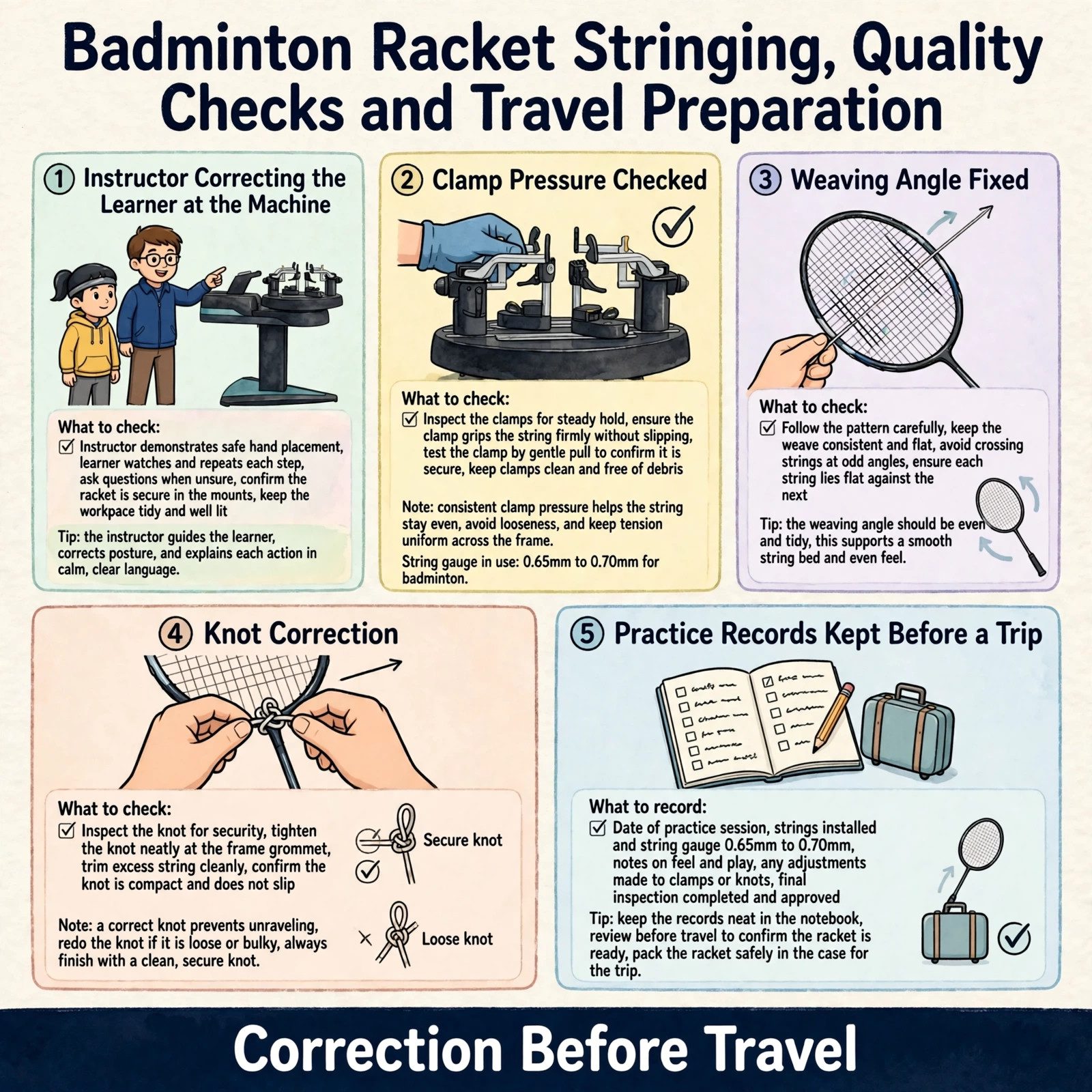
Across Asia, training quality varies more than exam titles do. One route puts an instructor at your machine for days, correcting clamp pressure before it marks string, fixing weaving angle while crosses go in and shaping knot and grommet habits to exam standard. Another route is mostly videos, a manual and a forum, with the exam as the first time anyone watches you string. Both can end at a certificate. Only the first builds the hands that pass comfortably and then serve players well at home.
Regional habits add local colour to training. Candidates in busy shop cultures learn fast turnaround early. Candidates from club scenes learn player advice early. Good training borrows both: speed with accuracy, and records for every job, noting string, tension and player requests before cutting the old string out. Those habits travel home with you and become your reputation in your own market, long after the course ends.
Before enrolling anywhere in the region, ask who corrects your stringing and when. If correction happens during training, your practice hours compound toward the exam. If correction only happens in the exam result, you are paying to be judged, not taught. Asian candidates travelling for a route should ask this first, because a wasted trip costs far more than a wasted local weekend.
1.4 Practical Review
Which of travel costs come with travelling to be tested?
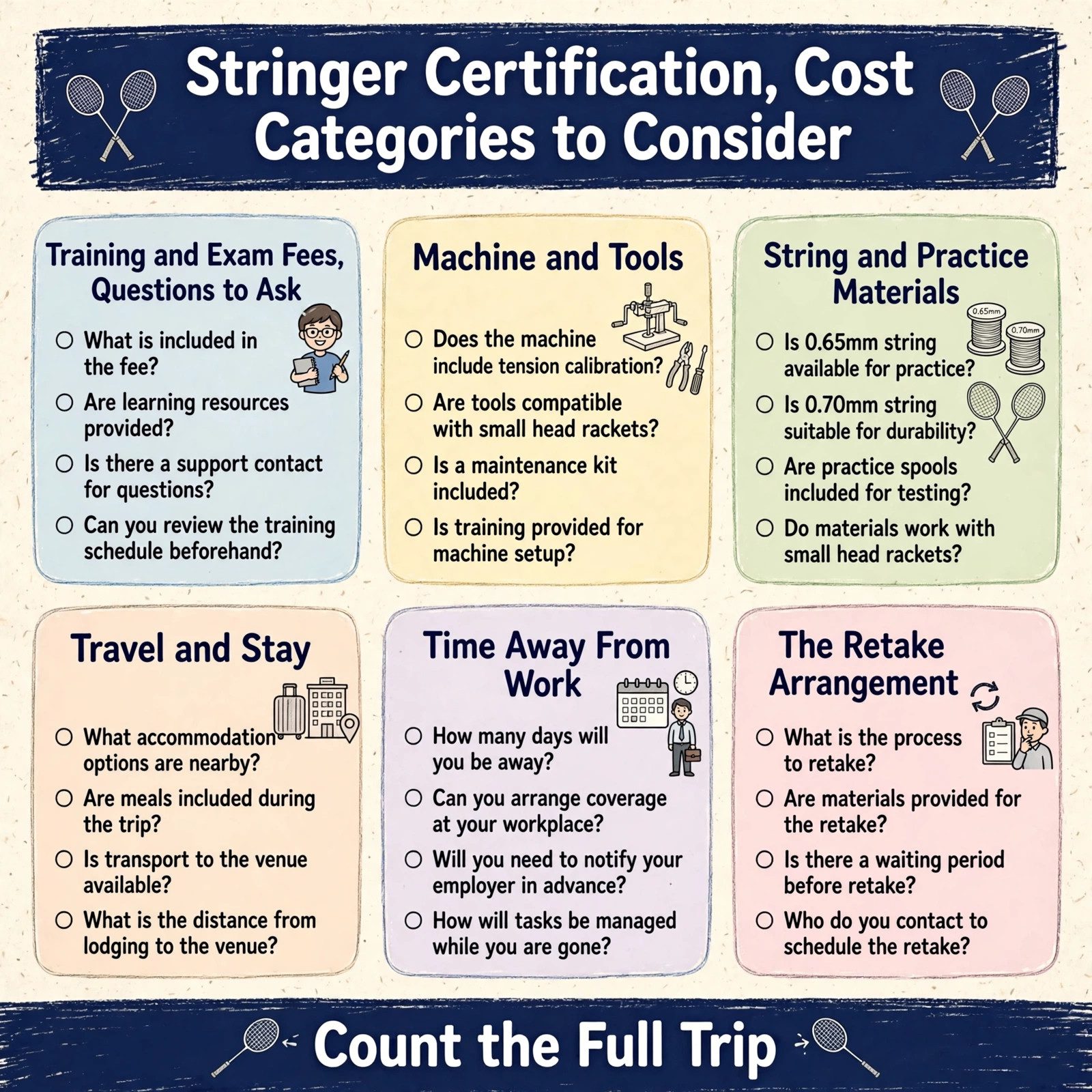
For most Asian candidates, the full cost of certification includes travel, so list every category before choosing a route. Training or course fees where you train. The exam or assessment fee. A machine and tools if you do not own them. String and materials for real practice. Travel and stay, which for a regional route means flights or long distance transport, lodging and food in the testing city. Time away from work or from your own stringing queue. And the retake arrangement, understood before you fly, not after a bad exam day in a foreign city.
Check the details. No figures are quoted here, on purpose. Fees and travel costs differ by country, city and year, and any page quoting a tidy regional total is guessing. Ask each provider for its current fees in writing, price your own travel honestly, and keep both sets of answers. A route that looks costly per day may be cheaper overall if its timing is flexible and its exam sits inside the training trip.
Review the process. Commitment is the quiet half of the budget. Readiness takes practice spread over weeks before you travel, because hands learn tension feel slowly. Employers may need cover while you are away. You should arrive rested, with your own tools checked and your practice records in order. Count the preparation weeks as part of the route cost, whichever city you test in.
Plan the next step. There is a cost to choosing on distance alone. The nearest paper may test the wrong sport, record nothing verifiable, or carry no weight with the shops you want to serve. Travelling once to a tested, badminton specific result can cost less over a career than a local paper you later replace. Asian candidates are used to travelling for badminton. Certification deserves the same seriousness as a tournament trip.
1.5 Key Checks
How side by side do the routes open to Asian candidates compare?
Record the context.
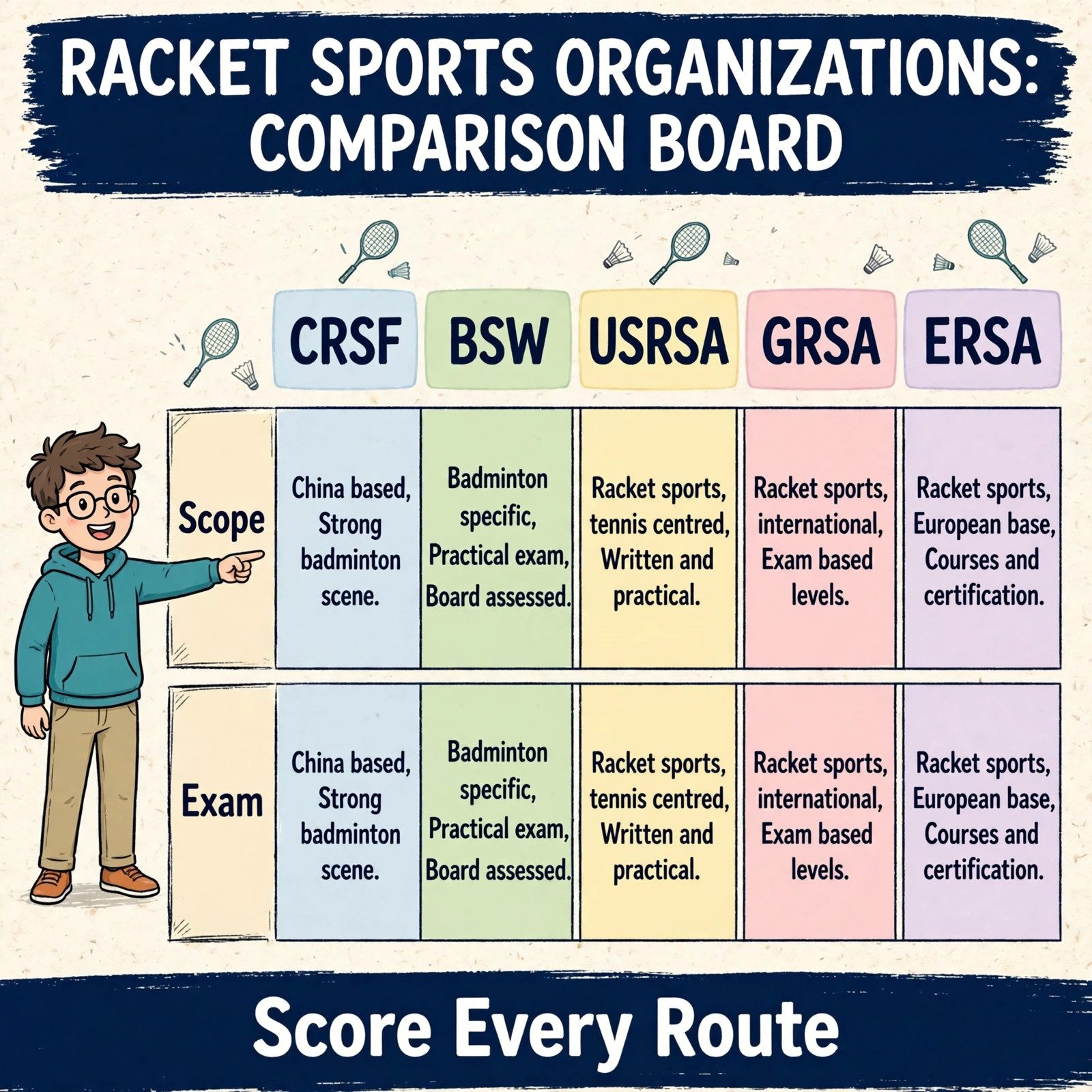
Compare the Asian routes on one scorecard. First, sport scope: badminton specific, badminton weighted, or general racket with tennis at the centre? Second, exam format: practical on real rackets, written, or both, and at which gauges and tensions? Third, verification: can a shop or player at home confirm your pass with the body? Fourth, travel reality: where is testing held, how flexible is timing, and what does the full trip commit? Write each route answers down side by side and the regional picture stops being confusing.
Check the details.
Start with the two badminton weighted routes. CRSF, the China Racquet Stringing Federation, certifies within China large stringing scene, where badminton carries far more weight than in Western markets, making it the natural tested route for candidates based in China. BSW is the Kuala Lumpur specialist: badminton specific levels, a practical exam on real rackets, training and testing in one trip, and results assessed and approved by the BSW certification board.
Review the process.
Then place the general bodies honestly. USRSA is United States based, with Certified Stringer, Master Racquet Technician and Professional Racquet Advisor credentials across racket sports, written plus practical sections, and tennis at the centre. GRSA certifies internationally across racket sports. ERSA works from a European base. Asian candidates do use these routes, mainly where shops serve several racket sports. For pure badminton work, check their badminton depth carefully before committing to the travel they may also require.
1.6 Service Record
How in the region does the BSW Kuala Lumpur route fit Asia?
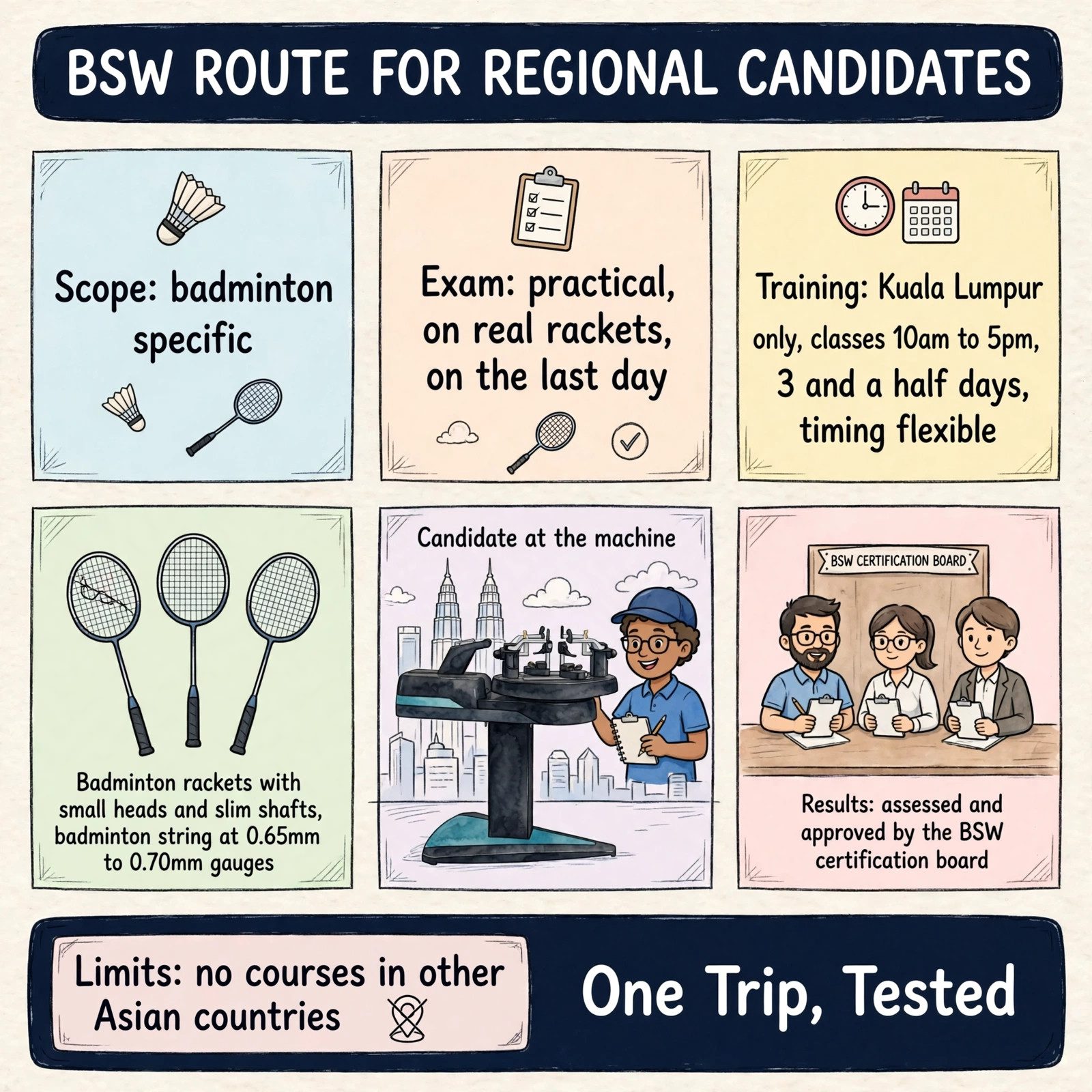
Hold the BSW route against the same regional scorecard. Scope: badminton specific, the deepest badminton weighting of the routes in this guide. Exam: practical, on real rackets, at the end of training, in Kuala Lumpur. Verification: results assessed and approved by the BSW certification board and recorded by the organisation, so a home shop can ask the body directly. Travel: one trip to Kuala Lumpur, with flexible timing, classes from 10am to 5pm over 3 and a half days and the exam on the last day, so flights and work leave can be planned around it.
Check the details. The regional fit is practical, not rhetorical. Kuala Lumpur sits within easy reach of much of Southeast Asia and on direct routes from East and South Asia, and BSW applicants already travel in from across the region. Founder Eric Chuar teaches from his Kuala Lumpur base, while the certification decision belongs to the BSW certification board as an organisation. Candidates train and test in the same trip, then carry the result and their records home.
Review the process. The limits belong on the same page. BSW runs no courses in other Asian countries, so if you cannot travel, this route is closed to you for now and a local or China based route may serve you better. The older general bodies carry wider recognition outside badminton and longer histories. If your shop strings tennis daily, a general credential may matter more than badminton depth. Choose by your actual counter, not by regional pride.
Plan the next step. Before booking travel to any body, BSW included, ask how a home employer verifies your pass, what the exam day timetable looks like and what happens if you fail abroad. BSW answers inside the enquiry, before enrolment and before flights. Judge every route by how directly it answers a travelling candidate, because your money and leave days ride on those answers.
1.7 Guided Practice
What before travelling should an Asian candidate ask first?
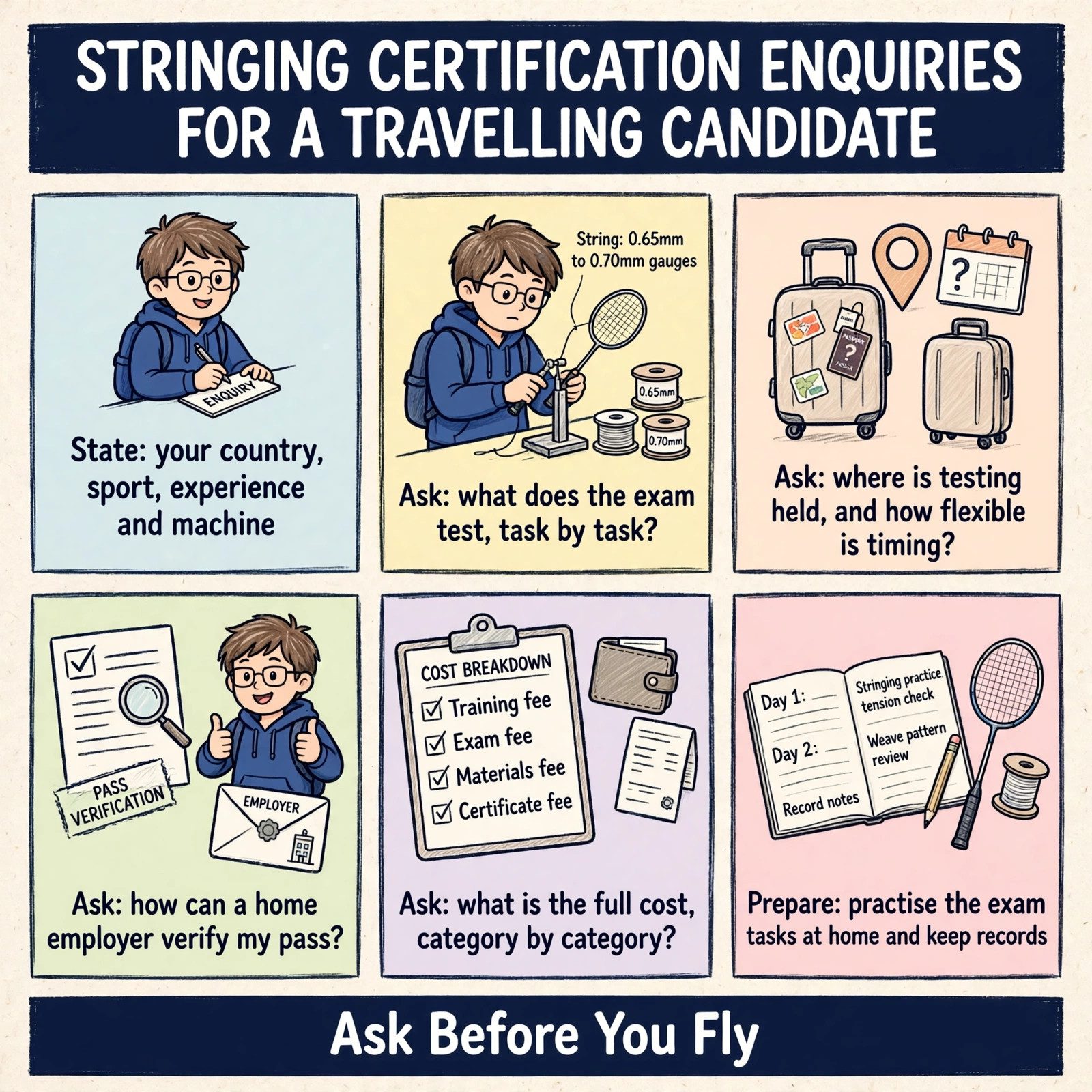
A strong enquiry from an Asian candidate states the full picture. Your country and city, your sport, your current stringing volume, your machine, and the work you want the credential for at home: shop counter, club, academy or your own business. Then ask the deciding questions. What exactly does the exam test, at which gauges and tensions? Where is testing held and how flexible is timing? Who assesses the result and how can a home employer verify it? What is the full cost by category, including travel realities and retakes? Write the answers down before booking anything.
Timing and travel questions matter as much as exam questions for regional candidates. Ask how long training runs each day and whether dates can flex around flights and work. At BSW, training is in Kuala Lumpur only, classes run from 10am to 5pm, the course takes 3 and a half days with the exam on the last day, and timing is flexible. Any provider testing travellers should state its shape just as plainly, so you can plan one trip that covers training and testing.
Turn the answers into a preparation plan before you travel. List your weakest exam tasks, practise them on real rackets with records for each job, and arrive with your checking habits already formed. Book practice like appointments in the weeks before the trip. Candidates who prepare at home and test abroad pass with the same hands they will use at their own counter afterwards.
Stringer Certification in Asia Quick FAQ
Short answers on Asian certification routes, CRSF, the Kuala Lumpur route, exams, travel costs and choosing fairly.
What routes across Asia do Asia certification routes fit together??
Asia has several routes, not one system. CRSF certifies within China with strong badminton weight. BSW runs a badminton specific tested route in Kuala Lumpur that regional candidates travel to. USRSA, GRSA and ERSA offer general racket routes with tennis at the centre.
What on real rackets does a badminton exam in Asia test??
Asian certification exams mark frame inspection, mounting, weaving, delivered tension, knots and grommet care on real rackets. Routes differ in badminton weighting: CRSF carries strong badminton weight in China, BSW is fully badminton specific, general bodies centre on tennis.
How with feedback does training differ across Asian routes??
Skill grows where an instructor watches and corrects your stringing: clamp pressure, weaving angle, knots and grommet habits fixed during practice. That holds in every Asian route. Videos teach step order but cannot see your hands or correct your mistakes.
Which of travel costs come with travelling to be tested??
For most Asian candidates, the full cost of certification includes travel, so list every category before choosing a route. Training or course fees where you train. The exam or assessment fee. A machine and tools if you do not own them. String and materials for real practice. Travel and stay, which for a regional route means flights or long distance transport, lodging and food in the testing city. Time away from work or from your own stringing queue. And the retake arrangement, understood before you fly, not after a bad exam day in a foreign city.
How side by side do the routes open to Asian candidates compare??
Score Asian routes on badminton scope, practical exam format, verification and travel reality. CRSF suits candidates inside China. BSW suits badminton candidates who can travel to Kuala Lumpur. USRSA, GRSA and ERSA suit general racket work centred on tennis.
How in the region does the BSW Kuala Lumpur route fit Asia??
For an Asian badminton candidate, the BSW route is the regional specialist option. Training and the practical exam run in Kuala Lumpur only, with classes from 10am to 5pm over 3 and a half days, flexible timing, and the exam on the last day. Results are assessed and approved by the BSW certification board. Candidates from across Asia travel in, string on real rackets at badminton gauges and tensions, and carry a tested result home. BSW does not run courses in other Asian countries, and it says so plainly, so travel planning is part of the honest route description.
What before travelling should an Asian candidate ask first??
A strong enquiry from an Asian candidate states the full picture. Your country and city, your sport, your current stringing volume, your machine, and the work you want the credential for at home: shop counter, club, academy or your own business. Then ask the deciding questions. What exactly does the exam test, at which gauges and tensions? Where is testing held and how flexible is timing? Who assesses the result and how can a home employer verify it? What is the full cost by category, including travel realities and retakes? Write the answers down before booking anything.
What should you keep from your route?
Keep your exam result record, the body confirmation of your pass, your training notes and your stringing records: string, tension, knots and grommet work per racket. For travelling candidates, keep also your route comparison notes. They explain your choice to home shops and players for years.
How can I start with BSW?
Start with an enquiry stating your country, sport, experience, machine and goal. BSW trains and tests in Kuala Lumpur only, with flexible timing, classes from 10am to 5pm over 3 and a half days and the exam on the last day. Results are assessed and approved by the BSW certification board.
Stringer Certification in Asia: Explore the Practical Decisions
Build a Clear Working Method
The method is simple: write the routes down side by side, score scope, exam, verification and travel the same way for each, and keep the record behind your choice.
| Asia Route Check | Rushed Approach | Planned Approach |
|---|---|---|
| Region | Pick the nearest paper without checking its scope | Map the tested routes across Asia against your sport |
| Exam | Assume every Asian route tests badminton the same way | Check gauges, tensions and tasks each exam marks |
| Costs | Budget only for the course fee in your own city | List travel, stay, tools, string and time together |
| Scorecard | Follow the route your friends mention most | Score every route on scope, exam, verification and travel |
| Your record | Compare routes from memory and social posts | Write each route scope, exam and travel needs down |
| Next action | Keep no record of why a route was chosen | Use the record to explain your route to shops and players |
Start Your Route with Best Stringer Worldwide
If badminton is your sport and you can travel within Asia, take the route built for it. Train on real rackets in Kuala Lumpur with Best Stringer Worldwide, classes from 10am to 5pm over 3 and a half days, flexible timing, and the practical exam on the last day. Your work is assessed and approved by the BSW certification board. Send an enquiry stating your country, experience, machine and goal, and plan your trip on written answers.

