1.1 Frame Shape Fundamentals
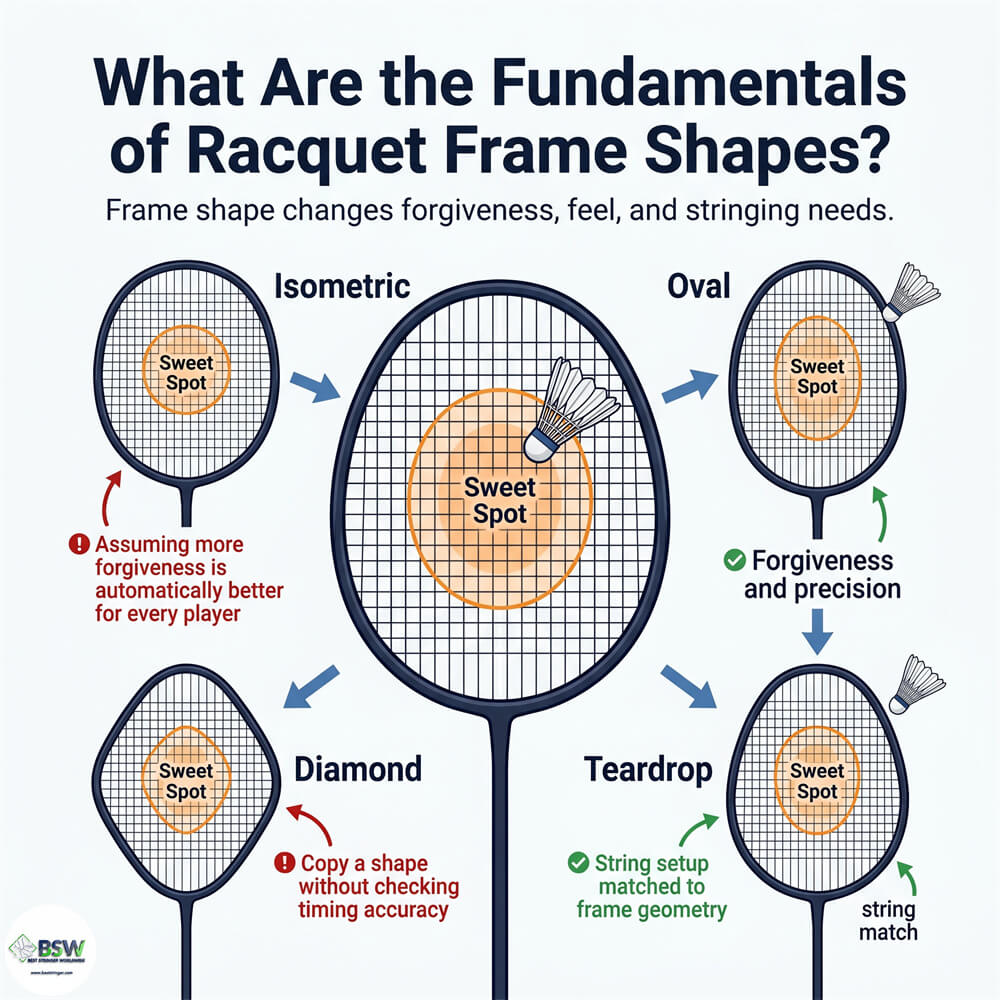
What Are the Fundamentals of Racquet Frame Shapes?
Equipment fundamentals refer to how specific racquet characteristics, particularly frame shape, combine to enhance your playstyle. In this guide, you will learn why an isometric head shape offers a larger sweet spot, alongside how oval, diamond, and teardrop designs differ in feel and control.
In short, the frame shape dictates your hitting zone and forgiveness, while string choice dictates your feeling and touch. Mastering these concepts is crucial for any badminton player aiming to improve, as “more forgiving” does not automatically mean “better for every player.”
Here is a simple decision flow:
Step 1: Assess your accuracy and timing honestly.
Step 2: Understand that a massive sweet spot from an isometric frame is highly beneficial for consistency.
Step 3: Consult a certified stringer to select a string gauge and tension that perfectly matches your racquet’s shape and your specific playstyle.
1.2 The Role of Sweet Spot Size
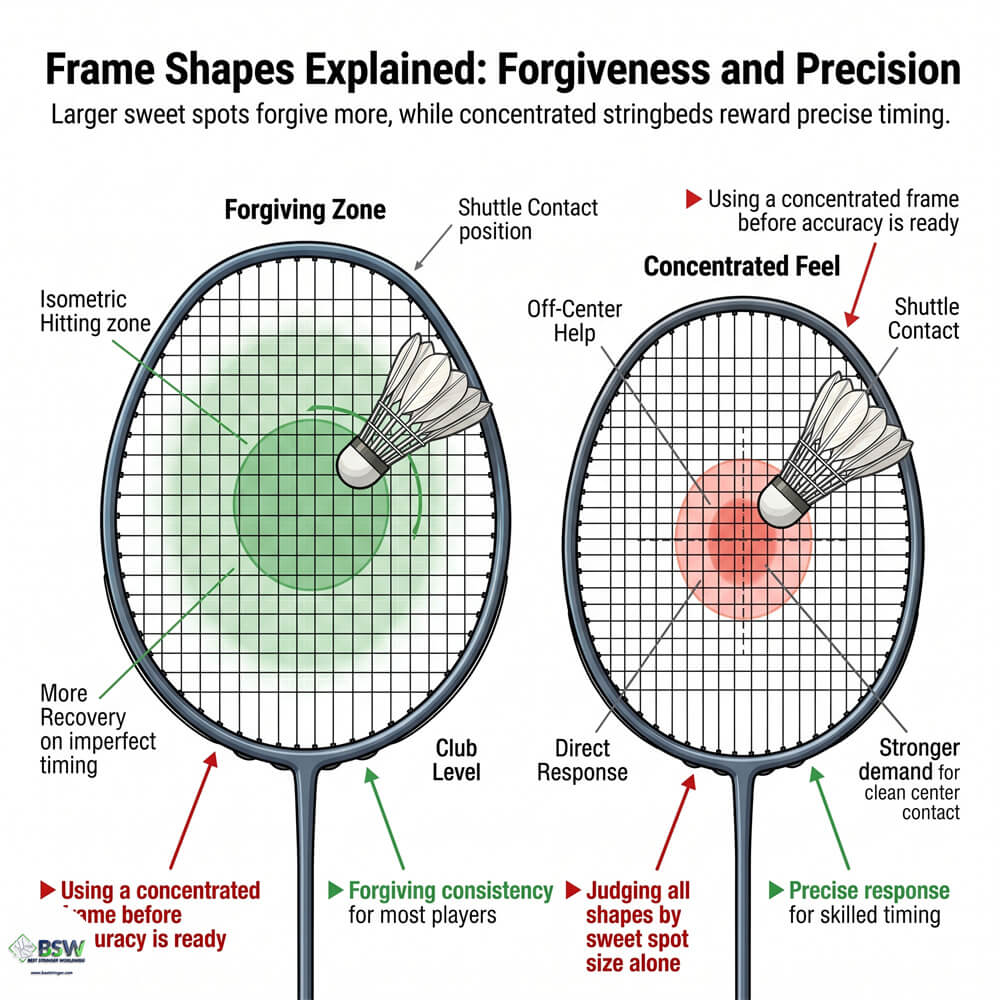
Frame Shapes Explained: Forgiveness and Precision
The golden rule of frame design is that it dictates the size and location of your usable hitting zone. An isometric (squarish) frame provides a larger, more forgiving sweet spot, making off-center hits much easier to manage. This shape ensures that you can still clear the shuttle effectively even when your timing isn’t perfect, offering an incredible boost to player confidence.
However, a traditional oval shape offers a highly concentrated feel. While the sweet spot is smaller, the density of the string bed creates a direct, precise response that some advanced players prefer for net play and touch shots. Diamond and teardrop frames often attempt to blend aerodynamic speed with varying sweet spot properties.
A badminton player needs the right balance between forgiveness, maneuverability, and feel. For beginners and most club players, the forgiving nature of an isometric frame is universally recommended. Advanced players often refine their choice based on the exact aerodynamic feel and string bed concentration they desire.
1.3 Oval & Isometric Profiles
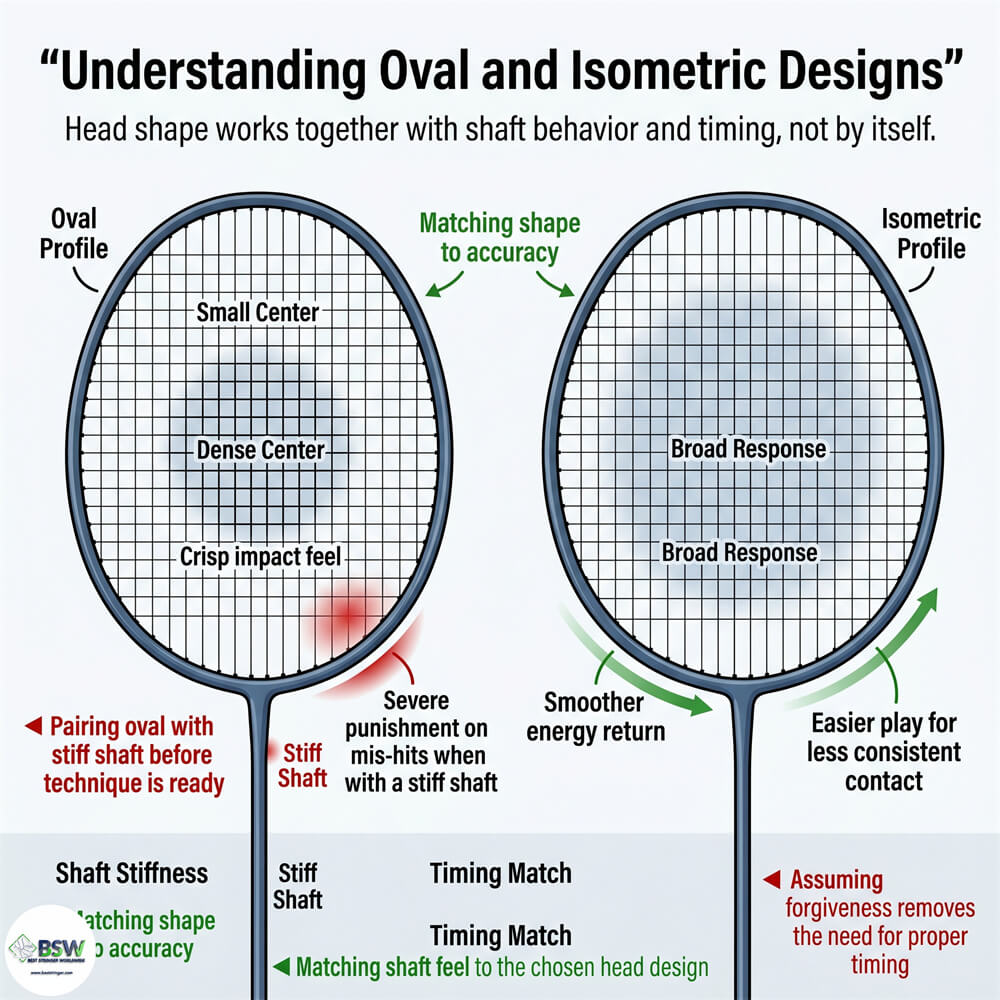
Understanding Oval and Isometric Designs
While the frame shape dictates the hitting zone, the player’s timing and the shaft stiffness must match it. An oval frame provides a concentrated, solid impact response, but only if the player has advanced accuracy to hit the smaller sweet spot consistently. If you lack solid technique, pairing an oval frame with a stiff shaft will severely punish mishits and weaken your clears.
An isometric head shape is highly forgiving. It creates a more consistent string bed, storing and releasing energy smoothly to help players effortlessly return the shuttle, even if their swing action is slightly off-center or less refined.
Understanding these shape profiles also helps you make sense of hybrid designs. For example, some diamond shapes emphasize an aerodynamic cut through the air to increase swing speed, though they might sacrifice a fraction of the pure isometric sweet spot to achieve that agility.
1.4 String Setup by Shape
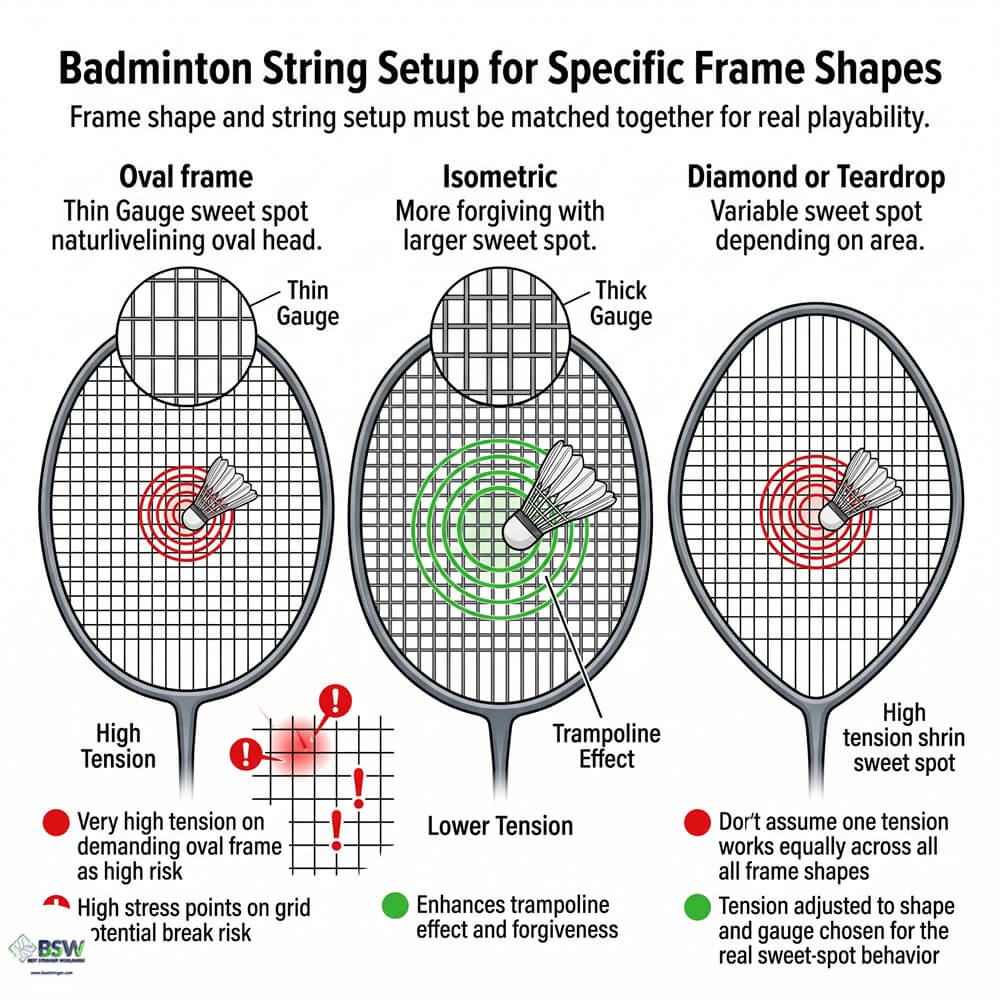
Badminton String Setup for Specific Frame Shapes
Different frame shapes require thoughtful string tension choices to perform optimally. Understanding this synergy is essential for all levels:
What is String Gauge? Gauge refers to the thickness of the string. Thin strings (e.g., 0.65mm) offer incredible repulsion and aerodynamic sound, which can enliven a smaller oval sweet spot, while thick strings (e.g., 0.70mm) sacrifice a bit of crispness for robust durability on large isometric frames.
Tension Basics. Tension is how tightly the strings are pulled. High tension (26+ lbs) shrinks the sweet spot but increases control. Putting high tension on an oval frame creates a very demanding setup. Low tension acts like a trampoline, boosting power and maximizing the forgiveness of an isometric shape.
The Sweet Spot Risk. If you use a highly concentrated oval frame but string it at an extremely high tension without the required accuracy, the sheer force of an off-center hit will result in a dead feel and snapped strings. A professional badminton stringer will always align tension with your frame’s shape and your skill level.
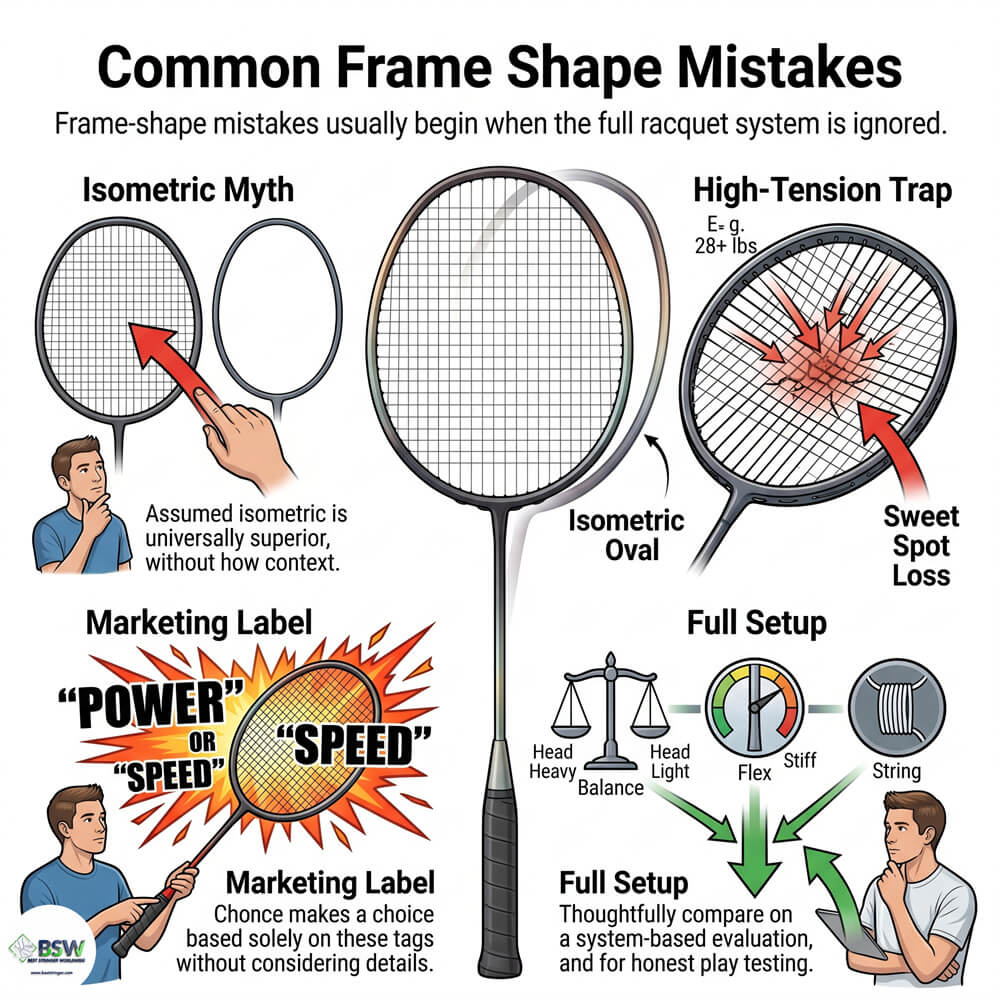
1.5 Common Shape Mistakes
Common Frame Shape Mistakes
Mistake 1: Assuming Isometric is Always Better.
While an isometric shape is highly forgiving and widely recommended, choosing a shape based purely on sweet spot size ignores the fact that some advanced players prefer the distinct aerodynamic speed of a diamond frame or the concentrated control of an oval frame.
Mistake 2: Ignoring Setup Synergy.
Chasing a massive sweet spot with an isometric frame but stringing it at an excessively high tension negates the forgiveness benefits, making the string bed overly rigid and difficult for casual players to use effectively.
Mistake 3: Choosing Based on Marketing Alone.
Relying solely on marketing labels like ‘pure power teardrop’ or ‘fast diamond’ is a common error. The real-world feel depends heavily on how the frame shape interacts with the balance point, shaft stiffness, and stringing.

1.6 Shape Selection Framework
Beginner-Safe Frame Shape Decision Flow
A step-by-step decision flow is crucial for balancing forgiveness and precision safely. Use this simple framework before upgrading your equipment:
Step 1: Check Your Accuracy. An isometric badminton racquet is almost universally recommended for beginners because its larger sweet spot compensates for developing hand-eye coordination. Stick with this shape until your timing is highly consistent.
Step 2: Identify Your Desired Feel. Determine if you want the sharper aerodynamic swing of a diamond frame for fast flat exchanges, or the reliable, forgiving nature of a classic isometric shape for solid defense and deep clears.
Step 3: Test for Actual Improvement. Try different frame shapes and test whether an oval’s concentrated feel genuinely improves your control, or if an isometric shape is simply necessary for your confidence on the court.

1.7 Professional Education
The Value of Stringer Certification
Proper equipment education is a core part of a professional badminton stringing course and good stringer certification standards. A certified stringer understands that recommending a specific frame shape blindly without considering a player’s real accuracy is a disservice.
At Best Stringer Worldwide, we know that frame shape directly influences the advice given to players. The magic is not just in buying an isometric or diamond racquet, but in the precise consultation logic a badminton stringer uses to match string type and tension to your new frame’s geometry.
By prioritizing accurate equipment knowledge, our stringer certification ensures that every setup perfectly balances forgiveness, stability, and speed. You eliminate guesswork, avoid dead-feeling string beds, and focus purely on improving your game.
Frame Shape Selection Quick FAQ
Quick, definition-first answers to common questions about badminton frame shapes and sweet spot basics.
Does an isometric shape always mean more power?
Generally, yes. An isometric badminton racquet provides a larger sweet spot, which helps players maintain power on off-center hits. However, absolute peak power also depends heavily on technique, swing speed, and racquet balance.
Why does an oval racquet feel more concentrated?
The traditional oval shape creates a smaller, denser string bed area. This concentrates the energy return, giving advanced players a very direct, crisp, and precise feel when hitting the exact center of the racquet.
Is a diamond frame better for all players?
Not every badminton player will benefit equally. While diamond frames often feel faster and more aerodynamic through the air, they may slightly reduce the absolute size of the sweet spot compared to a purely isometric design.
How does frame shape affect smash power?
Frame shape influences how forgiving the string bed is during a heavy impact. An isometric shape allows a player to execute a powerful smash even if they catch the shuttle slightly off-center, whereas an oval requires precise, dead-center timing.
Why do some players prefer teardrop shapes?
Teardrop shapes attempt to combine a longer string bed for repulsion with a solid, traditional feel. They are chosen by players looking for a specific blend of power and aerodynamics, though they are much less common today.
How does string tension affect different shapes?
A highly tensioned oval frame can feel completely dead to a developing player. A certified stringer will carefully adjust tension based on the frame’s specific shape and the player’s accuracy to ensure the sweet spot remains accessible.
What should a stringer consider before changes?
A professional badminton stringer should always evaluate the player’s accuracy and playing style. They should never just recommend an isometric frame or a diamond frame without considering the overall balance and stiffness of the entire racquet.
Why is stringer certification important?
A comprehensive badminton stringing course teaches the science behind frame shapes, sweet spots, and string synergy. A certified stringer provides educated guidance rather than relying on absolute claims or brand hype.
Are stringing courses necessary?
For those wanting to master equipment consultation, yes. A stringer learns measurement consistency, precise knot tying, and the logic to match string setups to specific frame shapes, eliminating guesswork from equipment selection.
The Physics of Forgiveness: Why Frame Shape Matters
Frame Shape & Forgiveness Simulator
Compare how Sweet Spot size affects off-center hits.
Modern Isometric: High Forgiveness
The squarish top extends the strings, creating a massive sweet spot. Even when your timing is off and you hit near the top edge, the stringbed absorbs the shock cleanly and clears the shuttle with power.
Proven Shape & Setup Matching
Our stringing approach is based on verified equipment parameters used by top professionals. We prioritize arm safety, proper frame evaluation, and playstyle efficiency over pure tension hype.
| Frame Shape Spec | Traditional (Oval) | Modern (Isometric) |
|---|---|---|
| Sweet Spot Size | Smaller, concentrated area requiring high precision. | Larger, expanding the usable hitting area significantly. |
| Forgiveness | Punishes off-center hits with a noticeable loss of power. | Highly forgiving, maintaining shuttle speed on mishits. |
| Control Feel | Direct, crisp touch for advanced net placement. | Stable and reliable across a much wider string bed. |
| Aerodynamics (Diamond) | Traditional box/oval frames are solid but have slightly more drag. | Diamond/Aero shapes cut through the air for faster swing speeds. |
| Beginner Suitability | Demanding; much better suited for established technique. | Excellent starting point to quickly build confidence. |
| Stringing Approach | Demands careful tension scaling to avoid a completely dead feel. | Versatile, handling a wider range of tensions and gauges safely. |
Master Your Equipment with Best Stringer Worldwide
Ready to upgrade your knowledge? Best Stringer Worldwide offers professional stringing consultation to teach you how frame shapes and string setups interact to provide power and control safely. We serve badminton players worldwide especially in Singapore, Hong Kong, Malaysia, Indonesia, UK, France and Europe. Contact a certified stringer to find the perfect tension and gauge for your specific frame geometry.