1.1 Balance Fundamentals
What Is Racquet Balance and Why Does It Matter?
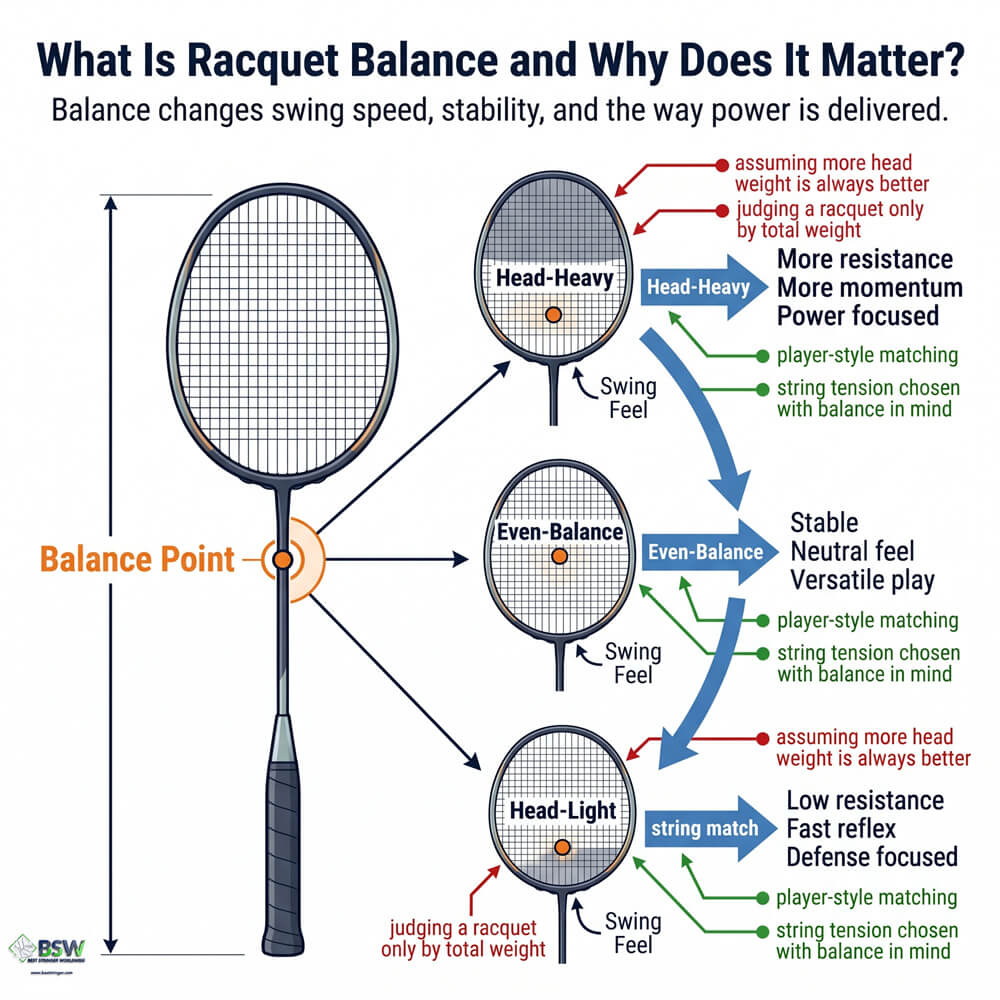
Racquet balance is one of the most important feel-related design factors in badminton. Two racquets with the exact same total weight can feel very different depending on how that weight is distributed along the frame and handle. In this guide, you will learn how head-heavy, balanced, and head-light designs affect power, control, and maneuverability.
Understanding balance helps players and stringers make more intelligent equipment decisions. The balance point dictates swing speed and stability, while string setup complements that feel. “More head weight” does not automatically mean “better for every player.”
The decision process requires nuance:
Step 1: Assess your playing style and defensive needs honestly.
Step 2: Understand that a head-heavy frame only boosts power if you can maintain your swing speed.
Step 3: Consult a certified stringer to ensure your string tension aligns with the racquet’s balance profile.
1.2 Head-Heavy vs. Head-Light
Understanding Head-Heavy and Head-Light Racquets
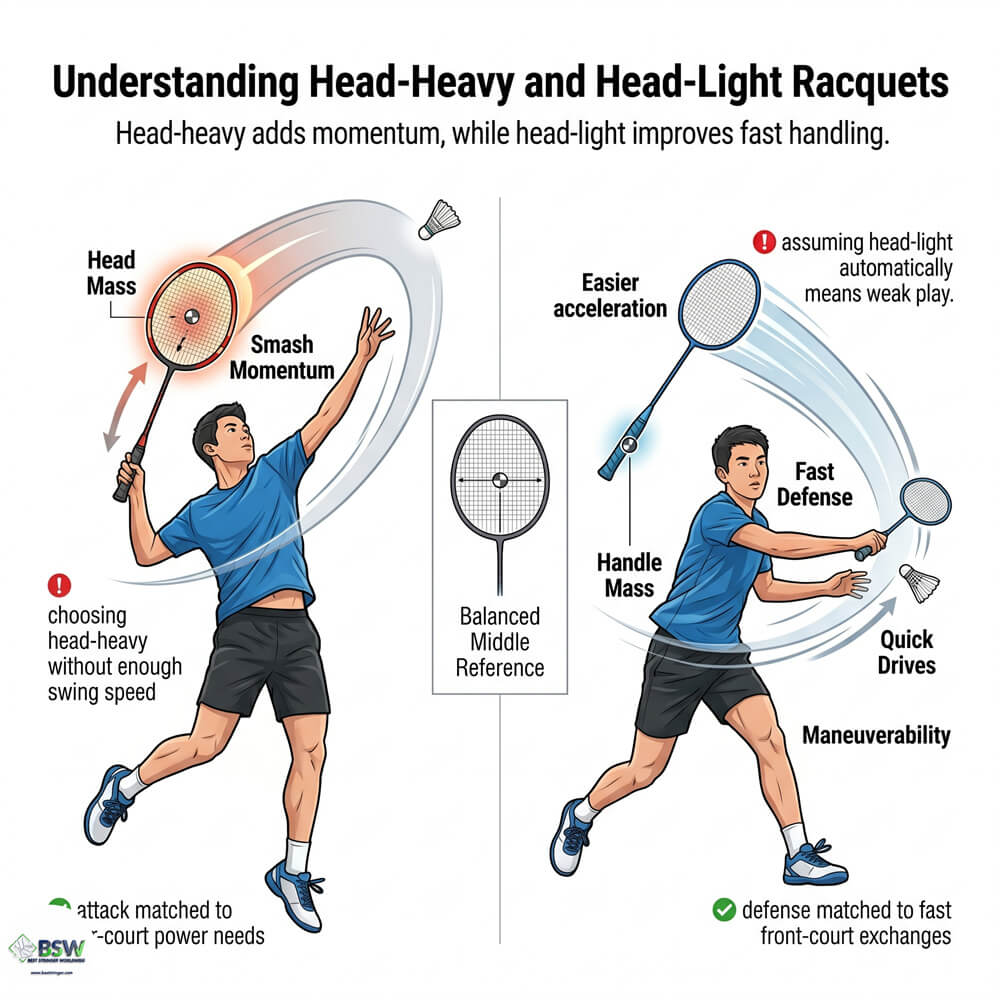
The balance point of a badminton racquet is typically measured from the bottom of the handle toward the head. Racquets with a higher balance point (head-heavy) concentrate more mass in the frame, providing extra momentum for aggressive rear-court power. However, this added head mass can noticeably reduce maneuverability.
Conversely, head-light racquets have more weight resting near the handle. This design sacrifices some easy smash power but significantly improves swing speed and handling. This makes head-light frames ideal for fast-paced defensive blocks, rapid drive exchanges, and quick net interceptions.
Balanced (or even-balance) racquets sit comfortably in the middle, offering a versatile feel for all-around players. When choosing, a badminton player must weigh their need for sheer power against their requirement for fast reaction times and control.
1.3 Impact on Performance
How Balance Affects Power, Speed, and Control
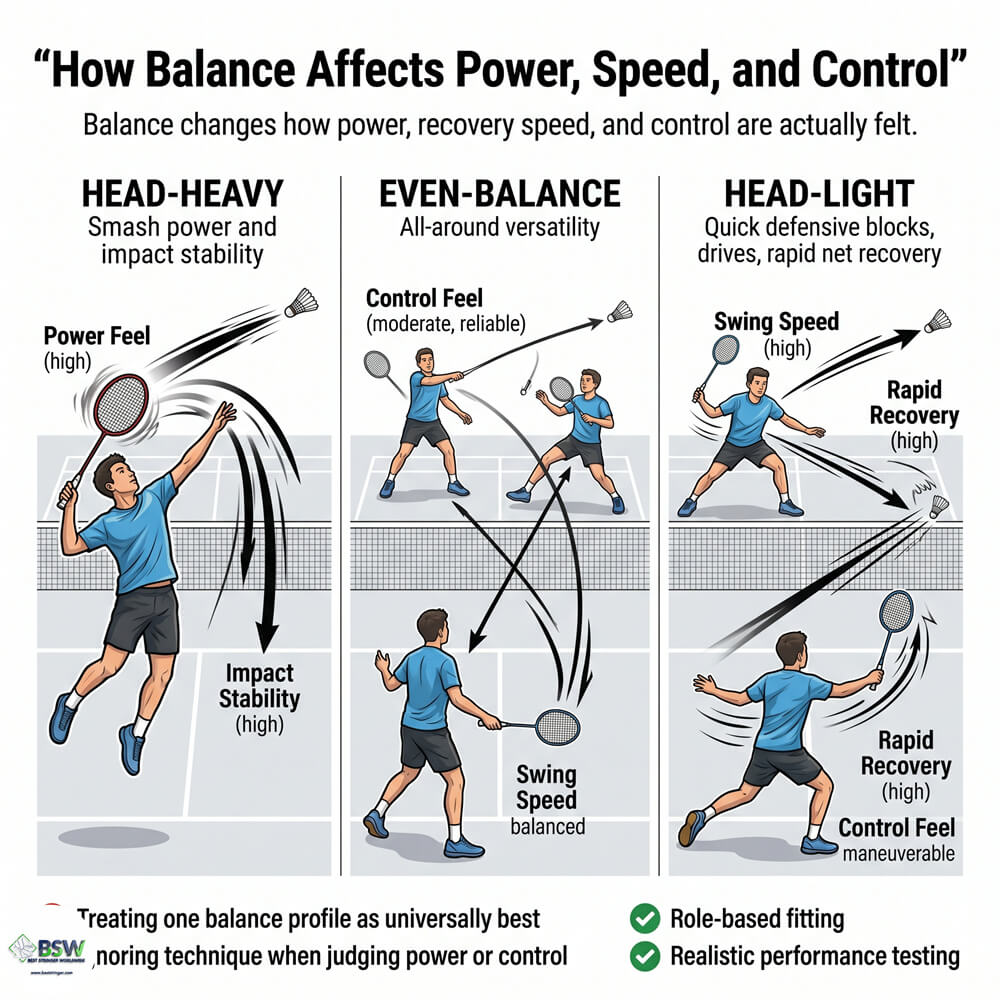
The balance of your racquet directly impacts on-court performance. A head-heavy design can feel stronger in attack because it naturally carries momentum through the shuttle, creating a heavier smash. It also tends to feel more stable on impact, transferring less vibration to the arm on well-timed shots.
However, head-light designs shine in swing speed and maneuverability. Because the head is easier to whip through the air, players experience faster reaction times. This is why many front-court doubles specialists prefer head-light or balanced frames, as they rely on quick hands rather than absolute rear-court power.
Control is subjective: some find control in the stability of a head-heavy frame, while others find it in the rapid adjustability of a head-light frame. Ultimately, a racquet’s balance is a tendency, not an absolute guarantee of performance player technique matters most.
1.4 Weight & Balance Interplay
The Interplay Between Overall Weight and Balance
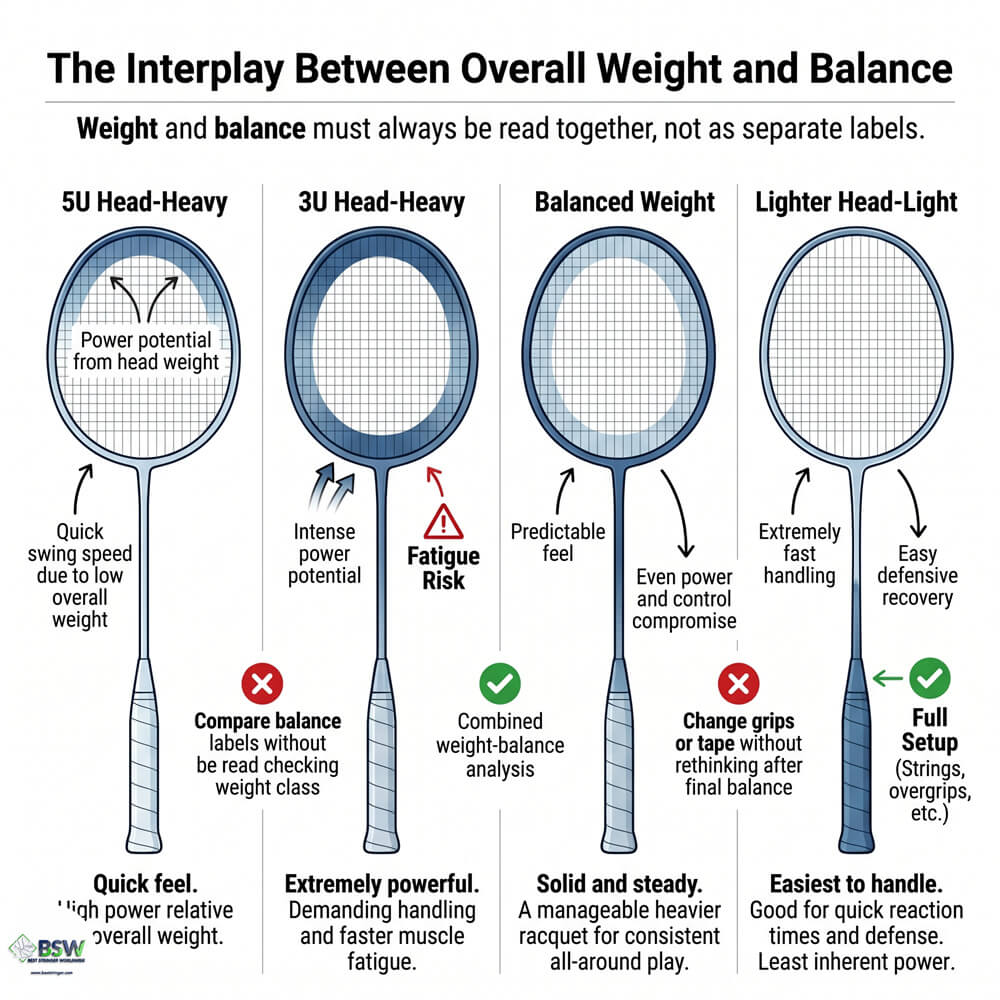
It is crucial to understand that total weight and balance must always be considered together. A head-heavy label on a lightweight 5U racquet will feel drastically different from a head-heavy label on a heavier 3U racquet.
Lightweight Compensation. Manufacturers often use more head-heavy designs in lighter weight classes to ensure the racquet still delivers acceptable power. The concentrated mass at the head makes up for the lack of overall frame weight.
Heavyweight Control. Conversely, heavier racquets are frequently designed with a more balanced or head-light profile so they remain usable and maneuverable without causing severe arm fatigue.
The Stringer’s Role. This interplay is exactly why stringers should understand balance before advising on final setups. Adding a heavy overgrip to a head-light racquet, for example, will shift the balance point even further down the handle, drastically altering the intended playing characteristics.
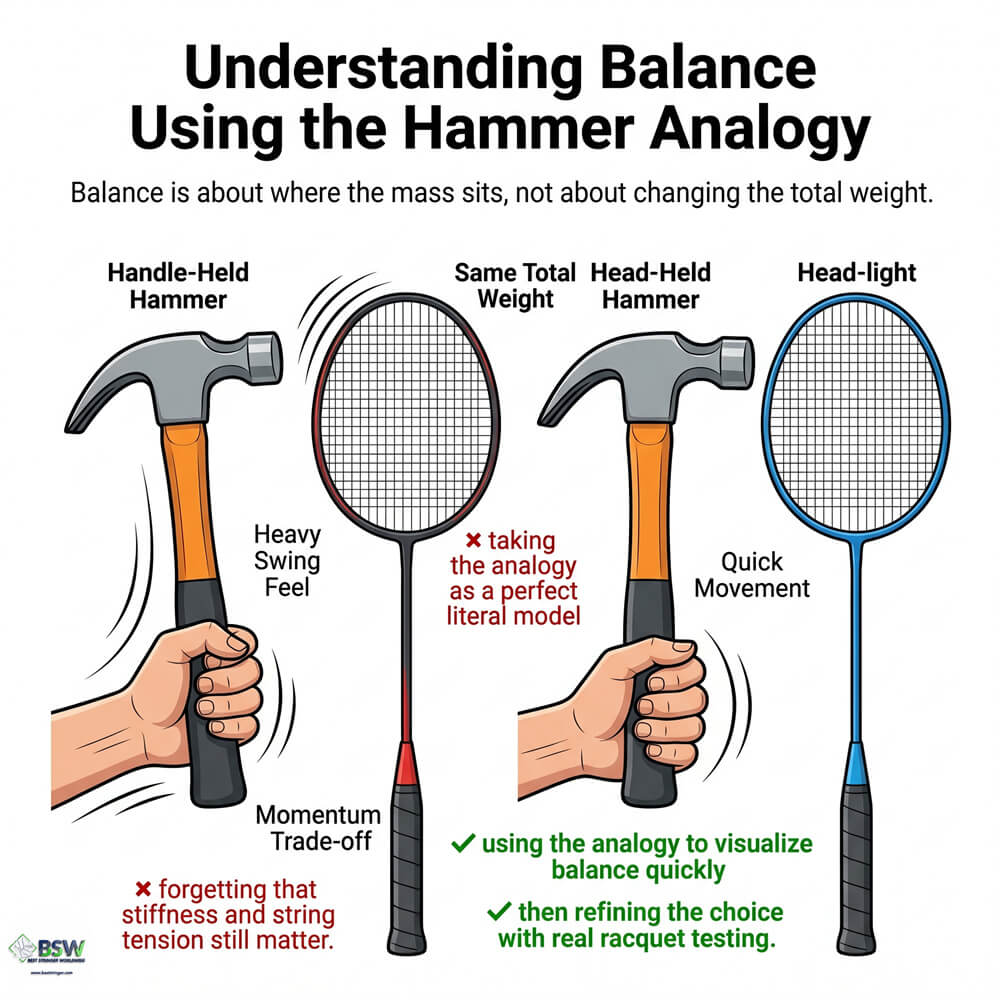
1.5 The Hammer Analogy
Understanding Balance Using the Hammer Analogy
The Head-Heavy Swing.
If you hold a hammer normally by the handle, the weight is concentrated at the far end. Swinging it feels heavy, but when it strikes, it delivers massive force. This perfectly illustrates the momentum-driven feel of a head-heavy racquet.
The Head-Light Swing.
Now, imagine holding that same hammer by the metal head itself. The total weight hasn’t changed, but swinging the wooden handle feels effortless and lightning-fast, though it strikes with far less momentum. This illustrates the speed and maneuverability of a head-light racquet.
Practical Application.
While useful, this analogy is not perfect. Badminton racquets are engineered tools where stiffness and string tension also play major roles. However, keeping the hammer principle in mind helps players quickly visualize the trade-offs of weight distribution.
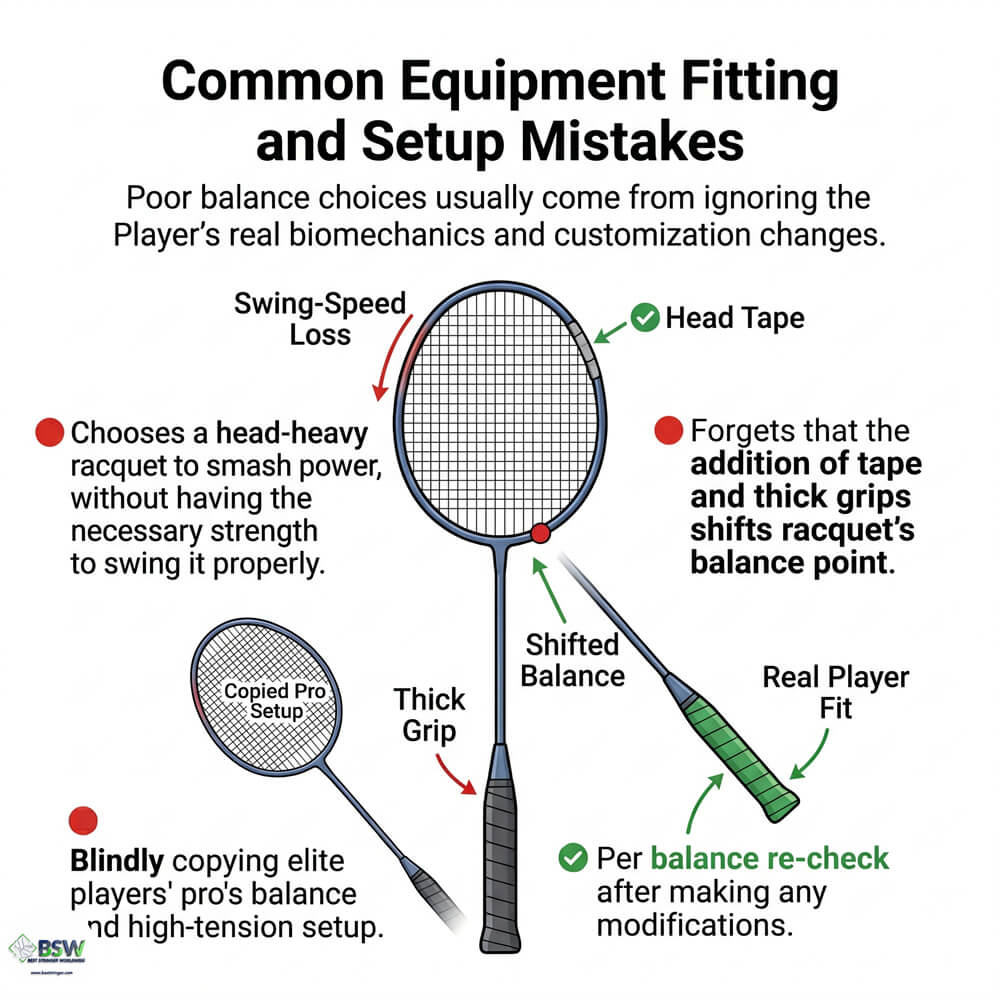
1.6 Player Fit & Setup Mistakes
Common Equipment Fitting and Setup Mistakes
A frequent error among badminton players is assuming ‘head-heavy is always better for smashes’ without considering their own swing mechanics.
Mistake 1: Ignoring Physical Strength. If a player lacks the physical strength to whip a head-heavy frame quickly, their smash will actually lose speed and power, defeating the purpose of the racquet’s balance.
Mistake 2: Forgetting Customization Impacts. Adding heavy tape to the racquet head or changing to a much thicker grip alters the balance point significantly. A certified stringer knows how these small adjustments change the overall feel and dynamic weight.
Mistake 3: Blindly Copying the Pros. Using a professional player’s exact balance profile and high string tension is a recipe for poor performance. Elite setups are tailored for elite biomechanics; amateur players almost always benefit from more forgiving, balanced setups.
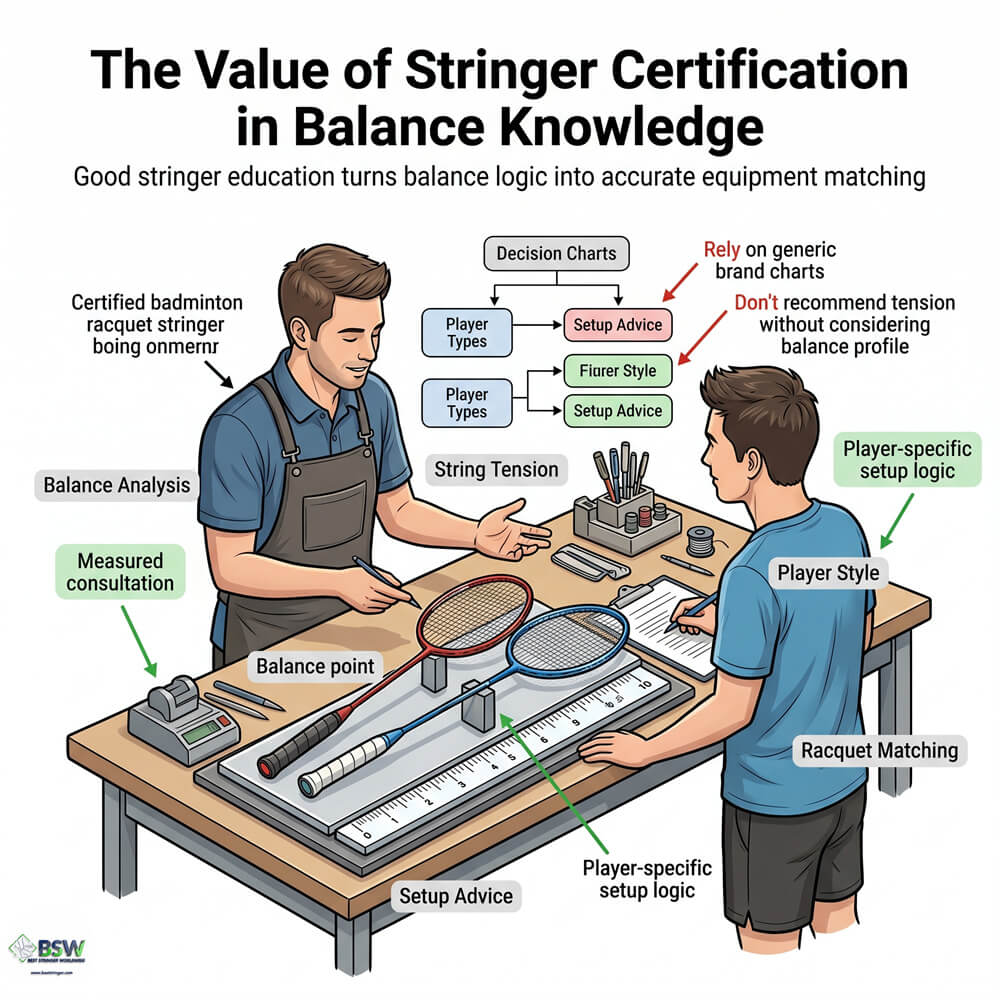
1.7 Further Learning
The Value of Stringer Certification in Balance Knowledge
Understanding racquet balance logic is a fundamental requirement for any professional racquet technician. A certified stringer must go beyond simply installing strings; they need to analyze how a frame’s balance point will interact with the player’s requested string tension and gauge.
At Best Stringer Worldwide, our badminton stringing course emphasizes comprehensive racquet knowledge. We teach stringers how to interpret balance intelligently so they can make superior player-equipment matching decisions instead of relying on generic brand charts.
By mastering these concepts, stringer certification elevates a technician’s ability to offer real value. When a stringer can accurately explain the trade-offs between maneuverability and power feel, players receive setups that genuinely enhance their confidence and on-court performance.
Racquet Balance Quick FAQ
Quick, definition-first answers to common questions about badminton racquet balance and setup logic.
What exactly is a racquet balance point?
The balance point is a measurement, typically in millimeters, from the bottom of the handle toward the racquet head. A higher number indicates a head-heavy frame (mass concentrated toward the top), while a lower number indicates a head-light frame (mass closer to the grip).
Are head-heavy racquets always better for smashes?
Not always. While head-heavy racquets provide greater momentum for powerful smashes, they require sufficient arm strength and technique to swing quickly. If the racquet is too head-heavy for the player, swing speed drops, actually resulting in a weaker smash.
Why are head-light racquets easier to maneuver?
Because the mass is concentrated closer to the player’s hand, a head-light racquet has lower swing weight. This makes it much easier to change the direction of the racquet head rapidly, which is essential for fast defensive blocks and flat drives.
How do weight and balance work together?
Total weight and balance must be viewed as a pair. A very light racquet (like 5U) can be extremely head-heavy to compensate for the lack of overall mass, whereas a heavier 3U racquet might be balanced or head-light to keep it physically playable without causing exhaustion.
Does balance affect vibration feel?
Yes, to an extent. Head-heavy racquets often feel more stable and solid upon impact, absorbing some shock through the mass in the head. Lighter, head-light racquets may transfer slightly more vibration to the handle, making string selection and tension even more critical.
Why should a certified stringer understand balance?
A professional stringer must recommend setups based on the whole racquet. For instance, stringing a head-heavy power frame at a high tension requires the player to hit the sweet spot perfectly, or risk injury. A stringer course teaches these critical matching skills.
Can grip changes alter racquet balance?
Absolutely. Adding a thick replacement grip or multiple overgrips adds weight to the handle, shifting the balance point downward and making the racquet more head-light. Stringers must account for this when setting up a racquet for a player’s specific style.
Are head-light racquets bad for singles?
Not necessarily. While many singles players prefer balanced or head-heavy racquets for sustained power from the back of the court, a player with exceptional natural power and quick footwork might prefer a head-light frame to maximize their defensive recovery.
What does even-balance mean?
An even-balance (or balanced) racquet has its weight distributed fairly equally between the head and the handle. It serves as a middle ground, offering a comfortable blend of power potential and defensive maneuverability for all-around players.
Visualizing Balance: How Weight Distribution Changes Feel
Even Balance
Weight is distributed equally. Offers a versatile middle-ground between rear-court power and front-court reaction speed.
Proven Specifications
Our stringing approach is based on verified equipment parameters used by top professionals. We prioritize arm safety, proper racquet balance evaluation, and playstyle efficiency over pure tension hype.
| Racquet Characteristic | Head-Heavy Tendency | Head-Light Tendency |
|---|---|---|
| Primary Advantage | Generates more momentum and smash power. | Faster swing speed, better maneuverability and defense. |
| Swing Feel | Feels solid and demanding, carrying momentum through the shot. | Feels fast and whip-like, easy to change direction rapidly. |
| Defense & Drives | Slower reaction time for flat exchanges and quick blocks. | Exceptional for rapid defensive blocks and front-court interception. |
| Vibration & Stability | Extra mass in the head often absorbs impact for a stable feel. | Requires clean timing; may transfer slightly more feedback. |
| Suitable Playing Style | Aggressive rear-court players relying on heavy smashes and clears. | Fast-paced doubles players, defensive specialists, and front-court control. |
| Stringer Consideration | Requires careful tension matching so the player doesn’t fatigue easily. | Allows for varied tension setups due to highly forgiving maneuverability. |
Master Racquet Knowledge with Best Stringer Worldwide
Ready to upgrade your knowledge? Best Stringer Worldwide offers professional stringing consultation and courses to teach you how racquet balance and string setups affect feel safely. We serve badminton players and aspiring stringers worldwide, especially in Singapore, Hong Kong, Malaysia, Indonesia, UK, France and Europe. Get your stringer certification and learn how to match equipment to any player perfectly.