1.1 Equipment Fundamentals: Grip Size
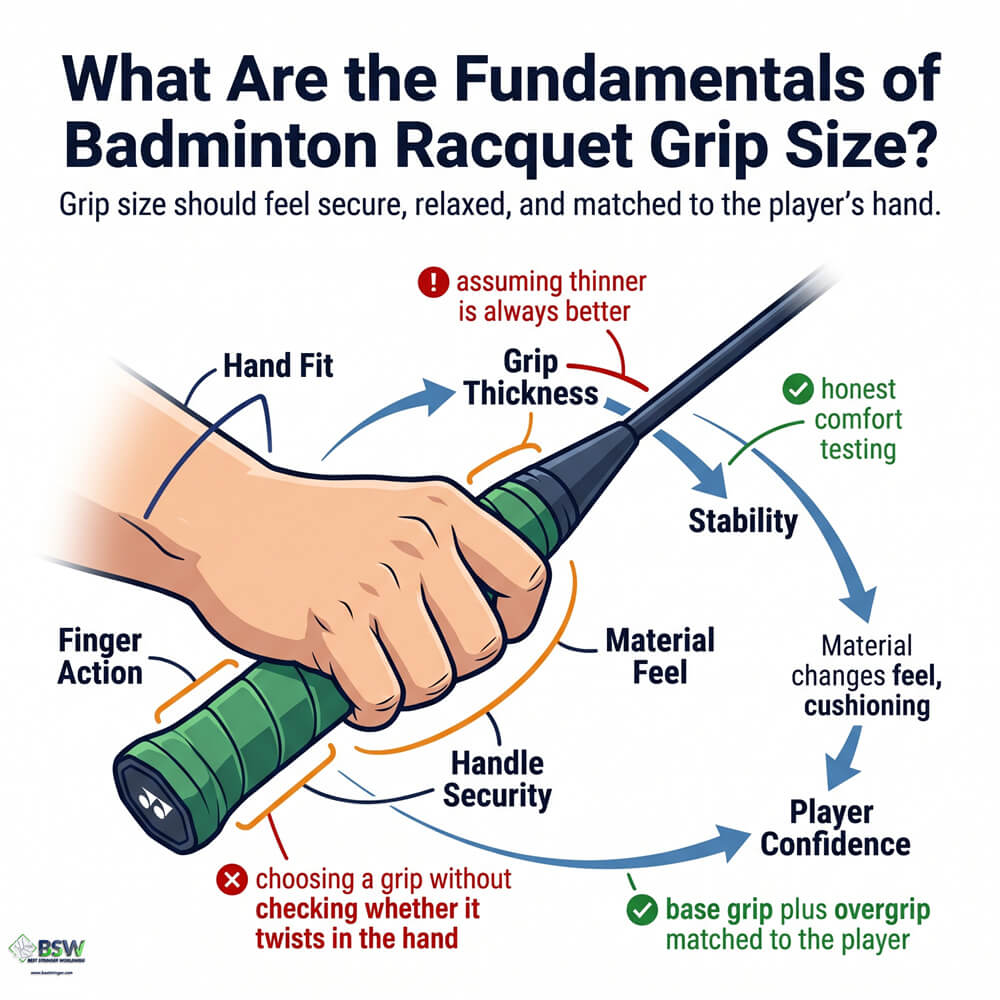
What Are the Fundamentals of Badminton Racquet Grip Size?
Equipment fundamentals refer to how specific racquet characteristics, particularly grip size, combine to enhance your playstyle. In this guide, you will learn why badminton racquet grip sizes matter, alongside how thickness affects your comfort, control, and finger action.
In short, grip thickness dictates how securely you can hold the racquet, while grip material dictates your feeling and touch. Mastering these concepts is crucial for any badminton player aiming to improve, as a thinner handle does not automatically mean a “better” handle for every player.
Here is a simple decision flow:
Step 1: Assess your hand size and comfort honestly.
Step 2: Understand that more finger action from a thinner grip is only beneficial if you can hold it securely without it twisting.
Step 3: Consult a certified stringer to select a base grip and overgrip thickness that perfectly matches your hand size and confidence.
1.2 Understanding Grip Thickness
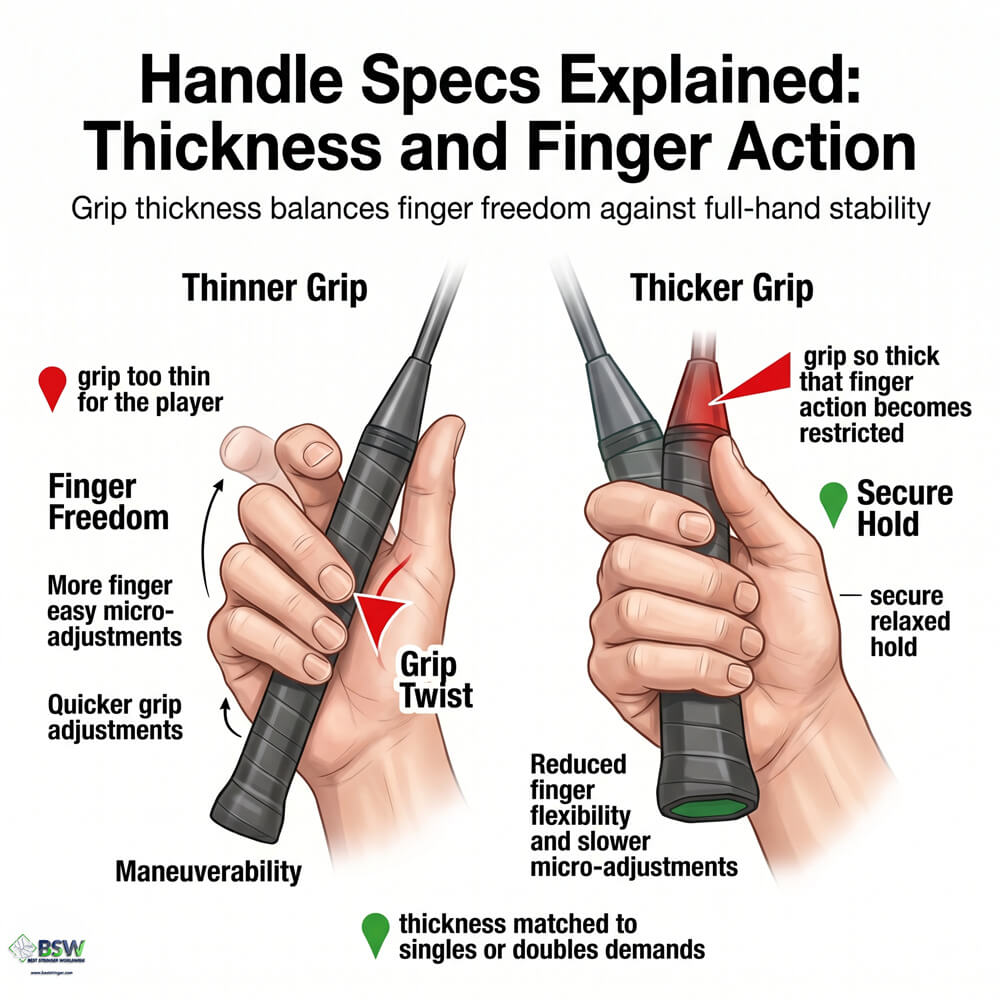
Handle Specs Explained: Thickness and Finger Action
The golden rule of handle fit is that the right badminton grip size allows you to tighten and relax your fingers seamlessly during fast exchanges. A thinner grip provides excellent finger freedom, allowing for rapid adjustments and deceptive wrist movements. However, if the grip is too thin for your hand, it can feel insecure and twist easily during heavy strokes.
Changing grip size drastically alters how the frame feels in the hand. A thicker grip generates a more solid, stable hold for heavy clears and smashes, but it naturally reduces your finger flexibility. Thinner grips sacrifice some of that full-hand stability for maneuverability.
A badminton player needs the right balance between security, maneuverability, and comfort. For doubles players needing rapid finger adjustments and quick defense, a thinner grip is generally preferred. Singles players often benefit from the extra stability of a slightly thicker handle to comfortably execute sustained pacing.
1.3 Natural vs. Synthetic Materials
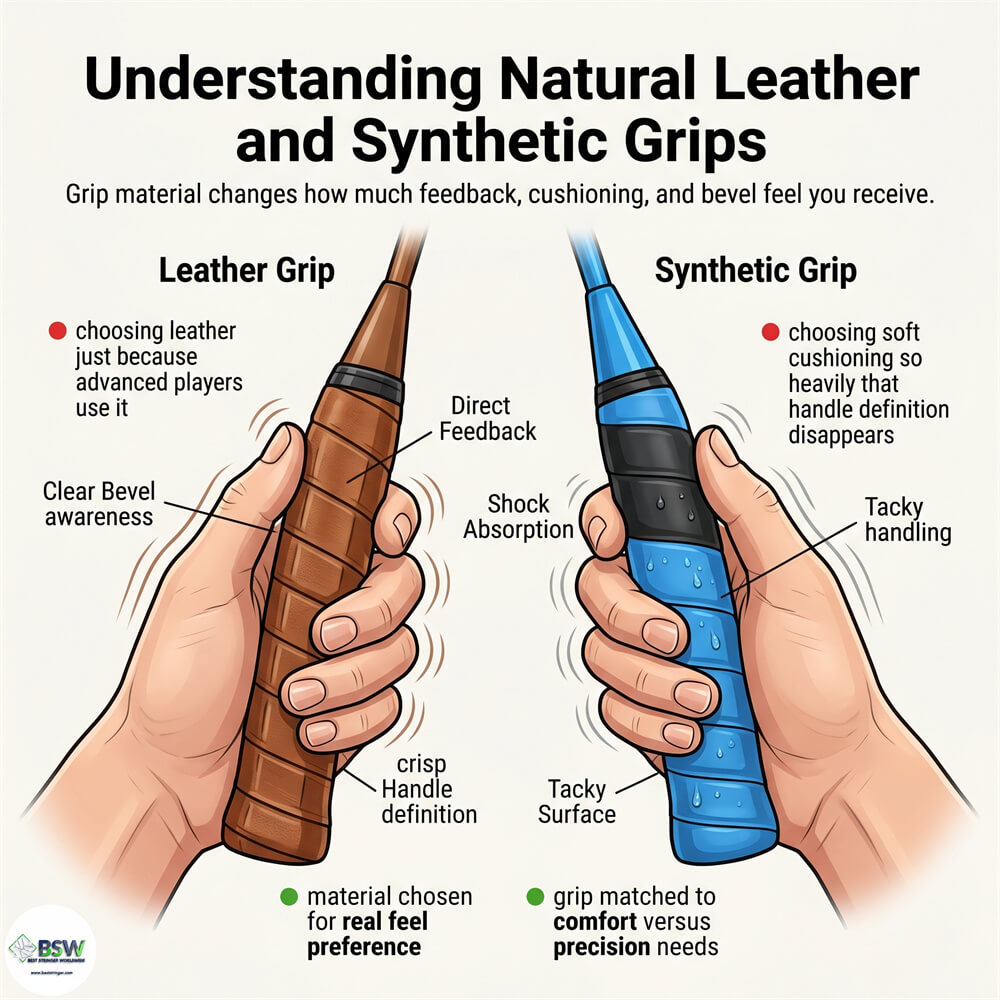
Understanding Natural Leather and Synthetic Grips
While grip size provides the foundation, grip material dictates how energy and vibration are transferred. A natural leather grip provides maximum direct feedback and clear edge definition, but only if the badminton player enjoys a firm, crisp feel. High-end racquets sometimes use leather to offer precise handle awareness during play.
A synthetic grip is highly forgiving. It acts like a cushion, absorbing shock smoothly to help players effortlessly handle impact vibrations, offering a softer, comfort-oriented feel. Synthetic grips reduce direct impact feedback compared with firmer materials.
The choice depends heavily on your preference. Leather helps you feel the bevels clearly to track your racquet face angle, while synthetic polyurethane options provide a tacky, comfortable surface that prevents the racquet from slipping during intense, sweaty rallies.
1.4 Customizing Your Grip
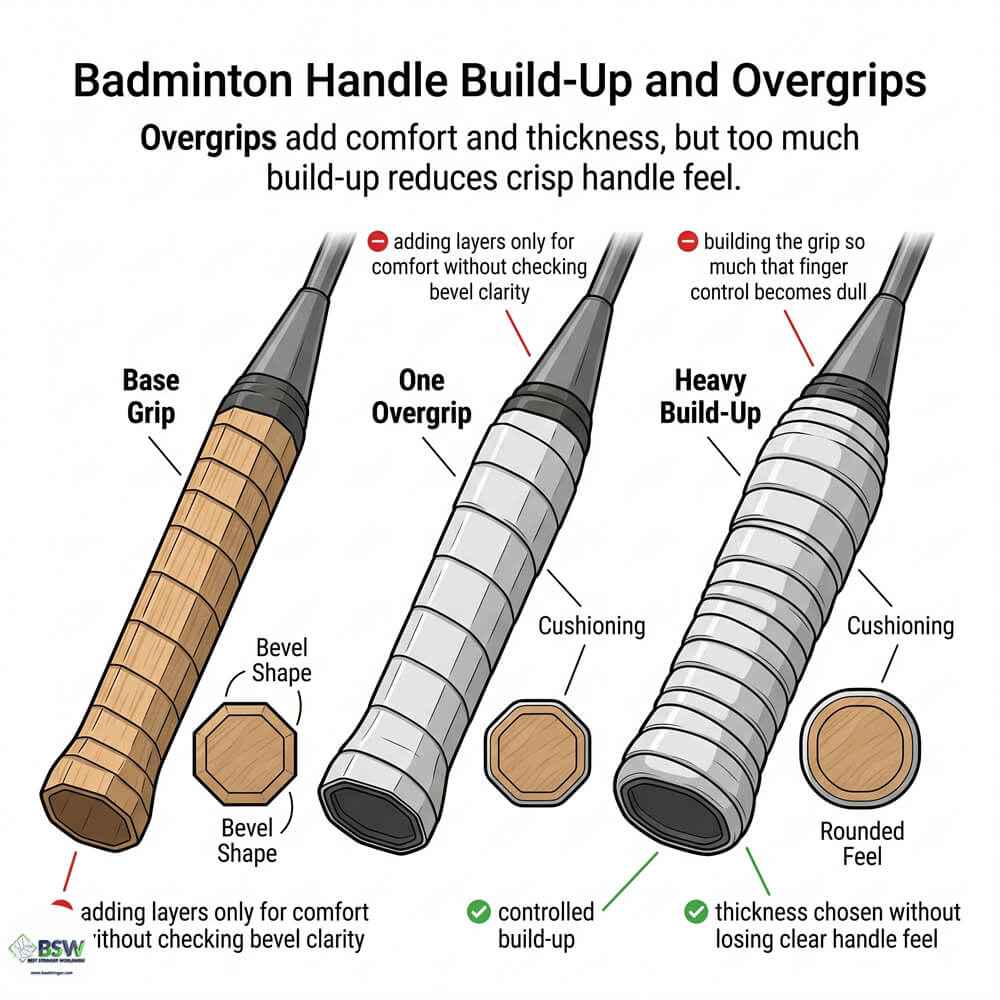
Badminton Handle Build-Up and Overgrips
Customizing your handle requires the correct overgrip application to truly unlock its potential. Understanding this synergy is essential for all levels:
What is an Overgrip? Overgrips are thin outer layers wrapped over the base grip. They provide a tacky or dry surface for better hold, while also increasing the overall thickness of the handle.
Build-Up Basics. Adding overgrips increases handle thickness and shock absorption. A heavy build-up offers massive comfort, but it limits finger action and can make the handle feel unnaturally round if overdone.
The Customization Risk. If you build up your grip too much for comfort without considering bevel feedback, you obscure the handle’s edges, reducing your angle awareness. A professional badminton stringer will always align these factors to maintain your crisp handle feel.
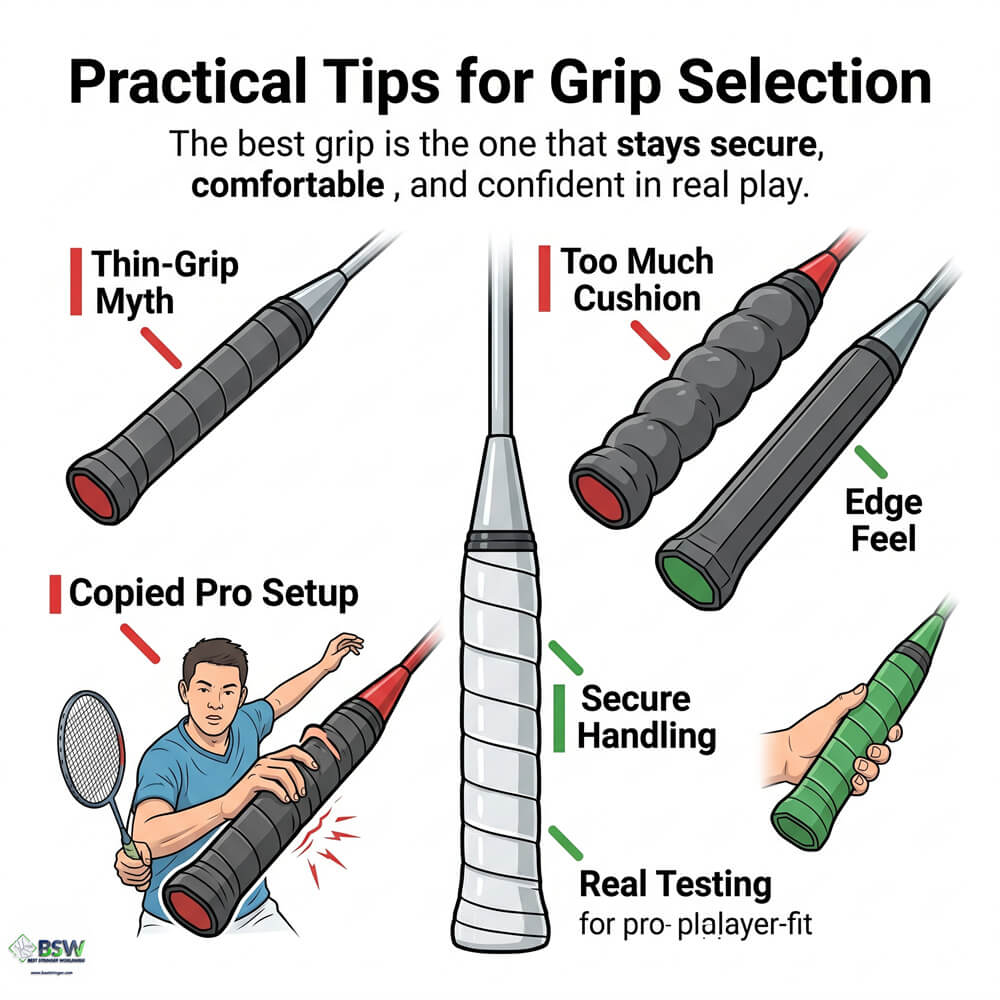
1.5 Practical Tips for Choosing Grip Size
Practical Tips for Grip Selection
Mistake 1: Assuming Thinner is Always Better.
While a smaller badminton grip allows more finger action, choosing a thin handle without the necessary grip strength guarantees a loose hold, poor racquet stability, and potential slipping.
Mistake 2: Ignoring Cushioning and Feedback.
Chasing pure comfort with multiple overgrips often means sacrificing direct edge feel. If you cannot feel the handle bevels during fast drives in doubles, the extra cushioning is useless.
Mistake 3: Copying Pro Setups Blindly.
Using the exact thin grip or specific leather wrap of an elite player is a common error. Advanced grip setups require advanced finger control; otherwise, they simply reduce your handling confidence.
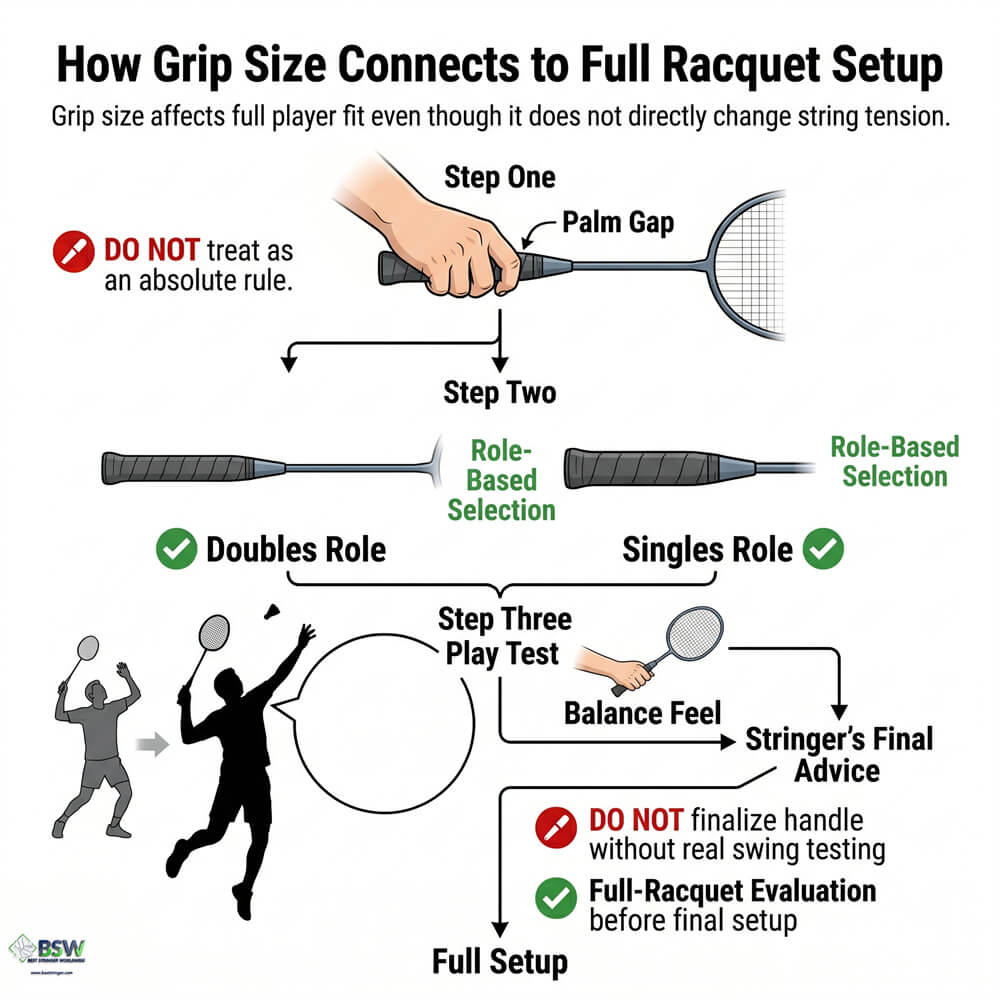
1.6 Grip Size and Stringing: The Connection
How Grip Size Connects to Full Racquet Setup
A step-by-step decision flow is crucial for balancing security and maneuverability safely. Use this simple framework before finalizing your equipment:
Step 1: Check the General Gap Rule. When holding the racquet in a standard forehand, there should roughly be a finger’s width gap between your fingertips and the base of your thumb. This is just a starting reference, not an absolute rule.
Step 2: Identify Your Playing Role. Determine if you are primarily a fast-paced doubles player requiring rapid grip changes, or a singles player needing the full-hand stability of a slightly thicker wrap.
Step 3: Test for Actual Improvement. Try different sizes and test whether a specific thickness genuinely improves your shot control and relaxation. Grip size influences confidence and balance feel, which is why a good stringer considers handle build-up alongside string tension.
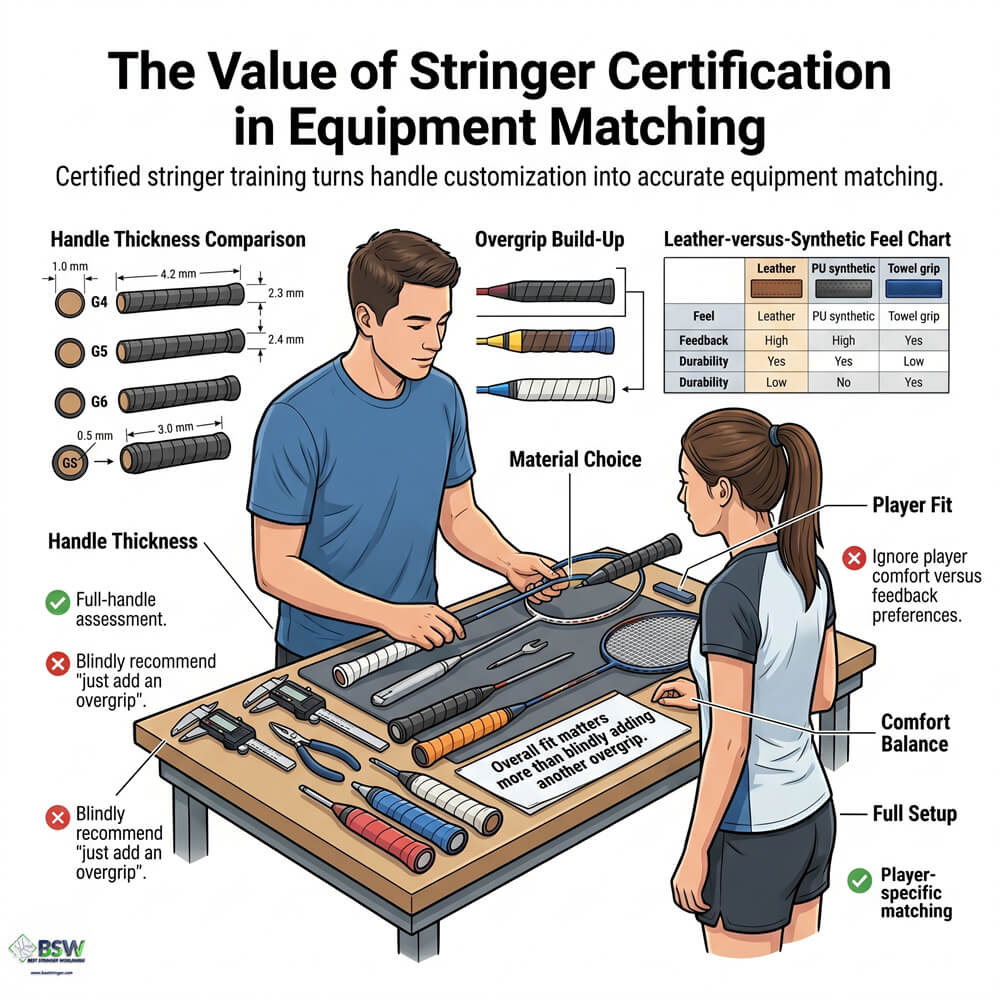
1.7 Professional Stringer Knowledge
The Value of Stringer Certification in Equipment Matching
Proper equipment education is a core part of a professional badminton stringing course and good stringer certification standards. A certified stringer understands that recommending “just use an overgrip” blindly without considering a player’s final handle thickness is a disservice.
At Best Stringer Worldwide, we know that grip size directly influences the advice given to players. The magic is not just in buying a premium string, but in the precise consultation logic a badminton stringer uses to match grip material and build-up to your hand size.
By prioritizing accurate equipment knowledge, our stringer certification ensures that every setup perfectly balances comfort, control, and feedback. You eliminate guesswork, avoid cramping from poorly fitted handles, and focus purely on improving your game.
Grip Size and Material Quick FAQ
Quick, definition-first answers to common questions about badminton racquet grip sizes and materials.
Is a smaller badminton grip always better?
No. While a smaller badminton grip allows for more finger action and quick adjustments, it can feel insecure and twist in your hand if it is too small, reducing stability during heavy strokes.
What is the difference between G3, G4, and G5?
These G-scale labels indicate the circumference of the base grip. In most common markets, a higher number means a thinner grip, meaning G5 is noticeably thinner than G4.
Should I choose a leather or synthetic grip?
Leather grips feel firmer and provide clear, direct feedback from the handle bevels. Synthetic grips are softer, better cushioned, and tend to absorb more impact shock for added comfort.
How much does an overgrip change the feel?
An overgrip increases the handle’s thickness and adds cushioning. A thick build-up improves shock absorption but can round out the handle, reducing your direct feel of the racquet’s edges.
Can grip size affect stringing setups?
Yes. While grip size doesn’t mechanically change string tension, it affects your handling confidence and the racquet’s balance feel, meaning a stringer must consider it for overall player fit.
Does the general palm gap rule work for everyone?
The rule suggesting a finger-width gap in your palm is a helpful starting reference, but personal preference and actual swinging feel always matter more than rigid formulas.
Why should a certified stringer understand grip build-up?
A professional badminton stringer needs to evaluate the player’s full setup. They must understand how base grips and overgrips combine to ensure the handle thickness matches the player’s comfort needs.
Do grip sizes vary between brands?
Yes, while the G-scale (like G4 or G5) is a common reference across markets, actual thickness and handle shape can vary slightly between manufacturers, making real-world testing essential.
Why is grip knowledge in a stringing course?
A badminton stringing course teaches that racquets are customized systems. A certified stringer learns how handle materials and thickness affect final player feedback, eliminating guesswork from equipment advice.
Handle Feedback: How Grip Build-Up Affects Feel
Handle Feedback & Grip Customization
Select a grip build-up below and simulate an impact to see how handle thickness alters vibration feedback and bevel feel.
Proven Specifications
Our stringing approach is based on verified equipment parameters used by top professionals. We prioritize arm safety, proper handle fit evaluation, and playstyle efficiency over pure marketing hype.
| Grip Setup | Option A (Thicker / Softer) | Option B (Thinner / Firmer) |
|---|---|---|
| Grip Size (G4 vs G5) | G4: Thicker, offers stability but less finger freedom. | G5: Thinner, allows more relaxed finger action for most. |
| Base Material (Synthetic vs Leather) | Synthetic: Softer, absorbs more shock and vibration. | Leather: Firmer, provides direct feedback and clear bevels. |
| Overgrip Application | Thick Overgrip: Maximum comfort, rounded handle feel. | Thin Overgrip: Maintains handle shape, crisp feedback. |
| Handle Feedback | Cushioned: Reduces impact shock, good for comfort. | Direct: Transfers vibration clearly, good for precise touch. |
| Sizing Guide Rule | Gap in Palm: A rough starting reference for beginners. | Actual Play Test: The ultimate deciding factor for fit. |
| Stringer’s Focus | Build-up Advice: Matching overall thickness to the player. | Playstyle Matching: Understanding comfort vs. precision. |
Master Racquet Customization with Best Stringer Worldwide
Ready to upgrade your racquet knowledge? Best Stringer Worldwide offers professional stringing consultation to teach you how grip sizes, materials, and overgrips affect player confidence safely. We serve badminton players worldwide especially in Singapore, Hong Kong, Malaysia, Indonesia, UK, France and Europe. Contact a certified stringer to find the perfect grip setup for your game.