1.1 ITF Rule Foundations
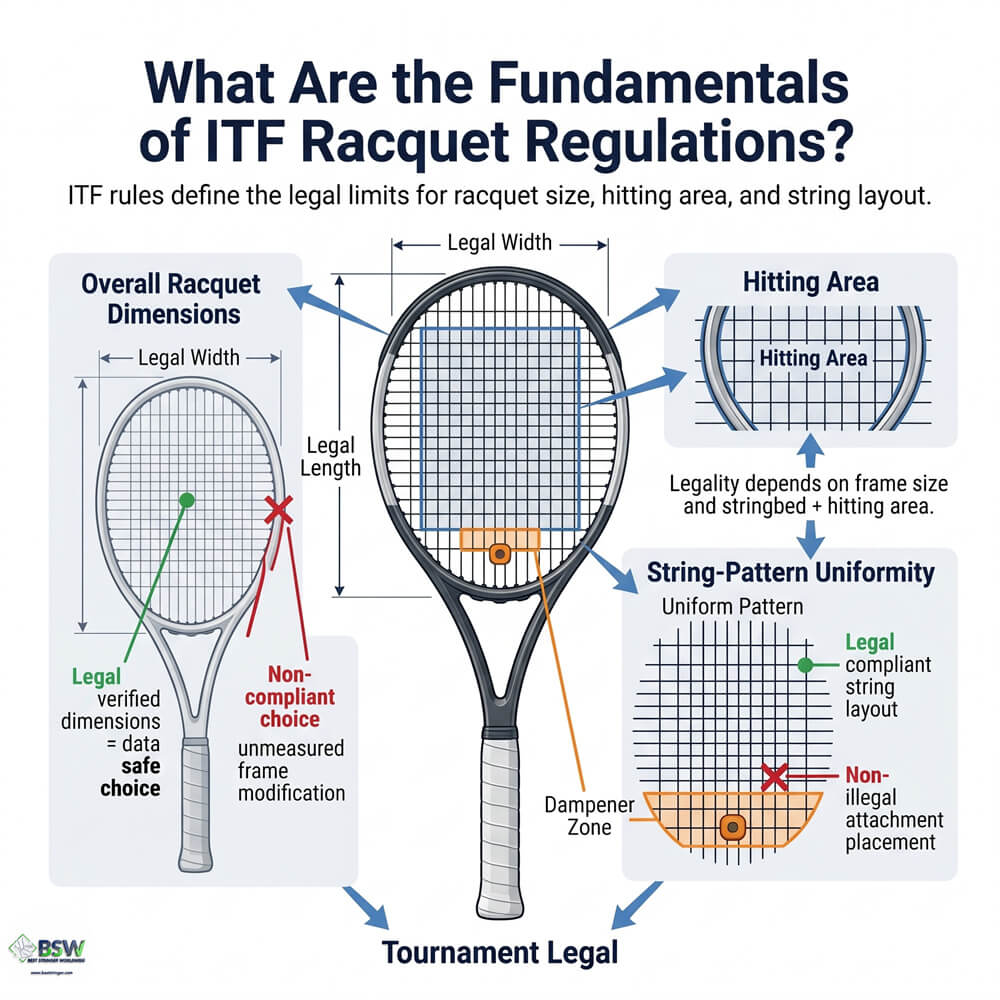
What Are the Fundamentals of ITF Racquet Regulations?
ITF tennis racquet regulations create the legal framework within which tennis players, stringers, and manufacturers must work. In this guide, you will learn the exact rules governing racquet dimensions, hitting areas, and string patterns, ensuring your equipment meets professional standards.
In short, overall dimensions dictate racquet legality, while string pattern rules govern the hitting surface. Mastering these concepts is vital for any tennis player or stringer aiming for tournament readiness, as an illegal modification can lead to match disqualification.
Here is a simple compliance flow:
Step 1: Learn the maximum allowed length and width.
Step 2: Understand that string patterns must remain generally uniform.
Step 3: Consult a certified stringer to ensure all modifications, such as lead tape or vibration dampeners, are positioned legally.
1.2 Racquet Dimensions
Racquet Specs Explained: Size and Hitting Area
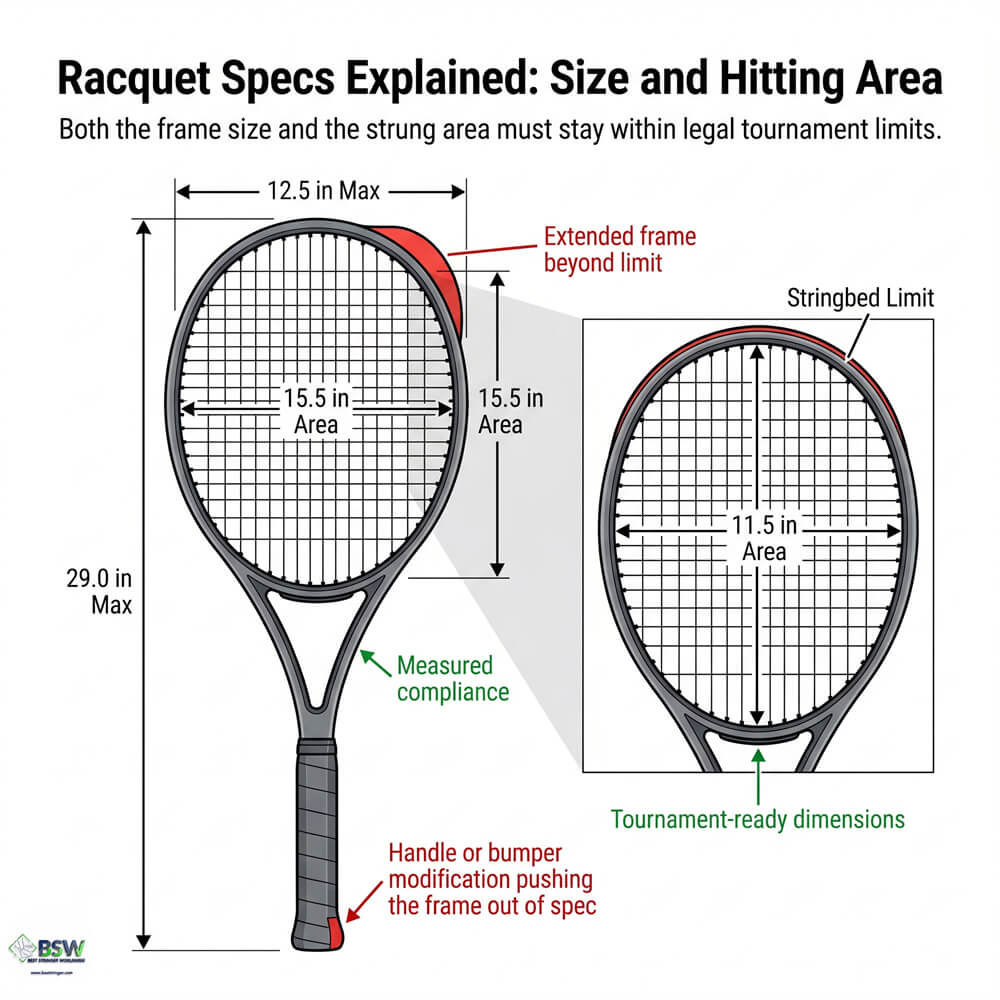
The golden rule of tournament preparation is ensuring the frame complies with ITF dimension limits. The maximum overall length of a legal tennis racquet is 29.0 inches (73.7 cm). While most standard adult racquets are 27 inches, extended frames are popular, but they must strictly stay under the 29-inch boundary.
Overall width is also strictly regulated, capped at 12.5 inches (31.7 cm). The hitting surface itself has specific limits: the strung area must not exceed 15.5 inches (39.4 cm) in overall length, and 11.5 inches (29.2 cm) in overall width.
A tennis player needs confidence that their equipment is legal for formal competition. For stringers, measuring racquets after replacing bumper guards or modifying handles is essential, as even a minor length extension beyond 29 inches renders the frame illegal for tournament play.
1.3 String Pattern Rules
Understanding String Patterns and Uniformity
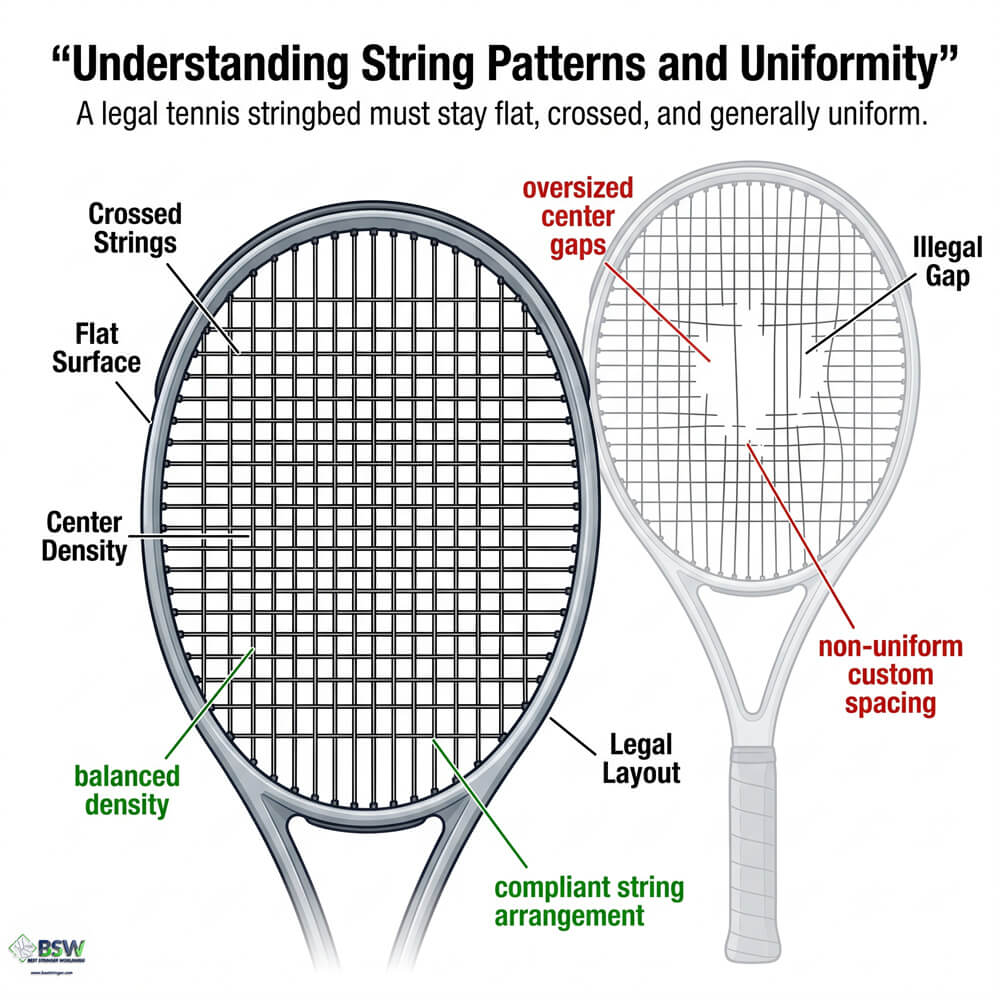
While players often request custom string setups, ITF regulations strictly define how a racquet can be strung. The hitting surface must be flat and consist of a pattern of crossed strings connected to the frame. Crucially, the string pattern must be generally uniform.
This means stringers cannot freely invent erratic string spacing. Specifically, the center of the string pattern must not be less dense than the outer areas. This rule prevents extreme custom stringing styles designed to generate unnatural spin effects by creating huge gaps in the sweet spot.
A professional stringer should know where legal setup choices end and illegal modifications begin. Whether a player prefers a dense 18×20 pattern or an open 16×19 pattern, the stringer must ensure the final installation maintains the required uniform density across the entire hitting area.
1.4 Legal Modifications
Legal Modifications and Attachments
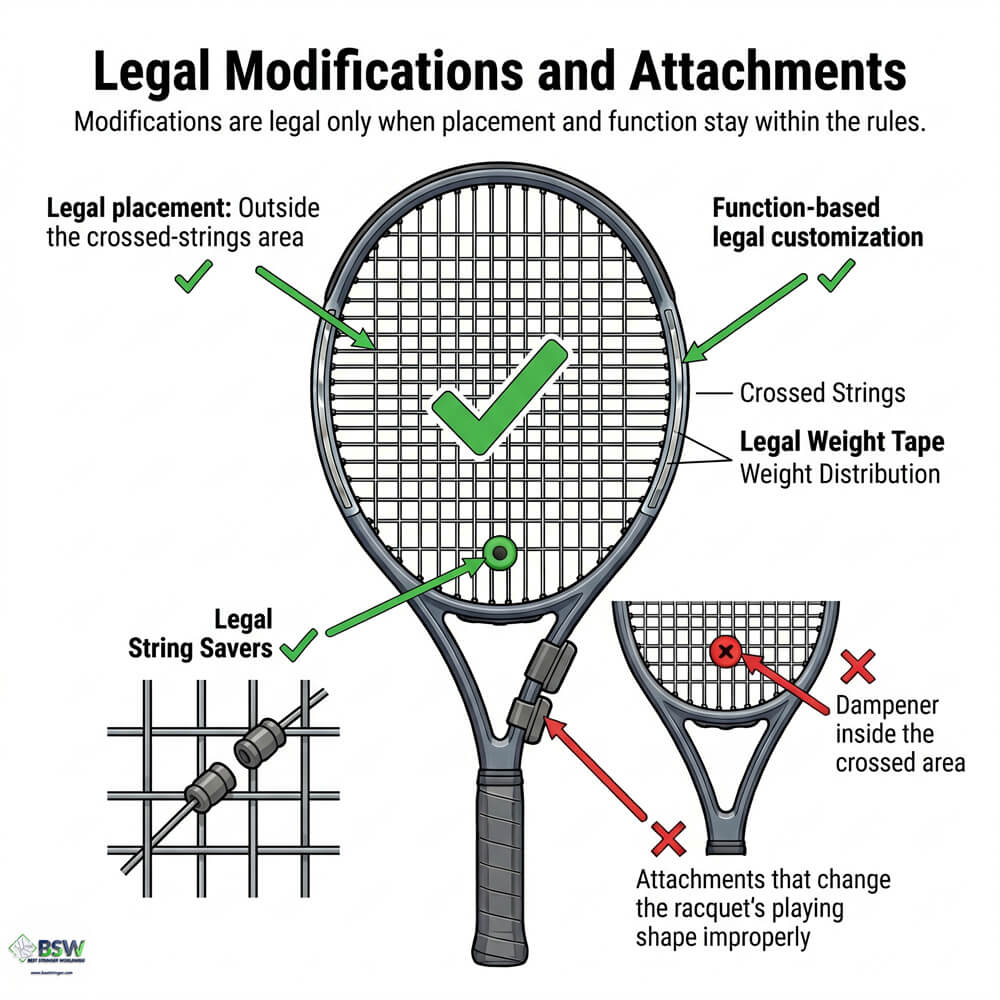
A tennis racquet cannot be modified arbitrarily. Permitted additions are limited to specific functions, such as wear prevention, vibration reduction, or weight distribution. Understanding these boundaries is essential for all levels:
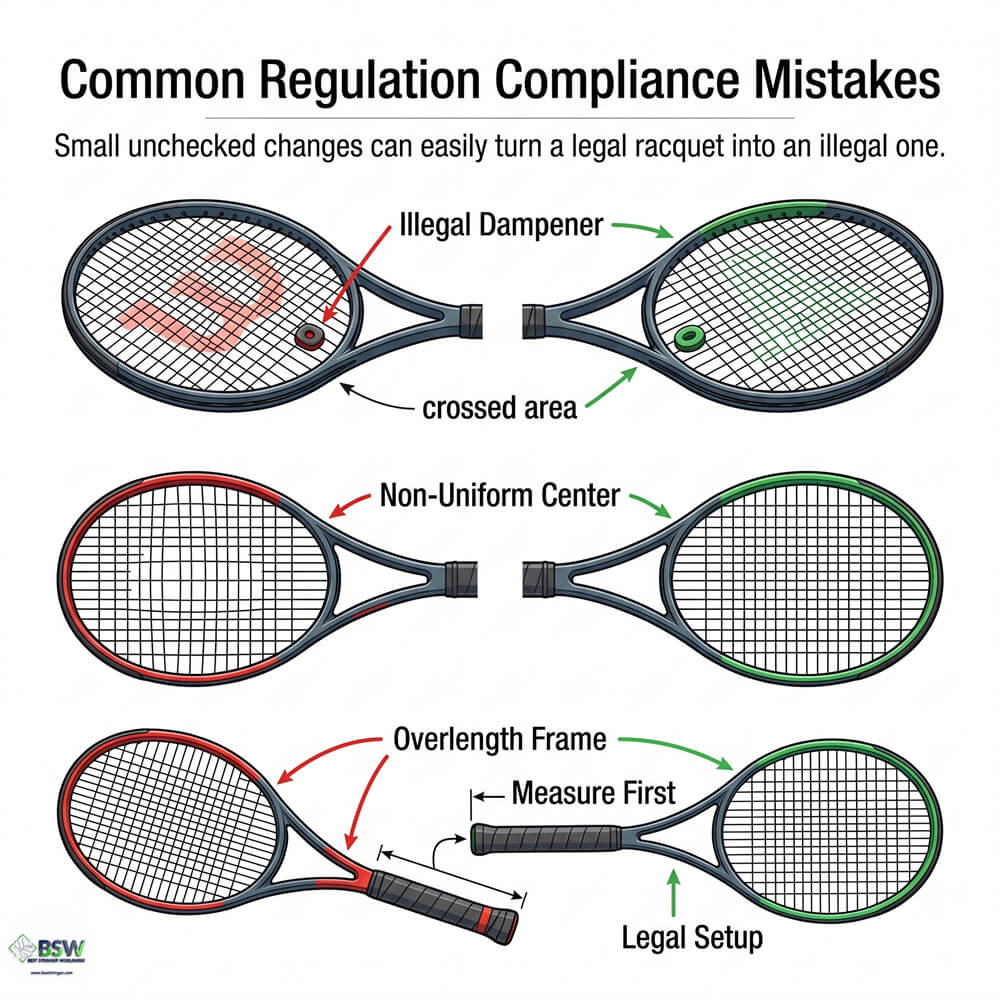
Vibration Dampeners. Dampeners are legal, but their placement is strictly regulated. They must be installed exclusively outside the pattern of crossed strings. Placing a dampener inside the crossed area is a common violation.
Weight Distribution. Players frequently add lead or tungsten tape to customize swing weight. This is perfectly legal, provided the tape does not alter the dynamic shape of the racquet during play.
Wear Prevention. String savers (small inserts between crossed strings) are permitted to prevent string wear. However, any attachment that significantly alters the mass distribution or physical profile beyond standard functional limits crosses into illegal territory.
1.5 Common Mistakes
Common Regulation Compliance Mistakes
Mistake 1: Illegal Dampener Placement.
A vibration dampener placed anywhere inside the crossed strings renders the tennis racquet illegal. It must be positioned below the bottom cross string or above the top cross string.
Mistake 2: Extreme Custom String Patterns.
Skipping specific grommets to create an extremely wide, non-uniform gap in the center of the stringbed violates the ITF rule that the center must not be less dense than the outer edges.
Mistake 3: Ignorance of Maximum Length.
Adding extensive custom molded grips or extended butt caps without measuring the final length. If the total racquet length exceeds 29.0 inches, it is disqualified from formal competition.
1.6 Compliance Check
Tournament Preparation Decision Flow
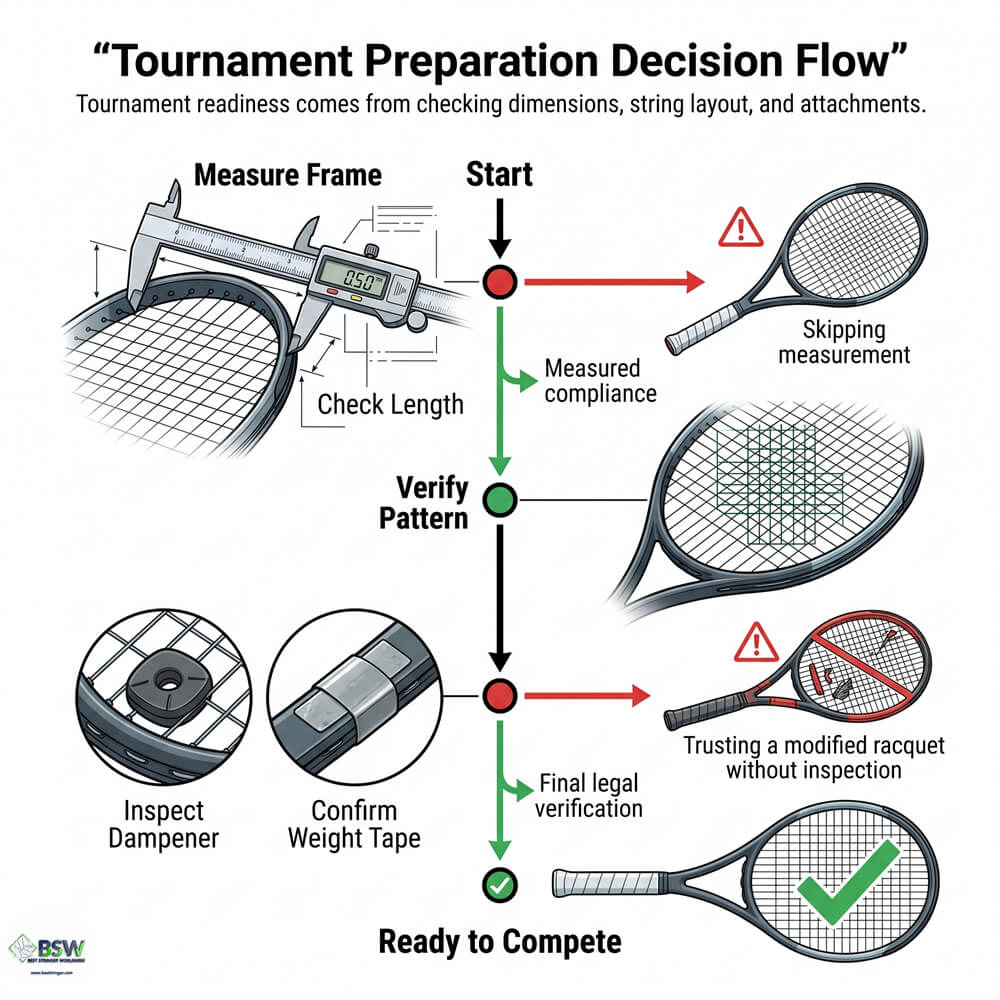
A step-by-step compliance check is crucial before entering formal competition. Use this simple framework to verify your equipment:
Step 1: Check Physical Dimensions. Measure the overall length and width, especially if the handle or bumper has been modified. Ensure the racquet does not exceed 29.0 inches in length and 12.5 inches in width.
Step 2: Verify String Uniformity. Inspect the string pattern. Confirm that it is flat, generally uniform, and that the density in the center is equal to or greater than the edges.
Step 3: Confirm Attachment Placement. Verify that any vibration dampeners are entirely outside the crossed strings, and that all added weight or string savers serve their intended legal purpose without violating structural rules.
1.7 Professional Knowledge
The Value of Stringer Certification
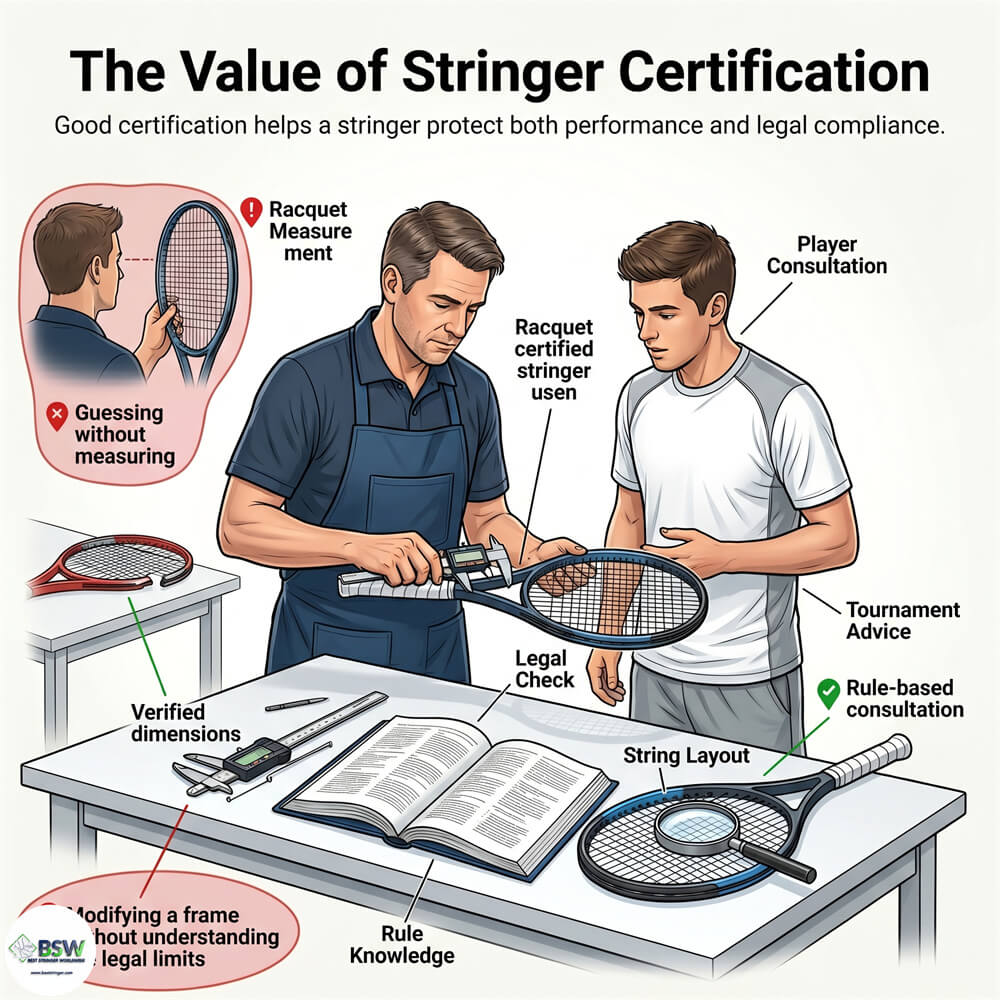
Proper regulation knowledge is a core part of a professional racquet stringing course and good stringer certification standards. A certified stringer understands that modifying a racquet without knowing the ITF limits is a serious disservice.
At Best Stringer Worldwide, we know that legal compliance directly influences the advice given to players. The magic is not just in precise stringing, but in the consultation logic a stringer uses to ensure the frame remains tournament-ready.
By prioritizing accurate equipment knowledge, our stringer certification ensures that every setup perfectly balances performance optimization and rule adherence. You eliminate guesswork, prevent disqualification, and focus purely on competing.
Equipment Compliance Quick FAQ
Quick, direct answers to common questions about ITF tennis racquet regulations.
What is the maximum legal length?
Under ITF tennis rules, the overall length of the racquet frame, including the handle, must not exceed 29.0 inches (73.7 cm).
Where can I place a vibration dampener?
Vibration dampening devices may only be placed outside the pattern of crossed strings. Placing them inside the crossed string area is illegal.
Are custom string patterns allowed?
The string pattern must be generally uniform and flat. Crucially, the pattern in the center cannot be less dense than in any other area of the stringbed.
What is the limit for hitting area dimensions?
The strung surface must not exceed 15.5 inches (39.4 cm) in overall length and 11.5 inches (29.2 cm) in overall width.
Can I add weight to my frame?
Yes, adding weight like lead tape for balance and distribution is permitted, provided it does not alter the dynamic shape of the racquet during the point.
Why compare tennis to badminton regulations?
Badminton stringers learning cross-sport rules benefit from seeing the exact dimensional contrasts. For example, a legal badminton racquet is capped at 680mm long, much shorter than a tennis frame.
What should a stringer check before modifying?
A professional stringer should always verify that extending a grip or replacing grommets will not push the racquet beyond the strict 29.0-inch length or 12.5-inch width limits.
Why is stringer certification important here?
A comprehensive racquet stringing course teaches the exact legal boundaries of customization. A certified stringer protects players from using non-compliant equipment in competitive matches.
Are stringing courses necessary?
For those wanting to master equipment consultation, yes. A stringer learns measurement consistency, precise knot tying, and the logic to match string setups to legal limits, eliminating guesswork.
Competitive Setup Dynamics: Legal Weight Modifications
ITF Compliance Inspector
Select modifications to verify if your equipment meets formal tournament regulations.
Proven Tournament Standards
Our stringing approach is based on verified ITF regulations used by top professionals. We prioritize tournament compliance, proper racquet specification limits, and structural integrity over blind customization.
| Specification Limit | Tennis (ITF) | Badminton (BWF) |
|---|---|---|
| Max Overall Length | 29.0 inches (73.7 cm): Strict limit for legality. | 680 mm (26.7 inches): Much shorter. |
| Max Overall Width | 12.5 inches (31.7 cm): Controls frame footprint. | 230 mm (9.0 inches): Narrower design. |
| Strung Area Limits | 15.5″ L x 11.5″ W: Maximum hitting size. | 280 mm L x 220 mm W: Compact zone. |
| String Pattern Rules | Uniform density; center must not be less dense. | Generally uniform and flat pattern. |
| Vibration Dampeners | Strictly outside the crossed string pattern. | Generally permitted outside the pattern. |
| Frame Modifications | Limited to wear, vibration, and weight. | Limited to weight and balance. |
Master Racquet Regulations with Best Stringer Worldwide
Ready to upgrade your knowledge? Best Stringer Worldwide offers professional stringing courses to teach you how racquet dimensions and string setups comply with ITF rules safely. We serve tennis and badminton stringers worldwide. Contact a certified stringer to learn proper tournament preparation and legal equipment optimization.



1 thought on “International Tennis Federation (ITF) Regulations”
Comments are closed.