Introduction to String Bed Stiffness
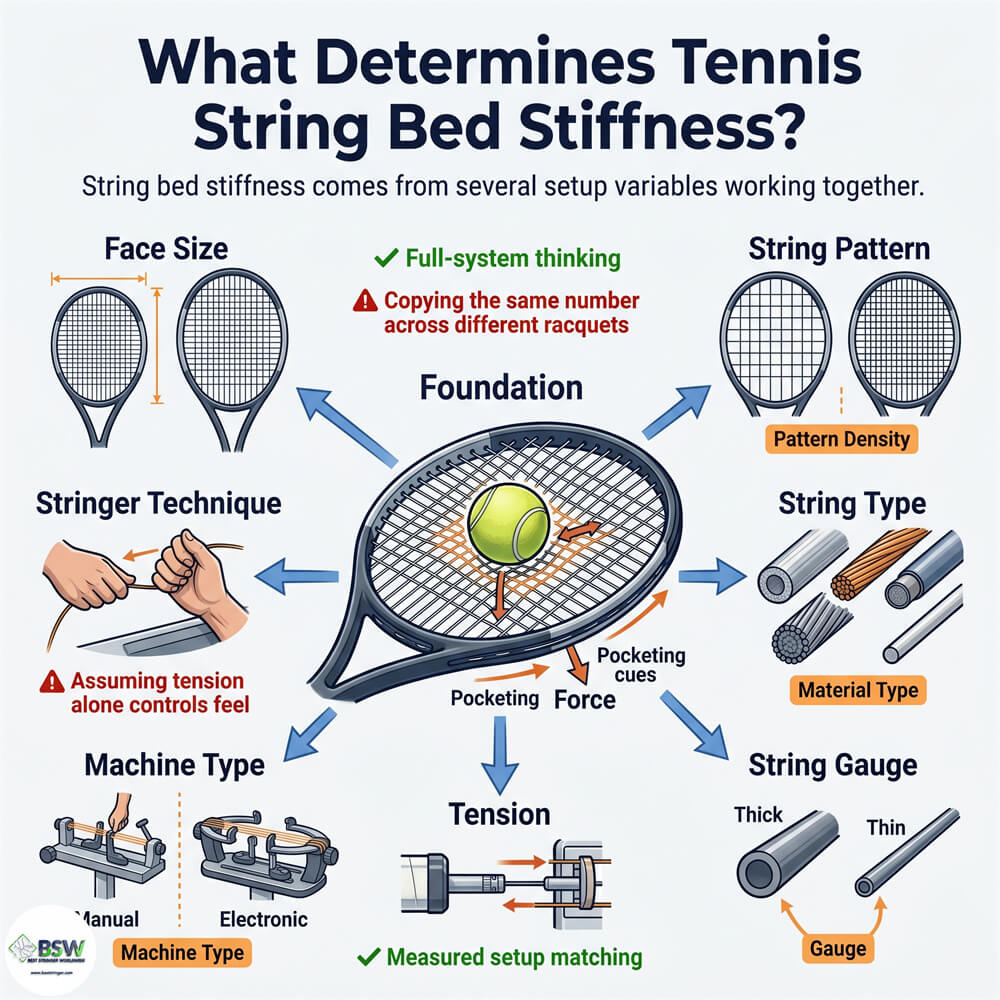
What Determines Tennis String Bed Stiffness?
Tennis string bed stiffness is one of the most important elements of racquet feel. While tennis players often talk exclusively about tension, the actual result on the court depends on a complex combination of factors, not just one isolated number.
In reality, string bed stiffness is the true on-court result of multiple setup variables working together. Two completely different racquets strung at the exact same tension can feel drastically different upon impact. Mastering these concepts is crucial for any player or professional stringer who wants to truly understand performance tuning.
This page explains the seven main factors that determine string bed stiffness: racquet face size, string pattern, string type, string gauge, stringing tension, machine type, and the stringer’s technique. Whether you are a player seeking comfort, or a certified stringer taking a racquet stringing course, understanding these factors will elevate your knowledge.
The Core Concept
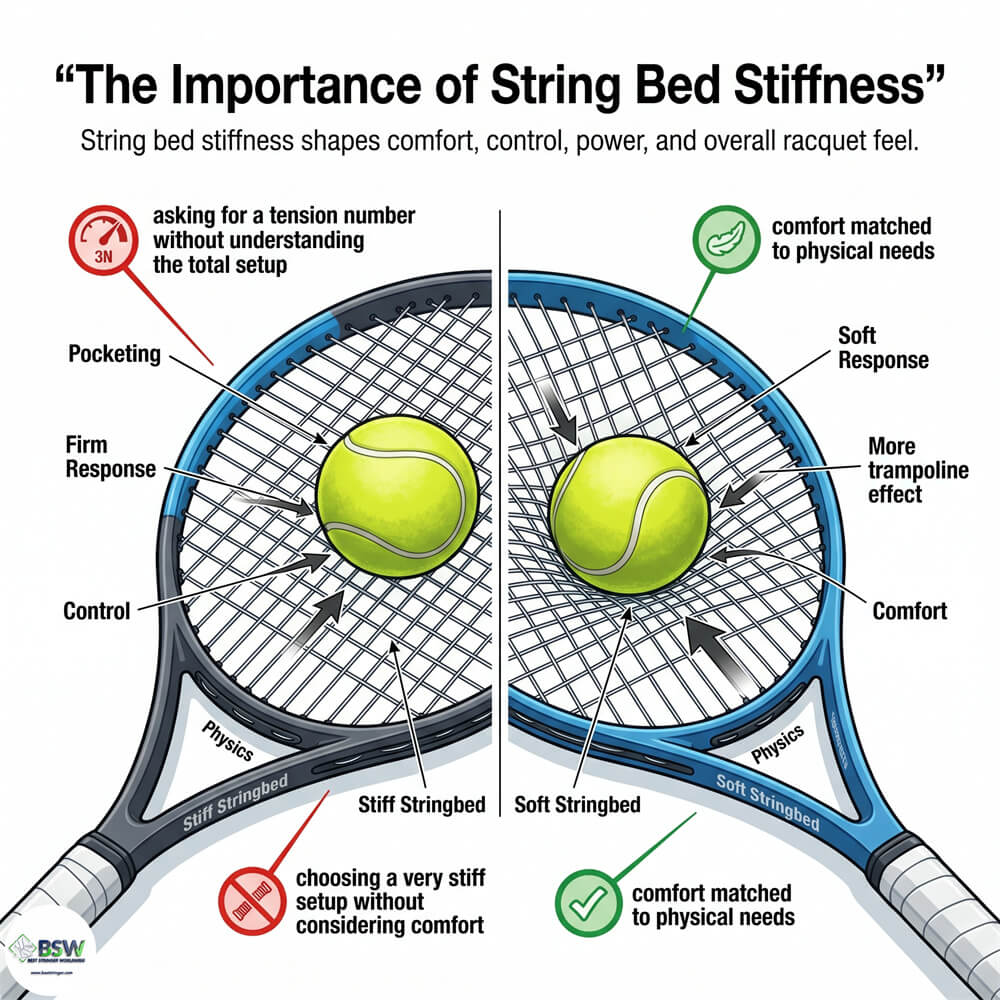
The Importance of String Bed Stiffness
The string bed is the only part of the tennis racquet that actually makes contact with the ball. As a result, it acts as the primary transmission system for power, control, spin potential, and overall feel. When we talk about string bed stiffness, we are referring to how firm or forgiving this woven surface behaves during that split-second impact.
Understanding string bed stiffness matters deeply for both performance and comfort. A stiffer string bed typically provides more precision and control, assuming the player can generate their own power. Conversely, a softer string bed acts like a trampoline, offering greater power generation and shock absorption, which is vital for player comfort and arm safety.
Players often mistakenly ask a stringer for a specific tension without realizing that string bed stiffness is the more complete concept. A professional stringer evaluates the entire racquet system because tension alone does not tell the full story. Recommending the ideal setup requires balancing all seven stiffness factors.
1. Racquet Face Size
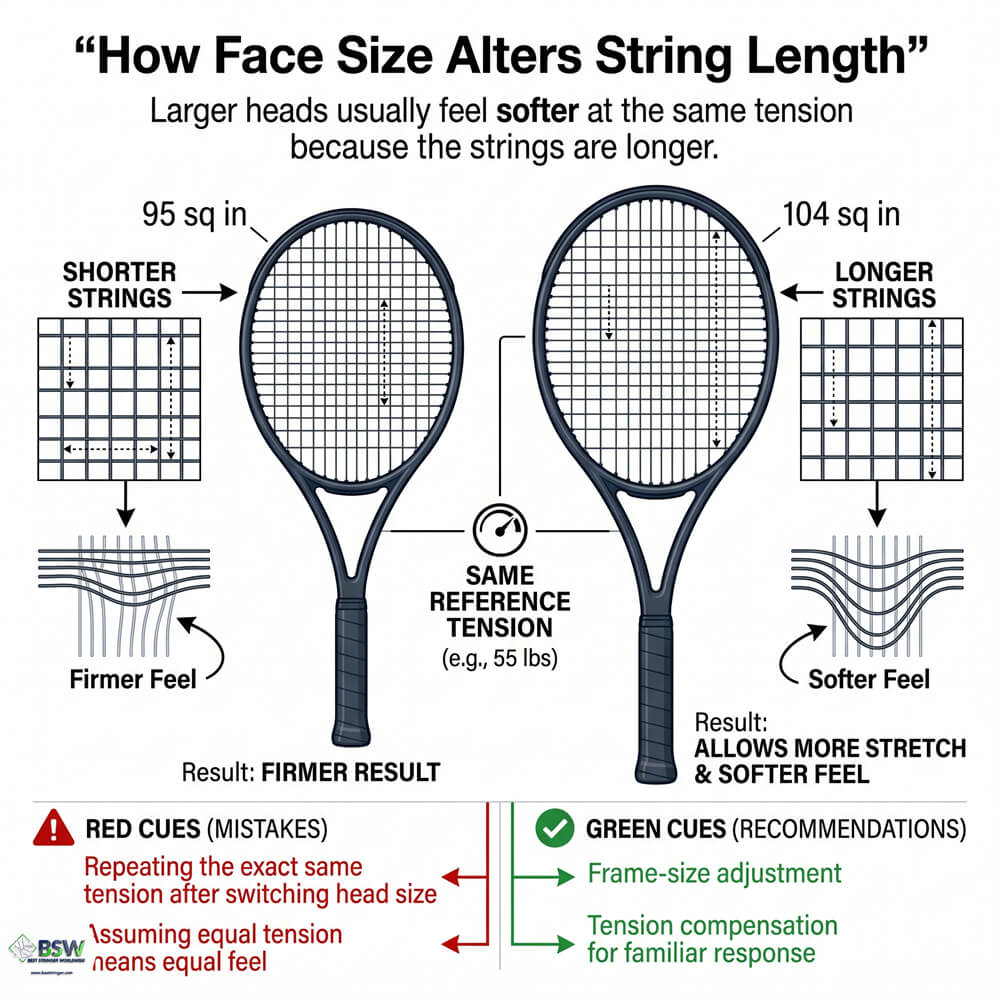
How Face Size Alters String Length
The first critical factor in determining tennis string bed stiffness is the racquet face size. A larger head size (such as 104 sq in) naturally requires longer main and cross strings than a smaller mid-size frame (such as 95 sq in). Because longer strings have more physical material to stretch upon impact, they feel inherently softer.
If you string both a 95 sq in racquet and a 104 sq in racquet at 50 lbs, the larger racquet will have a noticeably lower string bed stiffness. The longer strings create a more trampoline-like effect. This is a vital concept when players switch racquet sizes.
A certified stringer should never simply repeat the exact same reference tension when a player transitions to a differently sized frame. To achieve the same familiar feel on a larger racquet, the stringer usually needs to increase the reference tension to offset the longer string length.
2. String Pattern
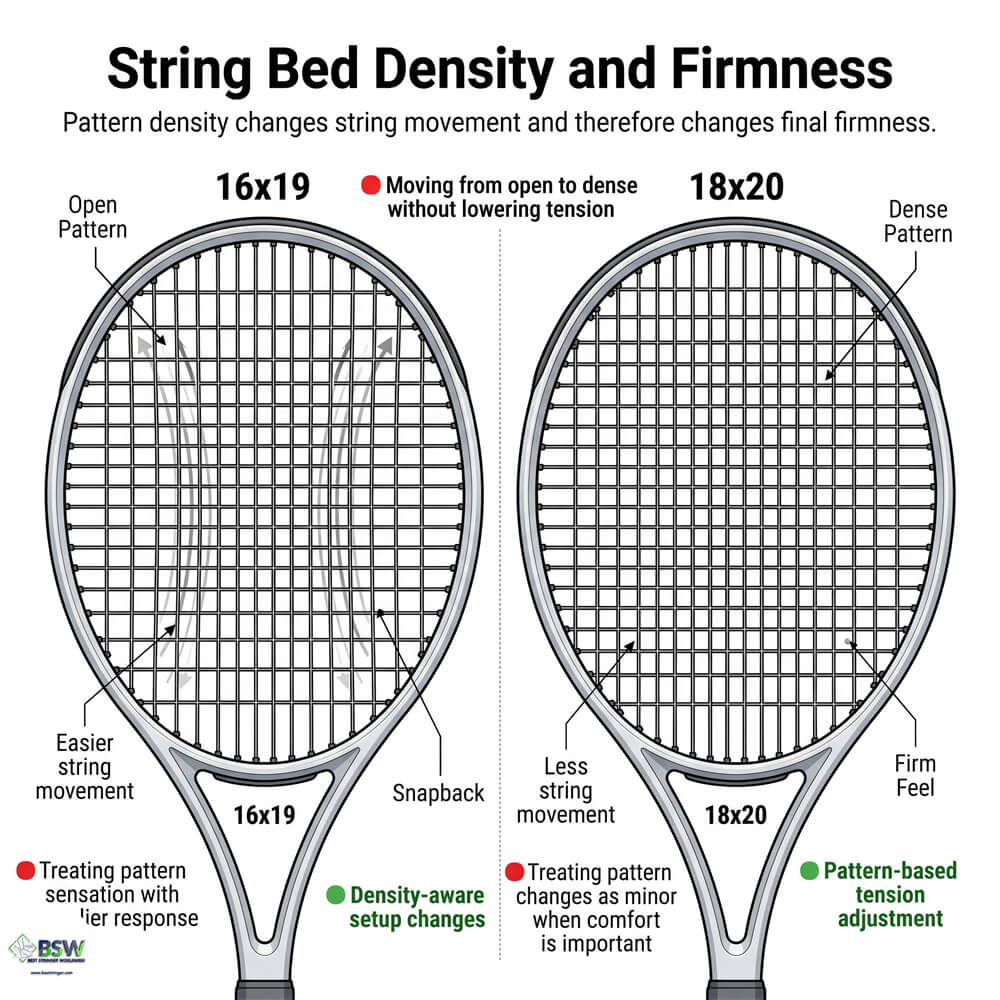
String Bed Density and Firmness
The second major factor is the string pattern, or string bed density. This refers to the number of main and cross strings, such as 16×19 or 18×20, and how tightly they are spaced together.
Denser Patterns. Denser patterns, like an 18×20 configuration, pack more strings into the same area. This tight spacing restricts individual string movement, resulting in a firmer string bed stiffness. It offers excellent control and durability but can feel rigid if strung too tight.
Open Patterns. More open patterns, such as a 16×19, have wider gaps between the strings. This allows the strings to move and snap back more freely, creating a softer, more lively feel that typically aids in spin generation.
The Contextual Risk. Because density affects firmness, string pattern effects must still be understood in context. A player switching from an open pattern to a dense pattern may need to lower their reference tension to maintain the same comfortable string bed stiffness they are used to.
3. String Type
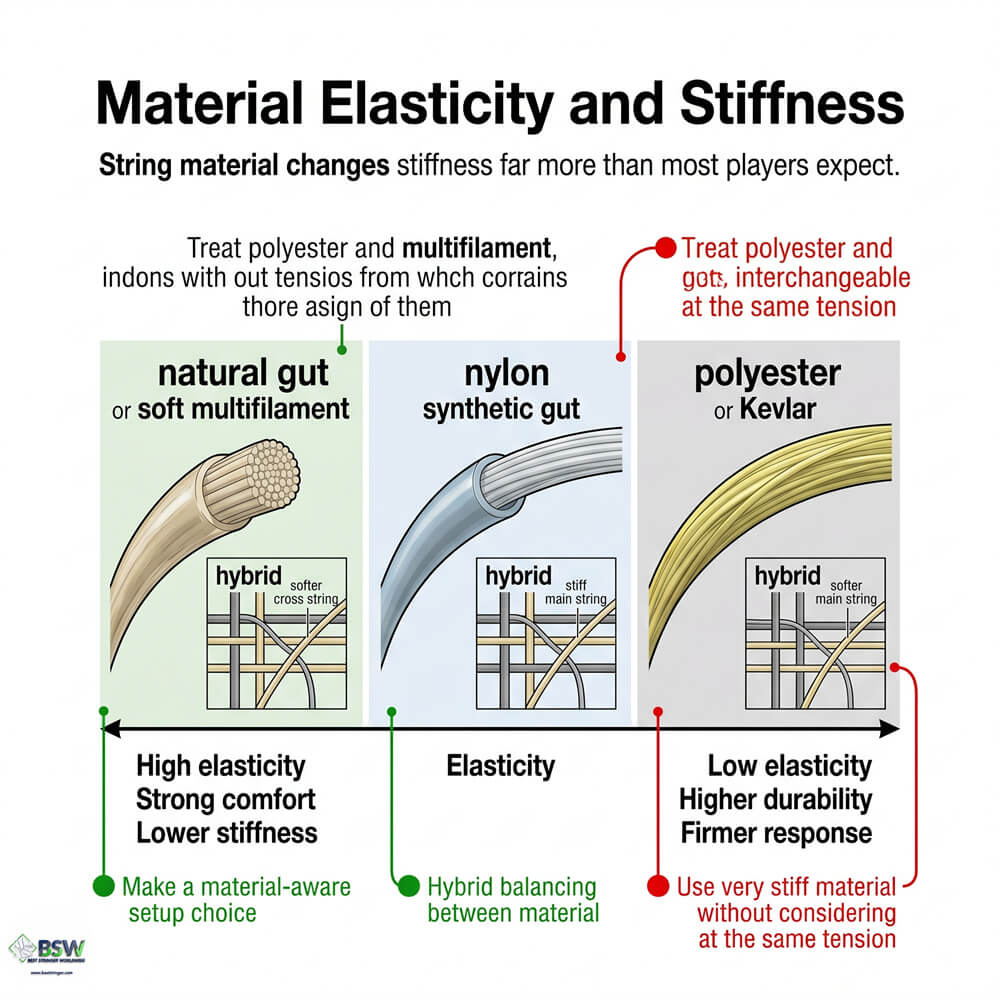
Material Elasticity and Stiffness
Natural Gut vs Synthetic.
String material fundamentally changes both feel and string bed stiffness because different materials possess drastically different levels of elasticity. Natural gut, for example, is highly elastic and retains tension exceptionally well, resulting in the softest and most comfortable string bed available.
Stiffer Polyester Options.
Nylon or synthetic gut provides a balanced, medium stiffness, making it a versatile choice. In contrast, polyester and Kevlar (aramid) are extremely stiff materials designed for durability and heavy spin. They stretch very little upon impact, producing a notably rigid string bed.
Understanding Hybrid Setups.
Because string type changes stiffness so dramatically, many professional stringers recommend hybrid setups—blending a stiff polyester with a soft multifilament to achieve a balanced feel. You cannot treat a highly elastic string and a stiff polyester as if they will yield the same string bed stiffness at the identical reference tension.
4. String Gauge
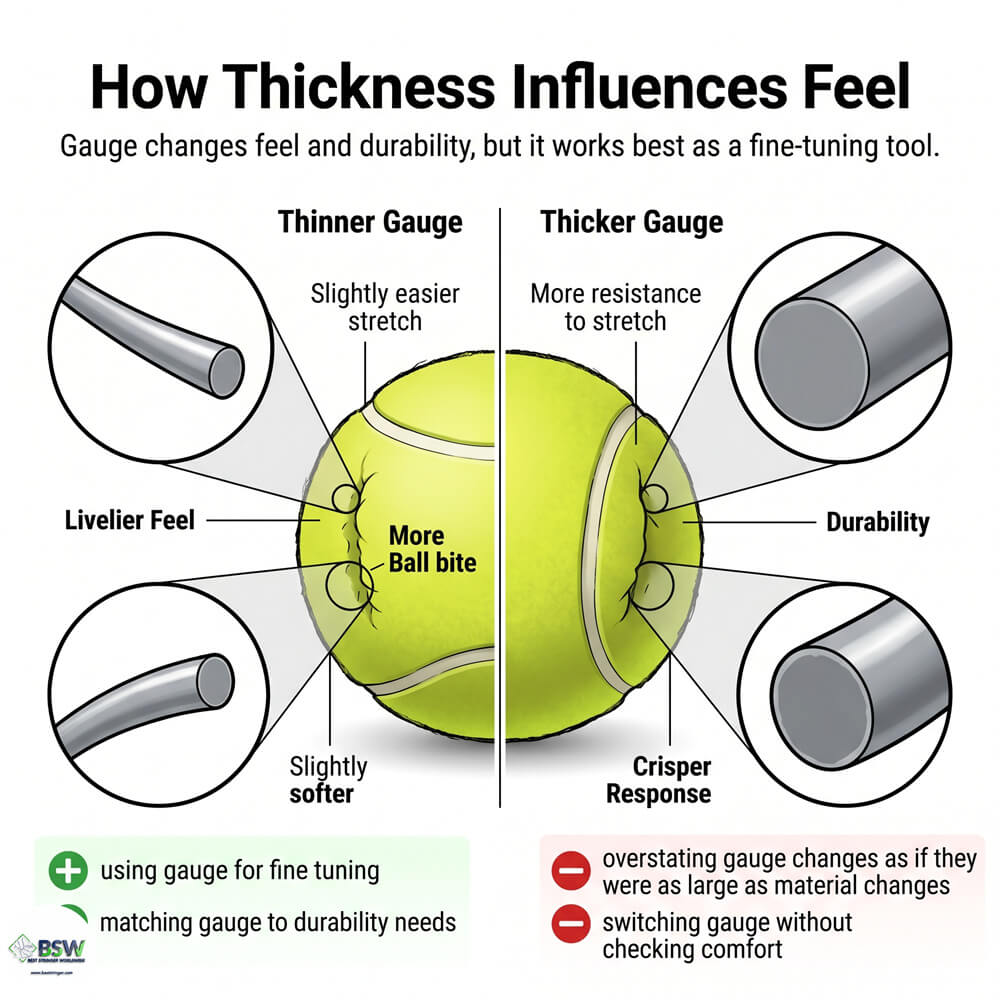
How Thickness Influences Feel
String gauge, or thickness, subtly but meaningfully influences the final string bed stiffness. While it is not as drastic as changing the string material, it remains an important variable for performance tuning and racquet customization.
Thinner Strings. Thinner strings (such as 17g or 1.20mm) have less physical mass. They tend to stretch slightly more easily upon impact and bite into the ball better. This can make the string bed feel a little softer or more lively compared to a thicker version of the exact same string.
Thicker Strings. Thicker strings (such as 15L or 1.35mm) offer superior durability and resist stretching more effectively. This extra material often results in a slightly firmer, crisper string bed stiffness. For a detailed breakdown, explore the interactive Tennis String Bed Setup Comparison Tool further down this page.
Fine-Tuning Setup. The effect of gauge is real, but some players overstate it. A professional stringer understands that adjusting gauge is an excellent way to fine-tune the string bed stiffness without completely overhauling a player’s preferred setup.
5. Stringing Tension
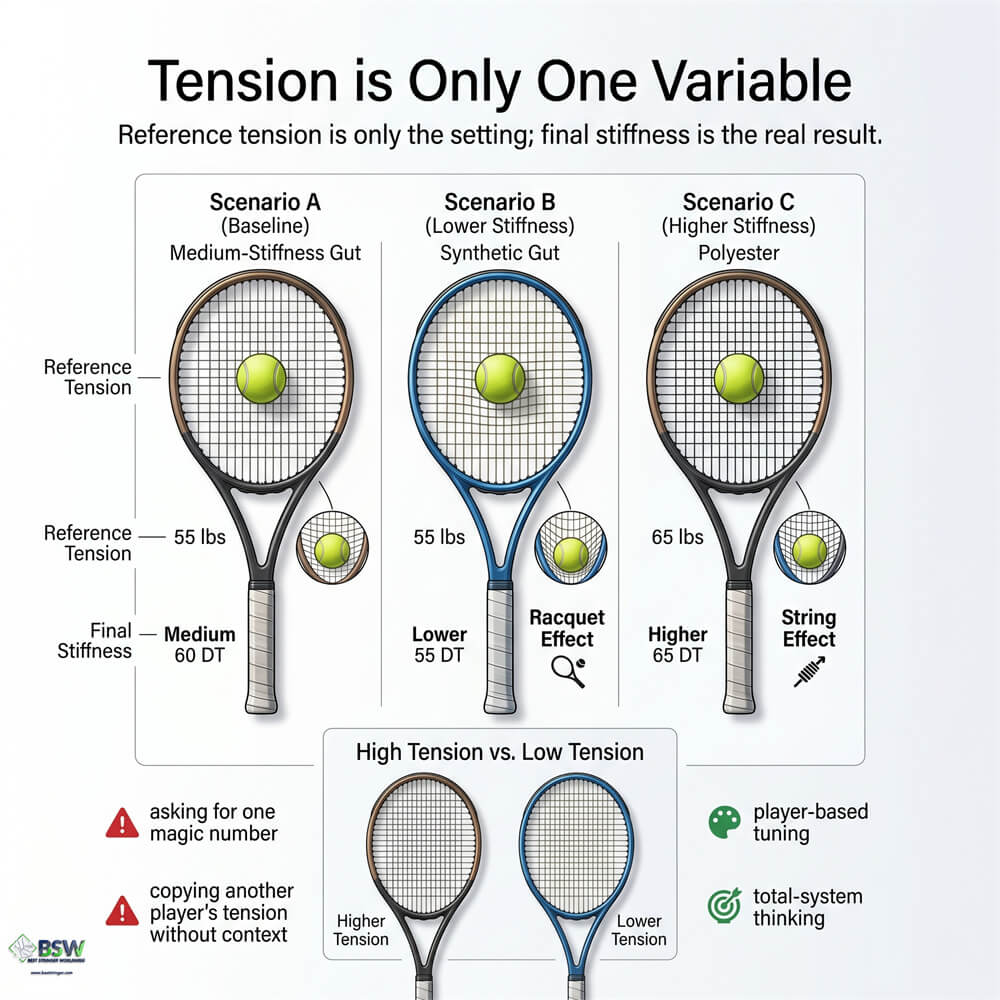
Tension is Only One Variable
Stringing tension is the most commonly discussed factor, but it must be viewed as just one piece of the puzzle. Reference tension is the machine setting, while string bed stiffness is the final result. Generally, higher reference tension usually increases string bed stiffness, creating a tighter, more control-oriented feel.
Lowering the tension usually softens the string bed, increasing the trampoline effect for greater power and comfort. However, the final feeling still depends heavily on the racquet size and string type involved.
There is no universal ‘best’ number. Player preference, physical style, and comfort needs always dictate the ideal setup. A certified stringer educates players that a 50 lbs tension on one frame is not identical to 50 lbs on another, shifting the conversation from a mere number to actual string bed stiffness.
6 & 7: Machine & Technique FAQ
Key answers explaining how machine type (Factor 6), stringer technique (Factor 7), and variables interact to create string bed stiffness.
What is a lock-out machine?
A lock-out (or crank) machine pulls the string until it reaches the reference tension, then a brake locks the tensioning mechanism. Because it stops pulling immediately, the string naturally relaxes slightly, often resulting in a softer practical string bed stiffness.
How does a constant-pull machine differ?
A constant-pull machine (usually electronic or drop-weight) continuously pulls the string even as it stretches. This removes more elasticity from the string during installation, typically producing a firmer and tighter final string bed stiffness.
Why does the same number feel different?
Because constant-pull and lock-out machines manage string stretching differently, requesting 50 lbs on a lock-out will usually yield a softer string bed than 50 lbs on a high-end constant-pull machine.
How should a stringer adjust for machine type?
If a professional stringer moves from a lock-out to an electronic constant-pull machine, they may need to drop the reference tension by a few pounds to recreate the exact same string bed stiffness the player is accustomed to.
How does clamping distance affect stiffness?
Stringer technique matters immensely. If a stringer clamps further away from the frame, more string is exposed to tension loss before the clamp is secured. This habit can slightly reduce the overall string bed stiffness compared to clamping tightly against the grommet.
What is the role of pre-stretching?
Pre-stretching involves manually or electronically stretching the string before installation. This removes initial creep and elasticity, ensuring tension maintenance but resulting in a noticeably firmer and stiffer feeling string bed.
Does tensioning speed matter?
Yes. Pulling strings too quickly on an electronic machine may not allow the material enough time to stretch properly before the machine registers the target tension. A smooth, consistent pull ensures a truer, more accurate string bed stiffness.
Why does stringer consistency influence the result?
Even between skilled technicians, weaving habits, knot tying tension, and clamping techniques vary. A certified stringer strives for absolute consistency so the resulting string bed stiffness is reliable every single time the player gets their racquet restrung.
String Bed Stiffness Estimator: Why Multiple Factors Matter
String Bed Stiffness: The Trampoline Effect
Observe how different setup variables visually alter the pocketing depth and rebound speed during a split-second shuttlecock impact.
Firmer Setup
Softer Setup
Proven Setup Knowledge
Our stringing approach is based on a complete understanding of tennis string bed stiffness. We prioritize player comfort, precise performance tuning, and holistic racquet customization over pure tension hype.
| Setup Factor | Firmer String Bed Result | Softer / Livelier Result |
|---|---|---|
| Racquet Head Size | Smaller Head (e.g., 95 sq in): Shorter strings create a firmer feel at the same tension. | Larger Head (e.g., 104 sq in): Longer strings stretch more, feeling softer. |
| String Pattern (Density) | Dense (e.g., 18×20): Tighter spacing restricts string movement, increasing stiffness. | Open (e.g., 16×19): Greater spacing allows more movement and a softer response. |
| String Type (Material) | Polyester / Kevlar: Stiffer materials stretch less, giving a firm, crisp feedback. | Natural Gut / Nylon: Highly elastic materials stretch deeply for maximum comfort. |
| String Gauge (Thickness) | Thick (e.g., 1.35mm): More material resists stretching, offering a slightly firmer bed. | Thin (e.g., 1.20mm): Less material stretches easier, feeling more lively. |
| Reference Tension | Higher Tension: Less remaining elasticity creates a tight, stiff bed. | Lower Tension: More elasticity remains, creating a pocketing, soft effect. |
| Machine Type & Technique | Constant-Pull / Pre-Stretch: Removes elasticity, yielding a tighter, firmer outcome. | Lock-Out / Fast Pulls: Retains some elasticity, often resulting in a softer bed. |
Master Racquet Customization with Best Stringer Worldwide
Ready to upgrade your knowledge? Best Stringer Worldwide offers professional racquet stringing courses to teach you how string bed stiffness and setup variables affect tennis performance safely. We serve tennis and badminton stringers worldwide—especially in Singapore, Hong Kong, Malaysia, Indonesia, the UK, France, and Europe. Join a certified stringer program to master the seven factors of perfect racquet customization.