






1.1 Starting Point
What is BSW certification and what does it prove?
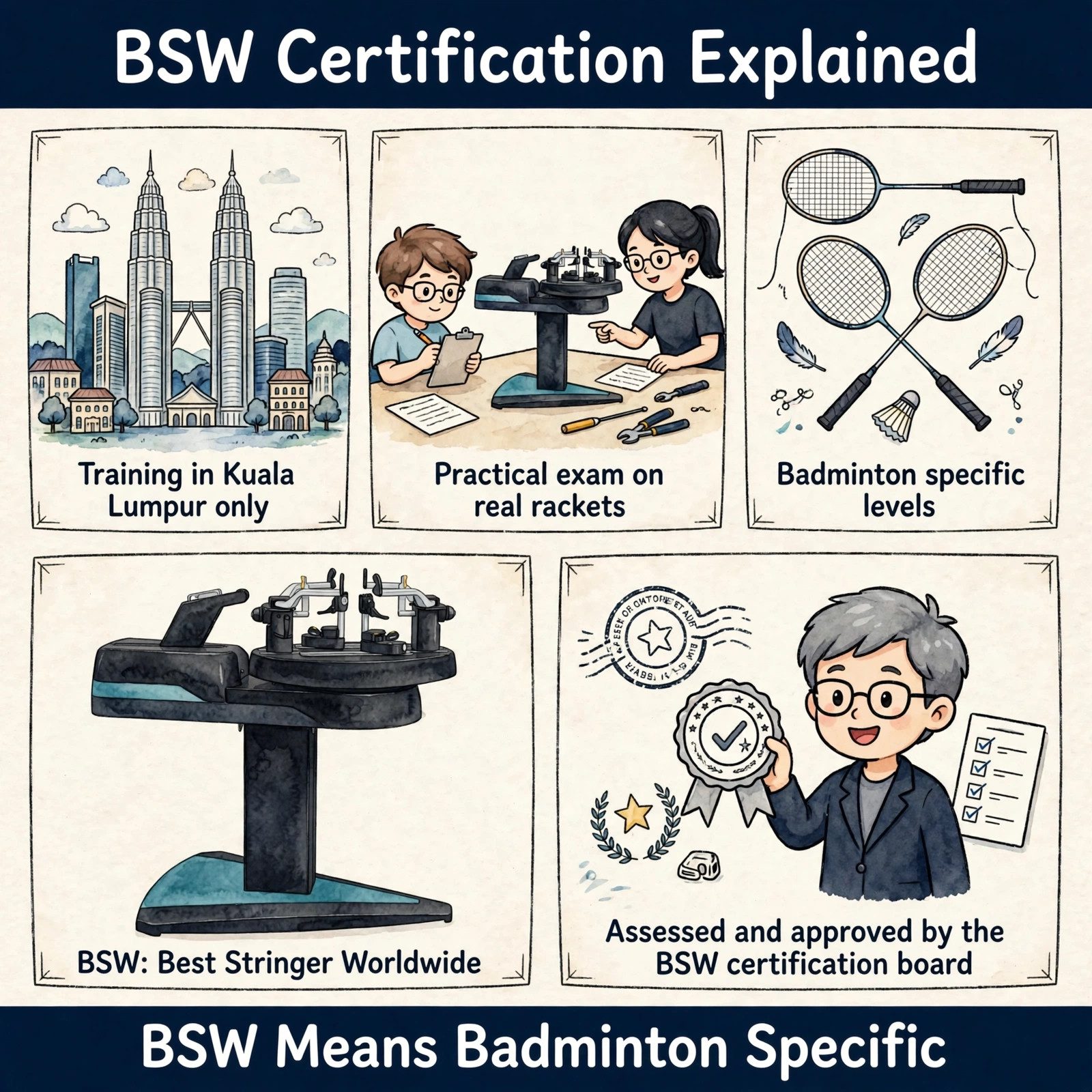
BSW certification is the badminton specific credential offered by Best Stringer Worldwide, founded by Eric Chuar and based in Kuala Lumpur, Malaysia. It exists for one sport done properly: badminton levels assessed through a practical exam on real rackets, with every result assessed and approved by the BSW certification board as an organisation. There is no general racket paper and no attendance shortcut. Training runs in Kuala Lumpur only, over 3 and a half days with classes from 10am to 5pm and flexible timing, and the practical exam sits on the last day. That is the whole offer, stated plainly.
Badminton specific means the standard is built around badminton numbers from the start. String runs thin at 0.65mm to 0.70mm gauges, frames are light, and tensions are high for the frame weight, so the exam judges the touch badminton actually demands. A general racket credential can be honest in its own scope and still leave those habits untested. BSW levels keep the scope narrow on purpose, so the paper and the daily work match.
A BSW pass proves that on exam day, this stringer’s tension accuracy, knot work, grommet care and frame handling met the board standard on real badminton rackets, and the organisation recorded the result. It does not prove every later restring will be perfect, it is not a government licence, and it does not promise work. Players and shops can ask what the exam tested and how the board records a pass, and expect a direct answer.

1.2 Preparation
What does a BSW certification exam actually test?
The BSW practical exam tests the work a badminton shop checks every day. Frame inspection first: cracks, worn grommets and old damage spotted before stringing starts. Safe mounting with the light frame held firmly without distortion. Clean weaving of mains and crosses at badminton gauges. Tension delivered at the set number. Clamp control that does not mark thin string. Starting and finishing knots tied cleanly, because a sloppy knot loses tension across the bed. Grommet care through shared holes, with damaged grommets replaced and no string dragged across sharp edges.
Badminton candidates should read that scope with badminton numbers in mind. Badminton string runs at 0.65mm to 0.70mm gauges, frames are light, and tensions are high for the frame weight, so small errors show quickly. Check whether the level you enter tests badminton rackets directly, or whether badminton sits inside a wider racket test weighted toward other sports.
What a certification exam cannot test also matters. It cannot test a rushed tournament queue, a player arguing about tension at the counter, or hidden frame damage found minutes before a match. The level proves exam day standard under observation. Your records, repeat players and honest counter habits prove the rest of your working standard over time.

1.3 Working Method
How do BSW courses and feedback build exam skill?
Certification levels reward corrected practice, not repeated practice alone. A learner who strings many rackets with the same weaving angle error carries that error into every standard. Training with an instructor changes the loop: clamp pressure is checked before it marks string, weaving is fixed while crosses are going in, knot tails are trimmed correctly on the spot, and grommet habits are corrected before they become routine. Videos and manuals teach the order of steps, and they help before a course, but they cannot see your hands or tell you which habit will cost marks.
Good preparation for a certification exam also builds checking habits. Read the frame before mounting, note the old string and tension before cutting, record what you installed, and keep the record by racket. Those habits feel slow at first. By exam day they separate a candidate who hopes the work is right from one who can show, task by task, why it is right.
Ask any trainer one question before you enrol: who corrects my stringing, and when? If the answer is a video library and a forum, plan honestly. If an instructor watches your rackets and marks them against the exam standard during training, your practice hours compound toward the credential you want, instead of simply adding hours.

1.4 Practical Review
Which costs and commitments come with BSW certification?
BSW certification costs more than one exam fee, and honest planning lists every category before you commit. Training or course fees where you prepare with a provider. The exam or assessment fee for the level you enter. A machine and tools if you do not own them: a reliable machine, clamps, cutters, awl and starting clamp. String and materials for practice on real rackets. Travel and stay if testing or training happens in another city or country. Time away from work or your own stringing queue. And the retake arrangement, understood before you need it.
Check the details. This guide puts no figures on those categories, on purpose. Fees differ by body, level, country and year, and any page quoting a tidy total without naming the body, level and date is guessing. Ask BSW and your trainer for the current figure for every category, in writing, and keep the replies together.
Review the process. Commitment is the other half of cost. A tested practical exam asks for practice spread over weeks, because hands learn tension feel slowly and higher standards punish rushed habits. If you travel for testing, arrive rested. If a shop employs you, arrange cover while you train. Count practice rackets and days as seriously as money.
Plan the next step. The cheap route has a later cost too. An attendance paper or a bought level saves money this month, then fails when a shop or tournament asks what was actually tested. Retraining under a real body costs more than preparing properly once. With tested systems especially, entering the right level first is cheaper than failing a level you were not ready for.

1.5 Key Checks
How does BSW compare with the other main bodies?
Record the context.
Compare BSW with every other body on the same four points. First, sport scope: which rackets does the credential actually cover? Second, exam format: practical, written, or both, and on real rackets or on paper? Third, verification: can a player or employer confirm a pass with the body? Fourth, maintenance: what must the holder do to stay listed and current? Write the answers side by side. A body that answers all four clearly is easy to judge. A body that answers none is asking you to buy paper and hope.
Check the details.
USRSA, the United States Racquet Stringers Association, certifies across racket sports with tennis at the centre, through Certified Stringer, Master Racquet Technician and Professional Racquet Advisor, using written and practical sections, with the MRT title maintained by an annual written update test. GRSA, the Global Racket Stringers Association, runs exam based graded levels internationally across racket sports. ERSA offers courses and certification from a European base, with tennis at the centre of gravity.
Review the process.
CRSF, the China Racquet Stringing Federation, certifies inside China’s large stringing scene, where badminton carries strong weight. BSW sits in this company as the specialist with a single city base: badminton specific levels, a practical exam on real rackets, training in Kuala Lumpur only, and results assessed and approved by the BSW certification board. General reach and long history sit with the older bodies. Badminton depth and a board assessed practical exam sit with BSW.
1.6 Service Record
How does the BSW route measure up beside BSW?
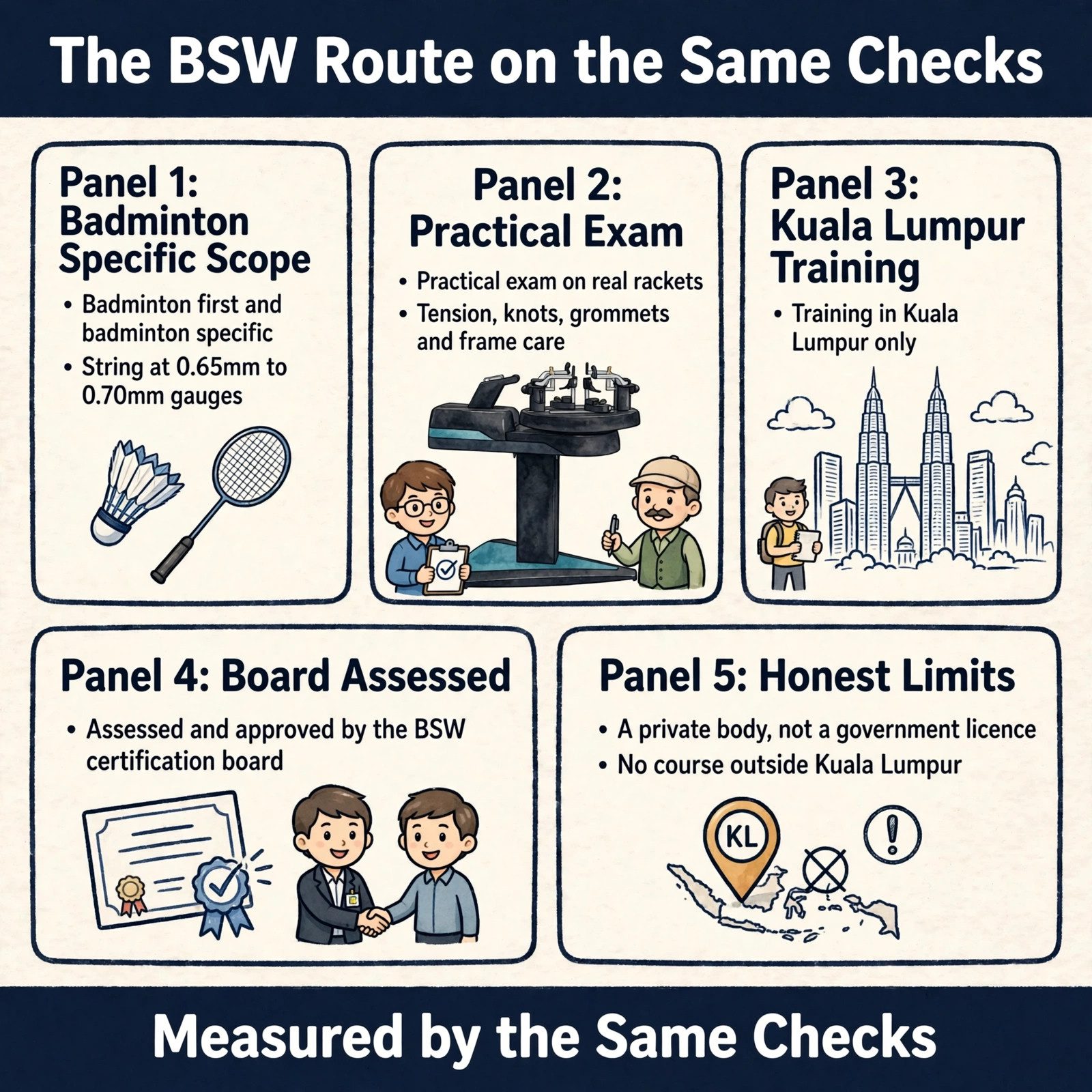
Hold the BSW route against the same four points, with no special pleading. Sport scope: badminton specific, a strength for badminton stringers and a limit for anyone wanting one paper across every racket sport, which is the ground BSW covers. Exam format: practical, on real rackets, at the end of training. Verification: results are assessed and approved by the BSW certification board, and graduates are recorded by the organisation. Honesty points: BSW is a private certification body, not a government licence, and its course runs in Kuala Lumpur only.
Check the details. The BSW training shape is fixed and public. The course runs 3 and a half days, classes run from 10am to 5pm, timing on dates is flexible, and the practical exam sits on the last day. Learners train on real rackets with instructor correction, the loop described earlier in this guide. Founder Eric Chuar teaches from his Kuala Lumpur base, while the certification decision belongs to the BSW certification board as an organisation.
Review the process. Where does BSW not measure up? Say it plainly, because this is BSW’s own page and honesty is the point. The older bodies have longer histories, bigger member lists and wider name recognition outside badminton, especially in tennis. BSW runs one course in one city, Kuala Lumpur, and nowhere else. If your work is mostly tennis in the United States or Europe, another body may serve you better. If your work is badminton, this narrow scope is the strength.
Plan the next step. One check protects you whichever body you choose. Before paying, ask how an employer verifies your pass, what exam day looks like task by task, and what happens if you fail. BSW answers those questions in the enquiry, before enrolment. Judge BSW, BSW and every other body by how directly they answer. A credential you cannot question is hard to trust, and players notice that at the counter.

1.7 Guided Practice
What should you ask BSW before applying anywhere?
A good enquiry makes the body do the proving. State your sport mix, your current stringing volume, the machine you use and the work you want the credential for: shop counter, tournament team, academy or your own business. Then ask the deciding questions. Which level fits my current standard, and what does its exam test task by task? Is badminton tested directly at that level? Who assesses the result, and can an employer verify my pass? What is the full cost, category by category, including retakes? What happens if I fail? Score the written answers before you commit money or travel.
Timing questions matter as much as exam questions. Ask when and where training and testing run, and whether dates can flex around work. At BSW, training is in Kuala Lumpur only, classes run from 10am to 5pm, the course takes 3 and a half days with the exam on the last day, and timing is flexible for learners travelling in. Any body should state its own shape just as plainly in reply.
Turn the answers into a preparation plan the same day. List your weakest exam tasks, the rackets you will practise on, the string gauges you will use and the records you will keep. Book practice like appointments. By exam day, your plan should read like a checklist already worked through twice. Prepared candidates show that standard within the first racket, and examiners can tell.
BSW Certification Quick FAQ
Short answers to the questions candidates ask first about BSW, its courses, exam scope, costs and the BSW comparison.
What is BSW certification and what does it prove?
BSW certification is the badminton specific credential of Best Stringer Worldwide, based in Kuala Lumpur. Levels are earned in a practical exam on real rackets, and every result is assessed and approved by the BSW certification board as an organisation.
What does the certification exam test?
The BSW exam is practical and badminton specific. It tests frame inspection, safe mounting, clean weaving at badminton gauges, delivered tension, clamp control, starting and finishing knots and grommet care, all on real badminton rackets under observation on the last day of training.
How do courses and feedback build skill?
Training builds BSW exam skill when an instructor watches your work and corrects clamp pressure, weaving angle, knots and grommet habits on the spot. Videos teach step order but cannot see mistakes, so live feedback is what turns practice into certification exam readiness.
Which costs and commitments come with it?
BSW certification costs more than one exam fee, and honest planning lists every category before you commit. Training or course fees where you prepare with a provider. The exam or assessment fee for the level you enter. A machine and tools if you do not own them: a reliable machine, clamps, cutters, awl and starting clamp. String and materials for practice on real rackets. Travel and stay if testing or training happens in another city or country. Time away from work or your own stringing queue. And the retake arrangement, understood before you need it.
How does BSW compare with other bodies?
BSW is badminton specific, practical and assessed in Kuala Lumpur by its certification board. USRSA is US based and tennis centred. GRSA is international across racket sports. ERSA is Europe based. CRSF works in China, where badminton is strong.
How does the BSW route measure up?
Measured on the same checks, BSW is narrower and deeper: badminton specific scope, a practical exam on real rackets, training in Kuala Lumpur over 3 and a half days with classes from 10am to 5pm and the exam on the last day, and results assessed and approved by the BSW certification board. BSW is broader, covering stringers across racket sports internationally at certification levels. Choose breadth if you string many sports, and badminton depth if badminton is your work.
What should you ask before applying?
A good enquiry makes the body do the proving. State your sport mix, your current stringing volume, the machine you use and the work you want the credential for: shop counter, tournament team, academy or your own business. Then ask the deciding questions. Which level fits my current standard, and what does its exam test task by task? Is badminton tested directly at that level? Who assesses the result, and can an employer verify my pass? What is the full cost, category by category, including retakes? What happens if I fail? Score the written answers before you commit money or travel.
What should you keep from your certification route?
Keep your level result record, the association confirmation of your pass, your training notes and your stringing records from practice: tensions, strings, knots and grommet work per racket. Ask the body how employers verify your level. These records turn one exam day into a credential shops can check for years.
How can I start with BSW ?
Start with an enquiry that states your sport, your stringing experience, your machine and the work you want certification for. BSW trains in Kuala Lumpur only, with flexible timing, classes from 10am to 5pm over 3 and a half days and the practical exam on the last day. Your result is assessed and approved by the BSW certification board.
BSW Certification: Explore the Practical Decisions
Build a Clear Working Method
The method is simple: write the criteria first, score BSW and every other body against the same criteria, and keep the record so your choice can be explained to any player, shop or tournament that asks.
| BSW Check | Rushed Approach | Planned Approach |
|---|---|---|
| Scope | Assume one paper covers every racket sport | Check the badminton specific scope in writing |
| Exam | Assume certification comes with course attendance | Prepare for tested work assessed against the standard |
| Costs | Budget for the exam fee only | List training, exam, tools, travel and time together |
| Scorecard | Choose BSW because it is the known name in Malaysia | Score every body against the same criteria |
| Your record | Keep body comparisons in your head | Write each body’s scope and exam format down |
| Next action | Judge a credential from the certificate design alone | Use the record to choose the route that fits your sport |
Start Your Badminton Route with Best Stringer Worldwide
If badminton is your sport, take the route that tests badminton properly. Train on real rackets in Kuala Lumpur with Best Stringer Worldwide, with classes from 10am to 5pm over 3 and a half days, flexible timing, and the practical exam on the last day after your training is complete. Your work is assessed and approved by the BSW certification board. Send an enquiry that states your experience, your machine and your goal, and start with your questions answered in writing.
