






1.1 Starting Point
Who is the best stringer in India, and how can a player tell?
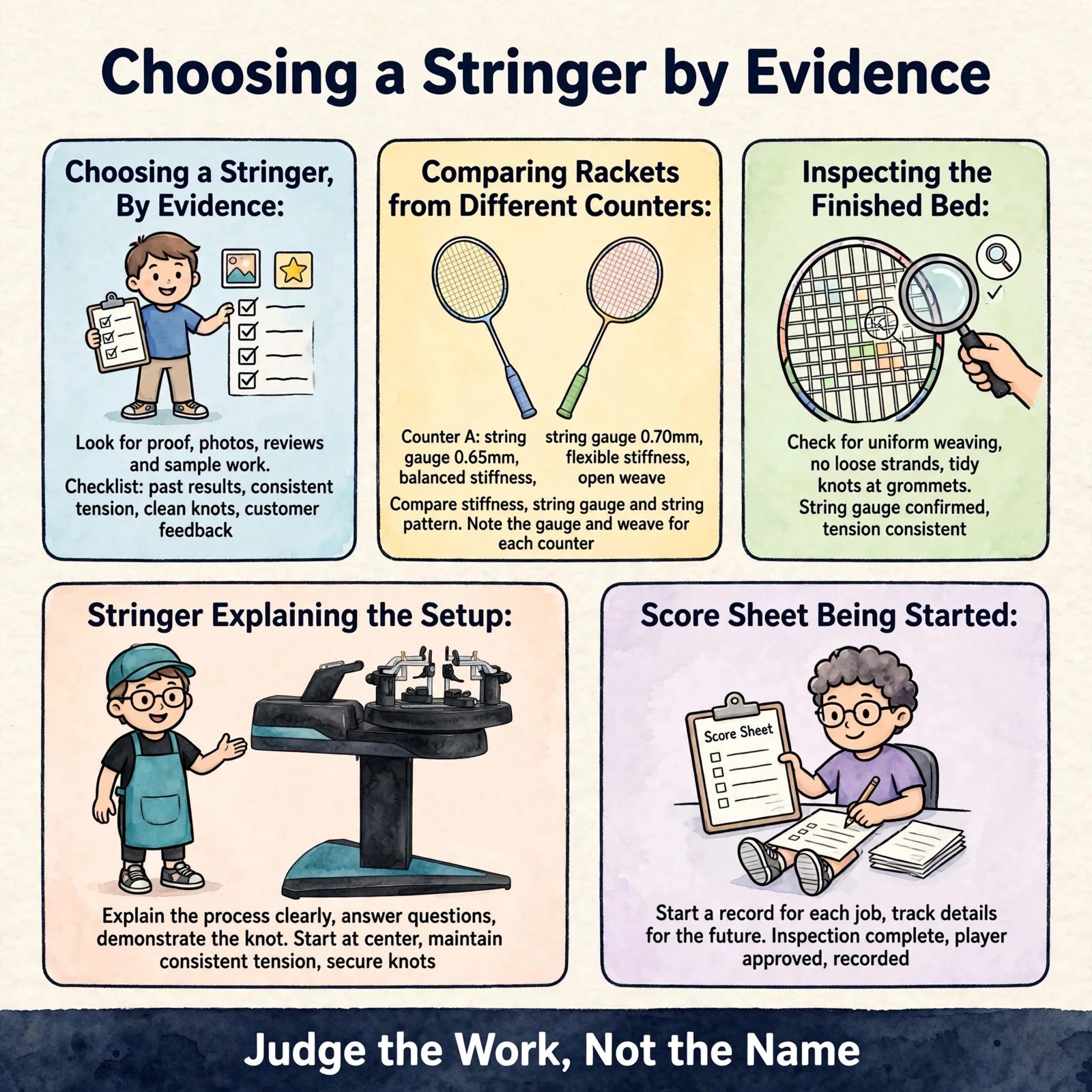
The best stringer in India is not the busiest counter or the one your group chat names first. It is the stringer whose work survives your inspection: the tension in the bed is the tension you ordered, the knots are clean, the grommets come back protected, and the same order plays the same way next month. What separates a certified stringer from an ordinary shop service is that this standard was trained, corrected and then examined on a badminton racket, not picked up informally and never tested. This guide gives players across India a way to find that standard and prove it.
India is a large, spread out badminton market: academies, clubs, school teams and independent shops, with quality that varies from counter to counter and city to city. That spread is exactly why a personal recommendation is not enough. A stringer can be excellent for a beginner setup and careless at higher tensions, so judge the work against checks, not against reputation.
Poor stringing rarely announces itself at the counter. It shows up later: a bed that feels different from the last identical order, a string snapping early at a worn grommet, or control that wanders for no clear reason. The checks in this guide catch those faults at handover, while you can still ask questions and choose a different counter next time.
1.2 Preparation
What does poor stringing look like on a finished racket?
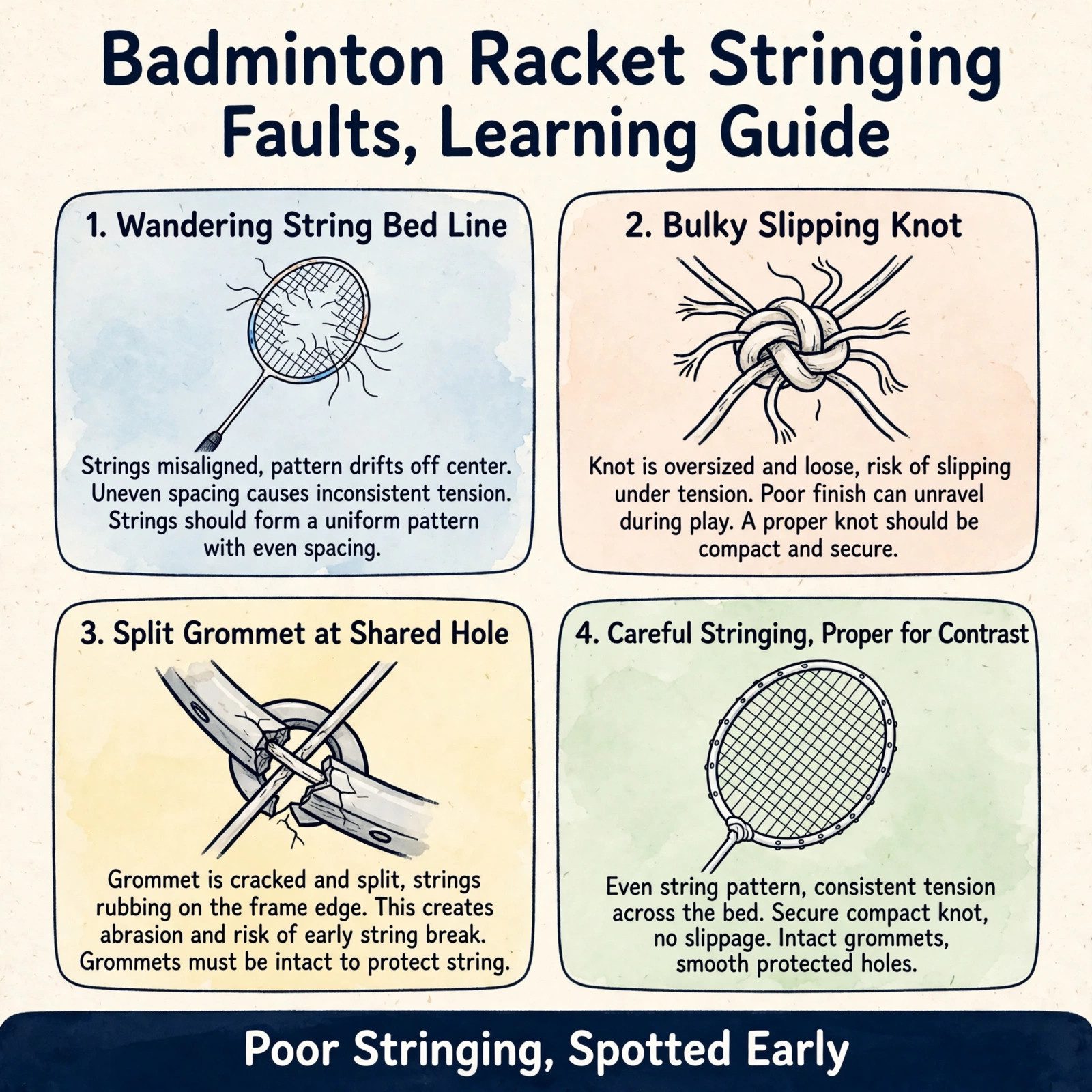
Learn to read poor stringing before it costs you a frame. Start with the bed: lines should run straight with even spacing, and no cross should sit loose or twisted. Move to the knots: a good finish is compact and firm, while a bulky or slipping knot is work done in a hurry. Then the grommets, especially at the shared holes and the top corners: splits, sharp edges and crushed plastic are damage a careful stringer spots and raises with you. Finish by confirming the tension figure that was set, in plain numbers.
Play is the second half of the inspection. With a known string like BG66 Ultimax or BG80 at your usual 25 to 27 lbs, a sound job feels settled within a few rallies and stays familiar across the session. A job that feels harsh one visit and soft the next, on the same order, is telling you the hands behind it are not holding a standard.
Notice the stringer who protects your frame without being asked: replacing a tired grommet, warning you about a crack starting near a hole, or advising against a tension your frame should not carry. That care is part of stringing, not an extra. A counter that never mentions wear is a counter that never looks for it.
1.3 Working Method
How does certified training change a stringer, habit by habit?
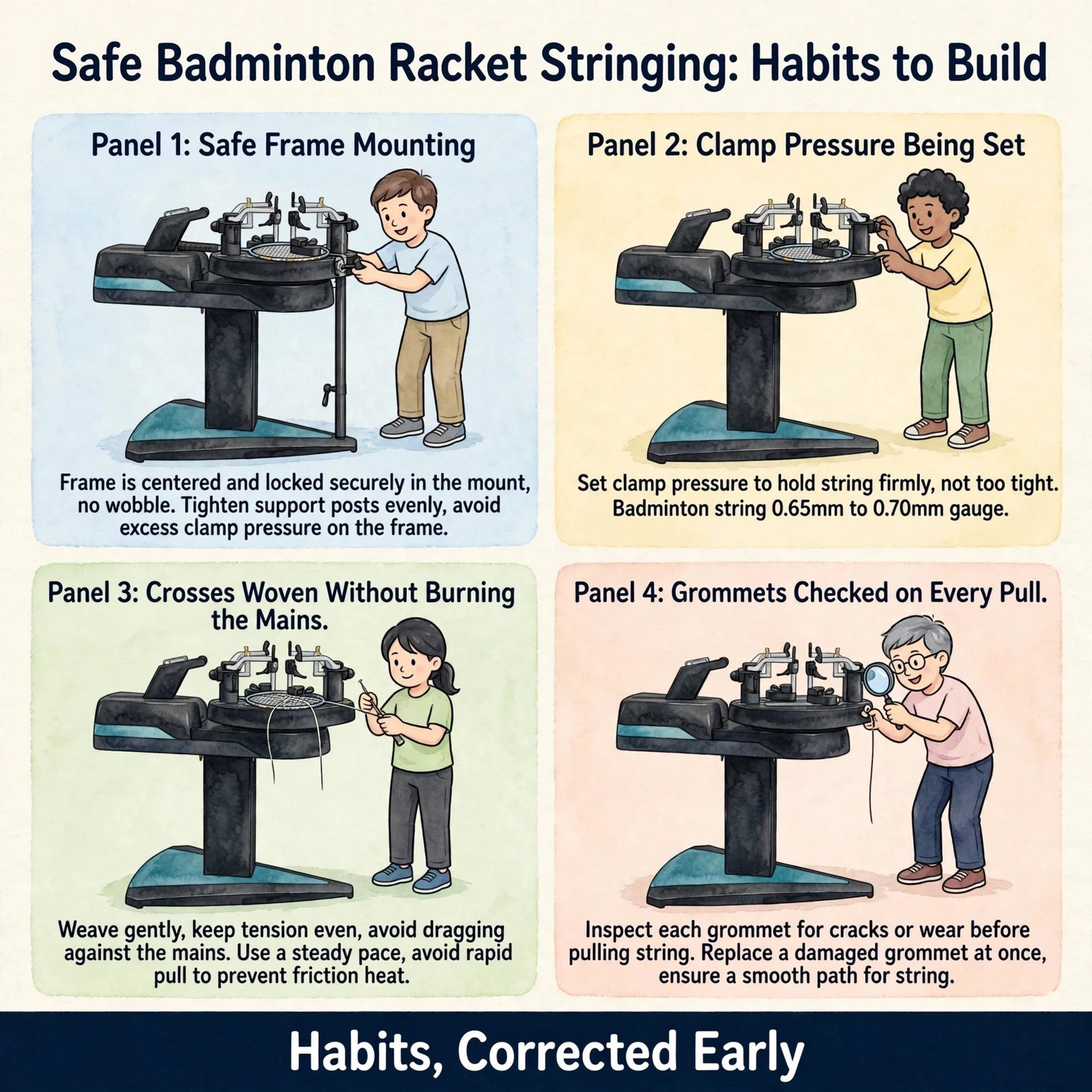
The difference between certified and ordinary work is made during training, long before your racket arrives. In proper training, an instructor corrects the small things as they happen: how the frame is mounted, how clamp pressure is set, how crosses are woven so the mains are not burned, how knots are started and finished, and how grommets are treated on every pull. Ordinary services grow by imitation, watching a senior stringer and copying the visible moves. The invisible judgement, when to slow down, when to replace a part, when a bed is not right, is the part imitation misses.
You can hear the difference in how a stringer talks about the job. A trained stringer explains why a string suits your game, what a tension change will do, and what was found on the frame. An untrained service talks about time and availability only. Both may be pleasant; only one is describing stringing as a craft with a standard behind it.
Ask directly: where were you trained, and did anyone examine your work? A certified stringer can name the training and the exam without hesitation. Treat a long history at the counter as a supporting detail, not the answer itself, because years of uncorrected habit produce very consistent ordinary work, which is not the same as correct work.
1.4 Practical Review
What are the four parts of a proper restring in India?
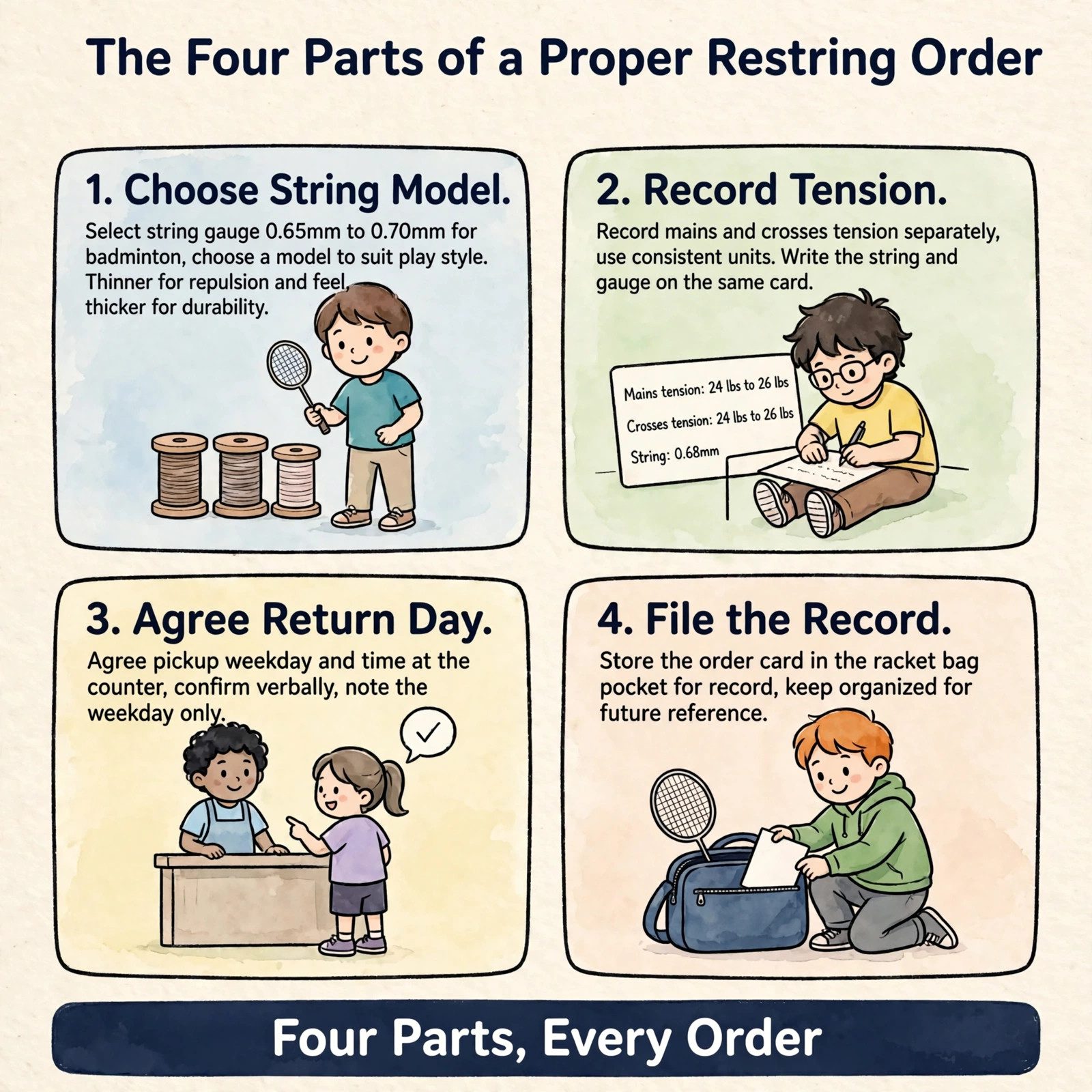
A restring done properly is a small contract with four parts. The string: models such as BG65, BG66 Ultimax, BG80, Exbolt 63 and 65 and KIZUNA Z61 each bring a different feel and life, so choose for your game, not by habit. The tension: the figure that turns that string into your setup. The timing: a return that fits your training and match days. And the record: the written setup that lets the next job repeat this one exactly, or change one thing on purpose and learn from it.
Check the details. State the full order every visit, even at a counter you know: racket, string model, mains and crosses tension, and the day you need it back. Familiarity breeds shortcuts, and a stringer juggling many rackets should be working from your written order, not from a memory of your face.
Review the process. Time the job around your badminton, not around the shop rush. Restring ahead of a tournament or a heavy training block, keep a second racket ready if your string goes during a session, and give a fresh bed one easy session before you judge it or trust it in a close match.
Plan the next step. Keep the record without fail: date, string, tension, stringer and two or three words on the feel after playing. Across a season that page becomes your evidence. It settles arguments about what changed, guides your next string or tension choice, and shows any new stringer exactly what your game needs from the first visit.
1.5 Key Checks
How should players in India compare stringers with one test and one scorecard?
Record the context.
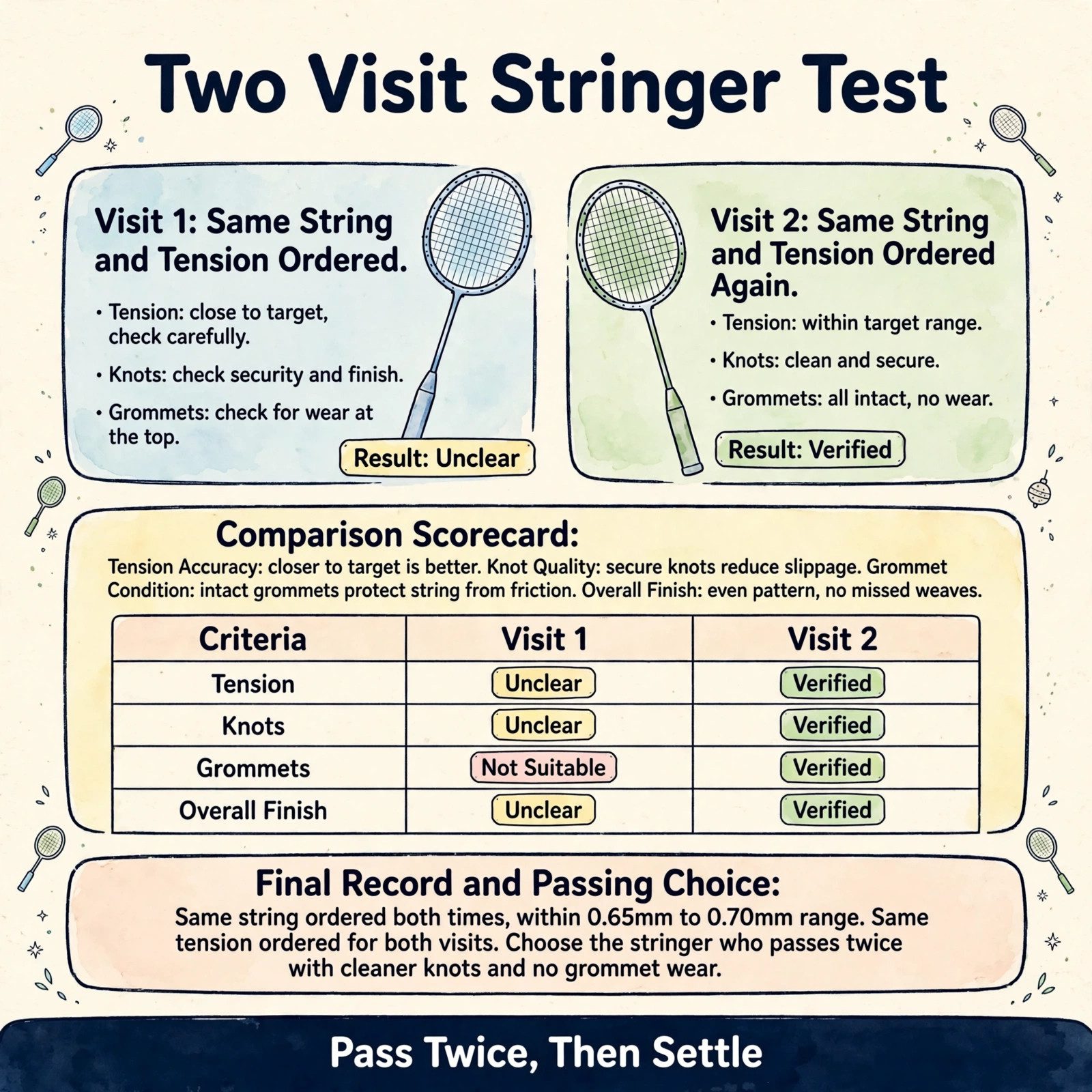
To compare stringers across a market this size, give them one identical test and one shared scorecard. Same string, same tension, same kind of racket, then score every return on the same six lines: tension against the order, knot quality, grommet care, evenness of the bed, honesty of answers and the record provided. Mark each line verified, unclear or not suitable for you. A stringer who passes twice, on two separate visits, has shown you a standard. A single good job has only shown you a good day.
Check the details.
Write the scores while the rackets are in front of you, with dates and setups noted. In a big city you may test three counters in a month; without notes, the last visit colours all the others. The sheet keeps each stringer judged on their own work, which is the only fair way and the only useful way.
Review the process.
Weight the sheet for your level. Academy and advanced players should weight tension accuracy and repeatability first, because small drifts change timing at speed. Developing players should weight grommet care and honest advice first, because protecting the frame and the arm matters more while the game is still growing.

1.6 Service Record
How does a BSW certified stringer in India score on your scorecard?
Run a BSW certified stringer in India through the identical scorecard, with no marks given for the certificate itself. Best Stringer Worldwide (BSW) is a badminton stringing course and certification provider based in Kuala Lumpur, Malaysia, founded by Eric Chuar. Its candidates train on real rackets with an instructor correcting their work, then sit a practical certification exam held the day after training. Certification is assessed and approved by the BSW certification board, so the mark states that tension work, knots, grommet care and bed quality were examined on a badminton racket and met the board standard.
Check the details. What you should notice at such a counter is process: questions about your game before the order is taken, the setup written down, wear on the frame raised early, and a handover that expects your inspection. If the process is missing, score what you see. The BSW standard is a standard of work, and work is what the scorecard measures.
Review the process. Hold the geography clearly in mind. The BSW course runs only in Kuala Lumpur, with flexible timing, and BSW does not run classes or a shop in India. An Indian stringer with BSW certification made the trip to train and sit the exam there. In a market full of unverified claims, a claim you can trace to a training route and an exam board is worth shortlisting, then testing like any other.
Plan the next step. Once a stringer passes your test twice, settle in, but keep the record running. Standards hold when both sides keep checking: you bring the notes, the stringer works to them, and any drift gets named early. That steady loop, more than any single certificate or single great job, is what the best stringer in India actually looks like over a season.
1.7 Guided Practice
What should you state and ask before you book a restring in India?
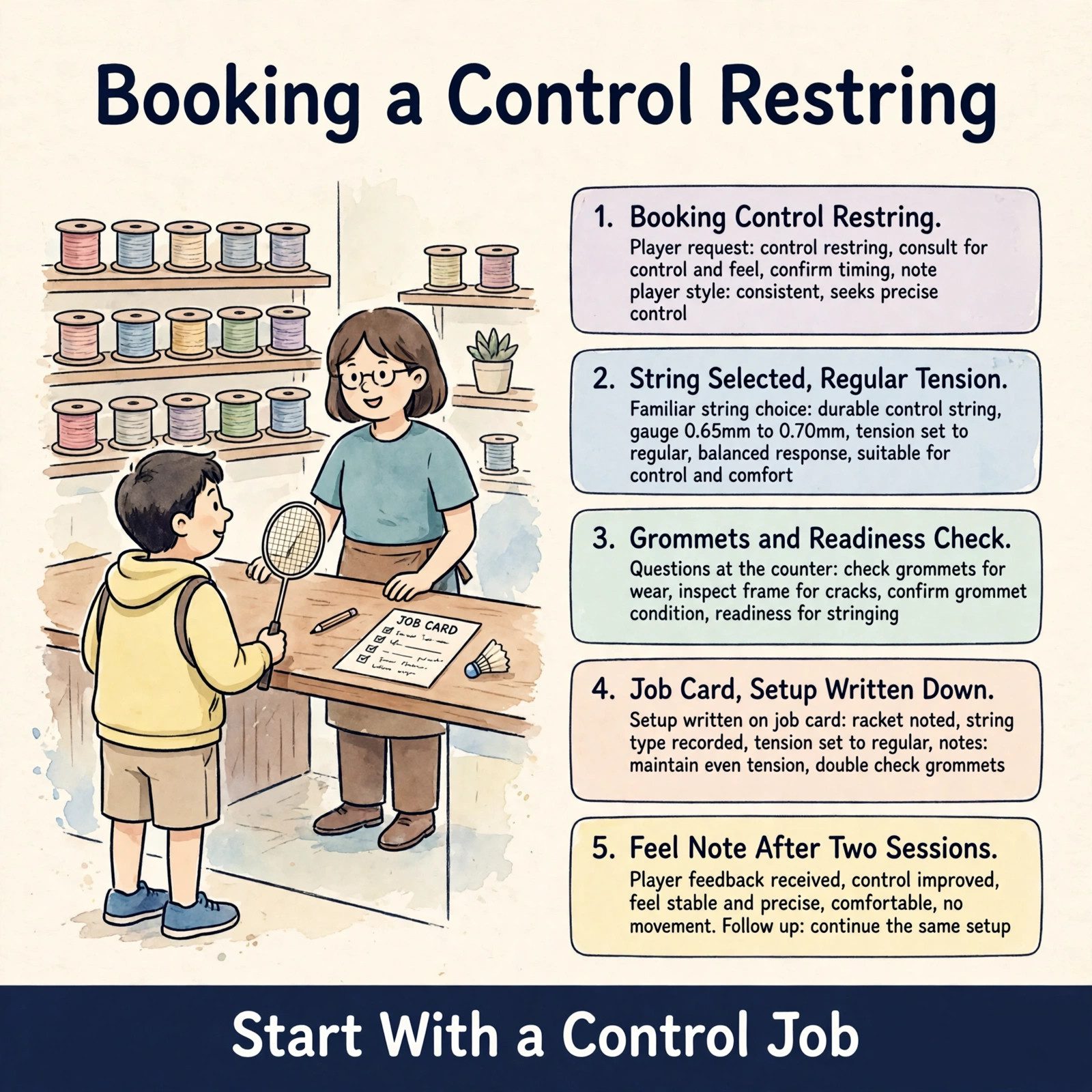
Book like a player who knows what good looks like. State your level, your weekly playing load, your racket, your current string and tension, and what went wrong with the last job, if anything did. Then ask: what tension will you set on the mains and crosses, will you inspect the grommets and replace any that are worn, when will the racket be ready, and will you write the setup down so we can repeat it? A stringer working to a standard answers each point directly. Evasion on any point is your answer about the rest.
Keep the first order a known quantity: your regular string, or a widely used one like BG65, at your regular tension. That control job separates the stringer from the setup, so a good or bad result tells you about the hands, not about an experiment. Try new strings and tensions only after the control job passes your checks.
Agree the follow up before you leave: play the racket, note the feel after two sessions, and bring the note back with the next job. Stringers who keep standards respect players who keep records, and the shared habit turns a scattered search across many counters into one reliable arrangement for your game.
Best Stringer in India Quick FAQ
Clear answers for players in India on spotting a proper stringer, reading poor stringing early and using certification as a trust check.
Who is the best stringer in India?
The stringer whose jobs repeat: ordered tension delivered, knots clean, grommets protected and the bed even, whether the racket is a first restring or a fifth. Certification signals that this standard was trained under correction and passed in a practical exam.
What does poor stringing look like?
Check the bed for straight and even spacing, the knots for a tight and tidy finish, and the grommets for splits or wear the stringer should have flagged. Ask for the set tension and compare the playing feel with your last identical job.
How does certified training change a stringer?
A certified stringer works from corrected habits: frame mounted safely, crosses woven with care, knots tied off cleanly and grommets checked as part of the job. Untrained work copies what was seen at a counter, with the errors copied too.
What are the four parts of a proper restring?
A restring done properly is a small contract with four parts. The string: models such as BG65, BG66 Ultimax, BG80, Exbolt 63 and 65 and KIZUNA Z61 each bring a different feel and life, so choose for your game, not by habit. The tension: the figure that turns that string into your setup. The timing: a return that fits your training and match days. And the record: the written setup that lets the next job repeat this one exactly, or change one thing on purpose and learn from it.
How should I compare stringers in India?
Set one identical test for every stringer: same racket type, same string, same tension. Score each return on tension, knots, grommets, bed, answers and record, marking each line verified, unclear or not suitable for you.
How does a BSW certified stringer score in India?
Score a BSW certified stringer in India exactly as you score the shop around the corner, and let the finished racket speak first. Behind a passing score sits a verifiable route: Best Stringer Worldwide is based in Kuala Lumpur, Malaysia, founded by Eric Chuar, and it trains stringers on real rackets before a practical exam, with certification assessed and approved by the BSW certification board. BSW runs no shop and no classes in India, so an Indian stringer carrying that certificate travelled to Kuala Lumpur to train and be examined. The certificate narrows your search; your own checks finish it.
What should I ask before I book?
Book like a player who knows what good looks like. State your level, your weekly playing load, your racket, your current string and tension, and what went wrong with the last job, if anything did. Then ask: what tension will you set on the mains and crosses, will you inspect the grommets and replace any that are worn, when will the racket be ready, and will you write the setup down so we can repeat it? A stringer working to a standard answers each point directly. Evasion on any point is your answer about the rest.
What should I keep from every restring?
Date, string, tension, stringer and the feel after a few sessions, written down for every job. In a market as large as India, that small record is how you hold one good setup steady across counters, cities and seasons.
How can I proceed with BSW?
Players in India can look for a stringer whose certification checks out, then prove the work with the tests on this page. Stringers who want the BSW route travel to Kuala Lumpur, train on real rackets, and take the practical certification exam the day after training.
Best Stringer in India: Explore the Practical Decisions
Build a Clear Working Method
Use the sections, comparison table and quiz to build a standard you can apply at any counter in India. Keep the record open when you judge, and score the work, not the welcome.
| Stringer Check | Rushed Approach | Planned Approach |
|---|---|---|
| Find | Follow the busiest counter and the group chat | Find a stringer whose standard survives inspection |
| Judge | Play first and discover the faults later | Read poor stringing at handover, not weeks later |
| Book | Rely on the stringer remembering your face | Give the full written order on every visit |
| Trust | Settle after a single good job | Settle only after the same test passes twice |
| Your record | Judge counters from different orders | Write the identical test and scores down |
| Next action | Change strings on a guess each time | Use the season record to guide each change |
Judge Stringing by a Tested Standard with Best Stringer Worldwide
Want a stringing standard that was tested, not just talked about? Best Stringer Worldwide trains stringers on real rackets in Kuala Lumpur and examines them in a practical test, with certification assessed and approved by the BSW certification board. Stringers in India can ask about the route and its flexible timing. Players can start with the checks on this page: one known setup, one careful inspection, one written record.

