






1.1 Starting Point
What is the best badminton stringing certification in the USA?
The best badminton stringing certification for a stringer in the USA is the one with a badminton specific practical exam, hands on training that corrects your work, and a certificate that states exactly what was tested. The US has a strong racket stringing culture, but much of it is built around tennis, with its own credentials, workshops and shop habits. That background helps with machines and workflow, yet it does not by itself prove badminton skill on small frames with thin string. Judge every route, American or overseas, by what its exam marks and what its training actually corrects.
Name the work you want first. Tournament support, a pro shop counter, a college club and a home based service all reward the same core skill, but they test it differently. Shops and clubs in the US ask a simple question before anything else: can this stringer repeat good work, racket after racket, when it is busy?
Write your standard down before you compare providers. Badminton frames only in the exam, feedback while you string, a syllabus you can read in advance, and certificate wording you could hand to a shop owner. An offer that cannot be checked against that list is asking you to trust the badge instead of the test behind it.
1.2 Preparation
What does a proper badminton exam actually check?
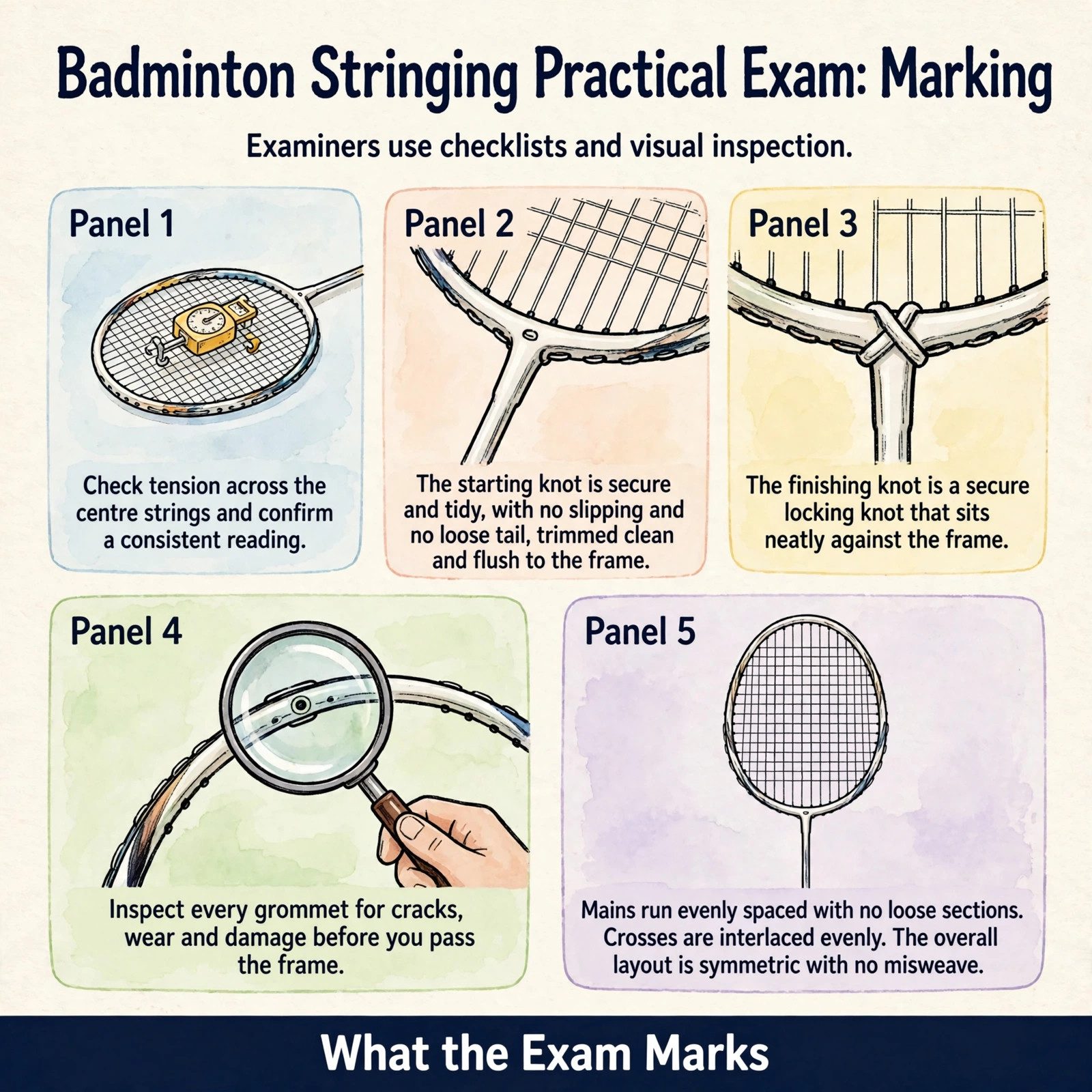
A serious badminton exam marks the finished racket and the habits behind it: tension accuracy against the setting given, clean starting and finishing knots, careful grommet work, and a straight, even string bed, produced more than once. The contrast with tennis matters in the US. Tennis string is far thicker, heads are larger, and the feel of a correct job is different. Badminton uses string at 0.65mm to 0.70mm gauges and playing tensions such as 25 to 27 lbs on a small head with a slim shaft, where a sloppy knot or a damaged grommet shows up fast.
Ask any provider to describe the marking before you enrol. Which frame, which string, which tension, and what counts as a fail? A provider running a real exam answers clearly and in detail. A provider who stays vague about marking, or who points only to a famous name, is asking you to buy reputation instead of a tested standard.
Repeatability is what US shops and tournament desks really buy. One tidy racket proves little on its own. The same tension, knots and care across several rackets, including frames like the Astrox 88D and the Yonex 100ZZ, tells a manager your standard will hold on a busy weekend with a queue of players waiting.
1.3 Working Method
How does hands on training with feedback build real skill?
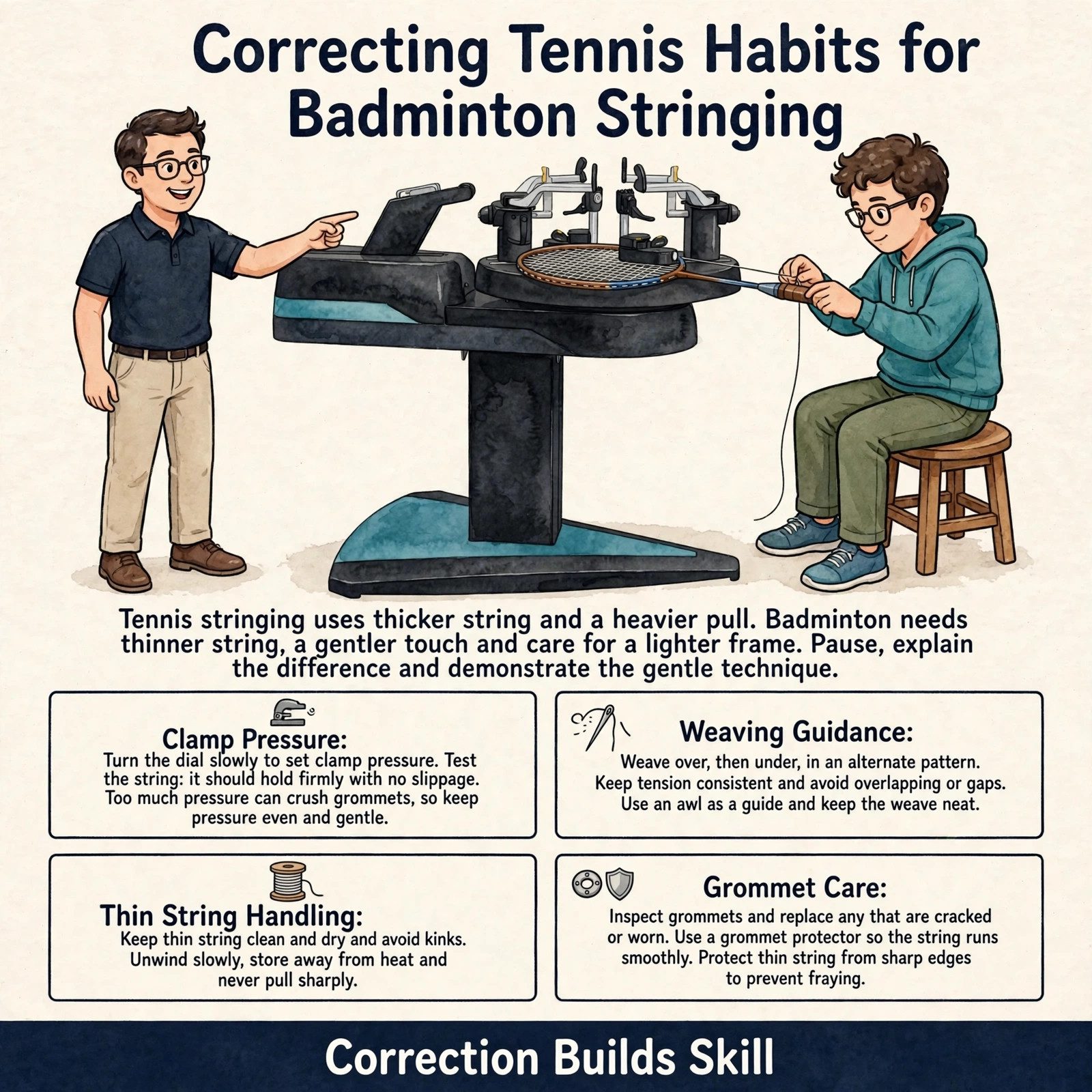
Skill at the machine grows through correction, not exposure. Clamp pressure, weaving angle, handling shared holes, starting and finishing knots, and grommet care decide whether a badminton racket plays cleanly and lasts. An instructor watching your hands can fix those habits as they happen. Learning from videos alone, or carrying tennis habits across without checking them, leaves faults in place because nobody sees your work. Tennis experience is a real head start on machine setup and workflow. It is not a substitute for badminton specific correction on tension feel, thin string handling and frame care.
Ask how a training day actually runs. How many badminton rackets do you string yourself, on strings such as BG66 Ultimax, BG80 or KIZUNA Z61? Who watches each job, and how is a mistake shown and put right? If most of the time is lecture and demonstration, you are buying information, not the corrected practice an exam rewards.
Build your home practice around the exam standard. String full rackets, record the string, tension and result for each job, and repeat the work you find hardest until it is routine. A written record from your own bench in the US turns casual practice into evidence a shop can read and an examiner can respect.
1.4 Practical Review
Which costs and commitments should a US learner list in full?
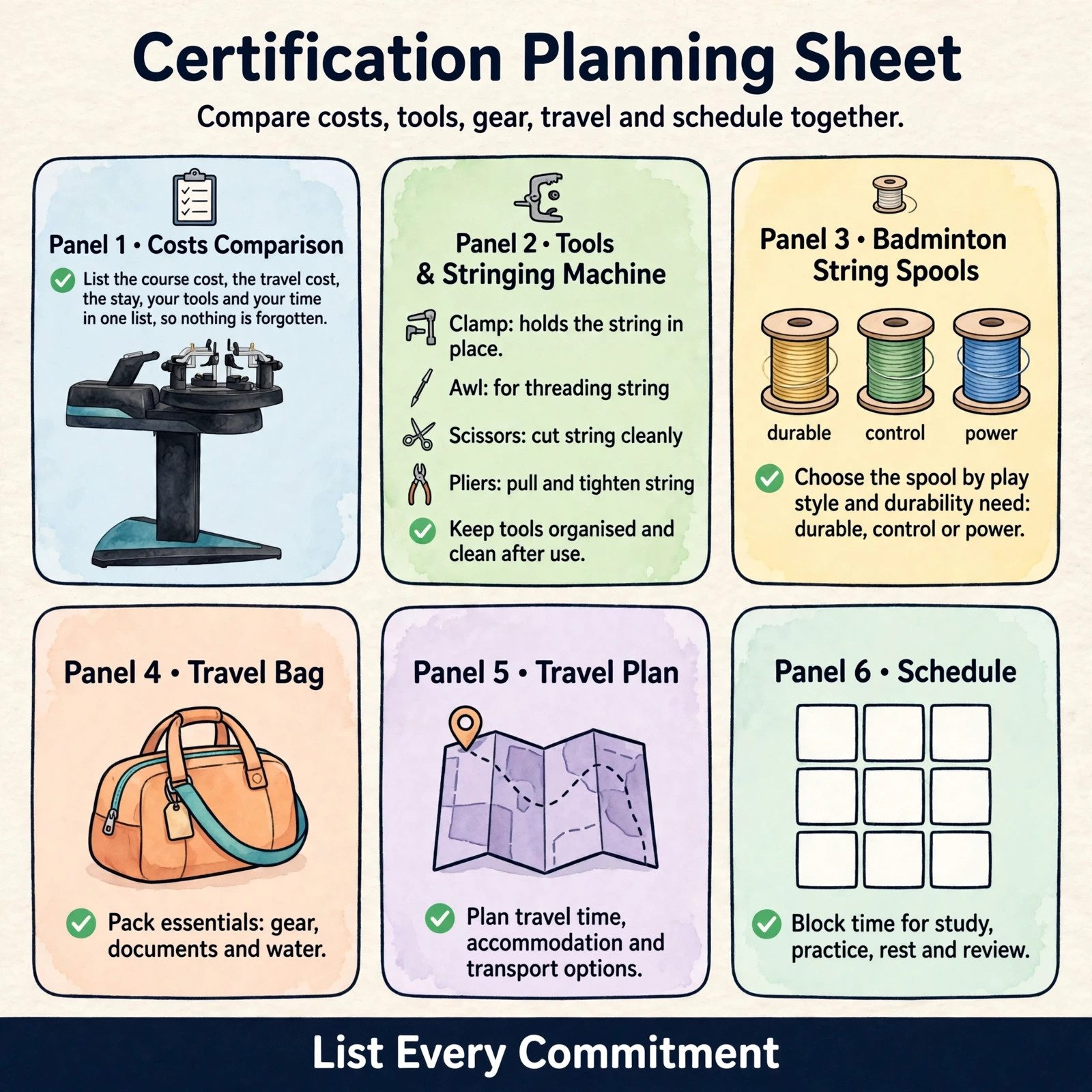
Put the full commitment on paper before you judge any route by price. For a US learner the lines are: the course, the exam, a machine and tools if you do not own them, string and materials for practice, travel and stay for wherever training happens, and time away from work. Add the retake arrangement if a first exam attempt goes badly. If you train in Kuala Lumpur, the flight and nights away belong on the same sheet as a domestic workshop, so the comparison between staying in the US and travelling is honest from the start.
Check the details. Give each item its own line and mark unknown lines as questions, not as zero. A domestic option with no badminton exam may look lighter until you add the cost of proving your badminton skill to every shop and club separately, again and again.
Review the process. Time counts beside money. Travel days, training days, the exam day and the practice weeks before you go all belong on the sheet. A route you can attend fully, prepared and rested, serves you better than a rushed trip squeezed between shop shifts and club nights.
Plan the next step. Use the same lines for every option and keep the sheet with your notes. When a provider will not state a commitment in writing, mark that line unclear and count it in the comparison. Silence about retakes, class size or what is included usually matters more later than the points a provider is happy to advertise today.
1.5 Key Checks
How should I compare US options against the Kuala Lumpur route?
Record the context.
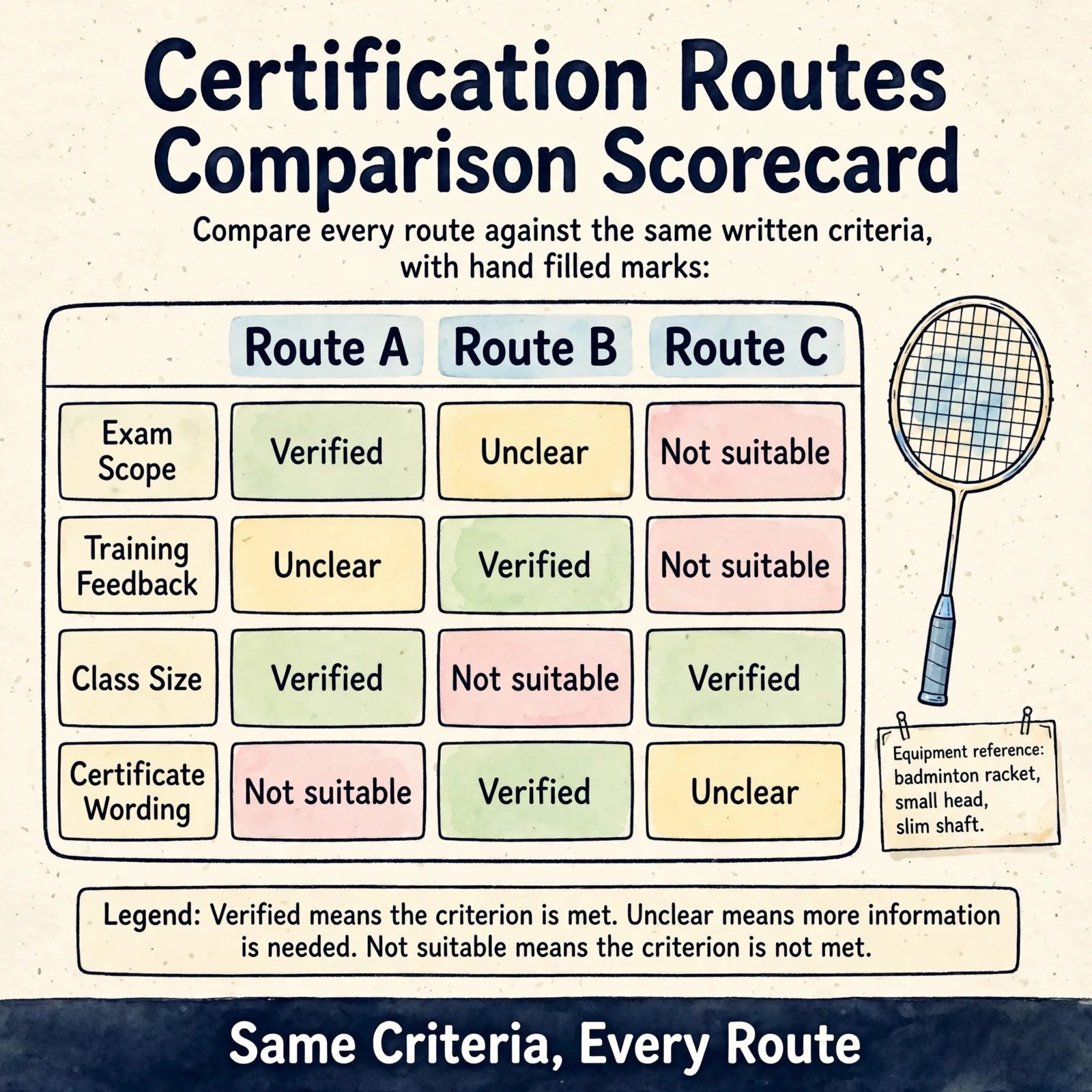
Compare routes with one scorecard, scored the same way for all of them. The criteria: badminton specific exam scope, training feedback, class size, syllabus in writing, complete commitments and certificate wording. For each line mark verified, unclear or not suitable for you, with a short note explaining the mark. That method treats a US workshop, a general racket credential and an overseas course equally. The best route for you is the one that scores best on those lines for the work you want, not the one with the loudest name in American racket sports.
Check the details.
Be strict on the badminton line. A credential earned mainly on tennis frames should score unclear or not suitable for badminton exam scope, however well known it is. A shop owner hiring for badminton work will ask the same question, so ask it first and in writing.
Review the process.
Check the scorecard against your goal before you narrow the field. If you want shop or tournament work, weight the exam and the training feedback highest, because repeatable work under pressure is what those jobs pay for. Keep open questions separate, so your next conversation goes straight to the gaps.

1.6 Service Record
How does the BSW route measure up for a US stringer?
Run the BSW route through that scorecard with no special treatment. Best Stringer Worldwide (BSW) is a badminton stringing course and certification provider based in Kuala Lumpur, Malaysia, founded by Eric Chuar. It does not run classes in the USA. The route is training on real badminton rackets with an instructor correcting your work, then the practical certification exam the day after training. Certification is assessed and approved by the BSW certification board, so a pass states tested badminton skill on the day, at real playing tensions.
Check the details. On the scorecard lines, the BSW route is badminton specific throughout: training, exam and certificate all concern badminton frames, badminton string and badminton tensions. For a US stringer whose local options lean toward tennis, that focus is the main point of difference, and it should be weighed openly against the travel the route requires.
Review the process. Timing is flexible, and the course runs in Kuala Lumpur only, so a US learner plans one trip covering training and the exam together. That structure suits a stringer who prepares at home first, travels once, and returns with a tested result and written feedback to show shops, clubs and tournament organisers in the US.
Plan the next step. Where a scorecard line stays unclear, ask about that line only. Ask what the exam marks, what equipment you will train on, and what preparation is expected before you travel. Put the answers into the sheet and judge the whole route on the completed picture, not on distance alone and not on any single selling point.
1.7 Guided Practice
What should I ask before I enrol from the USA?
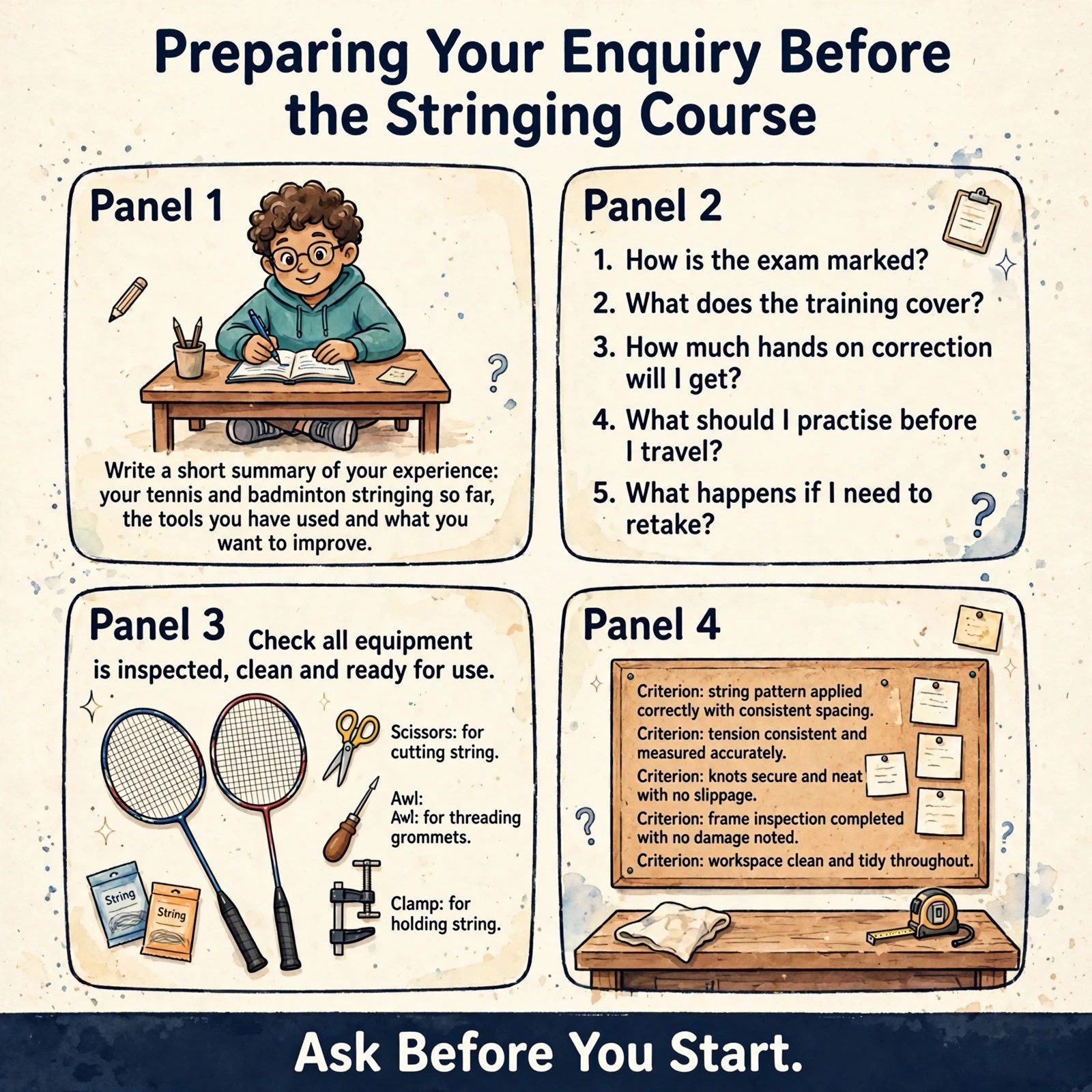
Before you enrol anywhere, state your case plainly: your stringing experience in tennis, badminton or both, the machine and rackets you use now, where in the USA you are based, and the work you want the certificate for. Send that summary with the questions still open on your scorecard. The questions worth sending are the ones that change a decision: what the exam marks, who corrects your work during training, what the full commitment list looks like including travel, and what happens if you need a retake.
Prepare before you travel or train. Practise on the badminton strings and tensions US players ask for most, log each job, and write down the faults you already know about, especially habits carried over from tennis work. Honest records give an instructor real material to correct from the first racket.
Keep every reply with your scorecard and goal. Once you choose a route, turn the confirmed details into a preparation plan: rackets and strings to practise on, tensions to repeat until they are boring, and the exam criteria kept visible at your bench. That plan turns a certificate choice into skill you can prove.
Best Badminton Stringing Certification in the USA Quick FAQ
Clear answers for US stringers on badminton specific exams, tennis heavy routes, full costs and the BSW course in Kuala Lumpur.
What is the best badminton stringing certification in the USA?
The route whose practical exam tests badminton work on badminton frames, with training that corrects your hands and a certificate stating what was marked. A respected tennis credential alone does not prove that badminton standard.
What does a proper badminton exam actually check?
Tension accuracy, clean knots, grommet care and an even string bed, repeated on badminton frames at real tensions with thin string. A test built around tennis frames and thick string checks a different skill set.
How does hands on training build real skill?
By correction on real rackets. An instructor watches clamp pressure, weaving and knots while you string and fixes faults at once. Videos and theory explain the sequence, but they cannot see or correct your own habits.
Which costs and commitments should I list?
Put the full commitment on paper before you judge any route by price. For a US learner the lines are: the course, the exam, a machine and tools if you do not own them, string and materials for practice, travel and stay for wherever training happens, and time away from work. Add the retake arrangement if a first exam attempt goes badly. If you train in Kuala Lumpur, the flight and nights away belong on the same sheet as a domestic workshop, so the comparison between staying in the US and travelling is honest from the start.
How should I compare US and overseas routes?
Use one scorecard for every route: exam scope, training feedback, class size, syllabus in writing, full commitments and certificate wording. Mark each line verified, unclear or not suitable, for US and overseas routes alike.
How does the BSW route measure up?
For a US learner, the BSW route means one planned trip to Kuala Lumpur rather than classes in the USA, because Best Stringer Worldwide runs its course only there. You train on real badminton rackets with an instructor correcting your work, then sit the practical certification exam the day after training. Certification is assessed and approved by the BSW certification board, so the result states tested badminton skill, not attendance or tennis experience. Score it on the same lines as any US option: exam scope, training feedback, class size, syllabus in writing, full travel and course commitments, and certificate wording.
What should I ask before I enrol?
Before you enrol anywhere, state your case plainly: your stringing experience in tennis, badminton or both, the machine and rackets you use now, where in the USA you are based, and the work you want the certificate for. Send that summary with the questions still open on your scorecard. The questions worth sending are the ones that change a decision: what the exam marks, who corrects your work during training, what the full commitment list looks like including travel, and what happens if you need a retake.
What should I keep from my certification route?
Your exam feedback, your practice records and the scorecard you chose by, kept together. For a US shop or club, that bundle shows what your certificate covered, how you were marked, and how you have kept the standard since, far better than a certificate alone.
How can I get certified with BSW from the USA?
State your experience, your equipment and the US work you want the certificate for, then follow the route: train on real rackets in Kuala Lumpur and sit the certification exam the day after training. Prepare at home first, using the exam criteria as your practice guide.
Best Badminton Stringing Certification in the USA: Explore the Practical Decisions
Build a Clear Working Method
Use the sections, questions and comparison on this page to score US and overseas routes the same way. Keep your scorecard and let the gaps on it decide what you ask next.
| US Certification Check | Rushed Approach | Planned Approach |
|---|---|---|
| Certificate | Pick the best known racket badge and stop checking | Judge every US route by what its exam actually tests |
| Exam | Assume a tennis exam proves badminton skill fully | Check tension, knots and grommets on a badminton frame |
| Costs | Budget for the course fee and forget the trip | List course, travel, stay, tools and time together |
| Scorecard | Compare routes by reputation and marketing alone | Score each route against the same written criteria |
| Your record | Keep the comparison in your head | Write the criteria and each answer down |
| Next action | File the certificate and forget the feedback | Use your exam feedback to plan the next practice |
Find the Best Certification Route from the USA with Best Stringer Worldwide
Ready to pick a certification route that ends in a real badminton exam? Tell Best Stringer Worldwide about your experience, your equipment and the shop or club work you want in the USA. Bring your scorecard or one sharp question so the reply can focus on fit, travel and preparation. Train on real rackets in Kuala Lumpur, then take the practical certification exam the day after training, assessed and approved by the BSW certification board.

