






1.1 Starting Point
What should a fair course fee actually include?
A fair badminton stringing course fee is not the lowest headline and it is not the highest either. It is a fee that clearly covers the things that make the course real: proper training time on real rackets, a small enough class for your work to be corrected, a practical exam and assessment, the certificate that follows a pass, materials you will use while learning, and clear retake terms if the first attempt goes badly. This guide gives you no fee figure for any course, on purpose. It teaches you how to read what a fee includes, so you can judge any offer on evidence.
Start by refusing to compare headlines. Two courses can ask very different fees and deliver opposite value once you read the inclusions. One may cover training, exam, certificate and materials in a single clear fee. Another may add each of those later, one surprise at a time.
Write the inclusion list before you ask about any fee. Training, class size, exam, assessment, certificate, materials and retake terms: seven lines. Every provider answers the same seven lines, in writing. An inclusion a provider will not confirm in writing should be treated as not included until it is confirmed.
1.2 Preparation
Is the exam and assessment inside the fee or outside it?
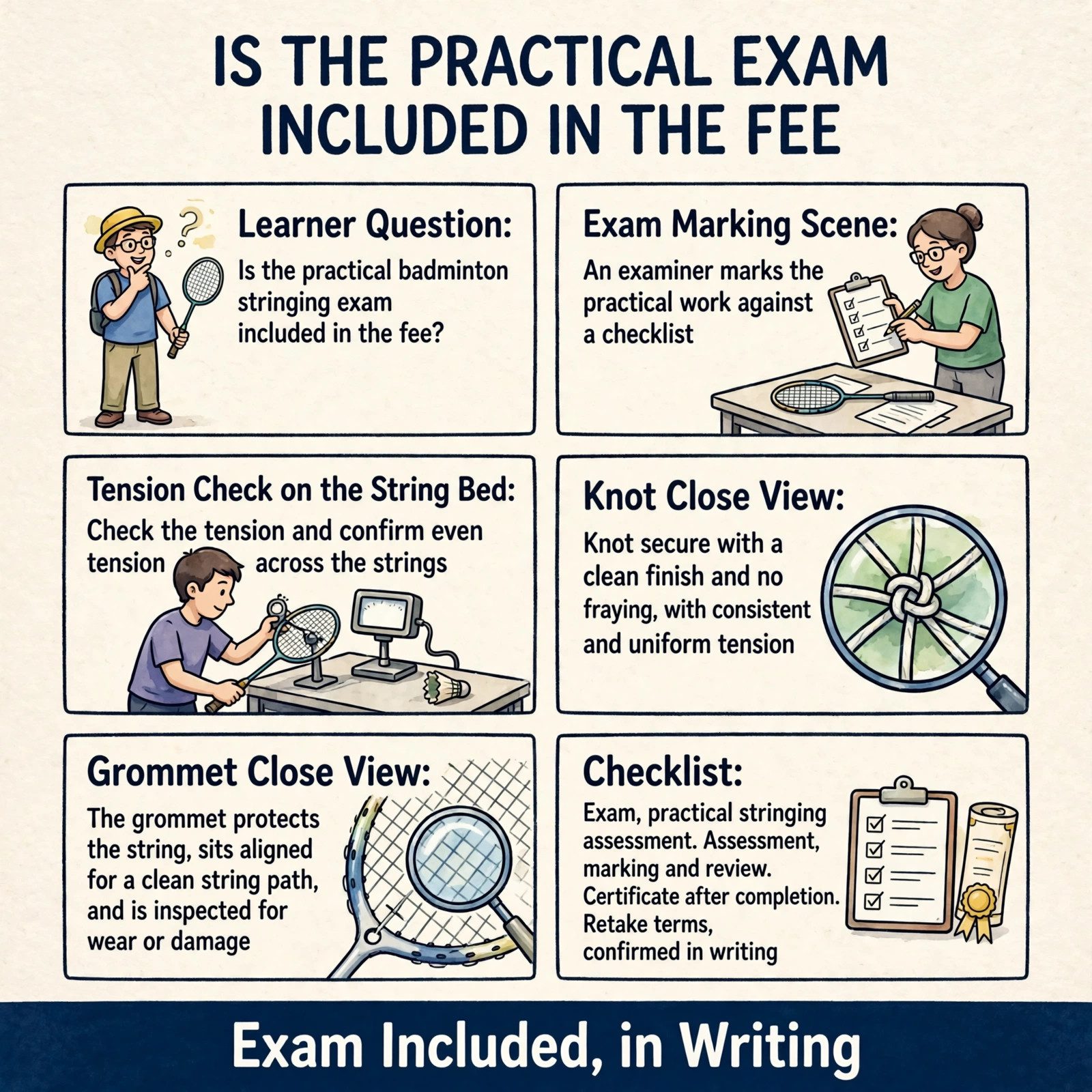
The exam is the line that most often hides outside a headline fee, so check it early. Ask whether the practical exam is included, whether assessment by a proper board or examiner is included, and whether the certificate itself carries a separate charge. Ask also what a fail means: is a retake allowed, what does a retake cover, and on what terms? A course whose fee covers teaching but not testing leaves you paying twice for one outcome, and a certificate charged as an extra after a pass is a warning about how the whole offer is built.
Ask what the exam actually checks while you are on this line. Tension accuracy, knots, grommet care, frame inspection and fault finding are practical skills. If the assessment behind the fee is vague, the certificate it buys will be vague too, whatever the fee was.
Get the retake terms in plain words before you pay. Retake terms show how a provider treats a learner who tried and fell short. Clear terms written in advance are a sign of a serious course. Terms you have to chase after a fail are a sign of the opposite.
1.3 Working Method
How do training time and class size change what a fee buys?
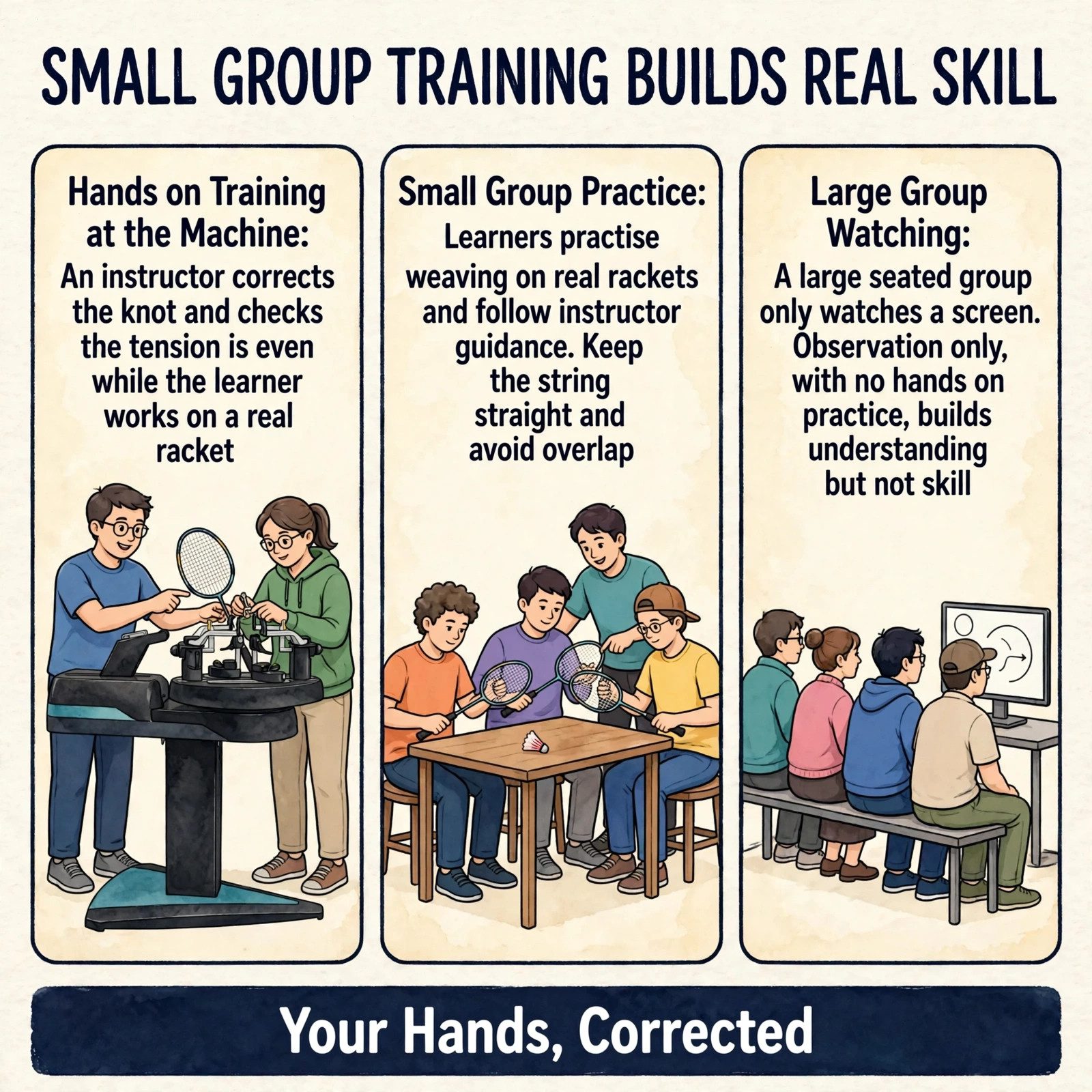
Training time and class size decide what a fee really buys, because stringing is learned by doing. A fee that covers long stretches of watching an instructor, in a large group where nobody checks your hands, buys far less skill than a fee that covers your own time at the machine in a small group with correction. Ask how much of the training is your hands on real rackets, how many learners share the instructor, and whether feedback on your own work is part of what you are paying for. Strings such as BG65 and BG66 Ultimax and rackets like the Astrox 88D should be in your hands, not only on a screen.
Small group teaching costs a provider more to run, and that is often where a fair fee goes. You are not paying for a room and a talk. You are paying for an expert to watch your clamp pressure, weaving and knots and to put them right before they become habits.
Be wary of a fee that sounds light because the teaching is thin. Videos only, theory only and large group watching are cheaper to deliver, and the saving shows up later in your exam result and in the first rackets you string for paying players.
1.4 Practical Review
Which costs beyond the fee should I list before comparing?
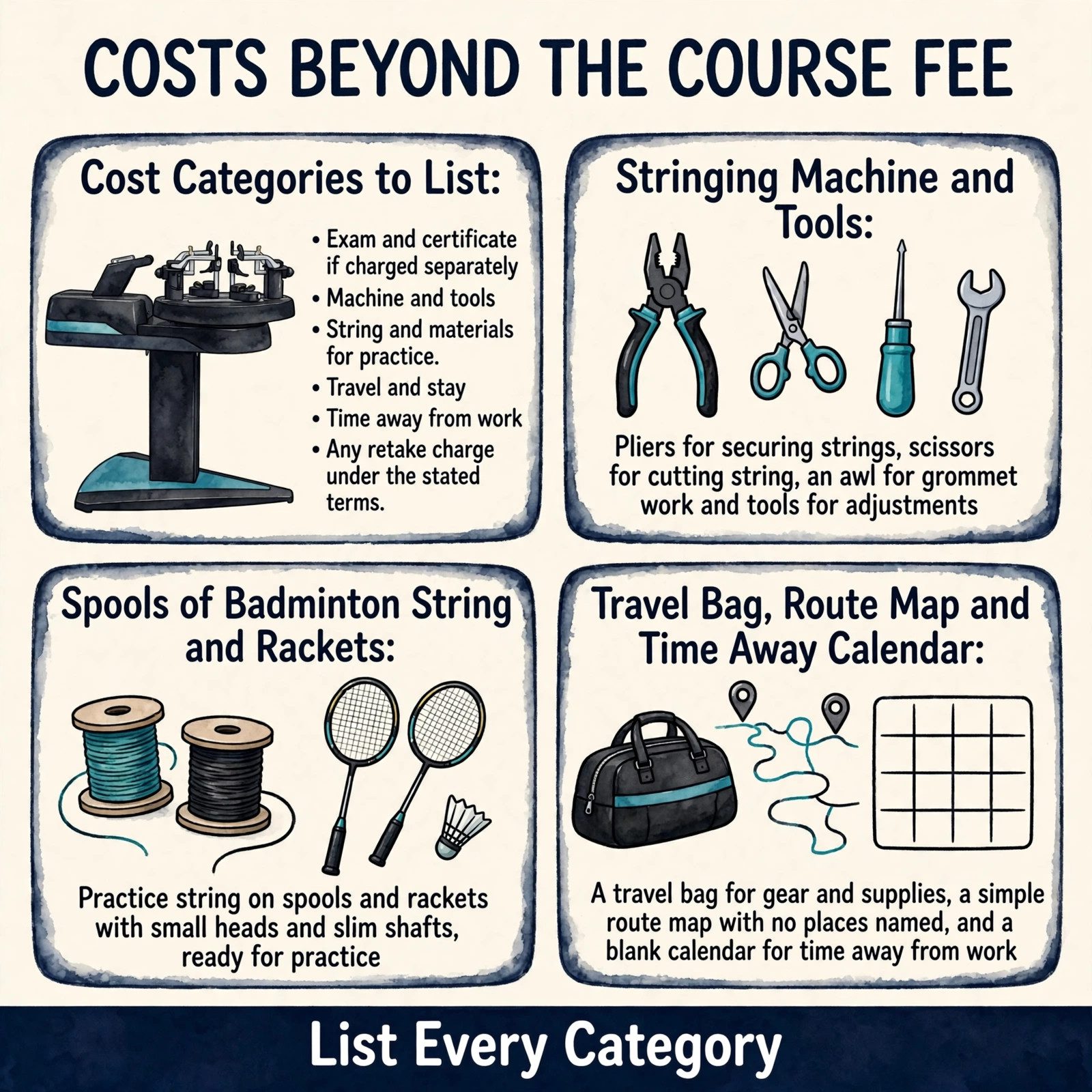
The fee is only one line in the full commitment, so list the rest before you call any course cheap or costly. Beyond the fee, write down: the exam and certificate if they sit outside it, a machine and tools if you will practise or work afterwards, string and materials for practice rackets, travel and stay if you train away from home, time away from your usual work, and any retake charge under the stated terms. This guide names categories only and sets no figures, because your totals depend on your own situation and on written answers from each provider.
Check the details. Give each category its own line and leave the amount blank until a provider confirms it in writing. A blank you can see is safer than a guess you forget you made. The list itself is the tool, not any single total.
Review the process. Notice how a low headline can grow. Separate charges for the exam, the certificate, materials and a retake can carry a light looking fee past a complete one. You only see that growth when every line is written side by side.
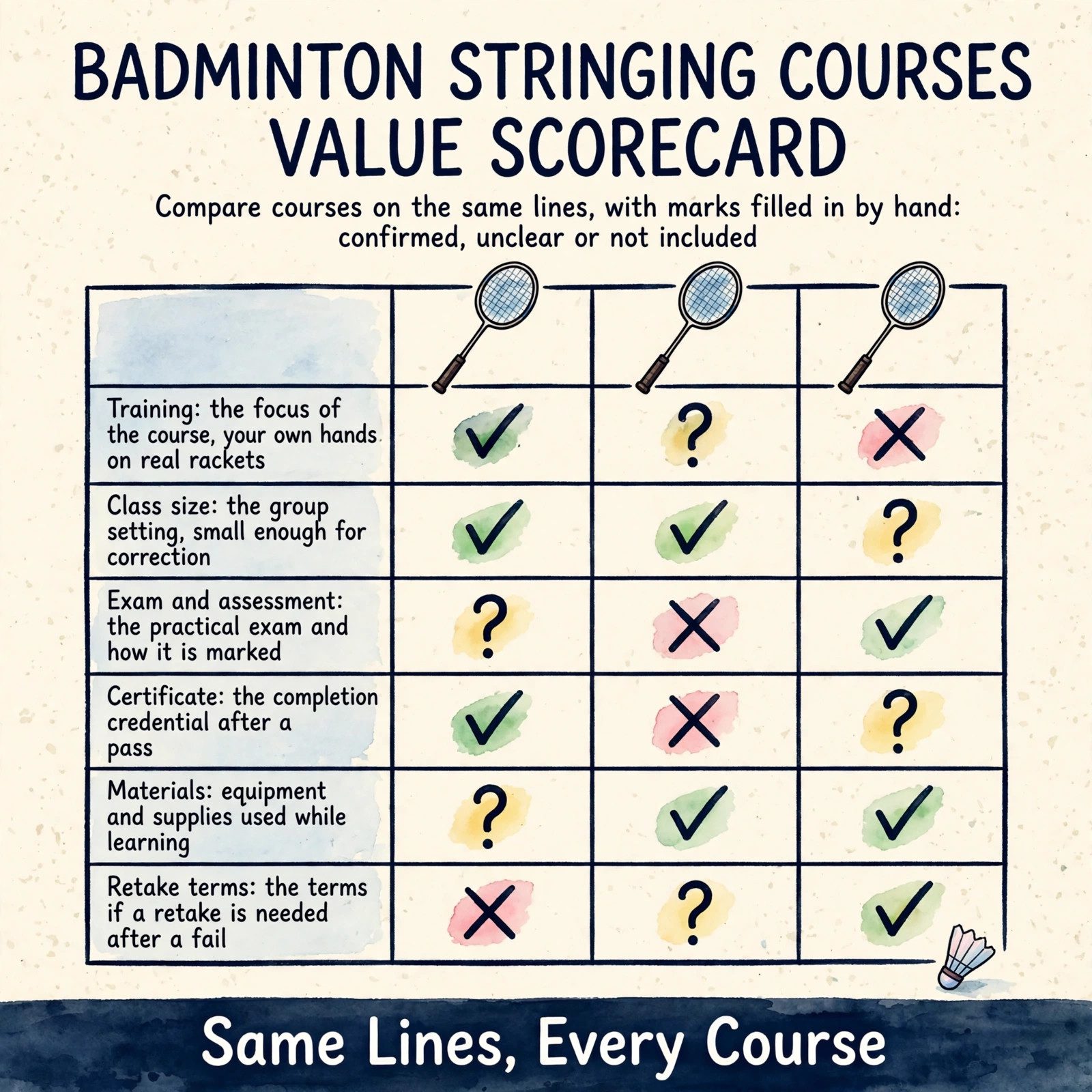
Plan the next step. Use the same lines for every course you compare, and mark each line confirmed, unclear or not included. A provider who answers all lines plainly has earned trust on the money side. A provider who answers only the headline has told you how the rest of the conversation will go.
1.5 Key Checks
How should I judge value between course fees fairly?
Record the context.
Judge value with a scorecard, not with a feeling about a headline. List the inclusion lines down one side: training time, class size, feedback, exam, assessment, certificate, materials and retake terms, plus the beyond fee categories from the full commitment list. For each course, mark every line confirmed, unclear or not included, with a short note of the exact answer given. Value is the course that confirms the lines that matter to your goal, at a total commitment you understand in full. The cheapest incomplete course is rarely the best value once retakes and extras are counted.
Check the details.
Ask the questions that expose an empty offer. What exactly will I string myself? Who corrects me? What does the exam check? What is charged separately? What happens after a fail? A strong course answers all five without dodging. A weak one changes the subject.
Review the process.
Keep unanswered lines visible on the sheet. Do not let a friendly conversation turn an unclear line into an assumed yes. Your scorecard should still show what was never confirmed when you make the final choice, because that gap is part of the price too.

1.6 Service Record
How does the BSW course answer the fee inclusion questions?
Apply the same fee questions to the BSW route. Best Stringer Worldwide runs its badminton stringing course with certification in Kuala Lumpur, Malaysia, under founder Eric Chuar. Training is on real rackets with instructor correction, the practical certification exam is held the day after training, and certification is assessed and approved by the BSW certification board. This guide does not state a BSW fee, and you should not accept a fee for any course, BSW included, until the inclusion lines are confirmed in writing for that course.
Check the details. Ask BSW the same seven lines as any provider: training time, class size, feedback, exam, assessment, certificate and materials, plus the retake terms. A provider that teaches learners to check inclusions should expect to be checked the same way, and BSW publishes its course and certification information for that review.
Review the process. Remember the beyond fee lines for this route too. The course runs only in Kuala Lumpur, with flexible timing, so travel, stay and time away from work belong on your list if you are based elsewhere. Plan them early and the trip becomes one clear commitment instead of a string of surprises.
Plan the next step. Where a line stays unclear, ask about that line only and wait for a written answer. Judge the completed sheet as a whole: what is confirmed, what is charged separately, and what was never answered. That habit protects you with every provider, not only with BSW, and it costs nothing to use.

1.7 Guided Practice
What should I ask about a fee before I pay anything?
Before you pay anything, send the provider a short summary of yourself and the inclusion questions together. State your experience, whether you own a machine and tools, where you are based, and the work you want to do after the course. Then ask for written confirmation of what the fee includes: training time and class size, your own practice on real rackets, the exam and assessment, the certificate, materials, and the retake terms, plus anything charged separately. Turn the written reply into your record and check the delivered course against it, line by line.
Do not pay on the strength of a conversation alone. If an inclusion matters to you, it should survive being written down. A provider who happily confirms inclusions in writing is showing you the same care you want in their teaching.
Keep the fee answers with your scorecard and your later exam feedback. Together they show what you paid for, what was delivered, and what your certificate actually covers. That record is useful when a shop or a player later asks what stands behind your certificate.
Badminton Stringing Course Fees Quick FAQ
Practical answers about course fees, what a fair fee includes, hidden extras, retake terms and how to judge value without guessing.
What should a fair fee include?
Training time on real rackets, a class small enough for correction, the practical exam and assessment, the certificate after a pass, materials used while learning, and clear retake terms, all confirmed in writing.
Is the exam inside the fee?
Ask directly and get it in writing: is the practical exam included, is the assessment included, is the certificate included, and what are the retake terms after a fail? Silence on any of those lines means not confirmed.
How do training time and class size change value?
Ask how much training time is your own hands on real rackets, how many learners share the instructor, and whether correction of your work is included. Watching in a large group buys less skill than practising in a small one.
Which costs beyond the fee should I list?
The fee is only one line in the full commitment, so list the rest before you call any course cheap or costly. Beyond the fee, write down: the exam and certificate if they sit outside it, a machine and tools if you will practise or work afterwards, string and materials for practice rackets, travel and stay if you train away from home, time away from your usual work, and any retake charge under the stated terms. This guide names categories only and sets no figures, because your totals depend on your own situation and on written answers from each provider.
How should I judge value between fees?
Score every course against the same inclusion lines: training, class size, feedback, exam, assessment, certificate, materials and retake terms. Mark each confirmed, unclear or not included, and judge the full commitment, not the headline.
How does BSW answer on inclusions?
Judge the BSW course by the same inclusion list as any other course. Best Stringer Worldwide is based in Kuala Lumpur, Malaysia, founded by Eric Chuar. Training is on real rackets with instructor correction, and the practical certification exam sits the day after training. Certification is assessed and approved by the BSW certification board. Ask BSW to confirm in writing what a fee covers: training, exam and assessment, certificate, materials used in training, class size and the retake terms. This guide sets no fee for any course, because a fair judgement starts from inclusions, not from a headline.
What should I ask before I pay?
Before you pay anything, send the provider a short summary of yourself and the inclusion questions together. State your experience, whether you own a machine and tools, where you are based, and the work you want to do after the course. Then ask for written confirmation of what the fee includes: training time and class size, your own practice on real rackets, the exam and assessment, the certificate, materials, and the retake terms, plus anything charged separately. Turn the written reply into your record and check the delivered course against it, line by line.
What should I keep from a fee enquiry?
Keep the written inclusion answers, your scorecard and the list of anything charged separately. They prove what your fee was meant to cover, and they let you check delivery against promise if anything is missing later.
How can I check fees with BSW?
Ask BSW for written confirmation of the same inclusion lines you would ask any provider: training, class size, exam, assessment, certificate, materials and retake terms. Then plan travel and stay for Kuala Lumpur on your own list.
Badminton Stringing Course Fees: Explore the Practical Decisions
Build a Clear Working Method
Use the sections, questions and interactive comparison to test any fee against the inclusion list. Keep your written answers and use them to choose a course with open eyes.
| Fees Check | Rushed Approach | Planned Approach |
|---|---|---|
| Includes | Judge a fee by the headline alone | Check what the fee actually includes line by line |
| Exam | Assume the exam and certificate are included | Confirm the exam, assessment and certificate in writing |
| Costs | Budget for the course fee only | List every cost beyond the fee before you compare |
| Scorecard | Call the lowest fee the best value | Score value against the same included items |
| Your record | Compare fees from memory and headlines | Write each included item and answer down |
| Next action | Keep no record of what was promised | Keep the written inclusions to check delivery against |
Judge Course Fees Clearly with Best Stringer Worldwide
Ready to judge a stringing course fee by what it includes instead of by its headline? Best Stringer Worldwide trains learners on real rackets in Kuala Lumpur and holds its practical certification exam the day after training, assessed and approved by the BSW certification board. Send BSW your experience, your equipment and your inclusion questions, and ask for the fee inclusions in writing so you can score them on the same sheet as any other course.

