1.1 Equipment Fundamentals
Understanding Racquet Vibration & Shock
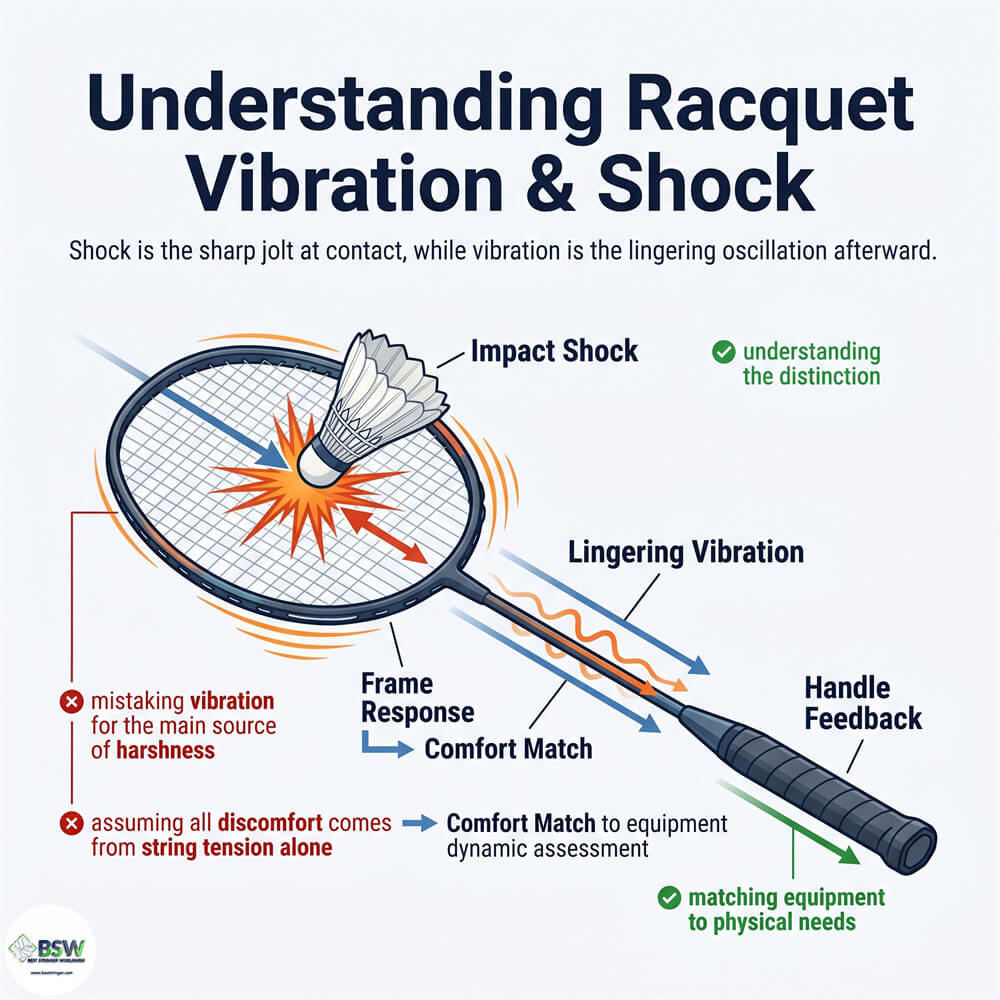
Equipment fundamentals go beyond just weight and balance; they encompass how a frame reacts upon impact. In this guide, you will learn the crucial difference between badminton racquet vibration and shock, how frame stiffness influences both, and how these effects directly change player comfort and on-court feel.
In short, shock is the immediate force you feel at contact, while vibration is the lingering oscillation that follows. Mastering these concepts is crucial for any badminton player aiming to protect their arm, as well as for stringers seeking to provide intelligent equipment advice.
Here is a simple comfort decision flow:
Step 1: Understand that shock is the primary cause of immediate harshness.
Step 2: Recognize vibration as the secondary, lingering effect that influences fatigue.
Step 3: Consult a certified stringer to select a racquet stiffness and string tension that perfectly matches your physical needs and playing style.
1.2 The Science
The Science of Immediate Shock and Lingering Vibration
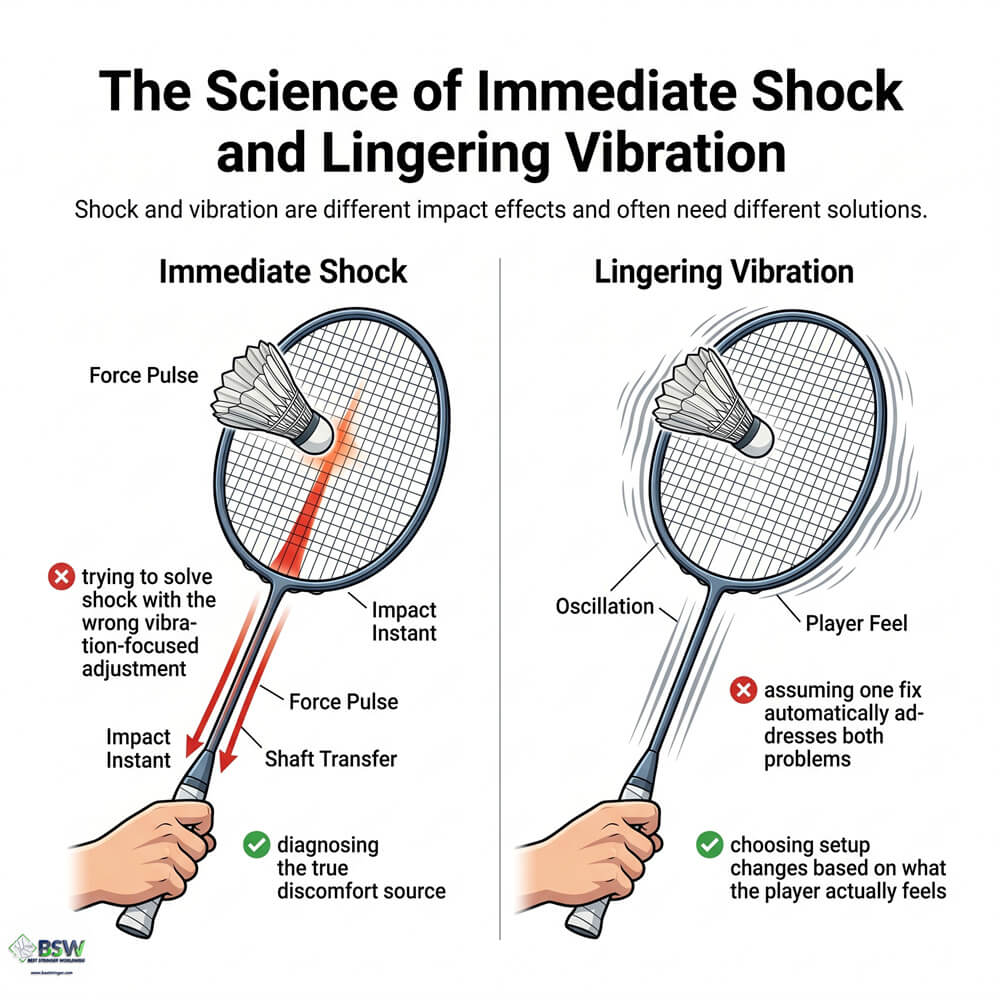
The golden rule of badminton racquet comfort is that shock and vibration are fundamentally different. Shock is the short, immediate force created the exact millisecond the shuttlecock strikes the stringbed. This intense jolt travels instantly down the shaft and into the player’s arm, often perceived as harshness or a jarring sensation.
Vibration, on the other hand, is the lingering oscillation that continues after the initial impact. While vibration is generally lower in intensity than shock, its continuous buzzing nature can influence player fatigue and overall perception of the racquet’s “feel” over a long match.
Both players and stringers need to understand this distinction. When a player complains about arm discomfort, adjusting the setup requires knowing whether the frame is transmitting too much immediate shock due to excessive stiffness, or if the lingering vibration is causing distraction and fatigue. Addressing one does not automatically fix the other.
1.3 Frame Stiffness
How Stiffness Affects Comfort
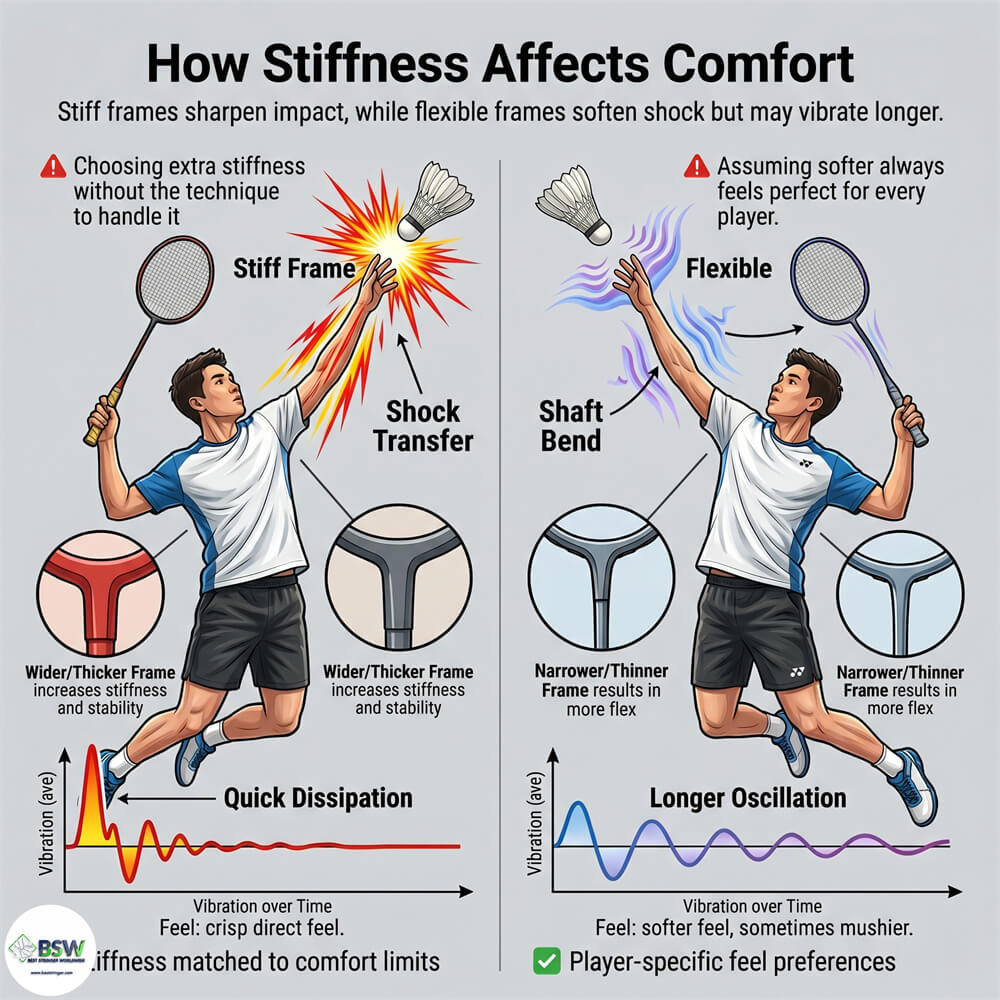
Frame stiffness dictates how impact forces behave. A stiffer badminton racquet provides maximum energy transfer and precision, but it also transmits significantly more immediate shock to the arm. Stiff frames tend to dissipate lingering vibration faster, giving them a crisp, direct feel. However, this directness can feel extremely harsh for players sensitive to sudden impact forces.
A flexible frame acts entirely differently. Because the shaft bends more upon impact, it absorbs a larger portion of the initial shock, creating a softer, more forgiving feel. The trade-off is that flexible frames often allow vibration to oscillate longer, which some players interpret as a “mushy” or lively response.
The thickness and width of the frame also play massive roles in this dynamic. Thicker, wider frames generally increase overall stiffness, resulting in higher shock transmission but greater stability. Badminton players must match these stiffness traits to their comfort limits and playing style.
1.4 String Synergy
Badminton String Setup for Comfort
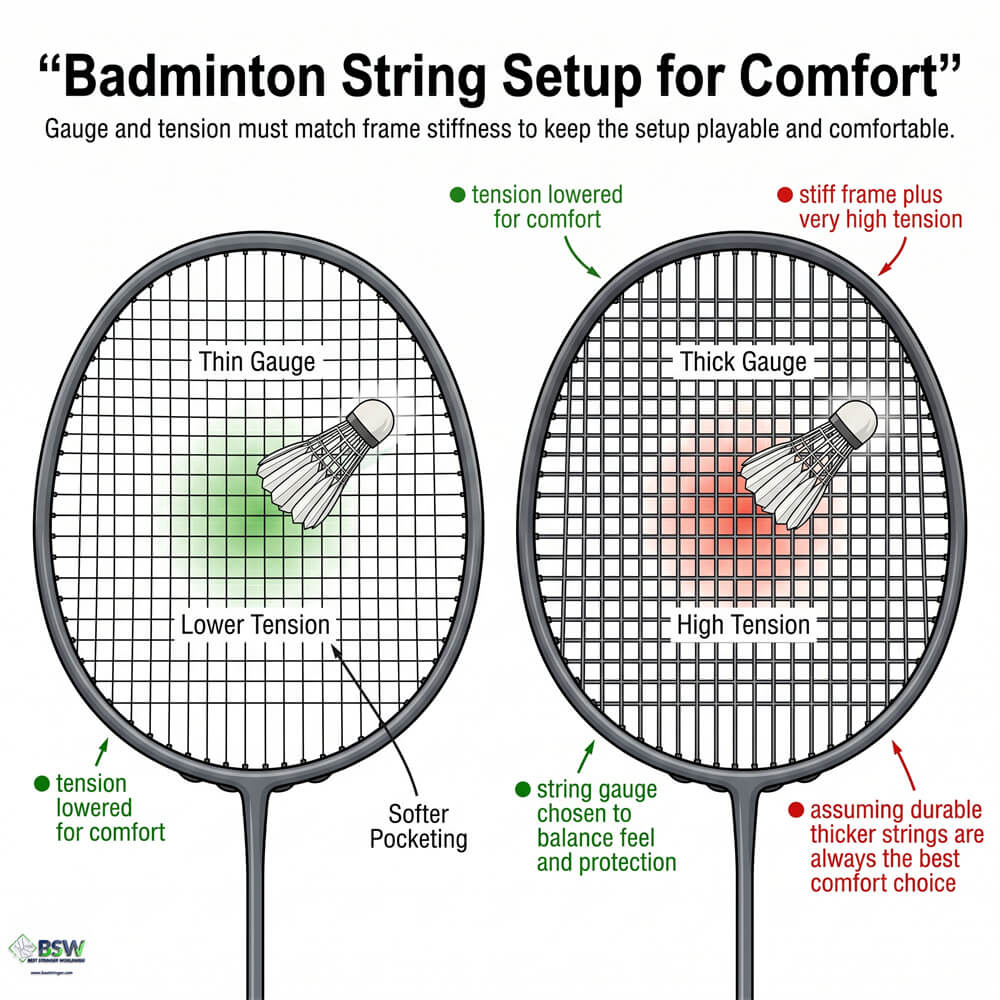
A racquet’s frame stiffness requires the correct string gauge and tension to properly balance player comfort. Understanding this synergy is essential for stringers and players:
What is String Gauge’s Role? Thinner strings generally feel more elastic and lively, which can help absorb a small amount of impact harshness. Thicker strings are more durable but can contribute to a stiffer, firmer stringbed response.
Tension and Shock. Tension dictates the rigidity of the stringbed. High tension offers excellent touch and control but significantly increases the harshness of immediate shock. Lower tension acts more like a trampoline, absorbing impact and easing the burden on the arm.
The Complete System. If you use a very stiff frame but string it at an extremely high tension, you create an unforgiving setup that maximizes shock. A professional badminton stringer will always align frame stiffness with appropriate tension to protect the player’s comfort while maintaining performance.
1.5 Common Mistakes
Common Shock & Vibration Mistakes
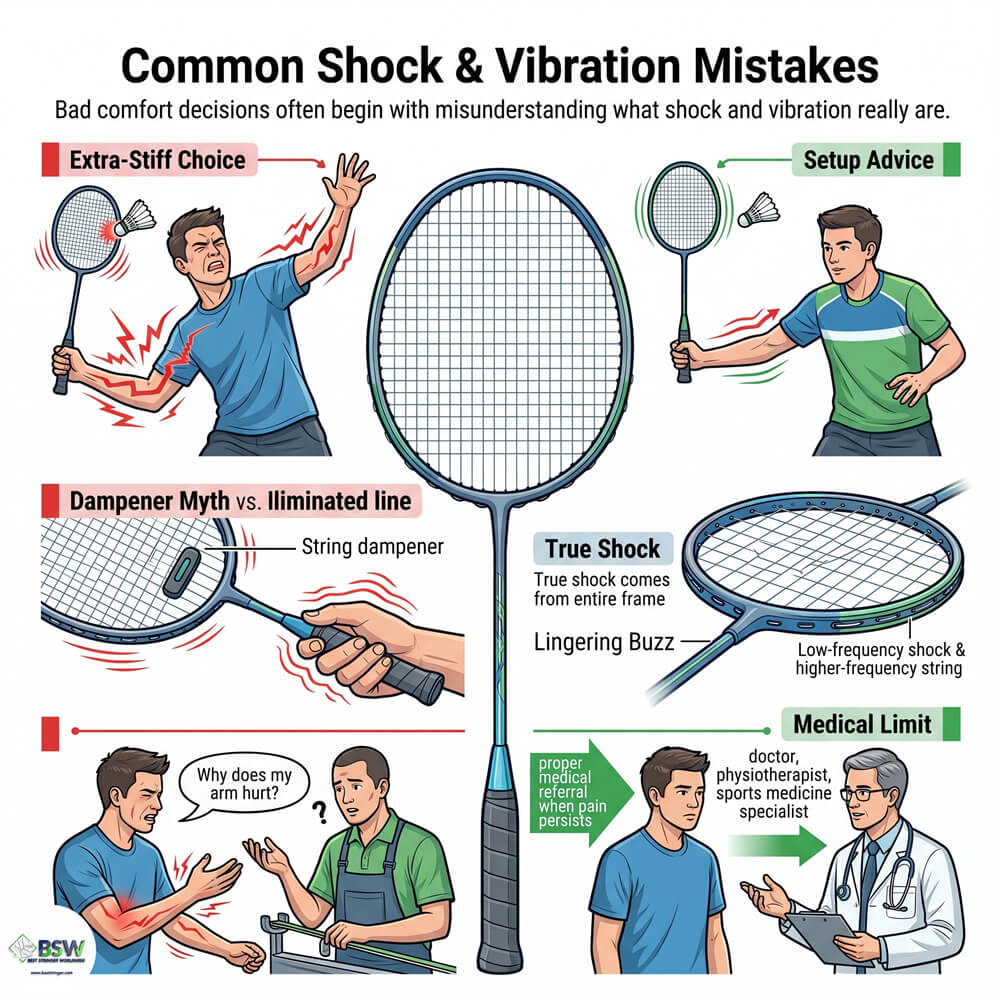
Mistake 1: Assuming Stiffness is Always Better.
While a stiff frame provides direct power and precision, choosing an extra-stiff racquet without the necessary technique guarantees high shock transmission, harsh feel, and potential arm fatigue.
Mistake 2: Confusing Shock with Vibration.
Many players believe vibration dampeners will protect their arm. Dampeners only alter the lingering string vibration and sound; they do practically nothing to reduce the intense, immediate frame shock that causes joint harshness.
Mistake 3: Thinking a Stringer Can Diagnose Injuries.
While a certified stringer can thoughtfully adjust your setup to soften impact and reduce harshness, they are not medical diagnosticians. Players experiencing persistent pain should always seek proper professional medical evaluation.
1.6 Selection Framework
Beginner-Safe Comfort Decision Flow
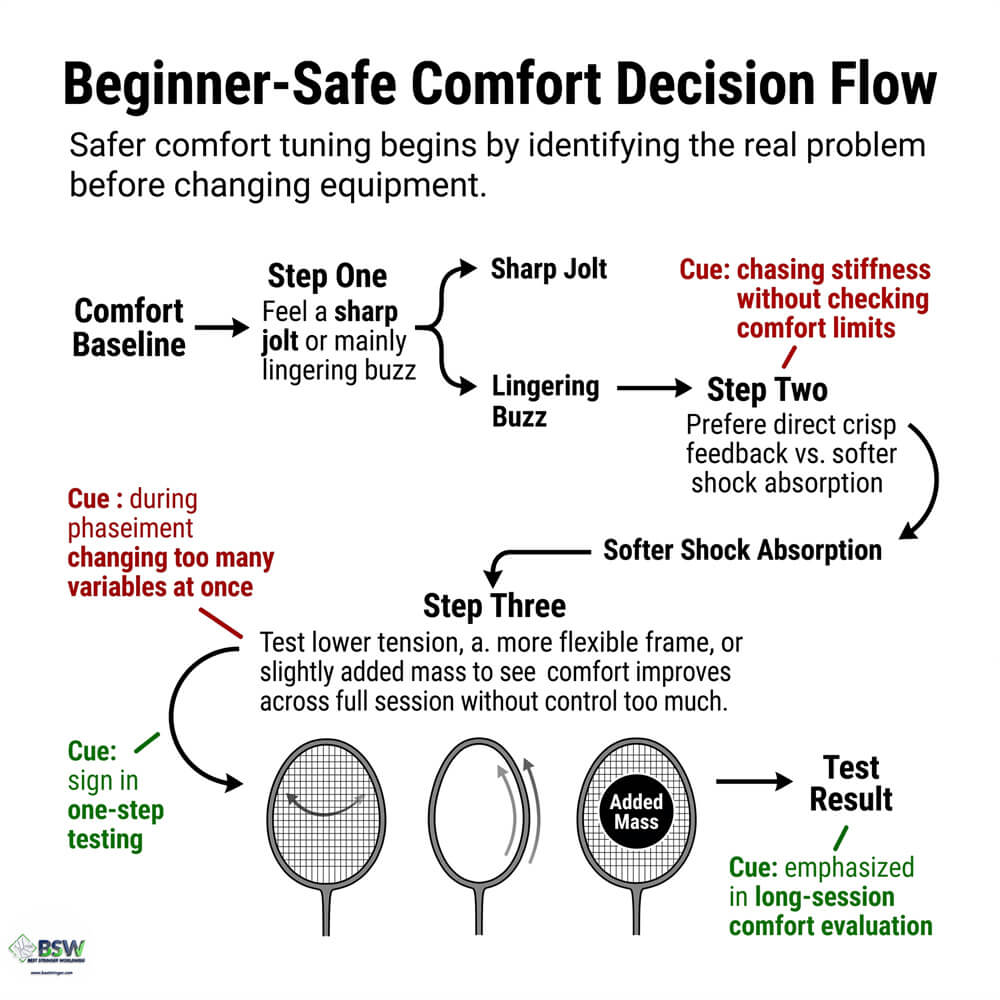
A step-by-step decision flow is crucial for balancing performance and player comfort safely. Use this simple framework to adjust your equipment:
Step 1: Check Your Comfort Baseline. Consider if your current racquet causes a sharp jolt upon impact. If you experience immediate harshness, you may be playing with a frame that is too stiff or a tension that is too high for your current technique.
Step 2: Identify Your Needs. Determine if you prefer the direct, low-vibration feedback of a stiff frame, or if your joints would benefit from the shock-absorbing, softer response of a more flexible racquet.
Step 3: Test for Actual Improvement. Try lowering your string tension slightly or testing a frame with extra mass to absorb shock. Evaluate whether the changes genuinely improve your comfort over a long session without hurting your shot control.

1.7 Stringer Education
The Value of Stringer Certification
Proper equipment education is a core part of a professional badminton stringing course and good stringer certification standards. A certified stringer understands that recommending an overly stiff frame blindly is a disservice to a player’s joint health.
At Best Stringer Worldwide, we know that frame stiffness directly influences the comfort advice given to players. The magic is not just in selling a high-end racquet, but in the precise consultation logic a badminton stringer uses to match string tension to a frame’s specific vibration and shock characteristics.
By prioritizing accurate racquet knowledge, our stringer certification ensures that every setup perfectly balances performance, feel, and comfort. You learn how to evaluate trade-offs, manage player expectations regarding harshness, and focus purely on educated stringing decisions.
Vibration & Shock Quick FAQ
Quick answers about badminton racquet shock, vibration, and comfort.
What is the difference between shock and vibration?
Shock is the intense, immediate impact force generated the millisecond the shuttlecock strikes the racquet. Vibration is the lower-intensity, lingering oscillation that continues through the frame after the initial impact.
Does a stiffer frame reduce vibration?
Generally, yes. Stiffer frames dissipate lingering vibration much faster, giving a clean, crisp feel. However, they transmit significantly higher immediate shock to the player’s arm compared to flexible frames.
Does a softer frame always feel better?
Not always. While a flexible frame reduces the harshness of immediate shock, it allows vibration to oscillate longer. Some players find this lingering buzz distracting or describe the racquet as feeling too “mushy.”
Can adding weight change the feel?
Yes. Adding physical weight to the frame increases its overall mass, which can help the racquet absorb more of the impact forces, potentially reducing the harshness of the shock felt by the player.
Can stringing change the feel?
Absolutely. Lowering string tension creates a softer stringbed that helps cushion impact, reducing shock. A professional stringer uses tension adjustments as a primary tool to fine-tune a frame’s comfort profile.
Do dampeners solve everything?
No. Vibration dampeners only alter the lingering string vibration and the sound of the impact. They do not reduce the initial, structural frame shock that travels into the arm upon striking the shuttle.
Can a stringer fix an injury?
No. A professional stringer can optimize your equipment setup to reduce harshness and improve comfort, but they cannot diagnose or cure medical conditions. Players with persistent pain must seek proper medical evaluation.
Why should a stringer know this?
A certified stringer must understand how frame stiffness and tension interact to advise players responsibly. Recommending a very demanding, stiff setup to a player seeking comfort shows a lack of essential racquet knowledge.
Are stringing courses necessary?
Yes. A comprehensive badminton stringing course teaches you how to accurately match racquet characteristics to player comfort. You learn to evaluate equipment safely, elevating you above simple knot-tying into true professional consultation.
The Physics of Feel: Shock vs Vibration
The Physics of Feel
Compare frame stiffness to see the difference between immediate shock and lingering vibration.
Proven Comfort Focus
Our approach is based on verified equipment parameters. We prioritize arm safety, understanding the subtle differences between shock and vibration, and optimizing playstyle efficiency rather than relying on pure tension hype.
| Frame Characteristic | Stiffer Frame Construction | More Flexible Frame Construction |
|---|---|---|
| Immediate Shock | Transmits higher initial impact force to the arm, feeling crisper but harsher. | Absorbs more of the initial impact, providing a softer, more forgiving feel. |
| Lingering Vibration | Dissipates quickly, leaving a direct, solid feel after the hit. | Continues oscillating longer, which some players find distracting. |
| Player Comfort | Can be demanding on joints if technique or physical strength is lacking. | Generally friendlier on the arm, helping reduce immediate fatigue. |
| Performance Feel | Direct energy transfer; rewards accurate, fast swings with heavy power. | Acts like a slingshot; assists slower swing speeds for easier clears. |
| String Synergy | Lower tensions can help offset the frame’s inherent harshness. | Higher tensions can add needed crispness to the softer frame. |
| Ideal Player Match | Advanced players prioritizing direct feedback and precision. | Players prioritizing comfort, joint relief, or easy clearance. |
Master Racquet Feel with Best Stringer Worldwide
Ready to upgrade your knowledge? Best Stringer Worldwide offers a professional badminton stringing course teaching how shock, vibration, and frame stiffness affect player comfort safely. We serve badminton players and aspiring certified stringers worldwide, especially in Singapore, Hong Kong, Malaysia, Indonesia, UK, France and Europe. Get certified and learn to find the perfect tension and gauge for any racquet.