1.1 Equipment Terminology
What Do Common Badminton Racquet Labels Really Mean?
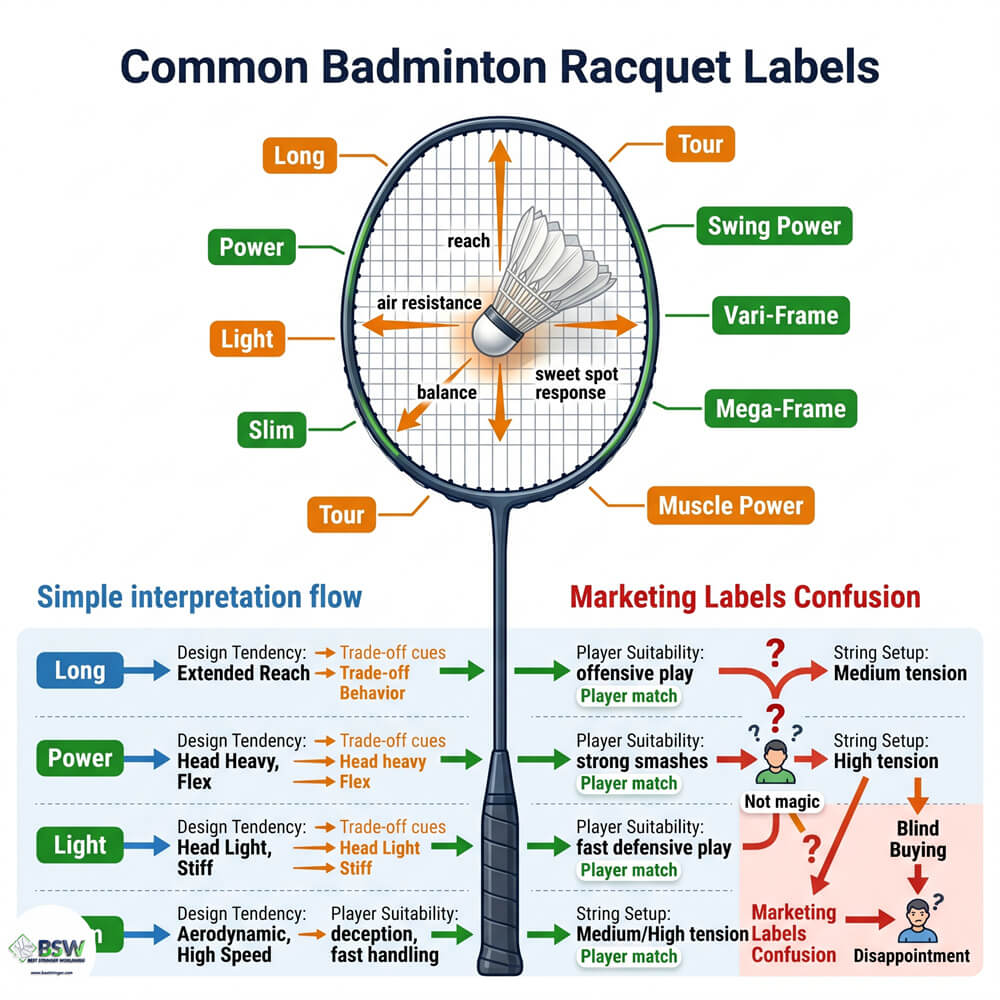
Badminton racquet terms such as “Long,” “Power,” “Light,” “Slim,” “Box,” “Aero” and “Isometric” describe design features or marketing directions, not guaranteed results for every player. Their practical effect depends on the complete racquet: static weight, balance point, shaft and frame stiffness, length, aerodynamics, string setup, technique and timing. Use BSW’s U/2U/3U/4U weight guide alongside this glossary, then compare actual model specifications and test how the racquet feels across repeated clears, drives, defence and net play. These labels are useful starting points, but they should not replace model-specific measurements or player testing.
1.2 “Long” and “Power”
Understanding Long and Power Terminology
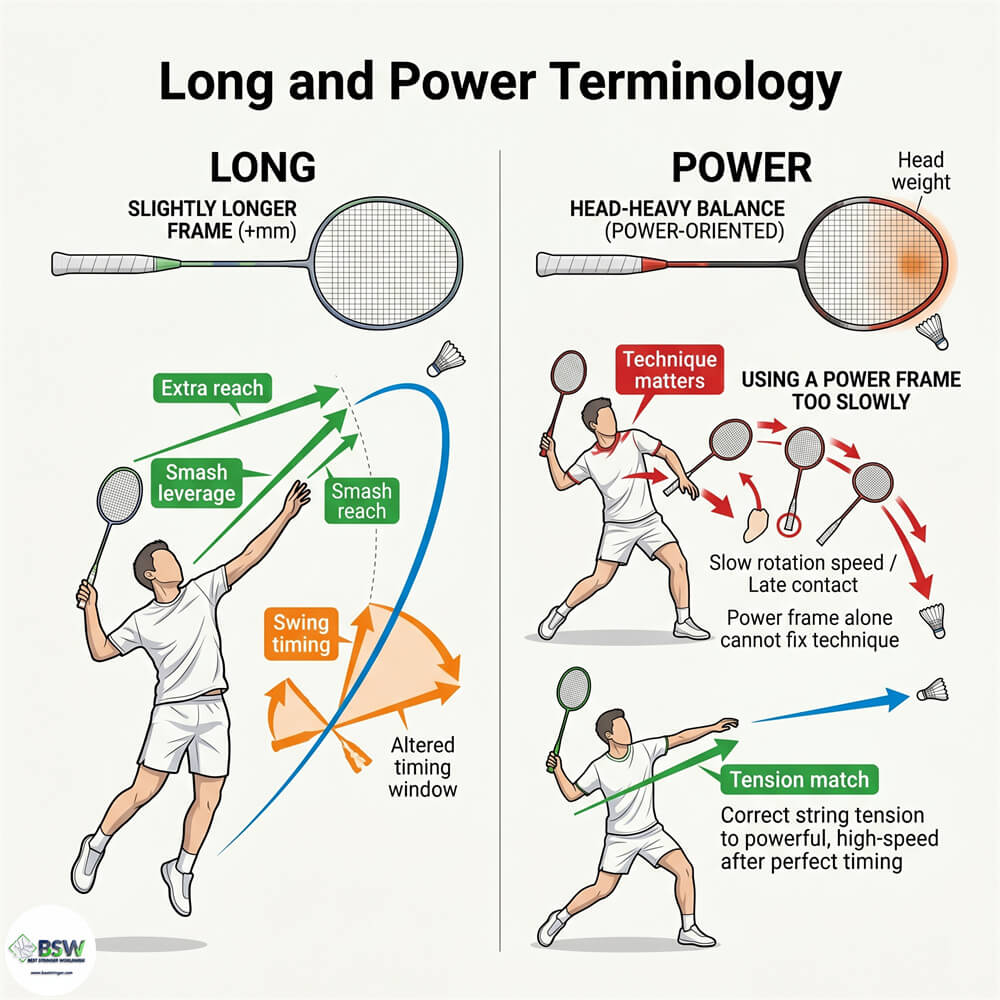
The term “Long” on a badminton racquet usually refers to extra overall length, often around 10mm longer than traditional frames. This design tendency may improve your reach and attacking leverage, but handling still depends heavily on the full racquet design. Not every player will benefit equally, as the extra length slightly alters swing timing.
Similarly, a “Power” label often suggests a head-heavier or more offensive design direction. However, “Power” does not automatically mean it will help a weak player smash harder. Real power feel still depends on your technique, timing, the flex of the shaft, and your string setup.
A power badminton racquet transfers energy effectively, but only if you have the biomechanical strength to swing it quickly. Badminton stringers should remind players that these labels indicate a design approach, not an automatic performance upgrade.
1.3 “Light” and “Slim”
Decoding Light and Slim Frame Labels
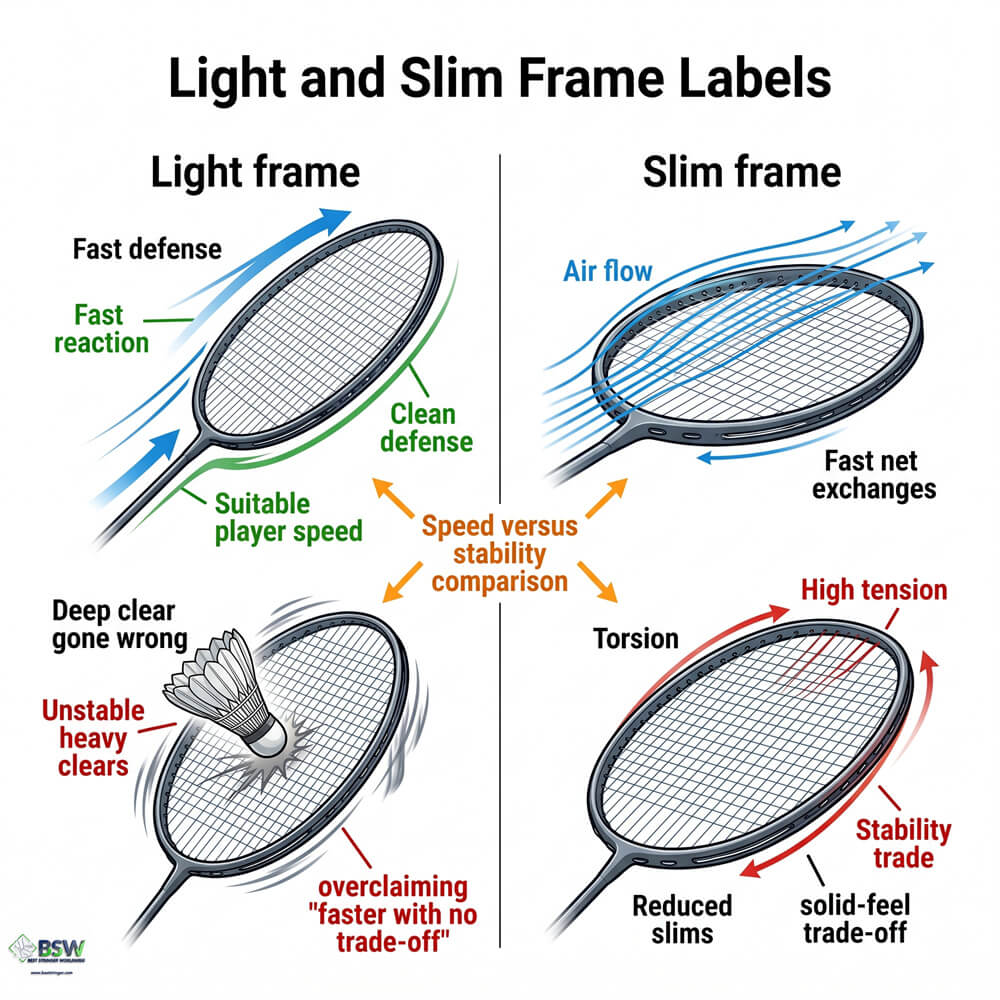
When you see a “Light” label, it usually points to a reduced overall weight designed to improve handling speed and defensive reaction times. While a light badminton racquet often feels faster, it does not mean it is strictly better for defense. It may reduce hitting stability or make it harder for some players to easily transfer weight behind the shuttle.
A “Slim” frame typically suggests reduced air resistance and a faster aerodynamic movement through the air. This faster swing impression is excellent for quick exchanges at the net.
However, slim frames are not magically faster with no trade-off. Frame stability, torsion resistance, and solid feel can vary across different models. A certified stringer will consider these tendencies when setting up the racquet, knowing that a very slim frame might perform differently under high string tension compared to a thicker, traditional box frame.
1.4 “Tour” and “Swing Power”
Advanced Labels: Tour and Swing Power
As players advance, they encounter terminology geared toward higher performance levels. Understanding these terms requires looking past the marketing appeal:
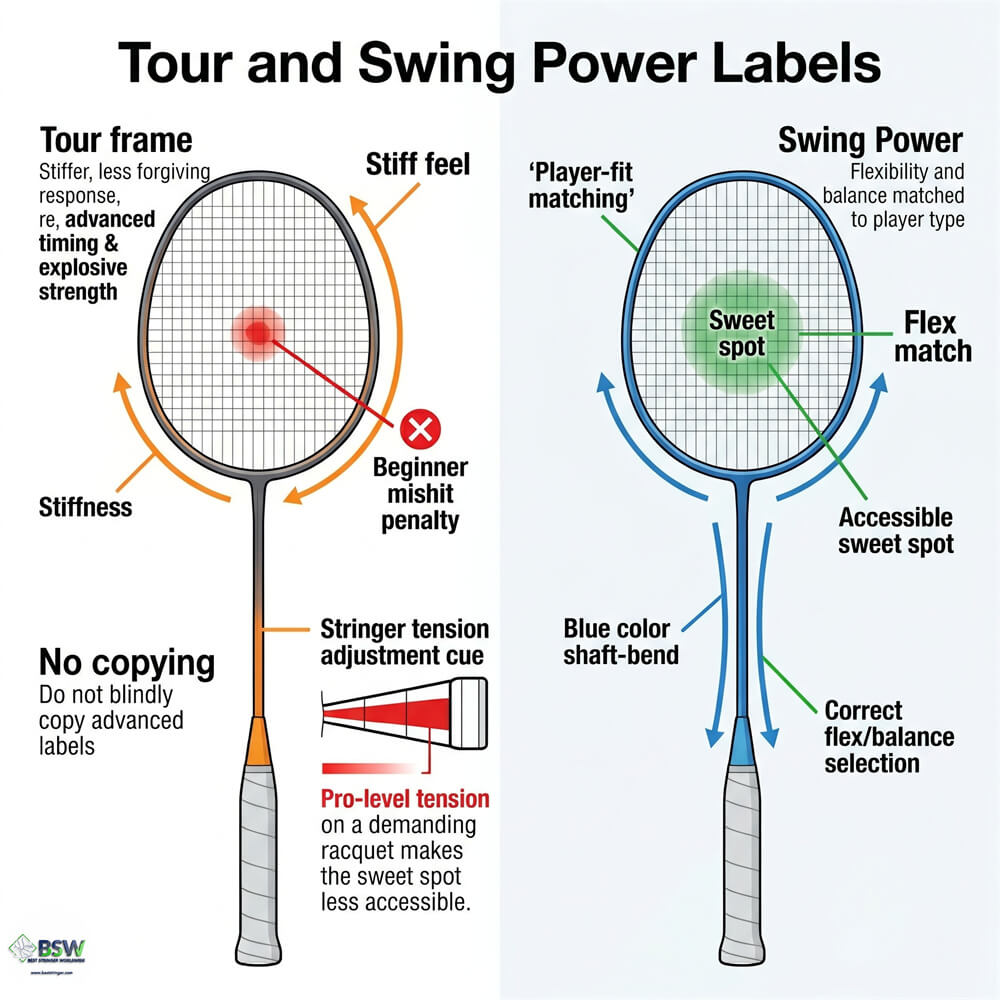
What is a Tour Racquet? “Tour” often signals a higher-grade or more demanding player focus. However, Tour versions are not strictly superior for everyone. Suitability still depends on the player’s technique, as these frames are often stiffer and less forgiving for beginners.
Understanding Swing Power. The “Swing Power” concept relates to matching racquet flexibility and balance to specific player types rather than offering a universal performance promise. Not every player should copy the same profile.
Professional Interpretation. A badminton stringing course should teach stringers how to interpret these labels. If a player uses a demanding Tour racquet, the stringer must know how to adjust tension to ensure the sweet spot remains accessible, rather than blindly stringing it at pro-level tensions.
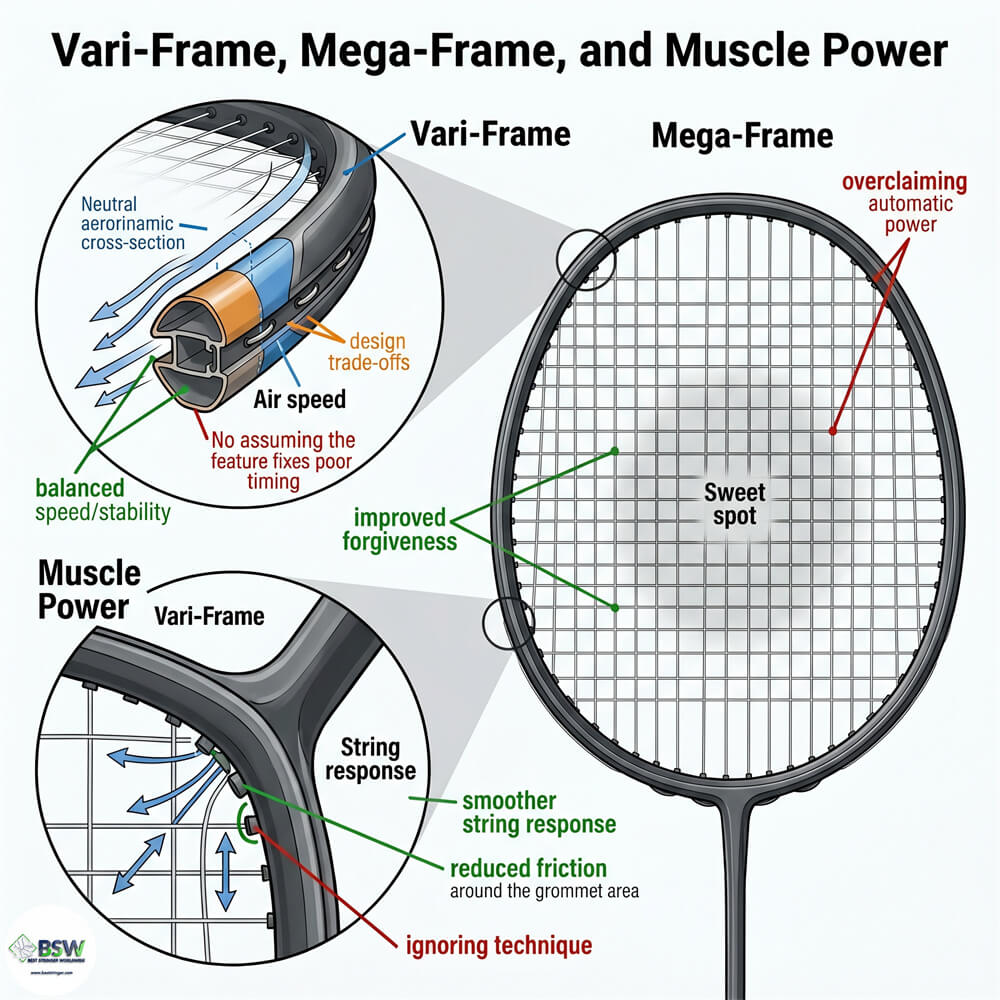
1.5 VF, MF, and MPF
Explaining Vari-Frame, Mega-Frame, and Muscle Power
VF (Vari-Frame) Technology.
Vari-Frame refers to a variable-frame idea, where different cross-sections are shaped differently. It often blends aerodynamic and box-style ideas to balance speed through the air with solid stability upon impact.
MF (Mega-Frame) Concept.
Mega-Frame is essentially a sweet-spot enlargement concept. While forgiveness on off-center hits may improve, a larger sweet spot does not automatically solve poor technique or mistimed strokes.
MPF (Muscle Power Frame).
The Muscle Power Frame is a frame-shape concept around the string bed intended to improve energy transfer or string response. It minimizes string friction over the grommets. Players should view it as an intelligent design approach, not a miraculous formula that automatically improves every shot.

1.6 Selection Framework
Applying Terminology Knowledge to Player Choices
Understanding badminton racquet terminology is the foundation of making smart equipment choices. Follow these principles before deciding:
Step 1: Assess Your Style. Are you seeking pure attacking momentum or rapid defensive maneuvering? A “Power” racquet will not help your game if the added head weight slows down your swing, just as a “Light” frame might lack the stability you need for heavy clears.
Step 2: Consider Physical Attributes. Height, arm length, and strength heavily influence how you handle equipment. A “Tour” stiffness label requires explosive power to bend the shaft, while a “Slim” frame aids players relying on fast twitch muscle speed.
Step 3: Consult a Stringer. A certified stringer uses racquet terminology to inform tension choices. They understand that stringing a “Mega-Frame” requires slightly different tension logic to maintain feel, helping you match the stringbed response to the frame’s true character.
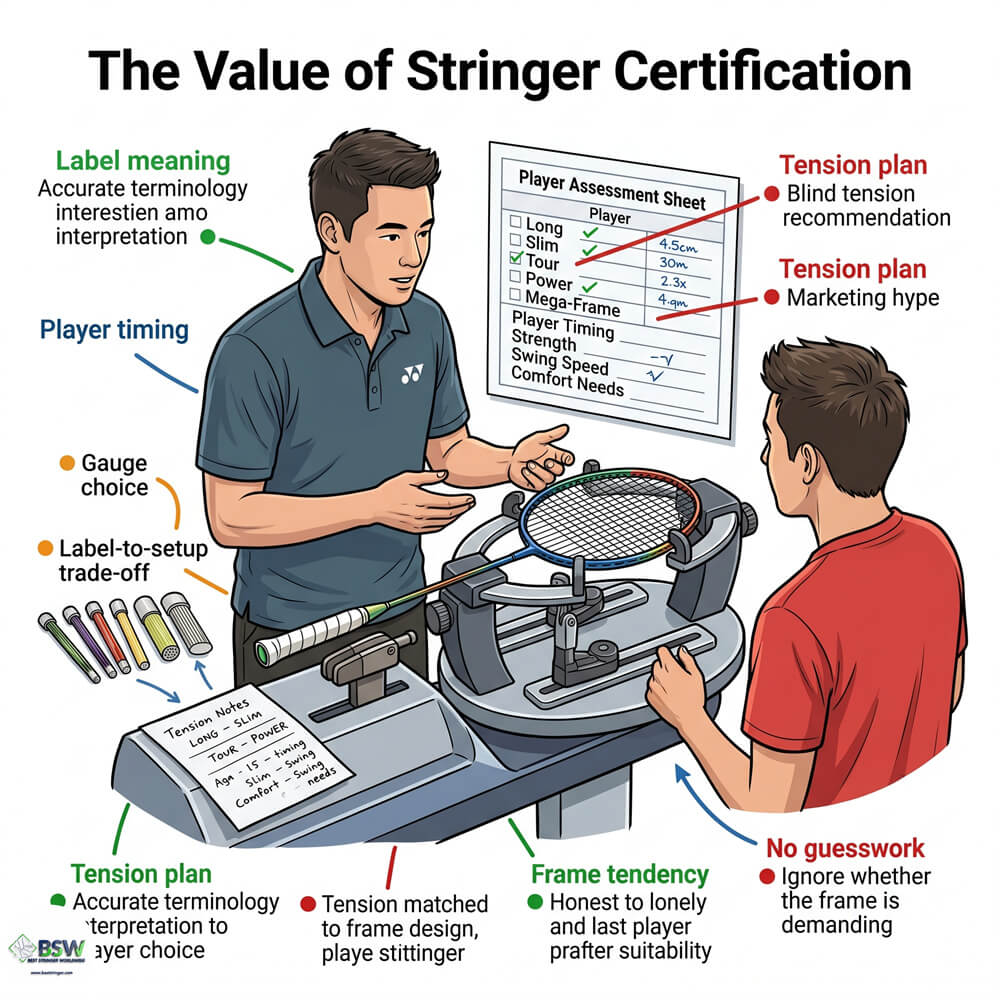
1.7 Further Learning
The Value of Stringer Certification
Proper equipment education is a core part of any reputable badminton stringing course. A certified stringer understands that recommending string tension blindly, without considering whether a frame is labeled “Long”, “Slim”, or “Tour”, is a disservice to the player.
At Best Stringer Worldwide, we believe that understanding badminton racquet terminology directly influences professional stringing logic. The magic is not just in identifying marketing terms, but in the precise consultation logic a stringer uses to match string characteristics to the frame’s true design tendencies.
By prioritizing accurate racquet knowledge, our stringer certification ensures that every setup navigates the hype. You learn how to translate manufacturer labels into practical insights, eliminate guesswork, and help players maximize their actual court potential.
Equipment Terminology Quick FAQ
Quick, definition-first answers to common questions about badminton racquet terminology and features.
What does “Long” mean on a racquet?
“Long” usually refers to extra overall frame length. This design tendency may improve reach and leverage for steep attacking shots, but it also slightly alters swing timing, meaning handling feel will vary by player.
Is a “Power” racquet always better?
Not automatically. “Power” often suggests a head-heavier design direction. While it helps transfer momentum, real power still depends entirely on the player’s technique, swing timing, and appropriate string tension.
Does “Light” always mean easy to use?
While a light badminton racquet improves handling speed and defensive maneuverability, it may reduce hitting stability or make it harder for some players to easily transfer weight behind the shuttle for deep backcourt clears.
What does a “Slim” frame actually change?
“Slim” usually suggests reduced air resistance and a faster swing impression through the air. However, actual frame stability and torsional control can still vary depending on the specific materials and overall frame design.
Are “Tour” versions strictly superior?
“Tour” often signals a higher-grade, performance-oriented version. Because these are generally stiffer and less forgiving, their suitability depends entirely on whether the player possesses the advanced technique required to wield them.
What is the goal of Mega-Frame (MF)?
Mega-Frame is essentially a sweet-spot enlargement concept designed to increase forgiveness on off-center hits. However, a larger hitting area does not automatically fix fundamental timing or technique problems.
How does Muscle Power Frame work?
Muscle Power Frame (MPF) is a shape concept around the string bed intended to minimize friction and improve energy transfer. It should be understood as a practical design approach, not a guaranteed miracle feature.
Why should stringers know these terms?
A professional badminton stringer must understand these labels to manage balance expectations, advise on suitable tension, and ensure the final string setup matches the actual design tendency of the frame.
Does certification cover terminology?
Yes. A high-quality badminton stringing course includes equipment interpretation, ensuring stringers can read racquet labels intelligently and match them practically to a player’s real-world needs.
Terminology in Action: Standard vs Power Tendencies
Interactive Frame Anatomy
Tap the highlighted zones on the racquet to discover how marketing terms translate into physical design tendencies.
Mega-Frame (MF / MPF)
Mega-Frame is a sweet-spot enlargement concept designed to increase forgiveness on off-center hits. It improves energy transfer and reduces friction over the grommets, but it does not automatically substitute for poor stroke timing.
Stringer’s Insight: Requires slightly different tension logic to maintain feel across the enlarged hitting area.
Proven Terminology Knowledge
Our approach is based on understanding practical design tendencies. We prioritize honest equipment evaluation, responsible player matching, and real-world performance over marketing hype.
| Marketing Label / Term | General Design Concept | Practical Tendency & Feel |
|---|---|---|
| Long | Increased overall frame length. | Improves reach and leverage, but alters swing timing. |
| Power | Often points to head-heavy balance. | Enhances offensive momentum, but requires good technique. |
| Light | Reduced overall frame weight. | Faster handling and defense, potential loss in absolute stability. |
| Slim | Reduced aerodynamic cross-section. | Faster swing impression, though torsion resistance varies. |
| Tour / VF | Performance-grade or variable frames. | Demanding performance suited for advanced, consistent players. |
| MF / MPF | Sweet-spot or string-bed enhancements. | Aims for better energy transfer, but isn’t a substitute for skill. |
Master Racquet Knowledge with Best Stringer Worldwide
Ready to upgrade your knowledge? Best Stringer Worldwide offers a professional badminton stringing course to teach you how racquet terminology and design tendencies affect playability safely. We serve badminton stringers worldwide, especially in Singapore, Hong Kong, Malaysia, Indonesia, UK, France, and Europe. Become a certified stringer to learn proper equipment interpretation and player-matching logic.