






1.1 Starting Point
What stringer certification exam equipment must a fair test provide?
Stringer certification exam equipment is the machine and tool setup a candidate is tested on, and it matters because an exam is only fair when the equipment is not part of the problem. A proper setting means a calibrated floor standing stringing machine, a turntable with two clamp bases set in its centre slots, a tension unit that delivers the number it shows, and hand tools checked before marking starts. Best Stringer Worldwide, founded by Eric Chuar and based in Kuala Lumpur, Malaysia, tests badminton work on real rackets, with results assessed and approved by the BSW certification board.
Think about what a bad machine does to a good candidate. A tension unit reading high or low makes accurate work look sloppy. A clamp base that creeps lets tension escape no matter how clean the weaving is. Worn tools turn simple grommet work into a struggle. None of that tests the stringer. It tests luck, and a serious body removes luck from the room before the first racket is mounted.
The reverse is also true. Good equipment does not pass anyone. It simply makes the marking honest: tension, knots, grommets and frame care are judged as the candidate work, not as the machine faults. When you read about any exam, ask what the setting provides and what is checked before marking starts. The answers tell you how seriously the body takes its own standard.

1.2 Preparation
What is checked on the machine before marking starts?
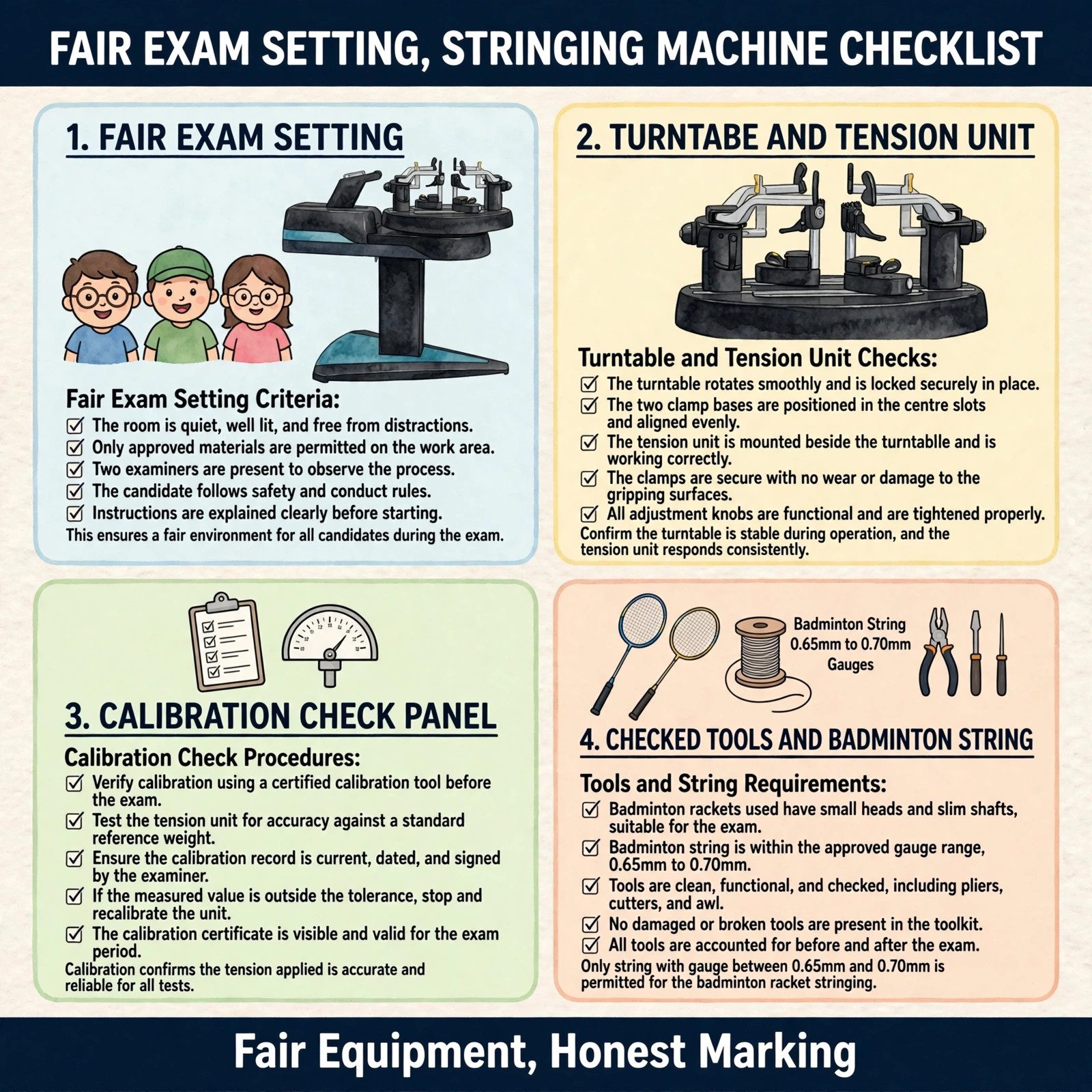
Before marking starts, the machine itself is checked as a structure. The standard badminton setup is a floor standing machine on a single central column, with a wide flat base plate on the floor, never a desktop unit balanced on a bench. At standing height the head has two parts side by side. One part is the turntable: a compact oval disc, racket sized, with two mounting towers near its ends carrying curved support arms over the racket lying flat, and two long slots across the middle. In the centre, exactly two clamp bases sit, one in each slot, each with a short steel post that the string clamp plugs onto.
The second part sits directly beside the turntable at the same height: the tension unit, a smooth rounded housing with a sloped top carrying a recessed control panel with a digital tension readout and a few round buttons, and the flat paddle shaped gripper rising at its back edge. Checks cover calibration of the delivered tension against the reading, clamp bases that lock and hold in their slots, clamps with clean jaws, and mounting arms that hold a frame without distortion.
Hand tools are checked with the same care: cutters that cut cleanly, an awl in good order, a starting clamp that grips, and grommet tools ready for shared holes and replacements. The racket and string provided matter too: real badminton rackets with small heads and slim shafts, and string at 0.65mm to 0.70mm gauges, at tensions such as 25 to 27 lbs. An exam set up with tennis weight string would not test badminton hands at all.

1.3 Working Method
How does practising on checked equipment build exam readiness?
Candidates prepare best on equipment that behaves like the exam setting. Practising on a machine with a drifting tension unit teaches a false feel: you learn to compensate for that one machine instead of learning to hit a set number. Practising with clamp bases that slip teaches rushed clamping. Training with checked equipment builds the right loop, where an instructor can correct your hands rather than your setup, and where a missed tension is your miss to fix, not a mystery to blame on the machine.
Good training adds setup habits to stringing habits. You learn to run the pre start check yourself: bases locked in the centre slots, clamps seated on their posts, tension reading sanity checked, tools laid out in reach order. That routine takes minutes and saves the small panics that cost marks: hunting for cutters mid bed, finding a loose base after the mains are in, or discovering a blunt awl at a shared hole.
Ask any provider how its training machines compare with its exam machines. If you train on one setup and are tested on a stranger, part of exam day becomes machine familiarisation, which is not what the certificate claims to measure. Videos can show a setup sequence, but only hands on practice on checked equipment makes the routine automatic under observation.
1.4 Practical Review
Which equipment costs and commitments should candidates count?
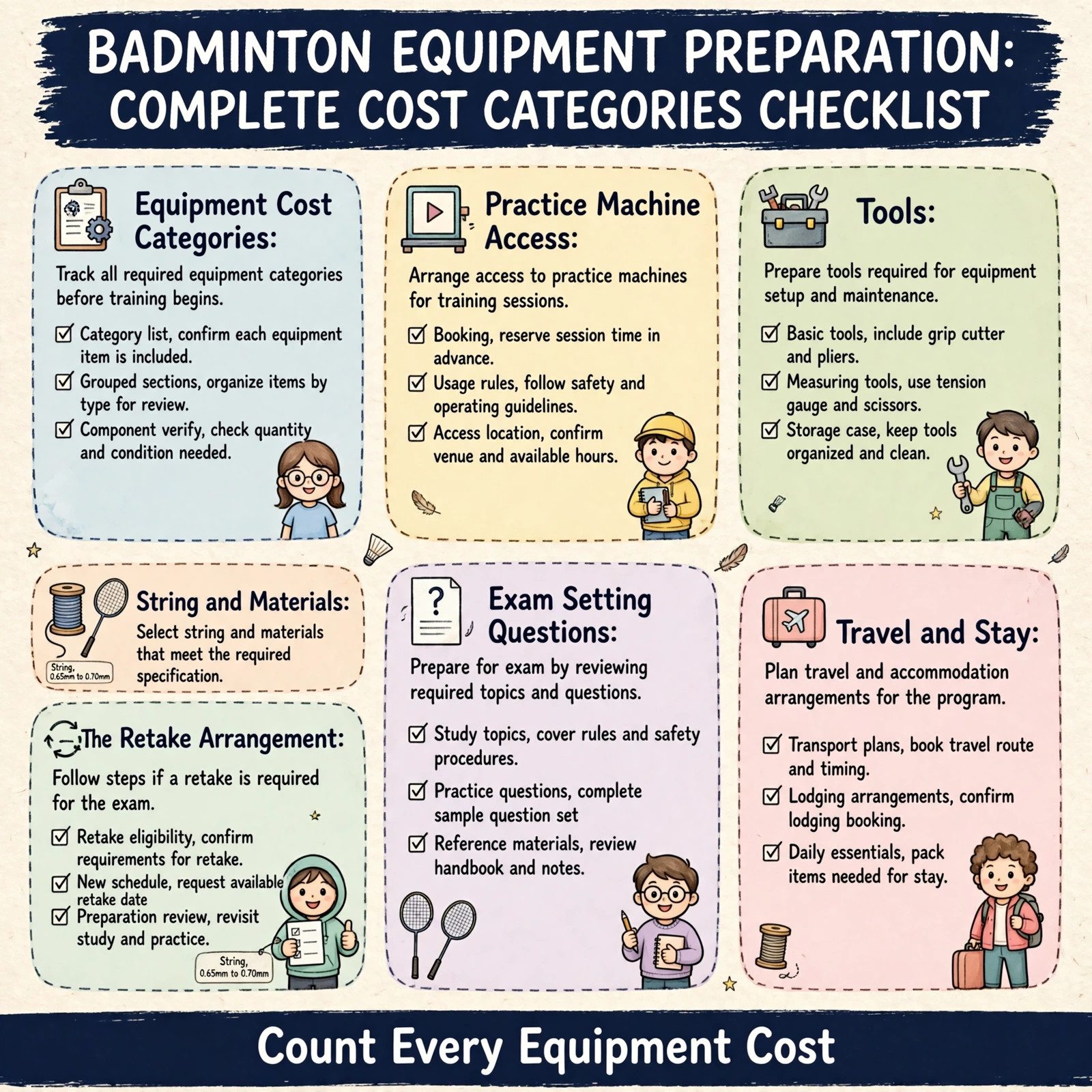
Equipment carries its own cost categories, and honest planning lists them without inventing figures. If you practise at home, a reliable machine and tools of your own are the largest category, or access to a shop machine is the arrangement to secure instead. String and materials for practice rackets follow. If the exam body provides the exam machine, ask whether any equipment or facility charge sits inside its fees. Travel and stay apply when the body tests in another city. Time away from work counts too, plus the retake arrangement, understood before you need it.
Check the details. This page puts no prices on machines or tools, on purpose. Prices vary by model, condition and country, and this article is about exam standards, not buying advice. Ask each provider what the exam setting provides, what you must bring, and what it charges for, in writing. Then price your own practice access separately, from real sellers, if you need it.
Review the process. Commitment shows in maintenance as much as money. A candidate who owns a machine must keep it calibrated and its clamp bases clean and true, or practice teaches drift. A candidate using a shop machine must book practice time around shop work. Either way, the equipment routine is part of readiness, and it is built over weeks, not assembled the night before the exam.
Plan the next step. The false saving is practising on neglected equipment because it is free. You save access cost and pay in false tension feel, sloppy clamping habits and exam day surprises on a true machine. Doing the equipment part properly once, with checks and records, costs less than relearning your hands under a working setup later.
1.5 Key Checks
How should candidates compare exam settings between bodies?
Record the context.
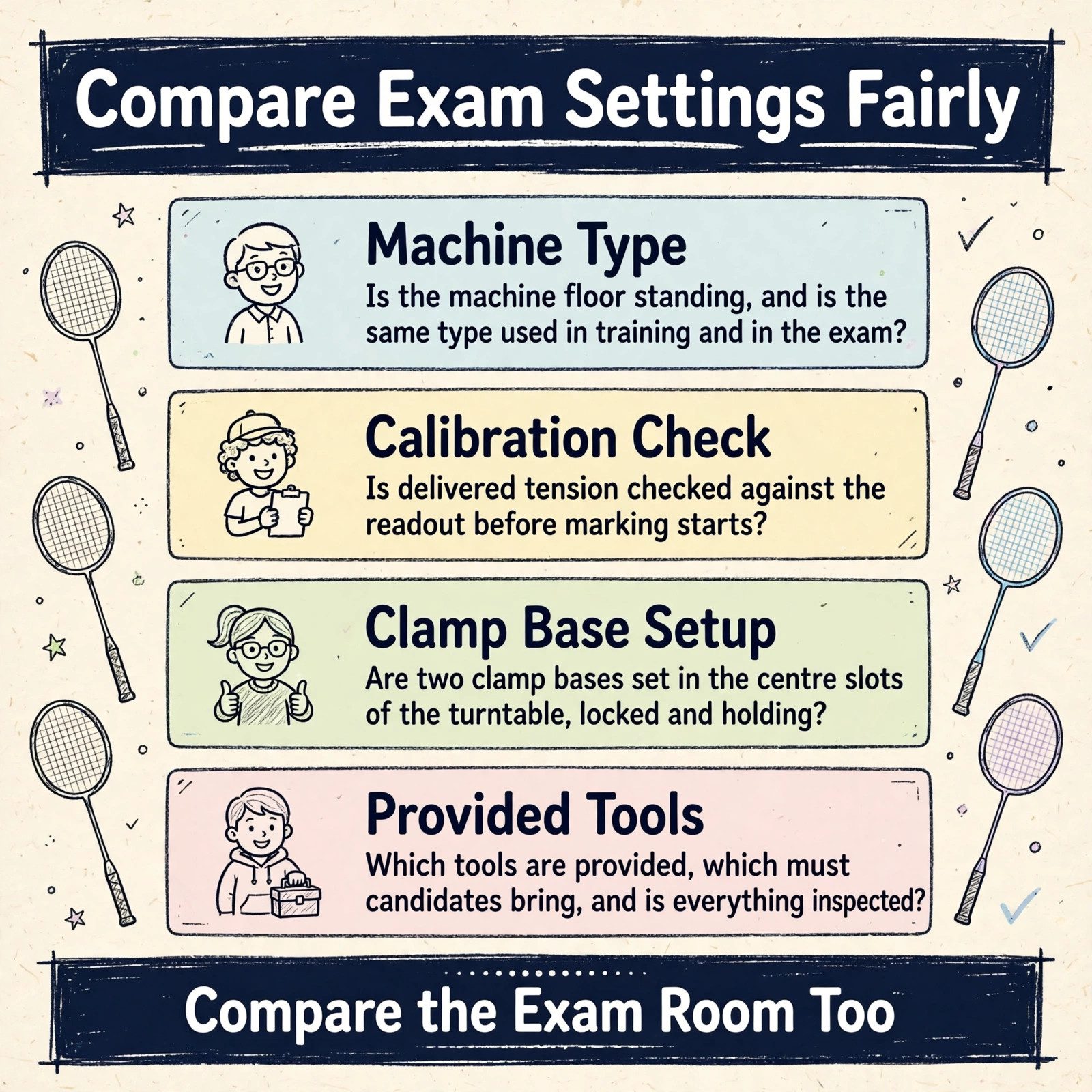
Compare exam settings between bodies with the same equipment questions, written down. First, machine: floor standing or desktop, and is the same model family used in training and in the exam? Second, calibration: is delivered tension checked against the readout, and how is that check recorded? Third, clamping: are there two clamp bases in the centre slots of the turntable, locked and holding? Fourth, tools: what is provided, what must candidates bring, and is it inspected? A body that answers plainly runs a fair room. A body that waves the questions away is telling you the setting is an afterthought.
Check the details.
General bodies run their exams on their own settings. USRSA, the United States Racquet Stringers Association, combines written and practical sections across racket sports through its Certified Stringer, Master Racquet Technician and Professional Racquet Advisor credentials, with tennis at the centre. GRSA certifies across racket sports internationally and ERSA from a European base. Their practical settings are built for general racket work, so a badminton candidate should ask which rackets, gauges and tensions the practical setting actually uses.
Review the process.
CRSF certifies within China, where badminton carries real weight in the stringing scene. BSW is the badminton specific setting in this company: real badminton rackets, thin gauges, a practical exam, and results assessed and approved by the BSW certification board in Kuala Lumpur. Whichever body you choose, judge the room as well as the syllabus: the equipment standard is part of the credential standard.
1.6 Service Record
How does the BSW exam setting measure up on equipment?
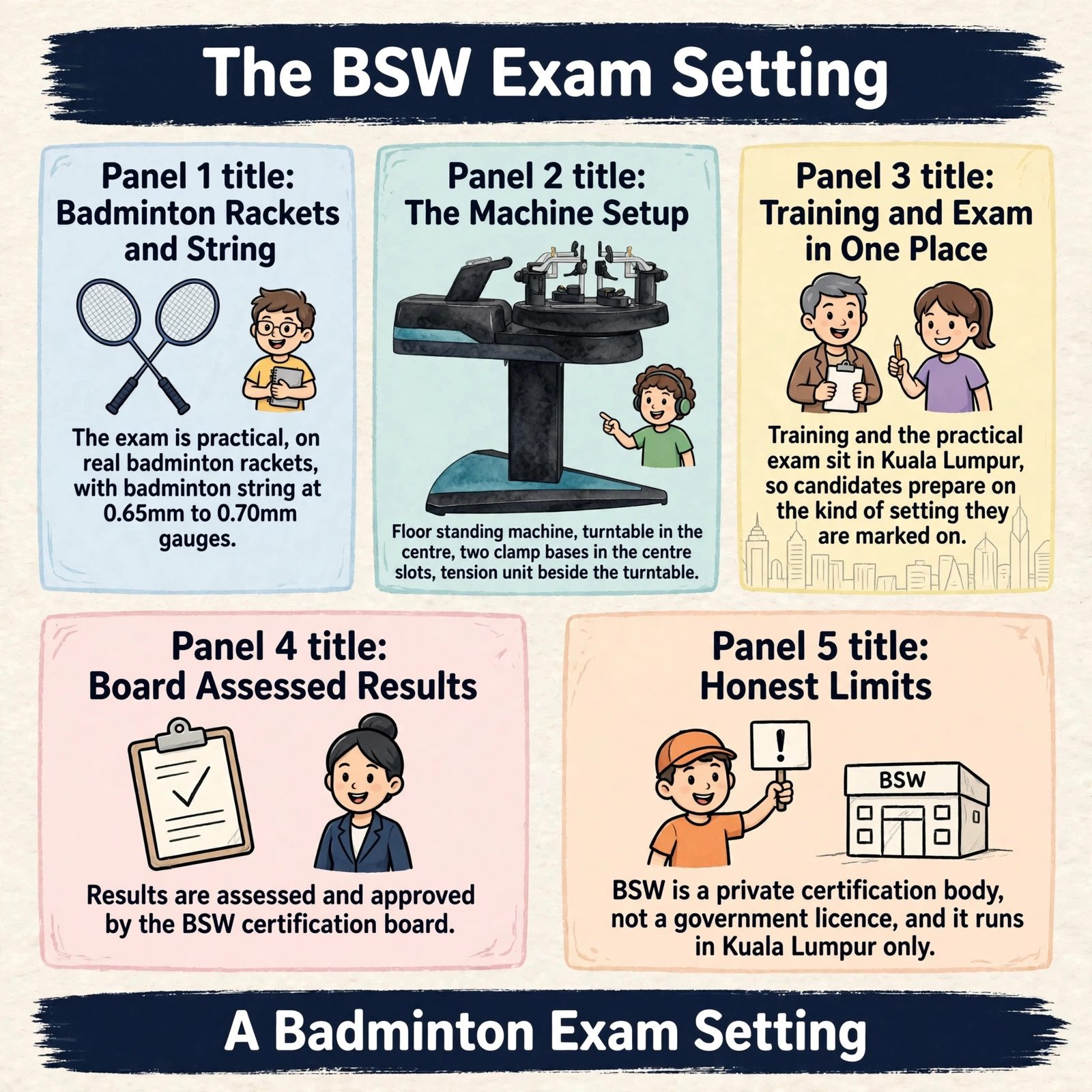
Hold the BSW exam setting to the same equipment checks. The exam is practical and badminton specific, worked on real rackets with badminton string at 0.65mm to 0.70mm gauges, so the machine setup is the badminton setup described in this guide: floor standing, turntable centred, two clamp bases, tension unit beside the turntable. Training and exam sit in the same place, Kuala Lumpur, so candidates prepare on the kind of setting they are marked on. Results are assessed and approved by the BSW certification board.
Check the details. The training shape around that setting is public. Classes run from 10am to 5pm, the course takes 3 and a half days with flexible timing, and the practical exam sits on the last day, after hands on training with instructor correction. That order matters for equipment: by exam day the pre start check, clamp routine and tension habits have been practised on real rackets under watch, not read from a manual in the exam room.
Review the process. State the limits plainly too. BSW is a private certification body, not a government licence, and it runs in Kuala Lumpur only. The older general bodies have longer histories and wider recognition outside badminton. If your work is mostly tennis abroad, their settings and credentials may fit better. If your work is badminton, an exam room set up for badminton gauges and frames tests the equipment handling you use every week.
Plan the next step. Before enrolling anywhere, ask the equipment questions in writing and keep the replies: what is provided, what is checked before marking, and what happens if a machine faults mid exam. BSW answers enquiry questions before enrolment. Judge every body, BSW included, by how directly it answers. An exam that cannot explain its own equipment standard cannot ask you to trust its marking standard either.
1.7 Guided Practice
What should you ask about exam equipment before applying?
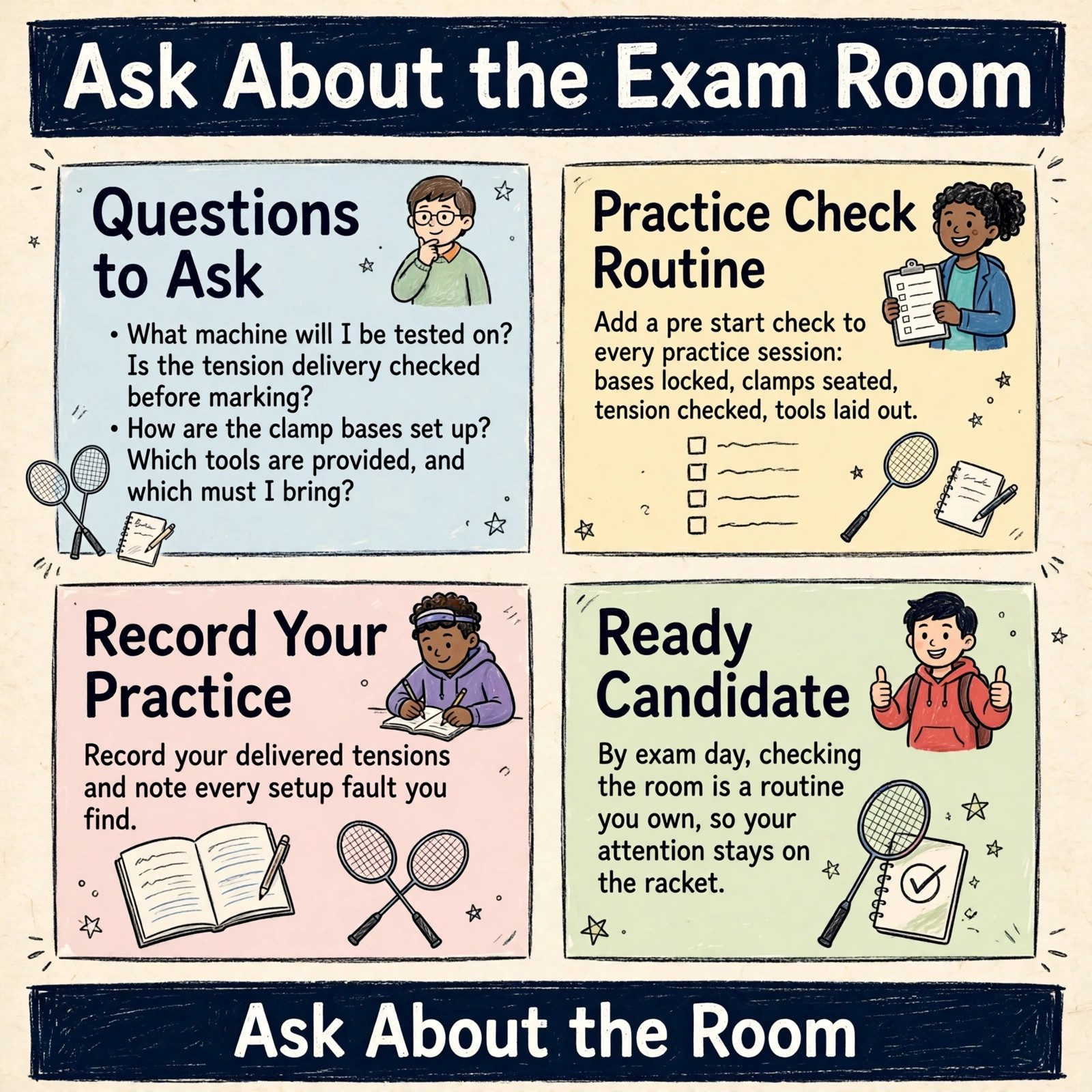
A good enquiry asks about the room, not just the syllabus. State your sport, the machine you practise on now and the work you want the credential for. Then ask: what machine will I be tested on, and is it the same type used in training? Is the tension delivery calibration checked before marking, and how? How are the clamp bases set up? Which tools are provided and which must I bring? What happens if equipment faults during my exam? Write the answers down and score them with the comparison method in this guide.
Timing questions sit beside equipment questions. Ask when training runs, how long each day lasts and whether dates can flex around your work. At BSW, training is in Kuala Lumpur only, classes run from 10am to 5pm, the course takes 3 and a half days with the exam on the last day, and timing is flexible. A provider should be able to describe both its timetable and its exam room in the same plain terms.
Turn the answers into a preparation plan. Add a pre start equipment check to every practice session: bases locked, clamps seated, tension checked, tools laid out. Practise on the truest machine you can access, record your delivered tensions, and note every setup fault you find. By exam day, checking the room should be a routine you own, so your attention stays on the racket in front of you.
Stringer Certification Exam Equipment Quick FAQ
Short answers to the questions candidates ask first about exam machines, clamp setups, tool checks and the BSW exam setting.
What exam equipment must a fair test provide?
Exam equipment means the machine and tools a candidate is tested on: a calibrated floor standing machine, a turntable with two clamp bases in the centre slots, a true tension unit and checked hand tools. Fair equipment makes the marking judge the stringer, not the machine faults.
What is checked on the machine before marking?
Before marking, the machine structure and calibration are checked: single column floor standing frame, turntable with two clamp bases in the centre slots, tension unit beside it delivering the shown number, plus cutters, awl, starting clamp and grommet tools in working order.
How does checked equipment practice build readiness?
Practising on checked equipment builds readiness because your tension feel, clamping and tool routine are learned on a setup that behaves like the exam machine. An instructor can then correct your hands, not your equipment, and your pre start check becomes automatic.
Which equipment costs and commitments should candidates count?
Equipment carries its own cost categories, and honest planning lists them without inventing figures. If you practise at home, a reliable machine and tools of your own are the largest category, or access to a shop machine is the arrangement to secure instead. String and materials for practice rackets follow. If the exam body provides the exam machine, ask whether any equipment or facility charge sits inside its fees. Travel and stay apply when the body tests in another city. Time away from work counts too, plus the retake arrangement, understood before you need it.
How should candidates compare exam settings?
Compare exam settings by asking what machine type is provided, whether its tension delivery is calibration checked, how the two clamp bases are set, which tools are supplied or required, and whether the setup is checked before marking starts. Written answers beat showroom impressions.
How does the BSW exam setting measure up?
The BSW exam setting is a badminton practical setting in Kuala Lumpur: real rackets, string at 0.65mm to 0.70mm gauges, floor standing machine work with two clamp bases, after 3 and a half days of training with classes from 10am to 5pm and the exam on the last day. Results are assessed and approved by the BSW certification board.
What should you ask about exam equipment?
A good enquiry asks about the room, not just the syllabus. State your sport, the machine you practise on now and the work you want the credential for. Then ask: what machine will I be tested on, and is it the same type used in training? Is the tension delivery calibration checked before marking, and how? How are the clamp bases set up? Which tools are provided and which must I bring? What happens if equipment faults during my exam? Write the answers down and score them with the comparison method in this guide.
What should you keep from your exam equipment checks?
Keep your exam result record, your pre start check routine, your practice tension records and notes on every machine you trained on: its type, its clamp setup and any drift you found. These records show how you prepared and help you set up fairly wherever you string after certification.
How can I start with BSW?
Start with an enquiry that states your sport, your current machine and your stringing experience. BSW trains in Kuala Lumpur only, with flexible timing, classes from 10am to 5pm over 3 and a half days and the practical exam on the last day. Your result is assessed and approved by the BSW certification board.
Stringer Certification Exam Equipment: Explore the Practical Decisions
Build a Clear Working Method
The method is simple: write the equipment criteria first, score every exam setting against the same criteria, and keep the record so your choice can be explained to any shop or player who asks.
| Equipment Check | Rushed Approach | Planned Approach |
|---|---|---|
| Machine | String the exam on any machine that happens to be free | Use a checked floor standing machine with a true tension unit |
| Clamps | Work with loose or wandering clamp bases | Set two clamp bases in the centre slots before starting |
| Tools | Borrow tools during the exam when a gap appears | Lay out and check every tool before marking starts |
| Record | Trust the machine reading without any check | Record the setup and calibration check for the exam |
| Setup record | Set up from memory on exam morning | Write the machine and tool checks down in order |
| Next action | Leave the setup unrecorded after the exam | Keep the setup record beside the exam result |
Face a Fair Exam Setting with Best Stringer Worldwide
If badminton is your sport, take the exam in a setting built for badminton equipment and badminton hands. Train on real rackets in Kuala Lumpur with Best Stringer Worldwide, with classes from 10am to 5pm over 3 and a half days, flexible timing, and the practical exam on the last day. Your work is assessed and approved by the BSW certification board. Send an enquiry that states your machine, your experience and your questions about the exam setting, and start with the answers in writing.
