






1.1 Starting Point
What routes across Europe do Europe certification routes differ?
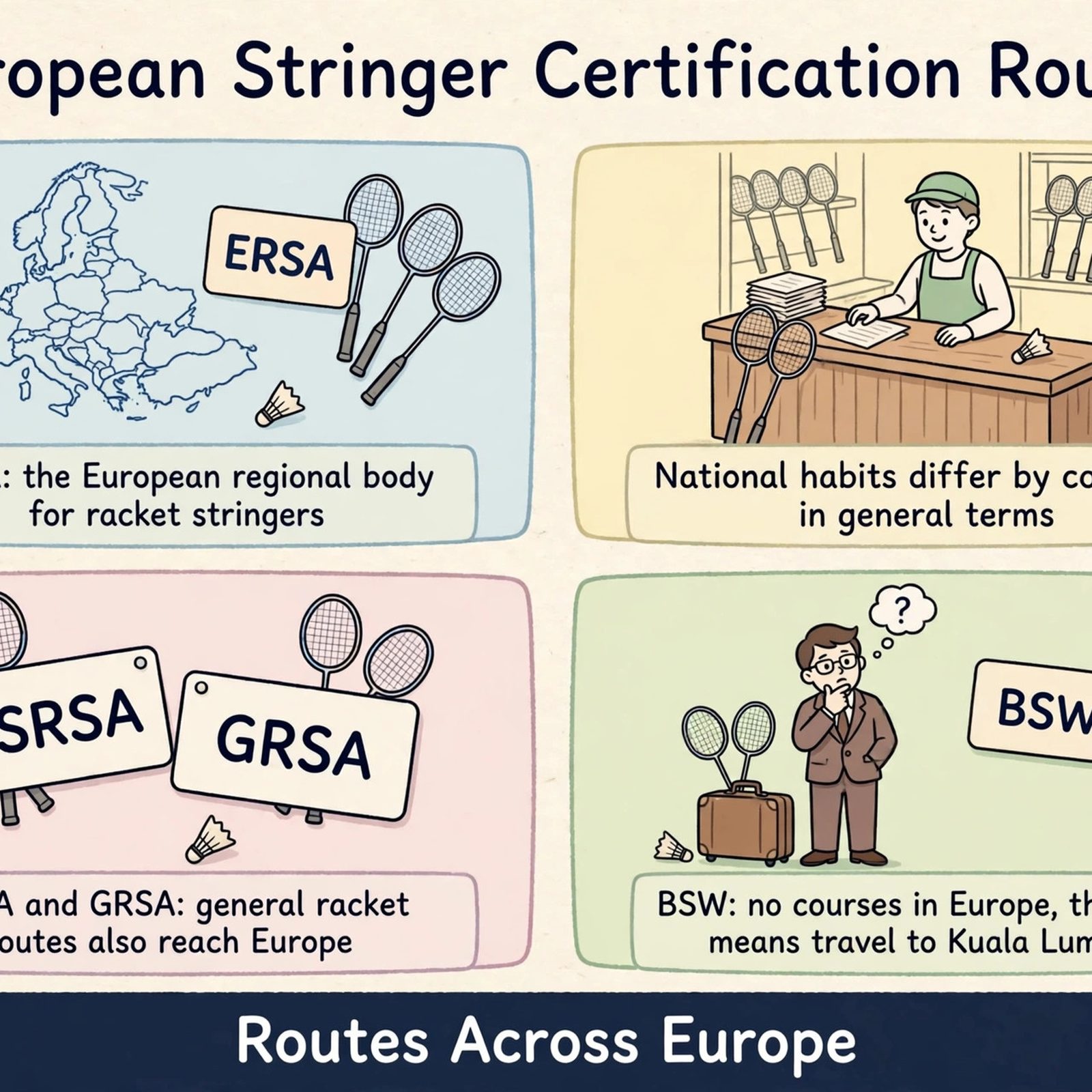
Stringer certification in Europe is a patchwork, not a single system. ERSA, the European Racket Stringers Association, is the regional body most European candidates meet first, running courses and certification for racket stringers from its European base. Around it sit national habits that differ by country, plus global routes such as USRSA and GRSA. Best Stringer Worldwide, founded by Eric Chuar and based in Kuala Lumpur, Malaysia, enters this picture honestly: it runs no courses in Europe, and its badminton specific route means travel to Kuala Lumpur for training and a practical exam assessed and approved by the BSW certification board.
Tennis shapes much of the European picture. Many European stringing cultures grew inside tennis clubs and tennis shops, so general racket credentials carry real weight and long habits behind them. Badminton is strong in parts of Europe too, notably in northern and western playing countries, but badminton specific testing is thinner on the ground. That gap is the honest reason a European badminton stringer might look beyond the region for an exam built only around badminton.
Judge European routes the way you would judge any route. Where is the exam held, what tasks does it mark, at which gauges and tensions, who records the result, and can a shop verify it later? National familiarity is comfortable, but comfort is not a standard. This guide compares the routes in general terms, without inventing national providers, fees or dates, and places the Kuala Lumpur option beside them with its travel cost stated openly.

1.2 Preparation
What on real rackets does a badminton exam in Europe test?
A serious certification exam in Europe tests the same practical core as anywhere else. Frame inspection before stringing, spotting cracks and worn grommets. Safe mounting without distortion. Clean weaving of mains and crosses. Delivered tension at the set number, checked on the finished bed. Clamp control that does not mark string. Starting and finishing knots that hold. Grommet care throughout, including shared holes and proper replacement of damaged grommets. The work is observed on real rackets, marked task by task, and the result is recorded by the body.
The badminton question sits inside that core. Badminton string runs at 0.65mm to 0.70mm gauges on light frames at high tensions, while much European exam tradition grew around tennis string and heavier frames. Before choosing a European route, read its scope for badminton gauges, frame sizes and tensions in writing. If the scope is silent on badminton, assume the exam tests general racket habits and judge whether that matches your weekly work.
Remember what no exam can test, in Europe or elsewhere. It cannot test your club night rush, your tournament deadline manner or your honesty with a player whose frame has hidden damage. Certification proves exam day standard under observation. Your records, repeat players and counter honesty prove the rest, which is why this guide treats every certificate, European or otherwise, as a starting point rather than the whole story.

1.3 Working Method
How with feedback does training differ across European routes?
European training routes differ in how correction reaches the learner. Strong routes put an instructor at the machine during training: clamp pressure checked before it marks string, weaving angle fixed while crosses are going in, knot tails and grommet habits shaped to the exam standard, with practice work marked before exam day arrives. Weaker routes lean on videos, manuals and occasional workshops, where the exam becomes the first time anyone senior watches you string a full racket. Both patterns exist across Europe, often inside the same country.
Good training also builds record habits that European shops value. Inspect the frame before mounting. Note the old string and tension before cutting. Record what you installed and what the player asked for, every job. Those habits feel slow in week one and priceless by exam day, because they show a candidate who checks rather than hopes. They also travel well: a stringer with records can explain his standard in any country and any shop.
Ask any European provider who corrects your stringing, and when, before you enrol. If the answer names instructors, marked practice and feedback during training, your hours compound. If the answer is a video library and a hope, set your expectations at that level. For badminton candidates, add one more question: will anyone correct my work on badminton frames at badminton tensions during training, or only on tennis equipment?

1.4 Practical Review
Which of travel costs come with travelling to be tested?
Cost planning for European candidates must include the travel question honestly, because the badminton specific route sits outside the region. List every category for any route: training or course fees, the exam or assessment fee, a machine and tools if you do not own them, string and materials for real practice, travel and stay in the testing city, time away from work or your own stringing queue, and the retake arrangement understood in advance. A nearby general route and a Kuala Lumpur badminton route are different totals, and both deserve full lists before comparison.
Check the details. This page quotes no figures, on purpose. Fees and travel costs differ by body, country and year, and a tidy quoted total from any page would be a guess. Ask each provider for current fees in writing, price your own travel with real fares and lodging, and keep the answers together. Only then can you judge whether badminton specific testing is worth a longer trip for your particular counter.
Review the process. Commitment counts alongside money. Exam readiness takes practice spread over weeks, not a single attended weekend, because tension feel and knot consistency build slowly. If you travel, arrive rested and leave recovery time after the exam before returning to a full queue. If a shop employs you, plan cover. Count preparation weeks and travel days as part of the route, not as extras around it.
Plan the next step. The nearest route can carry a delayed cost too. A general paper that never tested your badminton work may satisfy a tennis led shop and still leave your badminton standard unproven to the clubs and academies you actually serve. Replacing or supplementing it later costs more than choosing deliberately once. European candidates should price the fit of the credential, not only the distance to it.

1.5 Key Checks
How side by side do the routes open to European candidates compare?
Record the context.
Compare the routes open to European candidates on one scorecard. First, sport scope: general racket, or badminton specific? Second, exam format: practical on real rackets, written, or both, and at which gauges and tensions? Third, verification: can an employer confirm your pass with the body afterwards? Fourth, travel and timing: where is testing held, how flexible are dates, and what does the full trip commit? Write the answers for ERSA, the general bodies, your national options in general terms, and the Kuala Lumpur route side by side before deciding.
Check the details.
ERSA is the natural starting point inside Europe: a European base, courses and certification for racket stringers, and recognition inside European racket sport circles, with tennis at the centre of gravity. USRSA, from the United States, certifies across racket sports through Certified Stringer, Master Racquet Technician and Professional Racquet Advisor, with written and practical sections. GRSA certifies internationally across racket sports. For a multi sport European shop, these general routes are proven and respected.
Review the process.
National habits sit underneath those bodies. In general terms, some European countries have strong club based stringing cultures where reputation and shop training carry a candidate far, while formal testing is less common. Others lean more on association courses and certificates. Neither habit is wrong, but neither replaces the scorecard questions. Ask what any national route actually tests and records, especially for badminton, before treating familiarity as proof.

1.6 Service Record
How honestly does the Kuala Lumpur route fit European candidates?
Now place the Kuala Lumpur route on the same European scorecard, with geography stated first. BSW does not run courses in Europe, so this route costs a long trip and should only win when badminton depth is the deciding factor. Scope: badminton specific, the full exam weighted to badminton. Exam: practical, on real rackets, at the end of training. Verification: results assessed and approved by the BSW certification board and recorded by the organisation. Timing: flexible, classes from 10am to 5pm over 3 and a half days, exam on the last day, so one planned trip covers training and testing.
Check the details. The candidates this route suits are specific. A badminton club or academy stringer whose European options test mainly tennis habits. A shop stringer building a badminton counter and wanting a credential that names badminton tasks. A tournament minded stringer who wants gauges, tensions and frame care examined at badminton values. For those candidates, founder Eric Chuar teaching in Kuala Lumpur and a board assessed practical result can be worth the flight. For others, it will not be, and this guide says so.
Review the process. Where European routes win is equally clear. ERSA and the general bodies carry longer histories, wider recognition inside Europe and no intercontinental travel. If your work is tennis led, or mixed racket work in a European shop, a European general credential will usually serve you better and cheaper. If you cannot travel, the Kuala Lumpur route is simply closed, and the honest move is the best tested route you can reach, with its badminton scope checked in writing.
Plan the next step. Before committing to any route, ask how an employer verifies your pass, what exam day looks like and what happens if you fail, including where a retake would happen. For BSW those answers come inside the enquiry, before enrolment and before flights are booked. Judge the European routes by the same directness. A travelling candidate, in either direction, deserves written answers before money moves.

1.7 Guided Practice
What before travelling should a European candidate ask first?
A strong enquiry from a European candidate is specific from the first line. State your country, your sport, your stringing volume, your machine and the work you want the credential for. Then ask the deciding questions. What does the exam test, task by task, and at which gauges and tensions? Is badminton tested on badminton frames? Where is testing held and how flexible is timing? Who assesses the result and how can an employer verify it? What is the full cost by category, including travel and retakes? Keep every answer in writing and score it before booking.
Timing questions carry extra weight when a flight is involved. Ask how long training runs each day and whether dates can flex around work and travel. At BSW, training is in Kuala Lumpur only, classes run from 10am to 5pm, the course takes 3 and a half days with the exam on the last day, and timing is flexible for learners travelling in. A European provider should state its own shape just as plainly, so you can compare one trip against a local route fairly.
Turn the chosen answers into a preparation plan the same day. List your weakest exam tasks, practise them on real rackets at the gauges and tensions you will be tested on, and keep a record for every practice job. Book practice like appointments across the weeks before you travel or test locally. Prepared candidates look the same in every region: their checklist is already worked through before exam day begins.
Stringer Certification in Europe Quick FAQ
Short answers on European routes, ERSA, national habits, badminton weighting, travel costs and the Kuala Lumpur option.
What routes across Europe do Europe certification routes differ??
Europe has no single certification system. ERSA is the European regional body for racket stringers, national habits differ by country, and USRSA and GRSA routes also reach European candidates. BSW runs no courses in Europe: its route means travel to Kuala Lumpur.
What on real rackets does a badminton exam in Europe test??
European exams mark frame inspection, mounting, weaving, delivered tension, knots and grommet care on real rackets. The open question for badminton stringers is weighting: much European tradition centres on tennis, so check the written scope for badminton gauges and tensions.
How with feedback does training differ across European routes??
Training builds exam skill when an instructor watches your stringing and corrects clamp pressure, weaving, knots and grommet habits during practice. That is true on every European route. Videos teach step order but cannot see or fix your mistakes.
Which of travel costs come with travelling to be tested??
Cost planning for European candidates must include the travel question honestly, because the badminton specific route sits outside the region. List every category for any route: training or course fees, the exam or assessment fee, a machine and tools if you do not own them, string and materials for real practice, travel and stay in the testing city, time away from work or your own stringing queue, and the retake arrangement understood in advance. A nearby general route and a Kuala Lumpur badminton route are different totals, and both deserve full lists before comparison.
How side by side do the routes open to European candidates compare??
Score European options on badminton scope, practical exam format, verification and travel. ERSA is the European regional body, USRSA and GRSA are general global routes, national habits vary, and BSW is the badminton specific option reached by travelling to Kuala Lumpur.
How honestly does the Kuala Lumpur route fit European candidates??
For a European candidate who wants badminton specific testing, the BSW route means travel to Kuala Lumpur, stated plainly. BSW does not run courses in Europe. Training and the practical exam run in Kuala Lumpur only, classes from 10am to 5pm over 3 and a half days, flexible timing, exam on the last day, with results assessed and approved by the BSW certification board. Candidates who make the trip gain an exam weighted entirely to badminton gauges, tensions and frames. Candidates who cannot travel should use a European route and check its badminton depth carefully.
What before travelling should a European candidate ask first??
A strong enquiry from a European candidate is specific from the first line. State your country, your sport, your stringing volume, your machine and the work you want the credential for. Then ask the deciding questions. What does the exam test, task by task, and at which gauges and tensions? Is badminton tested on badminton frames? Where is testing held and how flexible is timing? Who assesses the result and how can an employer verify it? What is the full cost by category, including travel and retakes? Keep every answer in writing and score it before booking.
What should you keep from your route?
Keep your exam result record, the body confirmation of your pass, your training notes and your stringing records: string, tension, knots and grommet work per racket. Keep your route comparison notes too, especially the travel reasoning, so your choice can be explained to any European shop later.
How can I start with BSW?
Start with an enquiry stating your country, sport, experience, machine and goal, and ask the geography question directly. BSW trains and tests in Kuala Lumpur only and runs no courses in Europe, with flexible timing, classes from 10am to 5pm over 3 and a half days and the exam on the last day.
Stringer Certification in Europe: Explore the Practical Decisions
Build a Clear Working Method
The method is simple: write each route scope, exam, verification and travel answers down, score them on the same points, and keep the record behind the route you choose.
| Europe Route Check | Rushed Approach | Planned Approach |
|---|---|---|
| Region | Assume one European system covers every country | Compare the European routes against your sport and country |
| Exam | Assume a European paper tests badminton in depth | Check gauges, tensions and tasks each exam marks |
| Costs | Budget only for a nearby course fee | List travel, stay, tools, string and time together |
| Scorecard | Follow the best known name in your country | Score scope, exam, verification and travel for every route |
| Your record | Compare routes from reputation alone | Write each route scope, exam and travel needs down |
| Next action | Keep no record of why a route was chosen | Use the record to explain your route to shops and players |
Start Your Route with Best Stringer Worldwide
If badminton is your sport and European routes test it too lightly, consider the trip honestly. Train on real rackets in Kuala Lumpur with Best Stringer Worldwide, classes from 10am to 5pm over 3 and a half days, flexible timing, and the practical exam on the last day. Your work is assessed and approved by the BSW certification board. BSW runs no courses in Europe, so plan the travel with written answers first. Send an enquiry stating your country, experience, machine and goal.

