






1.1 Starting Point
How do certification bodies set their exam standards?
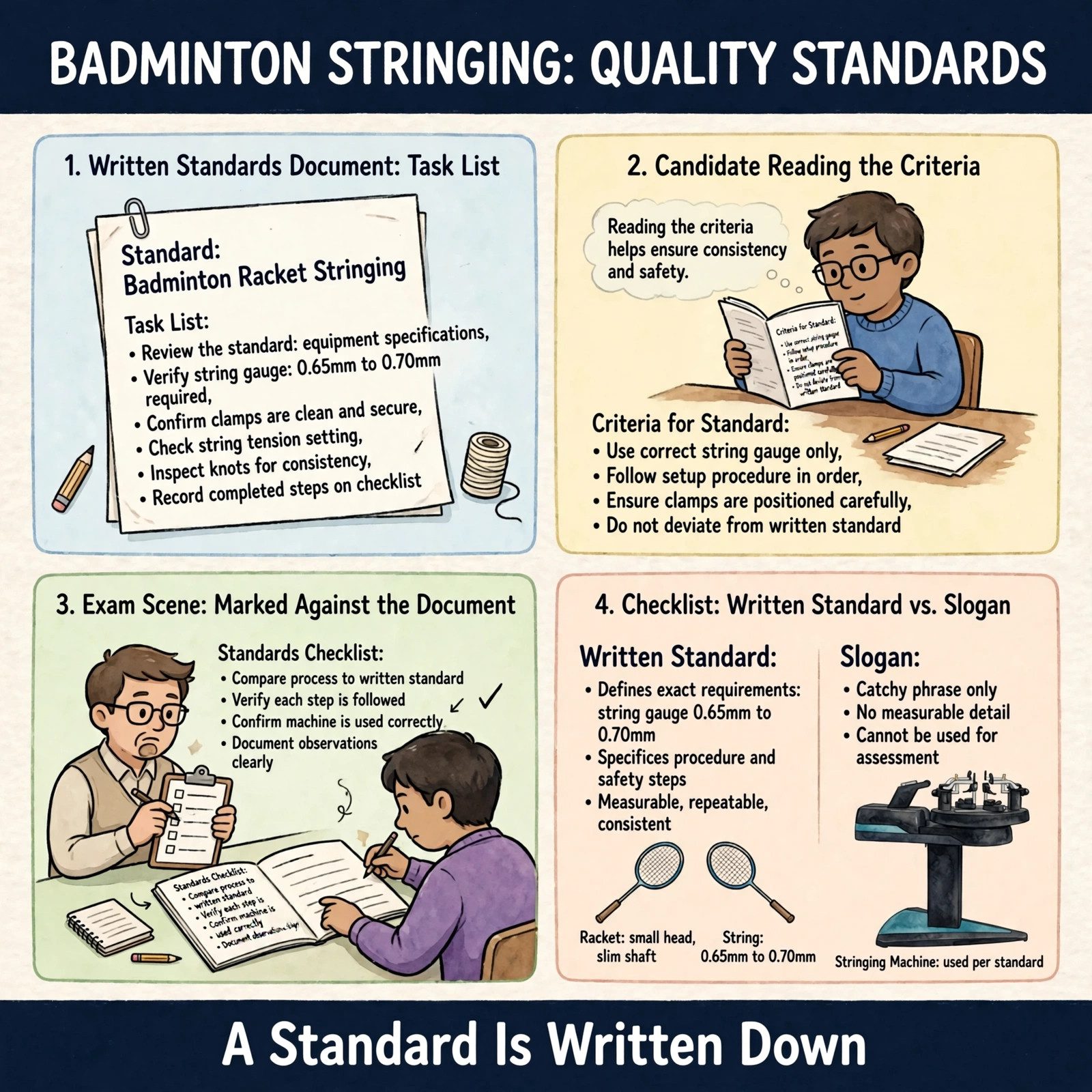
Stringer certification standards are the written rules a certifying body uses to decide what its exam tests and what counts as a pass. A body starts from the work itself: the frames, strings, tensions and faults a stringer meets at a real counter. It then turns that work into testable tasks, marking criteria and examiner instructions, so two candidates doing the same job face the same judgement. Bodies such as USRSA, GRSA, ERSA, CRSF and Best Stringer Worldwide each set their own version. Best Stringer Worldwide, founded by Eric Chuar and based in Kuala Lumpur, Malaysia, sets a badminton specific standard, with results assessed and approved by the BSW certification board.
A standard is not a slogan on a website. It is a document, or a set of documents, that names the tasks, the conditions and the quality expected for each one. When a body can show you that document, or explain it plainly task by task, the exam that follows has something solid behind it. When nobody can explain what the standard says, the certificate rests on habit and opinion.
Standards protect three people at once. The candidate knows what to prepare for. The examiner knows what to mark. The player or shop reading the certificate later knows what the pass actually meant. Without a written standard, each of those three is guessing, and the same certificate can mean careful work in one town and a friendly nod in another.
1.2 Preparation
What does a standards document actually decide?
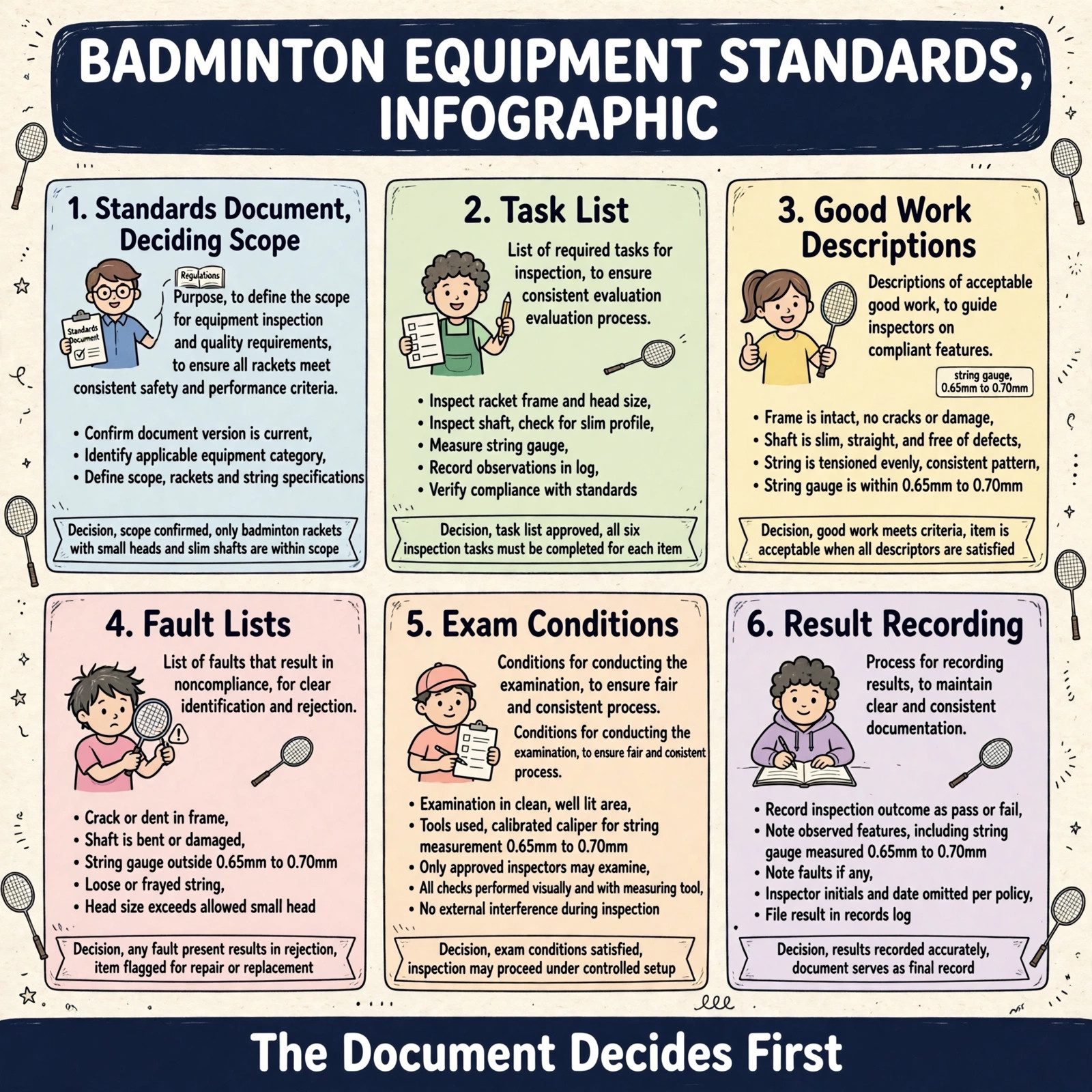
A standards document decides the exam before any candidate walks in. It names the scope first: which sports, which frame types and which string work the credential covers. Then it breaks the job into tasks: frame inspection, safe mounting, weaving, delivered tension, clamp control, knots and grommet care. For each task it describes what good work looks like and what faults lose marks, in words an examiner can apply the same way every time. It also sets the exam conditions: real rackets or paper questions, observed work or posted evidence, and how long a candidate has to show the skill.
The document also decides how results are recorded. A careful body writes down which tasks were marked, who marked them and what the outcome was, so a pass can be checked later. That record is part of the standard, not paperwork after it. If a body cannot say how your result would be recorded and confirmed, its standard has a hole in it, however tidy the exam room looks.
What a standard leaves out is a decision too. A body may test speed, or it may test only accuracy and finish. It may include player advice and string knowledge in a written section, or keep the exam purely practical. None of those choices is wrong on its own. The point is that the choice should be written, public and the same for every candidate, not invented on the day.
1.3 Working Method
How does examiner marking turn a standard into a result?
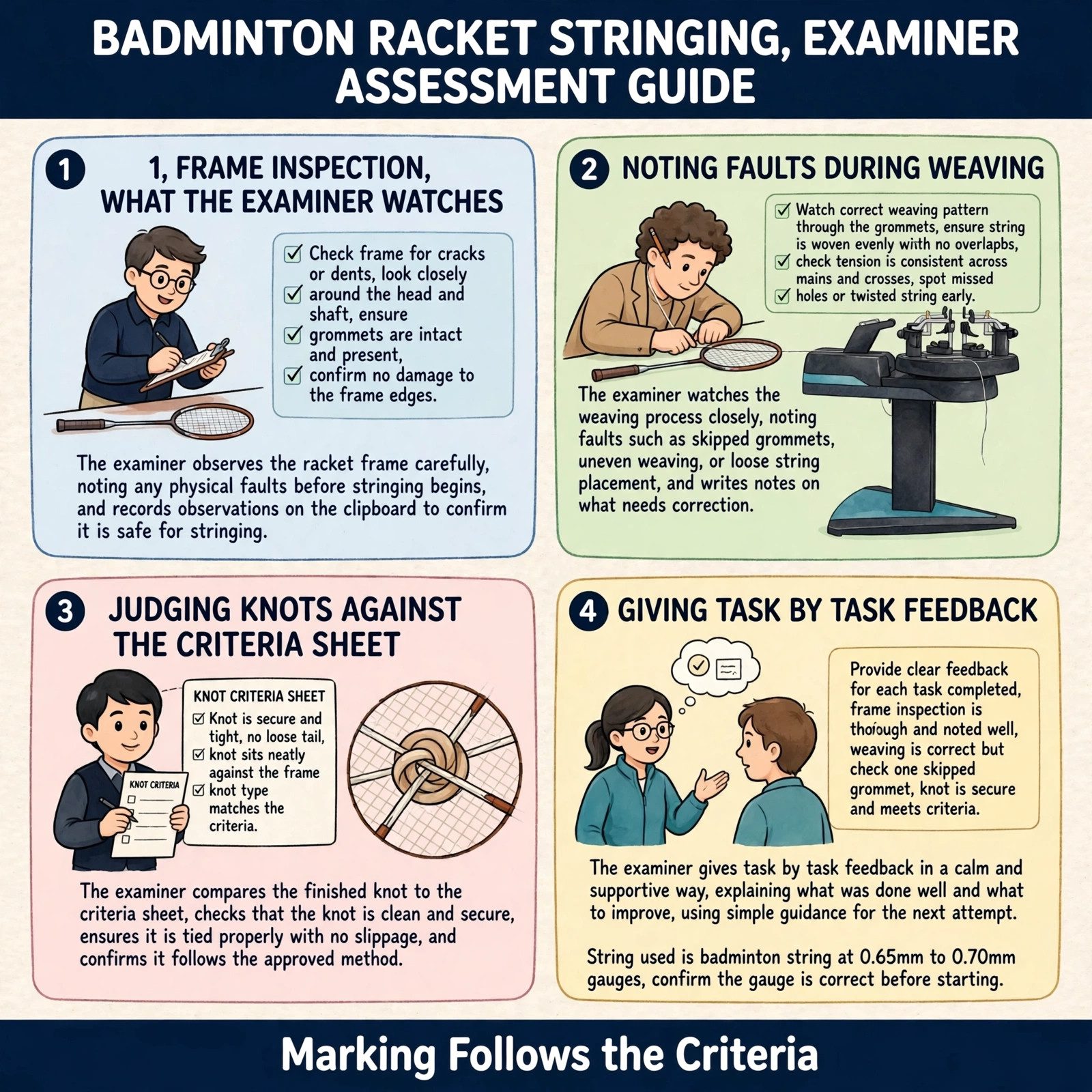
A standard only becomes real when an examiner applies it, and marking is where bodies work hardest to stay fair. Examiners are usually experienced stringers who are shown the standard in detail: what to watch during each task, which faults matter most, and how to judge borderline work. Many bodies have examiners mark sample rackets or observe alongside a senior examiner before marking alone. During the exam, the examiner records faults as they happen rather than relying on memory at the end, because a knot judged an hour later is a guess, not a mark.
Steady marking also needs steady conditions. The same machine setup, the same task order and the same instructions to every candidate stop the exam itself from becoming the variable. When a candidate fails, a good examiner can point to the exact task and the exact words in the standard that the work missed. That feedback is what makes a retake a plan instead of a second lottery ticket.
Ask any body how it keeps marking consistent. The honest answers sound plain: written criteria, trained examiners, recorded results and a way to question a result. Vague answers about experienced staff and high standards, with nothing written behind them, tell you the standard lives in one person’s head. People change. Documents stay, and candidates can prepare against documents.
1.4 Practical Review
Which costs and commitments come with a standards based exam?
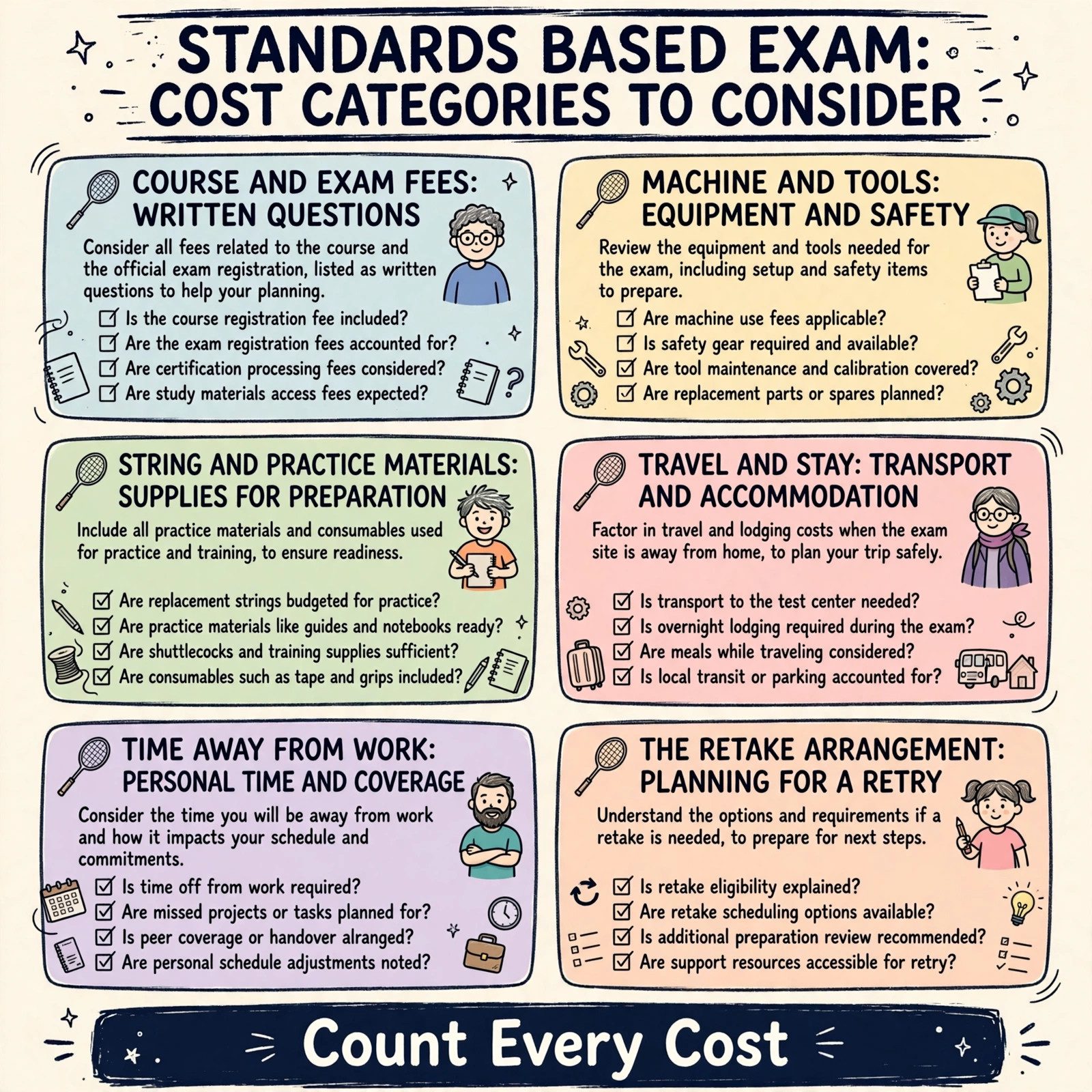
Sitting an exam built on a real standard carries the same full set of costs as any serious certification, and honest planning lists every category before you commit. The course or training fee, where you take one. The exam or assessment fee itself. A machine and tools, if you do not already own them: a reliable machine, clamps, cutters, awl and starting clamp. String and materials for practice against the standard, because readiness takes real rackets strung to the published tasks. Travel and stay if your chosen body tests in another city or country. Time away from work. And the retake arrangement, understood before you need it.
Check the details. This guide puts no figures on those categories, on purpose. Fees differ by body, by country and by year, and a page that quotes a tidy total without naming the body and the date is guessing. Ask each provider for the current figure for every category, in writing. A body with a real standard usually answers plainly, because its whole way of working is written down.
Review the process. The commitment side is practice shaped by the standard itself. Instead of stringing random rackets and hoping, you work through the published tasks one by one: inspection, mounting, tension, knots, grommets. That focus makes practice hours count double, but it still takes hours, spread over weeks, and it may need cover at your shop while you train.
Plan the next step. There is also a cost to choosing a body with no visible standard, and it is paid later. The paper may be cheaper and quicker, then it fails the first time a shop or tournament asks what was tested and how it was marked. Retraining under a body with a written standard costs more than preparing properly once. A standard you can read is also a saving: you stop paying for guesswork.
1.5 Key Checks
Why do standards differ between certification bodies?
Record the context.
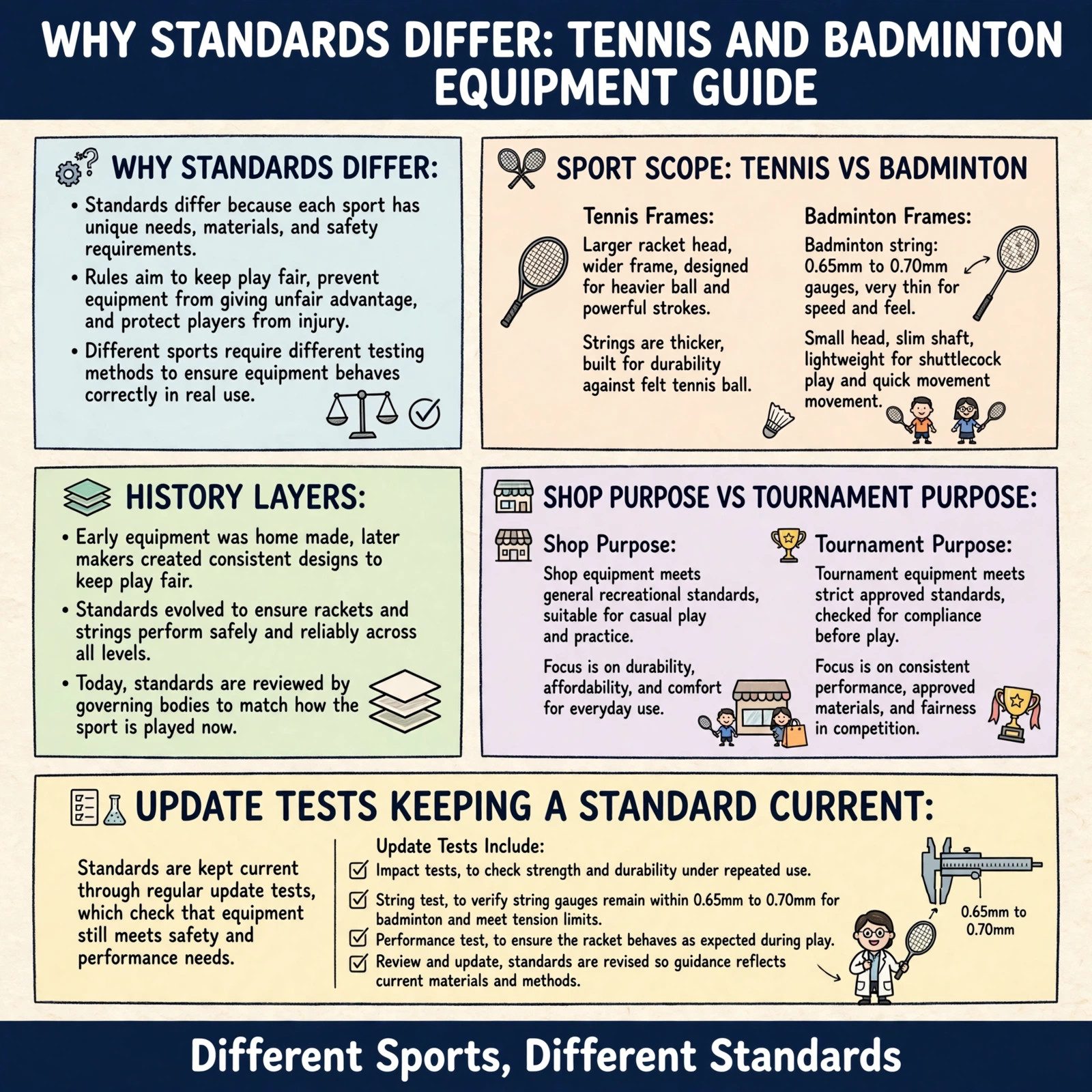
Standards differ between bodies for reasons you can inspect, and comparing them fairly starts with asking why. First, sport scope: a body built around tennis writes tasks for tennis frames, strings and tensions, while a badminton specific body writes for thin strings at 0.65mm to 0.70mm and light frames. Second, history: older bodies built standards around the tools and habits of their founding years, then updated them in layers. Third, purpose: some credentials certify shop counter work, others aim at tournament rooms. Fourth, maintenance: some bodies refresh their standard with update tests, like the annual written update test that maintains the USRSA Master Racquet Technician title.
Check the details.
Update tests are how a standard stays alive after exam day. Strings change, machines change and playing habits change, so a body that never revisits its document slowly certifies yesterday’s job. The USRSA pattern shows one honest model: the Certified Stringer status itself has no expiry, with listing tied to current membership, while the Master Racquet Technician title is held current by an annual written update test. Different levels, different maintenance, all of it written down where candidates can read it.
Review the process.
When you compare bodies, score the standard itself, not the marketing around it. Can you read what is tested? Is marking described? Is there an update route? Does the scope match your rackets? A newer body with a clear, current, badminton specific document can serve a badminton stringer better than an older body whose standard barely mentions the sport. Age earns respect. It does not mark your exam.

1.6 Service Record
How does the BSW standard measure up on the same checks?
Now hold the BSW route against the same standard setting checks, with no special pleading. Scope: the BSW standard is written for badminton only, which is a strength for badminton stringers and a limit for anyone wanting one paper for every racket sport. Exam basis: a practical exam on real rackets, so the tasks marked are the tasks the standard names. Decision: results are assessed and approved by the BSW certification board as an organisation, and graduates are recorded by the organisation. Setting: Kuala Lumpur only, stated openly rather than dressed up as a worldwide network.
Check the details. The training shape behind the exam is fixed and public. The course runs 3 and a half days, with classes from 10am to 5pm and flexible timing on dates, and the practical exam sits on the last day. Learners train on real rackets with instructor correction against the same tasks the exam will mark. Founder Eric Chuar teaches from his own stringing and coaching base in Kuala Lumpur, while the certification decision itself belongs to the BSW certification board, not to one person.
Review the process. Where does BSW not measure up? Say it plainly. The older general bodies have longer standard histories, larger examiner pools and wider recognition outside badminton, especially in tennis. Their documents have been revised over many cycles. If your work is mostly tennis in the United States or Europe, a USRSA or ERSA standard may fit your rackets better. If your work is badminton, a standard written for badminton gauges and frames is the honest match.
Plan the next step. One more check protects you whichever body you choose. Before paying anything, ask to see or hear the standard explained task by task, ask how marking is kept steady, and ask how an employer can verify your pass. BSW answers those questions in the enquiry itself, before enrolment. Judge every body, BSW included, by how directly it answers. A standard that cannot be questioned cannot be trusted, and candidates can smell the difference quickly.
1.7 Guided Practice
What should you ask about standards before applying anywhere?
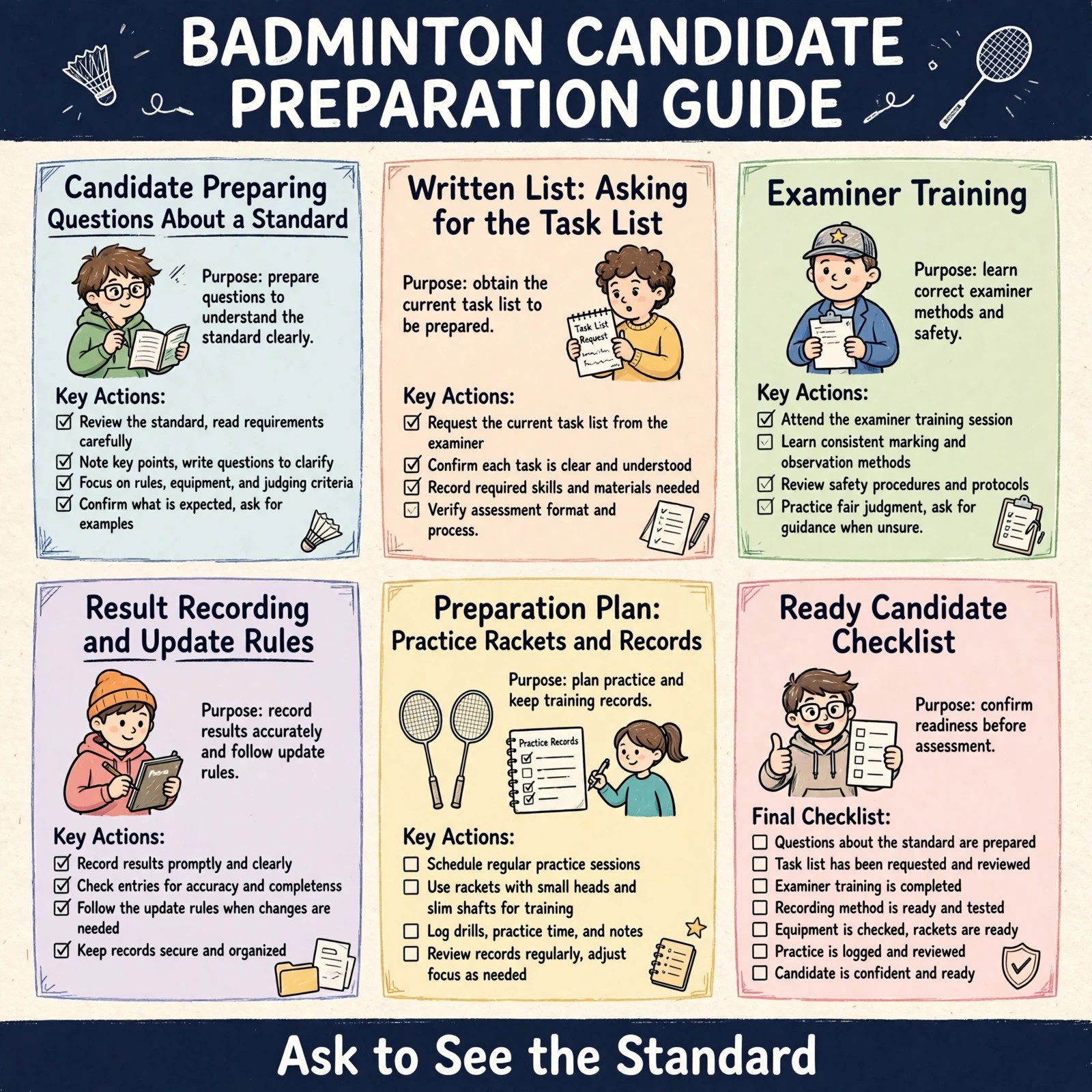
A good enquiry makes the provider show its standard. State your sport, your current stringing volume, the machine you use and the work you want the credential for: shop counter, tournament team, academy or your own business. Then ask the deciding questions. What exactly does your standard test, task by task? How are examiners trained and checked? How is my result recorded, and can an employer verify it? Is there an update test or membership condition after I pass? What does the full cost look like, category by category, including retakes? Write the answers down and score them with the comparison method from this guide before you commit money or travel.
Timing questions matter as much as standards questions. Ask when training runs, how long it lasts each day, and whether dates can flex around your work. At BSW, training is in Kuala Lumpur only, classes run from 10am to 5pm, the course takes 3 and a half days with the exam on the last day, and timing is flexible so learners travelling in can plan around flights and work. Any provider should be able to state its own shape just as plainly.
Turn the answers into a preparation plan the same day. List the standard’s tasks, mark your weakest ones honestly, and set practice rackets against each one. Keep a record of tensions, knots and grommet work as you go. By exam day, your plan should read like the standard itself, worked through twice. Examiners can tell within the first racket whether a candidate prepared against the document or against a rumour of it.
How Certification Bodies Set Exam Standards Quick FAQ
Short answers to the questions candidates ask first about how exam standards are set, marked, updated and compared.
How do certification bodies set exam standards?
Certification bodies set exam standards by writing down the work a stringer must prove: the tasks, the conditions and the quality expected for each task. Examiners then mark candidates against that document, so the same work earns the same judgement from any examiner.
What does a standards document decide?
A standards document decides the scope, the task list, what good work looks like for each task, which faults lose marks, the exam conditions and how results are recorded. Frame inspection, mounting, weaving, tension, knots and grommet care are the usual practical tasks.
How does examiner marking work?
Examiners mark against written criteria, not personal taste. They watch each task, note faults as they happen and judge the finished racket against the standard. Good bodies train and check their examiners so marking stays steady between candidates, rooms and days.
Which costs and commitments come with it?
Sitting an exam built on a real standard carries the same full set of costs as any serious certification, and honest planning lists every category before you commit. The course or training fee, where you take one. The exam or assessment fee itself. A machine and tools, if you do not already own them: a reliable machine, clamps, cutters, awl and starting clamp. String and materials for practice against the standard, because readiness takes real rackets strung to the published tasks. Travel and stay if your chosen body tests in another city or country. Time away from work. And the retake arrangement, understood before you need it.
Why do standards differ between bodies?
Standards differ because bodies serve different sports, regions and histories. A tennis centred body weights its tasks toward tennis frames and habits. A badminton specific body weights thin strings, high tensions and small frames. Scope, exam format and update rules follow those choices.
How does the BSW standard measure up?
Measured against the same checks used for every body in this guide, the BSW standard holds up where badminton is concerned. Its scope is written around badminton work: thin strings, real tensions and small frames. Its exam is practical, on real rackets, covering frame inspection, mounting, delivered tension, knots and grommet care. Results are assessed and approved by the BSW certification board, and the result is recorded by the organisation. Training is hands on in Kuala Lumpur, running 3 and a half days with classes from 10am to 5pm and the exam on the last day. What BSW does not claim is equally plain: no government licence, no promise that a pass brings work, and no course outside Kuala Lumpur.
What should you ask about standards first?
A good enquiry makes the provider show its standard. State your sport, your current stringing volume, the machine you use and the work you want the credential for: shop counter, tournament team, academy or your own business. Then ask the deciding questions. What exactly does your standard test, task by task? How are examiners trained and checked? How is my result recorded, and can an employer verify it? Is there an update test or membership condition after I pass? What does the full cost look like, category by category, including retakes? Write the answers down and score them with the comparison method from this guide before you commit money or travel.
What should you keep from your standards research?
Keep the standard documents or notes you collected from each body, the comparison scores you wrote down, and your own practice records: tensions, strings, knots and grommet work per racket. After you pass, keep the body’s confirmation of your result with those papers, so anyone can trace what your pass was judged against.
How can I start with BSW?
Start with an enquiry that states your sport, your stringing experience, your machine and the work you want certification for, and ask how the BSW standard is applied on exam day. BSW trains in Kuala Lumpur only, with flexible timing, classes from 10am to 5pm over 3 and a half days and the practical exam on the last day. Your result is assessed and approved by the BSW certification board.
How Certification Bodies Set Exam Standards: Explore the Practical Decisions
Build a Clear Working Method
The method is simple: read the standard first, score every body against the same questions about scope, marking and updates, and keep the record so your choice can be explained to any player or shop that asks.
| Standards Check | Rushed Approach | Planned Approach |
|---|---|---|
| Document | Trust a standard nobody wrote down | Read the written standard behind the exam |
| Marking | Assume marking is one examiner guessing | Check how examiners mark against set criteria |
| Costs | Budget for the exam fee only | List training, tools, travel and time together |
| Compare | Pick the body with the boldest claim | Score each body on scope, marking and updates |
| Your record | Keep standard comparisons in your head | Write each body’s standard and marking method down |
| Next action | Judge a standard from the certificate design alone | Use the record to choose the body that tests your sport |
Check the Standard Behind Your Certification with Best Stringer Worldwide
If badminton is your sport, choose the standard written for badminton. Train on real rackets in Kuala Lumpur with Best Stringer Worldwide, with classes from 10am to 5pm over 3 and a half days, flexible timing, and the practical exam on the last day after your training is complete. Your work is assessed and approved by the BSW certification board. Send an enquiry that states your experience, your machine and your goal, and ask how the standard will be marked.
