






1.1 Starting Point
What is the USRSA Certified Stringer credential?
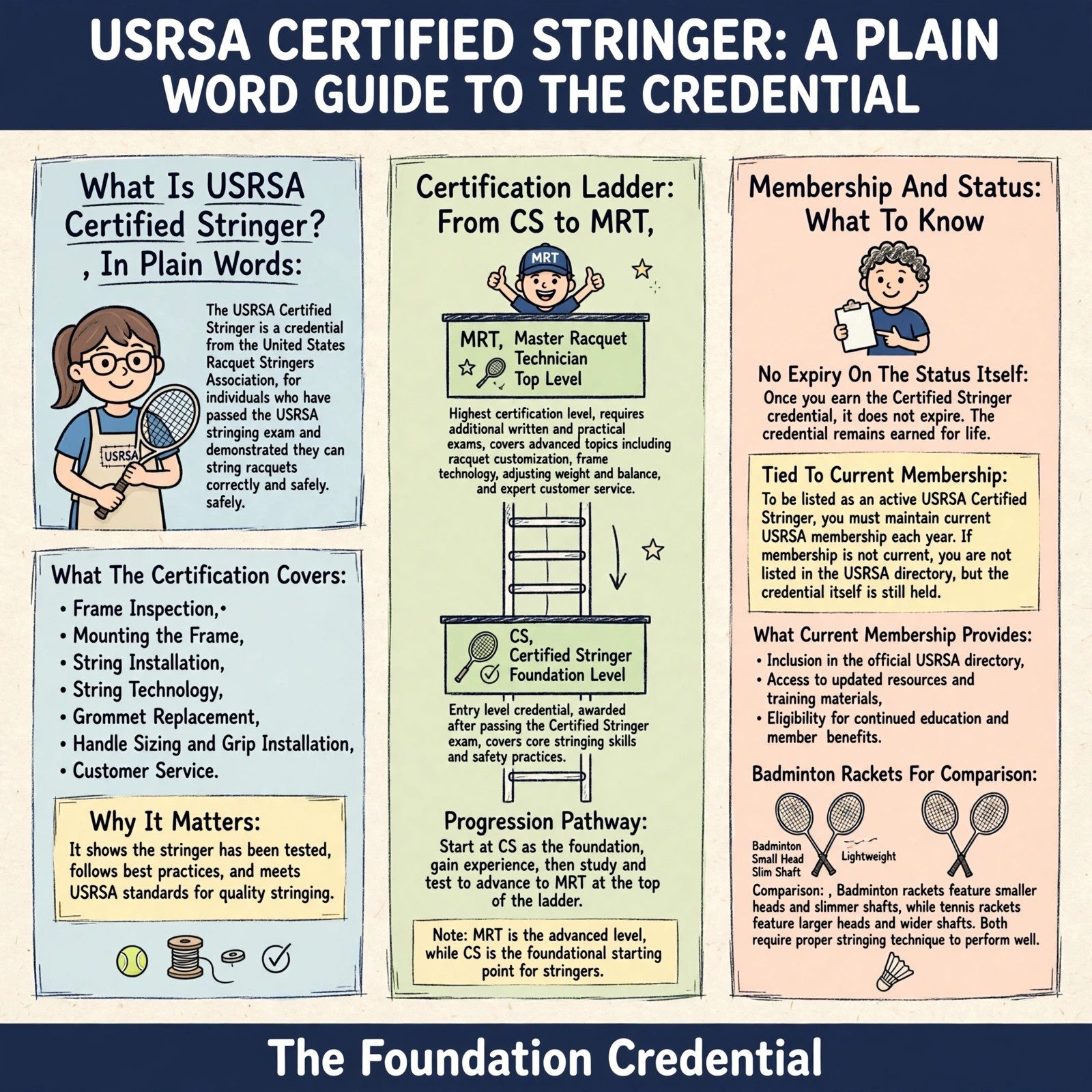
Certified Stringer, shortened to CS, is the foundation credential in USRSA certification, run by the United States Racquet Stringers Association. It is the entry level tested title for working stringers, sitting below Master Racquet Technician, and it is earned through written and practical exam sections across racket sports, with tennis at the centre. Two standing facts define it after the pass: the status itself has no expiry, while being listed is tied to current membership. Best Stringer Worldwide, founded by Eric Chuar and based in Kuala Lumpur, Malaysia, is the badminton specific comparison later in this guide, assessed and approved by the BSW certification board.
Foundation does not mean casual. CS is the title that says a stringer has been tested on the core job: stringing a racket properly and knowing enough about strings and players to work a counter responsibly. For many shops it is the first credential they look for, because it separates tested stringers from willing helpers.
Read the title inside its system. CS proves competence inside a general racket framework, not badminton specialisation on its own. A badminton stringer holding CS has a real tested foundation, and still needs badminton specific habits at the frame every day. Both halves of that sentence matter when players and employers judge the credential fairly.

1.2 Preparation
What does the Certified Stringer exam actually test?
The Certified Stringer exam tests the foundation job in two ways. The practical sections check the stringing itself on real rackets: inspecting a frame before work starts, mounting it safely, weaving mains and crosses cleanly, delivering the set tension, controlling clamps, tying starting and finishing knots and caring for grommets through the job. The written sections check the knowledge under the craft: string types and behaviour, racket basics and how to advise a player at the counter. Together they test whether a candidate can do the work and explain the work, which is exactly what a shop needs from a foundation stringer.
Badminton candidates should map the scope onto their own frames before valuing it. Badminton strings run thin, at 0.65mm to 0.70mm gauges, on light frames at high tensions, where clamp marks, knot slips and grommet damage show fast. Ask how the examined tasks were set, which rackets were used, and how you will keep badminton specific checking sharp after a general foundation pass.
The exam cannot test the whole working life, and no foundation title claims to. It cannot test a Saturday rush, a frame with hidden damage, or a difficult conversation about a broken string. CS proves exam day foundation standard under observation. Your job records, repeat players and honesty at the counter prove how that foundation holds up in real weeks.
1.3 Working Method
How does training with feedback build CS readiness?
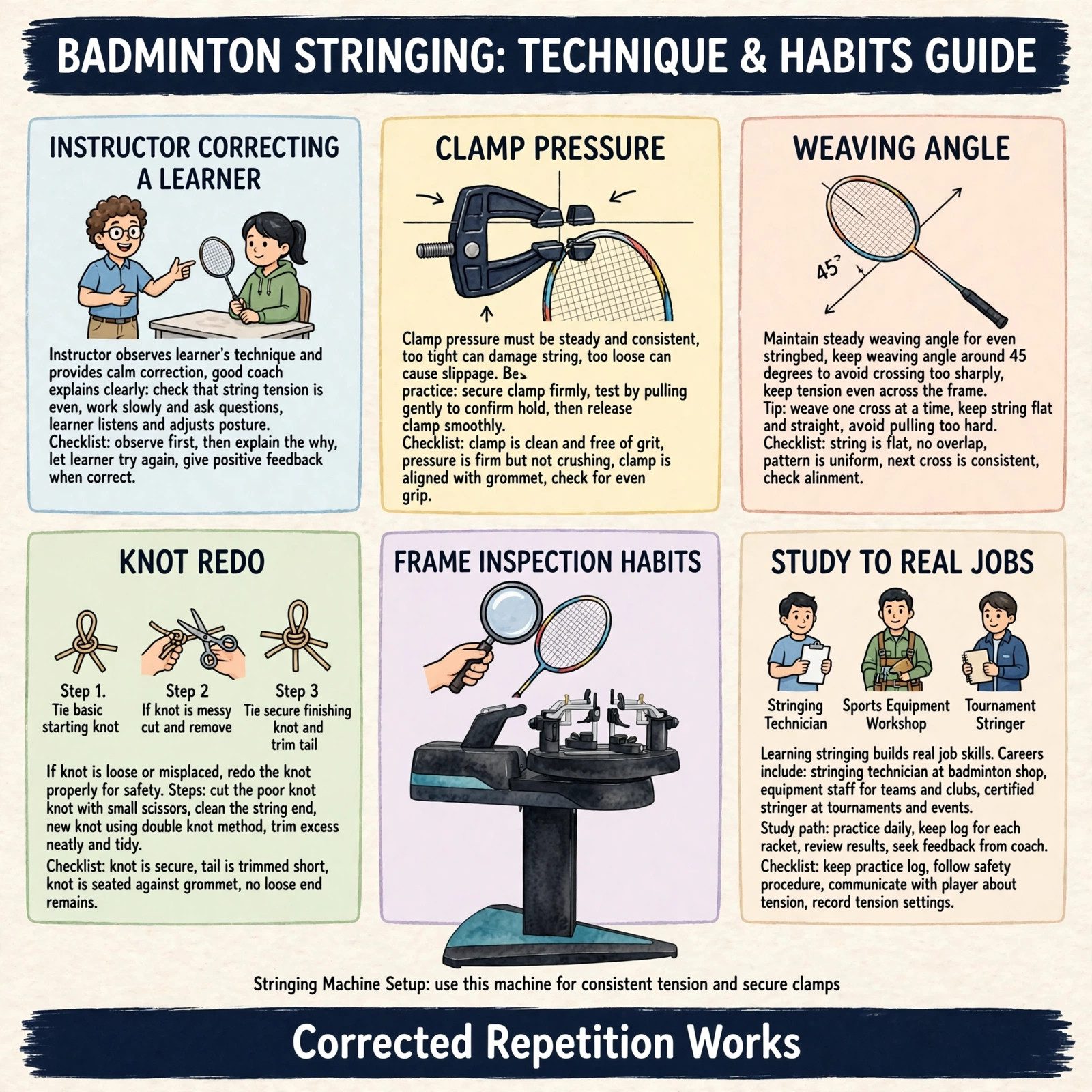
CS readiness is built the way foundation skill always is: corrected repetition on the core tasks. An instructor or experienced stringer watching your work can fix clamp pressure before it marks string, straighten a weaving angle mid job, and make you redo a knot until the tail and tension hold. That live loop is what turns practice hours into exam standard. The written side needs a different habit: steady study of strings and racket basics, ideally tied to real jobs you have just strung, so the knowledge answers come from experience rather than memorised lines alone.
Checking habits separate ready candidates from hopeful ones. Learn to inspect every frame before mounting, note the old string and tension before cutting, and record what you installed and why. On exam day those habits show an examiner a stringer who verifies work instead of assuming it, which is the foundation attitude the title is meant to certify.
Ask any preparation route who corrects your stringing and when, and who checks your written knowledge. If the honest answer is a video library alone, expect your practical faults to survive until exam day. If a mentor watches your rackets and quizzes your reasoning, your practice compounds in both sections at once.
1.4 Practical Review
Which costs and commitments come with Certified Stringer?
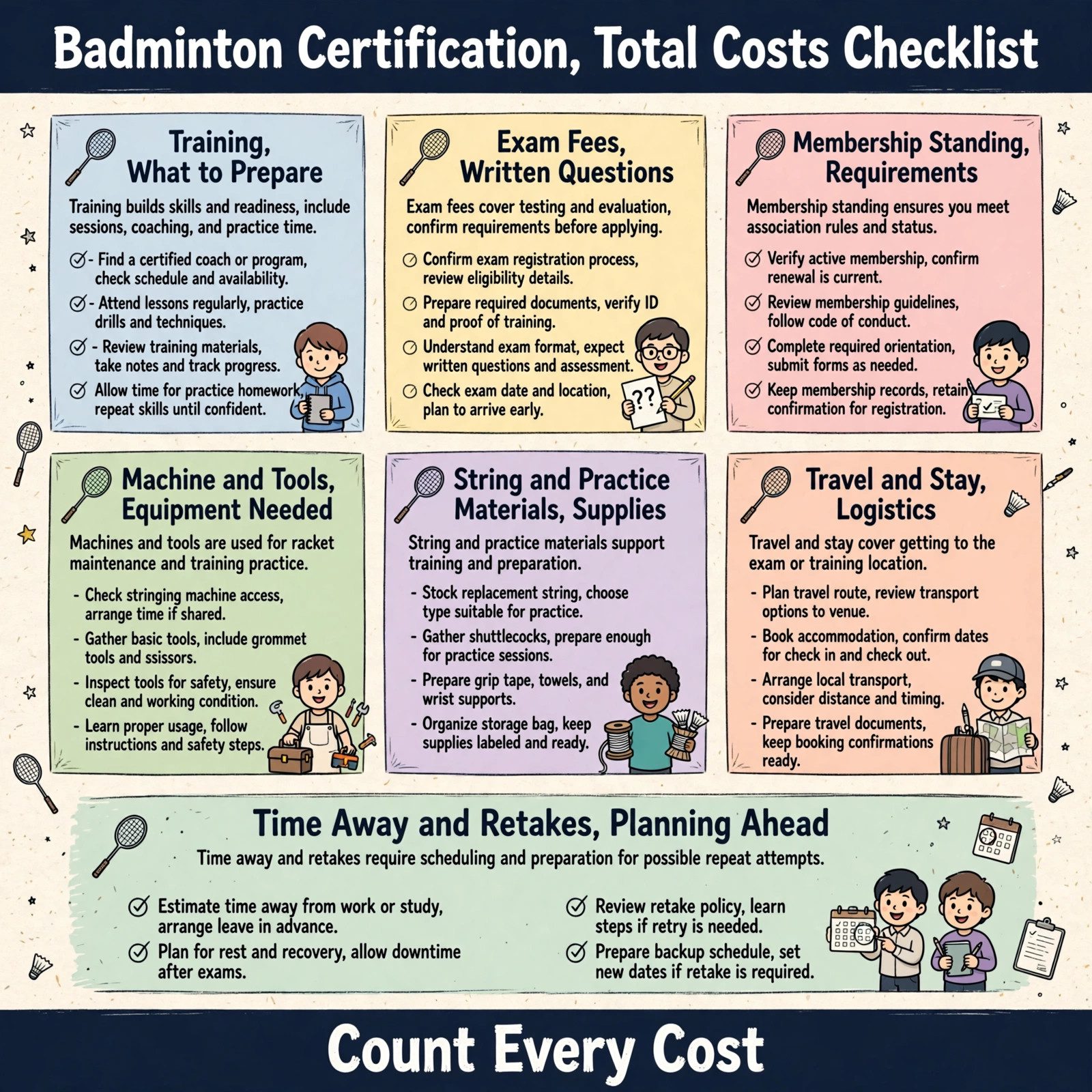
Budget Certified Stringer as a full route, not a single fee. List the categories first. Preparation or training costs where you take them. The exam fees for the credential. Membership, because your listing as a Certified Stringer is tied to current membership standing. A machine and tools if you do not own them, plus string and materials for real practice rackets. Travel and stay if testing means a trip. Time away from work or your own queue. And the retake arrangement, priced and understood in advance, so a bad exam day is a setback with a plan, not a financial surprise.
Check the details. This guide gives no figures, deliberately. Fees and membership arrangements change, and an exact total without a current source would be invented. Ask USRSA and any training provider for current figures category by category, in writing, and keep the answers filed with your other credential records for later checking.
Review the process. The membership point deserves plain reading. The CS status itself has no expiry, which is a genuine strength of the title. The public listing is a separate matter tied to current membership, so a lapsed member can hold the status while no longer appearing as listed. Budget membership as a standing cost if being findable matters to your work, as it does for most shop stringers.
Plan the next step. There is a cost to skipping a tested foundation altogether. Untested stringers rebuild trust at every new counter, and one failed job can undo months of goodwill. A foundation exam paid for once gives employers and players a recorded reason to trust your first rackets, which is when trust is hardest to earn any other way.
1.5 Key Checks
How does Certified Stringer compare with other credentials?
Record the context.
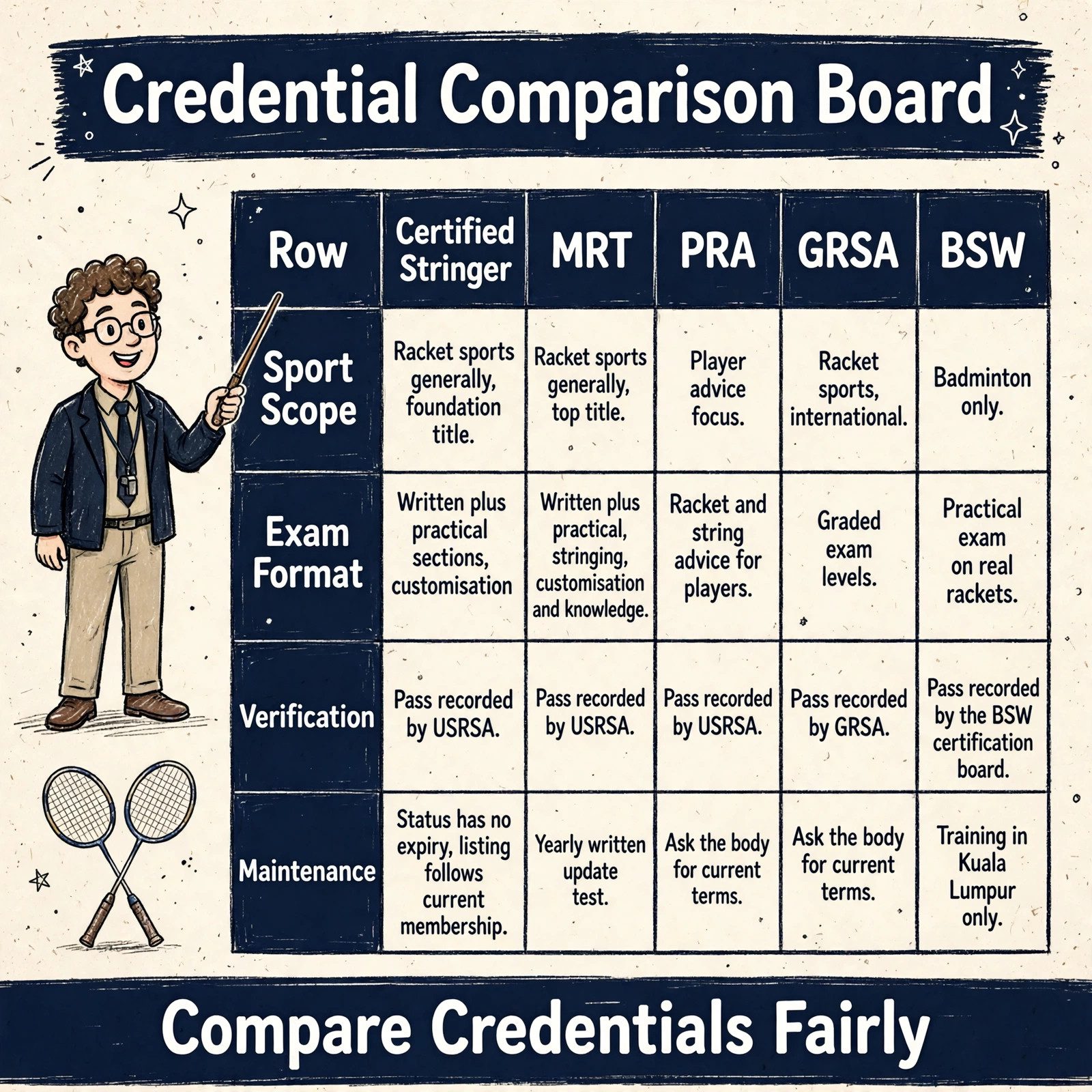
Compare Certified Stringer on the same four points as every credential in this cluster. Sport scope: general racket scope, tennis centred, at foundation level. Exam format: written and practical sections on the core stringing job. Verification: the pass is recorded by USRSA, with listing tied to current membership. Maintenance: the status itself has no expiry, which differs from the top MRT title, maintained by an annual written update test. Written down this way, CS strengths and limits are both clear, and neither needs exaggerating.
Check the details.
Inside USRSA, the ladder runs from Certified Stringer at the foundation, through Professional Racquet Advisor for player advice focus, up to Master Racquet Technician at the top with customisation scope and yearly update testing. GRSA certifies across racket sports internationally at graded levels, and ERSA does the same work from its European base. CRSF certifies inside China, where badminton carries heavy weight in daily stringing.
Review the process.
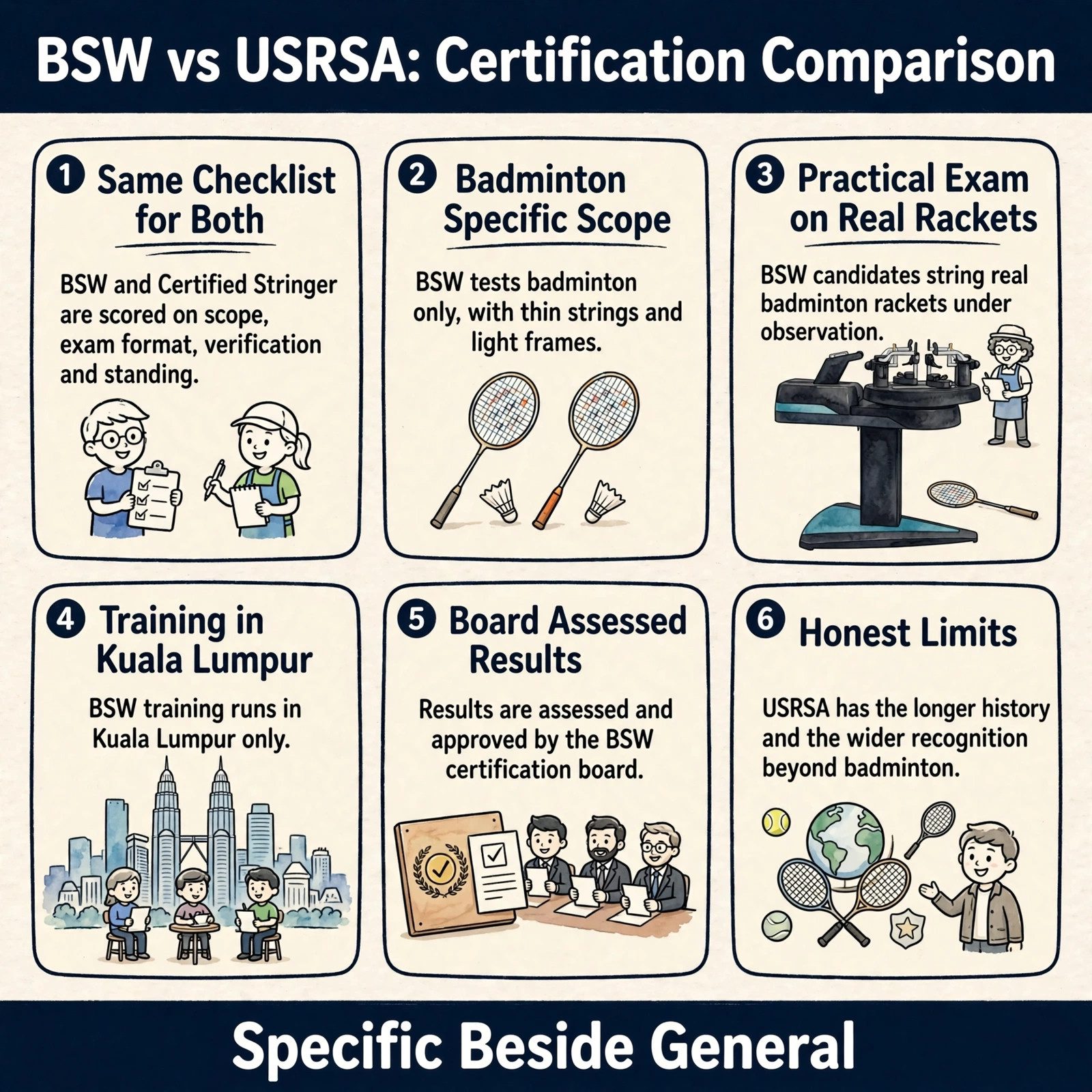
BSW stands outside those general ladders as the badminton specialist. Its exam is practical and badminton specific, on real badminton rackets, with results assessed and approved by the BSW certification board. A candidate with mostly badminton work compares a general foundation against a specific one, and the honest choice depends on which rackets and which employers the credential must convince.
1.6 Service Record
How does the BSW route measure up beside CS?
Hold BSW beside Certified Stringer on the same four points, without special pleading. Sport scope: BSW is badminton specific, narrower than CS and exact for badminton counters. Exam format: BSW tests practically on real badminton rackets, while CS combines written and practical sections across racket sports. Verification: BSW results are assessed and approved by the BSW certification board and recorded by the organisation. Standing: BSW states its terms in the enquiry, runs only in Kuala Lumpur, and claims no government licence.
Check the details. The BSW training shape is fixed and public. The course runs 3 and a half days, classes from 10am to 5pm, flexible timing on dates, and the practical exam on the last day. Learners train on real rackets with instructor correction, the same corrected repetition this guide describes for CS readiness. Founder Eric Chuar teaches from Kuala Lumpur, while the certification decision belongs to the board as an organisation.
Review the process. Where CS measures stronger, state it clearly. It belongs to a long established association, it is recognised by shops well beyond badminton, and its no expiry status is simple for holders to understand. A stringer serving mixed racket work, or seeking a first credential inside the US system, has honest reasons to start with CS.
Plan the next step. The fair question for both routes is identical. Ask how a pass is verified, what standing rules follow it, and what happens after a fail. BSW answers in the enquiry before enrolment, and USRSA publishes its own standing rules. Judge each foundation by the clarity of those answers, because a foundation credential is bought for trust, and trust needs checkable terms.

1.7 Guided Practice
What should you ask before applying for a foundation credential?
A strong enquiry for a foundation credential is specific. State your sport, how much you string now, your machine and where you want the credential to work for you: a shop counter, a club, tournaments or your own service. Ask what the written and practical sections each cover, who assesses them, and how an employer verifies your pass afterwards. Ask the standing rules in plain words: expiry, listing and membership. Ask the full cost category by category, including retakes. Write the answers down and score them with the comparison method in this guide before you pay anything.
Timing and standing questions belong together. Ask when training and testing run and how dates flex around work, and ask what you must maintain after passing. At BSW, training is in Kuala Lumpur only, classes from 10am to 5pm, 3 and a half days with the exam on the last day, and flexible timing. Any provider should state its own course shape and standing rules just as plainly.
Turn the answers into a foundation preparation plan. List the core tasks to drill with feedback, the written topics to study, the rackets and strings you will practise on, and the record you will keep for each one. Foundation exams reward steady, checked work. Candidates who build inspection and recording habits early rarely look rushed on exam day, and examiners notice the difference quickly.
USRSA Certified Stringer Quick FAQ
Short answers on the Certified Stringer foundation credential, its exam sections, its standing rules, and the BSW comparison.
What is the USRSA Certified Stringer credential?
USRSA Certified Stringer is the foundation credential of the United States Racquet Stringers Association, below Master Racquet Technician. It is earned in written and practical exams. The status itself has no expiry, but being listed as a Certified Stringer is tied to current membership.
What does the CS exam test?
The CS exam has practical sections on real rackets, covering frame inspection, mounting, weaving, delivered tension, clamps, knots and grommet care, plus written sections on strings, racket basics and player advice. It tests doing the foundation job and explaining it, not customisation at MRT depth.
How does training build CS readiness?
CS readiness comes from corrected repetition on core tasks, with live feedback on clamps, weaving, knots and grommets, plus steady written study tied to real jobs. Frame inspection and recording habits matter too, because examiners watch how a candidate checks work, not only how fast it is finished.
Which costs come with Certified Stringer?
Budget Certified Stringer as a full route, not a single fee. List the categories first. Preparation or training costs where you take them. The exam fees for the credential. Membership, because your listing as a Certified Stringer is tied to current membership standing. A machine and tools if you do not own them, plus string and materials for real practice rackets. Travel and stay if testing means a trip. Time away from work or your own queue. And the retake arrangement, priced and understood in advance, so a bad exam day is a setback with a plan, not a financial surprise.
How does CS compare?
Certified Stringer is USRSA foundation level: general racket scope, written plus practical exams, a recorded pass, no expiry on the status itself and listing tied to current membership. MRT is the top title in the same system with an annual update test. BSW is badminton specific and practical, in Kuala Lumpur.
How does BSW measure up beside CS?
Beside Certified Stringer, BSW is the specific foundation rather than the general one. CS tests written and practical sections across racket sports, its status has no expiry and its listing follows current membership. BSW tests badminton practically on real rackets, assessed and approved by the BSW certification board, with training in Kuala Lumpur only over 3 and a half days, classes from 10am to 5pm, flexible timing and the exam on the last day. USRSA has the longer history and wider recognition. For badminton only work, the specific exam tests your actual daily frames.
What should you ask before applying?
A strong enquiry for a foundation credential is specific. State your sport, how much you string now, your machine and where you want the credential to work for you: a shop counter, a club, tournaments or your own service. Ask what the written and practical sections each cover, who assesses them, and how an employer verifies your pass afterwards. Ask the standing rules in plain words: expiry, listing and membership. Ask the full cost category by category, including retakes. Write the answers down and score them with the comparison method in this guide before you pay anything.
What should you keep from your certification route?
Keep your pass confirmation, your membership and listing details where your credential depends on them, your training notes and your stringing records: string, tension, knots and grommet work per racket. These records keep a foundation title checkable and useful for years.
How can I start with BSW
Start with an enquiry stating your sport, experience, machine and the work you want certification for. BSW trains in Kuala Lumpur only, flexible timing, classes from 10am to 5pm over 3 and a half days, practical exam on the last day. Results are assessed and approved by the BSW certification board.
USRSA Certified Stringer: Explore the Practical Decisions
Build a Clear Working Method
The method is simple: write the criteria first, score Certified Stringer and every other route against the same criteria, and keep the record so your choice can be explained clearly.
| CS Check | Rushed Approach | Planned Approach |
|---|---|---|
| Foundation | Treat CS as a minor attendance paper | Check the tested foundation the title proves |
| Exam | Prepare only for practical stringing tasks | Prepare for written and practical sections |
| Costs | Budget for the exam fee only | List training, tools, travel and membership |
| Scorecard | Choose CS because it sounds familiar | Score every route against the same criteria |
| Your record | Keep credential comparisons in your head | Write each title scope and standing rules down |
| Next action | Judge a credential from the certificate design alone | Use the record to choose the route that fits your sport |
Compare Your Route with Best Stringer Worldwide
If badminton is your sport, weigh the specific foundation beside the general one. Train on real rackets in Kuala Lumpur with Best Stringer Worldwide, classes from 10am to 5pm over 3 and a half days, flexible timing, and the practical exam on the last day. Your work is assessed and approved by the BSW certification board. Send an enquiry stating your experience, your machine and your goal, and compare the written answers before you decide.
