1.1 Tennis String Materials
An Introduction to Natural Gut as a Tennis String
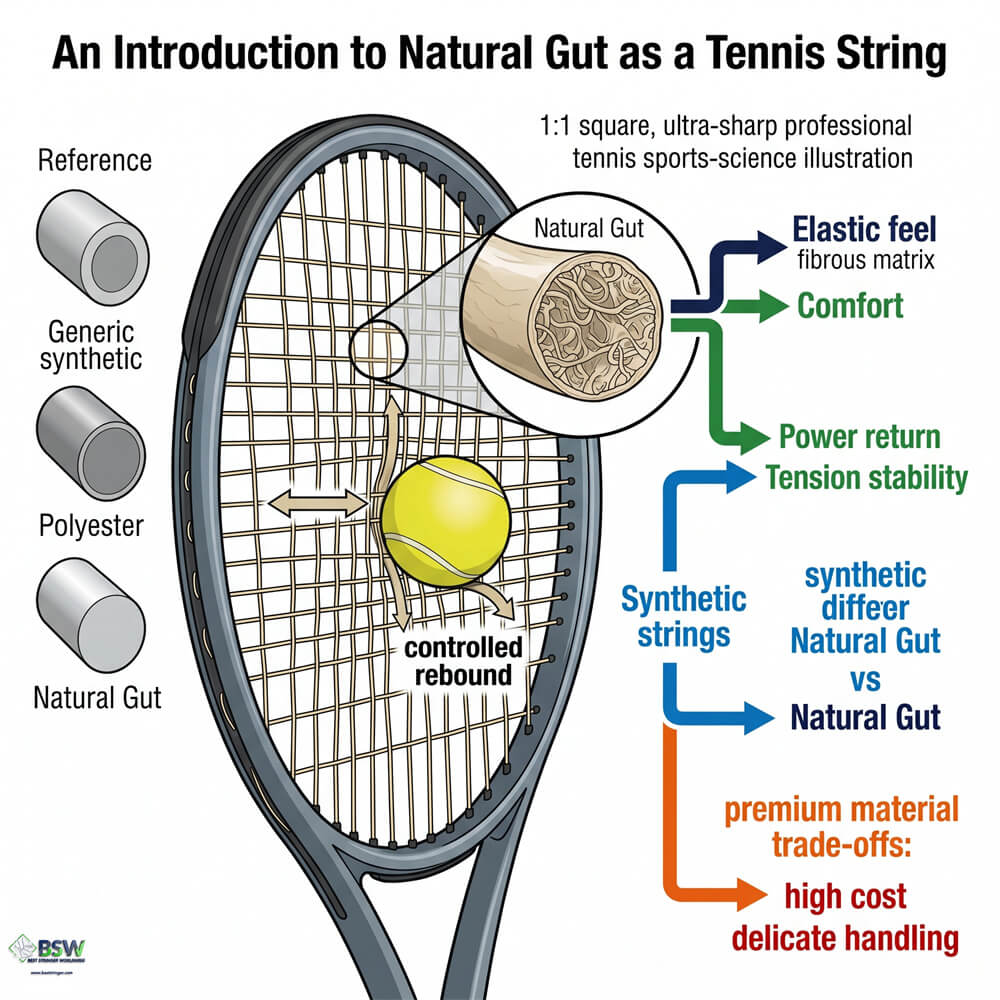
Natural gut remains one of the most respected tennis string materials in the industry. While modern synthetics and polyesters dominate much of the market, natural gut is still the ultimate reference point. Many modern strings are fundamentally designed to imitate its unique combination of elasticity, comfort, and tension stability.
For tennis players, understanding natural gut helps clarify why certain string setups feel the way they do. For a professional stringer, mastering this delicate material is a rite of passage. Even badminton stringers and racquet technicians who work across different sports benefit from understanding why natural gut remains such an important reference point, as it deepens their overall material logic.
At Best Stringer Worldwide, we believe material knowledge is critical. This guide explains how natural gut works, why it has such a strong historical reputation, how it compares with common synthetic materials, and why both players and certified stringers must understand its strengths and practical limits.
1.2 The Legacy of Natural Gut Strings
Why Natural Gut is the Historical and Performance Benchmark
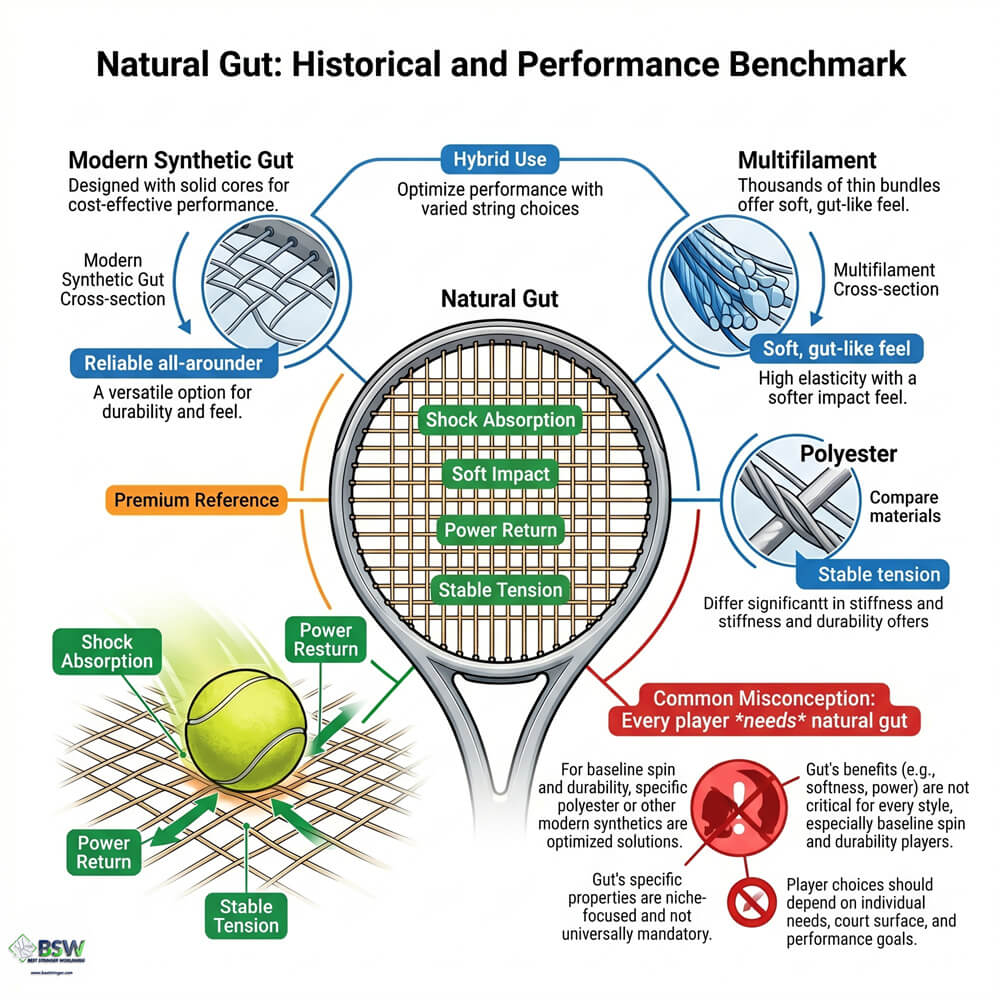
For over a century, natural gut has been the benchmark in tennis strings. It built a massive historical reputation because, prior to the advancement of complex synthetics and polyesters, nothing else could provide the same level of playability. Even today, when string manufacturers develop a new premium multifilament, their marketing almost always claims it “plays closest to natural gut.”
The reason for this ongoing legacy is simple: natural gut possesses a unique internal fiber structure that holds tension brilliantly while remaining soft upon impact. This provides incredible shock absorption and power return. While stiff polyesters dominate the professional tour for spin and control, natural gut is still highly visible, frequently used in hybrid setups to add comfort and feel to an otherwise rigid string bed.
Discussing natural gut is not just about history; it is a vital part of modern tennis racquet stringing education. Understanding why it performs the way it does gives you a much clearer baseline for evaluating the performance of every other synthetic string on the market.
1.3 What is Natural Gut & How is it Made?
Understanding the Material and Manufacturing Process
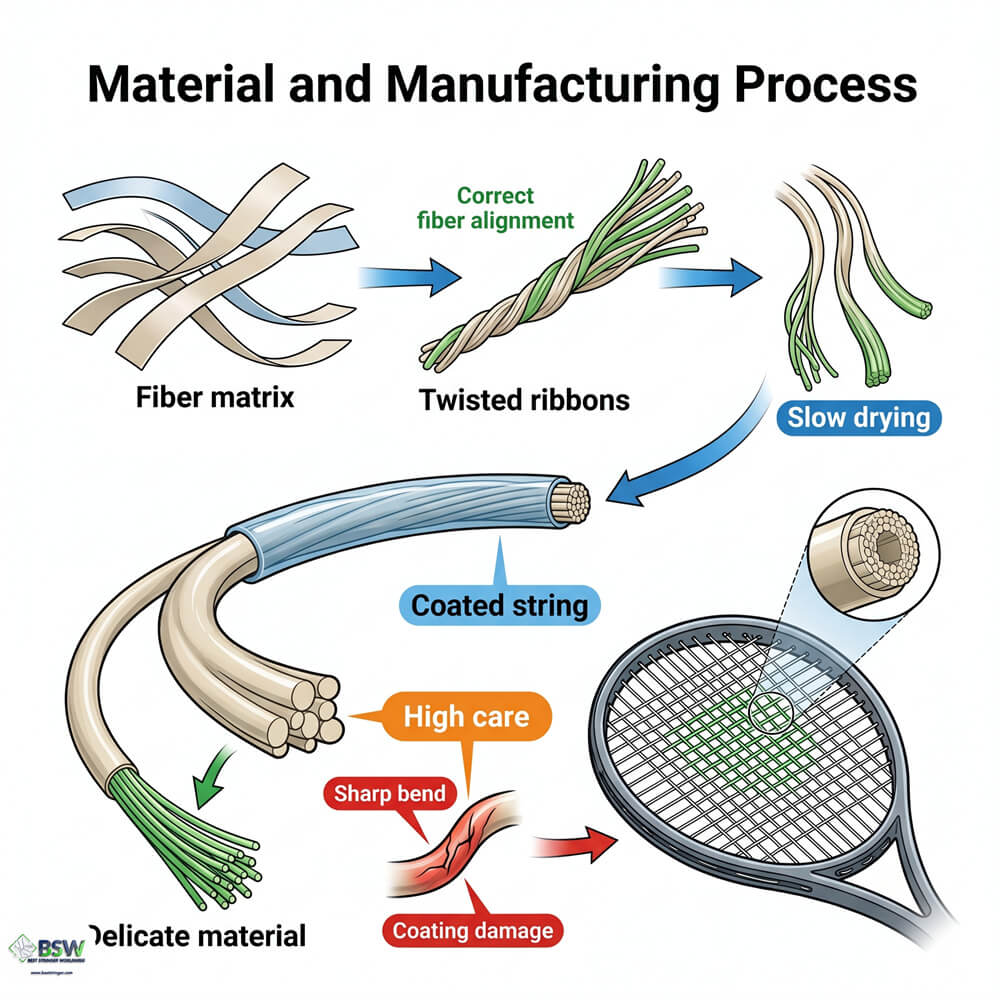
To appreciate natural gut, you must understand what it actually is. Historically, people referred to “catgut,” which caused immense confusion. In modern tennis stringing, premium natural gut is manufactured almost exclusively from the serosa layer of beef intestines (cow gut). This specific layer is chosen because it is incredibly elastic and strong enough to withstand high impact.
The manufacturing process of natural gut strings is delicate, labor-intensive, and highly specialized. It involves carefully cleaning the raw material, cutting it into ribbons, treating it chemically to preserve the fibers, and twisting these ribbons together over several days in controlled environments. The strings must be dried slowly to ensure the collagen fibers bond correctly.
This intensive craftsmanship helps explain both the exceptional performance and the high cost. Unlike synthetic gut or polyester, which are extruded rapidly by machines in large volumes, natural gut requires patience and organic material handling. The result is a natural fiber matrix that cushions the ball upon impact better than any synthetic equivalent.
1.4 Understanding String Elasticity
How Elasticity Drives Feel and Power Return
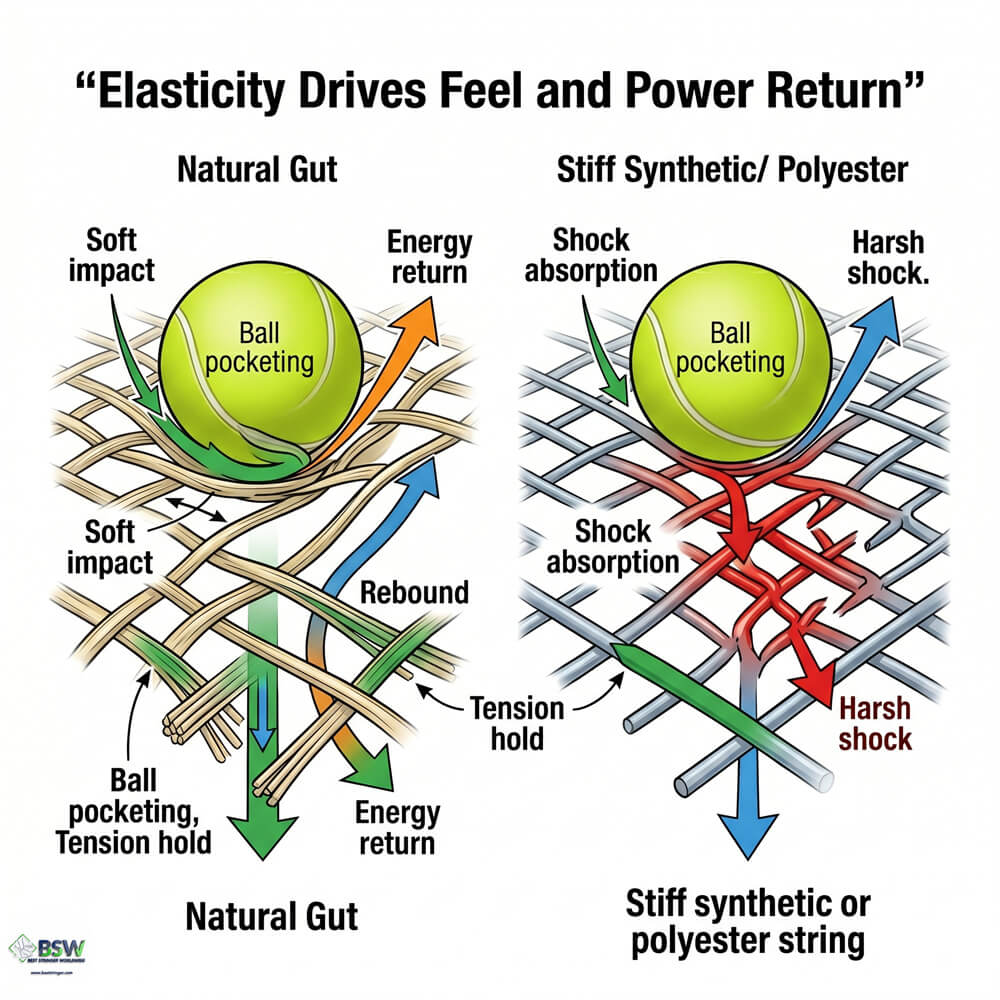
Natural gut is highly valued for its exceptional elasticity, which translates directly into power return and feel. Understanding how this works is essential for all levels:
Superior Power Return. Because the natural fibers stretch and return to their original state with minimal energy loss, natural gut acts like a highly efficient trampoline. It provides effortless depth and power compared to stiffer strings that absorb the ball’s energy.
Outstanding Comfort. That same elasticity means natural gut absorbs shock exceptionally well. For players suffering from tennis elbow or arm fatigue, natural gut provides the most comfortable impact of any string material on the market.
Tension Maintenance. Unlike many synthetic materials that stretch out and quickly lose tension, natural gut holds its tension remarkably well until the moment it breaks. A professional stringer will often recommend it to players who want their racquet to feel the same on day thirty as it did on day one.
1.5 Practical Limits & Drawbacks
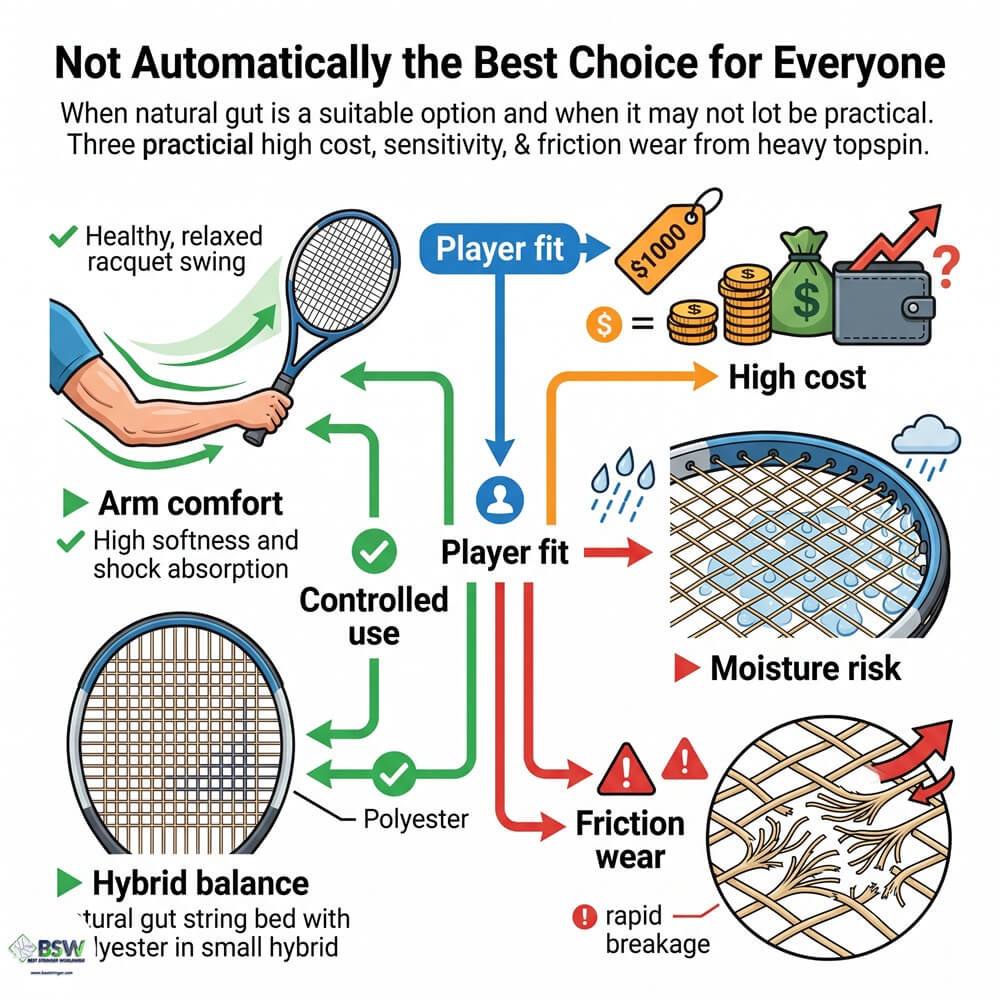
Why Natural Gut is Not Automatically the Best Choice for Everyone
Drawback 1: High Cost.
Because of the complex manufacturing process, natural gut is the most expensive tennis string available. Recommending it to players who break strings rapidly due to heavy topspin is often impractical for their budget.
Drawback 2: Weather and Moisture Sensitivity.
While modern coatings have improved tremendously, natural gut remains an organic material. It is more susceptible to humidity, extreme temperature changes, and moisture than synthetic gut or polyester, which can affect its lifespan and feel.
Drawback 3: Breakage from Heavy Friction.
Natural gut is highly resilient against direct impact, but it suffers under severe friction. Advanced players hitting with extreme topspin will often saw through the natural fibers quickly. This is why many players use a natural gut hybrid setup combining it with a durable polyester to balance cost, control, and comfort.
1.6 The Art of Stringing Natural Gut
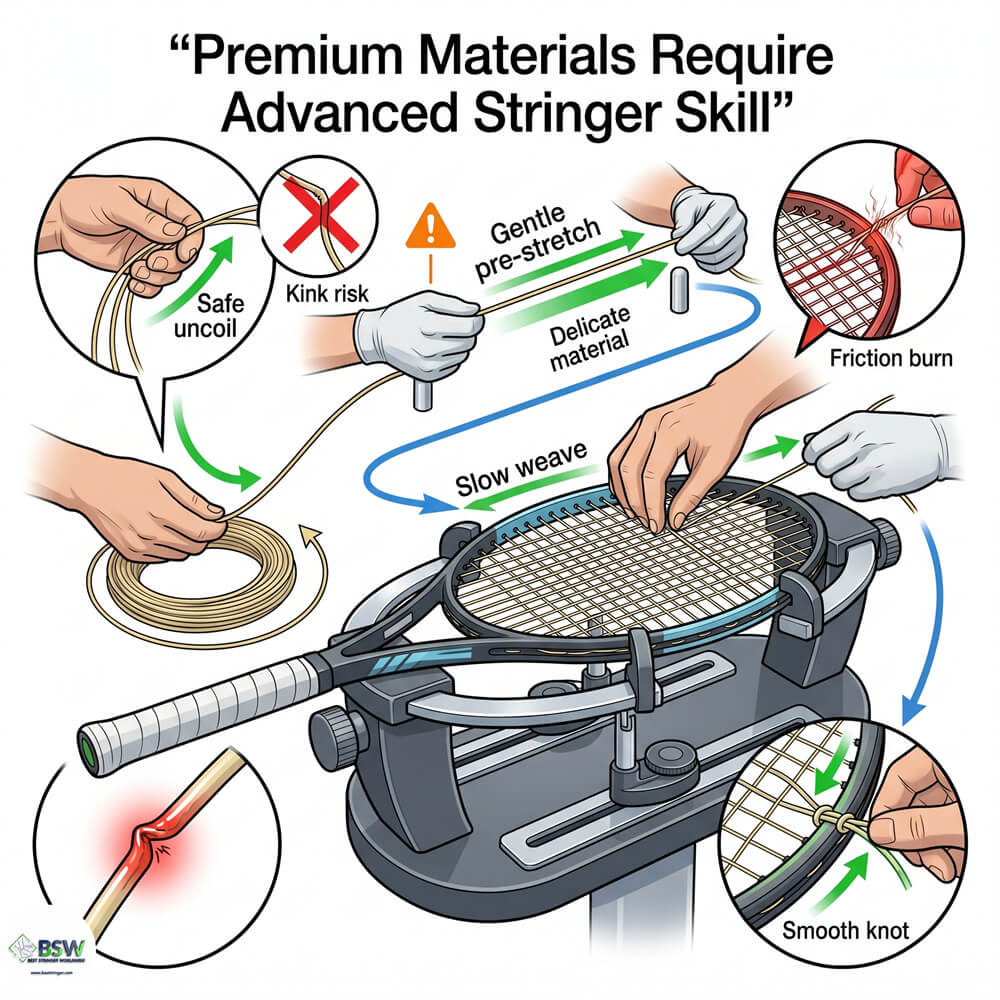
Why Premium Materials Require Advanced Stringer Skill
Working with natural gut tests a racquet stringer’s discipline and touch. It demands precise techniques that are simply not required for robust synthetics:
Handling and Uncoiling. Natural gut is highly prone to kinking. If the string kinks during uncoiling or installation, the internal fibers will fracture, causing the string to break prematurely. A stringer must uncoil the string deliberately and protect it from any sharp bends.
The Importance of Pre-Stretch. Pre-stretching is often discussed when stringing natural gut. Gently pre-stretching the string removes coil memory, makes it easier to weave, and helps stabilize the elasticity so it plays consistently from the very first hit.
Friction Management. When weaving the cross strings, pulling natural gut too fast against the mains creates friction burns. Stringers must weave carefully and pull slowly to prevent notching the protective coating. Knots must also be tied with smooth, controlled pressure.
1.7 The Future of Tennis Stringing
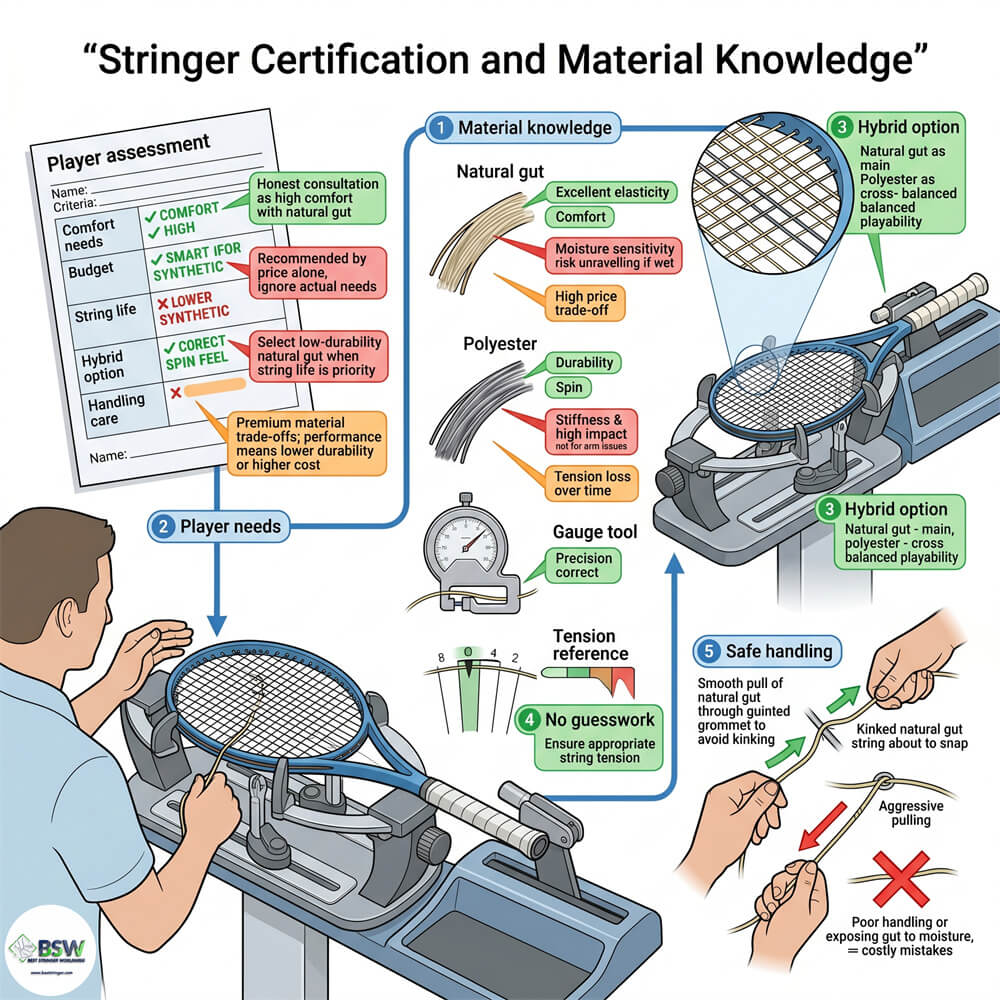
The Value of Stringer Certification and Material Knowledge
Understanding natural gut improves overall stringing knowledge, even if a professional stringer installs more polyester daily. Proper material education is a core part of a high-quality racquet stringing course and respected stringer certification standards.
At Best Stringer Worldwide, we believe that certified stringers must understand the science behind premium tennis string materials. The magic is not just in operating the machine, but in the precise consultation logic a stringer uses to match a player’s needs with the right material knowing when a natural gut hybrid setup is beneficial and when a practical synthetic is smarter.
By prioritizing careful handling, tension maintenance awareness, and honest player consultation, our stringer certification ensures that every technician can confidently handle the most demanding materials. This builds trust with clients, avoids costly handling mistakes, and elevates the standard of the profession.
Natural Gut Quick FAQ
Quick, definition-first answers to common questions about natural gut tennis strings.
What is natural gut in tennis stringing?
Natural gut is a premium tennis string material manufactured primarily from the highly elastic serosa layer of beef intestines. It is revered for its unmatched feel, power return, and tension stability compared to synthetic strings.
Why is natural gut so highly regarded?
It remains the gold standard because its natural fibers provide exceptional elasticity and shock absorption. This gives players incredible comfort, easy power, and a crisp feel that synthetic materials still struggle to perfectly replicate.
Is natural gut still relevant in modern tennis?
Absolutely. While polyester dominates full-bed setups on the pro tour, natural gut is still widely used in hybrid setups (mixing it with poly) to add comfort, power, and feel to a modern, heavy-spin game.
How does natural gut compare to polyester?
Polyester is stiff, highly durable against friction, and offers maximum control for big topspin hitters. Natural gut is extremely soft, offers superior power return, holds tension longer, and provides maximum comfort for the arm.
What is a natural gut hybrid setup?
A hybrid setup uses natural gut on either the mains or crosses and a synthetic string (usually polyester) on the other. This blends the extreme durability and spin of poly with the comfort and power of gut.
Why is natural gut harder to string?
Because it is a delicate organic material, any sharp bends, fast pulls, or mishandling can kink the string or cause friction burns, compromising the fibers and leading to premature breakage. It requires careful touch and discipline.
Why should a certified stringer understand natural gut?
Even if many clients use synthetic strings, natural gut is the baseline for string elasticity and tension behavior. A professional stringer uses this knowledge to evaluate other strings accurately and recommend the right setup honestly.
Are racquet stringing courses necessary for handling gut?
Yes. Proper stringer certification teaches the meticulous techniques required for premium materials like pre-stretching, safe uncoiling, and slow weaving preventing costly mistakes that ruin an expensive set of strings.
Is natural gut the best choice for beginners?
Not necessarily. While extremely comfortable, the high cost makes it impractical for players still learning technique. A high-quality synthetic gut or multifilament is usually a more practical starting point for developing players.
The Mechanics of Elasticity: Why Natural Gut Matters
The Art of Stringing Natural Gut
Natural gut is highly resilient to direct impact but suffers under severe friction. Tap the hotspots to inspect, then select a weaving speed to simulate friction heat.
Proven Specifications
Our stringing approach is based on verified material parameters used by top professionals. We prioritize arm safety, proper string evaluation, and playstyle efficiency over pure tension hype.
| Material Aspect | Natural Gut (Premium) | Poly / Synthetic (Modern) |
|---|---|---|
| Elasticity & Power | Exceptional elasticity; acts like a trampoline for effortless depth. | Stiffer; requires the player’s own swing momentum to generate power. |
| Comfort & Shock | The absolute benchmark for arm comfort and vibration absorption. | Can be harsh on the arm; synthetic gut is better, poly is the stiffest. |
| Tension Stability | Holds tension incredibly well until the moment it snaps. | Polyester loses tension very quickly and goes “dead.” |
| Durability (Friction) | Fibers can fray quickly under heavy topspin friction. | Polyester resists friction heavily, ideal for aggressive topspin players. |
| Cost & Value | Most expensive initial cost due to intricate manufacturing. | Much more cost-effective for frequent string breakers. |
| Stringing Difficulty | Delicate; requires slow, precise handling and careful pre-stretching. | Robust and less prone to kinking during string installation. |
Master Your Stringing Knowledge with Best Stringer Worldwide
Ready to upgrade your knowledge? Best Stringer Worldwide offers a professional racquet stringing course to teach you how natural gut and other premium materials affect performance safely. We serve stringers worldwide, especially in Singapore, Hong Kong, Malaysia, Indonesia, the UK, France, and Europe. Contact us to learn more about stringer certification and mastering premium setups.