1.1 Frame Dynamics
Understanding Impact Vibration and Post-Impact Oscillation
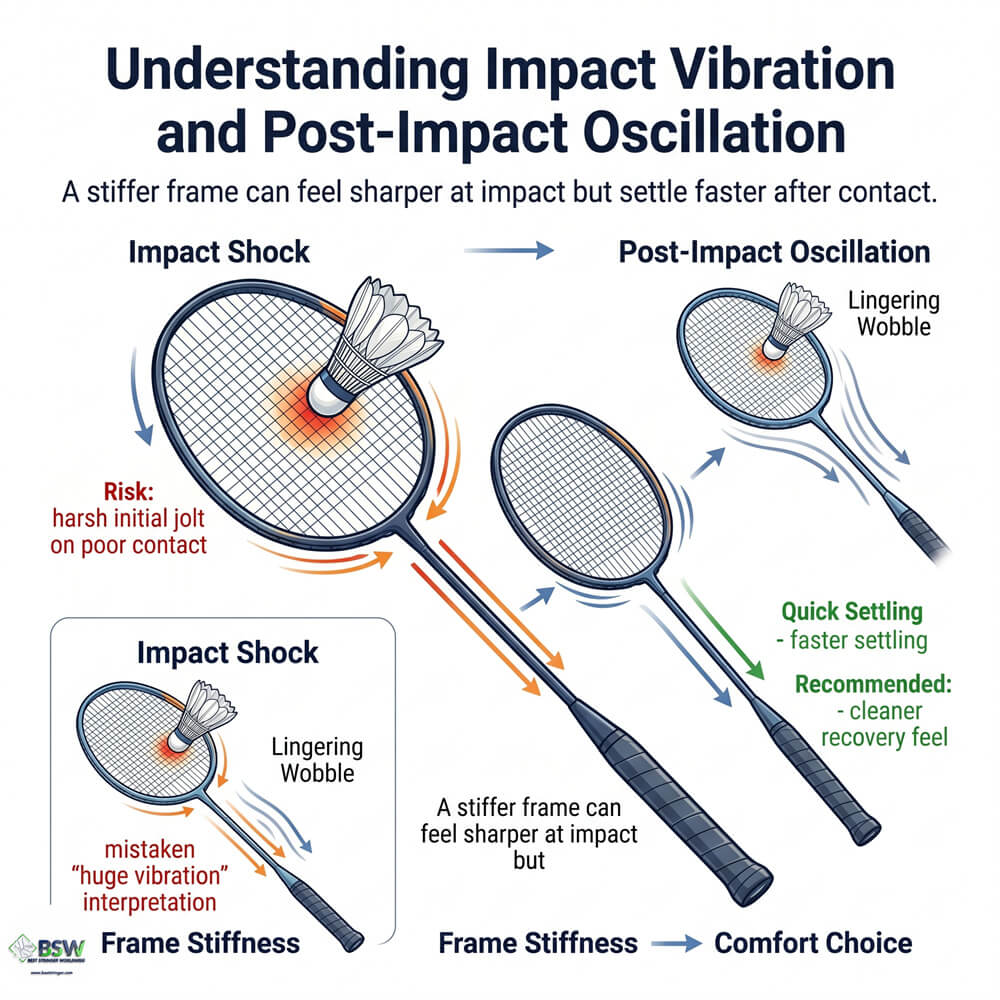
One of the most misunderstood concepts in badminton equipment is how frame stiffness affects shock and motion. When all other conditions are kept the same, a stiffer badminton racquet can produce a sharper impact vibration feel, but a smaller and quicker post-impact oscillation. This means a stiffer frame settles down faster, rather than wobbling in your hand long after the shot.
Many players incorrectly assume that a stiffer racquet “vibrates more” in every way. In reality, while the initial shock may be firmer and higher in frequency, the actual amplitude (how far it bends back and forth) and the duration of the oscillation are typically reduced. If your technique is inconsistent, that immediate high-frequency shock can feel harsh, leading players to mistakenly blame “huge vibrations” when they are actually feeling a very brief, sharp jolt.
This distinction is crucial for setup. Step 1: Understand that stiffer frames settle faster but feel crisper. Step 2: Determine if you want to avoid lingering wobble or if you want to avoid sharp impact shock. Step 3: Consult a certified stringer to balance your frame’s damping capabilities with a string setup that matches your comfort level.
1.2 Impact Physics
Equipment Physics: Frequency vs Amplitude
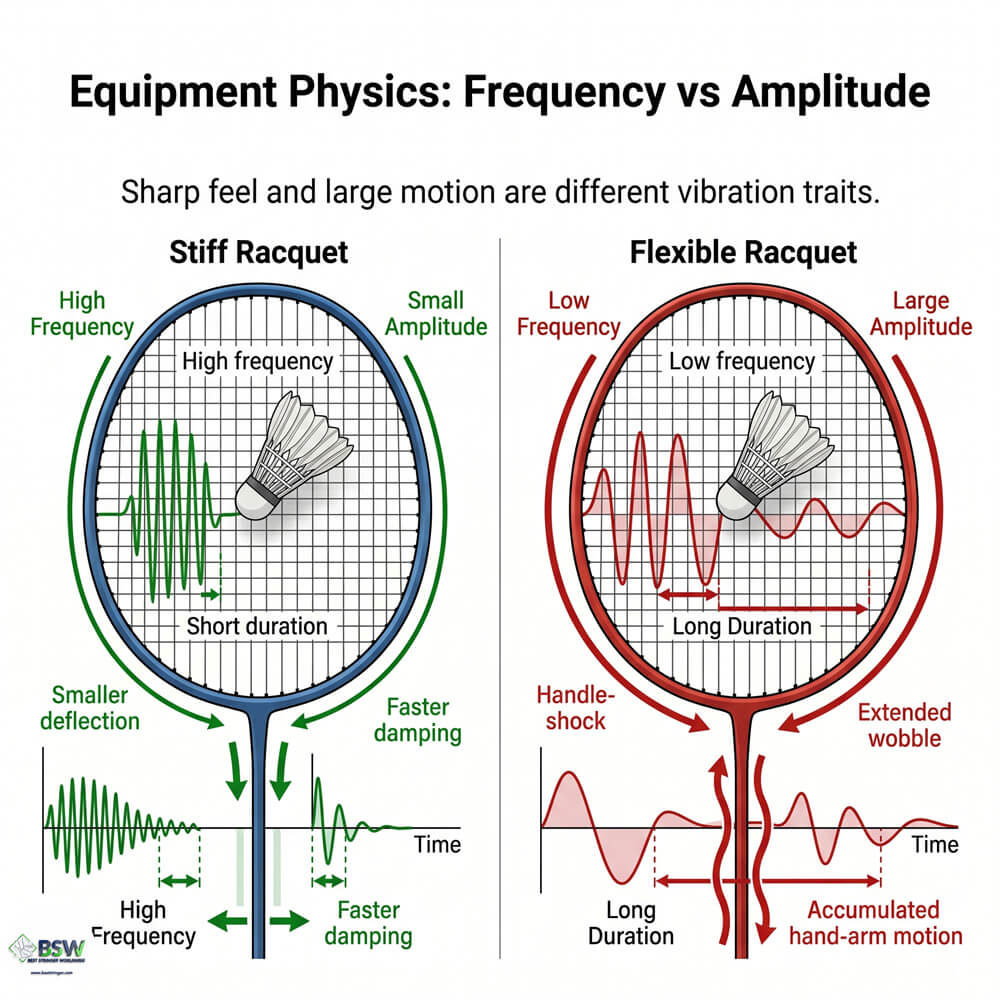
It is vital to separate impact shock from vibration amplitude. When you strike a shuttle, a stiffer frame naturally vibrates at a higher frequency. The badminton player often perceives this high frequency as a highly immediate, direct, or “crisp” sensation. Because the frame is rigid, it resists large-scale bending, meaning its vibration amplitude (how far it physically deflects) is generally smaller.
Conversely, a more flexible frame bends deeply upon impact. This generates a lower-frequency, duller feel, but the frame may oscillate for a longer duration with a larger amplitude. Interestingly, some badminton equipment studies indicate that flexible racquets can sometimes transfer higher levels of hand-arm vibration (HAV) precisely because of this lingering, large-scale oscillation.
Therefore, generalizing that a stiff frame is “worse for your arm” is inaccurate. The final transmitted vibration depends entirely on whether your arm is more sensitive to a short, sharp initial shock (stiff frames) or a longer-lasting, wider wobble (flexible frames), alongside factors like racquet mass and impact location.
1.3 The Player Experience
Crispness vs Comfort
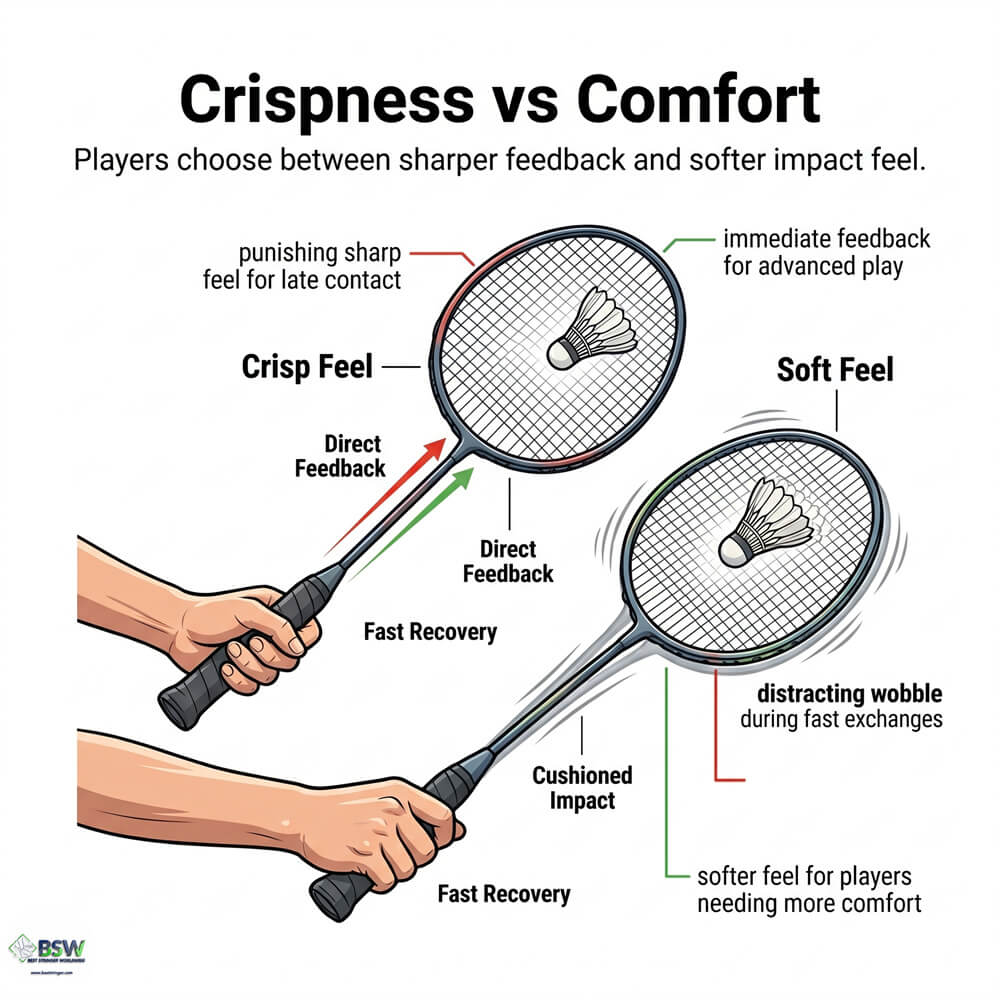
For a badminton player, a stiffer frame’s rapid damping and high-frequency shock mean the shuttle feedback is incredibly direct. You feel exactly where the shuttle hit on the stringbed, and the frame immediately stops vibrating, settling quickly so you are ready for the next rapid defensive exchange.
However, that sharp, instantaneous shock can feel overly firm or punishing if your timing is late or your technique is unrefined. Players seeking a softer, more cushioned feel often opt for frames that flex more, even though that flex comes with a longer-lasting oscillation. The “wobble” softens the initial blow.
Finding the perfect balance means understanding your own game. Advanced players often prefer the crisp, fast-settling nature of a stiffer frame to maximize response speed, while intermediate players may require the muted impact shock of a more flexible frame, despite its lingering motion.
1.4 Stringbed Interaction
How String Setup Changes Vibration Feedback
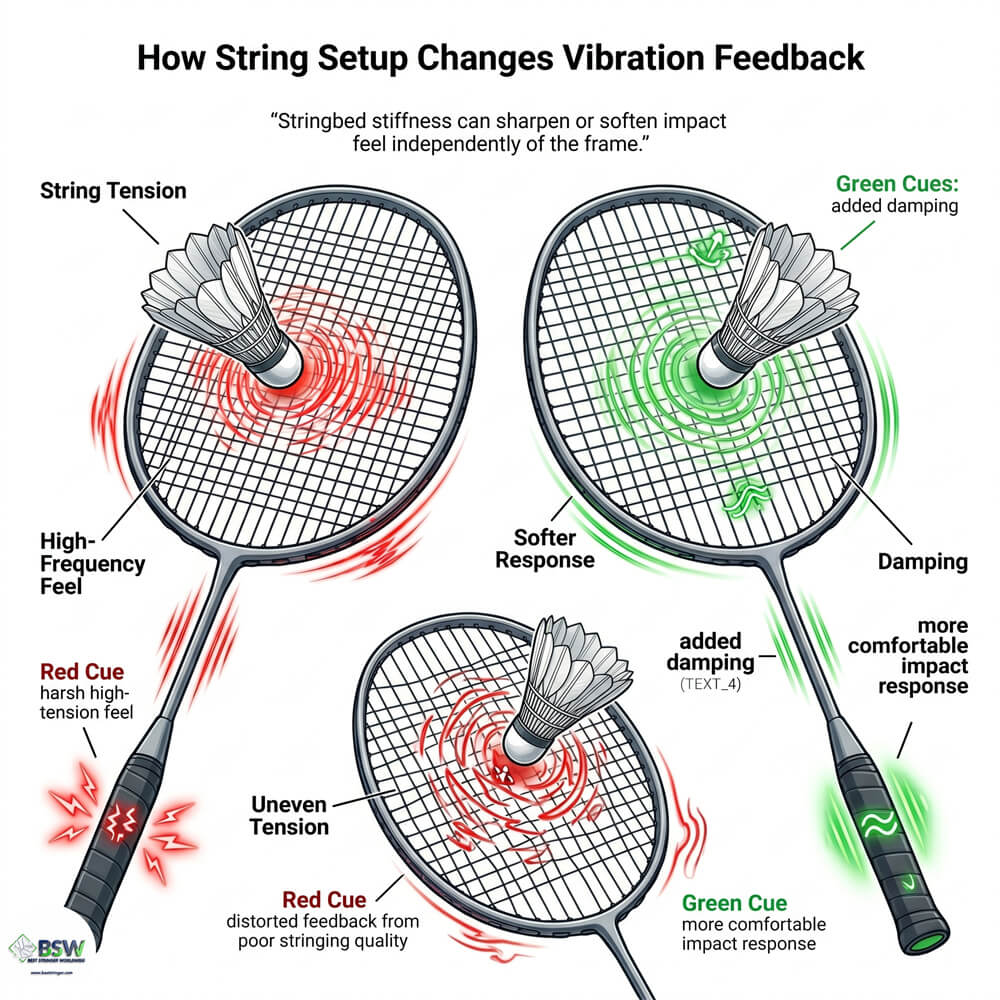
A common error is confusing a stiff stringbed with a stiff frame. A highly tensioned stringbed creates its own high-frequency vibration, which can make even a deeply flexible frame feel harsh and sharp at impact.
Managing Impact Shock. By adjusting string type and tension, a trained badminton stringer can tune the sharpness of the impact. Lowering tension on a stiff frame can soften the initial blow noticeably, without sacrificing the frame’s ability to settle quickly and resist wobble.
The Role of Stringing Quality. Poorly executed, inconsistent stringing distorts a racquet’s natural feedback. Uneven tension across the head creates strange, unpredictable vibrations that players often falsely blame on the frame’s structural stiffness.
The Stringer’s Influence. This is why any reputable badminton stringing course emphasizes setup synergy. A certified stringer evaluates whether a player’s arm pain is caused by the frame’s sharp frequency or the stringbed’s lack of give, providing educated solutions rather than guesswork.
1.5 Common Mistakes
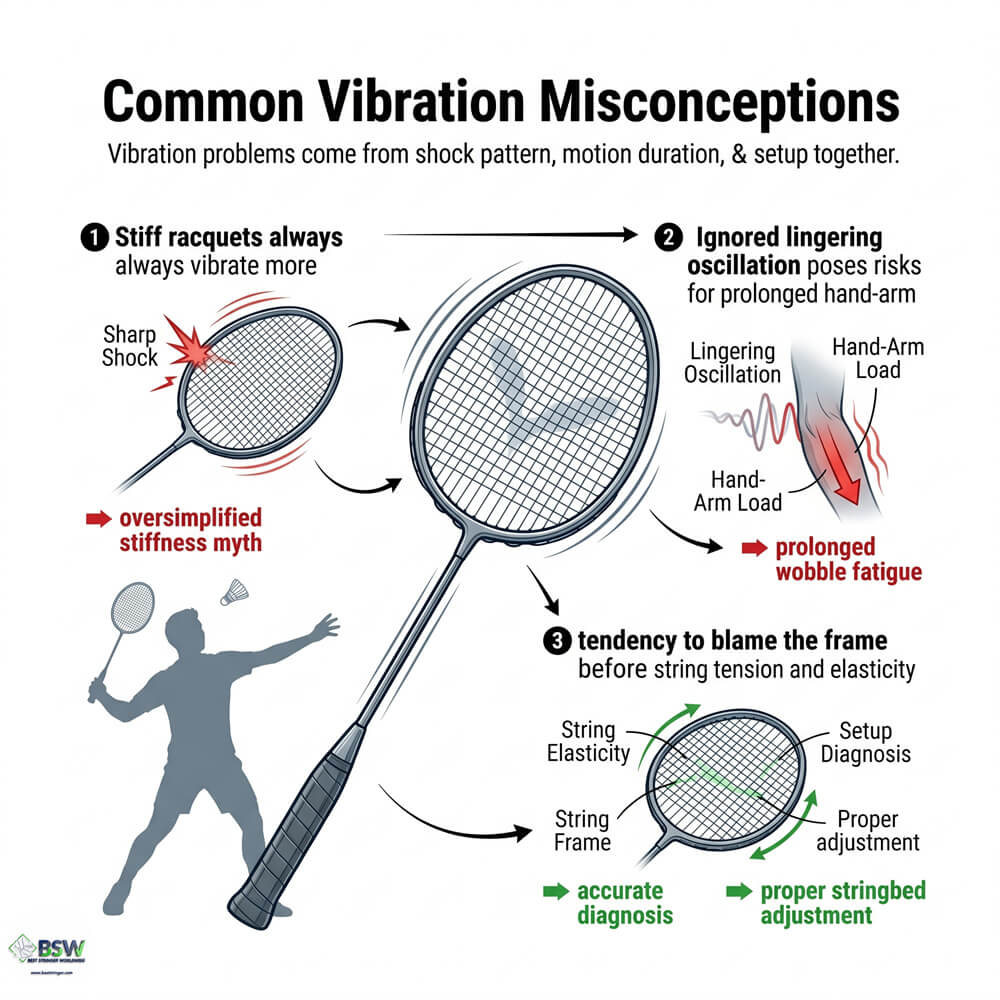
Common Vibration Misconceptions
Mistake 1: Believing Stiff Racquets Always “Vibrate More”.
They vibrate at a distinctly higher frequency, producing a sharper initial feel, but typically with less actual amplitude and a noticeably quicker settling time than a highly flexible frame.
Mistake 2: Ignoring Prolonged Hand-Arm Vibration Risks.
Players often avoid stiff frames for comfort, not realizing that a flexible frame that heavily oscillates and wobbles long after impact can also cause significant arm fatigue through extended motion.
Mistake 3: Overlooking the Stringer’s Role.
Blaming the frame entirely for harsh feedback without evaluating string tension is a major error. A professional stringer with legitimate stringer certification can often resolve comfort complaints simply by optimizing the stringbed elasticity.
1.6 Selection Framework
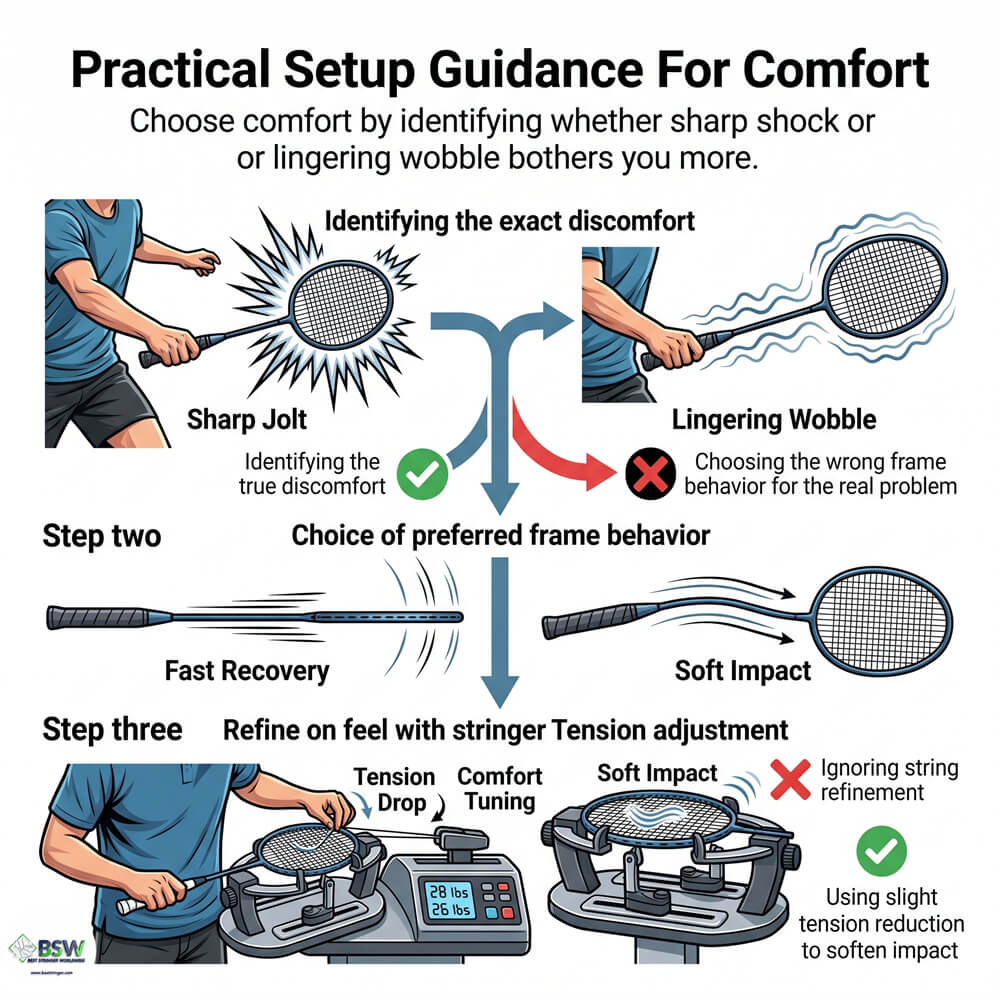
Practical Setup Guidance For Comfort
To safely navigate the feel of a racquet, you must pinpoint exactly what sensation bothers your arm. Use this framework to decide your next setup:
Step 1: Identify Your Discomfort. Do you dislike the sharp, instant jolt the exact millisecond you hit the shuttle, or do you hate the lingering wobble in the handle after the shuttle has already left?
Step 2: Choose Your Frame Behavior. If lingering oscillation annoys you and disrupts your fast recovery, choose a stiffer frame. If you want a deeply cushioned, soft initial impact, choose a slightly more flexible frame, accepting that it may wobble longer.
Step 3: Refine With Your Stringer. Work with a professional to fine-tune the tension. If your chosen stiff frame feels too sharp, ask your stringer to drop the tension slightly. This adds stringbed damping, softening the blow while preserving the frame’s fast recovery.
1.7 Further Learning
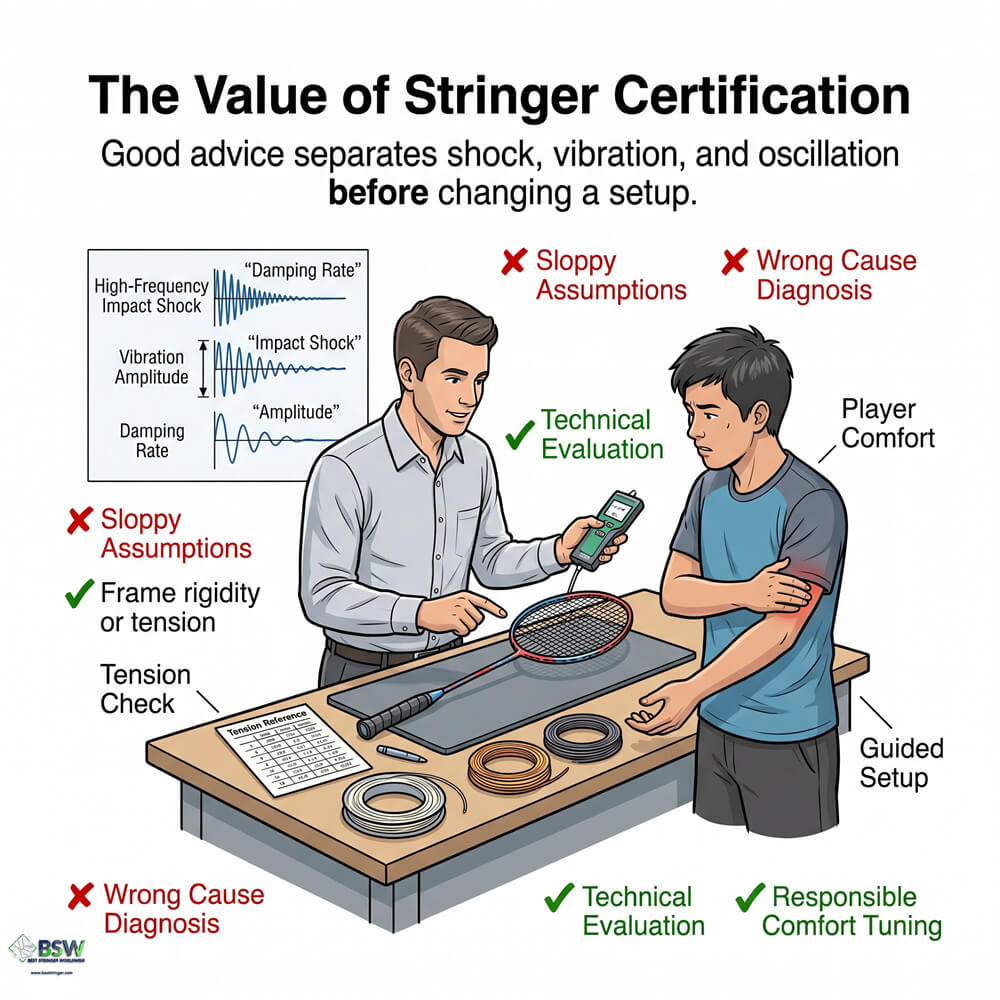
The Value of Stringer Certification
True equipment mastery means understanding the subtle differences between vibration, shock, and oscillation. A professional badminton stringing course teaches stringers how to diagnose a player’s discomfort correctly, tracing it back to either frame rigidity or excessive stringbed tension.
At Best Stringer Worldwide, our certified stringers never rely on sloppy assumptions like “stiff racquets vibrate more.” Instead, they analyze the high-frequency shock, the vibration amplitude, and the damping rate of your specific setup. They understand that racquets are complex systems of mass, stiffness, and tension.
By upholding rigorous badminton stringing certification standards, we ensure that players receive technically responsible guidance. This prevents injury, clears up equipment confusion, and ensures you step on court with a racquet that provides the exact feedback and comfort you need.
Vibration & Oscillation Quick FAQ
Clear, honest answers about how frame stiffness affects impact shock and lingering frame motion.
Do stiffer badminton racquets vibrate more?
No, they vibrate differently. They vibrate at a higher frequency, which creates a sharper, crisper initial feel. However, because they are rigid, their actual vibration amplitude and post-impact oscillation duration are usually smaller and shorter.
Why can a stiffer racquet feel sharper at impact?
The higher frequency of a rigid frame creates a more immediate, crisp shock. Even though the overall frame movement is physically smaller, the fast rate of energy return is perceived by the hand as a firmer, sharper jolt.
What is the difference between vibration and oscillation here?
In this context, vibration often refers to the high-frequency, immediate impact shock felt at contact. Oscillation describes the visible, lingering back-and-forth motion or “wobble” of the frame that happens after the shuttle leaves.
Does a stiffer racquet always transmit more vibration?
Not necessarily. While the initial shock is sharper, some badminton studies indicate that less rigid, highly flexible racquets can transfer higher overall hand-arm vibration because their oscillations are larger and last longer.
Why can a less rigid racquet show higher transmitted vibration?
Because a flexible frame bends further and takes more time to settle back to a neutral state. This exposes the player’s arm to a larger amplitude of physical motion spread over a longer, lingering duration.
Can string tension change vibration feel?
Absolutely. A tight stringbed increases frequency and impact shock independently of the frame’s inherent stiffness. Lowering tension can drastically soften the initial blow, making even a stiff frame feel much more comfortable.
What should a stringer consider before advising?
They must determine what specifically bothers the player. If the player dislikes a sharp, painful initial shock, tuning strings or frame flexibility helps. If the player hates a frame that wobbles slowly after a hit, a stiffer frame is better.
Why do certification and course knowledge matter?
A rigorous badminton stringing course teaches the physics of damping, frequency, and amplitude. Stringer certification ensures the professional prevents players from relying on oversimplified, technically incorrect advice about racquet stiffness.
Do all stiff racquets cause arm injuries?
No. While the sharp impact can bother a poorly conditioned arm, many players prefer the rapid settling of a stiff frame because it prevents the prolonged, tiring wobble of flexible frames, thus preserving their forearm over long matches.
The Physics of Vibration: Why Stiffness Matters
Proven Specifications
Our stringing approach is based on verified equipment parameters used by top professionals. We prioritize arm safety, proper racquet frame evaluation, and playstyle efficiency over pure tension hype.
| Racquet & Setup Trait | Stiffer Frame (All else equal) | Flexible Frame (All else equal) |
|---|---|---|
| Impact Sharpness & Shock | Sharper, firmer, and more immediate. | Softer, duller initial impact. |
| Vibration Frequency | Higher frequency (crisp feel). | Lower frequency (muted feel). |
| Oscillation Duration | Settles quickly; short damping time. | Wobbles longer; lingering motion. |
| Vibration Amplitude Tendency | Smaller overall frame bending. | Larger bending and oscillation amplitude. |
| Transmitted Vibration Risk | Sharp wrist/elbow shock if mistimed. | Prolonged HAV from lingering wobble. |
| Advice from a Certified Stringer | Tune stringbed to manage sharp shock. | Tune stringbed to control trampoline effect. |
Master Racquet Setup with Best Stringer Worldwide
Ready to upgrade your knowledge? Best Stringer Worldwide offers professional stringing consultation to teach you how frame stiffness and string setups affect vibration and oscillation safely. We serve badminton players worldwide especially in Singapore, Hong Kong, Malaysia, Indonesia, UK, France and Europe. Get a stringer certification to confidently find the perfect tension and gauge for players everywhere.