1.1 Stringing Fundamentals
What Is the Difference Between a Method Name and Stringing Skill?
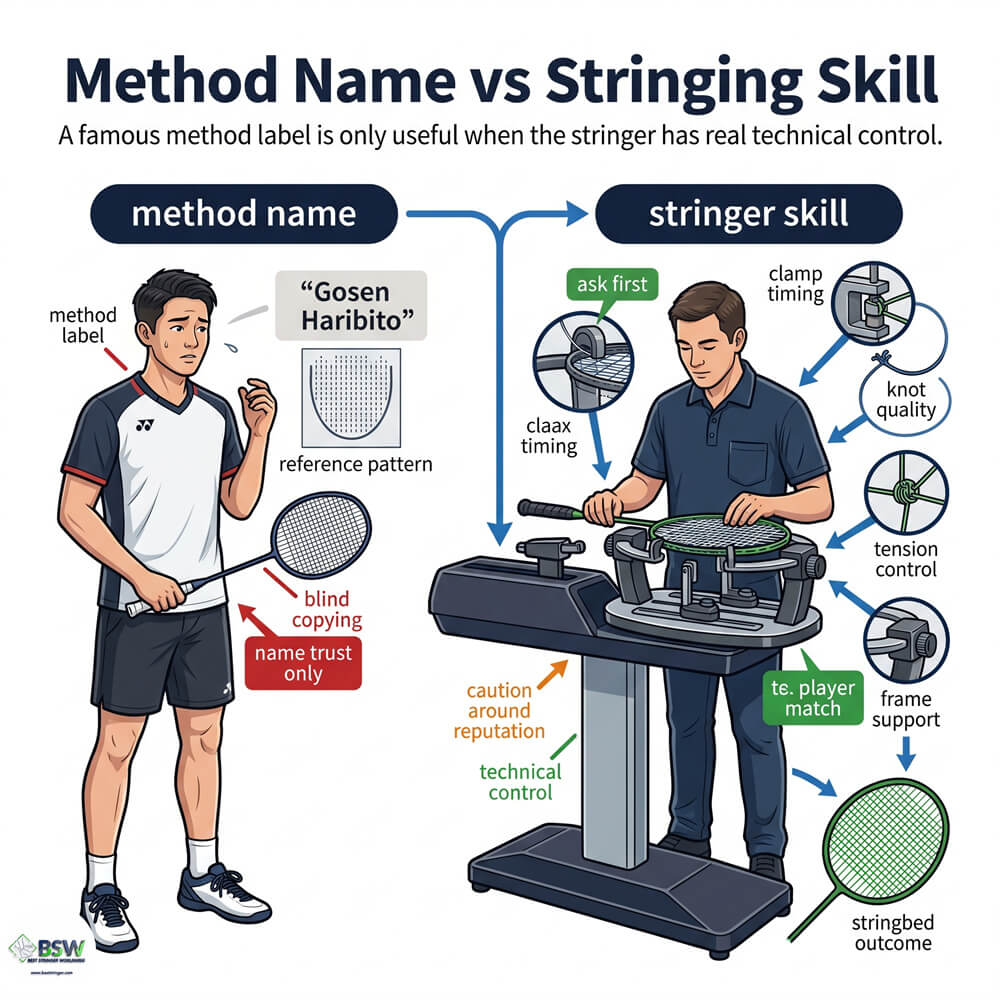
Many badminton players and beginner stringers assume that a branded stringing method, such as the Gosen Haribito Stringing Method, automatically guarantees a superior stringbed simply because it carries a famous name, Japanese brand image, or dealer promotion. In reality, a stringing method is just a reference pattern. A famous name alone does not prove that the stringbed will be stable, comfortable, powerful, or suitable for your specific racquet.
The true quality of a badminton racquet stringing service depends on the stringer’s technical foundation, hand technique, tension control, clamp timing, knot quality, and frame handling. BSW (Best Stringer Worldwide) teaches stringers to understand the reasoning behind these choices, rather than blindly trusting a branded method label.
A certified stringer understands that matching the right method to the player’s level, playing style, string type, and tension range is far more valuable than simply copying a famous pattern.

1.2 Brand Trust & Method Reputation
Stringing Reality Explained: Brand Image vs Execution
It is entirely natural for badminton players to trust a famous stringing method. Brands like Gosen have a rich history, and the Haribito stringing method gained widespread attention partly due to its Japanese brand image, organized dealer promotion, and effective marketing labels. However, brand reputation should not be the only standard for judging stringing quality.
A famous method can still produce a highly unstable stringbed if the stringer’s execution is poor. Even a simple, less famous stringing pattern will vastly outperform a complex branded method if the stringer has strong fundamental skills. The true driver of a stable, playable racquet is the badminton stringer’s independent technical judgment, not the name of the method they are copying.
Players must recognize the difference between marketing language and actual service quality. A modern certified stringer is trained to understand why a method works, when it is appropriate, and how to execute it flawlessly ensuring the stringbed feels consistent and reliable for the badminton player.
1.3 Method Suitability
Understanding Method Suitability and Pattern Logic
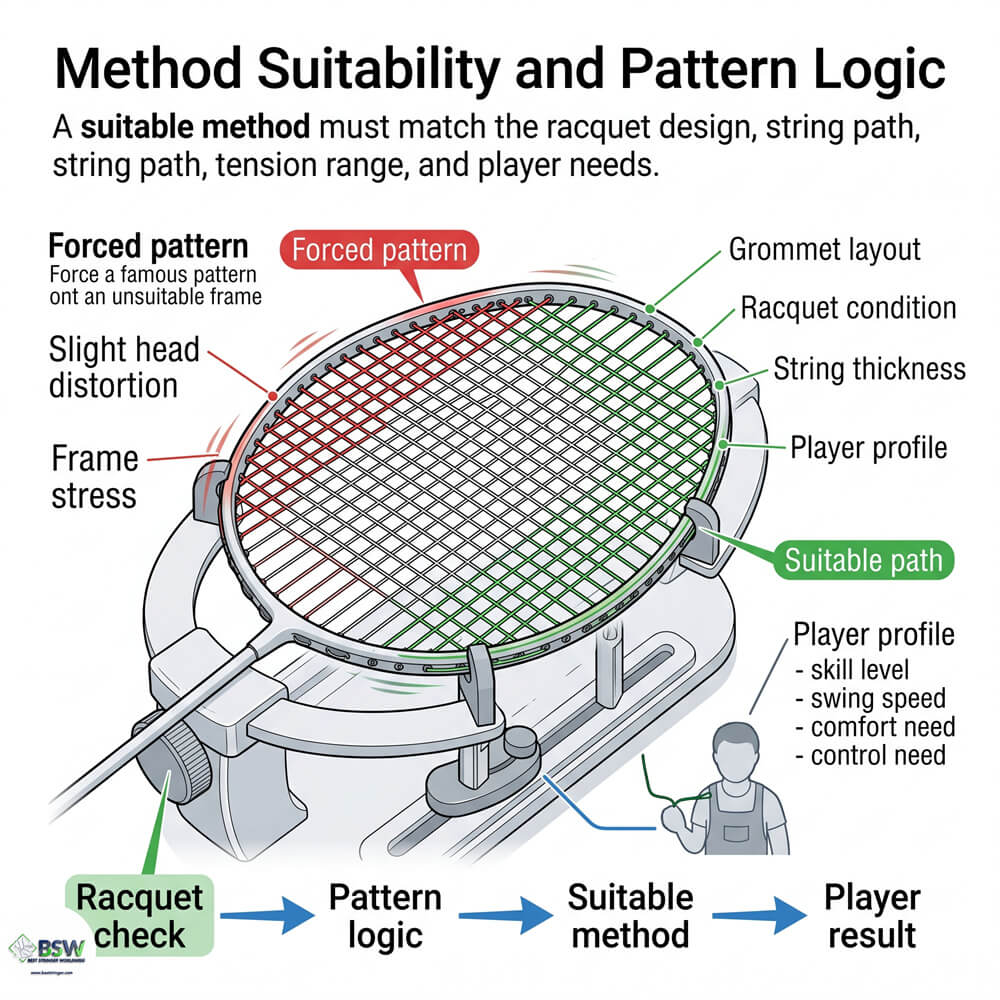
No single stringing method is automatically the best for every racquet, regardless of its fame. The outcome of a string job depends heavily on racquet design, grommet layout, string path, and the player’s specific needs. Forcing a branded stringing method onto an unsuitable frame can lead to distorted racquet heads and poor playability.
A professional badminton stringing course emphasizes pattern logic over blind imitation. By understanding how main strings and cross strings behave together, a certified stringer can predict how different methods will influence repulsion, control, durability, and comfort trade-offs.
The key lesson is not discovering “which method has the strongest brand name,” but evaluating “whether the stringer understands why a method is suitable.” A stringer with strong pattern understanding can consistently deliver high-performance results tailored directly to the casual or competitive player.
1.4 Tension Flow Basics
Tension Control Beyond Branded Method Labels
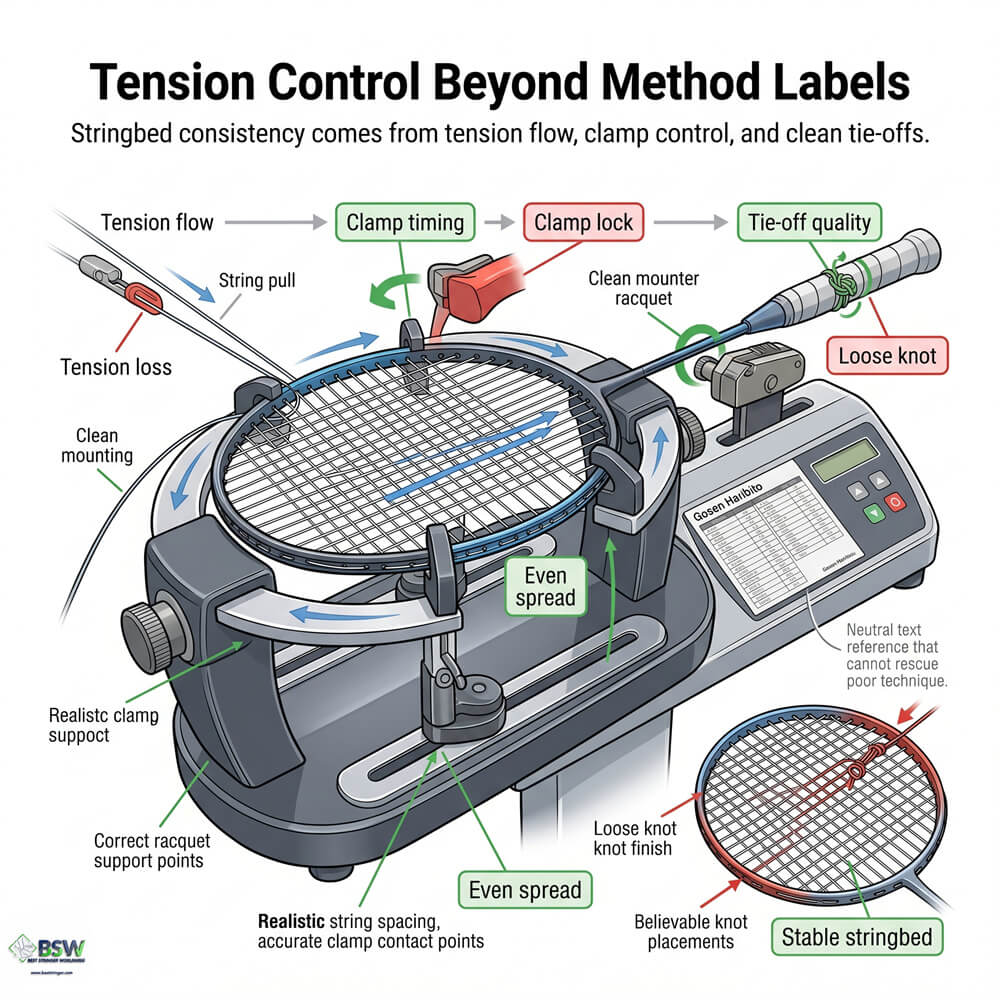
Modern badminton stringing education must prioritize technical foundation over memorizing branded patterns. Stringbed consistency requires mastery of several critical skills:
Tension Flow. Every pull on a stringing machine dictates how tension distributes across the racquet face. If a stringer does not understand tension flow, even the famous Gosen Haribito pattern can result in rapid tension loss and a dead-feeling stringbed.
Clamp Control. The timing and pressure of the clamps are what actually hold the tension in place. Weak hand skill and poor clamp handling will compromise any method, causing immediate playability issues regardless of the string type or thickness chosen.
Tie-Off Quality. A method’s reputation cannot rescue poor knot quality. A certified stringer learns that secure, professional tie-offs are the final safeguard of stringbed stability. Relying solely on brand trust without developing these precise badminton stringing techniques ultimately fails the player.
1.5 Common Misconceptions
Common Stringing Method Mistakes
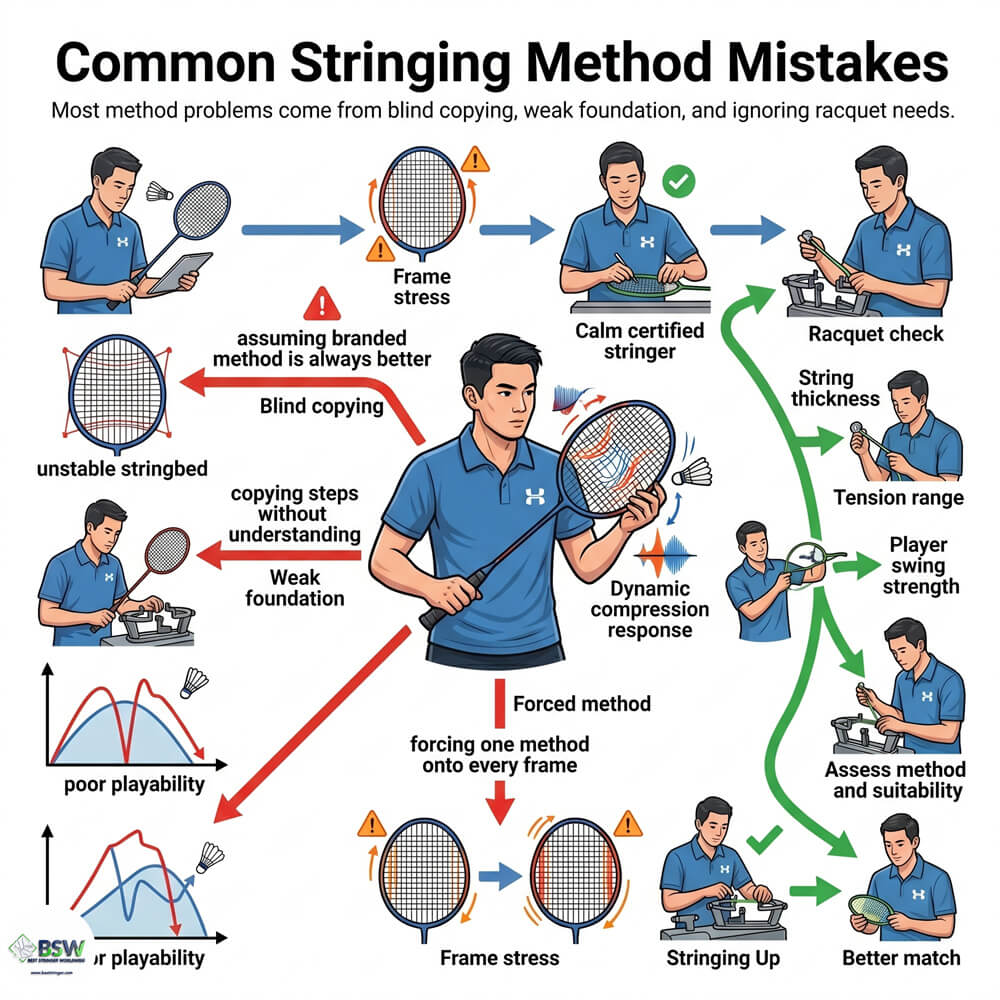
Mistake 1: Assuming Branded Methods are Always Better.
While Haribito may be one reference, believing that any branded method is automatically superior for every racquet is a trap. Method name alone does not guarantee stringbed stability.
Mistake 2: Ignoring Foundation for Method Labels.
Many learners assume that simply copying the steps of a famous method makes them professional. In reality, a stringer’s hand skill, frame mounting care, and tension control matter far more than the pattern name.
Mistake 3: Copying Patterns Blindly.
Stringing a racquet without understanding the underlying pattern logic often leads to structural frame stress. A modern certified stringer evaluates string thickness, tension range, and player swing strength before blindly executing a method.
1.6 Stringing Framework
Education-Based Method Decision Flow
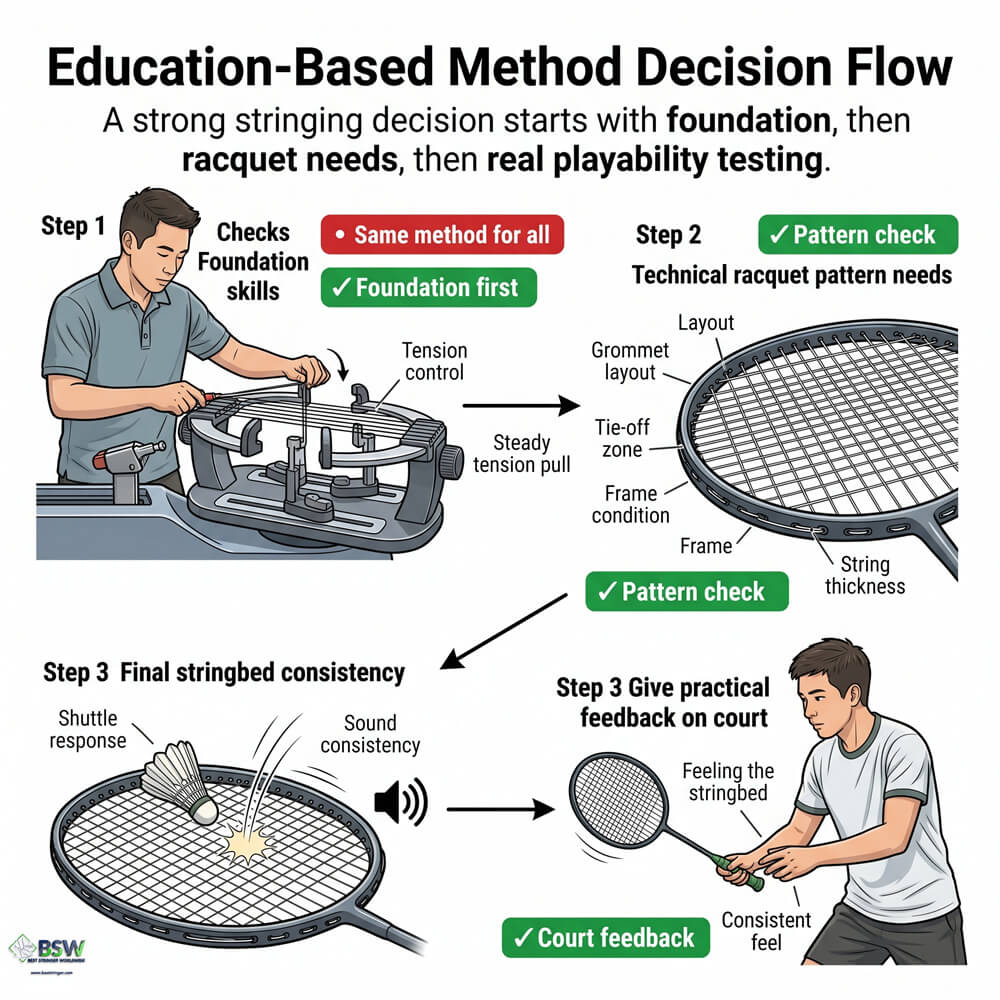
A step-by-step decision flow is crucial for balancing stringbed consistency and playability. Use this educational framework when evaluating stringing services:
Step 1: Check Foundation and Clamp Control. A branded stringing method will only yield great results if the stringer can maintain precise tension flow. Badminton stringers should develop proper fundamental hand skills before worrying about famous method names.
Step 2: Identify Racquet Pattern Needs. Determine if the racquet’s grommet layout and condition require a specific tie-off approach or modified pattern, rather than blindly forcing a singular branded method onto every frame.
Step 3: Test for Stringbed Consistency. Evaluate the result not by the label, but by whether the stringing genuinely improves shot feeling, sound consistency, and tension retention for the player.
1.7 BSW Certification
The Value of BSW Stringer Certification
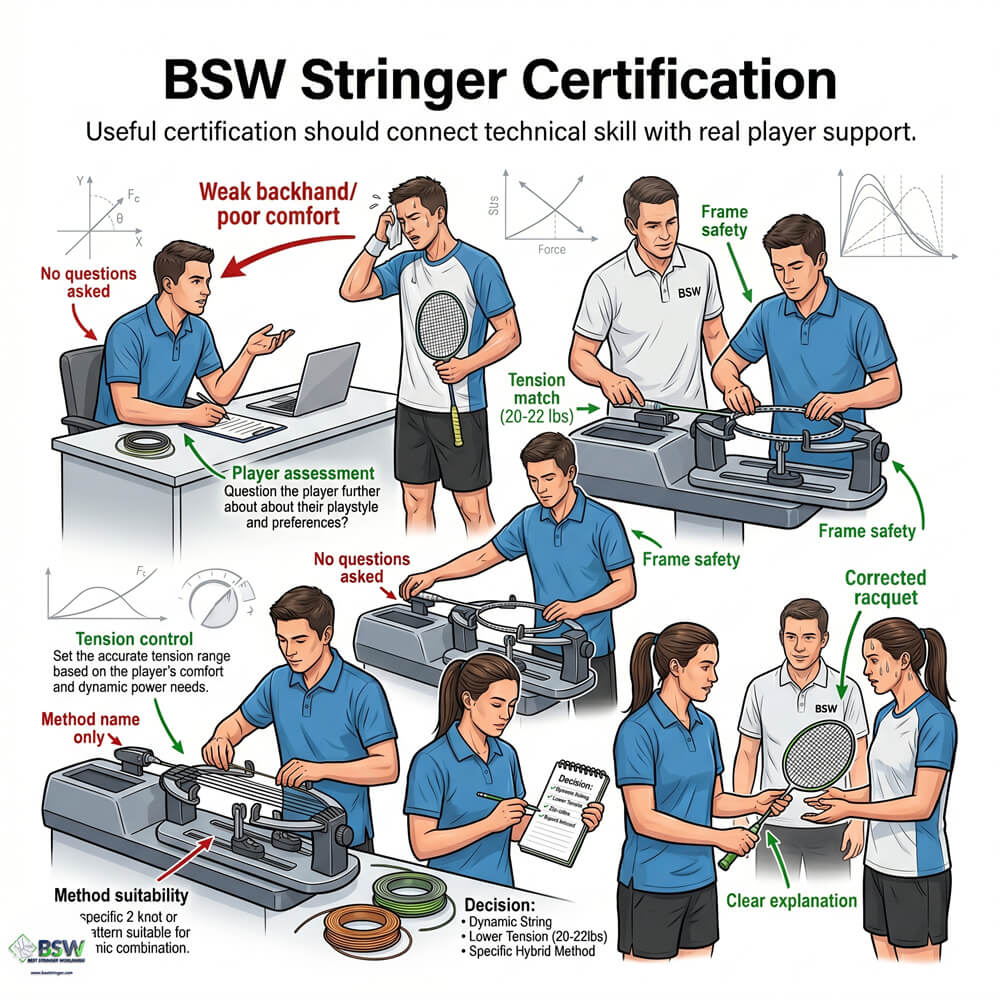
Proper technical education and player consultation are core parts of a professional badminton stringing course. A BSW certified stringer understands that relying solely on method names, like Gosen Haribito, without considering a player’s real ability or the racquet’s condition is a disservice.
At Best Stringer Worldwide, we know that brand-based confidence cannot replace education-based confidence. The magic is not in copying a famous pattern, but in the precise technical explanation a badminton stringer uses to match string type, tension range, and method suitability to your actual needs.
By prioritizing accurate equipment knowledge and technical correction, BSW stringer certification ensures that every setup perfectly balances consistency, stability, and playability. You eliminate guesswork, look past marketing labels, and focus purely on real badminton stringing skill.
Stringing Method & Education Quick FAQ
Clear answers to common questions about branded stringing methods and badminton stringer education.
Is the Gosen Haribito Stringing Method always better?
Not automatically. A branded method can be a useful reference point, but stringbed consistency still heavily depends on the stringer’s fundamental foundation, clamp control, and tension flow. Copying a method does not fix weak hand skill.
Does a branded stringing method guarantee better performance?
No. A famous method name or Japanese brand image creates player trust, but actual badminton playability comes from accurate execution, knot quality, and matching the specific stringing method to the racquet’s condition and player’s level.
Why can a famous stringing method still feel unstable?
Any method, even a highly promoted one, will feel unstable if the badminton stringer lacks fundamental technique. Weak clamp timing, improper mounting care, and poor tie-offs will ruin the best patterns, leading to rapid tension loss.
Can a simple method produce a stable stringbed?
Absolutely. When a stringer possesses a strong foundation and excellent tension control, even basic stringing methods can produce a highly consistent, durable, and powerful stringbed tailored effectively to the badminton player.
What should badminton players check when choosing a stringer?
Instead of only looking for a specific method label or dealer promotion, players should evaluate the stringer’s explanation ability, actual stringbed consistency, and thorough player consultation skills before making a decision.
Why should a badminton stringer understand method suitability?
Because racquets have distinctly different grommet layouts and frame stresses. A modern certified stringer learns to choose the safest, most effective method rather than blindly forcing one branded pattern onto every frame.
How does BSW teach badminton stringers differently?
BSW focuses on the reasoning behind stringing choices. Instead of just teaching how to copy a famous method, the BSW badminton stringing course emphasizes technical correction, foundation, and adapting to real player needs.
Why should players care about certified stringer training?
A BSW certified stringer is trained to provide real player service. They understand frame safety, string characteristics, and how to fine-tune tension flow to meet both casual and competitive player needs seamlessly.
What should a modern stringing course teach?
A professional badminton stringing certification must teach proper frame mounting, tension flow, pattern logic, and business communication, proving that real, tested stringing skill consistently outlasts marketing hype.
The Physics of Consistency: Why Stringer Foundation Matters
Stringing Reality: Brand Image vs Real Execution
A famous method name (like Haribito) is just a reference pattern. Discover why blindly trusting a brand name fails, and how true BSW stringing skills guarantee an optimized, reliable stringbed.
Method Name vs. Real Skill
Many players assume a branded method, like Gosen Haribito, guarantees a superior stringbed. In reality, a method is just a reference pattern. True stringing quality depends entirely on the stringer’s technical foundation, clamp timing, and ability to assess the player’s real needs.
Proven Foundation
The BSW badminton stringing certification is based on technical understanding, not brand hype. We prioritize frame safety, proper tension control, method suitability, and actual playability over famous method names.
| Evaluation Criteria | Branded Method Approach (e.g. Haribito) | BSW Education-Focused Approach |
|---|---|---|
| Trust Signal | May rely heavily on a famous brand name, Japanese image, or recognized method label. | Focuses on technical understanding, learning depth, and player-focused education. |
| Method Selection | One method may be treated as automatically superior for every racquet. | Teaches stringers to choose methods based on racquet, string, tension, and player needs. |
| Technical Foundation | Copying the method pattern may not fix weak hand skill or poor tension control. | Emphasizes clamp control, tension flow, knot quality, and finishing detail. |
| Marketing Label | The method name creates strong trust before the actual result is tested. | Teaches learners to logically explain the reason behind each stringing decision. |
| Stringbed Consistency | A famous pattern name does not automatically guarantee consistency or feel. | Focuses on repeatable technique, producing reliable racquet performance. |
| Player Consultation | Focus may appear more on promoting the method itself rather than the player. | Trains stringers to adjust advice by level, comfort, playing style, and racquet condition. |
Master Real Stringing Skill with Best Stringer Worldwide
Ready to upgrade your knowledge? Best Stringer Worldwide offers a professional badminton stringing course to teach you why stringer foundation matters more than marketing labels. We serve badminton players and stringers worldwide especially in Singapore, Hong Kong, Malaysia, Indonesia, UK, France and Europe. Contact a certified stringer to learn the real logic behind stringing methods.