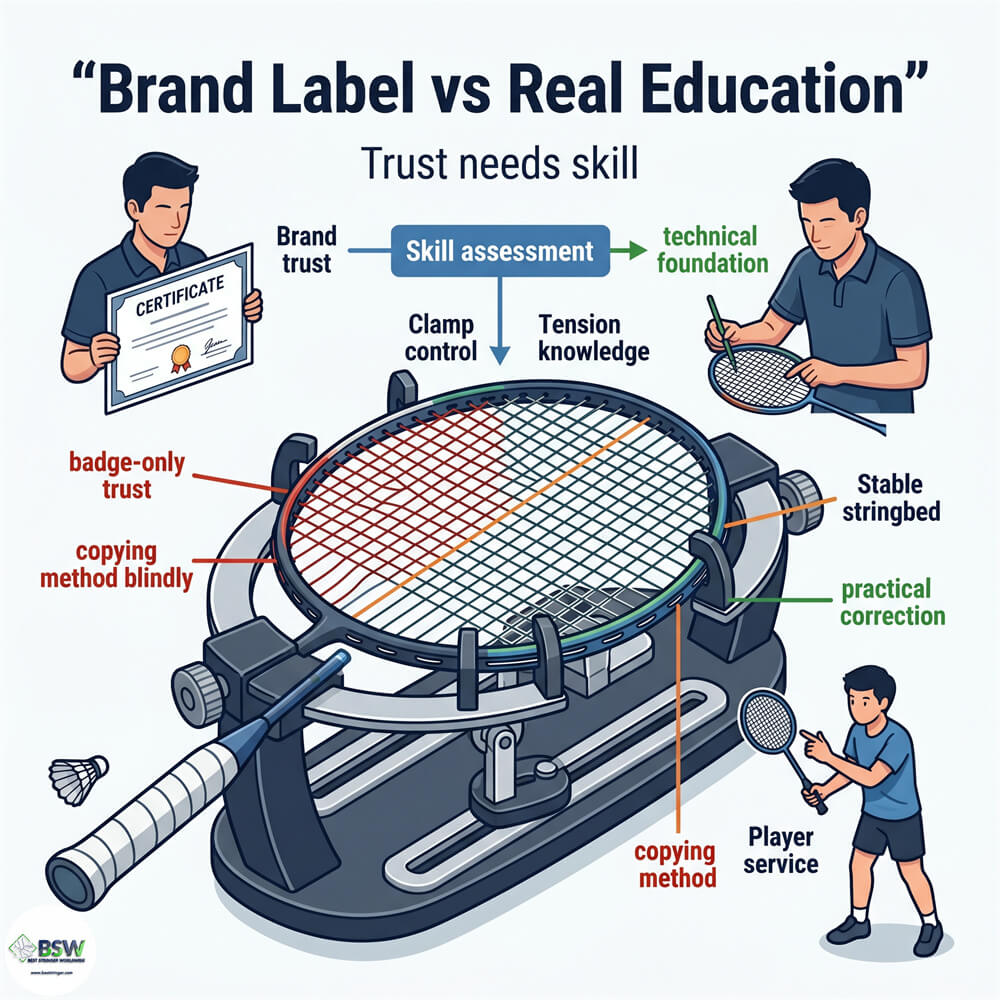
1.1 The Certification Question
What Is the Difference Between a Brand Label and Real Education?
Many badminton players and beginner stringers may think that a Gosen Haribito Certified Stringer is automatically superior because the title is connected to a famous brand, a specific method name, and limited-number positioning. In this guide, you will learn why a brand-based certified stringer badge creates trust, but should not be treated as automatic proof of deep badminton stringing skill.
In short, a certificate label dictates your marketing appearance, while your technical foundation dictates your stringbed consistency and player service. Mastering real stringing knowledge is crucial, as a “famous branded method” does not automatically mean “perfectly executed for every player.”
Here is a simple decision flow: Step 1: Realize that brand trust does not replace actual skill assessment. Step 2: Understand that copying a branded method is only beneficial if the stringer possesses strong clamp control and tension knowledge. Step 3: Choose a complete badminton stringing course like BSW that focuses on education, reasoning, and practical correction rather than merely providing a product-associated badge.
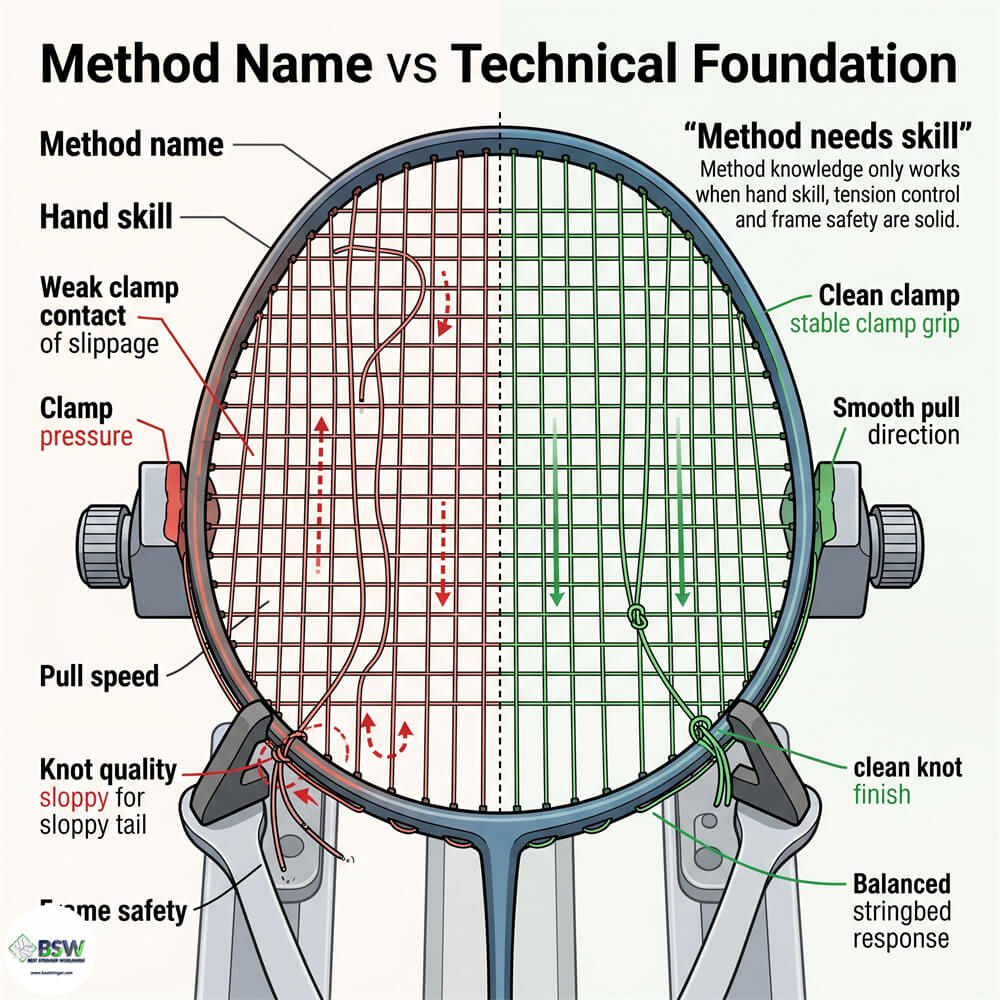
1.2 Stringing Foundation vs Branded Method
Why Method Name Cannot Replace Technical Foundation
The golden rule of badminton stringing education is that an impressive method name cannot hide poor hand skill. A Gosen Haribito Certified Stringer might use a highly recognizable branded method, which can appear professional. However, knowing the Haribito stringing method steps is only the starting point for a real certified stringer.
Any branded method can produce weak results if the stringer lacks a solid technical foundation. A famous pattern will still lose tension quickly if the stringer has poor clamp control, inconsistent pulling speeds, or sloppy knot quality. Conversely, a simpler or less famous method can produce an incredibly stable stringbed when executed by a stringer with excellent fundamentals.
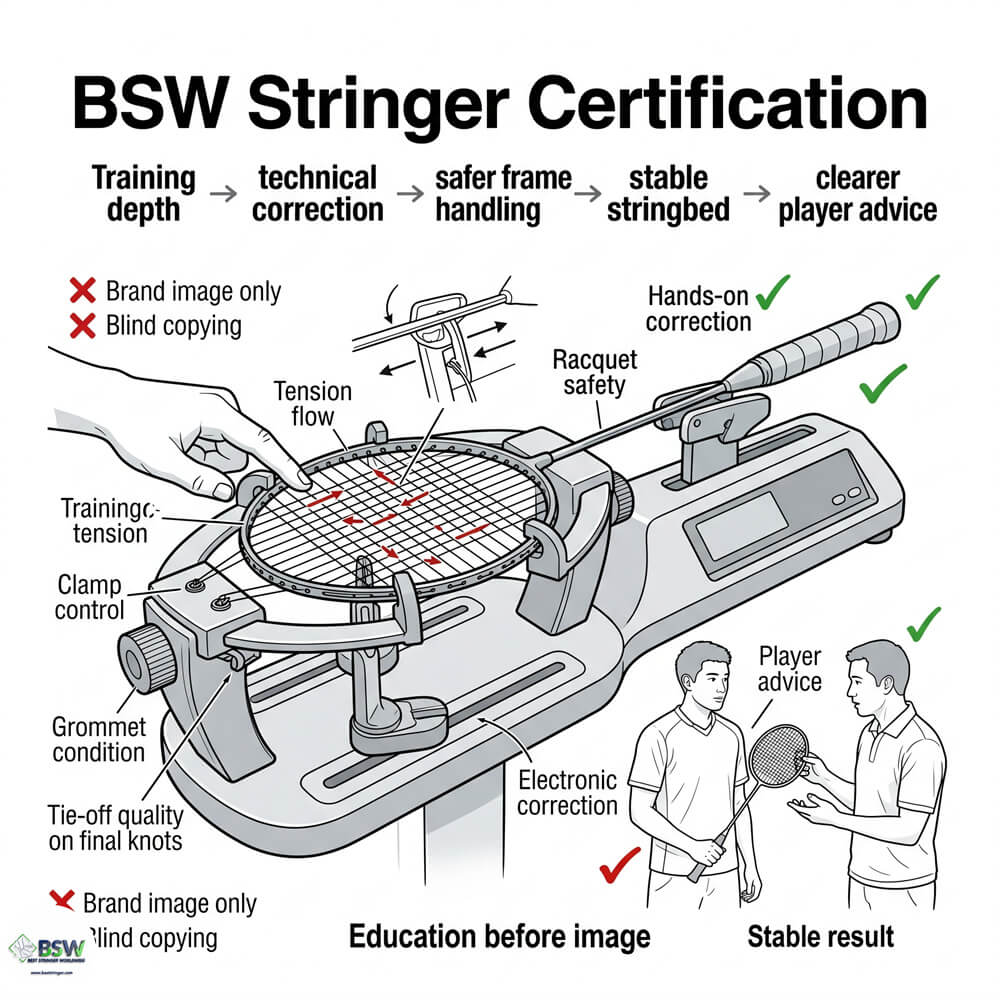
A modern badminton stringer needs the right balance between method knowledge and foundational ability. BSW certification is positioned as a stronger educational choice because it teaches learners to understand why a method works, how to properly mount the frame for safety, and how to execute perfect tie-offs, ensuring real consistency beyond a brand badge.

1.3 Tension Control & Consistency
Understanding Clamp Control and Stringbed Consistency
While a brand-certified title provides an aura of professionalism, true stringbed consistency dictates how a racquet actually performs on court. A famous method provides a theoretical path for tension flow, but only if the badminton stringer has the practical ability to execute it without tension loss. If a stringer lacks proper clamp control, applying a complex branded pattern often results in an uneven stringbed and poor playability.
A badminton stringing certification should not be judged only by “how few people have it.” Limited availability can create perceived value, but it does not automatically prove stronger training depth or hands-on correction. Real consistency comes from meticulous practice and rigorous technical assessment.
BSW focuses extensively on hands-on correction. By teaching a stringer exactly how to handle grommet friction, mounting pressure, and tie-off tension loss, the resulting stringbed offers reliable repulsion and control regardless of whether the player requested a branded method or a standard professional pattern.
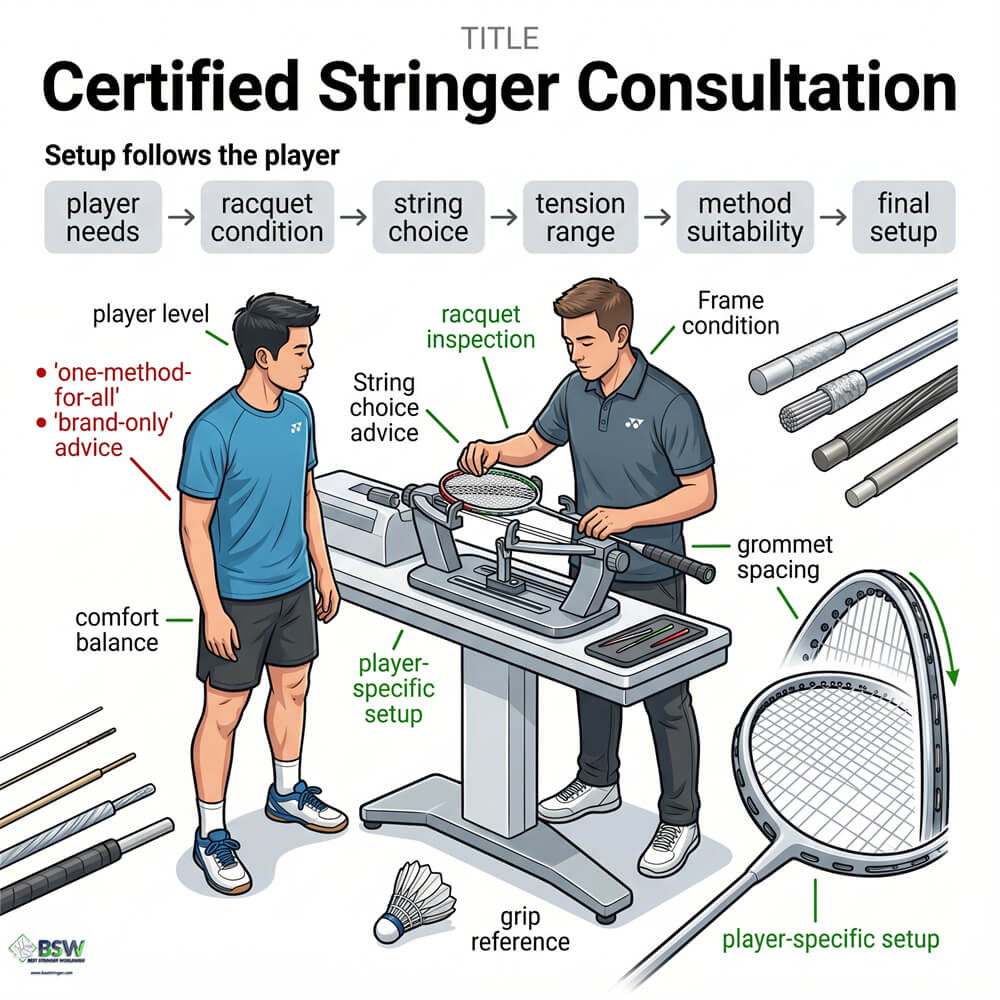
1.4 Player Consultation
Why a Certified Stringer Must Offer Real Consultation
A modern badminton stringer must do more than just execute a branded pattern. Understanding method suitability and real player consultation is essential for all levels:
Independent String Judgment. A brand-certified stringer may be closely tied to a product promotion ecosystem. A fully educated stringer should be able to evaluate different string types, comparing durability and comfort trade-offs independent of brand association.
Method Suitability. There is no single method or certification label that is automatically best for every racquet. A good stringer evaluates the grommet layout, racquet condition, and frame strength before deciding which stringing method to apply.
The Playing Needs Priority. A badminton player should not judge stringing quality only by a certificate on the wall. A certified stringer should be evaluated by their ability to explain tension range, swinging strength, and how to balance repulsion for casual players versus control for competitive players.
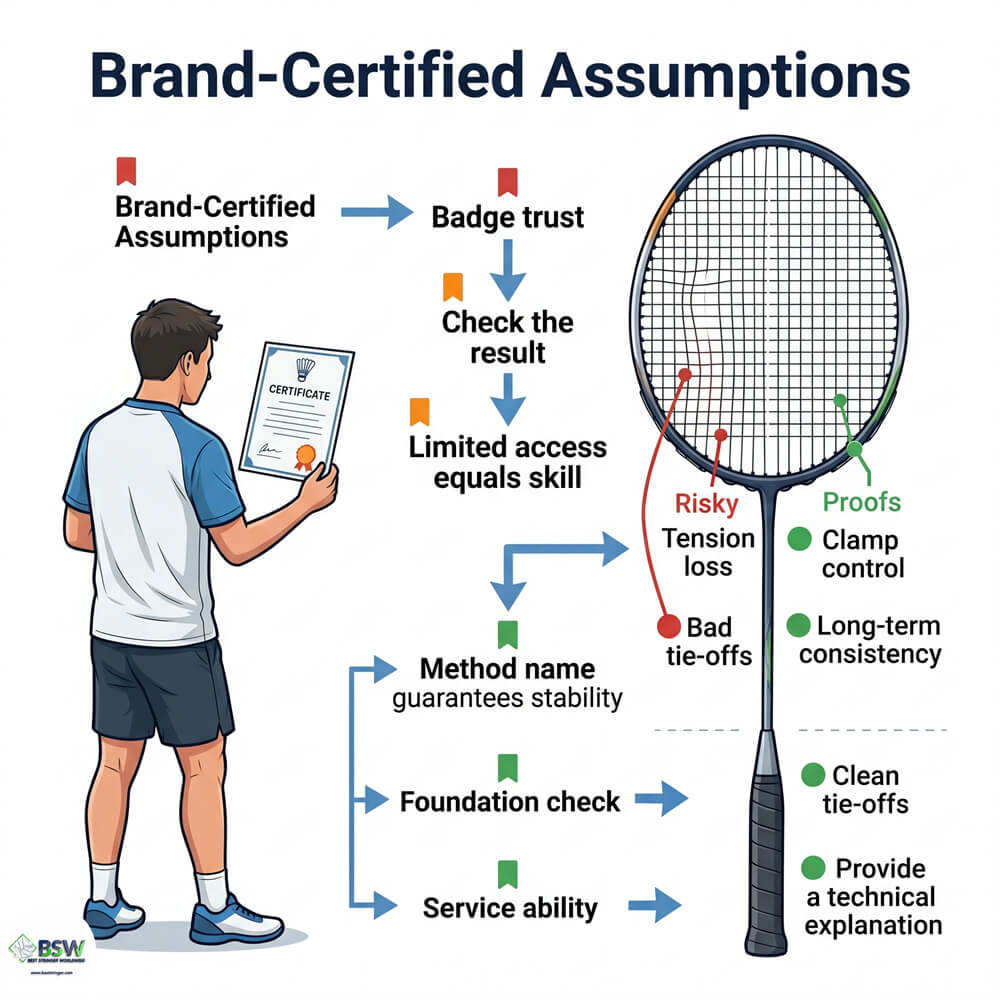
1.5 Common Certification Myths
Common Brand-Certified Assumptions
Assumption 1: A Badge Means Perfection.
While a brand-certified label can create trust, players often assume it guarantees flawless performance. The reality is that the final result always depends heavily on the stringer’s personal foundation and daily consistency, not just the certificate label.
Assumption 2: Method Name Guarantees Stability.
Chasing the prestige of a recognized method name often causes players to ignore actual stringbed feel. If the stringer cannot execute proper tie-offs or maintain clamp pressure, even the most famous pattern will feel unstable and lose tension rapidly.
Assumption 3: Limited Availability Equals Higher Skill.
Believing a stringer is superior simply because “only a few people have this badge in the country” is a common marketing trap. Real stringing value should be measured by actual training depth, technical explanation, and continuous long-term service ability.

1.6 The Education Pathway
Choosing a Modern Stringing Education
A step-by-step learning progression is crucial for developing real stringing skill. For 2026 learners, understanding the logic is better than just following a label:
Step 1: Build Core Foundation. BSW focuses heavily on the basic stringer foundation. Before a stringer even considers which method to use, they must demonstrate proper frame inspection, secure mounting without excessive pressure, and perfect knot quality.
Step 2: Understand the “Why”. Instead of blindly copying a branded method step-by-step, BSW certified stringer development teaches learners why specific string paths are chosen, helping them adapt to different racquets dynamically.
Step 3: Provide Practical Consultation. A BSW certified stringer learns how to translate technical knowledge into real-world advice, ensuring every badminton player receives post-stringing feedback and tension adjustments suited for their level.
1.7 BSW Certification
The Value of BSW Stringer Certification
Complete badminton stringing education goes far beyond wearing a brand logo. A good stringer certification sets standards based on continuous assessment, hands-on correction, and real badminton-specific knowledge, not just promoting a dealer’s product ecosystem.
At Best Stringer Worldwide, we believe that badminton players deserve stringers who understand the reasoning behind stringing choices. BSW certification is positioned as an education-based pathway because we emphasize pattern logic, tension flow, and racquet safety instead of blindly demanding stringers copy a famous brand method.
By prioritizing educational depth over brand image, the BSW badminton stringing course equips stringers to serve players honestly. You eliminate guesswork, provide accurate advice for beginners and competitive players alike, and build your business on genuine technical skill.
Brand Certification vs BSW Quick FAQ
Clear, educational answers about badminton stringing certification, method choices, and BSW.
Is a Gosen Haribito Certified Stringer automatically better?
A brand-certified label can create initial trust, but it does not automatically prove superior stringing skill. The final quality of the stringbed depends heavily on the stringer’s technical foundation, clamp control, and daily consistency, not just the certificate label they hold.
Why does stringer foundation matter more than method name?
Because poor hand skills will ruin any method. If a stringer lacks proper tension control, safe frame mounting, and high-quality knot tying, even the most famous branded stringing method will result in rapid tension loss and an unstable feel.
Does limited availability make a stringer more skilled?
No. Claiming “only a few people have this certification” is a marketing strategy that creates perceived exclusivity. Real skill should be measured by comprehensive badminton stringing education, practical assessment, and the ability to serve players consistently.
What should a badminton player check when choosing a stringer?
Players should judge a stringer based on their explanation ability and service quality. Look for a stringer who carefully inspects grommet condition, explains string choices clearly, and recommends tension based on your actual playing style, rather than just showing a badge.
Why does BSW focus on stringing education?
BSW focuses on technical understanding to train stringers who know the “why” behind their choices. Instead of blindly copying brand methods, a BSW certified stringer learns how to adjust for different racquets and provide genuine player consultation.
Can a simple method produce a stable stringbed?
Yes. Proper execution of a suitable standard method can easily outperform a poorly executed famous method. Correct tension pulling, stable clamp positioning, and excellent tie-off techniques are the real factors that ensure stringbed durability and consistent repulsion.
Why should a badminton stringer understand method suitability?
No single method fits all racquets perfectly. A knowledgeable stringer evaluates frame shape, string path geometry, and the player’s performance needs to select the most appropriate pattern, rather than forcing every racquet into one brand’s system.
What is the difference between a brand label and service ability?
A brand label only shows association with a specific company or method. Real service ability refers to the stringer’s practical capacity to answer questions, diagnose racquet issues, offer tailored advice, and consistently deliver high-quality stringing results.
What should a modern stringing course teach?
A professional badminton stringing course should focus on technical depth: frame safety, grommet condition, clamp maintenance, pattern logic, and how to effectively communicate with customers, rather than just teaching how to memorize a branded method’s steps.
The Stringing Focus: Why Technical Foundation Matters
Proven Standards
BSW stringing education is based on deep technical understanding, proper frame care, and practical player service. We prioritize learning and reasoning over simple badge appearance.
| Evaluation Criteria | Brand-Certified Approach | BSW Education Approach |
|---|---|---|
| Trust signal | May rely on a Gosen Haribito label or famous brand name to show association. | Focuses on technical understanding, learning depth, and player-focused education. |
| Method selection | A specific branded method may be treated as automatically superior for all. | Teaches stringers to choose methods based on racquet and player needs. |
| Technical foundation | Holding a method label might not fix weak clamp control or poor knots. | Emphasizes tension flow, knot quality, and meticulous execution. |
| Player consultation | Focus may lean heavily toward brand promotion and method image. | Trains stringers to adjust advice by level, comfort, and playing style. |
| Limited availability | “Only a few stringers” may be used to create perceived exclusivity. | Value comes from continuous learning, correction, and service ability. |
| Stringbed consistency | Famous pattern name does not automatically guarantee a stable stringbed. | Focuses on repeatable technique and understanding why a method works. |
Upgrade Your Skills with Best Stringer Worldwide
Ready to move beyond brand labels? Best Stringer Worldwide offers professional badminton stringing certification to teach you real method suitability, tension control, and player consultation. We serve badminton players and stringers worldwide especially in Singapore, Hong Kong, Malaysia, Indonesia, UK, France and Europe. Contact BSW to become a truly capable certified stringer.