1.1 Introduction
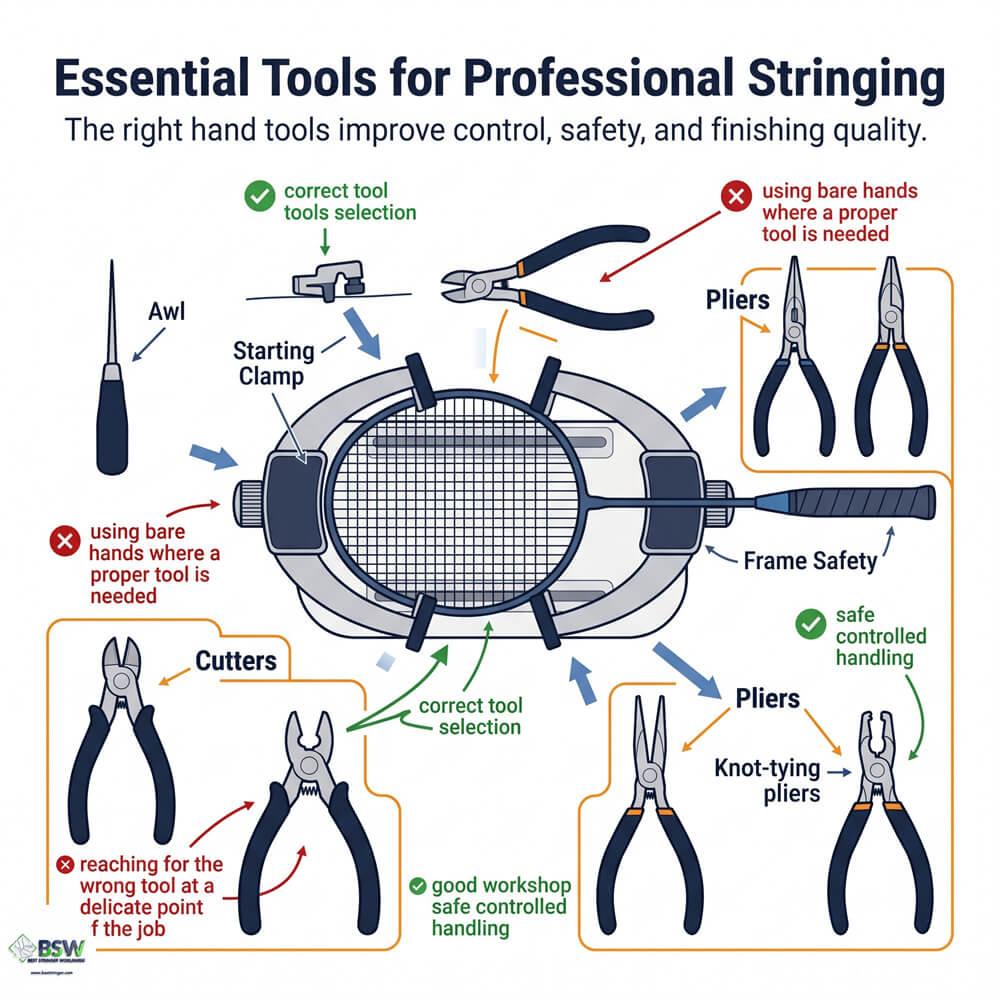
Essential Tools for Professional Stringing
Racquet stringing uses a small set of hand tools alongside the stringing machine: cutters for preparing and trimming string, pliers for controlled handling, a starting clamp for approved anchoring or bridging procedures, and an awl or safer pathfinding tool for selected grommet-access tasks. No tool guarantees racquet safety or a professional result; correct inspection, mounting, pattern, tension and technique remain essential.
Start by matching the tool to the task and checking that its jaws, edges and tips are clean, aligned and undamaged. Keep sharp tools away from the face and body, never lever against the frame, do not clamp across damaged string, and follow the tool, racquet and machine manufacturer instructions.
For related equipment decisions, compare stringing-machine clamp systems and racquet stringing tension systems.
1.2 Why Quality Matters
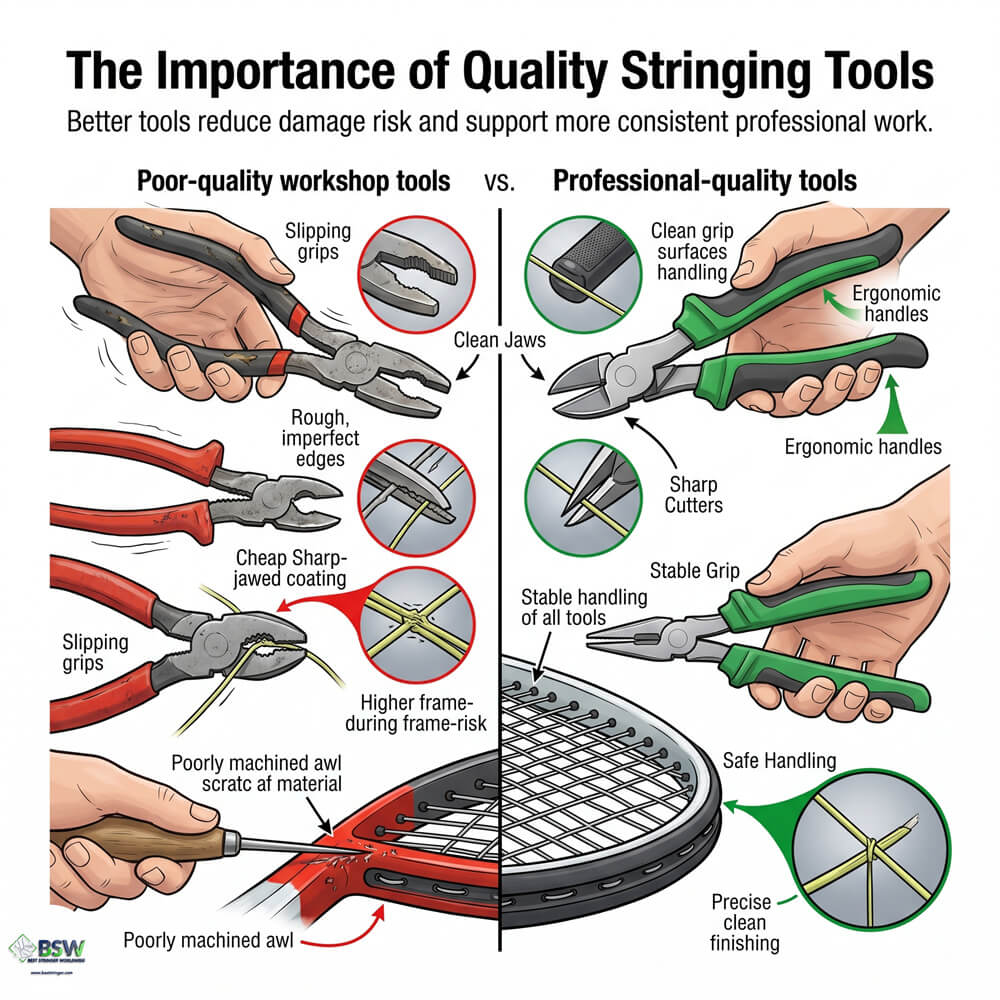
The Importance of Quality Stringing Tools
Tool quality should be judged by condition and task fit: cutters should make a clean cut, plier jaws should grip without sharp burrs, and clamps should hold the intended string without crushing or slipping. Inspect and clean tools regularly, and replace damaged or misaligned components rather than relying on a professional-grade label.
Any awl can scratch a frame or damage string when forced, and any plier can crush string when its jaws or technique are unsuitable. Better tools can improve control and repeatability, but they cannot remove the risk of an incorrect procedure.
Build the kit around the work actually performed, the machine and racquet instructions, and repeatable handling practice rather than price or prestige.
1.3 The Core Kit
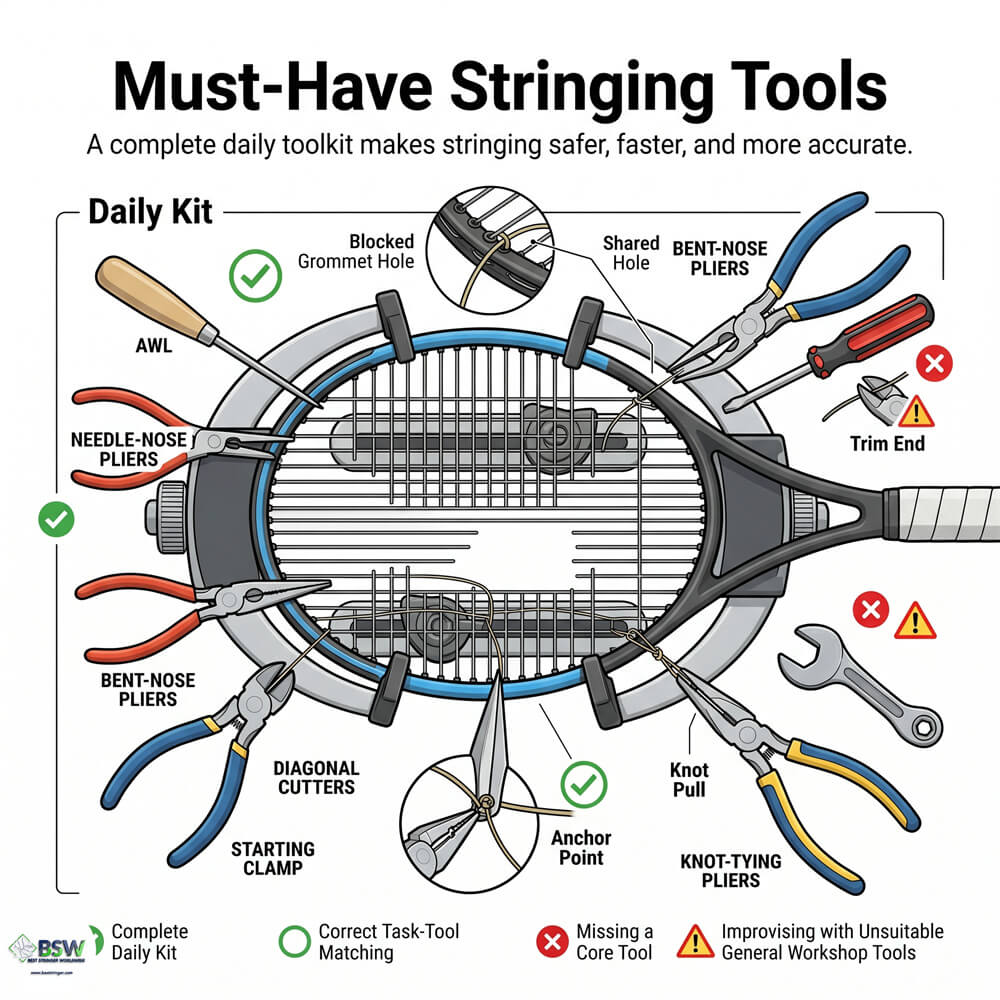
Must-Have Stringing Tools
A practical starter kit usually includes sharp cutters, smooth-jaw or task-appropriate pliers and the tools required by the stringing machine and intended patterns. A starting clamp is useful for procedures the stringer has been trained to perform. An awl is situational and should not be treated as the default solution for every blocked or shared hole.
BSW training covers tool selection and controlled handling as part of the wider stringing process. Competence is demonstrated through the applicable course and assessment requirements, not by owning a fixed shopping list or by an unsupported claim of external recognition.
1.4 Hole Access
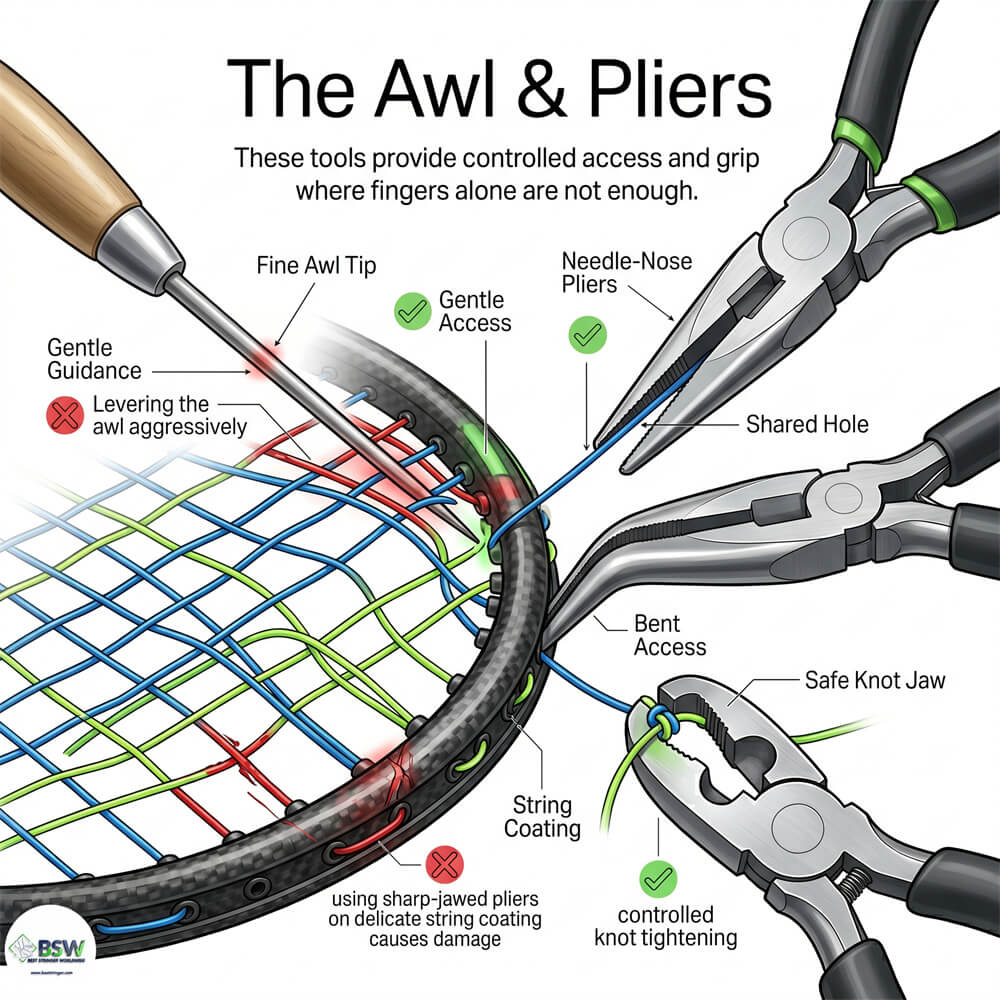
The Awl & Pliers
1. The Awl. An awl is a situational path-access tool, not a general device for enlarging every blocked hole. Never force it beside a tensioned string, lever it against the frame or use it on a split grommet. Inspect the grommet first and use the least invasive approved method; replace damaged grommets where required.
2. Needle-Nose & Bent-Nose Pliers. Pliers can guide a free string end in confined areas when their jaws are smooth and correctly aligned. Grip only with the pressure needed, avoid already tensioned string and do not pull or pry against the frame or grommet.
3. Knot-Tying Pliers. Task-appropriate pliers can provide controlled grip on a knot tail. Use smooth, clean jaws and steady hand tension without crushing the coating or levering the tool against the frame. The tool supports consistent technique but does not guarantee retained tension.
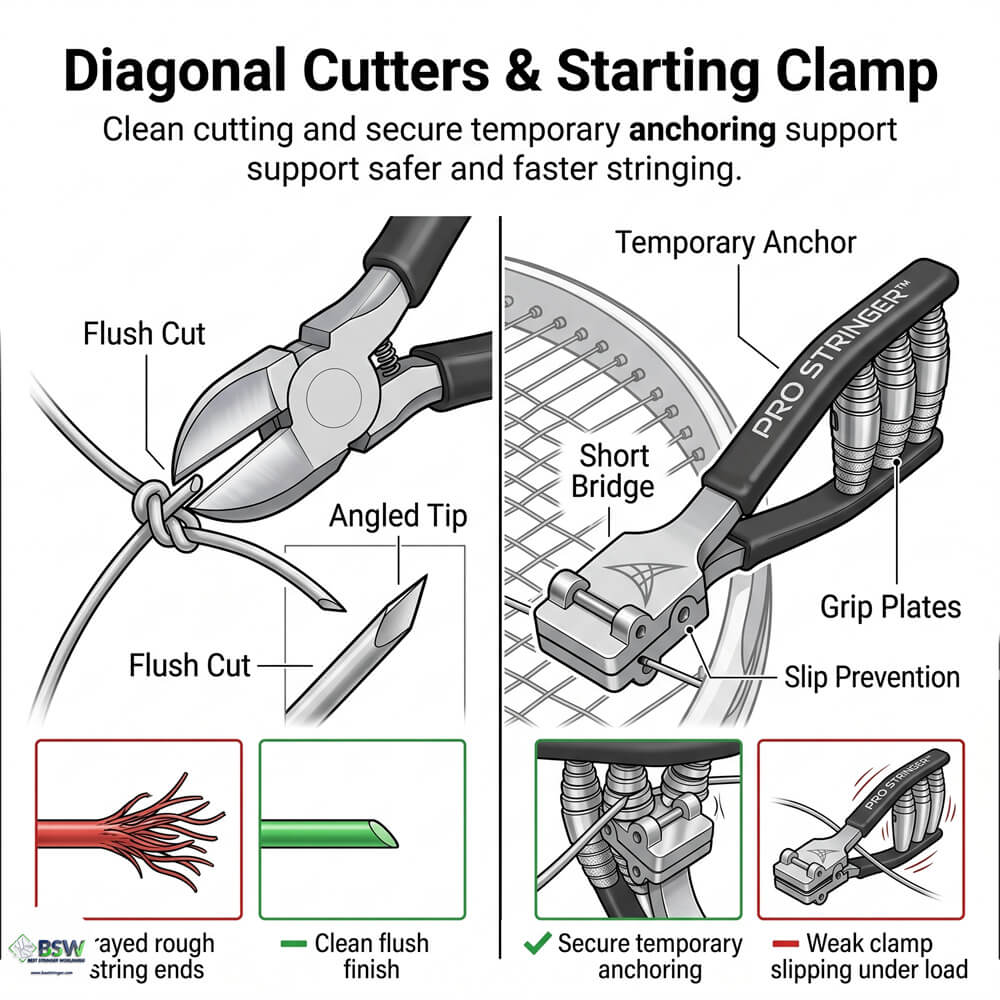
1.5 Cutting & Anchoring
Diagonal Cutters & Starting Clamp
4. Diagonal Cutters. Use sharp, correctly sized cutters to prepare a free string end or trim a finished knot tail. Keep the jaws clear of the frame and body, leave the intended safe tail length, and never cut a loaded string unless the racquet is being de-tensioned through an appropriate balanced procedure.
5. The Starting Clamp. A starting clamp can serve as a temporary anchor or bridge in procedures supported by the machine and pattern. Check the jaw condition and holding capacity, protect the frame from contact and use the method taught for that setup.
A starting clamp can also bridge a short string to the tension head when the specific procedure is understood. Test that it holds without crushing the string, keep it clear of the frame finish and do not assume that price alone prevents slippage.
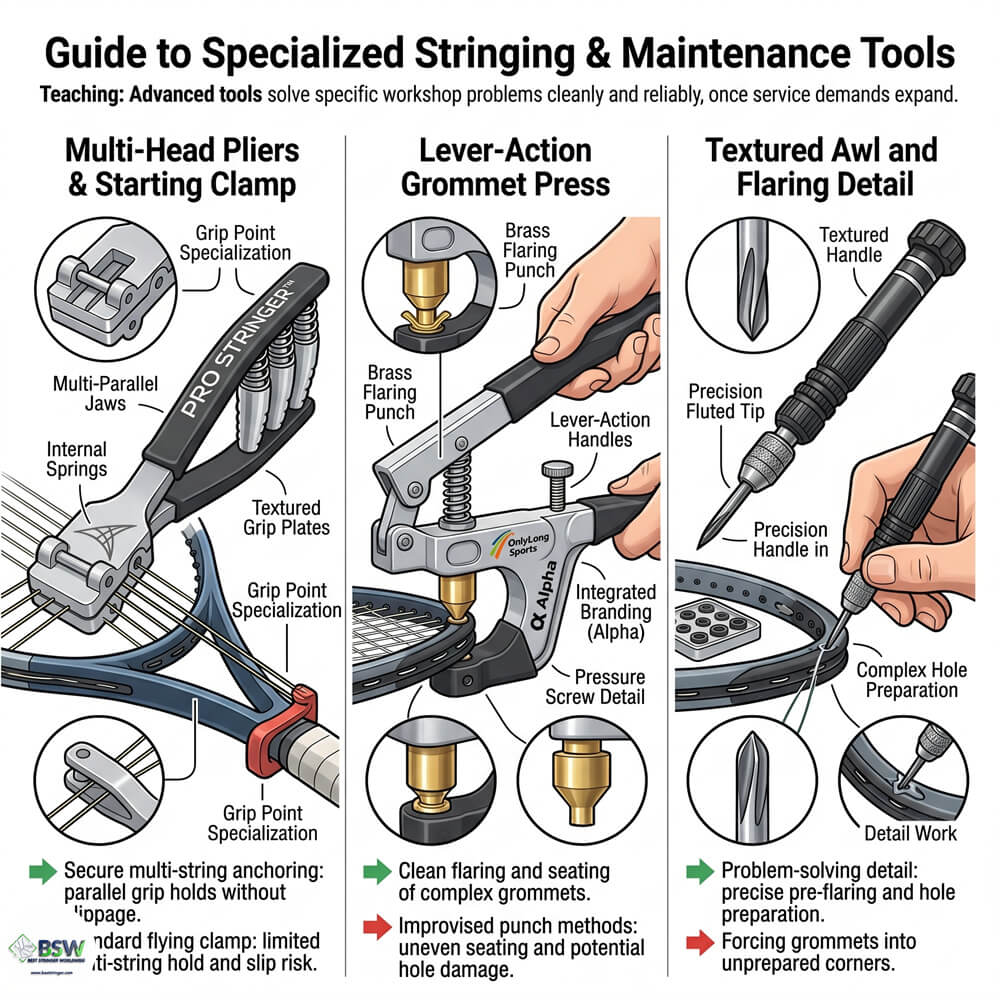
1.6 Expanding Your Kit
Specialized Stringing Tools
As a stringer’s service scope expands, specialized stringing tools transition from optional luxuries to daily necessities. These tools handle niche tasks faster and more reliably.
Cam-Lever Knot Pliers. Featuring a mechanical lever system, these pliers provide incredibly strong, controlled pulling power with minimal hand effort. They are specialized for stringers who want maximum knot tightness without struggling.
Grommet Insertion Tool. Worn grommets frequently cause premature string breakage. A grommet insertion tool (often paired with a grinder) allows a stringer to quickly remove and press individual flared replacement grommets into the frame, saving time when a full bumper replacement isn’t necessary.
Flying Clamps. Unlike the fixed clamps attached to your machine base, flying clamps grip two strings together independently in the air. They are highly situational but exceptionally valuable in badminton stringing for securing tension near awkward, tight corners where standard bulky machine clamps simply cannot fit.
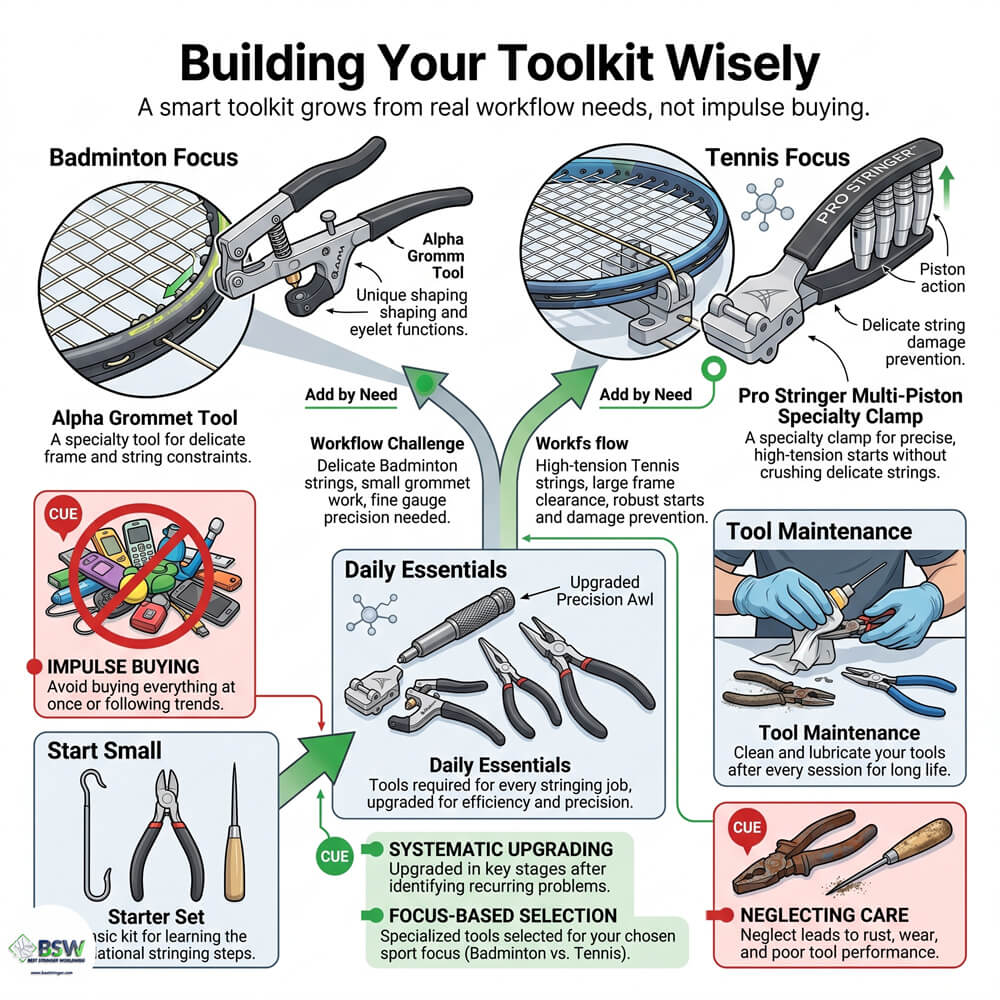
1.7 Professional Growth
Building Your Toolkit Wisely
Building a professional toolkit should be realistic and practical. Start with the absolute essentials—cutters, pliers, and an awl—then systematically add high-quality specialty tools like a starting clamp or grommet tool as you encounter recurring challenges in your workflow.
It is important to choose tools that match your primary focus, whether that is badminton or tennis, and maintain them properly so they last. Stay informed about equipment upgrades, but avoid impulse-buying every new gadget on the market without understanding its true utility.
Correct tools expand your service capability and support consistency, but tool mastery is what truly matters. In a dedicated badminton stringing course or stringer certification path, technicians learn that judgment and technique are just as important as the hand tools they wield.
Stringing Tools Quick FAQ
Clear, direct answers about the hand tools used in professional racquet stringing.
What tools should a beginner stringer buy first?
A beginner should start with a reliable awl, sharp diagonal cutters, and needle-nose pliers. A sturdy starting clamp should be added immediately after, as it makes tensioning and knot tying significantly easier and safer.
Why is a starting clamp so important?
It is incredibly versatile. It acts as a secure temporary anchor for starting mains, helps tension short string ends that can’t reach the machine head, and provides a safe starting point for two-piece stringing jobs.
When should a stringer use an awl carefully?
An awl should only be used gently to guide strings through blocked holes or align grommets. You should never force or aggressively lever an awl, as this can easily crack the carbon frame or snap the tool’s fine tip.
Are flying clamps mainly for badminton?
While they can be used in tennis, flying clamps are highly favored in badminton because the frame’s narrow string spacing and tight corners often make maneuvering bulky fixed machine clamps very difficult.
Do expensive tools create better results?
No. Premium tools are more durable and ergonomic, but a stringer’s judgment and technique dictate the final quality. A certified stringer with basic tools will easily outperform an untrained novice holding luxury tools.
Why use specialized knot-tying pliers?
Knot-tying pliers feature optimized jaws that grip the string firmly without flattening or cutting into the coating. This ensures knots are pulled securely and consistently without damaging the delicate filament structure.
Why does this matter for certification?
Stringer certification emphasizes safety and consistency. Knowing which tool to use, and exactly how to use it, prevents frame damage, protects string integrity, and ensures a highly professional service workflow.
How should a stringer build their toolkit?
Start with the essentials included with a good machine, then systematically add high-quality specialty tools like a starting clamp or grommet tool as you encounter specific recurring challenges in your daily workflow.
Can tools replace a stringer’s skill?
No. While specialized pliers and clamps provide vital holding power and efficiency, a certified stringer must still possess the manual technique to weave correctly, pull consistently, and interpret when a tool is safely needed.
Stringing Tool Selector: Task vs Equipment
Essential Tools Inspector
Select a tool to observe its functional application
Safe and Repeatable Tool Handling
Our training emphasizes practical tool handling, frame and grommet inspection, controlled gripping and repeatable finishing procedures. These practices reduce avoidable errors but do not guarantee the same result for every racquet or player.
| Tool Name | Primary Function | Practical Role in Stringing |
|---|---|---|
| Awl | Supports selected blocked-hole access after grommet inspection. | Situational: use the least invasive approved method and never force the tool beside loaded string. |
| Diagonal Cutters | Prepares free string ends and trims finished knot tails. | Useful for controlled trimming when kept clear of the frame, body and loaded string. |
| Starting Clamp | Provides a temporary string anchor in supported procedures. | Useful for trained starting, bridging and selected hybrid procedures. |
| Knot-Tying Pliers | Provides controlled grip on a free knot tail. | Use smooth, aligned jaws and steady hand tension; do not crush the coating or lever against the frame. |
| Bent-Nose Pliers | Guides a free string end through confined areas. | Situational for selected path-access tasks; avoid tensioned string and frame leverage. |
| Flying Clamps | Holds string outside a fixed-base clamp system. | Use only with a compatible machine and supported procedure; inspect grip and alignment first. |
Master Stringing Tools with Best Stringer Worldwide
Ready to elevate your stringing professionalism? Best Stringer Worldwide offers advanced education to help you understand proper tool handling, workflow efficiency, and safe racquet maintenance. We serve racquet stringers worldwide, including in Singapore, Hong Kong, Malaysia, Indonesia, UK, and Europe. BSW certification pathways assess the applicable knowledge and practical skills for each selected program.