






1.1 Starting Point
What does a badminton stringing course in Kuala Lumpur actually cover?
A badminton stringing course in Kuala Lumpur should cover the full working craft: mounting and clamping a frame safely, weaving and tension work on real rackets, starting and finishing knots, grommet care, string and tension choices for real players, and a practical exam at the end that tests the work. Kuala Lumpur is the training base for Best Stringer Worldwide, and the course runs only in Kuala Lumpur, with flexible timing. Judge any Kuala Lumpur course by that coverage list. A course that teaches on real rackets and ends in a real exam is a training route. One that stays at theory is a talk.
Start with who the course suits, because that shapes what good coverage means for you. A player who strings for a club, a shop worker adding a proper skill, and a future stringing business owner all need the same core craft, but they differ in how much guided practice and exam preparation they should look for.
Keep the coverage list written down while you read course pages and send enquiries. Every claim a course makes gets checked against it: real rackets or demo frames, your hands on the machine or watching, feedback while you work, and an exam that marks the finished racket. Missing items are not small print. They change the product.
1.2 Preparation
What does the practical exam at the end of the course check?
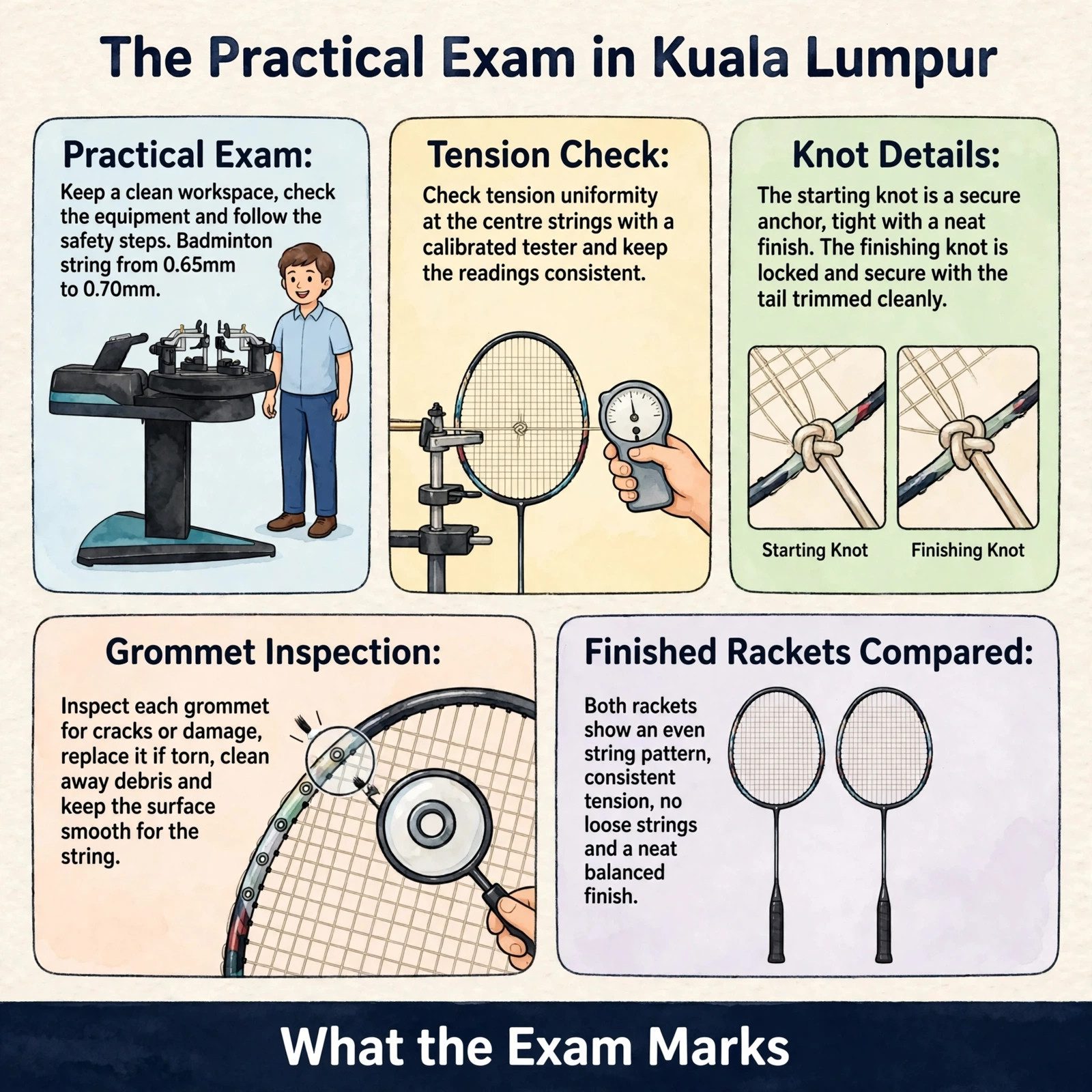
The practical exam is what turns a Kuala Lumpur course into certification, so know what it checks before you choose where to train. A serious exam marks the finished racket and the habits behind it: tension accuracy against the setting given, clean starting and finishing knots, grommet care, a straight and even string bed, and the same result produced more than once, all on a badminton racket at real playing tensions such as 25 to 27 lbs. It is a practical test of stringing work, judged on rackets you string yourself, not a review of what you can repeat from a lesson.
Ask any Kuala Lumpur course to describe its exam marking before you book. What is checked, how it is checked, and what happens if the first attempt falls short. A provider who answers plainly is running a real exam. A provider who stays vague is asking you to value the certificate without seeing the test behind it.
Prepare for the exam the way it is marked. Repeat full rackets at the tensions you find hardest, with strings like BG65 and BG66 Ultimax, and judge your own work against the same list: tension, knots, grommets, bed. Exam day then feels like one more checked job, which is exactly what good training builds toward.
1.3 Working Method
How does hands on training in Kuala Lumpur differ from learning alone?
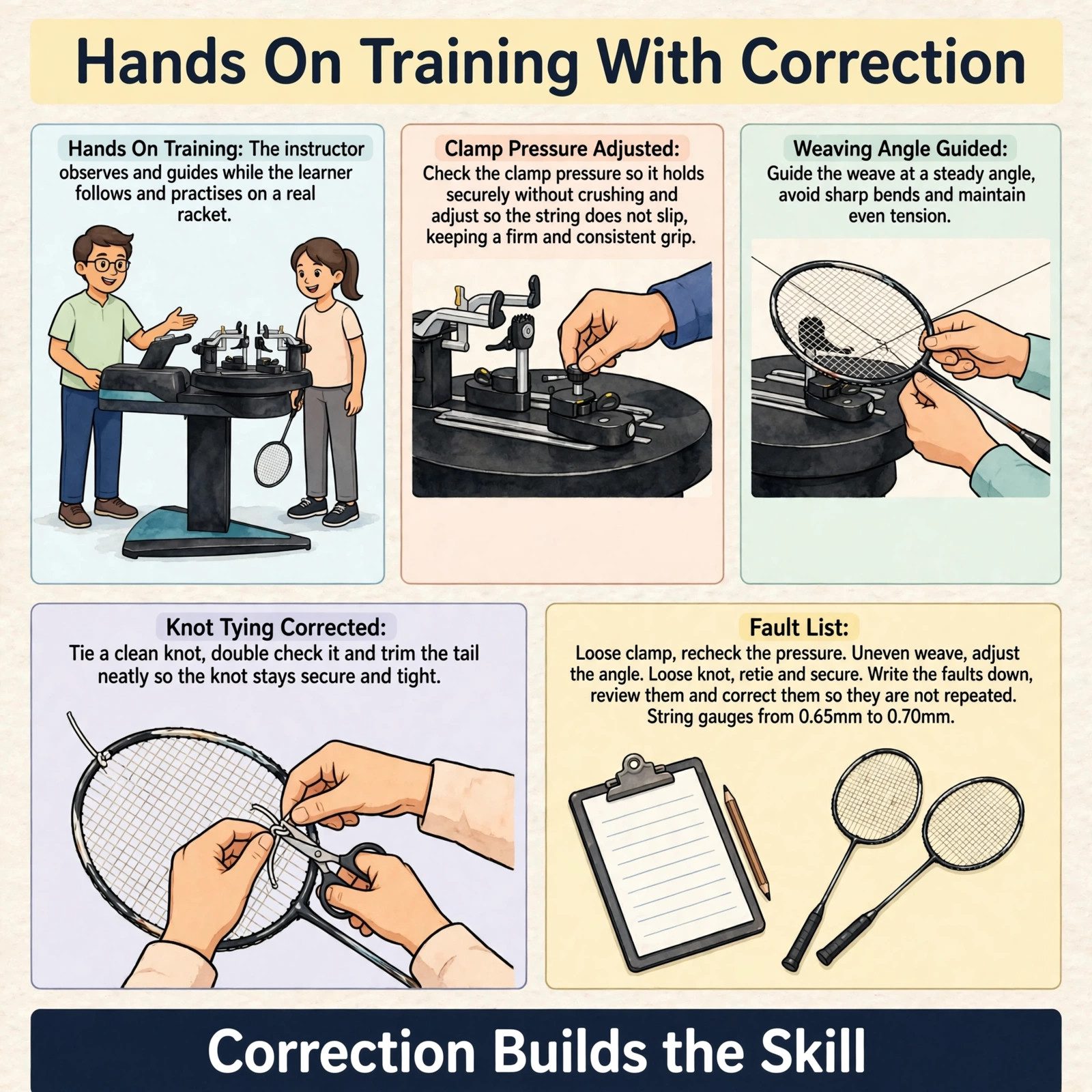
Hands on training in Kuala Lumpur differs from learning alone by correction, and correction is where stringing skill actually forms. An instructor watches your hands on real rackets: clamp pressure, weaving angle, knot work and how you treat grommets as string pulls through. Each fault is named and fixed during the session, so the next racket is strung differently. Learning alone has no such loop. Videos and manuals can teach the step order and the reasons behind it, and they are useful before and after a course. They cannot see your work, so they cannot correct it.
Ask how a training day actually runs before you commit. How many rackets do you string yourself, on frames like the Astrox 88D or the 100ZZ? Who watches your work, and how are mistakes pointed out and put right? The answers separate a working course from a demonstration with seats.
Use the days around the course well. Arrive with your current faults written down, the tensions and strings you struggle with, and questions from your own practice. A student who brings a fault list gives the instructor something exact to correct, and leaves Kuala Lumpur with habits changed rather than notes taken.
1.4 Practical Review
Which costs and commitments should I list for a Kuala Lumpur course?
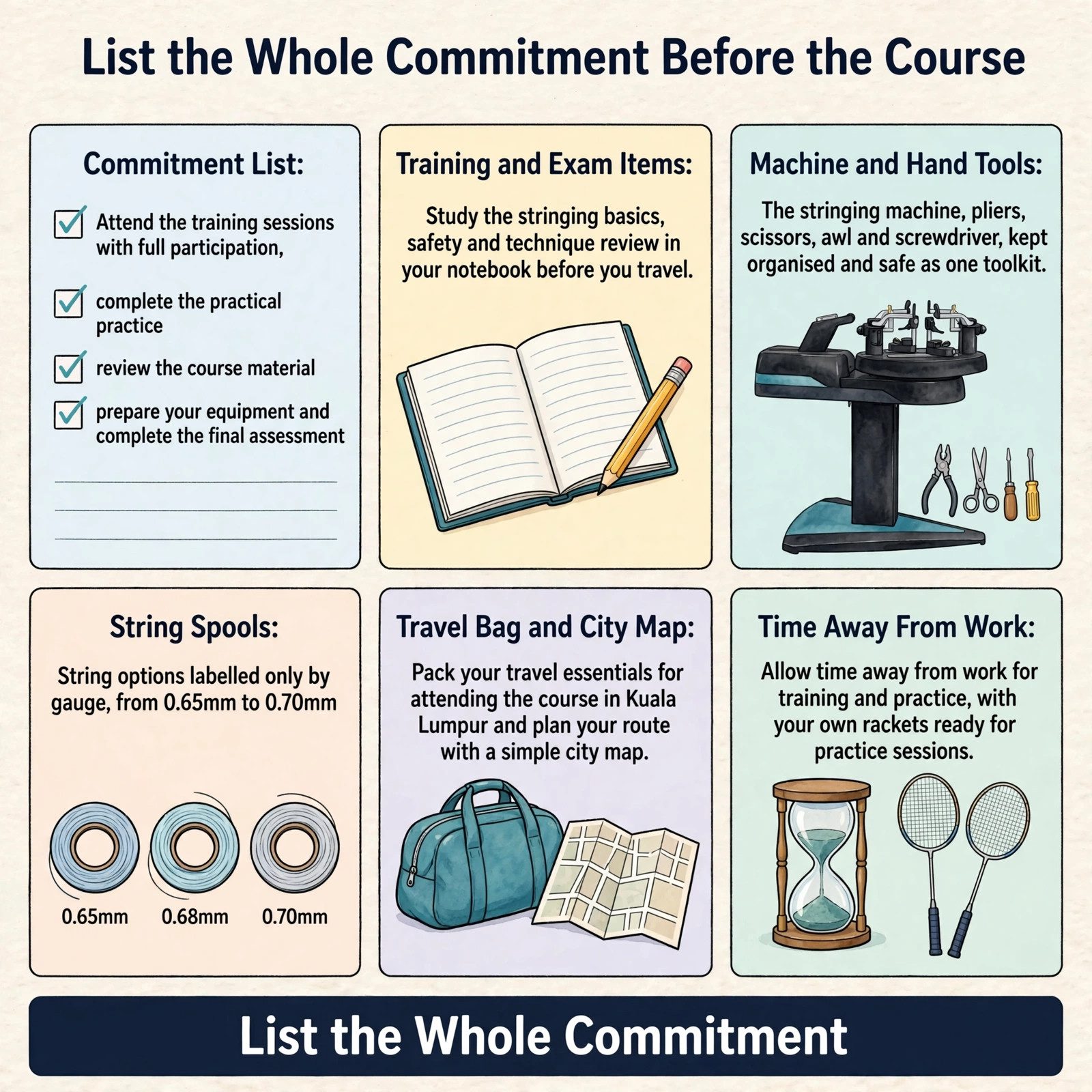
List the commitments for a Kuala Lumpur course in full, in categories and without invented figures. On the course side: training, the exam, a machine and tools if you plan to keep practising at home, and string and materials for preparation and follow up practice. On the trip side: travel to Kuala Lumpur, your stay, local transport and meals, and time away from work. Add the retake arrangement to confirm if a first exam attempt goes badly. The right course can still need planning, and a written list is what lets you judge the whole commitment honestly.
Check the details. Give each item its own line and note what you already own or can arrange. A learner based near Kuala Lumpur carries a short trip list. A learner flying in carries a longer one, and should weigh flexible timing heavily, because one well planned trip beats two rushed ones.
Review the process. Read the full list before comparing courses on any single figure. A course that needs a second trip for the exam, new tools at once and unpaid days away can pass the total commitment of a complete route, and you only see that when every line is written down together.
Plan the next step. Use the same lines for every option and mark any line a provider has not answered as a question to resolve, not as zero. Ask for course coverage, exam scope and the retake arrangement in writing. Where a provider will not state a commitment plainly, that silence belongs in your comparison beside the parts they are happy to print.

1.5 Key Checks
How should I compare Kuala Lumpur courses and other routes fairly?
Record the context.
Compare a Kuala Lumpur course with any other route the same fair way: one scorecard, same criteria, same marking. Score each option on course coverage in writing, exam scope, training feedback, timing that fits your life, complete commitments and what the certificate states. Mark each criterion verified, unclear or not suitable for you, with a short note beside each mark. A local course with no real exam does not beat a Kuala Lumpur course with one merely by being nearer, and a Kuala Lumpur course earns its travel only by scoring better on the same lines.
Check the details.
Date every answer and write the exact question that would clear each unclear mark. The scorecard turns a pile of course pages into a short list of sharp questions, and those questions are what your enquiry should carry, whichever city the course sits in.
Review the process.
Weight the criteria by your aim. A future shop stringer should weight exam scope and training feedback highest. A club player stringing for teammates may weight timing fit and follow up practice more. The method stays the same; the weights follow the work you plan to do with the skill.

1.6 Service Record
How does the BSW course in Kuala Lumpur measure up?
Apply the finished scorecard to the BSW course in Kuala Lumpur. Best Stringer Worldwide (BSW) is a badminton stringing course and certification provider based in Kuala Lumpur, Malaysia, founded by Eric Chuar, and Kuala Lumpur is its training base: the course runs only in Kuala Lumpur. Training is on real rackets with an instructor correcting your work, timing is flexible, and the practical certification exam sits the day after training. Certification is assessed and approved by the BSW certification board, so the certificate states tested skill, judged by the board standard.
Check the details. Score BSW on the same lines as every other option: coverage, exam scope, feedback, timing, commitments and certificate wording. BSW publishes its course and certification information for that review, and a provider based in the city it teaches in should have no trouble being measured by the checklist built for that city.
Review the process. The single city base cuts both ways and the guide should say so plainly. If you live outside Kuala Lumpur, the route asks for a trip. In return, training and the exam sit in one place and one plan, with flexible timing to fit the trip, rather than learning in one place and hunting for assessment in another.
Plan the next step. Where a line stays unclear, ask about that line only. Ask how the course covers the work you named as your aim, what the exam marks, and what preparation is expected before training and the exam day after. Fill the answers into the scorecard and judge the whole sheet before you book travel or time away.
1.7 Guided Practice
How do enquiries work and what should I ask first?
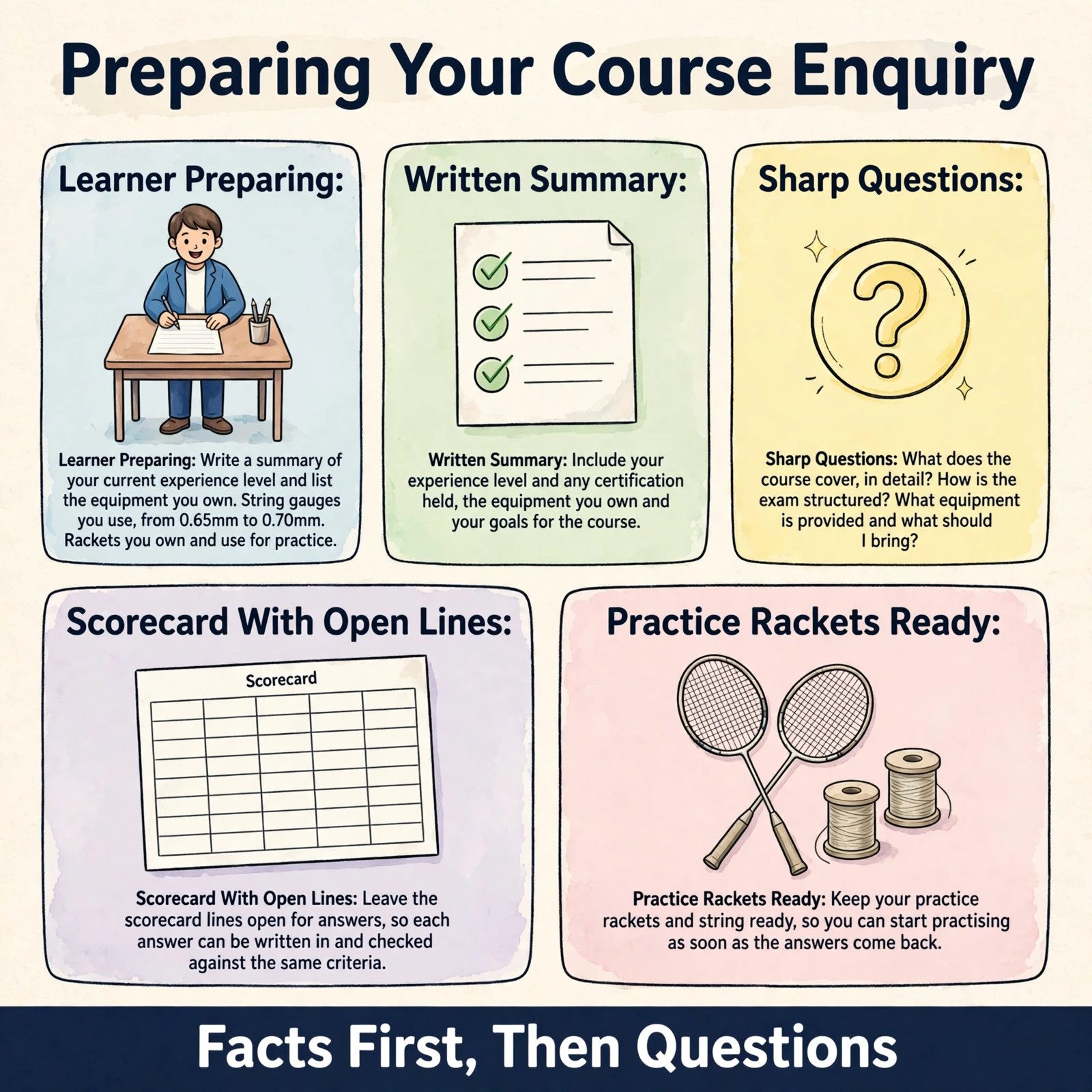
Enquiries work best when they carry your facts first. State your racket sport, your current stringing experience, where you are based, the equipment you own, and the work you want the course for, then ask the few questions still open on your scorecard. For a Kuala Lumpur course the questions that change decisions are what the course covers in writing, what the practical exam marks, who corrects your work during training, how flexible timing can fit your trip, and what the full commitment list looks like. Turn the replies into a preparation plan: practice tasks, travel tasks and exam criteria kept in view.
Keep the enquiry short and sharp. A focused message about your experience, your aim and your open questions gets a useful answer you can file in the scorecard. A long message with vague questions gets a general reply that clears no line and leaves the decision exactly where it started.
Once you choose, prepare in the order the course runs. Practise full rackets on the strings and tensions you find hardest, write down your faults for the instructor, and plan the Kuala Lumpur trip around training and the exam day after it. Good preparation is simply the scorecard and the fault list, worked through before you arrive.
Badminton Stringing Course in Kuala Lumpur Quick FAQ
Practical answers about the badminton stringing course in Kuala Lumpur, its coverage, exam, costs, enquiries and the BSW route.
What does the Kuala Lumpur course cover?
Mounting, clamping, weaving, tension work, knots and grommet care on real rackets, string and tension choices for players, and a practical exam at the end. Judge any Kuala Lumpur course against that full list.
What does the practical exam check?
Tension accuracy, clean knots, grommet care, an even string bed and the same result repeated, on a badminton racket strung by you. Ask any course to describe the marking before you book a place.
How does hands on training differ from learning alone?
Correction. Instructors watch your hands on real rackets and fix clamp pressure, weaving, knots and grommet handling during training. Learning alone offers step order and theory, but nothing that can see and correct your work.
Which costs and commitments should I list?
List the commitments for a Kuala Lumpur course in full, in categories and without invented figures. On the course side: training, the exam, a machine and tools if you plan to keep practising at home, and string and materials for preparation and follow up practice. On the trip side: travel to Kuala Lumpur, your stay, local transport and meals, and time away from work. Add the retake arrangement to confirm if a first exam attempt goes badly. The right course can still need planning, and a written list is what lets you judge the whole commitment honestly.
How should I compare courses fairly?
Use one scorecard for every route: coverage in writing, exam scope, training feedback, timing fit, complete commitments and certificate wording. Mark each line verified, unclear or not suitable for you.
How does the BSW course measure up?
The BSW course measures up by meeting the same checklist this guide builds. Best Stringer Worldwide is based in Kuala Lumpur, Malaysia, founded by Eric Chuar, and Kuala Lumpur is its training base, the only place the course runs. You train on real rackets with an instructor correcting your work, with flexible timing, then sit the practical certification exam the day after training. Certification is assessed and approved by the BSW certification board. Score it like any other route: course coverage in writing, exam scope, feedback during training, full commitments listed, and certificate wording, and ask about any line that stays unclear before you travel.
How do enquiries work?
Enquiries work best when they carry your facts first. State your racket sport, your current stringing experience, where you are based, the equipment you own, and the work you want the course for, then ask the few questions still open on your scorecard. For a Kuala Lumpur course the questions that change decisions are what the course covers in writing, what the practical exam marks, who corrects your work during training, how flexible timing can fit your trip, and what the full commitment list looks like. Turn the replies into a preparation plan: practice tasks, travel tasks and exam criteria kept in view.
What should I keep from the Kuala Lumpur course?
Your course notes, instructor corrections, practice records and exam feedback, kept together with your scorecard. They show what your training covered, how your work was marked, and what to practise next, and they help any shop judge your preparation honestly.
How can I start with BSW in Kuala Lumpur?
State your experience, where you are based and the work you want the course for, then follow the route: train on real rackets in Kuala Lumpur with flexible timing and sit the certification exam the day after training. Ask your open scorecard questions in the same message.
Badminton Stringing Course in Kuala Lumpur: Explore the Practical Decisions
Build a Clear Working Method
Use the sections, questions and comparison to choose and prepare. Keep your scorecard and fault list together from the first enquiry onwards.
| Course Check | Rushed Approach | Planned Approach |
|---|---|---|
| Course | Book the first course found in Kuala Lumpur | Check what the course covers before booking |
| Exam | Treat the exam as an attendance formality | Prepare for the practical tasks the exam marks |
| Costs | Budget for the course fee only | List travel, stay, tools and time together |
| Scorecard | Choose by the boldest course promise | Score every course against the same criteria |
| Course record | Keep course answers in your head | Write the criteria and answers down |
| Next action | Arrive without notes or practice records | Use your records to plan preparation and practice |
Train in Kuala Lumpur with Best Stringer Worldwide
Ready to train in Kuala Lumpur on real rackets and be tested on the work? Tell Best Stringer Worldwide about your racket sport, current experience, where you are based and the equipment you own. Bring your scorecard or a specific question so the discussion can focus on your preparation. Train on real rackets in Kuala Lumpur, then take the practical certification exam the day after training, assessed and approved by the BSW certification board.

