






1.1 Starting Point
What decides what a badminton stringer actually earns?
There is no honest single figure for what a badminton stringer earns, and any guide that gives you one without asking where you work is guessing. Earnings depend on things that change from town to town and stringer to stringer: how much work you win, the prices you set for your own work, whether you string in a shop, freelance, or inside an academy, how quickly you work without dropping quality, and how many customers come back. Certification belongs in that picture as support. It helps a shop or a player trust work they have not seen yet, and trust is what turns into repeat custom. It never guarantees income.
Start by naming the kind of earning you mean. A shop role usually means steadier work arranged by someone else. Freelance stringing means you find the work, set the prices and carry the quiet periods yourself. Academy and club work sits between the two, often tied to coaching programmes and regular players. The same hands can earn very differently in each setting.
Write those variables at the top of your plan before you chase any figure. Volume, pricing, setting, speed with quality, and repeat custom. Every claim you hear about stringer earnings, including claims attached to courses and certificates, gets checked against those lines. A claim that cannot say which line it improves is a claim to set aside.

1.2 Preparation
What does the certification exam check that customers value?
If certification supports earnings, it does so through the exam, so know what the exam checks. A serious practical exam marks tension accuracy against the setting given, clean starting and finishing knots, care around the grommets, a straight and even string bed, and the same result produced more than once. The work is done on badminton rackets at real playing tensions such as 25 to 27 lbs. Those are not abstract skills. Tension that matches the request, knots that hold, and a bed that feels the same next month are exactly what a paying player notices, and exactly what makes that player return instead of trying the next shop.
Ask any provider to describe the marking before you treat its certificate as an earning asset. What is checked, how it is checked, and what a fail looks like. A certificate backed by a plain, checkable exam can be shown to a shop owner with confidence. A certificate with no described test behind it adds a line to a wall and little else.
Notice what the exam does not do. It does not set your prices, find your customers, or fill your week. It certifies the standard of the work. Earnings grow when that standard meets real demand, steady habits and fair dealing, in a place where players actually need rackets strung. Keep those parts separate in your thinking and the picture stays honest.

1.3 Working Method
How does training feedback shape speed with quality?
Training with feedback shapes earnings in a quieter way: through speed with quality. An instructor watching your hands can correct clamp pressure, weaving angle and knot work while you string real rackets, on badminton strings in the usual gauges. Corrected habits mean fewer faults to redo, less string wasted, and a racket that leaves the machine right the first time. Redone work is unpaid work, and it costs trust as well as time. Videos and manuals can teach the order of the steps, and they have their place, but they cannot see your hands, so they cannot remove the small fault that keeps slowing you down.
Ask how training handles the faults that cost money in real work: a knot that slips under load, tension lost at the finish, a grommet damaged during a pull. A course that names those faults and corrects them on the spot is teaching earning skill, not only exam skill. The two overlap more than most course pages admit.
Build your own practice around the same standard. String full rackets, repeat the settings players ask for most, and record what went wrong and what it cost you in time and materials. A stringer who knows their own fault pattern can price work calmly, promise turnaround honestly, and improve the exact habit that is holding earnings back.
1.4 Practical Review
Which costs and commitments belong beside an earning plan?
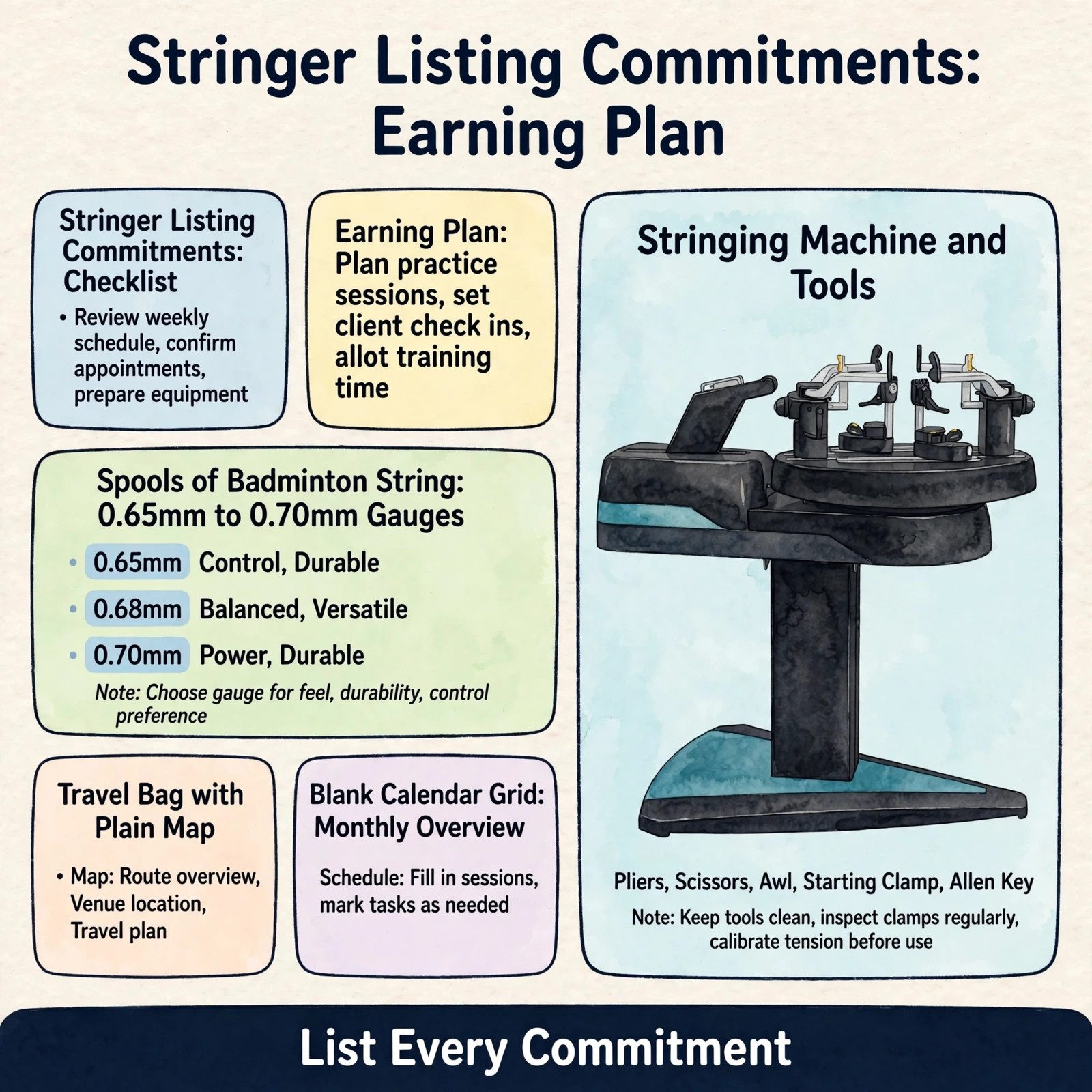
List the commitments behind any earning plan, because income talk without cost talk is only half a picture. On the training side: the course, the exam, a machine and tools if you do not own them, string and materials for practice, and the retake arrangement if an exam attempt goes badly. On the working side: string stock, machine upkeep, travel and stay if you train away from home, and time away from other work while you build a customer base. None of that needs a figure here. It needs each line written down, so the earnings you hope for are judged against the full commitment, not against a hopeful guess.
Check the details. Give each item its own line and keep the list beside your earning notes. Course, exam, machine and tools, string and materials, travel and stay, time away from work. Add the slow lines too: time spent finding customers, and time spent redoing a job properly when something goes wrong. Honest lists make honest plans.
Review the process. Read the whole list before you compare routes into paid work. A cheaper course that leaves your faults uncorrected can cost more in redone jobs than a complete one. A shop role with no training support can cost you the feedback that would have raised your standard. The list shows what a headline figure hides.
Plan the next step. Use the same lines for every option, so comparisons stay fair. Mark any line a provider has not answered as a question to resolve, not as zero. When a provider will not discuss commitments in writing, yet speaks freely about earnings, that contrast is itself information, and it belongs on your sheet in plain words.

1.5 Key Checks
How do I compare earning paths against the same lines?
Record the context.
Compare earning paths the way you would compare exam results: same lines, same marking. Build a short scorecard and score each path, shop work, freelance work, academy work or a mix, against the same criteria: how the work is found, who sets the prices, how steady the flow is, how quality is checked, and what brings customers back. For each line, mark the path verified, unclear or not suitable for you, with a short note beside the mark. A path is only better than another when it scores better on the lines that matter for your situation, judged the same way.
Check the details.
Date every answer and write the exact question that would clear each unclear mark. Where does the work actually come from in this town, who are the regular players, what do they ask for, and how does a new stringer get seen? Those answers are local, and no course page from another country can supply them for you.
Review the process.
Check the sheet against your real life before you choose. A path with higher possible earnings and wild swings may suit a stringer with low fixed costs and patience. A steadier path may suit a stringer supporting a family or a shop lease. Neither is the correct answer for everyone, and any guide that names one without asking about your situation is selling, not advising.

1.6 Service Record
How does the BSW route support earnings, honestly stated?
Apply the finished scorecard to the BSW route, with the same honesty about earnings. Best Stringer Worldwide (BSW) runs its badminton stringing course and certification in Kuala Lumpur, Malaysia, under founder Eric Chuar. You train on real rackets with an instructor correcting your work, then sit the practical certification exam the day after training. Certification results are assessed and approved by the BSW certification board. What that supports, in earning terms, is trust: a shop owner or player who has never seen your work has a marked result to rely on, and that makes a first chance easier to win.
Check the details. Score BSW on the same lines as every other route: exam scope, training feedback, class size, syllabus in writing, full commitments and certificate wording. Note plainly what the route does not claim. It does not claim a salary, a rate, or a flow of customers. The earning lines that stay yours are pricing, volume and repeat custom, built where you live and work.
Review the process. Timing is flexible, and the course runs in Kuala Lumpur only, so plan travel around the training and the exam day that follows. If you are based outside Malaysia, treat the trip as part of the commitment list, written down like every other line. The question the scorecard answers is whether a tested standard is worth that trip for the work you want.
Plan the next step. Where a line stays unclear, ask about that line only. Ask how the training covers the faults that cost working stringers time, what equipment you will learn on, and what preparation is expected before the training and the exam. Fill the answers into the scorecard and judge the whole sheet, including the parts certification cannot do for you.

1.7 Guided Practice
What should I ask before choosing a route into paid work?
Your enquiry is where earning talk becomes a plan. Tell the provider your sport, your stringing experience, where you are based, the equipment you own, and the kind of paid work you want to build. Then ask the questions that change a decision: what the exam marks, who corrects your work during training, what the full commitment list looks like, and what happens if an exam attempt falls short. Ask as well what the provider will not promise. A provider who states plainly that earnings depend on your market, your pricing and your repeat custom is giving you the most useful answer in this whole topic.
Before you send, cut every question that asks for a guaranteed figure. Nobody honest can give you one, and asking for it invites the kind of answer you should not trust. Ask about the work, the standard and the support instead. Those answers can be checked, and checked answers are what plans are built on.
Keep the replies with your scorecard and commitment list. Once you choose a route, turn the confirmed details into a preparation plan: rackets and strings to practise on, settings to repeat until they are routine, and the exam points pinned where you can see them while you work. Earnings follow the standard and the habits. Build those, and the money side has something real to stand on.
Badminton Stringer Salary and Earnings Quick FAQ
Honest answers about stringer earnings: what shapes them, why no honest guide quotes a figure, and where certification helps.
What decides what a badminton stringer earns?
Earnings depend on how much work you win, the prices you set, where you work, and how many customers return. Certification supports trust and repeat work. It does not guarantee any income.
What does the certification exam check that customers value?
The exam checks tension accuracy, knot quality, grommet care, an even string bed and the same result repeated, all on a badminton racket. Those are the habits paying customers feel in the finished racket.
How does feedback build speed with quality?
Feedback builds speed with quality: corrected clamp pressure, weaving and knots mean fewer faults, fewer redone jobs and rackets that feel right, which is what brings players back to the same stringer.
Which costs and commitments belong on the list?
List the commitments behind any earning plan, because income talk without cost talk is only half a picture. On the training side: the course, the exam, a machine and tools if you do not own them, string and materials for practice, and the retake arrangement if an exam attempt goes badly. On the working side: string stock, machine upkeep, travel and stay if you train away from home, and time away from other work while you build a customer base. None of that needs a figure here. It needs each line written down, so the earnings you hope for are judged against the full commitment, not against a hopeful guess.
How do I compare earning paths fairly?
Judge any stringing path by the same lines: how work is found, what prices the stringer sets, how steady the setting is, and whether customers return. Mark each line verified, unclear or not suitable for you.
How does BSW support earnings?
The BSW route treats earnings honestly: certification is presented as proof of a tested standard, never as a promise of income. Best Stringer Worldwide is based in Kuala Lumpur, Malaysia, founded by Eric Chuar. Learners train on real rackets with correction, then sit a practical certification exam the day after training. Certification is assessed and approved by the BSW certification board. What that gives an earning stringer is a record a shop or player can check, and feedback that sharpens the work customers pay for. The work itself, the pricing and the repeat custom still have to be built by the stringer, in the market where they actually operate.
What should I ask before I choose?
Your enquiry is where earning talk becomes a plan. Tell the provider your sport, your stringing experience, where you are based, the equipment you own, and the kind of paid work you want to build. Then ask the questions that change a decision: what the exam marks, who corrects your work during training, what the full commitment list looks like, and what happens if an exam attempt falls short. Ask as well what the provider will not promise. A provider who states plainly that earnings depend on your market, your pricing and your repeat custom is giving you the most useful answer in this whole topic.
What should I keep from my stringing work?
Your exam feedback and a simple work record: the jobs you take, the settings you use, which customers return, and what players say about the result. Over time that record shows where your earning strength really sits.
How can I build trusted work with BSW?
State your experience, where you are based and the stringing work you want to build, then ask what the practical exam checks and how training feedback works. BSW trains on real rackets in Kuala Lumpur, with the certification exam the day after training.
Badminton Stringer Salary and Earnings: Explore the Practical Decisions
Build a Clear Working Method
Use the sections and comparison on this page to judge any earning claim about stringing, including claims made for certification. Keep notes and let the unclear lines drive your questions.
| Earnings Check | Rushed Approach | Planned Approach |
|---|---|---|
| Earnings | Chase a single promised income figure | Judge earnings by volume, pricing and repeat custom |
| Exam | Treat the exam as a formality at the end | Prepare for the exact skills the exam marks |
| Costs | Budget for the course fee only | List every cost and commitment beside the plan |
| Scorecard | Pick the path with the loudest income claim | Score every earning path against the same criteria |
| Your record | Keep the earning plan in your head | Write the criteria and the local answers down |
| Next action | Repeat the same week without reviewing it | Use the record to see where earnings really come from |
Build Trusted Stringing Work with Best Stringer Worldwide
Thinking about certification as part of how you earn from stringing? Tell Best Stringer Worldwide about your racket sport, current experience and available equipment, and ask how the practical exam and its feedback can support the work you want to win. Train on real rackets in Kuala Lumpur, then take the practical certification exam the day after training, assessed and approved by the BSW certification board.

