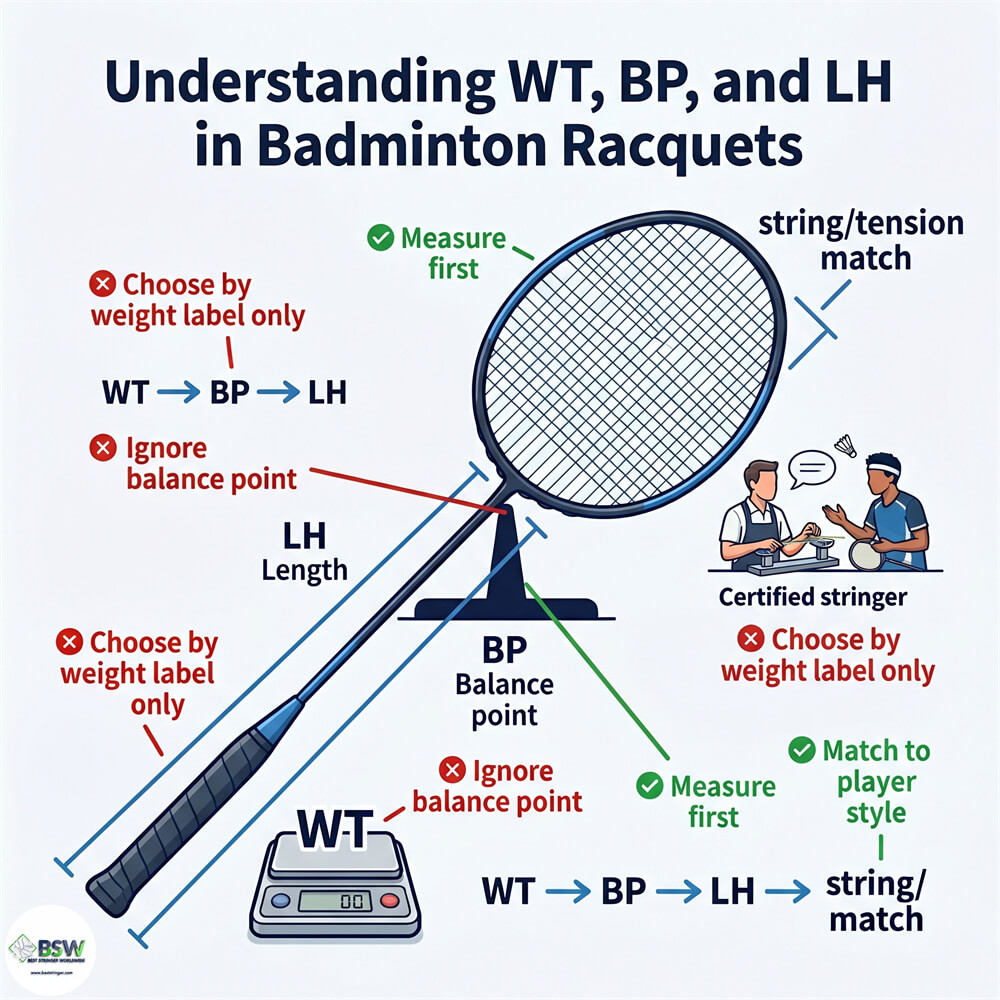
1.1 Basic Performance Parameters
Understanding WT, BP, and LH in Badminton Racquets
Badminton racquet performance analysis begins with three basic parameters: weight (WT), balance point (BP), and length (LH). In this guide, you will learn why racquet weight is one of the first specifications a badminton player or certified stringer must understand, as it directly affects power, handling speed, defensive response, wrist control, smash stability, and player comfort.
While weight affects the overall mass of the frame, balance point dictates whether that mass is concentrated in the head or near the handle. Length affects your swing arc and reach. A good badminton racquet selection process considers all three.
Here is a simple assessment flow:
Step 1: Understand how the U weight system categorises mass.
Step 2: Identify whether heavier or lighter frames suit your swing speed and playing style.
Step 3: Consult a badminton stringer to match string tension to your racquet’s weight for the best possible hitting feel.
1.2 The U Weight System
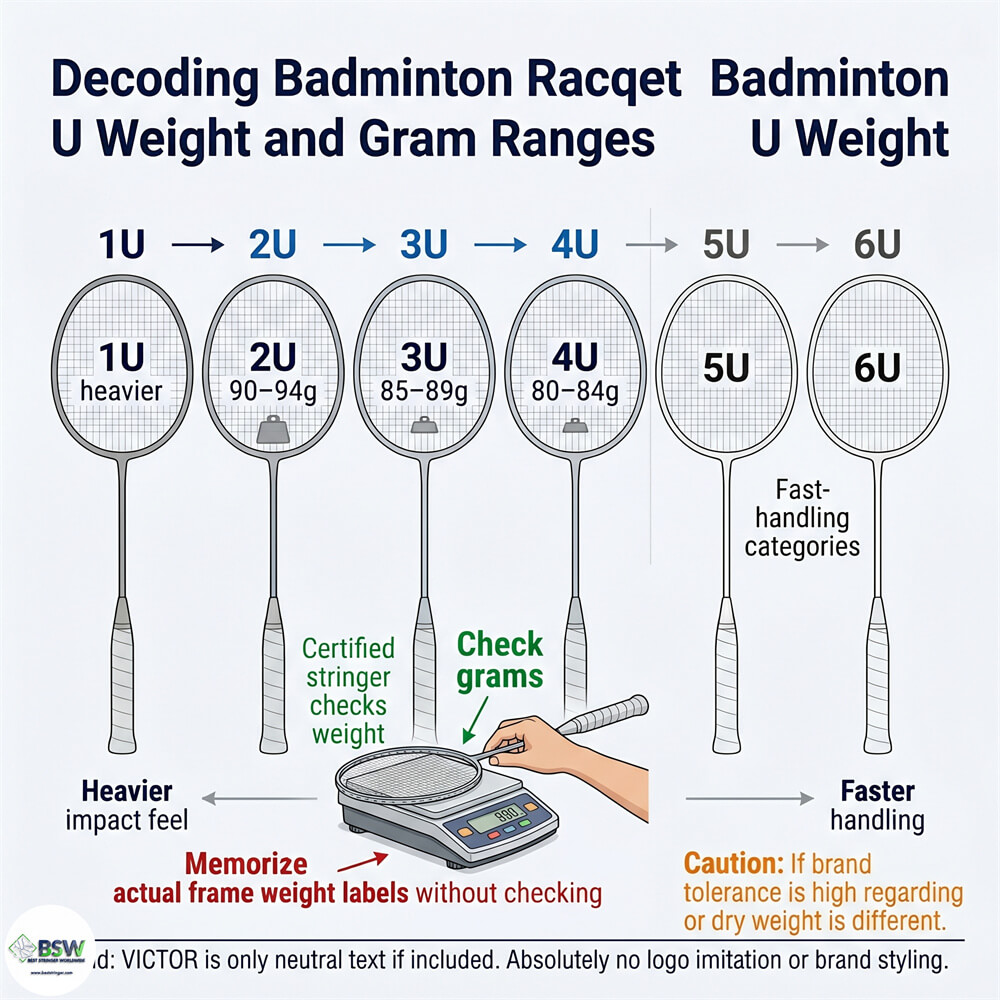
Decoding Badminton Racquet U Weight and Gram Ranges
Most badminton racquets are roughly around 80–90g before strings and grip are added. The common badminton racquet weight system uses labels like U, 2U, 3U, 4U, 5U, and 6U. The smaller the number, the heavier the racquet: 1U > 2U > 3U > 4U > 5U > 6U. Older aluminium frame racquets may weigh 1U (95–99g) or more, but modern full-carbon racquets are typically lighter.
Common reference ranges for full-carbon frames include 2U (around 90–94g), 3U (around 85–89g), and 4U (around 80–84g). 5U and 6U are lighter categories designed for fast handling. While the U system is an industry standard, actual weight varies by brand, model, and production tolerance. Some brands even use different weight labels, such as VICTOR’s W1 or W2, so a certified stringer should always check the actual gram range instead of only memorising the letter.
A 2U badminton racquet provides extra mass for power and stability, making it suitable for strong attackers. In contrast, 4U and 5U racquets support faster defence and easier manoeuvrability. Understanding this system is essential for any player comparing equipment.
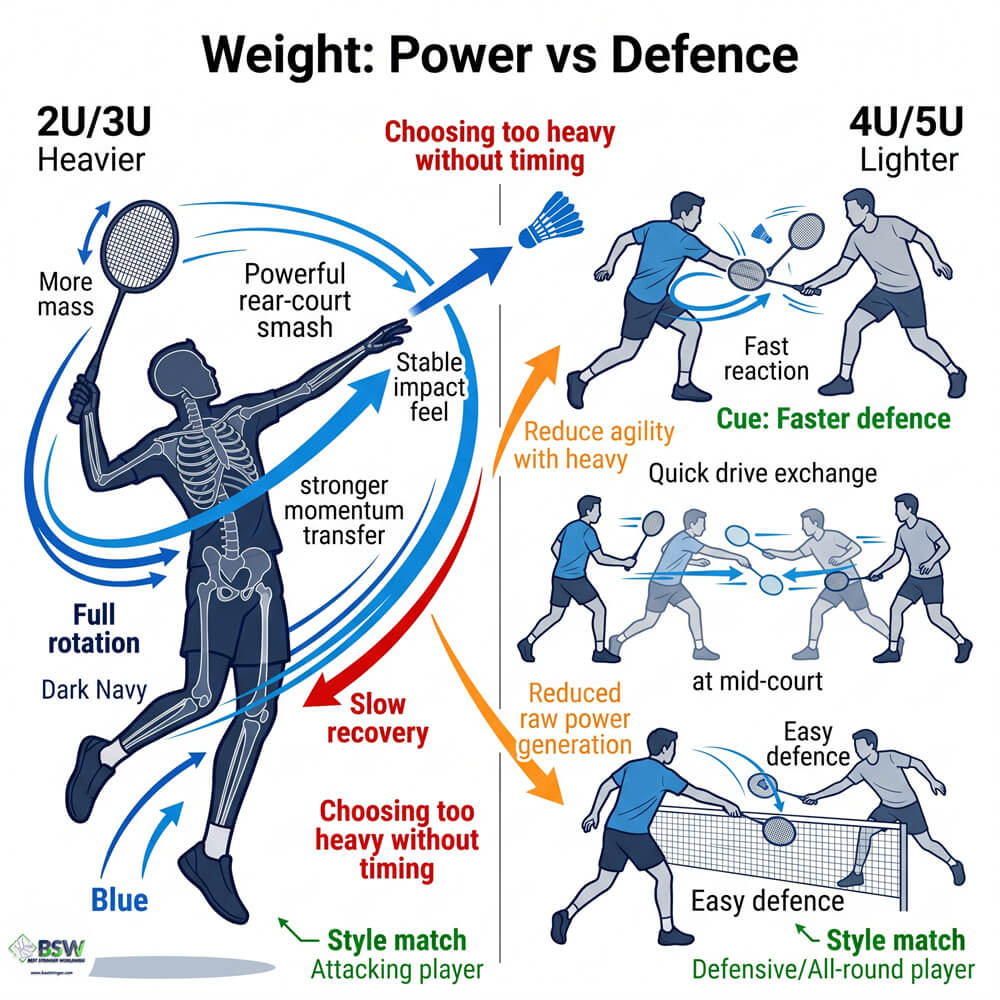
1.3 Attacking vs Defensive Styles
How Racquet Weight Affects Power and Defence
When comparing badminton racquets, weight drastically changes the playing experience because the racquet is controlled mainly through the hand, wrist, and forearm. When other conditions are equal, a heavier racquet can give more stability and more hitting mass. This creates a solid impact feel for attacking players who have the strength and timing to control a heavy swing.
On the other hand, lighter racquets can feel faster and easier for defence. A 4U or 5U racquet helps with quick reactions, fast drive exchanges, and easy net interceptions, reducing fatigue during long sessions. However, a very light frame may feel less solid for some hard hitters looking for maximum smash power.
While a 3U badminton racquet is often considered a practical middle option that balances power and handling for many amateur players, it is not automatically suitable for everyone. A developing player or someone who wants less physical demand might find a 4U frame much more comfortable and consistent.
1.4 String and Grip Setup
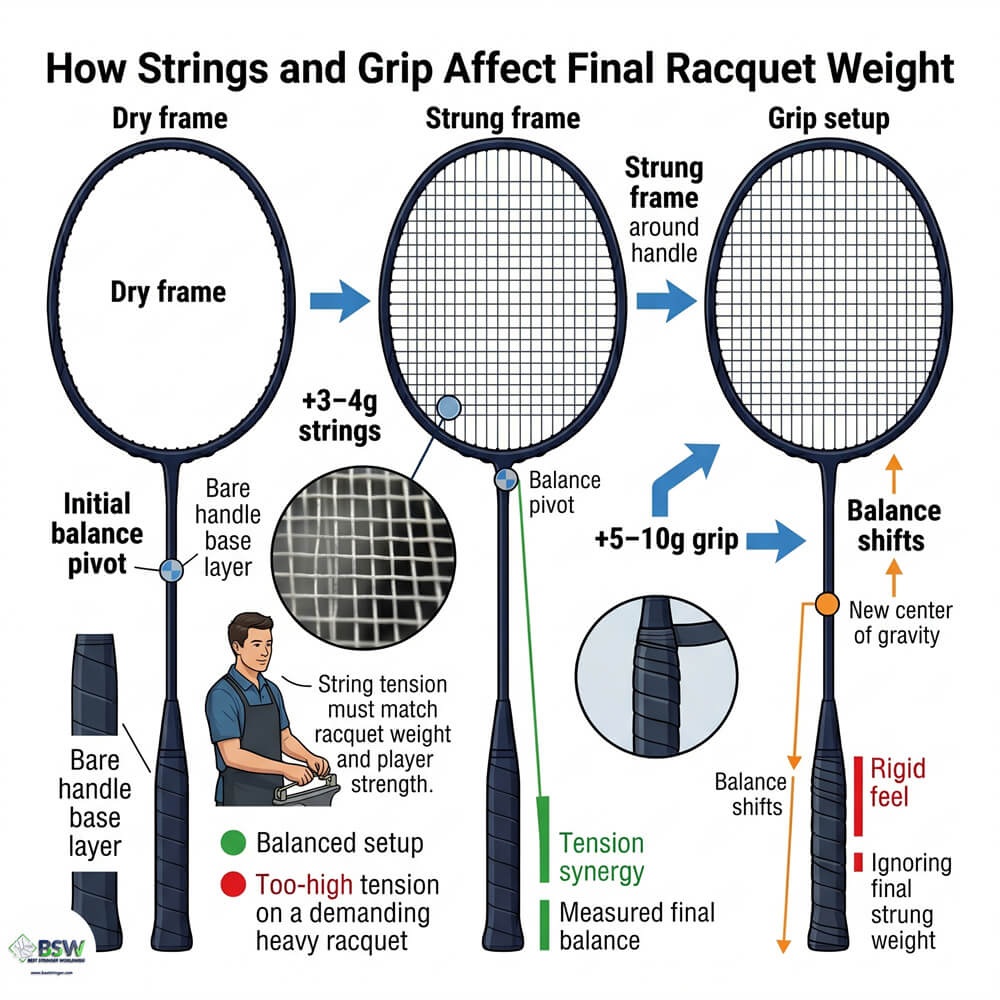
How Strings and Grip Affect Final Racquet Weight
A badminton racquet’s dry frame weight is only the starting point. Once you add strings and a grip, the final strung weight and balance point will change significantly.
Dry Weight vs Strung Weight. Strings typically add around 3 to 4 grams to the racquet. While the U weight label refers to the unstrung frame, the added string mass slightly shifts the balance point towards the head, changing the swing weight feel.
Grip Customization. Adding a replacement grip or an overgrip adds another 5 to 10 grams, shifting the balance point closer to the handle. This means a head-heavy 3U badminton racquet might feel more even-balanced if a heavy grip is applied.
String Tension Synergy. String tension must support the racquet weight. A heavy attacking racquet strung at a tension that is too high might feel demanding and rigid for recreational players, reducing the power benefits of the heavier frame. A professional racquet stringer will always align these factors.
1.5 Player Suitability Mistakes
Common Racquet Weight Selection Mistakes
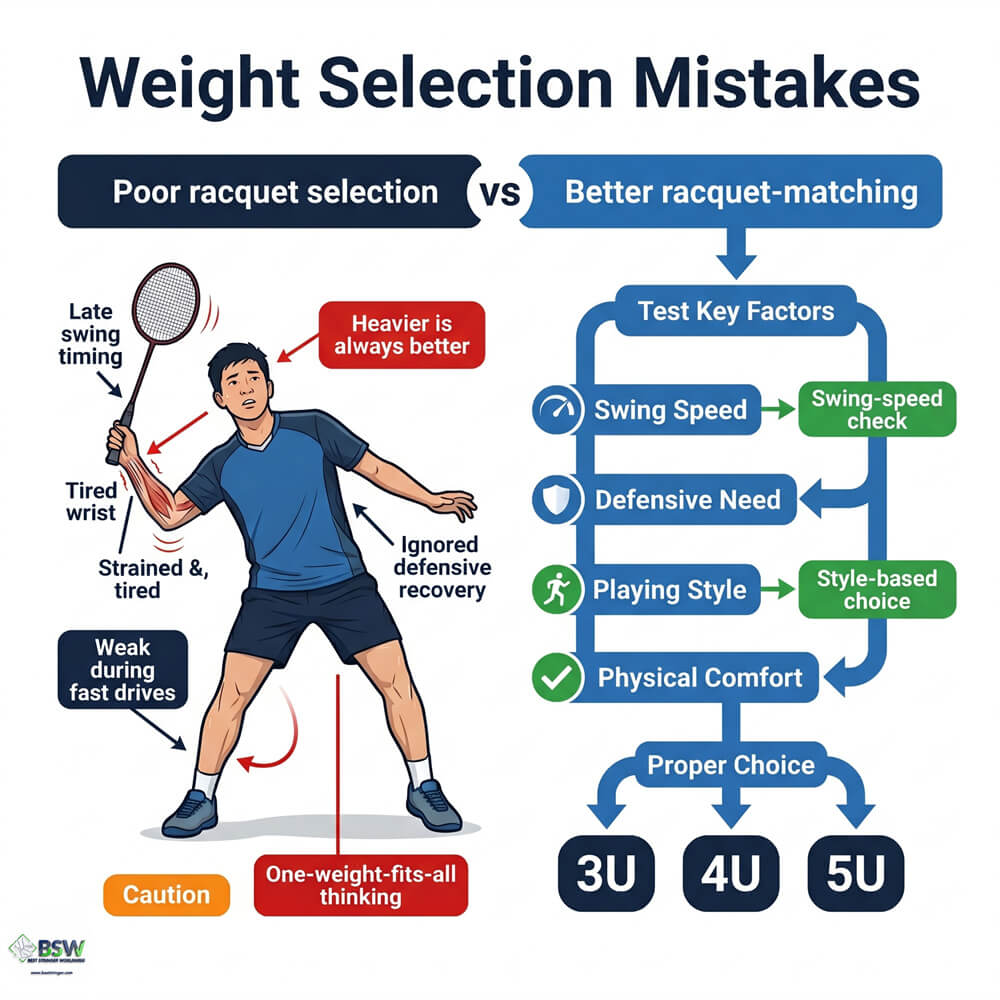
Mistake 1: Assuming Heavier is Always Better.
While a 2U badminton racquet can give more solid impact for attacking players, choosing a heavy frame without sufficient physical strength and timing can lead to slow swings, poor wrist control, and rapid fatigue.
Mistake 2: Ignoring Defensive Needs.
Chasing pure rear-court power with the heaviest racquet available often sacrifices defensive speed. If you cannot react quickly to flat drives, the extra hitting mass becomes a disadvantage.
Mistake 3: Believing One Weight Suits Everyone.
Assuming that 3U is perfect for every amateur player, or that 4U is only for women, are common misconceptions. The right weight depends entirely on your swing speed, playing style, and physical ability.
1.6 Racquet Assessment
Practical Racquet Weight Decision Flow
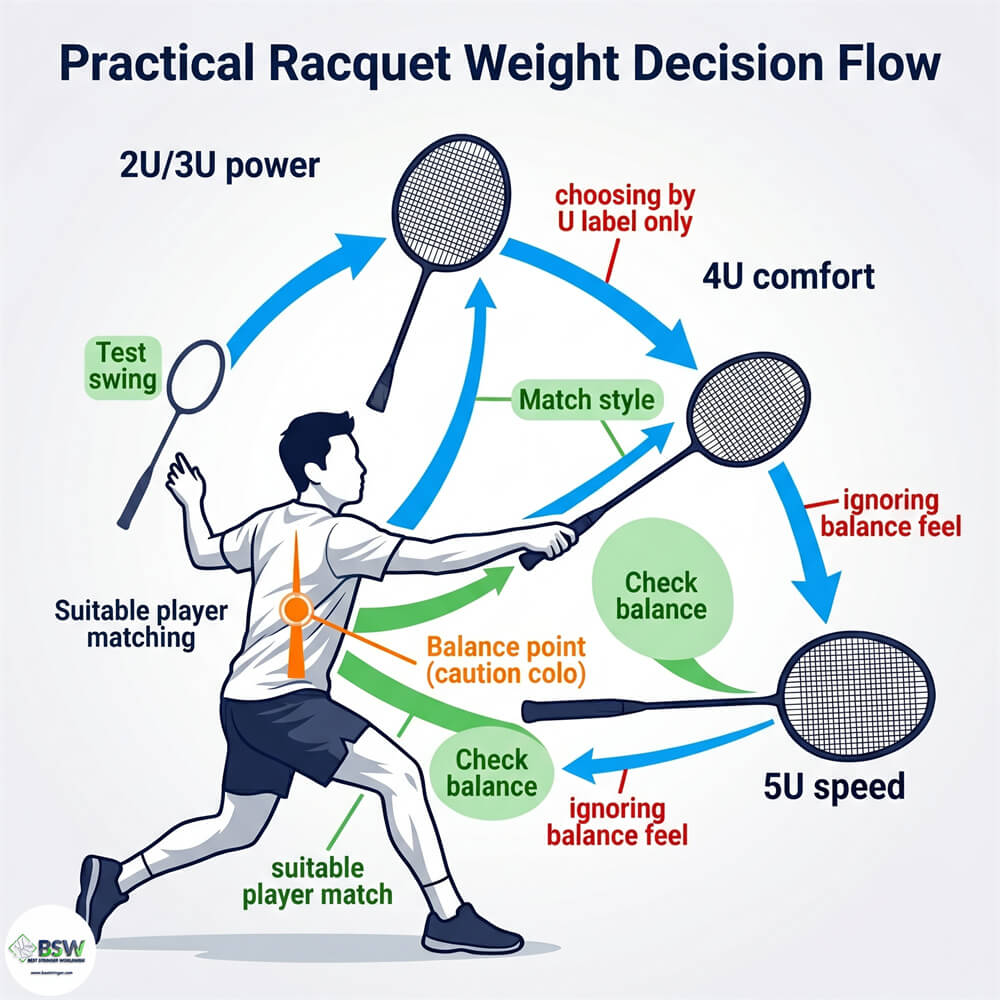
A systematic racquet assessment helps badminton players choose the right U weight category safely. Follow these steps to find your ideal fit:
Step 1: Honestly Assess Your Swing Speed. A 2U or 3U badminton racquet will only provide more power if you can swing it quickly. Many recreational players benefit from starting with a lighter 4U racquet to develop proper mechanics before trying heavier options.
Step 2: Match Weight to Playing Style. Determine if you need the fast handling of a 4U or 5U racquet for doubles defence and quick net interceptions, or the stable smash feel of a 3U racquet for singles play and rear-court attacks.
Step 3: Consider the Balance Point. Weight alone does not decide performance. A 4U head-heavy racquet might feel heavier during a swing than a 3U head-light racquet. Always test how the balance point affects your handling speed.
1.7 Stringer Responsibility
The Role of a Certified Stringer in Equipment Advice
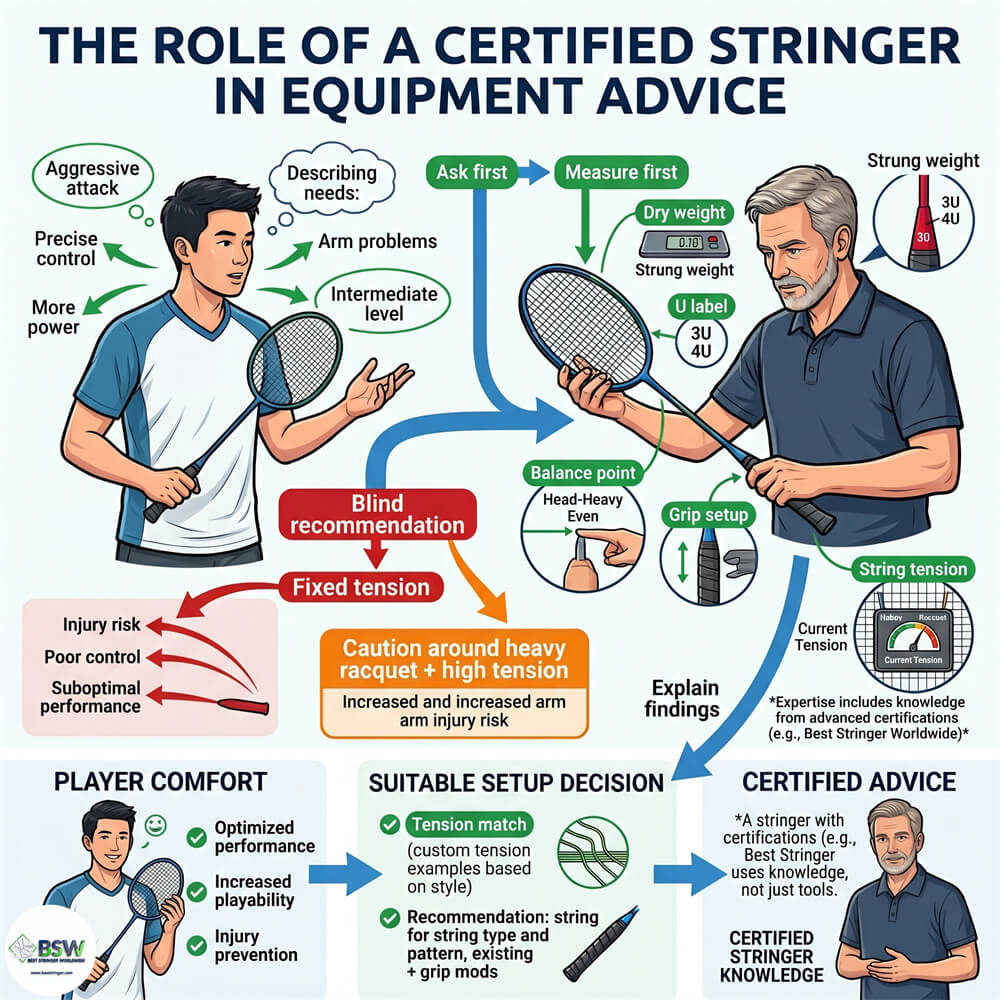
Proper equipment education is a core part of a professional badminton stringing course. A badminton stringer should never blindly recommend a racquet weight or tension without asking questions about the player’s level and style.
At Best Stringer Worldwide, we teach that racquet weight directly influences string and tension advice. A certified stringer must understand the difference between dry weight, strung weight, U labels, and balance point to provide a proper racquet assessment.
Quality badminton stringing certification goes beyond machine operation. It ensures stringers can guide players toward a racquet weight that balances power, defence, and comfort, helping players perform better and avoid unnecessary fatigue.
Badminton Racquet Weight Quick FAQ
Quick, direct answers to common questions about badminton racquet weight, U labels, and player selection.
What does U mean in badminton racquet weight?
In the badminton racquet U weight system, the U label indicates the approximate weight of the unstrung frame. The smaller the number, the heavier the racquet, meaning 1U > 2U > 3U > 4U > 5U > 6U.
Is 2U heavier than 3U in badminton?
Yes, a 2U badminton racquet is heavier than a 3U racquet. A 2U frame usually weighs around 90–94 grams, while a 3U frame weighs approximately 85–89 grams, though exact weights vary slightly by brand.
What is the difference between 3U and 4U?
A 3U racquet (85–89g) provides balanced power and stability, making it a popular all-round choice. A 4U racquet (80–84g) is slightly lighter, offering faster handling and easier defence, which suits players wanting less physical demand.
Is a heavier racquet more powerful?
A heavier racquet can provide a more solid impact and stronger rear-court hitting potential, but only if the player has enough strength and timing to maintain a fast swing speed without fatigue.
Is a lighter racquet better for defence?
Yes, a lighter racquet (like a 4U or 5U) usually allows for faster handling and easier reaction times in defence, quick drives, and net interceptions, making it excellent for fast-paced exchanges.
How does balance point change racquet weight feel?
The balance point determines how the weight is distributed. A lighter racquet with a very head-heavy balance point can feel heavier during a swing than a heavier racquet with a head-light balance point.
Do strings and grip change racquet weight?
Yes. Strings typically add about 3 to 4 grams, and adding an overgrip or replacement grip can add 5 to 10 grams. This combined weight changes both the overall mass and the final balance point of the racquet.
What should a certified stringer know about weight?
A certified stringer must understand WT (weight), BP (balance point), and LH (length) to provide accurate player consultation. They use this knowledge to ensure their string and tension advice matches the racquet’s mass and the player’s style.
How does weight connect with a stringing course?
A professional badminton stringing course teaches more than machine operation. It includes comprehensive racquet performance analysis so stringers can honestly advise players on equipment suitability and avoid bad recommendations.
Racquet Weight Dynamics: How Mass Affects Performance
Racquet Weight & Dynamics Analyzer
2U/3U Heavy Frame
A heavier frame (85–94g) provides maximum hitting mass and stability. It delivers a solid impact feel for attackers, but requires high strength and reduces defensive reaction speed.
Professional Racquet Analysis
A professional badminton stringing course teaches verified equipment parameters. We prioritize understanding racquet mass, balance point, and playstyle suitability over blind recommendations.
| Category | Heavier (2U/3U) | Lighter (4U/5U) |
|---|---|---|
| Range | 2U (90–94g) / 3U (85–89g). Solid impact. | 4U (80–84g) / 5U+. Speed & agility. |
| Attack | Stability and power for heavy smashes. | Quick counter-attacks and fast drives. |
| Defense | Slower reactions due to higher mass. | Fast handling and less arm fatigue. |
| Suitability | Singles players or power hitters. | Doubles specialists and defensive players. |
| Stringing | Needs careful tension to avoid “board” feel. | High repulsion is key for light frames. |
Learn Racquet Analysis with Best Stringer Worldwide
Ready to upgrade your knowledge? A professional badminton stringing course teaches you how U weight, balance point, and string tension affect performance. We educate badminton players and stringers worldwide, especially in Singapore, Hong Kong, Malaysia, Indonesia, UK, France and Europe. Become a certified stringer to provide accurate player consultation.